The Bell Tolls For Covid-19
I have just watched Sir John Bell; the Regius Professor of Medicine at the University of Oxford talking about the Pfizer vaccine and his emotional response to it, where he shouted “Yes, yes yes!” and threw his arms in the air on BBC Radio 4. Sir John and another Oxford academic; Melinda Mills are talking about multiple vaccines.
They certainly felt that we’re on our way back to normality.
Microwaves Could Turn Plastic Waste Into Hydrogen Fuel
This headline from this article in The Times could be the headline of the day!
Although thinking about it, it wouldn’t be a good idea to put all your plastic waste in the microwave and switch it on. It might catch fire or even worse create lots of hydrogen in your kitchen, which could be followed by a mini-Hindenburg disaster in the kitchen.
These are the introductory paragraphs.
From the yellowed bottles in landfill to the jellyfish-like bags clogging the oceans, plastics pollution is an apparently intractable problem.
Yet, chemists lament, it shouldn’t be. Within this waste there is something extremely useful, if only we could access it: hydrogen. Now a British team of scientists believes it has found a way to get at it, and do so cheaply, thanks to tiny particles of iron and microwaves.
If their system works at scale they hope it could be a way of cheaply converting useless plastic into hydrogen fuel and carbon.
Don’t we all want to believe that this impossible dream could come true?
Some Background Information
Some of the things I talk about will be technical, so I will have a bit of a preamble.
Hydrogen; Handling And Uses
Because of pre-World War Two airships, which tended to catch fire and/or crash, hydrogen has a bad reputation.
I used to work as an instrument engineer in a hydrogen plant around 1970. To the best of my knowledge the plant I worked in is still producing hydrogen in the same large building at Runcorn.
Hydrogen is one of those substances, that if you handle with care, it can be one of the most useful elements in the world.
It is a fuel that burns creating a lot of energy.
The only by-product of hydrogen combustion is steam.
It is one of the feedstocks for making all types of chemicals like ethylene, fertilisers, ammonia, pharmaceuticals and a wide range of hydrocarbons.
Hydrogen is a constituent of natural gas and in my youth, it was a constituent of town gas.
Hydrogen and hydrocarbons are involved in the manufacture of a lot of plastics.
In the future, hydrogen will have even more uses like making steel and cement, and powering railway trains and locomotives, and shipping of all sizes.
Hydrocarbons
According to Wikipedia, hydrocarbons are compounds consisting entirely of atoms of hydrogen and carbon.
In a kitchen, there are several hydrocarbons.
- If you cook by gas, you will probably be burning natural gas, which is mainly methane, which is a hydrocarbon
- Some might use propane on a barbecue, which is another hydrocarbon.
- I suspect you have some polythene or polyethylene, to use the correct name, in your kitchen. This common plastic is chains of ethylene molecules. Ethylene is another hydrocarbon.
- There will also be some polypropylene, which as the name suggests is made from another hydrocarbon; propylene.
Hydrocarbons are everywhere
Plastics
I used to work in two ICI divisions; Mond at Runcorn and Plastics at Welwyn Garden City
- The forerunners of ICI Mond Division invented polyethylene and when I worked at Runcorn, I shared an office, with one of the guys, who had been involved before the Second World War. in the development of polyethylene.
- Plastics Division used to make several plastics and I was involved in various aspects of research plant design and production.
One day, I’ll post in this blog, some of the more interesting and funnier stories.
Many plastics are made by joining together long chains of their constituent molecules or monomer.
- Ethylene is the monomer for polyethylene.
- Propylene is the monomer for polypropylene.
- Vinyl chloride is the monomer for polyvinylchloride or PVC.
So how are the chains of molecules built?
- Polyethylene was made by ICI. by applying large amounts of pressure to ethylene gas in the presence of a catalyst.
- They used to make polypropylene in large reaction vessels filled with oil, using another catalyst.
I suspect both processes use large quantities of energy.
Catalysts
A catalyst is a substance which increases the rate of a chemical reaction.
Judging by the number of times, I find new catalysts being involved in chemical reactions, the following could be true.
- There are processes, where better catalysts can improve yields in the production of useful chemicals.
- There is a lot of catalyst research going on.
Much of this research in the UK, appears to be going on at Oxford University. And successfully to boot!
Velocys
It should be noted that Velocys was spun out of Oxford University, a few years ago.
- The company appears to have improved the Fischer-Tropsch process.
- They are building a waste-to-aviation biofuel plant in Lincolnshire.
- They are backed by British Airways, Shell and UK plc.
This infographic shows their process.
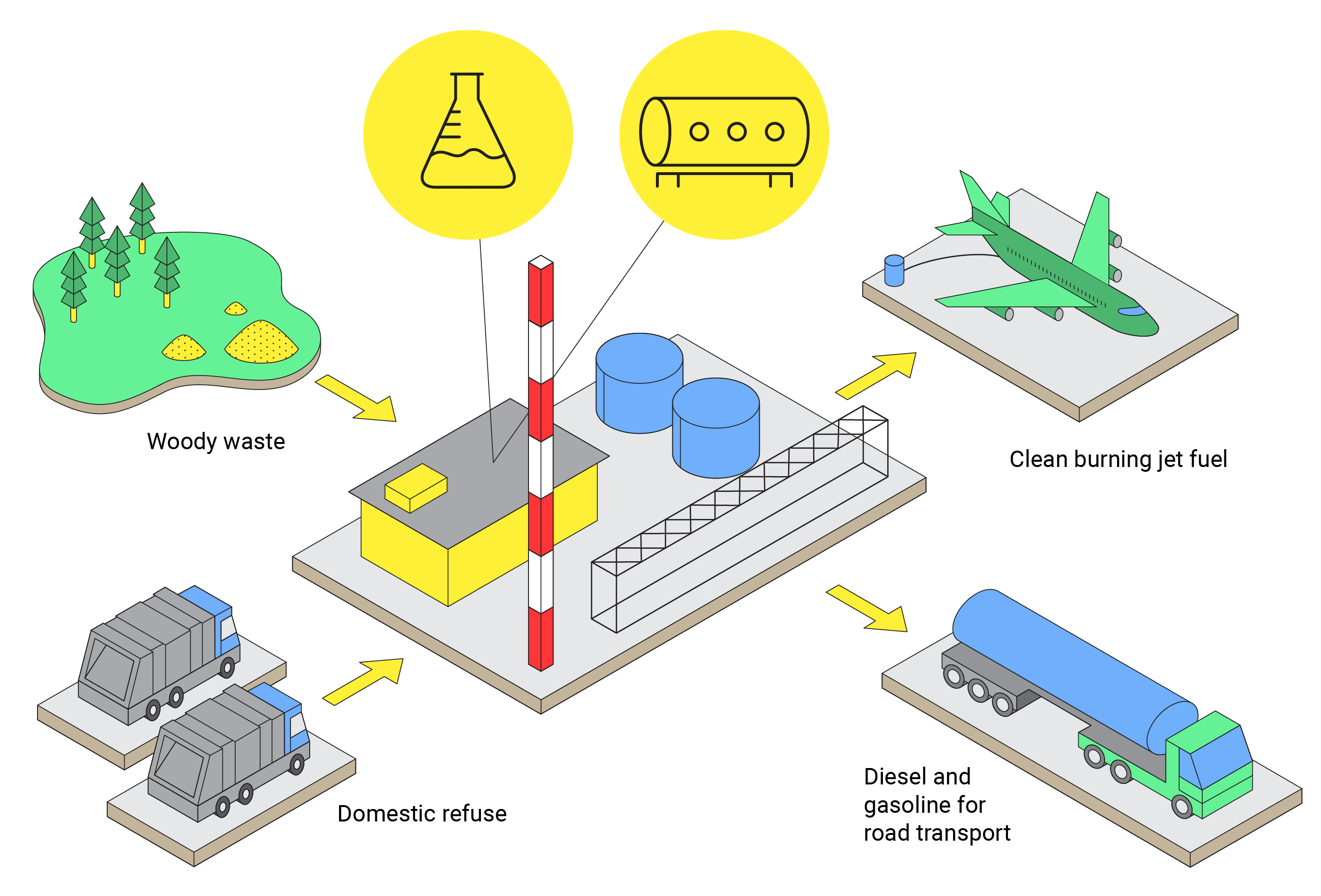
This could be a route to net-zero carbon aviation and heavy haulage.
The beauty is that there would need to be little modification to existing aircraft and trucks.
Oxford University’s Magic Process
These paragraphs from The Times article explain their process.
The clue came in research on particles of iron, and what happens when they get really small. “There’s a fascinating problem,” Professor Edwards said. “You take a bit of metal, and you break it into smaller and smaller bits. At what stage does it stop behaving like a copy of the bigger bit?”
When the particle gets below a critical size, it turns out it’s no longer a metal in the standard sense. The electrical conductivity plummets, and its ability to absorb microwaves does the reverse, increasing by ten orders of magnitude.
Professor Edwards realised that this could be useful. “When you turn on the microwaves, these things become little hotspots of heat,” he said. When he put them in a mix of milled-up plastic, he found that they broke the bonds between the hydrogen and carbon, without the expense and mess of also heating up the plastic itself.
What is left is hydrogen gas, which can be used for fuel, and lumps of carbon nanotubes, which Professor Edwards hopes might be of a high enough grade to have a use as well. The next stage is to work with industry to find ways to scale it up.
It sounds rather amazing.
Going Large!
This article from The Times on Friday, is entitled Plastic To Be Saved From Landfill By Revolutionary Recycling Plants.
These are the two introductory paragraphs.
Thousands of tonnes of plastic waste will be turned into new plastic in Britain rather than dumped in landfill sites, incinerated or sent overseas under plans for four new plants that will use cutting-edge recycling technology.
Up to 130,000 tonnes of plastic a year will be chemically transformed in the facilities, which are to be built in Teesside, the West Midlands and Perth.
It all sounds like technology, that can transform our use of plastics.
Conclusion
In the years since I left Liverpool University in 1968 with a degree in Electrical and control Engineering, it has sometimes seemed to me, that chemistry has been a partly neglected science.
It now seems to be coming to the fore strongly.
Dexamethasone Declared First Drug To Save Lives Of Coronavirus Patients
The title of this post, is the same, as that of this article in The Times.
These are the introductory paragraphs.
British scientists have hailed a “huge breakthrough” in the fight against Covid-19 after a cheap drug was declared the first to save lives.
Dexamethasone, a decades-old steroid that costs about 50p per day, was found to reduce deaths by up to one third for the sickest patients. NHS hospitals were advised to begin using it immediately.
According to a retired Senior Hospital Pharmacist friend, Dexamethasone has been around a long time and is used in shock. She added “So don’t know why not tried before.”
The Times article says this about previous use.
While it had been administered to Covid patients in China and elsewhere its use was controversial, with no definitive proof that it worked.
Could it be that the research was discounted on ageist grounds against the drug?
Wikipedia also says this about the drug?
it was the 259th most prescribed medication in the United States, with more than a million prescriptions.
That is about 1-in-327 of the US population.
Dexamethasone And Coeliac Disease
Out of curiosity, I typed “Dexamethasone and coeliac disease” into Google.
I found this page on SpringerLink, which is entitled The Role of Corticosteroids In Celiac Disease.
This is the first sentence.
Since Dickie first described the benefits of a gluten-free diet in the 1940s and 1950s, this diet is the standard of care for all patients with celiac disease. For patients with a new diagnosis, dietary compliance can be difficult to achieve, possibly resulting in a clinical course marked by delayed recovery and persistent symptoms. This is of particular concern for patients in the developing world, where gluten-free food items may be difficult to obtain or to identify. While dietary modifications are likely to remain the treatment of choice in celiac disease, the use of adjuvant corticosteroids in newly diagnosed patients is a topic that has been addressed previously.
I’m no medic, so what follows in the scientific report is beyond my limited medical knowledge.
However in A Thought On Deaths Of The Elderly From Covid-19, I estimated that there are around 120,000 undiagnosed coeliacs in the UK, who are over 65. I used data from Age UK and Coeliac-UK.
According to Joe West of Nottingham University, diagnosed coeliacs on a gluten-free diet have less chance of getting cancer!
Could it be that this group of people, of which I am one, have a strong immune system?
So could the reverse be true and that undiagnosed coeliacs on a typical gluten-rich diet have a compromised immune system?
My son was an undiagnosed coeliac, with a poor diet who smoked. He died at just thirty-seven from pancreatic cancer!
Could some of the patients, who recovered from COVID-19, when given dexamethasone, have been undiagnosed coeliacs?
I, of course don’t know.
But the role of coeliac disease in the recovery from COVID-19 must be investigated.
A quick way to test my theory would be to survey the catering departments of all hospitals and see how much gluten-free food was being sent to wards, where COVID-19 is being treated.
Coeliacs, whether diagnosed by doctors or self-diagnosed, will probably be vociferous in their need for gluten-free food. I certainly was, when I had my stroke in Hong Kong.
Give me the data and I’ll analyse it!
I would also like to hear from any coeliacs, who have been given dexamethasone!
Oxford Splashes Out On £4bn Science Hub
The title of this post is the same as that of this article on page 8 of today’s copy of The Times.
Legal & General is investing the four billion in three related projects.
- Affordable homes for post-gradiates and staff.
- An innovation hub in Begbroke.
- An innovation quarter at Osney Mead.
Oxford is breaking out!
If I have one criticism, it is that Begbroke and Osney Mead appear badly placed for rail and bicycle access.
As some of the best innovators and researchers are short of money, this could be a mistake.
All our universities; large or small, ancient or modern, must come to the aid of the country!
Treatment Turns Up Heat On Tumours
The title of this post, is the same as that of an article in Tuesday’s Times.
It describes research at the Oxford Institute of Biomedical Engineering, where ultrasound is used to heat liver cancers to over 39.5 °C. The raised temperature then triggers the release of a drug.
The last quote of the report is from a researcher involved.
We can now begin to realise the promise of precision cancer medicine.
I’ve read about other ideas with the same outcome of precision.
I suspect my grandchildren will have a much higher chance of being cured of cancer.
Keeping Your Brain Healthy
Look at any list of symptoms for coeliac disease and you’ll find a lot of them are concerned with brain or mental problems.
- Mild Depression
- Feelings of Inadequacy
- Gait Ataxia/Apraxia
- Lightheadness and Fainting
- Migraine or Persistent Headaches
- Mood Swings
- Sleep Disturbance
I used to suffer from most of these except for sleep disturbance.
Once I went on a gluten-free diet all of these symptoms cleared up. Now I know that I am a special case in that I’m a coeliac, but once the B12 levels were back up to normal, all of the symptoms disappeared. Research at Oxford University has indicated that higher B12 levels may help brain health.
It would be interesting to repeat their experiments with coeliacs. When a hospital diagnoses a coeliac, they should immediately undergo the tests before starting a gluten-free diet. And then they should be tested at intervals after starting the diet. My body actually reacted quite quickly in that my dandruff cleared up after about two weeks.
Now I know several people who have MS. One has sent me a link to an article about a new treatment for the disease called The Liberation Treatment. Here are the first couple of paragraphs.
Amid the centuries-old castles of the ancient city of Ferrara is a doctor who has come upon an entirely new idea about how to treat multiple sclerosis, one that may profoundly change the lives of patients.
Dr. Paolo Zamboni, a former vascular surgeon and professor at the University of Ferrara in northern Italy, began asking questions about the debilitating condition a decade ago, when his wife Elena, now 51, was diagnosed with MS.
He found that in some patients, the blood flow to the head was restricted and by improving this using standard surgical procedures, their health improved. Here’s a couple of paragraphs from the article.
One of those patients was Buffalo resident Kevin Lipp. Lipp had MS for over a decade, and as part of the study, discovered he had five blocked veins in his neck. After undergoing the Liberation Treatment 10 months ago, he says he hasn’t had a single new MS attack.
Zamboni emphasizes that the Liberation Treatment does not make people in wheelchairs walk again. Rather, it seems to stop the development of further MS attacks, and in some cases, improves movement and decreases the debilitating fatigue that are the hallmarks of MS.
It may not cure MS, but it is all very interesting.
I tend to look on the body, as an engineer would look on a machine or a car. Machines don’t work well if they don’t have all of the things they need like fuel, electric power, oil, water and all the other necessities.
Is the body any different to my car in that respect?
And now today, it has been reported that those who develop Alzheimer’s are less likely to get cancer.
This would appear to push things in another direction, as research at Nottingham University has shown that coeliacs are less likely to get breast cancer. Diagnosed coeliacs have on the whole healthy brains because they eat well, so this research might show the opposite.
We need to do a lot more research to find all of these links.

