Where Will Lumo Strike Next?
Yesterday, First Group reported that they had added more possible services to their network of open-access services.
I gave my view in FirstGroup Acquires London – South Wales Open Access Business And Plans Lumo To Devon.
Their list of possible services and destinations include.
- Hull Trains – London King’s Cross and Beverley via Stevenage, Grantham, Retford, Doncaster, Selby, Howden, Brough, Hull Paragon and Cottingham
- Hull Trains – London King’s Cross and Hull Paragon via Stevenage, Grantham, Retford, Doncaster, Selby, Howden and Brough
- Hull Trains – London King’s Cross and Sheffield via Worksop and Woodhouse
- Lumo – London Euston and Rochdale via Warrington Bank Quay, Newton-le-Willows, Eccles and Manchester Victoria
- Lumo – London King’s Cross and Edinburgh/Glasgow via Stevenage, Newcastle and Morpeth
- Lumo – London Paddington and Carmarthen via Bristol Parkway, Newport, Severn Tunnel Junction, Cardiff Central, Gowerton and Llanell
- Lumo – London Paddington and Paignton via Bath Spa, Bristol Temple Meads, Taunton, Exeter St David’s and Torquay
I believe that all services could be run by identical versions of Hitachi’s high speed Intercity Battery Electric Train, which are described in this page on the Hitachi web site.
The London Paddington and Paignton service would require the longest running without electrification at 210 km. and I don’t believe First Group would have put in a bid, unless they were certain zero-carbon trains with sufficient performance would be available.
Other possible open access services could be.
Hull And Blackpool Airport
Note.
- This could be the first half of a Green Route between the North of England and the island of Ireland, if zero-carbon aircraft can fly from Blackpool Airport.
- Trains would call at Selby, Leeds, Bradford, Huddersfield, Manchester Victoria, Blackburn and Preston.
- Blackpool Airport has good access from Squires Gate station and tram stop, which could be improved.
- Blackpool Airport could be well supplied with green electricity and hydrogen from wind power.
These are distances to possible airports.
- Belfast City – 111 nm.
- Belfast International – 114 nm.
- Cardiff – 143 nm.
- Cork – 229 nm.
- Donegal – 200 nm.
- Derry/Londonderry – 163 nm.
- Dublin – 116 nm.
- Inverness – 228 nm
- Ireland West Knock – 204 nm.
- Kerry – 253 nm.
- Ronaldsway, IOM – 59 nm.
- Shannon – 220 nm.
Note.
- The Wikipedia entry for the all-electric Eviation Alice, gives the range with reserves as 250 nm.
- The Belfast and Dublin airports could be within range of a round trip from Blackpool without refuelling.
- ,Cork, Kerry and Shannon airports may need to go by another airport, where a small battery charge is performed.
- The Isle of Man is surprisingly close.
Blackpool has reasonably good coverage for the island of Ireland.
London Euston And Holyhead
This could be the first half of a Green Route to Dublin, if the trains met a high speed hydrogen-powered catamaran to speed passengers across to Dun Laoghaire.
London King’s Cross And Aberdeen Or Inverness
Why not? But these routes would probably be best left to LNER.
London King’s Cross And Grimsby Or Cleethorpes
In Azuma Test Train Takes To The Tracks As LNER Trials Possible New Route, I talked about how LNER had run a test train to Grimsby and Cleethorpes.
The Government might prefer that an open access operator took the risk and got all the blame if the route wasn’t worth running.
Humberside is very much involved in the energy industry, with several gas-fried power-stations at Keadby.
It might be more efficient in terms of trains and infrastructure, if this service was an extension of the Lincoln service.
London King’s Cross And Scarborough Via Beverley
This would probably be one for Hull Trains, but it would also serve Bridlington and Butlin’s at Filey.
The BBC was running a story today about how holiday camps are making a comeback. Surely, one on a direct train from London wouldn’t be a bad thing. for operators, train companies or holidaymakers.
London King’s Cross And Middlesbrough, Redcar Or Saltburn
As with the Grimsby and Cleethorpes service, the government might think, that this might be a better service for an open access operator.
Teesside is heavily involved in the offshore wind industry and may add involvement in the nuclear industry.
London Paddington And Fishguard, Haverfordwest, Milford Haven Or Pembroke Dock
Note.
- This could be the first half of a Green Route to Southern Ireland, if the trains met a high speed hydrogen-powered catamaran to speed passengers across to Rosslare or an electric or hydrogen-powered aircraft from Haverfordwest Airport.
- These three ports and one airport will feature heavily in the development of offshore wind power in the Celtic Sea.
- RWE are already planning a hydrogen electrolyser in Pembrokeshire, as I wrote about in RWE Underlines Commitment To Floating Offshore Wind In The Celtic Sea Through New ‘Vision’ Document.
- According to the Wikipedia entry for Fishguard Harbour station, it was built as a station to handle ship passengers and is now owned by Stena Line, who run the ferries to Rosslare in Ireland.
- I can see a tie-up between FirstGroup and Stena Line to efficiently transfer passengers between Lumo’s planned service to Carmarthen and Stena Line’s ships to Ireland.
All four secondary destinations would be a short extension from Carmarthen.
Summing Up
Note how energy, a Green Route to Ireland and other themes keep appearing.
I do wonder if running a budget train service to an area, is an easy way of levelling up, by attracting people, commuters and industry.
Have the budget airlines improved the areas they serve?
They’ve certainly created employment in the transport, construction and hospitality industries.
Zero-Carbon Ferries And Short-Haul Aircraft
These will be essential for Anglo-Irish routes and many other routes around the world.
I will deal with the ferries first, as to create a zero-carbon ferry, only needs an appropriate power unit to be installed in a ship design that works.
But with aircraft, you have to lift the craft off the ground, which needs a lot of energy.
This article on Transport and Environment is entitled World’s First ‘Carbon Neutral’ ship Will Rely On Dead-End Fuel, with this sentence as a sub-heading.
The Danish shipping giant Maersk announced it will operate the world’s first carbon-neutral cargo vessel by 2023. The company had promised a carbon-neutral container ship by 2030 but now says it will introduce the ship seven years ahead of schedule following pressure from its customers. While welcoming Maersk’s ambition, T&E says the company is betting on the wrong horse by using methanol which may not be sustainable and available in sufficient amounts.
Note.
- I’d not heard of this ship.
- Pressure from customers brought the date forward by seven years.
- As always, it appears that the availability of enough green hydrogen and methanol is blamed.
Perhaps, Governments of the world should put more teeth in green legislation to ensure that companies and governments do what they say they are gong to do?
But worthwhile developments in the field of shipping are underway.
For instance, I estimate that this Artemis Technologies hydrofoil ferry could take passengers across the 54 nautical miles between Dun Laoghaire and Holyhead in around 90 minutes.
This ferry is being designed and built in Northern Ireland and I can’t believe, it is the only development of its type.
A Fast Green Route To Ireland
I have talked about this before in High-Speed Low-Carbon Transport Between Great Britain And Ireland and I am certain that it will happen.
- Air and sea routes between the UK and the island of Ireland carry a lot of traffic.
- Some travellers don’t like flying. Especially in Boeings, which are Ryanair’s standard issue.
- It is the sort of trip, that will appeal to a lot of travellers and most probably a lot with Irish connections.
- An electric or hydrogen-powered aircraft or a fast surface craft will be able to cross the Irish Sea in a quick time.
- High speed trains and then High Speed Two will consistently reduce the travel times on the UK side of the water.
Cross-water travel routes, be they by aircraft, ferries, bridges or tunnels are generally popular and successful.
Conclusion
Given the opportunity at Fishguard, I can see that FirstGroup next move would be to extend the Carmarthen service to Fishguard Harbour.
RWE And the Norfolk Wind Farms
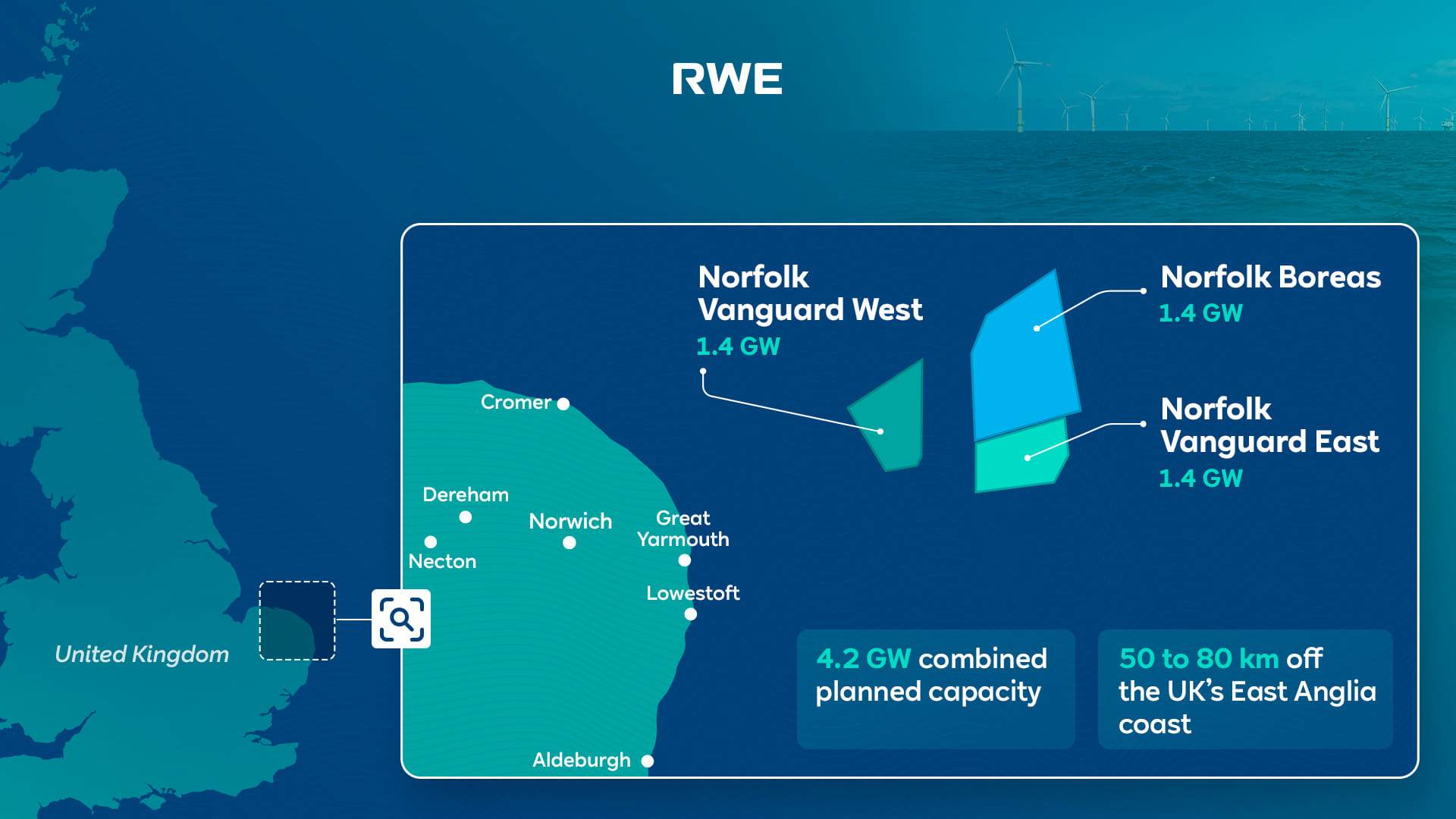
In March 2024, I wrote RWE And Vattenfall Complete Multi-Gigawatt Offshore Wind Transaction In UK, which described how Vattenfall had sold 4.2 GW of offshore wind farms, situated off North-East Norfolk to RWE.
This map from RWE shows the wind farms.
Note.
- The Norfolk Zone consists of three wind farms; Norfolk Vanguard West, Norfolk Boreas and Norfolk Vanguard East.
- The three wind farms are 1.4 GW fixed-foundation wind farms.
- In Vattenfall Selects Norfolk Offshore Wind Zone O&M Base, I describe how the Port of Great Yarmouth had been selected as the O & M base.
- Great Yarmouth and nearby Lowestoft are both ports, with a long history of supporting shipbuilding and offshore engineering.
The wind farms and the operational port are all close together, which probably makes things convenient.
So why did Vattenfall sell the development rights of the three wind farms to RWE?
Too Much Wind?
East Anglia is fringed with wind farms all the way between the Wash and the Thames Estuary.
- Lincs – 270 MW
- Lynn and Inner Dowsing – 194 MW
- Race Bank – 580 MW
- Triton Knoll – 857 MW
- Sheringham Shoal – 317 MW
- Dudgeon – 402 MW
- Hornsea 3 – 2852 MW *
- Scroby Sands – 60 MW
- East Anglia One North – 800 MW *
- East Anglia Two – 900 MW *
- East Anglia Three – 1372 MW *
- Greater Gabbard – 504 MW
- Galloper – 353 MW
- Five Estuaries – 353 MW *
- North Falls – 504 MW *
- Gunfleet Sands – 172 MW
- London Array – 630 MW
Note.
- Wind farms marked with an * are under development or under construction.
- There is 4339 MW of operational wind farms between the Wash and the Thames Estuary.
- An extra 6781 MW is also under development.
If all goes well, East Anglia will have over 11 GW of operational wind farms or over 15 GW, if the three Norfolk wind farms are built.
East Anglia is noted more for its agriculture and not for its heavy industries consuming large amounts of electricity, so did Vattenfall decide, that there would be difficulties selling the electricity?
East Anglia’s Nimbies
East Anglia’s Nimbies seem to have started a campaign against new overground cables and all these new wind farms will need a large capacity increase between the main substations of the National Grid and the coast.
So did the extra costs of burying the cable make Vattenfall think twice about developing these wind farms?
East Anglia and Kent’s Interconnectors
East Anglia and Kent already has several interconnectors to Europe
- Viking Link – Bicker Fen and Jutland – 1.4 GW
- LionLink – Suffolk and the Netherlands – 1.8 GW – In Planning
- Nautilus – Suffolk or Isle of Grain and Belgium – 1.4 GW – In Planning
- BritNed – Isle of Grain and Maasvlakte – 1.0 GW
- NeuConnect – Isle of Grain and Wilhelmshaven – 1.4 GW – Under Construction
- GridLink Interconnector – Kingsnorth and Warande – 1.4 GW – Proposed
- HVDC Cross-Channel – Sellinge and Bonningues-lès-Calais – 2.0 GW
- ElecLink – Folkestone and Peuplingues – 1.0 GW
- Nemo Link – Richborough and Zeebrugge – 1.0 GW
Note.
- Five interconnectors with a capacity of 6.4 GW.
- A further four interconnectors with a capacity of 6 GW are on their way.
At 12.4 GW, the future capacity of the interconnectors between South-East England and Europe, is nor far short of South-East English wind power.
There are also two gas pipelines from the Bacton gas terminal between Cromer and Great Yarmouth to Europe.
The Wikipedia entry for the Bacton gas terminal gives these descriptions of the two gas pipelines.
Interconnector UK – This can import gas from, or export gas to, Zeebrugge, Belgium via a 235 km pipeline operating at up to 147 bar. There is a 30-inch direct access line from the SEAL pipeline. The Interconnector was commissioned in 1998.
BBL (Bacton–Balgzand line) – This receives gas from the compressor station in Anna Paulowna in the Netherlands. The BBL Pipeline is 235 km long and was commissioned in December 2006.
It would appear that East Anglia and Kent are well connected to the Benelux countries, with both electricity and gas links, but with the exception of the Viking Link, there is no connection to the Scandinavian countries.
Did this lack of connection to Sweden make convincing the Swedish government, reluctant to support Vattenfall in their plans?
Bringing The Energy From The Norfolk Wind Farms To Market
It looks to me, that distributing up to 4.2 GW from the Norfolk wind farms will not be a simple exercise.
- Other wind farms like the 2852 MW Hornsea 3 wind farm, may need a grid connection on the North Norfolk coast.
- The Nimbies will not like a South-Western route to the National Grid at the West of Norwich.
- An interconnector to Denmark or Germany from North Norfolk would probably help.
But at least there are two gas pipelines to Belgium and the Netherlands.
RWE, who now own the rights to the Norfolk wind farms, have a large amount of interests in the UK.
- RWE are the largest power producer in the UK.
- They supply 15 % of UK electricity.
- They have interest in twelve offshore wind farms in the UK. When fully-developed, they will have a capacity of almost 12 GW.
- RWE are developing the Pembroke Net Zero Centre, which includes a hydrogen electrolyser.
RWE expects to invest up to £15 billion in the UK by 2030 in new and existing green technologies and infrastructure as part of this.
Could this be RWE’s plan?
As the Norfolk wind farms are badly placed to provide electricity to the UK grid could RWE have decided to use the three Norfolk wind farms to produce hydrogen instead.
- The electrolyser could be placed onshore or offshore.
- If placed onshore, it could be placed near to the Bacton gas terminal.
- There are even depleted gas fields, where hydrogen could be stored.
How will the hydrogen be distributed and/or used?
It could be delivered by tanker ship or tanker truck to anyone who needs it.
In Developing A Rural Hydrogen Network, I describe how a rural hydrogen network could be developed, that decarbonises the countryside.
There are three major gas pipelines leading away from the Bacton gas terminal.
- The connection to the UK gas network.
- Interconnector UK to Belgium.
- BBL to The Netherlands.
These pipelines could be used to distribute hydrogen as a hydrogen blend with natural gas.
In UK – Hydrogen To Be Added To Britain’s Gas Supply By 2025, I describe the effects of adding hydrogen to the UK’s natural gas network.
How Germany Is Dominating Hydrogen Market
The title of this post, is the same as that of this article on Hydrogen Fuel News.
This is the sub heading.
With 3827 kilometers of pipeline across the country, Germany is blazing a trail through the continent in terms of hydrogen infrastructure growth.
These are the first two paragraphs.
Indeed, plans within the country are so far advanced that Germany is set to become the biggest importer of hydrogen in Europe and the third biggest in the world, behind global leaders China and Japan.
All this leaves the German transport sector in good stead, with a strong infrastructure supporting clean fuel adoption, while the country transitions towards net zero.
So where are the Germans going to get their hydrogen from?
One possibility is the UK.
- The UK has vast amounts of renewable energy.
- We’re only hundreds of kilometres, instead of thousands of kilometres away.
- RWE; the German energy giant has full or partial interests in about 12,3 GW of UK wind farms.
- RWE is building the Pembroke Net Zero Centre which will generate green and blue hydrogen.
Hydrogen could be exported from the UK to Germany by tanker.
Conclusion
Production and exporting of green hydrogen will become significant industry in the UK.
RWE Underlines Commitment To Floating Offshore Wind In The Celtic Sea Through New ‘Vision’ Document
The title of this post, is the same as that of this press release from RWE.
These are the three bullet points.
- Offshore floating wind in the Celtic Sea could unlock 3,000 jobs and £682 million in supply chain opportunities by 2030
- RWE is targeting the development at least 1GW of floating wind in the region
- Using experience from demonstrator projects and partnerships with local supply chain to strengthen ambitions
These opening three paragraphs outline more of RWE’s vision.
RWE, the world’s second largest offshore wind player and largest generator of clean power in Wales, has unveiled its vision for the future of floating offshore wind in the Celtic Sea region and the opportunities it presents from new large-scale, commercial projects. Entitled “RWE’s Vision for the Celtic Sea”, the document was unveiled during day one of the Marine Energy Wales conference, in Swansea, where RWE is the Platinum Sponsor.
RWE sees floating wind technology as the next frontier in the development of the offshore wind sector, and which could potentially unlock a multi-billion pound opportunity for the broader Celtic Sea region and the UK.
Studies anticipate the first GW of floating wind to be developed in the Celtic Sea could potentially deliver around 3,000 jobs and £682 million in supply chain opportunities for Wales and the south west of England. Against this backdrop, it’s anticipated the technology could unlock a resurgence in Welsh industry, helping to decarbonise industry and transport, spur on academic innovation, and spearhead the growth of a new, highly skilled workforce.
Reading further down, there are these statements.
- RWE will be bidding in the upcoming Celtic Sea auction with the aim of securing at least 1 gigawatt (GW) of installed capacity, to be developed throughout the 2020’s.
- The Celtic Sea region is pivotal to RWE’s ‘Growing Green’ strategy in the UK, where we expect to invest £15 billion in clean energy infrastructure by 2030.
- A cooperation agreement with Tata SteelUK to understand and explore the production of steel components that could be used in high-tech floating wind foundations and structures for projects in the Celtic Sea.
- The company has also signed agreements with ABP Port Talbot, the Port of Milford Haven and Marine Power Systems of Swansea, to explore opportunities for building the supply chain for floating wind.
- RWE is the largest power producer and renewable energy generator in Wales with more than 3GW of energy across 11 sites.
- If successful in the leasing round, RWE’s Celtic Sea projects will also play a key role in the development of RWE’s Pembroke Net Zero Centre, as well as decarbonizing wider industrial processes and transportation across South Wales.
It looks like RWE are very serious about the Celtic Sea and Pembrokeshire.
Pembroke Net Zero Centre
The Pembroke Net Zero Centre looks to be a powerful beast.
It will be located at the 2200 MW Pembroke power station, which is the largest gas-fired power station in Europe.
These are the first two paragraphs on its web page.
RWE is a world leader in renewables, a market leader in the development of offshore wind and a key driver of the global energy transition. In turn, Pembroke is looking to continue its transformation as part of a decarbonisation hub under the title of the PNZC, linking-up with new innovative technologies needed for a low carbon future, including hydrogen production, Carbon Capture and Storage and floating offshore wind.
The PNZC will bring together all areas of the company’s decarbonisation expertise, including innovation, offshore wind, power engineering, trading and the development/operation of highly technical plants.
The page also talks of burning hydrogen in the power station and an initial 100-300 MW ‘pathfinder’ electrolyser on the Pembroke site.
Conclusion
In some ways, RWE are following a similar philosophy in the area, to that being pursued by SSE at Keadby on Humberside.
As The Crown Estate is talking of 4 GW in the Celtic Sea, it looks like RWE are positioning Pembroke to be the backup, when the wind doesn’t blow.
 The Anonymous Widower