Virgin Atlantic Granted Permit For Historic 100% Sustainable Aviation Fuel Flight
The title of this post, is the same as that of this press release from Virgin Atlantic.
These two paragraphs outline the proposed flight.
Virgin Atlantic’s historic 100% sustainable aviation fuel flight has been granted a permit to fly by the Civil Aviation Authority.
Virgin Atlantic plans to fly across the Atlantic from London Heathrow to New York JFK on 28 November 2023 to test and showcase the feasibility of flying on 100% SAF.
Note.
- Strangely, I’ve never flown Virgin, although I did once book then to go to Kenya, but as the flight was cancelled at the last minute, I swapped to Kenya Airways.
- Virgin have seventeen Rolls-Royce-powered Boeing 787s.
As Branson is involved, I do wonder, if this is more about PR than anything else.
This paragraph talks about sustainable aviation fuel (SAF).
SAF is fuel derived from non-petroleum based renewable sources that is capable of being used as a replacement for, or blended with, kerosene. SAF can currently be used in jet engines to a maximum blend of 50% with traditional kerosene without the need for any modifications. There are several processes to produce SAF, including algae, synthesised fuels from hydrogen waste, or from directly capturing carbon dioxide. When fully replacing kerosene, SAF could reduce lifecycle carbon emissions by over 70% compared to conventional fossil jet fuel.
There is nothing specifically said about the fuel, that Virgin Atlantic will use.
I first mentioned this flight in a post in December 2022, which is entitled World’s First Net Zero Transatlantic Flight To Fly From London in 2023, Powered By The Rolls-Royce Trent 1000.
The press release from Rolls-Royce, said that the flight would be this year. So, that appears to be happening.
In fact, it does appear that Rolls-Royce are being thorough with their testing of sustainable aviation fuel, as these posts include both Rolls-Royce and sustainable aviation fuel.
- Rolls-Royce Completes Next Step On Its Journey To Decarbonising Business Aviation
- New Rolls-Royce Small Engine Set To Begin Tests To Advance Hybrid-Electric Flight
- Rolls-Royce And Gulfstream Give Wings To Sustainable Business Aviation
- News Of The Day From Rolls-Royce
- First In-flight 100% Sustainable-Fuels Emissions Study Of Passenger Jet Shows Early Promise
- Rolls-Royce Joins Boeing And World Energy For Successful 100% Sustainable Aviation Fuel Flight
Several are based on Rolls-Royce press releases.
Daisy Hill Station To Go Step-Free
This document on the Government web site is entitled Access for All: 73 Stations Set To Benefit From Additional Funding.
Daisy Hill station is on the list.
These pictures show the station.
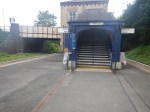
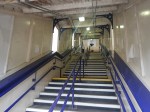
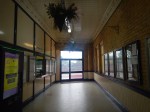
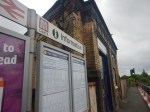

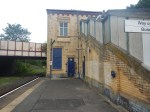
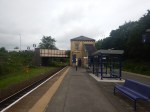
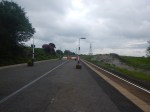
This Google Map shows the station.
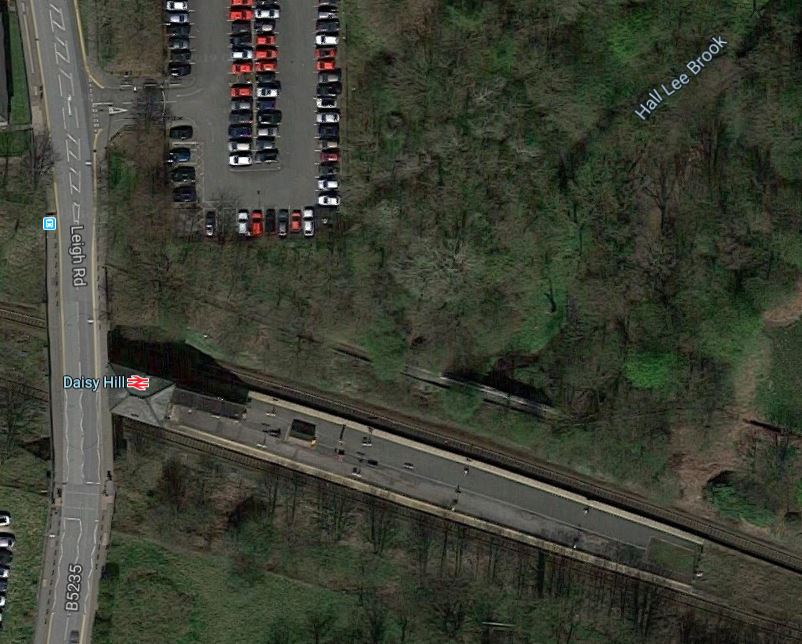
Whilst I was at Daisy Hill, I spoke to a couple who used the station regularly, who told me the following.
- The station needed step-free access.
- The station had been recently decorated and that the platforms were being extended.
- The local kids would get in and muck about in the lift.
- There is a lot of new housing to be built locally.
My own observations are.
- The steps are long, but swell-hand-railed.
- The station is in generally good condition.
- The Google Map shows that platforms have been longer in the past.
Surprisingly, the couple hadn’t heard that the station is to be made step-free.
Installing Step-Free Access
From the pictures, that I took, it looks like a single lift could be placed between the street and platform levels.
It would probably be tucked into the angle of the building.
This arrangement is not the most difficult of designs and lifts have been incorporated into stations like this, many times.
Conclusion
This station will be greatly improved by a single lift.
As to the fact, that the couple I spoke to, hadn’t heard of the step-free access, I’ve heard this at other stations on the list.
Network Rail need to sort their publicity.
HS2 Need To Get Their Act Together
Crossrail has been good in keeping Londoners and others informed about designs and what is happening, with constant updates to the News page on their web site.
Last month, HS2 started the contractual process to find a builder for the HS2 station at Old Oak Common.
But there is nothing about it on their News page, which is just a load of press releases.
I have found this picture of the proposed station in several places on the Internet.
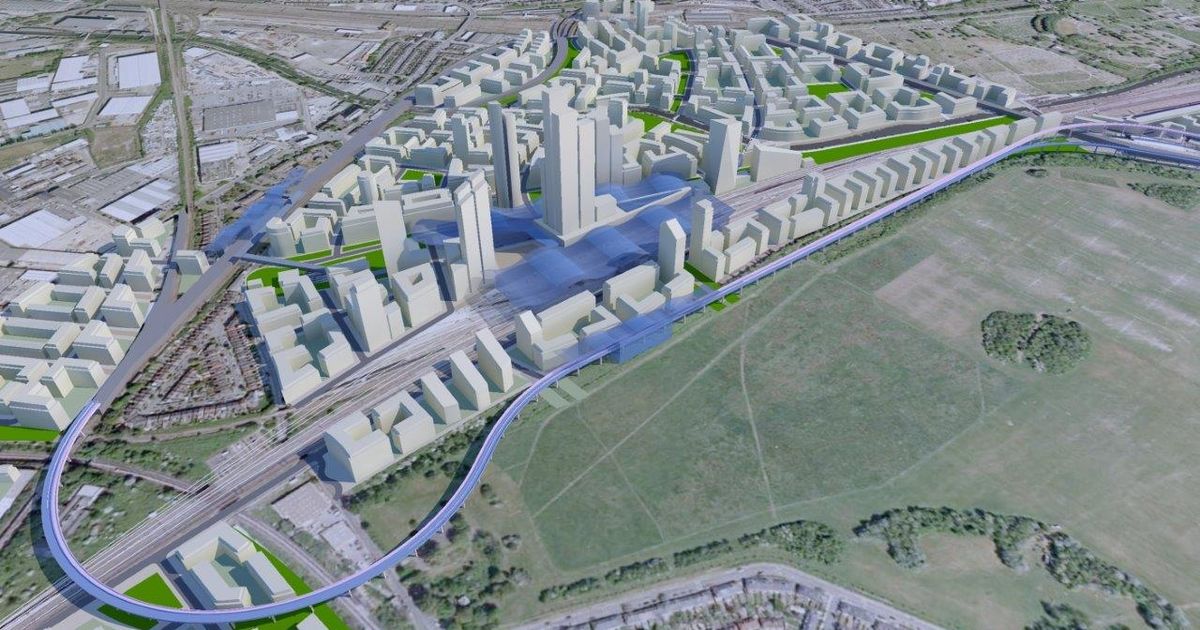
But where is the detailed information page, which explains it all?
I found this map of the rail lines in Wikipedia Commons.
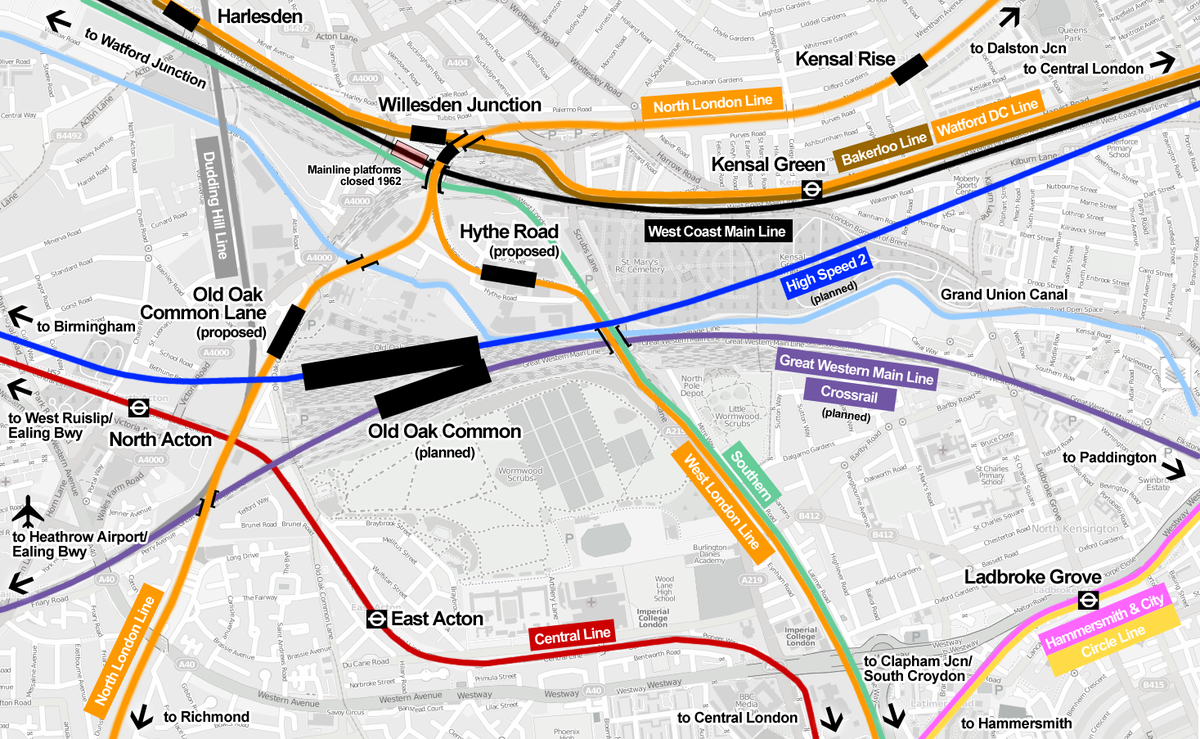
Note.
- It would appear that the rail line going along the North side of the common in the visualisation is the Great Western Main Line, which will also be used by Crossrail.
- It appears that the rail loop in the foreground of the visualisation, which is not shown on the map, is to allow Crossrail trains to access the North London Line.
- There must be another proposed loop or viaduct to allow trains to connect to the Northbound West Coast Main Line. This would allow Crossrail to be extended to Watford and Milton Keynes.
Where is the definitive map and information from HS2?
Old Oak Common station will affect travel plans for millions of travellers to and from most parts of London and a lot of places in the wider South East.
No wonder, there are people who don’t want HS2 to be built, if they have no information!
So why aren’t HS2 following the same news and information route, that has been successful for Crossrail?
Wightman Road Bridge Is Falling Down
I went to IKEA this morning on a 341 bus (As one does?) and the area around Harringay Green Lanes station.was locked solid.
A quick check on the Internetfrom my phone, told me that Wightman Road is closed.
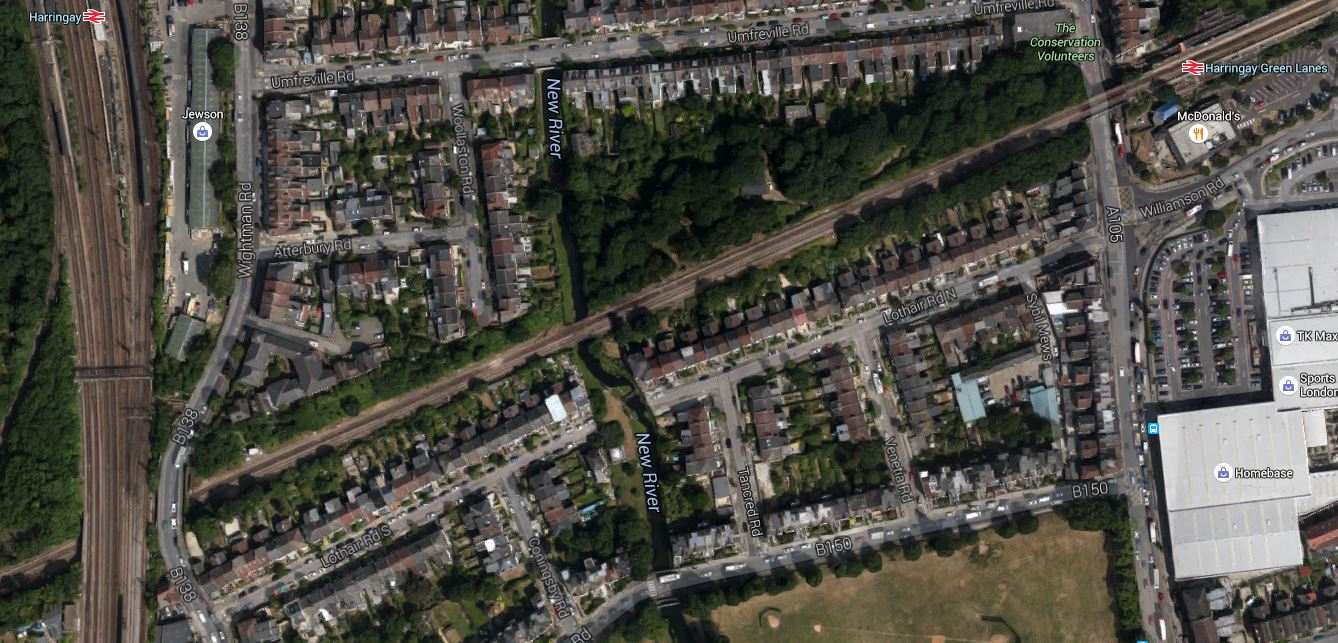
This Google Map shows the area between Harringay Green Lanes station and Harringay station.
Wightman Road Bridge
If you follow the Gospel Oak to Barking Line (GOBlin) westward from Harringay Green Lanes station, you come to the important bridge where the East Coast Main Line goes over the GOBlin. To the East of this bridge is a road bridge that takes Wightman Road, which is a major route numbered B138 over the railway.
This would appear to be the bridge that is causing the trouble.
I can only find one authorative document on the web and that is this page on the Haringey Council web site, which is entitled Bridge Reconstruction Work in Wightman Road. This is said.
Work is under way to replace the defective bridge over the railway lines on Wightman Road. The bridge is showing signs of severe deterioration. Network Rail are carrying out the work to coincide with the closure of the Gospel Oak-Barking line, which is undergoing electrification. Both projects are being carried out at the same time to help minimise transport disruption.
The main construction work will run from March to September 2016. While every effort will be made to minimize disruption to traffic, there will be a period when complete road closure will be unavoidable. A temporary footbridge will be put in place to provide access for pedestrians and cyclists while the work is in progress.
Incidentally,. I’ve not heard anything on the news or seen anything in the papers. When I checked a few minutes ago, there was nothing I could find on the Transport for London or Network Rail web sites.
So is this another case of Network Rail not giving the truth about bad problems in the hope they’ll not be spotted?
Or do they think that informing the general public is not important?
These are some pictures, I took at a visit to the bridge on a quiet Sunday morning.

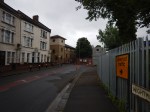





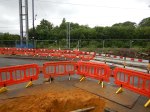


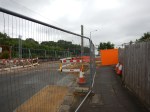
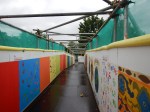
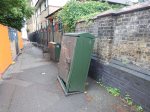
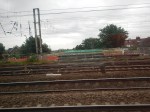
There’s certainly more useful infrormation at the bridge site, than on the web.
One notice labelled Wightman Road Overbridge says this.
- What: The existing Wightman Road Overbridge is to be demolished to bridge abutments to enable a complete bridge reconstruction.
- When: The construction phase is due to start in March 2016 and run until September 2016.
- Installation of scaffold walkway and access platform planned for March 2016.
- Diversion of services and removal of road surface are planned for April 2016 & May 2016.
- Removal of existing highway and bridge is planned for June & July 2016.
- Installation of new bridge deck planned for July 2016.
- Reinstatement of the highway, VRS and services is planned for July & August 2016.
- Why: The Wightman Road Overbridge is now at the end of its design life.In 2005 the structure was assessed and it was decided to renew the life-expired structure to modern-day standards.
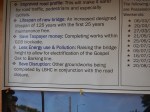
A second notice says this.
- Improved Road Profile: This will make it safer for road traffic, pedestrians and especially cyclists.
- Lifespan of New Bridge: An increased design lifespan of 125 years with the first 25 years maintenance free.
- Save Taxpayer Money: Completing works within GOB blockade.
- Less Energy Use And Pollution: Raising the bridge height to allow for electrification of the Gospel Oak to Barking Line.
- Save Disruption: Other groundworks being completed by LBHC in conjunction with the road closure.
The pictures show that good progress appears to be being made. It would appear that services are being diverted, but that the original road surface is still in place. There were also notices prominently displayed saying that on the weekends of the 25th June and 2nd July the pedestrian walkway would be closed, as a crane would be working. Could this be when the old bridge is lifted out and the new one is lifted in?
Let’s face it, 125 year old bridges do get tired! The bridges at Upper Holloway, South Tottenham and Highbury and Islington stations have all been or are being replaced!
I do wonder, if the urgent need to replace this bridge might explain the progress on the GOBlin electrification. Network Rail and Murphys seemed to have had a simple plan, which was proceeding in the early months of 2016. Then they found they needed a six month closure of the railway to replace the Wightman Road bridge and that blew a big hole right through everything.
But that doesn’t explain, why TfL and Network Rail haven’t disclosed the detailed truth to the people of North London!
At least when they’ve replaced the bridge, they’ll have a strong structure that they could use to support the overhead wires.
The East London Line Closure Of The Week Of 13th February 2016
Some have raised questions, as to why it is necessary to close the East London Line next week for Crossrail works?
I have found this vaugely-dated document on the Crossrail web site entitled Whitechapel Station closures between 13 and 21 February 2016. It says this.
The programme of activities scheduled to take place between 01:00 on Saturday 13 February and 05:30 on Monday 22 February 2016 includes the following:
- Ground reinforcement (piling) activity in the vicinity of the London Overground and London Underground platforms
- Removing the staircases, walls and canopies in the vicinity of the Whitechapel Station and the former ticket hall.
- Removing cables from the protection deck located over the London Overground, to the north of Durward Street • Removing part of the old pedestrian footbridge at the eastern end of Whitechapel Station
- Station steelwork in the vicinity of London Overground
- Concrete pours in the vicinity of the station.
- There will be concrete lorries in Durward Street and activity on Whitechapel Road to support these concrete pours.
I can certainly understand, that if they have to close the railway for Health and Safety reasons, then so be it.
I can also understand, if they’ve found something unexpected in the old part of the Victorian station. We’ve all found that when we’ve renovated old buildings.
And of course, the closure is when it is, as it is half-term in Swanlea School, which helps with access.
But this whole closure is a puzzle to me, as Crossrail’s project management and also their handling of community relations and the media has been generally good.
According to someone locally to me in Dalston, this is an unexpected closure. If it is, then where is the story in the local press or on the BBC?
These days, with cameras and crews everywhere, why hasn’t there been an honest report on BBC London television?
I think Crossrail have rather mucked up here, as people are annoyed and if they’d given us the truth, people would be more understanding.
But then we’re in the East End, and if there was an Olympic event of ducking and diving, all the medals would be won, by someone from this area.
Challenger Brands
This article from PR Week is untitled Challenge, stand up and stand out in 2016.
It’s aread that makes you think!
I picked the article up because it mentioned OVO Energy, s company I use and like!
Archaeology In Dresden
There is a lot of rebuilding going on in Dresden, and I came across this site that was being investigated for archaeological purposes.



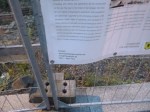
In a couple of places across Germany, I’ve recently come across examples of developers doing the sort of PR you see in London, to passify those affected by large developments.
Perhaps, everybody is watching Crossrail, who have used archaeology virtually as a PR weapon to fight off protesters and bad press!
Thames Water Gets It Wrong Again
Thames Water has just announced that it is applying to put up water bills. It is reported here on the BBC. Here’s the first couple of paragraphs.
Thames Water has asked its regulator, Ofwat, for permission to raise prices.
It wants to put up bills by about £29 per household during 2014-15, but has asked Ofwat if it can spread the rise over more than one year.
I have been privileged to go on a Thames Water tour of the sewers a couple of years ago, so I know some of the problems they face in dealing with London’s sewage and delivering the city’s water.
But I can’t help comparing the way they handle their customers, with the way Crossrail deals with those who might use their new railway.
From the burst water mains in Herne Hill, Notting Hill and Regent Street recently to the timing of announcements of price rises, they either seem to be unlucky or have no sense of how to use positive information to get customers on their side in a small way. For instance, where is the parallel archaeology project to the Super Sewer, like Crossrail’s one with their new rail line?
We’ve also seen no report on what caused the fatberg in Kingston recently? This would appear to be something that was beyond their control. So why not be honest?
I have seen no reports too, about some of the superb water and sewage engineering, put in by Thames Water at the Olympic site. And where’s the sewer cam on the Internet, that can show the conditions that they have to deal with?
Thames Water seem to be going out of their way to attract bad publicity.
Crossrail Don’t Just Dig Tunnels
This report on the BBC, gives the latest progress on the archaeology program, that runs alongside Crossrail. Similar reports have also turned up all over the world including this one from India. So perhaps Crossrail is showing the world how to dig in more ways than one!
You have to congratulate Crossrail on their attitude to the past, which seems to be much better than other projects.
I suppose you could also be cynical, and say that they see the public relations as beneficial to getting the project done on time, as it minimises objections.
But who cares, if the project comes in on or under budget? Everybody!
Crossrail And The Super Sewer
The two large tunneling projects in London at the moment are Crossrail and the Thames Tideway Tunnel or Super Sewer.
They both require long tunnels and will cost billions of pounds each.
But the public seem to have different attitudes to the two projects.
Nearly everybody seems to support Crossrail, whereas there is substantial opposition to the sewer.
I did ask a friend, if there had been any opposition to Crossrail and he said, there was a bit in the early days from places like Mayfair. People seemed to have been worried about dust and noise during the construction phase. But now everybody just gets on with life and hopes that Crossrail will be finished and walking and driving will get back to normal.
To be fair to Crossrail, they seem to have gone out of their way with green walls to minimise noise, using the river to carry tunnel spoil and being a good neighbour as at Stepney City Farm. They have also launched a well-funded and publicised archaeology program.
On the other hand, the Super Sewer, doesn’t seem to have done the same to allay the fears of a public, who don’t want all the problems of construction and the increase in water bills.
I do wonder, whether the difference is down to the fact that a new railway is something people can use and feel gives them tangible benefits, but a sewer, is something that they only use a few times every day and don’t want to think about. And it looks to me, that Thames Water have not done a good enough job to sell the benefits of the new sewer to the general public.
 The Anonymous Widower
