The Plans For Giant Seaweed Farms In European Waters
The title of this post, is the same as that of this article on the BBC.
The article describes how the Dutch are developing the growing and harvesting of seaweed.
This is all fascinating stuff and reminds me of reading of a company called Alginate Industries in the Meccano Magazine in the 1950s.
I can’t find much about the company, except that they were taken over by Merck & Co in 1979.
The Wikipedia entry for alginic acid, gives this information on alginates.
Alginates are refined from brown seaweeds. Throughout the world, many of the Phaeophyceae class brown seaweeds are harvested to be processed and converted into sodium alginate. Sodium alginate is used in many industries including food, animal food, fertilisers, textile printing, and pharmaceuticals. Dental impression material uses alginate as its means of gelling. Food grade alginate is an approved ingredient in processed and manufactured foods.
I remember the Meccano Magazine saying that alginates were an important food additive and UK production came from the North of Scotland.
This page on the Secret Scotland wiki gives details of current alginate production in Scotland.
Has Wikipedia replaced the Meccano Magazine, as a source of information for scientifically-inquisitive children?
XLCC Obtains Planning Approval To Build UK’s First HVDC Cable Factory In North Ayrshire
The title of this post, is the same as that of this press release from XLCC.
These are the first three paragraphs.
On 29th June 2022, the North Ayrshire Council Planning Committee resolved to grant planning permission for XLCC’s HVDC subsea cable manufacturing operations in Hunterston, Scotland.
Breaking ground in the coming months, the brownfield site will create a new UK industry to support global decarbonisation targets. Once fully operational, the facility will support 900 jobs in the area, with thousands more in the wider supply chain.
XLCC’s first order is for four 3,800km long cables to connect solar and wind renewable power generation in the Sahara to the UK for the Xlinks Morocco-UK power project.
XLCC have also issued two other important press releases.
XLCC To Build New Cable Laying Vessel To Address Increase In Future Demand For HVDC Cable
These are the first paragraphs.
XLCC, the new HVDC, renewable energy focused business in the UK, has completed the concept design of an advanced, first-of-a-kind Cable Laying Vessel to be delivered in the first half of 2025.
As the world strives for Net Zero, the UK, EU and other world economies have set themselves ambitious targets for decarbonisation. The UK, for example, has stated that it will be powered entirely by clean energy by 2035 and that it will fully decarbonise the power system in the same time frame. This ambition is driving an exponential growth in high voltage cable demand as the increase in installation of offshore wind and interconnectors drive a forecast six times increase (2020 – 2027 over 2014 – 2020) for HVDC cable.
The planned delivery of the XLCC CLV will support the Morocco – UK Power Project, the first client project, through the delivery of four 3,800km subsea HVDC cables from a wind and solar generation site in Morocco to the UK.
This press release can be read in full here.
XLCC Signs UK Steel Charter For New Export-Led Cable Industry
These are the first paragraphs.
XLCC signed the UK Steel Charter at an event in Parliament on 19 April 2022, alongside representatives from politics, business and the trade union movement.
XLCC will create a new export-led HVDC cable manufacturing industry for the UK, nearly doubling the world’s current production. It aims to support renewable energy projects with the first factory planned for Hunterston, Scotland. XLCC will deliver its first project for the Xlinks Morocco-UK Power Project, consisting of four 3,800km long subsea cables, with the first phase between 2025-2027 connecting wind and solar power generated in Morocco exclusively to the UK in Devon.
Signing the UK Steel Charter shows a commitment to supporting existing and future jobs within the sector and the supply chain. Along with strengthening UK-based business, sourcing steel locally will cut transport emissions and seek to support decarbonisation in a sector dedicated to finding ways to minimise environmental impact of steel use.
This press release can be read in full here.
I have a few thoughts.
You Wait For A Large Interconnector Project To Come Along And Then Two Arrive Holding Hands
This paragraph introduces the Morocco-UK Power Project.
The Xlinks Morocco-UK Power Project will be a new electricity generation facility entirely powered by solar and wind energy combined with a battery storage facility. Located in Morocco’s renewable energy rich region of Guelmim Oued Noun, it will cover an approximate area of 1,500km2 and will be connected exclusively to Great Britain via 3,800km HVDC sub-sea cables.
XLCC have this mission statement on their home page.
XLCC will establish a new, export-led, green industry in the UK: world class HVDC subsea cable manufacturing.
Our mission is to provide the connectivity required for renewable power to meet future global energy needs.
Xlinks Morocco-UK Power Project and XLCC appear to be made for each other.
In some ways it takes me back to the 1970s, where large oil and gas projects in the North Sea were paired with platform building in Scottish lochs.
There Are Several Interconnector Projects Under Development
We will see a lot of undersea interconnectors in the next few years.
- Country-to-country interconnectors
- Interconnectors along the coast of the UK.
- Connections to offshore wind farms.
This capacity, with a ship to lay it, is being created at the right time.
Icelink
Icelink is a proposed interconnector between Iceland and the UK.
- It would be up to 1200 km long.
- It would have a capacity of around 1 GW
XLCC could spur the development of this project.
Floating Wind Farms Hundreds Of Miles Out To Sea
The developer of a floating wind farm, say a hundred miles out to sea, is not going to develop it, if there isn’t a secure supply of cable.
Where Will Finance Come From?
Wind farms have proven to be good investments for finance giants such as Aviva.
See World’s Largest Wind Farm Attracts Huge Backing From Insurance Giant, for Aviva’s philosophy.
As mathematical modelling for electrical systems get better, the estimates of the finance needed and the returns to be made, will indicate whether these mega-projects can be funded.
It was done with North Sea oil and gas and it can be done with offshore wind power and its interconnectors.
In The Times on the 4th of July 2022, there is this article, which is entitled Schroders Chief Buzzing To Take Finance Offshore Wind Farms.
It is a must-read!
Conclusion
XLCC and its cable factory will spur the expansion of zero-carbon electricity in the UK.
Trains Disrupted After Lorry Crashes Onto Tracks In East Lothian
The title of this post, is the same as that of this article on the BBC.
These are the first two paragraphs.
Train services in and out of Edinburgh have been delayed after a lorry crashed onto the tracks in East Lothian.
The lorry driver was taken to hospital following the crash onto the East Coast Main Line between Wallyford and Prestonpans at about 13:30. His condition is not known.
Note.
- On a day with a rail strike, this was all that was needed.
- The place name is appropriate.
There is no excuse for an accident like this.
Will Coire Glas Start A Pumped Storage Boom In Scotland?
This article on Renewables Now is entitled SSE Gets Tenders For Construction Of 1.5-GW Pumped Hydro Scheme.
This is the first paragraph.
SSE Renewables said on Wednesday it has received tenders for the main construction works for the Coire Glas hydro pumped storage project with a capacity of up to 1.5 GW in the Scottish Highlands.
It then lists, the companies who have tendered for the project.
SE Renewables said the ITT has drawn global interest. The tenderers shortlisted for mechanical and electrical plant scope are a partnership between ANDRITZ HYDRO GmbH and Voith Hydro GmbH & Co KG, and GE Hydro France. The parties shortlisted for the civil engineering scope include three consortia and STRABAG UK Ltd. The consortia are made up of Bechtel Ltd, Acciona Construccion SA and Webuild SpA; BAM Nuttall Ltd, Eiffage Genie Civil SA and Marti Tunnel AG; and Dragados SA and BeMo Tunnelling UK Ltd.
It is an impressive list.
The article says that construction is to start in 2024. Other sources say the pumped storage project will have a storage capacity of 30 GWh, which will make it the largest pumped storage plant in the UK.
This press release from SSE Renewables is entitled Tenders Submitted For The Coire Glas Pumped Storage Scheme.
The press release contains this quote from the Project Director for Coire Glas; Ian Innes.
Receiving the tenders on schedule from the six short-listed tenderers is another significant milestone for the Coire Glas project and we are grateful for their continued interest in the project.
We are encouraged by the content of the tenders which now provides the Coire Glas project team with several options on how construction of the project could be undertaken. It is going to take some time to carefully consider and scrutinise the tenders thoroughly and we look forward to working with the tenderers as we endeavour to make our selection decision.
It appears that not only were the tenders received from quality companies, but that they contained options and ideas that could improve the project.
Coire Glas would appear to me to be a project, that is attracting the best companies and they could be putting their best workers on the project.
These are my thoughts.
The Potential For Pumped Storage Schemes In Scotland
There are at least six schemes under development or proposed in Scotland.
- Balliemeanoch – 45 GWh
- Coire Glas – 30 GWh
- Corrievarkie – 14.5 GWh
- Loch Earba – 33 GWh
- Loch Sloy – 14 GWh
- Red John – 2.8 GWh
This page on the Strathclyde University web site, gives these figures for the possible amounts of pumped-storage that can be added to existing hydro schemes.
- Errochty – 16
- Glasgarnock – 23
- Luichart – 38
- Clunie – 40
- Fannich – 70
- Rannoch – 41
- Fasnakyle – 78
- Tummel – 38
- Ben Lawers – 12
- Nant – 48
- Invermoriston – 22
- Invergarry – 41
- Quoich – 27
- Sloy – 20
That is a total of 547 GWh or 653.3 GWh if you include the new storage, I listed above.
Scotland would appear to be land overflowing with large pumped storage possibilities and could provide the modern equivalent of milk and honey.
The Potential For Offshore Wind Power Schemes In Scotland
This is the first two paragraphs of this press release on the Crown Estate Scotland web site.
Crown Estate Scotland has today announced the outcome of its application process for ScotWind Leasing, the first Scottish offshore wind leasing round in over a decade and the first ever since the management of offshore wind rights were devolved to Scotland.
The results coming just months after Glasgow hosted the global COP26 climate conference show the huge opportunity that Scotland has to transform its energy market and move towards a net zero economy.
Some highlights are then listed.
- 17 projects have been selected out of a total of 74 applications.
- A total of just under £700m will be paid by the successful applicants in option fees and passed to the Scottish Government for public spending.
- The area of seabed covered by the 17 projects is just over 7,000km2.
- Initial indications suggest a multi-billion pound supply chain investment in Scotland
- The potential power generated will move Scotland towards net-zero.
This map shows the location of each wind farm.

Note, that the numbers are Scotwind’s lease number in their documents.
Fixed Foundation Wind Farms
These are the six fixed foundation wind farms.
- 1 – BP Alternative Energy Investments – 859 km² – 2.9 GW
- 6 – DEME – 187 km² – 1.0 GW
- 9 – Ocean Winds – 429 km² – 1.0 GW
- 13 – Offshore Wind Power – 657 km² – 2.0 GW
- 16 – Northland Power – 161 km² – 0.8 GW
- 17 – Scottish Power Renewables – 754 km² – 2.0 GW
Adding up these fixed foundation wind farms gives a capacity of 9.7 GW in 3042 km² or about 3.2 MW per km².
Floating Wind Farms
These are the ten floating wind farms.
- 2- SSE Renewables – 859 km² – 2.6 GW
- 3 – Falck Renewables Wind – 280 km² – 1.2 GW
- 4 – Shell – 860 km² – 2.0 GW
- 5 – Vattenfall – 200 km² – 0.8 GW
- 7 – DEME Concessions Wind – 200 km² – 1.0 GW
- 8 – Falck Renewables Wind – 256 km² – 1.0 GW
- 10 – Falck Renewables Wind – 134 km² – 0.5 GW
- 11 – Scottish Power Renewables – 684 km² – 3.0 GW
- 12 – BayWa r.e. UK – 330 km² – 1.0 GW
- 14 – Northland Power – 390 km² – 1.5 GW
Adding up the floating wind farms gives a capacity of 14.6 GW in 4193 km² or about 3.5 MW per km².
Mixed Wind Farms
This is the single wind farm, that has mixed foundations.
15 – Magnora – 103 km² – 0.5 GW
This wind farm appears to be using floating wind turbines.
These wind farms total up to 24.8 GW
I would expect that this is only a phase in the development of Scottish wind power, which will grow substantially over the next decade.
As I write this the UK is generating a total of 26.2 GW of electricity.
Backing Up The Wind Power
This wind power, which could grow up to well over 50 GW in Scotland alone.
But what do you do, when there is no wind?
Energy will need to come from batteries, which in Scotland’s case could be over 500 GWh of pumped storage.
Europe’s Powerhouse
It is not an unreasonable prediction, that we will continue to expand our wind farms to supply Europe with thousands of GWh of electricity and/or millions of tonnes of green hydrogen.
Conclusion
It is likely that we’ll see an upward increase of wind power in Scotland closely matched by a similar increase in pumped storage.
It is no wonder that the world’s largest and most experienced contractors were so keen to get the first big contract in Scotland’s new pumped storage boom.
They know a good thing, when they see it and after their experience with the Scotland’s oil boom in the last century, I doubt they are delaying their return.
Consortium Plan To Build & Operate Scotland’s First Low Carbon, Energy Efficient, Soil-Free Vertical Farms In The Central Belt
The title of this post, is the same as that of this press release from RheEnergise.
These four paragraphs introduce the project.
A consortium of four British companies have earmarked a series of sites between Dumbarton and Dundee for the locations of Scotland’s next generation of hectare+ scale vertical farms, powered by 100% Scottish renewables. These farms would provide locally produced fresh foods (salads and fruits) to over 60% of the Scottish population.
The vertical farms will help meet the Scottish Government’s ambitions to produce more homegrown fruit and vegetables. Each vertical farm would be powered by locally produced renewable energy.
Next generation vertical farms use advanced soil-free growing techniques and stack crops in specially designed beds and trays. They minimise water, fertiliser and pesticide use which is highly beneficial to the environment and make use of artificial lighting and climate control to get the desired results.
The V-FAST consortium comprises UK Urban AgriTech (UKUAT), Vertegrow Ltd, Light Science Technologies Ltd and RheEnergise Limited, the UK energy storage company.
The press release is certainly worth a detailed read.
ScotWind Offshore Wind Leasing Delivers Major Boost To Scotland’s Net Zero Aspirations
The title of this post, is the same as that of this press release on the Crown Estate Scotland web site.
This is the first two paragraphs.
Crown Estate Scotland has today announced the outcome of its application process for ScotWind Leasing, the first Scottish offshore wind leasing round in over a decade and the first ever since the management of offshore wind rights were devolved to Scotland.
The results coming just months after Glasgow hosted the global COP26 climate conference show the huge opportunity that Scotland has to transform its energy market and move towards a net zero economy.
Some highlights are then listed.
- 17 projects have been selected out of a total of 74 applications.
- A total of just under £700m will be paid by the successful applicants in option fees and passed to the Scottish Government for public spending.
- The area of seabed covered by the 17 projects is just over 7,000km2.
- Initial indications suggest a multi-billion pound supply chain investment in Scotland
- The potential power generated will move Scotland towards net-zero.
This map shows the position of each wind farm.
Note, that the numbers are Scotwind’s lease number in their documents.
Fixed Foundation Wind Farms
These are the six fixed foundation wind farms.
- 1 – BP Alternative Energy Investments – 859 km² – 2.9 GW
- 6 – DEME – 187 km² – 1.0 GW
- 9 – Ocean Winds – 429 km² – 1.0 GW
- 13 – Offshore Wind Power – 657 km² – 2.0 GW
- 16 – Northland Power – 161 km² – 0.8 GW
- 17 – Scottish Power Renewables – 754 km² – 2.0 GW
Adding up these fixed foundation wind farms gives a capacity of 9.7 GW in 3042 km² or about 3.2 MW per km².
Floating Wind Farms
These are the ten floating wind farms.
- 2- SSE Renewables – 859 km² – 2.6 GW
- 3 – Falck Renewables Wind – 280 km² – 1.2 GW
- 4 – Shell – 860 km² – 2.0 GW
- 5 – Vattenfall – 200 km² – 0.8 GW
- 7 – DEME Concessions Wind – 200 km² – 1.0 GW
- 8 – Falck Renewables Wind – 256 km² – 1.0 GW
- 10 – Falck Renewables Wind – 134 km² – 0.5 GW
- 11 – Scottish Power Renewables – 684 km² – 3.0 GW
- 12 – BayWa r.e. UK – 330 km² – 1.0 GW
- 14 – Northland Power – 390 km² – 1.5 GW
Adding up the floating wind farms gives a capacity of 14.6 GW in 4193 km² or about 3.5 MW per km².
Mixed Wind Farms
This is the single wind farm, that has mixed foundations.
15 – Magnora – 103 km² – 0.5 GW
This wind farm appears to be using floating wind turbines.
I have a few general thoughts.
Are Floating Wind Farms Further Out?
There does appear to be a pattern, where the wind farms that are further from the land tend to be floating wind farms and those closer to the land appear to be fixed.
Consider.
- As the water gets deeper, fixed wind turbines will surely get more expensive.
- Floating wind turbines are the newer and more unproven technology, so only those bidders, who have done their research and are happy with it, will have bid.
Falck Renewables Wind Seem To Be Working With BlueFloat Energy
In the three Falck Renewables successes with leases 3, 8 and 10, BlueFloat Energy is a partner in the lease.
According to their web site, BlueFloat Energy were very much involved in WindFloat Atlantic, where this is said.
Top members of our team were key contributors to the development and construction of the WindFloat Atlantic project from concept to Final Investment Decision to commissioning. This 25 megawatt (MW) floating offshore wind project in Portugal marked a turning point in the offshore wind industry as it was the first floating offshore wind project to secure bank financing. With 3 x MVOW’s 8.4 MW turbines, the WindFloat Atlantic project was the world’s first semi-submersible floating wind project and continental Europe’s first floating wind project.
So do Falck Renewables intend to use WindFloat technology in their areas, which are to produce a total of 2.7 GW?
Perhaps a fleet of two hundred floating wind turbines based on WindFloat technology each with a capacity of 14 MW would be ideal.
- Wind turbines would be interchangeable between all three farms.
- There could be a few standby turbines to allow for maintenance.
- It would be possible to borrow a turbine to explore a new site.
All it would need is technology to be able to position and connect a turbine into the wind farm and disconnect and remove a turbine from the wind farm, with simple procedures.
Did BP Avoid the Floating Wind Farms?
BP, who are relatively new to offshore wind, only had one success, for a large fixed wind farm. So did they avoid the floating wind farms?
Do Shell and Scottish Power Have A Bigger Plan?
Shell and Scottish Power were successful with leases 4 and 11, which are reasonably close together.
They also won lease 17, which I wrote about in MacHairWind Wind Farm, where I concluded this.
The MacHairWind wind farm seems a well-positioned wind farm.
- It is close to Glasgow.
- It can be used in tandem with the Cruachan pumped hydro power station.
- It will have access to the Western HVDC Link to send power to the North-West of England.
Is Scotland replacing the 1.2 GW Hunterston B nuclear power station with a 2 GW wind farm, with help from Cruachan and other proposed pumped storage hydro schemes to the North of Glasgow?
So did Shell and Scottish Power get the pick of the bunch and will build two large floating wind farms close together?
Shell and Scottish Power seem to be using French company; Eolfi’s floating wind technology.
Why Do Floating Wind Farms Have A Higher Density?
The floating wind farms have an average energy density of 3.5 MW per sq. km, whereas the fixed wind farms only manage 3.2 MW per sq. km.
It may be only ten percent, but does that help the economics? It certainly, wouldn’t make them worse.
I do wonder though, if the reason for the higher density is simply that a floating turbine can be bigger, than a corresponding fixed turbine.
I also have a few more specific thoughts about individual farms.
Lease 15 – The Odd Bid Out
In any design competition, there is usually at least one design, that is not look like any of the others.
In the successful bids for the ScotWind leases, the bid from Magnora ASA stands out.
- The company has an unusual home page on its offshore wind web site.
- This page on their web site outlines their project.
- It will be technology agnostic, with 15MW turbines and a total capacity of 500MW
- It will use floating offshore wind with a concrete floater
- It is estimated, that it will have a capacity factor of 56 %.
- The water depth will be an astonishing 106-125m
- The construction and operation will use local facilities at Stornoway and Kishorn Ports.
- The floater will have local and Scottish content.
- The project will use UK operated vessels.
- Hydrogen is mentioned.
- Consent is planned for 2026, with construction starting in 2028 and completion in 2030.
This project could serve as a model for wind farms all round the world with a 500 MW power station, hydrogen production and local involvement and construction.
I discuss this project in more detail in ScotWind N3 Offshore Wind Farm.
A Conclusion About Floating Wind
The various successful bids in this round of Scottish wind farm leases can be split by capacity into two groups.
- Floating + Mixed – 15.1 GW – 61 %
- Fixed – 9.7 GW – 39 %
Note that I have included Magnora’s successful mixed bid with the successful floating bids, as it uses floating wind turbines to generate electricity.
The over 60 % of successful bids involving floating wind farms, indicates to me, that the day of floating wind farms has arrived.
Is This The World’s Most Ambitious Green Energy Solution?
In the 1970s and 1980s, when I was developing Artemis, which was the first desk-sized project management system, we were heavily involved in North Sea Oil, with dozens of systems in Aberdeen. As Norway developed the oil business on the other side of the North Sea, the number of systems there grew to at least twenty.
Increasingly, I became aware of a Norwegian company called Kværner, which seemed to have large numbers of Artemis systems.
In 2002, Kværner merged with Aker Maritime and this eventually led to the formation of Aker Solutions in 2008, which is a company that is headquartered in Oslo and employs nearly 14,000.
According to Wikipedia, the Kværner name was dropped somewhere along the way, as non-Scandinavians have difficulty pronouncing Kværner.
Aker Solutions appears to be wholly Scandinavian-owned, with Aker ASA owning a third of the company.
They are a very respected company, when it comes to offshore engineering for oil and gas and wind projects.
Aker ASA also have a subsidiary called Aker Horizons, which has this web site, where they call themselves a planet-positive company.
This page on the Aker Horizons is entitled Northern Horizons: A Pathway for Scotland to Become a Clean Energy Exporter.
These first two paragraphs outline the project.
A vision to utilise Scottish offshore wind resources in the North Sea to make the country an exporter of clean energy has been unveiled at the COP 26 climate change conference in Glasgow.
The Northern Horizons Project has been unveiled by Aker Horizons’ portfolio companies Aker Offshore Wind and Aker Clean Hydrogen, who have the technical know-how and expertise to realise the project, and DNV, the independent energy expert and assurance provider.
Various targets and ambitions are listed.
- 10 GW of renewable energy in the North Sea.
- 5 GW of green hydrogen.
- Giant turbines nearly as tall as the London Shard on floating platforms more than 130km from Shetland.
- Enough liquid hydrogen will be produced to power 40 percent of the total mileage of local UK buses.
- Enough synthetic fuel to make 750 round trips from the UK to New York.
A completion date of 2030 for this project is mentioned.
This article on The Engineer is entitled Northern Horizons Plans Clean Energy Exports For Scotland.
The article is dated the 4th of November 2021 and starts with this sub-heading and an informative video.
Aker Horizons’ new initiative, Northern Horizons, aims to make Scotland a clean energy exporter by utilising offshore wind resources in the North Sea.
There is an explanatory graphic of the project which shows the following.
- Floating wind turbines.
- A floating DC substation.
- A floating hydrogen electrolyser.
- An onshore net-zero refinery to produce synthetic aviation fuel and diesel.
- A hydrogen pipeline to mainland Scotland.
- Zero-carbon energy for Shetland.
It is all very comprehensive.
These are some other thoughts.
Project Orion
Project Orion how has its own web site and the project that seems to have similar objectives to Northern Horizons.
The title on the home page is Building A World-Leading Clean Energy Island.
There is this statement on the home page.
Orion is a bold, ambitious project that aims to transform Shetland into the home of secure and affordable clean energy.
We will fuel a cleaner future and protect the environment by harnessing the islands’ renewables potential, using onshore and offshore wind, tidal and wave energy.
The graphic has similar features to that Northern Horizons in the article on The Engineer, with the addition of providing an oxygen feed to Skyrora for rocket fuel.
German Finance
I feel very much, that the Germans could be providing finance for developments around Shetland, as the area could be a major source of hydrogen to replace Vlad the Mad’s tainted gas.
In Do BP And The Germans Have A Cunning Plan For European Energy Domination?, I described how BP is working with German utilities and finance to give Germany the hydrogen it needs.
NorthConnect
The NorthConnect (also known as Scotland–Norway interconnector) is a proposed 650 km (400-mile) 1,400 MW HVDC interconnector over the floor of the North Sea.
- It will run between Peterhead in North-East Scotland and Norway.
This project appears to be stalled, but with the harvesting of more renewable energy on Shetland, I can see this link being progressed, so that surplus energy can be stored in Norway’s pumped storage hydro.
Icelink
Icelink is a proposed electricity interconnector between Iceland and Great Britain.
- It would be the longest undersea interconnector in the world, with a length of 620 to 750 miles.
- It would be a 800–1,200 MW high-voltage direct current (HVDC) link.
- National Grid is part of the consortium planning to build the link.
- Iceland has a surplus of renewable energy and the UK, is the only place close enough for a connection.
I believe that if Icelink were to be built in conjunction with energy developments on and around Shetland, a more powerful and efficient interconnector could emerge.
Conclusion
This ambitious project will transform the Shetlands and the energy industry in wider Scotland.
This project is to the North-East of Shetland, but the islands are surrounded by sea, so how many other Northern Horizons can be built in a ring around the islands?
Union Demands Withdrawal Of All HSTs After Carmont Report
The title of this post, is the same as that of this article on Railnews.
This is the first paragraph.
The TSSA union says it has written to the regulator demanding the immediate withdrawal of all surving HSTs, after new revelations in the Carmont derailment. report.
Manuel Cortes of the TSSA feels that the corrosion problem found in the train that crashed at Carmont, may be present in other trains.
He finishes with this this statement.
Frankly, it’s time to ban the HSTs. They were great in their day, but that day is nearly 50 years ago now and they simply aren’t up to modern safety standards.
I must admit, that I tend to agree with him, on this last point.




















Scotrail have the following fleet of Inter7City trains.
- There are 52 Class 43 power cars and 120 Mark 3 coaches, which are arranged as nine four-car and seventeen five-car trains.
- The trains have sliding passenger doors.
- The trains meet all the regulations for Persons of Reduced Mobility.
- The trains have wi-fi and power points.
- They seem to run at up to 100 mph, as against the 125 mph for InterCity 125‘s in the past.
- The power cars have generally been reengined with modern MTU 16V4000 R41R diesel engines.
But they are now on average over forty years old.
In Battery And Hydrogen Trains For ScotRail ‘Could Make Scotland A Global Leader’ In Zero-Emission Transport, which is based on an article in the Scotsman with the same title, I said this.
Other points from the article.
- Talgo appear to have passed the story to Scotland on Sunday.
- Three routes are mentioned; Borders Railway, Fife Circle and Glasgow-East Kilbride.
- The new trains could help phase out diesel trains by 2035, which is Scottish Government policy.
- The Inter7City trains might be replaced by 2030.
- Talgo hopes to win an order for its factory in Fife.
Talgo’s Managing Director is quoted as saying, they are starting testing of a hydrogen and electric train with a range of 311 miles.
Consider.
- I wrote about this train in Talgo To Begin Fuel Cell Loco Trials.
- Talgo’s hydrogen and electric train would be ideal for Scotland’s railways of which only forty percent are electrified.
- A four or five-car high specification hydrogen and electric train would be ideal for the Inter7City routes, if it were built specifically for the routes.
- The range would cover all of Scotland.
- Hydrogen hubs are being planned all over Scotland.
- Scotland have 26 Inter7City trainsets.
This could be a rather nice order to fund the factory and test all the trains close to the factory.
- There could be as many as fifty trains.
- They would probably have an operating speed of 100 mph on electricity.
- Would the speed on hydrogen be 100 mph or perhaps a bit less?
- They would be able to use 25 KVAC overhead electrification, where it exists.
- They could have a length of three, four or five cars.
I wouldn’t be surprised to see three or four car trains for the suburban trains and four or five car trains for the Inter7City replacements.
Battery And Hydrogen Trains For ScotRail ‘Could Make Scotland A Global Leader’ In Zero-Emission Transport
The title of this post is the same as that of this article in the Scotsman.
This is the first paragraph.
New fleets of cutting-edge trains expected to include battery and hydrogen power are to be ordered for ScotRail which the rail industry believes will put Scotland at the forefront of zero-emission transport.
Other points from the article.
- Talgo appear to have passed the story to Scotland on Sunday.
- Three routes are mentioned; Borders Railway, Fife Circle and Glasgow-East Kilbride.
- The new trains could help phase out diesel trains by 2035, which is Scottish Government policy.
- The Inter7City trains might be replaced by 2030.
- Talgo hopes to win an order for its factory in Fife.
Talgo’s Managing Director is quoted as saying, they are starting testing of a hydrogen and electric train with a range of 311 miles.
Consider.
- I wrote about this train in Talgo To Begin Fuel Cell Loco Trials.
- Talgo’s hydrogen and electric train would be ideal for Scotland’s railways of which only forty percent are electrified.
- A four or five-car high specification hydrogen and electric train would be ideal for the Inter7City routes, if it were built specifically for the routes.
- The range would cover all of Scotland.
- Hydrogen hubs are being planned all over Scotland.
- Scotland have 26 Inter7City trainsets.
This could be a rather nice order to fund the factory and test all the trains close to the factory.
Is there a better place to show off your new train to a prospective buyer than the Highlands of Scotland?
In A Class 319 Train, But Not As We Know It!, I told this tale.
I am reminded of a tale, that I heard from a former GEC manager.
He was involved in selling one of GEC’s Air Traffic Control radars to a Middle Eastern country.
The only working installation of the radar was at Prestwick in Scotland, so he arranged that the dignitaries and the sales team would be flown to Prestwick in GEC’s HS 125 business jet.
As they disembarked at Prestwick and walked to the terminal, the pilot called the GEC Manager over.
The pilot told him “The Scottish Highlands at this time of the year, are one of the most beautiful places in the world! Would you and your guests like a low-level tour on the way back? I can arrange it, if you say so!”
Despite knowing GEC’s draconian attitude to cost control he said yes.
The sale was clinched!
I’m sure that Talgo will exploit the scenery and the local produce.
Talgo’s Hydrogen Trains
This page on the Talgo web site, is entitled Talgo’s Hydrogen Train Will Be Ready In 2023.
This paragraph gives an overview of Talgo’s hydrogen power system.
This system is configured as a modular solution that can be installed on all types of trains, as well as in upgrades from diesel to hydrogen. However, it has been specifically designed for the Vittal platform for Commuter and Regional trains, which Talgo has presented in the bidding process for various tenders in Spain and other countries.
And these two paragraphs describe Talgo’s hydrogen trains in more detail.
This innovative system uses hydrogen batteries that provide the energy for the train’s electric motors. It is powered by renewable energy sources, such as solar photovoltaic or wind, which produce hydrogen that is stored and then used to power fuel cell-based propulsion systems, such as the one designed by Talgo. The system is complemented by batteries that increase the speed of the train when it starts, taking advantage of the braking system to recharge it.
Unlike the extended battery systems in the automotive industry, hydrogen (H2) technology is the logical answer to the needs of heavy transport and, in particular, of those railway lines that do not have catenary electrification systems, and which today depend on trains powered by diesel engines. The hydrogen system designed by Talgo enables conventional network lines to be “electrified” without the need for costly and lengthy adaptation operations, and without the use of fossil fuels.
What do they mean by hydrogen batteries? Looking at the German and the Spanish on the page, I think Talgo means hydrogen fuel cells.
The Rebuilding Of Ukraine
It should be noted that Talgo have sold trains in the past to Russia, which has a gauge of 1.520 metres, which lies between Iberian gauge of 1.668 metres and our standard gauge of 1.435 metres.
- Talgo have also sold trains to Germany, who use standard gauge.
- Talgo have built Strizh trains for Russia, that are both standard gauge and Russian gauge for running between Berlin and Moscow.
- According to the BBC and The Times, Ukraine’s railways have been an important lifeline during the Russian invasion, but pictures show they are in need of modernisation and more electrification.
- The Strizh trains or a development would surely be ideal for running between Kviv and Berlin, Budapest, Prague and Warsaw.
- There would also appear to be a need for a hydrogen and electric regional train to reconnect the country back together.
- Other countries using Russian gauge include Mongolia, Kazakhstan, Kyrgyzstan, Tajikistan, Turkmenistan, Uzbekistan, Armenia, Azerbaijan, Georgia, Belarus, Moldova, Estonia, Latvia, Lithuania, and Finland.
So are Talgo positioning themselves to take part in the modernisation of Ukraine’s railways, once the war is over?
- Development and testing is done in Spain and Scotland.
- Manufacturing could be done in Spain and Scotland.
- Delivery from Scotland could either be by ship or if they were dual-gauge trains, they could be hauled through the Channel Tunnel and then through Germany and Poland.
As Talgo has the technology, I can certainly see them exploiting the Russian gauge market once Vlad the Mad has gone.
Wind Farms On The East Coast Of Scotland
This map shows the proposed wind farms off the East coast of Scotland.
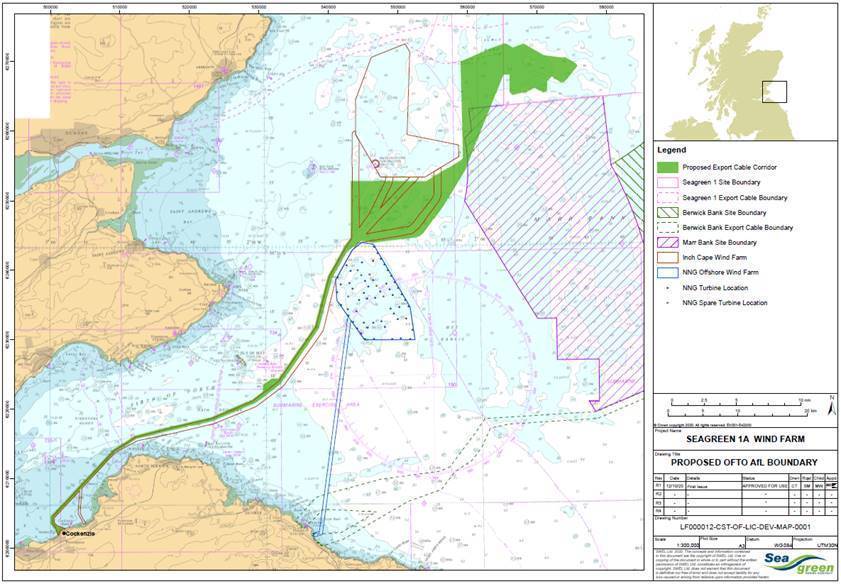
There are five wind farms in the map.
- The green area is the cable corridor for Seagreen 1a
- Inch Cape is the odd-shaped wind farm to the North and West of the green area
- Seagreen at the top of the map, to the North of Inch Cape.
- Marr Bank with the pink NE-SW hatching
- Berwick Bank with the green NW-SE hatching
- Neart Na Gaoithe is edged in blue to the South of the green area.
Berwick Bank and Marr Bank are both owned by SSE and appear to have been combined.
These are some more details on each of the now four wind farms.
Seagreen
These are details of the Seagreen wind farm.
- Seagreen will be Scotland’s largest and the world’s deepest offshore wind farm when complete.
- The first phase will have 114 turbines and a capacity of 1075 MW.
- It will connect to the grid at a new substation at Tealing near Dundee.
- The cables will run to the North of the Inch Cape wind farm.
- It will be completed in 2023.
- The second phase (1a), will have 36 turbines.
- It may have larger turbines.
- The cables will run in the green area to Cockenzie in East Lothian.
This press release from SSE is entitled Another Milestone For Scotland’s Largest Offshore Wind Farm As 4,800 Tonnes Offshore Platform Completed.
This is the first paragraph.
The topside forms the backbone of the offshore wind farm. At 40 metres long, 45 metres wide and 15 metres high, the heavyweight superstructure’s role is to collect and manage 1,075MW of power generated by the 114 Vestas wind turbines before transferring it ashore via around 60km of offshore subsea cabling.
This platform is used to connect the 114 turbines to the shore.
Inch Cape
This paragraph from the home page of the Inch Cape web site, describes the wind farm.
The Inch Cape Offshore Wind Farm, currently in late stage development, will see up to 72 turbines located 15 km off the Angus Coast and connect to the National Grid at Cockenzie, East Lothian. Once complete, it will be one of Scotland’s largest single sources of renewable energy and power up to 1 million homes with clean electricity.
The home page says it will generate up to 1 GW of electricity.
Neart Na Gaoithe
This sentence for the Wikipedia entry for the Neart Na Gaoithe web site describes the wind farm.
It is being developed by Mainstream Renewable Power at a cost of £1.4bn. Offshore work began in 2020, with completion planned for 2023.
The Wikipedia entry says it will generate up to 450 MW of electricity.
Berwick Bank
These two paragraphs from the project page of the Berwick Bank web site describes the wind farm.
Located in the North Sea, in the outer Firth of Forth, Berwick Bank Offshore Wind Farm has the potential to deliver up to 4.1 GW of installed capacity, making it one of the largest offshore opportunities in the world.
Berwick Bank Wind Farm is in the development stage and previously the project was comprised of two separate proposals, Berwick Bank Wind Farm and Marr Bank Wind Farm. Following initial rounds of consultation, it has been decided to combine our proposals into one single opportunity – Berwick Bank Wind Farm.
At 4.1 GW, Berwick Bank is a big wind farm.
The capacity of the four farms can be summarised as follows.
- Seagreen – 1075 MW
- Neart Na Gaoithe – 450 MW
- Inch Cape – 1000 MW
- Berwick Bank – 4100 MW
This gives a total of 6625 MW.
 The Anonymous Widower