Green Volt On Track To Power UK Oil & Gas Platforms By Mid-2020s
The title of this post, is the same as that of this article on offshoreWIND.biz.
This is the sub-heading.
Flotation Energy and Vårgrønn have submitted a Marine Licence application for the Green Volt floating offshore wind farm.
These two paragraphs outline the project.
This consent application could allow the project to start generating power in the mid-2020s, making it the most advanced oil and gas decarbonisation project in the UK, the developers said.
Flotation Energy and Vårgrønn are applying for a lease for Green Volt under the Crown Estate Scotland’s Innovation and Targeted Oil and Gas (INTOG) round.
Green Volt wind farm already has a web site, which gives these details of the wind farm.
- It will be 50 miles off Peterhead.
- 300-500 MW
- Operational in 2027.
The offshoreWIND.biz article also says that the project has the potential to generate enough green power to electrify all major oil and gas platforms in the Outer Moray Firth area.
I can’t wait for the successful INTOG bids to be announced in April.
Engineers are creating exciting times.
Scotland And Brittany Discuss Partnership On Floating Wind Turbines
The title of this post, is the same as that of this article on offshoreWIND.biz.
This is the sub-heading.
A delegation of fifteen Scottish companies met in Rennes, France, with companies from the Brittany offshore wind and marine energy sector to discuss the development of partnerships around floating wind turbines.
I can see more partnerships like this.
Ofgem OKs Transmission Investments Needed For UK’s 2030 Offshore Wind Target
The title of this post, is the same as that, of this article on offshoreWIND.biz.
This is the sub-heading.
Ofgem has approved the strategic electricity transmission reinforcements required to deliver the UK Government’s 50 GW offshore wind by 2030 target, set out as part of the regulator’s Accelerated Strategic Transmission Investment (ASTI) framework.
A map then shows the principle new transmission reinforcements.
These include two 2 GW subsea HVDC links from Peterhead to England, both of which will be taken forward as joint ventures with National Grid Electricity Transmission (NGET), a 2 GW subsea HVDC link from Spittal in Caithness, connecting to Peterhead, as well as a 1.8 GW subsea HVDC link from Arnish on the Western Isles to the Beauly area near Inverness.
The approval also implies 400 kV onshore reinforcements, between Beauly, Blackhillock, New Deer and Peterhead; between Beauly, Loch Buidhe and Spittal; and between Kintore, Tealing and Westfield; and uprating the existing Beauly to Denny line to enable 400 kV operation on both circuits.
All cables seem to lead to Peterhead.
Scotland’s Renewable Energy Jackpot: Hydrogen Exports Alone Could Be worth £25 Billion A Year By 2045
The title of this post, is the same as that of this article on the Edinburgh News.
This is the sub-heading.
Scotland is a phenomenally energy rich country. For decades the largest oil-producing nation in the European Union, it is now set to trail-blaze as a leader in renewable energy.
The title and sub-heading say it all for Scotland.
But these words could equally well apply to Anglesey, Cornwall, Devon, East Anglia, Humberside, Liverpool and Morecambe Bays, the Severn Estuary and Pembrokeshire.
We also mustn’t forget the Dogger Bank!
Offshore Wind Developers Answer Scotland’s Call For Innovation, Oil And Gas Decarbonisation
The title of this post, is the same as that of this article on offshoreWIND.biz.
This is the sub-heading.
Crown Estate Scotland has received a total of 19 applications for its Innovation and Targeted Oil and Gas (INTOG) offshore wind leasing process.
INTOG
Note that there are two sections to INTOG.
This document on the Crown Estate Scotland web site, is entitled INTOG – Public Summary and it defines the two sections.
Innovation:
- To enable projects which support cost reduction in support of commercial deployment of offshore wind including alternative outputs such as Hydrogen.
- To further develop Scotland as a destination for innovation and technical development which will lead to risk reductions and supply chain opportunity.
Applications in this section should be no more than 100 MW in capacity.
Targeted Oil and Gas:
- To maximise the role of offshore wind to reduce emissions from oil and gas production.
- To achieve target installed capacity in a way that delivers best value for Scotland, creating supply chain opportunity in alignment with Just Transition principles.
A rough estimate is that powering rigs by using offshore wind would increase gas production by around ten percent.
The Applications
The article says this about the applications.
Of the 19 applications, ten are for the Innovation part, while nine have been submitted for the TOG element.
It is expected that up to 500 MW will be awarded to innovation projects and around 4 GW for projects looking to decarbonise oil and gas assets.
The article also lists the known bidders.
Conclusion
I believe that there is going to be some outstanding applications for leases under the INTOG scheme.
I have already written about Cerulean Winds ambitious proposal in Cerulean Winds Is A Different Type Of Wind Energy Company, which could result in 6 GW of wind turbines installed amongst the oil and gas fields to provide electricity and decarbonise the platforms and rigs.
DEME Returns To Scotland, Announces Offshore Wind Industry Firsts
The title of this post, is the same as that of this article on offshoreWIND.biz.
This is the sub-heading.
DEME has won the contract to install foundations at the 882 MW Moray West wind farm offshore Scotland.
The industry firsts are described in these paragraphs.
In an industry breakthrough, the Moray West project will be the first time XXL monopiles will be installed in the winter period, and DEME will deploy its double-staged, motion-compensated pile gripper, the company said.
Moray West will also be the first time a vibro-hammer is being utilised for the XXL monopiles to overcome weaker soil layers.
Note.
- The water depth at Moray West wind farm is 35-54 metres, which necessitates the XXL monopiles.
- Working offshore in winter can be challenging.
- DEME’s gripper sounds just like what the engineers wanted.
This is just like with North sea oil and gas, where everything got bigger and more capable over time. But it did speed construction!
Global Port Services Wins Pre-Assembly Contract For Scottish Offshore Wind Farm
The title of this post, is the same as that of this article on offshoreWIND.biz.
These are the first two paragraphs.
Global Port Services, owned by Global Energy Group alongside the Port of Nigg, has secured multiple contracts to support Seagreen Wind Energy Limited (SWEL) with site-enabling works for the pre-assembly construction of wind turbine components at its Port of Nigg facility.
The news comes as the final turbine foundations for the Seagreen offshore wind project arrive at Nigg to be prepared for installation 27 kilometres off the coast of Angus.
Note.
- Nigg is a village in the Highlands to the North of Inverness.
- The Port of Nigg has a busy Marine Fabrication Yard.
- There is a very interesting BBC documentary called Rigs of Nigg, which tells some of the stories of the port from the 1970s.
- As the article indicates, the yard is now very much involved in the wind power industry.
- SSE have invested in the yard.
This Google Map shows the port.
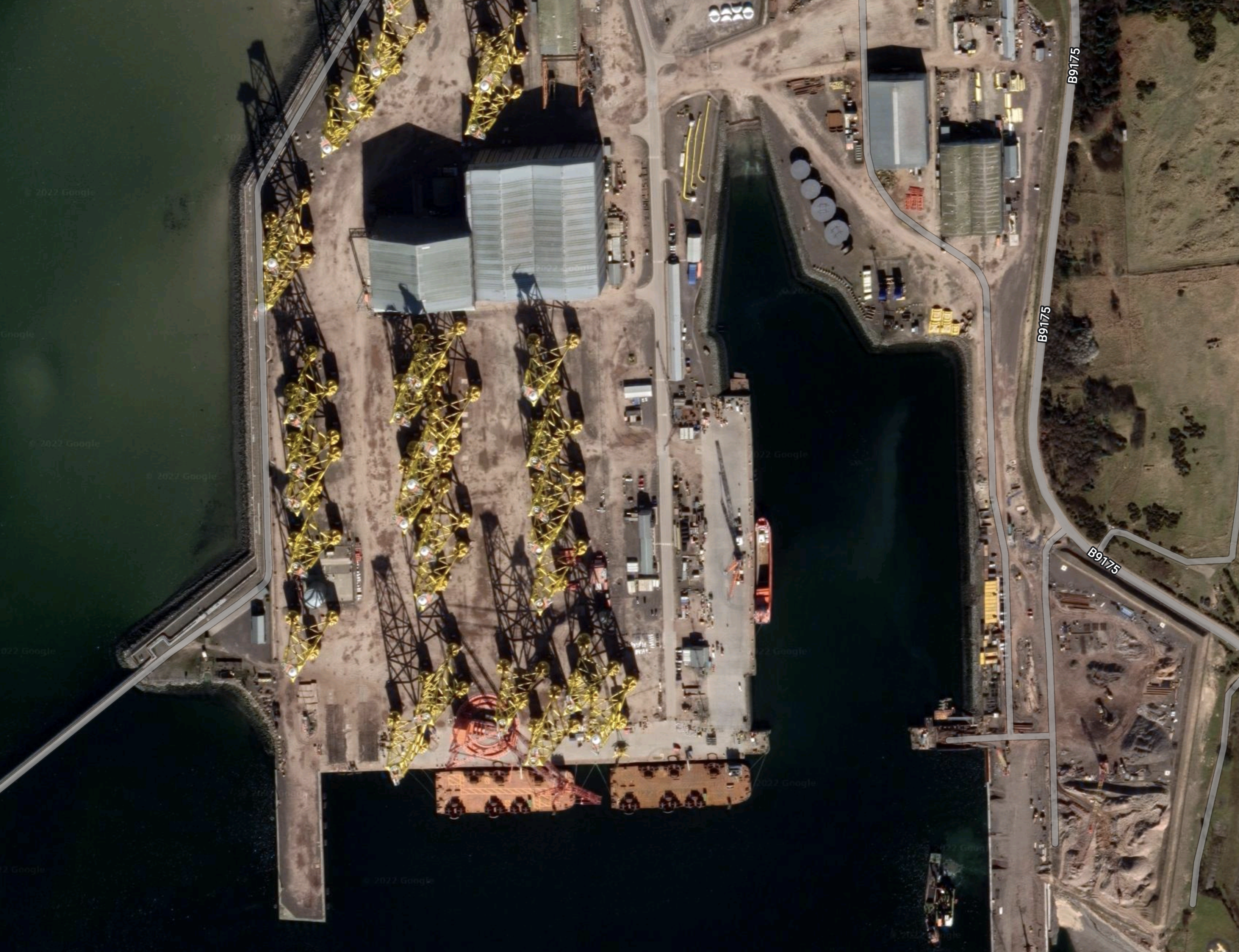
Note. all the yellow steel structures, which look like the fixed foundations for the Seagreen Wind Farm.
I am a bit surprised that foundations for Seagreen are being assembled a fair distance from Angus.
Is there not a fabrication yard on the Firth of Forth?
Scotland’s Largest Offshore Wind Farm Entering Home Stretch
The title of this post, is the same as that of this article on offshoreWIND.biz.
100 MW Scottish Floating Wind Project To Deliver Lifetime Expenditure Of GBP 419 Million
The title of this post, is the same as that of this article on offshoreWIND.biz.
This is the sub heading, that gives more details on lifetime expenditure and full-time equivalent (FTE) jobs created.
The 100 MW Pentland Floating Offshore Wind Farm in Scotland is estimated to deliver lifetime expenditure of GBP 419 million in the UK and to support the creation of up to 1,385 full-time equivalent (FTE) jobs.
It does seem these figures have been compiled using the rules that will apply to all ScotWind leases and have used methods laid down by Crown Estate Scotland. So they should be representative!
Does it mean that a 1 GW floating wind farm would have a lifetime expenditure of £4.19 billion and create 13, 850 full-time equivalent (FTE) jobs?
This article from Reuters is entitled UK Grid Reforms Critical To Hitting Offshore Wind Targets and contains this paragraph.
The government aims to increase offshore wind capacity from 11 GW in 2021 to 50 GW by 2030, requiring huge investment in onshore and offshore infrastructure in England, Wales and Scotland.
If I assume that of the extra 39 GW, half has fixed foundations and half will float, that means that there will be 19.5 GW of new floating wind.
Will that mean £81.7 billion of lifetime expenditure and 270,075 full-time equivalent (FTE) jobs?
Conclusion
It does seem to me, that building floating offshore wind farms is a good way to bring in investment and create full time jobs.
Ocergy Floaters Selected For 100 MW Project Off Scotland
The title of this post, is the same as that of this article on Splash247.com.
These two paragraphs outline Ocergy’s OCG-Wind foundation technology.
The Salamander floating offshore wind project, a joint venture between Simply Blue Group, Ørsted and Subsea 7, has awarded the pre-FEED (front-end engineering design) deal to Ocergy for its OCG-Wind foundation technology.
The US-based Ocergy has developed a novel semisub floater called OCG-Wind, to support turbines larger than 10 MW, designed for the development of large-scale wind farms. It is targeting a levelised cost of energy (LCOE) that can start to drive reductions in floating offshore wind farms to eventually be competitive with fixed offshore wind farms.
Note.
- There is a picture showing two turbines on OCG-Wind floats.
- Salamander is intended to be an INTOG project of 100 MW.
- The floaters are expected to be fabricated at Global Energy Group’s Port of Nigg.
- ERM’s Dolphyn electrolysis, desalination and hydrogen production concept is also planned for the project.
The Salamander project is certainly going for a lot of innovation.
 The Anonymous Widower