Reinstatement Of The Clitheroe To Hellifield Railway Line
This is one of the successful bids in the First Round of the Restoring Your Railway Fund.
This line is part of the route between Blackburn and Hellifield stations, which I have tried to use a couple of times in the past without success.
Why Blackburn? You may ask!
When I’m in that area, I often stay in the Premier Inn in the town, as it’s only about a hundred metres from the station. There are a couple of reliable gluten-free eateries too by the hotel.
A couple of times, I’ve taken the train up the Ribble Valley Line to Clitheroe and had a look around.
Unfortunately, there aren’t many trains to Hellifield from Blackburn and only on Sundays. Twice, though, I’ve planned trips to get a Sunday morning train from Blackburn to Hellifield and twice the train has been cancelled.
Perhaps, I’ll get to go later this year.
I’ve been to Clitheroe a couple of times and these pictures show the state of the lower section of the line.
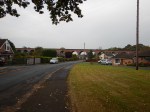
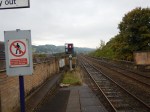

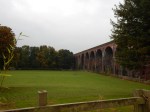
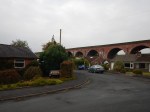
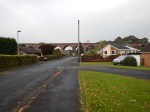
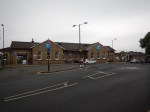
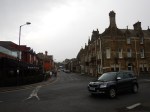
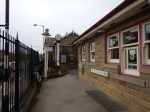
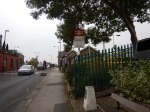
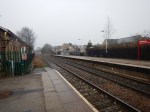

Wikipedia documents a lot of improvements to the line over the last few years and now there are now generally two trains per hour (tph) between Blackburn and Manchester and one tph between Blackburn and Clitheroe on the route.
Clitheroe And Hellifield
I have just flown my virtual helicopter between Clitheroe and Hellifield stations and the route is best characterised as follows.
- A fairly straight double-track railway.
- No current stations, although they used to exist at Chatburn, Rimington, Gisburn and Newsholme.
- Mainly agricultural countryside.
- Lots of businesses flagged up by Google Maps, of which many are visitor related.
Finally, I arrived at Hellifield station.
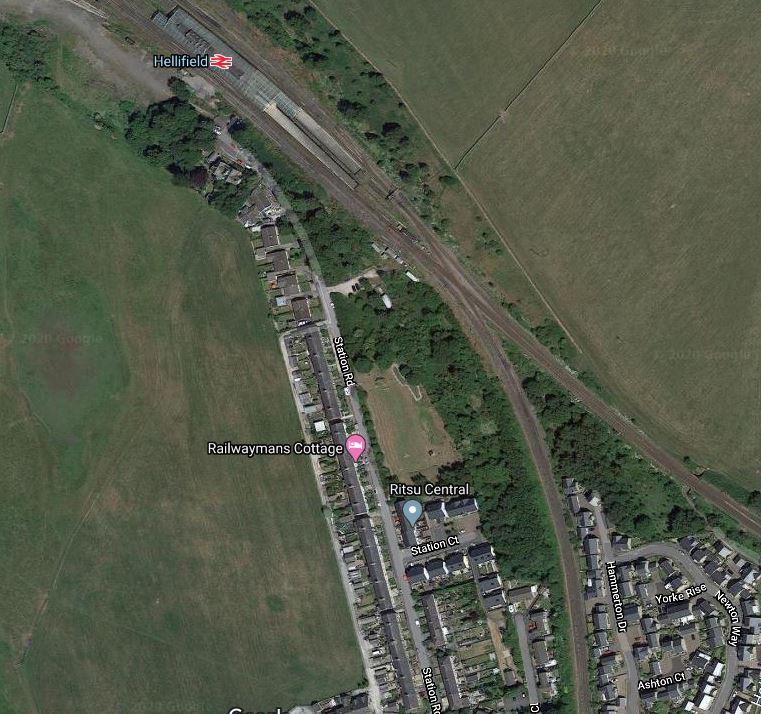
Note.
- The railway line to the South East leads to Skipton and Leeds
- The railway line to the South is the Ribble Valley Line and it leads to Clitheroe, Blackburn and Manchester.
- The line to the North East is the Settle and Carlisle Line.
I think I can see where those that took the trouble to nominate the Ribble Valley Line between Clitheroe and Hellifield are coming from.
- There is a well-maintained double-track railway in good condition between Manchester and Hellifield via Bolton, Darwen, Blackburn and Clitheroe, that links to the countryside above Clitheroe that needs vistors for its businesses and produce.
- Lancashire County Council, the Community Rail Partnerships in the area and local activists have done a good job on Network Rail to persuade them to improve the railway.
- The Settle and Carlisle is waiting for visitors to explore one of the world’s most iconic railways.
All it needs is a train service and possibly a station or two!
Some of my questions.
What Are The Local Aspirations?
I found this article on the Lancashire Telegraph, which is entitled Campaign To Restore Rail Service From Clitheroe To Hellifield.
This is a quote from the Ribble Valley Council leader.
This plan forms part of the council’s approved proposals to drive the Ribble Valley economy to create more jobs, particularly for our young people and further strengthen our strong tourist industry. It will take cars off congested roads and bring more tourists to the Ribble Valley. It will also improve the connectivity for the Ribble Valley community to surrounding urban conurbations for residents.
These are other points from the article.
- An aim is to see the reopening of Chatburn, Gisburn and Newsholme stations.
- Another is better links to Manchester.
- New rolling stock is planned for the line.
- The line is used daily by heavy freight trains.
- It would connect Clitheroe to Bradford, Leeds and Skipton
It does seem to me, that restoring the services between Clitheroe and Hellifield could offer a lot of benefits.
What Frequency Of Trains Is Needed Between Manchester and Hellifield, via Bolton, Blackburn and Clitheroe?
The frequency on the Settle and Carlisle Line is around eight trains per day (tpd), with six on Sundays.
That frequency would probably not be sustainable on the Ribble Valley Line, but the train timetable should be such, that someone can leave Manchester in the morning, have an adventure and return in the evening.
Is Any New Infrastructure Required?
As trains use the line occasionally, I suspect that all the track, signalling and communications needed for perhaps four tpd in both directions between Clitheroe and Hellifield is in place.
So the only thing needed in the fullness of time, might be the extra stations.
But which one do you do first?
I would do the following.
First I would ask passengers, where they would like additional stations on the route.
And then why not build a temporary one using scaffolding and see what happens.

The picture shows a temporary platform at Liverpool South Parkway station, whilst Lime Street was closed for rebuilding.
Conclusion
I have a feeling that it restoring psassenger trains between Clitheroe and Hellifield will be a worthwhile thing to do.
Colne – Skipton Reopening Moves Closer
The title of this post, is the same as that of this article on the Railway Gazette.
This is the introductory paragraph.
Rail minister Chris Heaton-Harris has confirmed that investigations have been commissioned into the proposed reinstatement of the 19·3 km Colne – Skipton ‘missing link’ connecting east Lancashire and west Yorkshire.
Investigations will look into.
- Capital costs
- Passenger demand forecasts
- Service options.
- Gauge enhancement measures necessary to increase rail freight capacity on TransPennine routes including between Accrington and Todmorden stations.
- Proposals for a rail freight terminal on the site of the demolished Huncoat power station near Accrington.
This sounds more than a simple proposal to reopen the route between Skipton and Colne stations.
These are a few of my thoughts.
The Rail Route Between Preston And Skipton
The rail route between Preston on the West Coast Main Line and Skipton can be summarised as follows.
- Preston and Rose Grove via Huncoat – double-track – electrification at Preston
- Rose Grove and Colne – single-track
- Colne and Skipton – to be reinstated – electrification at Skipton
Colne and Skipton might not be the easiest route to reinstate, as a dual carriageway has been built across the route to the North of Colne station.
Could Colne And Skipton Be Double-Track All The Way?
Consider.
- The new section between Skipton and Colne could be built with single or double tracks.
- The section between Rose Grove and Colne stations was built as a double-track and singled in 1971. British Rail’s accountants strike again!
- The single-track section includes the Bank Top Viaduct, in the centre of Burnley.
- Trains currently take twenty-one minutes between Rose Grove and Colne stations.
This picture shows Bank Top Viaduct.
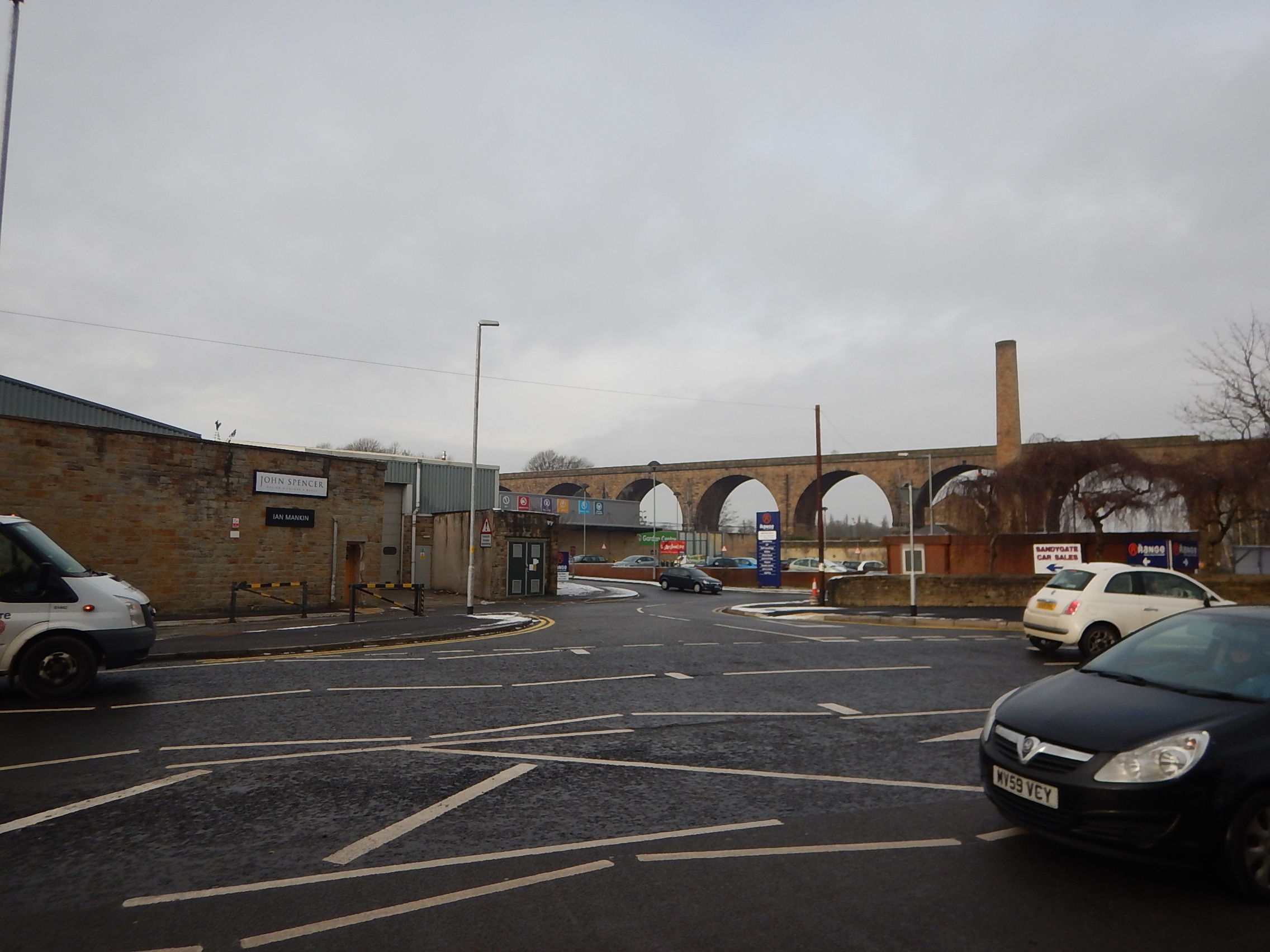
I think the viaduct could be key to whether the route is double-track all the way.
- If the redoubling can be performed at a reasonable cost, then that will be the way to go, as it might be possible to squeeze up to three trains per hour (tph) between Skipton and Rose Grove via Colne.
- If on the other hand, doubling is too difficult or expensive, I estimate that no more than two tph would be possible.
For both solutions, there will need to be double track or a long passing loop, between Skipton and Colne.
Could Colne And Skipton Be Electrified?
Consider.
- Preston is a fully-electrified station on the West Coast Main Line.
- Skipton is a fully-electrified station with electric trains to and from Leeds.
- Full electrification would create an electrified route between Leeds and Blackpool, Liverpool and Preston.
- It could be a useful diversion route for electric passenger trains across the Pennines, when their are engineering works on the Huddersfield Line or due to the building of Northern Powerhouse Rail.
- Electrification of the route, would allow electric haulage of freight trains to and from the proposed Huncoat Rail Freight Terminal.
- Electrification of the Calder Valley Line between Preston and Leeds is always being proposed.
- Electrication of Bank Top Viaduct could be tricky!
It should also be noted that this article on Rail Magazine was published on May 12th, 2020 and is entitled Electrification Key to Decarbonisation – Government. Views in Government about electrification have changed, so this might affect the decision to electrify the route.
The power is already there at both ends and electrification systems with low visual intrusion could be used.
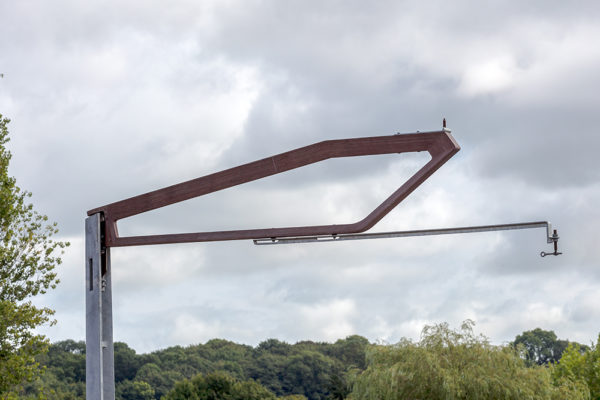
On the other hand, some might consider electrification of the route inappropriate.
Could Colne And Skipton Be Partially Electrified?
Consider.
- I estimate that the distance between Preston and Skipton will be 41 miles.
- If Blackpool North station were the final destination, there would be 34 miles (2 x 17) to charge the batteries.
- If Liverpool Lime Street station were the final destination, there would be 70 miles (2 x 35) to charge the batteries.
- If Leeds station were the final destination, there would be 52 miles (2 x 26) to charge the batteries.
- Manufacturers’ estimates of distances, indicate that battery electric trains could cover up to 65 miles on battery power.
As both ends of the route are electrified and trains would run extra miles under the wires, it would seem likely that a battery electric train could run between Preston and Skipton, without needing a charge en route.
Drax Group And Colne And Skipton Reinstatement
Drax power station uses Flue Gas Desulphurisation. Wikipedia says this about the process at Drax.
All six units are served by an independent wet limestone-gypsum flue gas desulphurisation (FGD) plant, which was installed between 1988 and 1996. This diverts gases from the boilers and passes them through a limestone slurry, which removes at least 90% of the sulphur dioxide (SO2). This is equivalent to removing over 250,000 tonnes of SO2 each year. The process requires 10,000 tonnes of limestone a week, sourced from Tunstead Quarry in Derbyshire. A byproduct of the process is gypsum, with 15,000 tonnes produced each week. This goes to be used in the manufacture of plasterboard. The gypsum is sold exclusively to British Gypsum, and it is transported by rail to their plant at Kirkby Thore (on the Settle-Carlisle Line).
The gypsum trains go through Skipton to access the Settle-Carlisle Line.
Drax power station is part-fuelled with biomass, which comes from all over the place including the United States via the Port of Liverpool.
It is no surprise that Drax Group are in favour of the Colne and Skipton reinstatement, as it would give them a new route between Drax and the Port of Liverpool.
This press release from Drax Group gives more details including this paragraph.
It will have a direct impact on improving our supply chain at Drax, allowing freight trains to travel much more quickly to the power station in North Yorkshire – reducing journey times from the Port of Liverpool to less than three hours, a journey which can take up to nine hours at the moment.
Trains will avoid the busy Huddersfield Line and Manchester Victoria station.
Drax’s statement would appear to be a powerful reason to reinstate Colne and Skipton.
These smart new or refurbished wagons, used by Drax to move woodchip should be much faster than the typical 20-30 mph freight speed of TransPennine routes.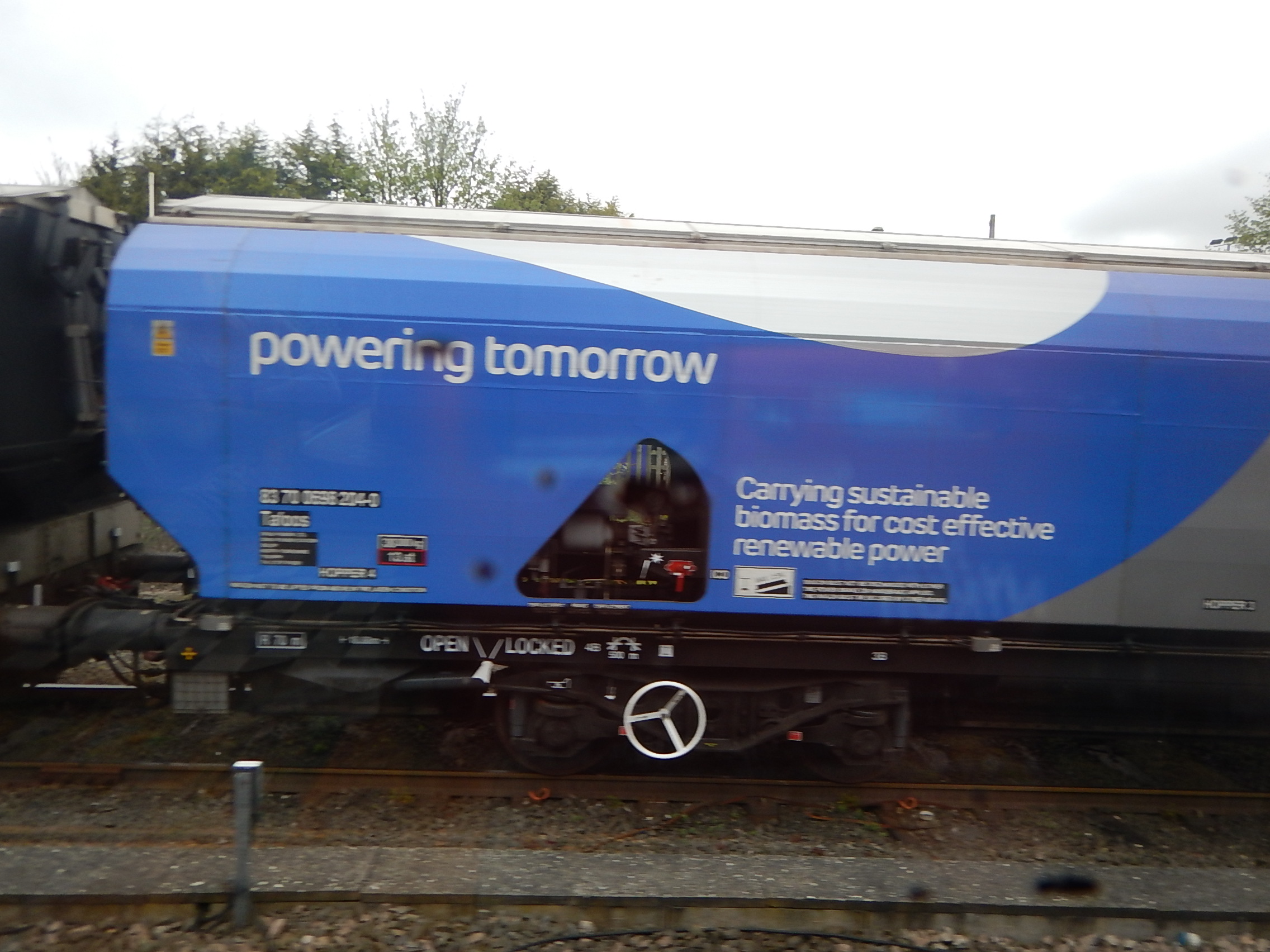
This page on the Drax web site, is entitled This train isn’t like any other in the UK, and it gives more details about the wagons.
- They were custom-designed and built in the last few years.
- The roofs open automatically for loading.
- A twenty-five wagon train can be loaded in 37 minutes.
- A full train can carry between 1,700 and 1,800 tonnes of biomass.
- Each train can unload in forty minutes.
- They are the largest wagons on UK railways by a margin of 30 %.
- Each wagon is nineteen metres long and can carry over seventy tonnes of biomass.
- Approximately 14 trains per day arrive at Drax, bringing 20,000 tonnes of biomass.
I suspect to minimise journey times, Drax would like to see a fully electrified route between Preston and Skipton and a new double-track route between Colne and Skipton.
The Huncoat Rail Freight Terminal
This Google Map shows the position of the former Huncoat power station.
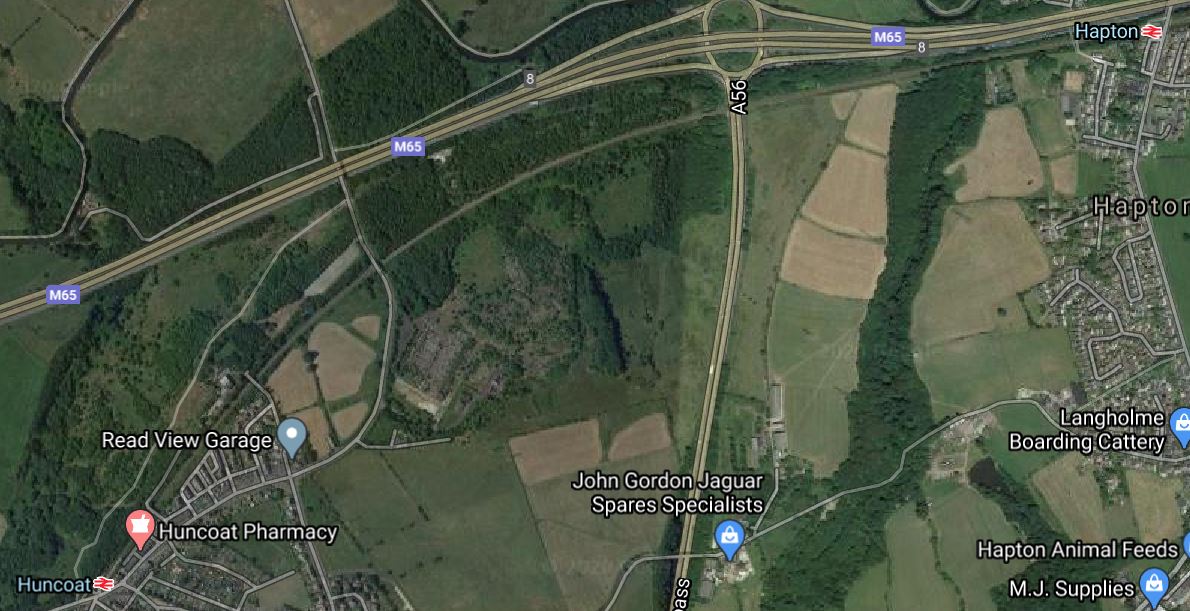
Note.
- Hapton station in the North-East corner of the map.
- Huncoat station in the South-West corner of the map.
- The East Lancashire Line running between the two stations.
- The M65 running across the top of the map.
- The A56 or Accrington bypass running North-South from the motorway junction at the top of the map.
Huncoat power station appears to have been in the South West corner of the rough-looking area, South of the M65 and the railway and West of the A56.
There is no Wikipedia entry for the demolished power station, but this page on The View From The North has some details and pictures.
It does appear to be a well connected site for a Rail Freight Terminal.
- There could be a direct connection to the motorway network.
- There is space for a connection with the East Lancashire Line, that would allow trains to access the interchange from both directions.
- Trains could go West to the Port of Liverpool and the West Coast Main Line via Preston.
- Trains could go East to Leeds and Yorkshire and on to the East Coast ports of Felixstowe, Hull, Immingham and Teesport.
- If the East Lancashire Line were to be electrified, electric haulage could be used.
The Rail Freight Terminal could be bigger than a hundred hectares.
Gauge Enhancement On TransPennine Routes Including Between Accrington And Todmorden
Consider
- Most freight trains passing through Hebden Bridge station use the route via Rochdale and Todmorden to get to and from Liverpool and the West.
- Few if any use the East Lancashire Line via Accrington.
- Some passenger trains do take the Accrington route.
- There are five tunnels between Accrington and the Todmorden Curve.
- The building of the Huncoat Rail Freight Terminal, must mean that trains between the Rail Freight Terminal and Leeds and the East would need to use the Calder Valley Line as far as the Todmorden Curve. or the East Lancashire Line to Colne for the new route.
As freight trains rarely seem to use the East Lancashire Line to the East of Accrington could it be that this section of track needs gauge enhancement?
But if this gauge enhancement were to be completed, that could give two routes between Huncoat Rail Freight Terminal and the East, for the largest freight trains.
Thoughts On The Project Management
It would appear that there are a series of sub-projects to be done.
- Perform gauge enhancement and route improvement on the East Lancashire Line between Rose Grove and Colne. This would include any doubling of the route, if that were to be done.
- Start building the link between Skipton and Colne.
- Start building the Huncoat Rail Freight Terminal.
- Finish building the link between Skipton and Colne.
- Start passenger and freight services between Skipton and Colne.
- Finish building the Huncoat Rail Freight Terminal.
- Perform gauge enhancement on the Calder Valley Line between Accrington and Todmorden.
My objectives would be.
- Open the Skipton and Colne route as a TransPennine diversion, as early as possible.
- Upgrade the East Lancashire Line between Rose Grove and Colne with minimum disruption.
- Open the Huncoat Rail Freight Terminal as early as possible.
- Create multiple freight routes to and from Huncoat Rail Freight Terminal.
Electrification would be a future aspiration.
Whither Drax?
Drax Gtroup and their flagship power station have a major environmental problem in that the power station is a large emitter of carbon dioxide.
They also run a lot of diesel locomotive hauled trains carrying biomass, fly ash, gypsum, limestone and other materials to and from Drax power station, which is on the Drax branch of the Pontefract Line.
- The Pontefract Line was built to serve the coalfields in the area.
- It runs between Leeds and Hull via Pontefract and Goole.
- It is not electrified, but it connects to the electrification at Leeds.
- In the East is has good connections to Cleethorpes, Goole, Grimsby, Hull and Immingham.
- The Port of Immingham is a major port, that is used by Drax to import biomass, which is hauled to the power station by diesel locomotives.
- The route between Drax and Immingham has been improved recently, by the addition of the North Doncaster chord.
- High Speed Two will run alongside the Pontefract Line on its approach to Leeds.
- Freight trains between Drax and Skipton use an electrified diversion South of Leeds via Armley, that avoids the need for freight trains to pass through Leeds station.
I can see that in a more favourable climate for electrification, that electrification of the Pontefract Line would be recommended.
Given, the environmental record of Drax, which is both good and bad, I would suspect they would like to see electrification of the Pontefract Line, as it would create a lower carbon route for biomass trains between Immingham and the power station.
A New Electrified TransPennine Route For Passengers And Freight
I sense that a grander plan might exist behind all my thoughts.
If the following routes were to be electrified.
- Preston and Skipton
- The Pontefract Line between Leeds and Hull.
- Knottingley and Immingham via Thorne
Hull and Liverpool would be connected for passenger electric trains and Liverpool and Immingham would be connected for freight.
Drax could also be on an electrified branch and they could say, they were hauling all their trains using renewable electricity. Marketing and environment are always important
Could Electric Trains Run On Long Scenic And Rural Routes?
In the UK we have some spectacular scenic rail routes and several long rural lines.
Basingstoke And Exeter
The West of England Main Line is an important rail route.
The section without electrification between Basingstoke and Exeter St. Davids stations has the following characteristics.
- It is just over one hundred and twenty miles long.
- There are thirteen intermediate stations, where the expresses call.
- The average distance between stations is around nine miles.
- The longest stretch between stations is the sixteen miles between Basingstoke and Andover stations.
- The average speed of trains on the line is around forty-four mph.
There is high quality 750 VDC third-rail electrification at the London end of the route.
Cumbrian Coast Line
The Cumbrian Coast Line encircles the Lake District on the West.
The section without electrification between Carnforth and Carlisle stations has the following characteristics.
- It is around a hundred and fourteen miles long.
- There are twenty-nine intermediate stations.
- The average distance between stations is around four miles.
- The longest stretch between stations is the thirteen miles between Millom and Silecroft stations.
- The average speed of trains on the line is around thirty-five mph.
There is also high standard 25 KVAC electrification at both ends of the line.
Far North Line
The Far North Line is one of the most iconic rail routes in the UK.
The line has the following characteristics.
- It is one-hundred-and-seventy-four miles long.
- There are twenty-three intermediate stations.
- The average distance between stations is around seven miles.
- The longest stretch between stations is the thirteen miles between Georgemas Junction and Wick stations.
- The average speed of trains on the line is around forty mph.
The line is without electrification and there is none nearby.
Glasgow To Oban
The West Highland Line is one of the most iconic rail routes in the UK.
The line is without electrification from Craigendoran Junction, which is two miles South of Helensburgh Upper station and the section to the North of the junction, has the following characteristics.
- It is seventy-eight miles long.
- There are ten intermediate stations.
- The average distance between stations is around eight miles.
- The longest stretch between stations is the twelve miles between Tyndrum Lower and Dalmally stations.
- The average speed of trains on the line is around thirty-three mph.
From Glasgow Queen Street to Craigendoran Junction is electrified with 25 KVAC overhead wires.
Glasgow To Mallaig
This is a second branch of the West Highland Line, which runs between Crianlarich and Mallaig stations.
- It is one hundred and five miles long.
- There are eighteen intermediate stations.
- The average distance between stations is around five miles.
- The longest stretch between stations is the twelve miles between Bridge Of Orchy and Rannoch stations.
- The average speed of trains on the line is around twenty-five mph.
Heart Of Wales Line
The Heart of Wales Line is one of the most iconic rail routes in the UK.
The line is without electrification and the section between Swansea and Shrewsbury stations, has the following characteristics.
- It is just over one hundred and twenty miles long.
- There are thirty-one intermediate stations.
- The average distance between stations is around four miles.
- The longest stretch between stations is the thirteen miles between Shrewsbury and Church Stretton stations.
- The average speed of trains on the line is just under forty mph.
There is also no electrification at either end of the line.
Settle And Carlisle
The Settle and Carlisle Line is one of the most iconic rail routes in the UK.
The section without electrification between Skipton and Carlisle stations has the following characteristics.
- It is just over eighty miles long.
- There are thirteen intermediate stations.
- The average distance between stations is around six miles.
- The longest stretch between stations is the sixteen miles between Gargrave and Hellifield stations.
- The average speed of trains on the line is around forty mph.
There is also high standard 25 KVAC electrification at both ends of the line.
Tyne Valley Line
The Tyne Valley Line is an important route between Carlisle and Newcastle stations.
The line is without electrification has the following characteristics.
- It is just over sixty miles long.
- There are ten intermediate stations.
- The average distance between stations is around six miles.
- The longest stretch between stations is the sixteen miles between Carlisle and Haltwhistle stations.
- The average speed of trains on the line is around mph.
There is also high standard 25 KVAC electrification at both ends of the line.
A Pattern Emerges
The routes seem to fit a pattern, with very similar characteristics.
Important Local Transport Links
All of these routes are probably important local transport links, that get children to school, many people to large towns for shopping and entertainment and passengers of all ages to see their friends and relatives.
Many would have been closed but for strong local opposition several decades ago.
Because of the overall rise in passengers in recent years, they are now relatively safe for a couple of decades.
Iconic Routes And Tourist Attractions
Several of these routes are some of the most iconic rail routes in the UK, Europe or even the world and are tourist attractions in their own right.
Some of these routes are also, very important in getting tourists to out-of-the-way-places.
Lots Of Stations Every Few Miles
The average distance between stations on all lines seems to be under ten miles in all cases.
This surprised me, but then all these lines were probably built over a hundred years ago to connect people to the expanding railway network.
The longest stretch between two stations appears to be sixteen miles.
Diesel Hauled
All trains seem to be powered by diesel.
This is surely very inappropriate considering that some of the routes go through some of our most peaceful and unspoilt countryside.
Inadequate Trains
Most services are run by trains, that are just too small.
I know to put a four-car train on, probably doubles the cost, but regularly as I explore these lines, I find that these two-car trains are crammed-full.
I once inadvertently took a two-car Class 150 train, that was on its way to Glastonbury for the Festival. There was no space for anything else and as I didn’t want to wait an hour for the next train, I just about got on.
Passengers need to be encouraged to take trains to rural events, rather than discouraged.
An Electric Train Service For Scenic And Rural Routes
What would be the characteristics of the ideal train for these routes?
A Four-Car Electric Train
Without doubt, the trains need to be four-car electric trains with the British Rail standard length of around eighty metres.
Dual Voltage
To broaden the applications, the trains should obviously be capable of running on both 25 KVAC overhead and 750 VDC third-rail electrification.
100 mph Capability
The trains should have at least a 100 mph capability, so they can run on main lines and not hold up other traffic.
No Large Scale Electrification
Unless there is another reason, like a freight terminal, quarry, mine or port, that needs the electrification, using these trains must be possible without any large scale electrification.
Battery, Diesel Or Hydrogen Power
Obviously, some form of power will be needed to power the trains.
Diesel is an obvious no-no but possibly could only be used in a small way as emergency power to get the trains to the next station, if the main power source failed.
I have not seen any calculations about the weight, size and power of hydrogen powered trains, although there have been some professional videos.
But what worries me about a hydrogen-powered train is that it still needs some sizeable batteries.
So do calculations indicate that a hydrogen-powered train is both a realisable train and that it can be produced at an acceptable cost?
Who knows? Until, I see the maths published in a respected publication, I will reserve my judgement.
Do Bombardier know anything?
In the July 2018 Edition of Modern Railways, there is an article entitled Bi-Mode Aventra Details Revealed.
A lot of the article takes the form of reporting an interview with Des McKeon, who is Bombardier’s Commercial Director and Global Head of Regional and Intercity.
This is a paragraph.
However, Mr McKeon said his view was that diesel engines ‘will be required for many years’ as other power sources do not yet have the required power or efficiency to support inter-city operation at high-speeds.
As Bombardier have recently launched the Talent 3 train with batteries that I wrote about in Bombardier Introduces Talent 3 Battery-Operated Train, I would suspect that if anybody knows the merits of hydrogen and battery power, it is Mr. McKeon.
So it looks like we’re left with battery power.
What could be a problem is that looking at all the example routes is that there is a need to be able to do station-to-station legs upwards of thirteen-sixteen miles.
So I will say that the train must be able to do twenty miles on battery power.
How Much Battery Capacity Should Be Provided On Each Train?
In Issue 864 of Rail Magazine, there is an article entitled Scotland High Among Vivarail’s Targets for Class 230 D-Trains, where this is said.
Vivarail’s two-car battery units contains four 100 kWh lithium-ion battery rafts, each weighing 1.2 tonnes.
If 200 kWh can be placed under the floor of each car of a rebuilt London Underground D78 Stock, then I think it is reasonable that up to 200 kWh can be placed under the floor of each car of the proposed train.
As it would be required that the train didn’t regularly run out of electricity, then I wouldn’t be surprised to see upwards of 800 kWh of battery installed in the train.
n an article in the October 2017 Edition of Modern Railways, which is entitled Celling England By The Pound, Ian Walmsley says this in relation to trains running on the Uckfield Branch, which is not very challenging.
A modern EMU needs between 3 and 5 kWh per vehicle mile for this sort of service.
So if we are aiming for a twenty mile range from a four-car train with an 800 kWh battery, this means that any energy consumption better than 10 kWh will achieve the required range.
Regular Charging At Each Station Stop
In the previous section, I showed that the proposed train with a full battery could handle a twenty mile leg between stations.
But surely, this means that at every stop, the electricity used on the previous leg must be replenished.
In Porterbrook Makes Case For Battery/Electric Bi-Mode Conversion, I calculated the kinetic energy of a four-car Class 350 train, with a full load of passengers, travelling at ninety mph, as 47.1 kWh.
So if the train is travelling at a line speed of ninety mph and it is fitted with regenerative braking with an efficiency of eighty percent, 9.4 kWh of energy will be needed for the train to regain line speed.
There will also be an energy consumption of between 3 kWh and 5 kWh per vehicle per mile.
For the proposed four-car train on a twenty mile trip, this will be between 240 and 400 kWh.
This will mean that between 240 and 400 kWh will need to be transferred to the train during a station stop, which will take one minute at most.
I covered en-route charging fully in Charging Battery/Electric Trains En-Route.
I came to this conclusion.
I believe it is possible to design a charging system using proven third-rail technology and batteries or supercapacitors to transfer at least 200 kWh into a train’s batteries at each stop.
This means that a substantial top up can be given to the train’s batteries at stations equipped with a fast charging system.
New Or Refurbished Trains?
New trains designed to meet the specification, could obviously be used.
But there are a several fleets of modern trains, which are due to be replaced. These trains will be looking for new homes and could be updated to the required battery/electric specification.
- Greater Anglia – 30 x Class 379 trains.
- Greater Anglia – 26 x Class 360 trains.
- London North Western Railway – 77 x Class 350 trains.
- TransPennine Express – 10 x Class 350 trains
In Porterbrook Makes Case For Battery/Electric Bi-Mode Conversion, I describe Porterbrook’s plans to convert a number of Class 350 trains to battery/electric trains.
These Class 350 Battery/FLEX trains should meet the specification needed to serve the scenic and rural routes.
Conclusion
I am led to the conclusion, that it will be possible to design a battery/electric train and charging system, that could introduce electric trains to scenic and rural routes all over the UK, with the exception of Northern Ireland.
But even on the island of Ireland, for use both North and South of the border, new trains could be designed and built, that would work on similar principles.
I should also say, that Porterbrook with their Class 350 Battery/FLEX train seem to have specfied a train that is needed. Pair it with the right charging system and there will be few no-go areas in mainland UK.
Yprkshire Gets Excited About The Borders Railway
The headline of Rail study looks at linking Leeds to Edinburgh along historic line in this article in the Craven Herald says it all.
After all England has its spectacular line in the shape of the Settle to Carlisle Line and linking it to Edinburgh would only be restoring its original purpose, when the route was built by the Midland Railway.
How Times Change
Several hundred years ago, those living in the North of England, would have waited with fear and trepidation at the thought of invasion from those living across the Border.
But not anymore!
According to this article in the Cumbria Crack, which is entitled Settle-Carlisle groups welcome Scottish rail study.
This is said.
Putting this into historical context, Mark Rand, Joint Vice Chairman of the 3500-member Friends of the Settle-Carlisle Line said: “People often ask why did the Victorians build a railway line from tiny Settle to the border city of Carlisle. It was part of a much greater whole – the Midland Railway’s main route from London St Pancras to Scotland via Leeds and Carlisle, from where what is today called the Borders Railway continued to Edinburgh. What opportunities the full Edinburgh-Carlisle re-opening would enable! The Friends of the Settle-Carlisle Line welcomes this study with open arms.”
Further, the full re-opening would give a railway offering world-class scenery for much of the 211 miles from Leeds to Edinburgh, attracting huge numbers of international tourists, as happens in countries such as Norway and Switzerland, an industry so vital to the UK economy.
Unlike many railway projects, this project only needs the railway to be built, as the trains that would be ideal for Leeds to Edinburgh via Caelisle, were built forty years ago.
What better route would there be to serve with refurbished examples of Terry Miller‘s masterpiece, the InterCity 125?
Exploring Skipton Station
Skipton station is more than just the terminus of the Airedale Line from Leeds and Bradford Forster Square stations.
It is the Eastern gateway to the iconic Settle and Carlisle Railway, that after suffering temporary closures in 2015-16 because of Storm Desmond and some of the most challenging reconstruction in recent years, the line is now ready to play its part as one of England’s most memorable tourist attractions.
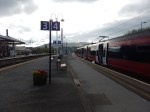
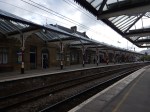
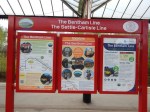
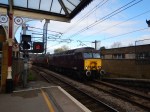
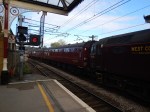
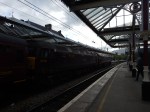
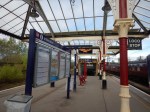
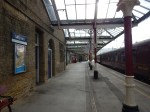
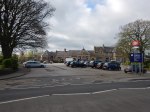
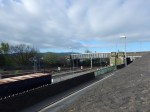
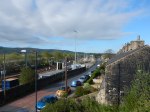
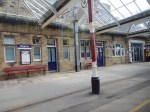
These pictures show the station and the lines towards Settle.



But Skipton and its station can get more important.
Under Future in the Wikipedia entry for the station, these improvements are mentioned.
More Virgin Services To London
Virgin Train’s new Class 800/801 trains are more flexible than the current trains working to Leeds.
- Five and nine car Class 801 electric trains.
- Five and nine car Class 800 electro-diesel trains.
I think we will see two five car trains joining together to form ten-car trains, as this will make better use of the capacity of the railway.
So could a five-car train from Skipton connect with a five-car train from Harrogate and become a ten-car train from Leeds to London?
I suspect the answer is yes, despite the fact that the Harrogate Line is not electrified.
More Capacity On The Airedale Line
This is needed and could be by allowing six instead of four car trains or increased frequencies.
The length increase to six-cars would be necessary for the Class 800/801 to run to Skipton.
More Trains To Carlisle Via Settle
After all the money spent on this line, I can see the line made to work hard to pay back the cost.
More Trains To Morecambe via Lancaster
If one line gets more trains, why not the other?
It also needs better trains than the Class 150 train, I saw going to Morecambe.
Skipton To Colne
SELRAP have been lobbying to reopen the rail link between Skipton and Colne.
There are problems with reopening the line, especially around Colne.
But I think it is one of those projects, that if that keen hill-walker and Prime Minister; Theresa May said go, it would happen.
It certainly, isn’t a crazy project.
Scheduled Steam-Hauled Services For the Settle And Carlisle Railway
The iconic Settle and Carlisle Railway has not had a good recent history.
A section in the Wikipedia entry for the line called 2015–16 Temporary Closures, gives full details of the damage wreaked by various storms. The section finishes with this statement.
The £23 million project is now scheduled for completion by the end of March 2017.
This gives an indication of the serious nature of the damage.
Northern obviously feel that some good publicity is needed to tell everybody that the Settle and Carlisle Line is open for business.
This article in Rail Magazine is entitled Steam to run timetabled Northern trains on S&C.
It describes how Steam trains in the form of the appropriate Tornado will be running two return services on each of February 14, 15 and 16.
This is said.
Steam trains formed of Mk 2 carriages will replace DMUs on timetabled trains over the Settle & Carlisle (S&C) route next month.
A1 ‘Pacific’ 60163 Tornado, completed in 2008, will haul the Northern trains over the S&C between Skipton and Appleby on three consecutive days. The first timetabled ordinary main line passenger steam trains to run in England for 50 years are the result of a pioneering modern and heritage industry alliance, formed to help revive the economic fortunes of the beleaguered S&C.
It is certainly a commitment to the future of the route.
An Excursion To Clitheroe
On Saturday morning before the football, I took a train along the Ribble Valley Line to Clitheroe and back to have a look.

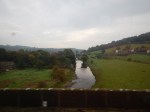
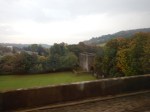
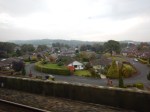
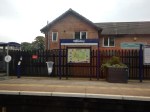
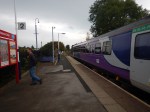

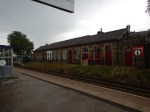

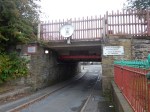
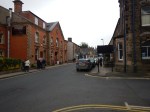

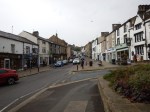
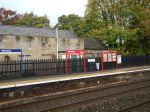
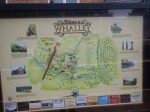
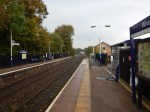
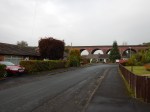
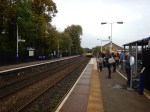
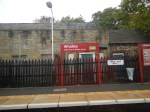

On the way back I stopped to have a look at the 48-arch Whalley Viaduct. Whalley is also a village with an ruins of an abbey.
Clitheroe reminded me very much of a Lancashire version of several I know well in Suffolk.
From the new houses, that I saw in the area, I suspect it’s becoming more important as a dormitory town.
The later history of the Ribble Valley Line between Manchester Victoria and Hellifield via Bolton, Blackburn and Clitheroe, is one of closure and reopening.
- Blackburn to Hellifield was closed to passengers in 1962.
- The only train, other than freight and diversions, was a once a week train between Manchester and Glasgow, which stopped in 1964.
- Blackburn to Bolton was reduced to a single-track.
- Public pressure led to a service between Blackburn and Clitheroe in 1994.
- Later a Sunday service was started between Blackburn and Hellifield.
- The line became a community rail line in 2007.
In the last few years, Network Rail have spent millions of pounds on improvements.
- A five million scheme renewed the permanent way between Blackburn and Clitheroe in 2008.
- Sections of single track have been doubled.
- Signalling has been improved.
- Line speed has been increased.
- Platforms have been lengthened.
- The passing loop at Darwen has been lengthened.
Builders certainly seemed to have been at work on the stations between Clitheroe and Whalley.
It All Happens In 2017
All of this should mean that two trains per hour (tph), can run between Manchester Victoria and Clitheroe in December 2017.
Probably by design rather than co-incidence, December 2017 is also given as the opening date of the Ordsall Chord and the completion of the electrification of the Manchester to Preston Line.
A year later, in December 2018 there could be the extra two through platforms into use at Manchester Pioccadilly, which will help alleviate capacity problems.
I don’t think we’ll see direct services between Clitheroe and London, but an improved Ribble Valley Line connecting with Manchester’s new cross-city line can only be good for passengers.
Things that could or should happen include.
- Two tph between Manchester Victoria and Clitheroe has virtually been promised.
- The service will become faster because of track improvement and new trains in a few years. Applying a conservative estimate reduces the end-to-end journey time from seventy-five to somewhere around fifty minutes.
- The Manchester Victoria to Clitheroe service could probably run two tph each of four carriages by December 2018. It all depends on rolling stock deliveries.
- TransPennine services will go through Manchester Victoria and any sensible train planner would arrange a decent link between Clitheroe and TransPennine services.
It will certainly be a big improvement.
Manchester Airport And Clitheroe
One journey that illustrates how the Ordsall Chord will improve services, is getting between Clitheroe and Manchester Airport.
Currently, these are typical timings.
- Clitheroe to Manchester Victoria – 75 minutes
- |Cliteroe to Manchester Airport via Bolton – 126 minutes
- Salford Crescent to Manchester Victoria – 9 minutes
- Salford Crescent to Manchester Airport – 30 minutes
As Manchester Victoria to Manchester Airport, is effectively via Salford Crescent with the train taking a short cut, it’s probably reasonable to assume that Manchester Victoria to Manchester Airport won’t be more than 39 minutes.
Current services take about twenty minutes from Manchester Piccadilly, but it’s not a proper airport service, which the full route to Victoria could be.
- It doesn’t use the same platforms every time.
- The trains are not built for heavy luggage.
The service certainly doesn’t say Manchester is open for business.
Wikipedia says this about services to Manchester Airport after the Ordsall Chord opens.
On completion, it is anticipated that the chord would allow four trains per hour to travel between Manchester Airport/Manchester Piccadilly and Manchester Victoria in each direction, with a further eight trains per hour possible from Manchester Victoria towards the west via Chat Moss, and six trains per hour from Manchester Piccadilly towards either Chat Moss or Bolton and Preston.
So this means that even if you just miss the connection at Manchester Victoria, you’d only wait a maximum of fifteen minutes for the next train to the Airport.
As I think we can reasonably assume that there will be a Clitheroe to Manchester Victoria time of around fifty minutes, this means that Clitheroe to the Airport could be about ninety minutes plus how long you wait at Victoria for the Airport train.
But I suspect there could be a better connection for Manchester Airport at Bolton.
If you opt for a route with only one change, then the journey takes a few minutes over two hours, often with a wait of thirty-five minutes, whilst trains are changed at Bolton.
- A route with only one change at Bolton, takes a few minutes over two hours, often with a wait of thirty-five minutes at the change.
- I wouldn’t be surprised to see Clitheroe to Manchester Airport in under ninety minutes via Bolton, with the current trains, after the Ordsall Chord is opened.
- But hopefully in |December 2017, Bolton to Manchester Airport will be served by 100 mph electric trains.
- December 2018 could bring the extra two through platforms into use at Manchester Pioccadilly.
Incidentally, various web sites, say it takes an hour to go by car.
One project that will speed up these services is the updating of Bolton station. I showed pictures and made some small assumptions in this post called Bolton Station.
I think it would be possible to have same- or cross-platform interchange between the following services.
- Clitheroe and Manchester Victoria.
- Preston and Manchester Piccadilly/Airport
- Preston and Manchester Victoria
- Wigan Wallgate and Manchester Piccadilly/Airport
This happens to a certain extent at Bolton already, as the Windsor Link Line allows trains to go direct from Bolton to Manchester Piccadilly and onto Manchester Airport.
If it could be arranged that the frequency between Bolton and Manchester Airport was 4 tph, then this would mean a maximum wait of fifteen minutes.
Currently, the frequency is a miserly 2 tph, which explains the long waits at Bolton.
Manchester Piccadilly
I suspect that because even with the Ordsall Chord built, that Piccadilly with its completion date a year later could be the main bottleneck.
You could say run twelve-car semi-fast Class 319 trains from Preston to Manchester Airport,, but if Mancunians are anything like Londoners for ducking and diving, then this could just add to the congestion at Manchester Piccadilly.
It all shows the problems of how the adding of the two extra platforms 13 and 14 in the 1960s was not a project that had any degree of future proofing.
When I see those draded numbers 13 and 14 against my train to or from Manchester Piccadilly, I breathe a sigh and ask myself, why I came this way.
Trains always seem to be late through the platforms and sometimes, I feel the platforms aren’t the safest.
Onward From Clitheroe
I have not taken the line northward from Clitheroe to Hellifield, where it joins to the Leeds to Morecambe Line with its connections to the Settle and Carlisle Line.
At present the historic Settle route is closed after last winter’s storms, but Network Rail is spending £23million to bring it back into top condition.
With the new franchise saying it will run extra trains on this route, I feel that the Settle route will have a busy future.
Blackburn to Carlisle via Settle is certainly a trip I want to take.
You have to ask the following questions about the current services to Clitheroe
- When two tph are going from Manchester Victoria to Clitheroe, should one tph go on to Hellifield?
- Given rivalry across the Pennines, do loyal Lancastrains feel that Leeds has no right to services along the Settle route and some should start in the county of the red rose?
From what I saw of the Ribble Valley Line at Blackburn, Whalley and Clitheroe, the track and stations would certainly be up to the increased footfall.
All the line needs is modern trains.
Conclusion
Without doubt, the Ribble Valley Line is ready to take its place in that group of secondary and rural rail lines across the North, that will take be good for the locals and will attract tourists to the area.
Is Community Rail A Good Thing?
This article from the BBC is entitled TransWilts rail service made permanent by government.
It would certainly appear that the revived fifty kilometre service across Wiltshire has been a success.
The line may not be as spectacular as Settle-Carlisle, but like that famous line, Transwilts seems to show that Community Rail lines work.
Carlisle Station Gets A Makeover
In If Manchester Victoria And Birmingham New Street Were The First Two Courses, Is Carlisle The Third?, I wrote how Carlisle station was going to get a £14.7 million upgrade including a new ETFE roof.
These pictures show the progress.
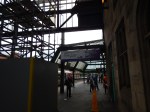
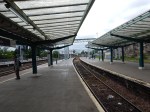
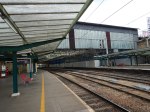
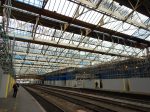
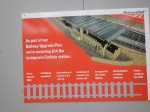

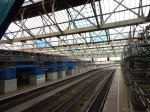
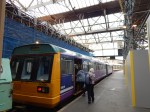


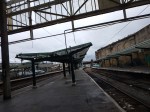
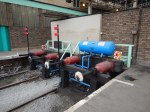
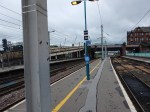
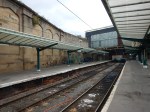
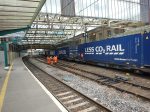
Note.
- There are two through lines in the station for freight and other trains that don’t stop.
- The four bay platforms at Carlisle are all electrified to some extent and it wouldn’t be the biggest task to make the station fully-electrified.
- It looked to me like a lot of the magnificent station building, isn’t being used to its full potential.
- The welcoming square outside the station needs an upgrade to become a real gateway to Carlisle.
I think that after the makeover, it will be a second very high-class station to mark the border between England and Scotland.
Carlisle could be in a unique position in a few years.
- It is already the best connected city in the Borderlands.
- Published plans mean that electric express trains will serve Birmingham, Edinburgh, Glasgow, Liverpool, Manchester and Manchester Airport, at least once an hour, with some places getting at least double.
- As I wrote in Arriva Rail North’s New Trains, new CAF Civity trains will be arriving, in both electric and diesel variants.
- After the current landslide at Armathwaite is cleared up on the Settle-Carlisle Line, these new trains will surely be running at least an hourly service to Leeds.
- The new trains will be providing an improvement in comfort, speed and possibly frequency on the hourly service to Newcastle, on the Tyne Valley Line.
- The new trains, would surely work their magic on the Cumbrian Coast Line around the Lake District.
- Scotrail is getting new trains too, and will some be used to provide a better service to Glasgow via Dumfries and Kilmarnock, using the Glasgow South Western Line.
If this doesn’t increase the numbers of tourists taking a rail-based exploration holiday of the Borderlands and the Lake District, I would be extremely surprised.
I’m not the only person, who thinks this way, as in the July 2016 Edition of Modern Railways, Theo Steel discusses options for the increase in traffic on the Settle to Carlisle Line.
In addition, other developments may happen, that will also increase Carlisle’s importance to the Anglo-Scottish railway system.
- The events of this winter, where the West Coast Main Line was closed because of bad weather, could see the Glasgow South Western Line improved and electrified to provide a valuable diversion route for train services between England and Glasgow.
- There could be a need for more Anglo-Scottish freight trains, but the West Coast Main Line is very busy. So will this mean that freight trains will increasingly use secondary routes like Settle-Carlisle and the Glasgow South Western Line.
- Carstairs station sits between Carlisle, Edinburgh and Glasgow and I can’t believe that Scotrail won’t use their new trains to improve services through the town. As ever, the improvements in services around Carstairs, will probably be driven by the need for new housing and commuting to Glasgow and Edinburgh.
The big question though, is whether the Borders Railway will ever get to Carlisle. If it does, then Carlisle will be ready with a refurbished and electrified platform, alongside the one currently used for services on the Glasgow South Western Line.
Network Rail seem to deserve a few plaudits for their foresight in preparing Carlisle station for the future.
 The Anonymous Widower