Berkeley Scientists Finally Solve 10-Year Puzzle Enabling Efficient CO2-to-Fuel Conversion With Major Climate Impact Potential
The title of this post, is the same as that of this article on Sustainability Times.
This is the sub-heading.
In a groundbreaking advancement, scientists at Lawrence Berkeley National Laboratory and SLAC National Accelerator Laboratory have unveiled the critical mechanisms behind the degradation of copper catalysts, a revelation that promises to revolutionize the production of sustainable fuels by enhancing the efficiency and stability of CO2 conversion processes.
This paragraph gives more details.
Scientists from the Lawrence Berkeley National Laboratory and SLAC National Accelerator Laboratory have made a groundbreaking discovery in the field of artificial photosynthesis. By utilizing advanced X-ray techniques, they have uncovered the critical factors that limit the performance of copper catalysts in converting carbon dioxide and water into useful fuels. This revolutionary insight could significantly enhance the stability and efficiency of catalysts in CO2 conversion processes, potentially accelerating the production of ethanol and ethylene. The research, which tackles a decades-old puzzle, offers promising avenues for the development of more durable catalyst systems, paving the way for future advancements in sustainable energy solutions.
I first came across catalysts in my working life, when I was working at ICI. I was modelling a chemical process called sulphonation for a guy who was trying to find an efficient way to create the monomer of building block for a new engineering plastic.
Some feel that all plastics are bad for the environment, but I think that, if the plastic is designed to replace another material in a long-lasting application, then plastic is good for the environment.
This picture shows my wonderful Sheba cutlery.
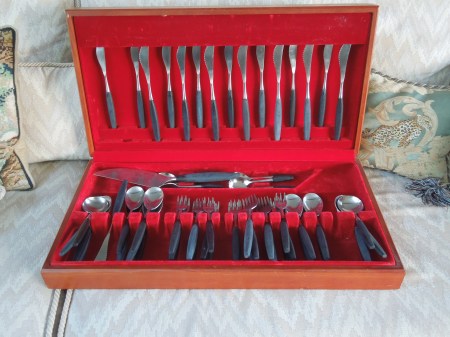
Note.
- C and I bought it in the 1960s, when we got married.
- Some have been used every day for over fifty years.
- The important bits are Sheffield stainless steel, with the handles formed of black Delrin plastic.
- Some of the handles have been in the dishwasher too many times and have faded.
- From what I have seen on the Internet, the average worth of pieces could be as much as a tenner.
Perhaps, when I pass on, all the pieces should be divided between my grandchildren.
I have digressed and I will return to my modelling project with one of ICI’s catalyst experts.
I remember him telling me, that if you could improve the way catalysts worked, you would open up whole new areas of chemistry.
It looks to me, that the scientists at Berkeley may have opened up a route to turn carbon dioxide into fuel.
Whether that is a good route to decarbonisation is another long discussion.
Putting Together IKEA Furniture
I took these pictures to show the tools I use to put together IKEA furniture.
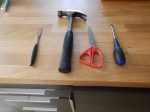
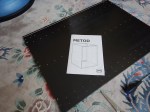
Note.
- The Sheba butter knife is excellent for opening packages, as it won’t scratch the furniture.
- The well-balanced hammer for nailing on the backs of cupboards.
- Scissors are always useful.
- This Phillips screwdriver doubled as a light hammer for banging in lcation pegs.
I rarely use anything else!
A Use For A Small Sheba Knife
My Sheba cutlery gets used in all sorts of ways.
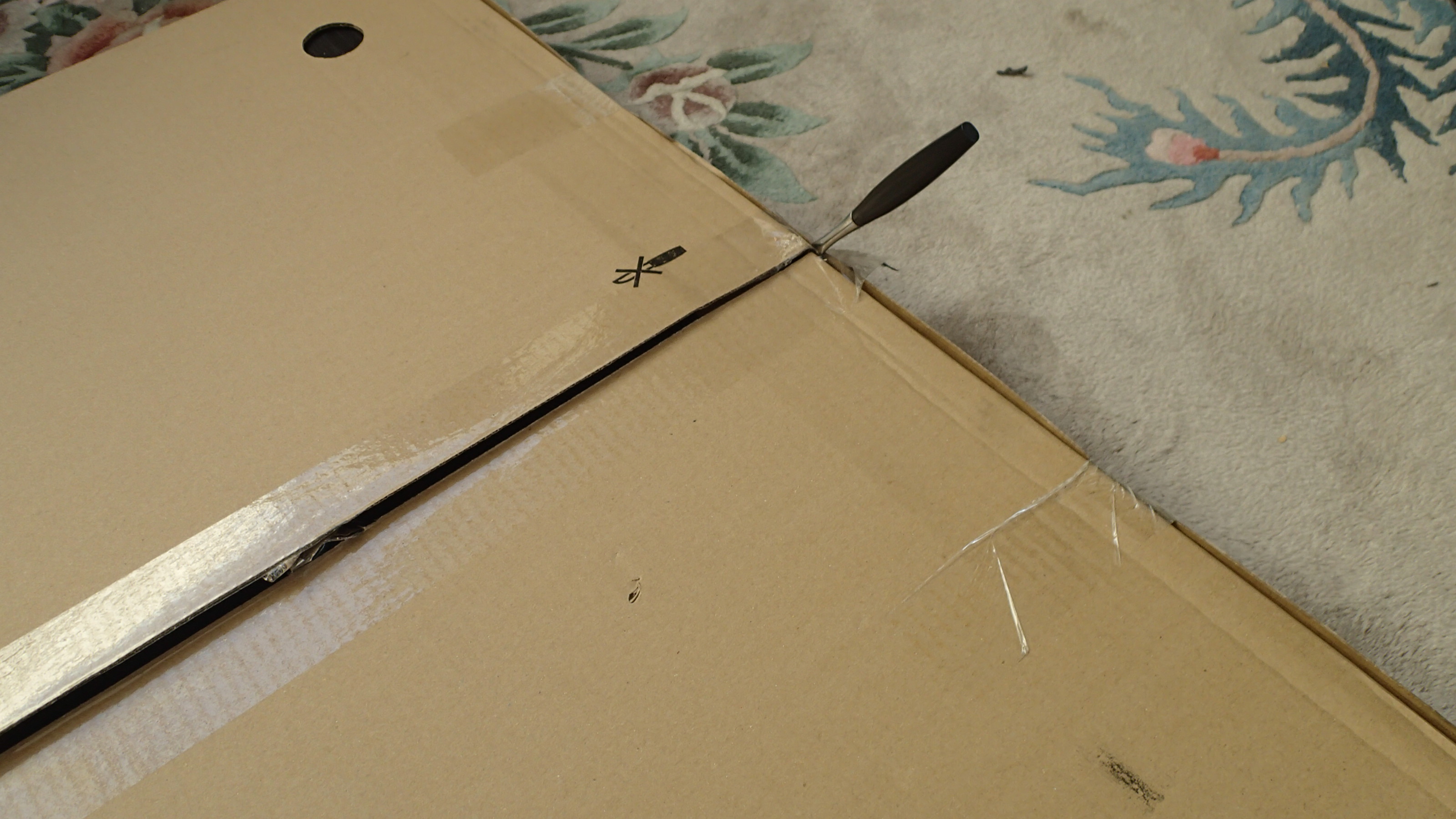
A Use For A Small Sheba Knife
As the small knives are more designed for spreading butter and jam, rather than cutting, they are ideal for opening packages without damaging the contents.
Sheba is the greatest cutlery design ever. And they were made in Sheffield and my upward of twelve settings have been used for nearly fifty years!
Two Knives From Sheffield At John Lewis
My kitchen knives are rather elderly and blunt, despite proper sharpening, so I thought I’d treat myself to some new ones from John Lewis.
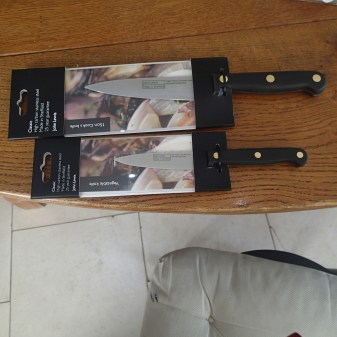
Two Knives From Sheffield At John Lewis
Made in Sheffield, as knives should be! Just like my Sheba cutlery was in the 1960s
My Ideal Kitchen
My current kitchen is not the best! But what do you expect as it was put in, by the idiot called Jerry, who built this house.
These three pictures show the kitchen as it is now.
This is the view looking into the kitchen from the living area.

Looking Into The Kitchen
Note.
1. The central heating box at the right.
2. The black IKEA shelving unit and one of my dining chairs.
3. The silly high shelf across the top, which is really just a convenient place to put things with no home.
This shows the other side of the wall looking out of the kitchen.
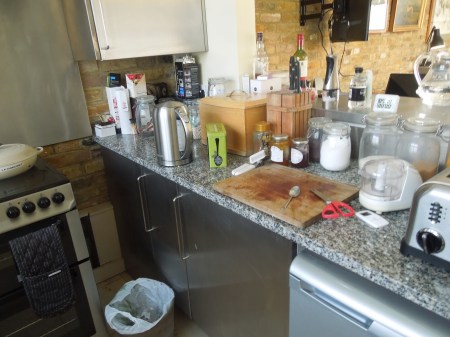
Looking Back
Note.
1. The small fridge without a freezer.
2. The general clutter.
This is the other side of the kitchen.
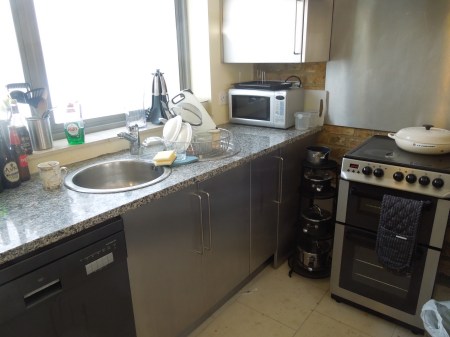
The Other Side
Note.
1. The dishwasher I hardly ever use.
2. The sink with the atrocious taps, that won’t fill a kettle with anything in the sink.
3. The cooker which does all I need. I never use timers or anything complicated like that, as before here, I cooked for nearly forty years on an AGA.
4. The Le Creuset shallow casserole, that I use a lot.
As you can see it’s not good. But the basic layout works for me.
There are other things to bear in mind.
1. It may seem daft, but I rarely use the dish washer, if I’m by myself. I tend to wash up by hand once a day in the morning to get my left hand thoroughly warmed so that I can do my blood test.
2. I am a pretty competent cook, but as I’m a coeliac, the sort of things are cook, tend to be fairly simple. I don’t keep many vegetables outside of the fridge for instance.
3. I do use lots of spices though.

Lots Of Spices
4. As the picture shows, I use a lot of glass jars for pasta, salt etc.
5. I also watch television and cook at the same time.
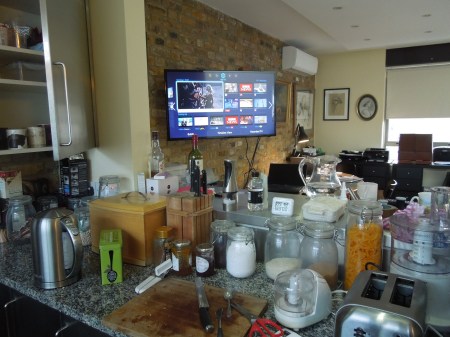
Watching Television From The Kitchen
5. I don’t have too many gadgets, except for a toaster, a kettle and a small food processor. Looking at this picture, you can see one of the problems with this kitchen. There isn’t enough space.
6. I do like to prepare everything on a big chopping board. My last one had a hole with a stopper, so I could chasse peelings into a bin underneath.
7. I do have lots of little utensils though.
8. I also want a home for my wonderful Sheba cutlery.
A Box Full Of Sheba Cutlery
Note the rare pie slice and teaspoons.
9. Colour is defined by the steel beams that run across the house. The black/brown IKEA colour is virtually right and I do like proper brass fittings.
Just writing all this down has given me a few ideas.
1. I think that the kitchen should be continuous and sort of overflow through the wall into the living room. Perhaps the worktop should be continuous between the two rooms! And at the normal ninety centimetre height.
2. In the living room, there would be a unit under the top. This would store the Sheba cutlery and other tablewear and crockery, a few bottles of wine and beer, perhaps include a wine fridge and of course hide the dreadful utilities cupboard. The unit would also be capable of holding most of the odds and ends that sit on the counter now.
3. Judging by past history, no-one would need to sit at the top, but it would be capable of being used as a serving table at a party.
4. The continuous worktop should give me a lot of space, which patently I lack at the moment.
5. The side facing the living area, would have a fridge and a freezer under the worktop, with some properly fitted out cupboards.
6. The cooker would be in the same place with cupboards, a built in microwave and a proper extractor above.
7. I do have several large casseroles that need homes.
8. On the window side, I want a double sink. I think, I’d probably still have a dishwasher, even if it’s only a half -size one.
2.
Made 1960, Still Going Strong
My everyday cutlery is Sheba by Butler of Sheffield. It was time for a changeround of the pieces, so I took the chance of photographing most of it.
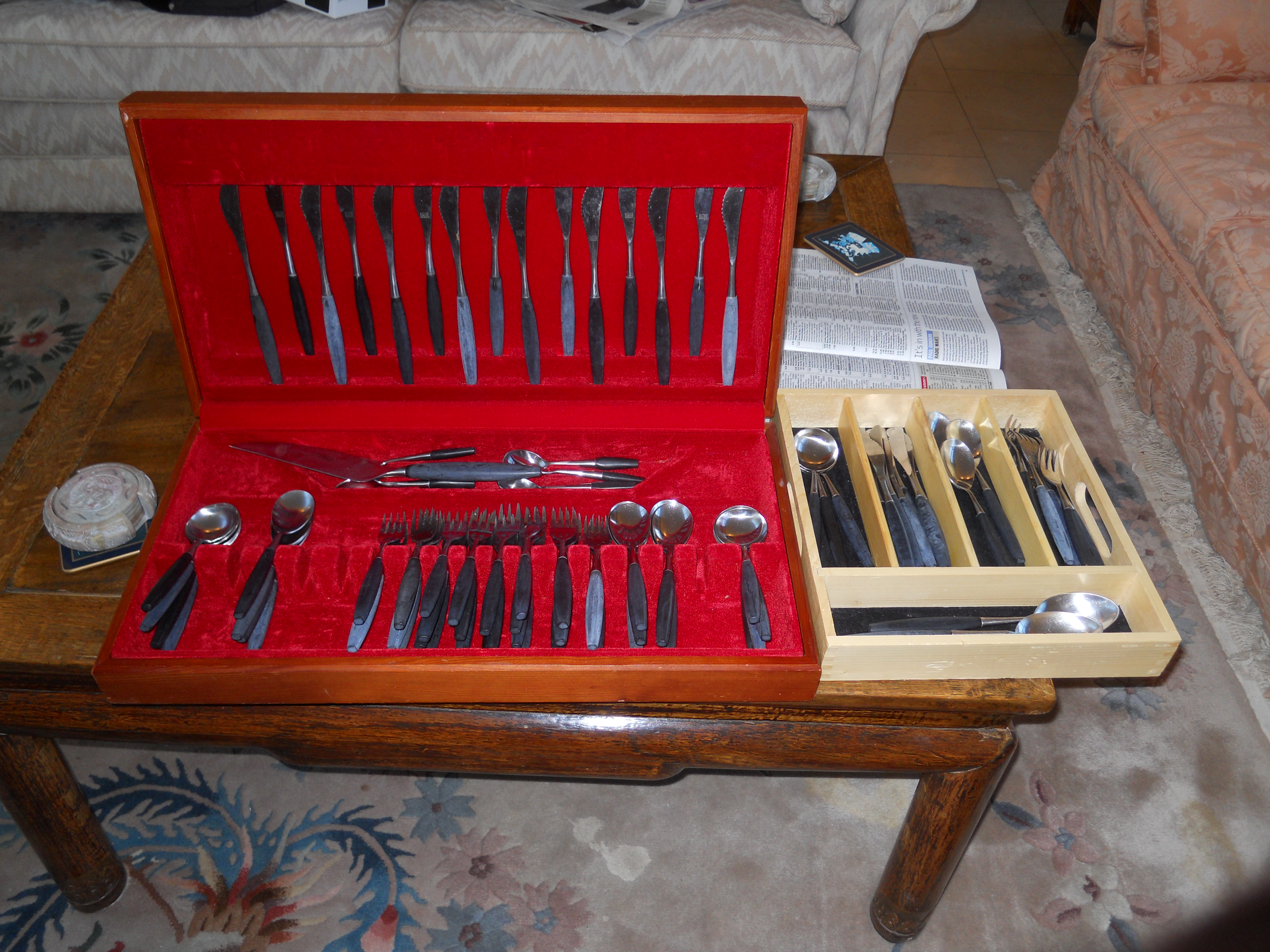
My Sheba Cutlery
There are a dozen or so other pieces, but they were in the dishwasher. For probably the several hundredth time for some of the knives.
This cutlery is really a good example of what design can do for something quite humble, like cutlery. This cutlery wasn’t designed to be thrown away, but to last a lifetime or perhaps as in my case outlast a marriage.
Butler Sheba Cutlery
When we married in 1968, we didn’t have much, but we did purchase a rather extravagant set of Butler Sheba cutlery. There is very little information about the cutlery on the Internet, except for this small piece in the Design 1965 Journal.
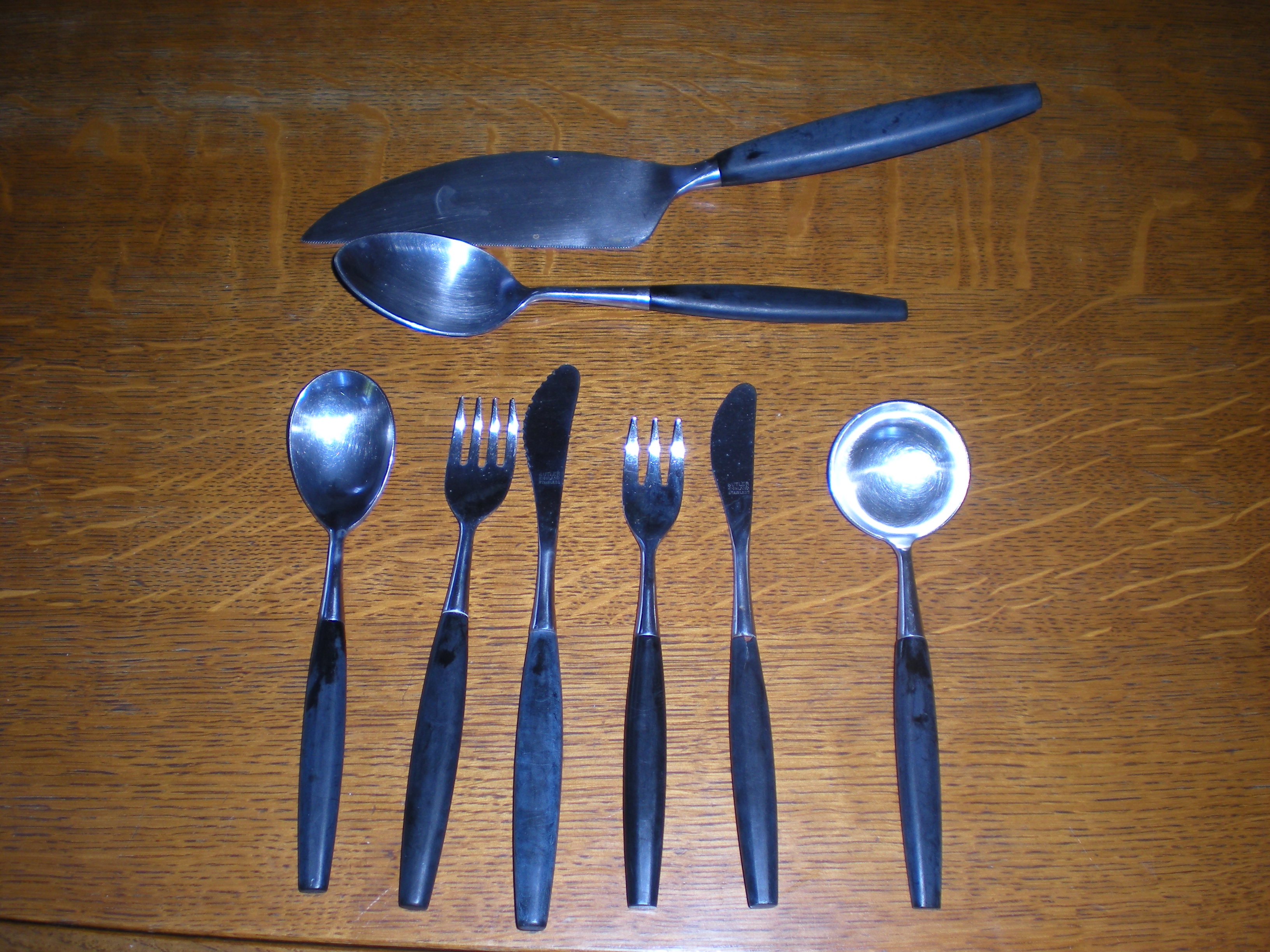
Sheba Cutlery
They are a classic sixties design that was made in Sheffield. The handles are actually a plastic called Delrin from DuPont.
I still use them everyday and they have always been washed in the dishwasher.
If anybody has any cutlery of this design in good nick, I might be pleased to purchase them.
 The Anonymous Widower