Centrica And X-energy Agree To Deploy UK’s First Advanced Modular Reactors
The title of this post, is the same as that of this press release from Centrica.
This is the sub-heading.
Centrica and X-Energy, LLC, a wholly-owned subsidiary of X-Energy Reactor Company, LLC, today announced their entry into a Joint Development Agreement (JDA) to deploy X-energy’s Xe-100 Advanced Modular Reactors (“AMR”) in the United Kingdom.
These three paragraphs add more details.
The companies have identified EDF and Centrica’s Hartlepool site as the preferred first site for a planned U.K. fleet of up to 6 gigawatts.
The agreement represents the first stage in a new trans-Atlantic alliance which could ultimately mobilise at least £40 billion in economic value to bring clean, safe and affordable power to thousands of homes and industries across the country and substantive work for the domestic and global supply chain.
A 12-unit Xe-100 deployment at Hartlepool could add up to 960 megawatts (“MW”) of new capacity, enough clean power for 1.5 million homes and over £12 billion in lifetime economic value. It would be developed at a site adjacent to Hartlepool’s existing nuclear power station which is currently scheduled to cease generating electricity in 2028. Following its decommissioning, new reactors would accelerate opportunities for the site and its skilled workforce. The site is already designated for new nuclear under the Government’s National Policy Statement and a new plant would also play a critical role in generating high-temperature heat that could support Teesside’s heavy industries.
This is no toe-in-the-water project, but a bold deployment of a fleet of small modular reactors to provide the power for the North-East of England for the foreseeable future.
These are my thoughts.
The Reactor Design
The Wikipedia entry for X-energy has a section called Reactor Design, where this is said.
The Xe-100 is a proposed pebble bed high-temperature gas-cooled nuclear reactor design that is planned to be smaller, simpler and safer when compared to conventional nuclear designs. Pebble bed high temperature gas-cooled reactors were first proposed in 1944. Each reactor is planned to generate 200 MWt and approximately 76 MWe. The fuel for the Xe-100 is a spherical fuel element, or pebble, that utilizes the tristructural isotropic (TRISO) particle nuclear fuel design, with high-assay LEU (HALEU) uranium fuel enriched to 20%, to allow for longer periods between refueling. X-energy claims that TRISO fuel will make nuclear meltdowns virtually impossible.
Note.
- It is not a conventional design.
- Each reactor is only about 76 MW.
- This fits with “12-unit Xe-100 deployment at Hartlepool could add up to 960 megawatts (“MW”) of new capacity” in the Centrica press release.
- The 960 MW proposed for Hartlepool is roughly twice the size of the Rolls-Rpoyce SMR, which is 470 MW .
- Safety seems to be at the forefront of the design.
- I would assume, that the modular nature of the design, makes expansion easier.
I have no reason to believe that it is not a well-designed reactor.
Will Hartlepool Be The First Site?
No!
This page on the X-energy web site, describes their site in Texas, which appears will be a 320 MW power station providing power for Dow’s large site.
There appear to be similarities between the Texas and Hartlepool sites.
- Both are supporting industry clustered close to the power station.
- Both power stations appear to be supplying heat as well as electricity, which is common practice on large industrial sites.
- Both use a fleet of small modular reactors.
But Hartlepool will use twelve reactors, as opposed to the four in Texas.
How Will The New Power Station Compare With The Current Hartlepool Nuclear Power Station?
Consider.
- The current Hartlepool nuclear power station has two units with a total capacity of 1,185 MW.
- The proposed Hartlepool nuclear power station will have twelve units with a total capacity of 960 MW.
- My instinct as a Control Engineer gives me the feeling, that more units means higher reliability.
- I suspect that offshore wind will make up the difference between the power output of the current and proposed power stations.
As the current Hartlepool nuclear power station is effectively being replaced with a slightly smaller station new station, if they get the project management right, it could be a painless exercise.
Will This Be The First Of Several Projects?
The press release has this paragraph.
Centrica will provide initial project capital for development with the goal of initiating full-scale activities in 2026. Subject to regulatory approval, the first electricity generation would be expected in the mid-2030s. Centrica and X-energy are already in discussions with additional potential equity partners, as well as leading global engineering and construction companies, with the goal of establishing a UK-based development company to develop this first and subsequent projects.
This approach is very similar to the approach being taken by Rolls-Royce for their small modular reactors.
Will Centrica Use An X-energy Fleet Of Advanced Modular Reactors At The Grain LNG Terminal?
This press release from Centrica is entitled Investment In Grain LNG Terminal.
This is one of the key highlights of the press release.
Opportunities for efficiencies to create additional near-term value, and future development options including a combined heat and power plant, bunkering, hydrogen and ammonia.
Note.
- Bunkering would be provided for ships powered by LNG, hydrogen or ammonia.
- Heat would be needed from the combined heat and power plant to gasify the LNG.
- Power would be needed from the combined heat and power plant to generate the hydrogen and ammonia and compress and/or liquify gases.
Currently, the heat and power is provided by the 1,275 MW Grain CHP gas-fired power station, but a new nuclear power station would help to decarbonise the terminal.
Replacement Of Heysham 1 Nuclear Power Station
Heysham 1 nuclear power station is part-owned by Centrica and EdF, as is Hartlepool nuclear power station.
Heysham 1 nuclear power station is a 3,000 MW nuclear power station, which is due to be decommissioned in 2028.
I don’t see why this power station can’t be replaced in the same manner as Hartlepool nuclear power station.
Replacement Of Heysham 2 Nuclear Power Station
Heysham 2 nuclear power station is part-owned by Centrica and EdF, as is Hartlepool nuclear power station.
Heysham 2 nuclear power station is a 3,100 MW nuclear power station, which is due to be decommissioned in 2030.
I don’t see why this power station can’t be replaced in the same manner as Hartlepool nuclear power station.
Replacement Of Torness Nuclear Power Station
Torness nuclear power station is part-owned by Centrica and EdF, as is Hartlepool nuclear power station.
Torness nuclear power station is a 1,290 MW nuclear power station, which is due to be decommissioned in 2030.
I don’t see why this power station can’t be replaced in the same manner as Hartlepool nuclear power station.
But the Scottish Nationalist Party may have other ideas?
What Would Be The Size Of Centrica’s And X-energy’s Fleet Of Advanced Modular Reactors?
Suppose.
- Hartlepool, Grain CHP and Torness power stations were to be replaced by identical 960 MW ADRs.
- Heysham 1 and Heysham 2 power stations were to be replaced by identical 1,500 MW ADRs.
This would give a total fleet size of 5,880 MW.
A paragraph in Centrica’s press release says this.
The companies have identified EDF and Centrica’s Hartlepool site as the preferred first site for a planned U.K. fleet of up to 6 gigawatts.
This fleet is only 120 MW short.
Scotland’s 450 MW Neart na Gaoithe Offshore Wind Farm Fully Operational
The title of this post, is the same as that of this article on offshoreWIND.biz.
This is the sub-heading.
The 450 MW Neart na Gaoithe (NnG) offshore wind farm has become fully operational, with Scotland’s First Minister John Swinney visiting Eyemouth on 24 July to mark the launch of the country’s newest offshore wind project.
These first three paragraphs give more details.
Located 15.5 kilometres off the coast of Fife, NnG is co-owned by EDF power solutions UK and Ireland and ESB. The wind farm’s 54 turbines are now generating up to 450 MW of clean electricity, which is enough to power around 375,000 homes and will offset over 400,000 tonnes of CO2 emissions each year, according to the developer.
The installation of Siemens Gamesa 8 MW turbines was completed in April 2025, while the project produced its first power in October 2024.
Electricity generated by Neart na Gaoithe is transmitted via the subsea export cable from the offshore substation to Thorntonloch Beach, where the underground onshore export cable feeds it to the national grid.
This Google Map shows the mouth of the Firth of Forth.

Note.
- The red arrow indicates Torness power station.
- The Fife Coast is at the top of the map.
- The most Easterly island is the Isle of May.
- The wind farm is located 15.5 kilometres off the Fife Coast.
This second Google Map shows the Fife Coast and the Isle of May.

Note.
- The red arrow indicates Fife Ness lighthouse.
- The island in the South-East corner of the map is the Isle of May.
- Leven station is in the South-West corner of the map, which I described in Leven Station – 15th May 2025.
From this map, I estimated that Fife Ness lighthouse and the Isle of May are around ten kilometres apart.
This third Google Map shows Torness nuclear power station on the other side of the Firth of Forth.

Note.
- Torness nuclear powerstation is indicated by the red arrow.
- The A1 road between Edinburgh and the South crossing the map diagonally.
- The East Coast Main Line following a similar route to the A1.
- The beach below the power station is Tgortonlock, where the cable from Neart na Gaoithe wind farm comes ashore.
Consider.
- Torness nuclear powerstation was built in 1988.
- It has a capacity of 1290 MW.
- Neart na Gaoithe wind farm has a capacity of 450 MW.
This is said in the Wikipedia entry for the Torness nuclear powerstation about its closure.
In December 2024, in response to concerns over energy security following delays to the opening of Hinkley Point C, EDF announced that the life of Torness would be extended two years until March 2030.
In January 2025, EDF stated that “their ambition is to generate beyond these dates [of March 2030], subject to plant inspections and regulatory oversight”
It looks like more power is needed at Torness to cover the closure of the nuclear powerstation.
I asked Google to give me an AI Overview of what wind farms will connect to the grid at Torness and I was given this answer.
Several wind farms are planned to connect to the grid near Torness, with the largest being the Berwick Bank Wind Farm. This offshore wind farm, located 40km off the coast, will connect to the National Grid at Branxton, near Torness. Another project, Eastern Green Link 1 (EGL1), will also connect to the grid near Torness, specifically at the Torness substation, and then link to Hawthorn Pit in County Durham. Additionally, the Neart na Gaoithe offshore wind farm is also being developed in the area.
As Berwick Bank wind farm and EGL1 have capacities of 4.1 and 2 GW respectively, I am fairly sure that Torness can be safely decommissioned.
Berwick Bank Wind Farm Could Provide Multi-Billion Pound Boost To Scottish Economy And Generate Thousands Of Jobs
The title of this post, is the same as that of this press release from SSE.
This press release is all about numbers.
- 307 turbines
- 4.1 GW nameplate capacity
- 5 million homes will be powered
- 8 million tonnes of carbon dioxide avoided
- Up to £8.3 billion to the UK economy
- 4650 potential jobs in Scotland
- 9300 potential jobs in the UK
These are all large figures.
This map from SSE shows the location of the wind farm.
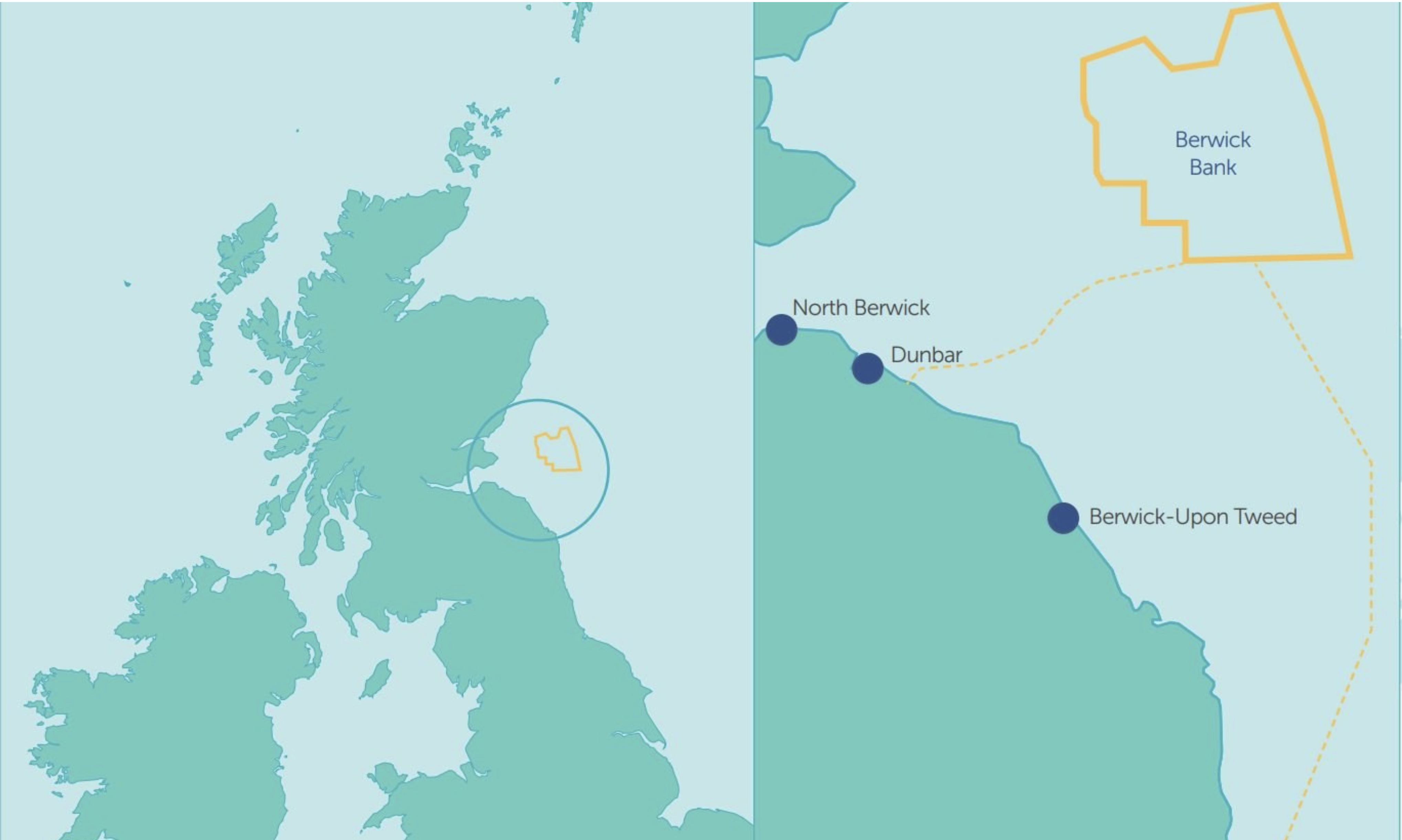
The press release says this about connections to the grid.
Berwick Bank has secured a grid connection at Branxton, near Torness, in East Lothian. A second grid connection will be required for the project, which has been determined as Blyth, Northumberland.
Note, that Torness is the site of Torness nuclear power station.
- It has a nameplate capacity of 1.29 GW.
- It is scheduled to be shutdown in 2028.
This Google Map shows the coast between Dunbar and Torness nuclear power station.
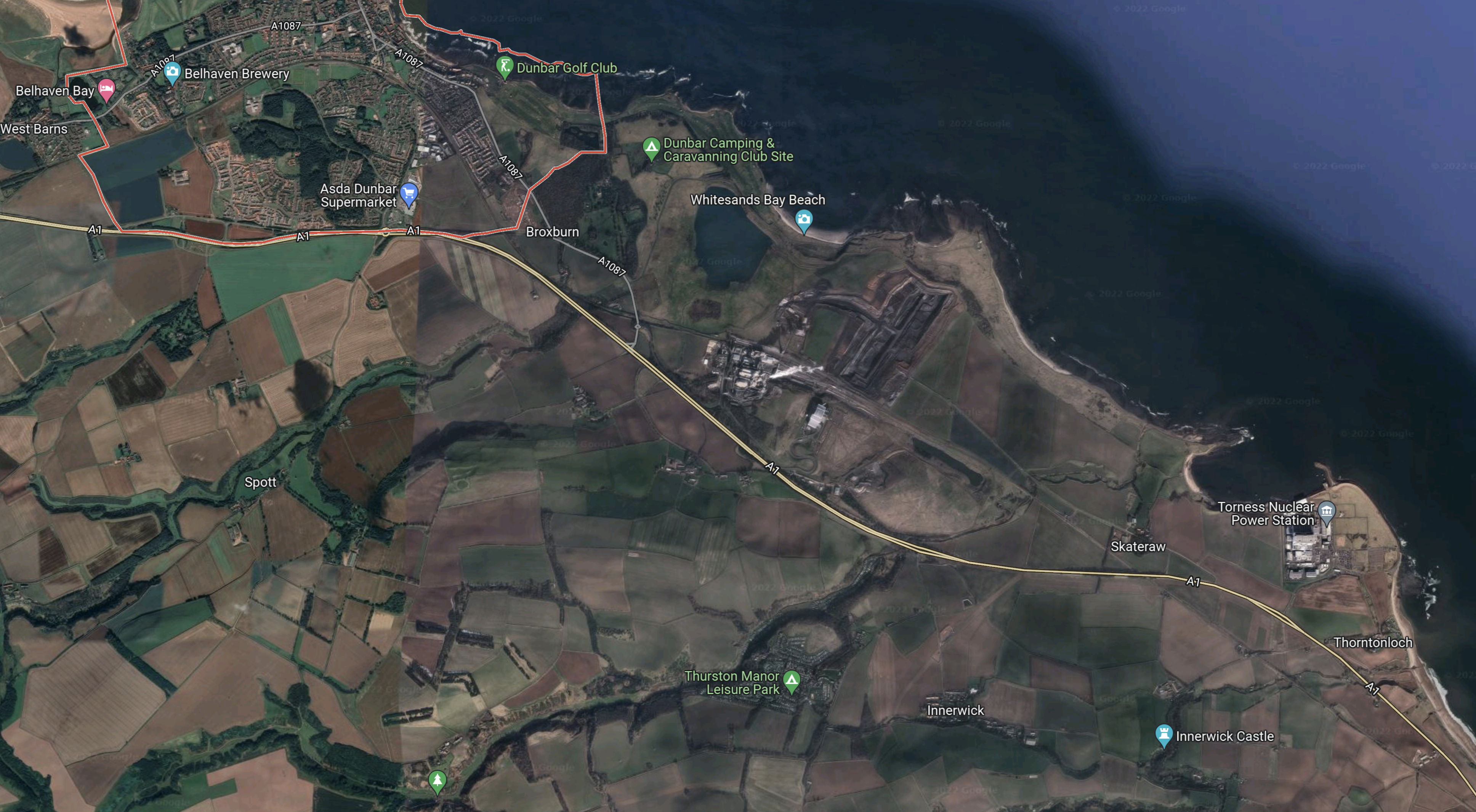
Note.
- The town of Dunbar is outlined in red.
- The yellow line running diagonally across the map is the A1 road.
- Torness nuclear power station is in the South-East corner of the map to the North of the A1.
This second Google Map shoes an enlargement of the South-East corner of the map.
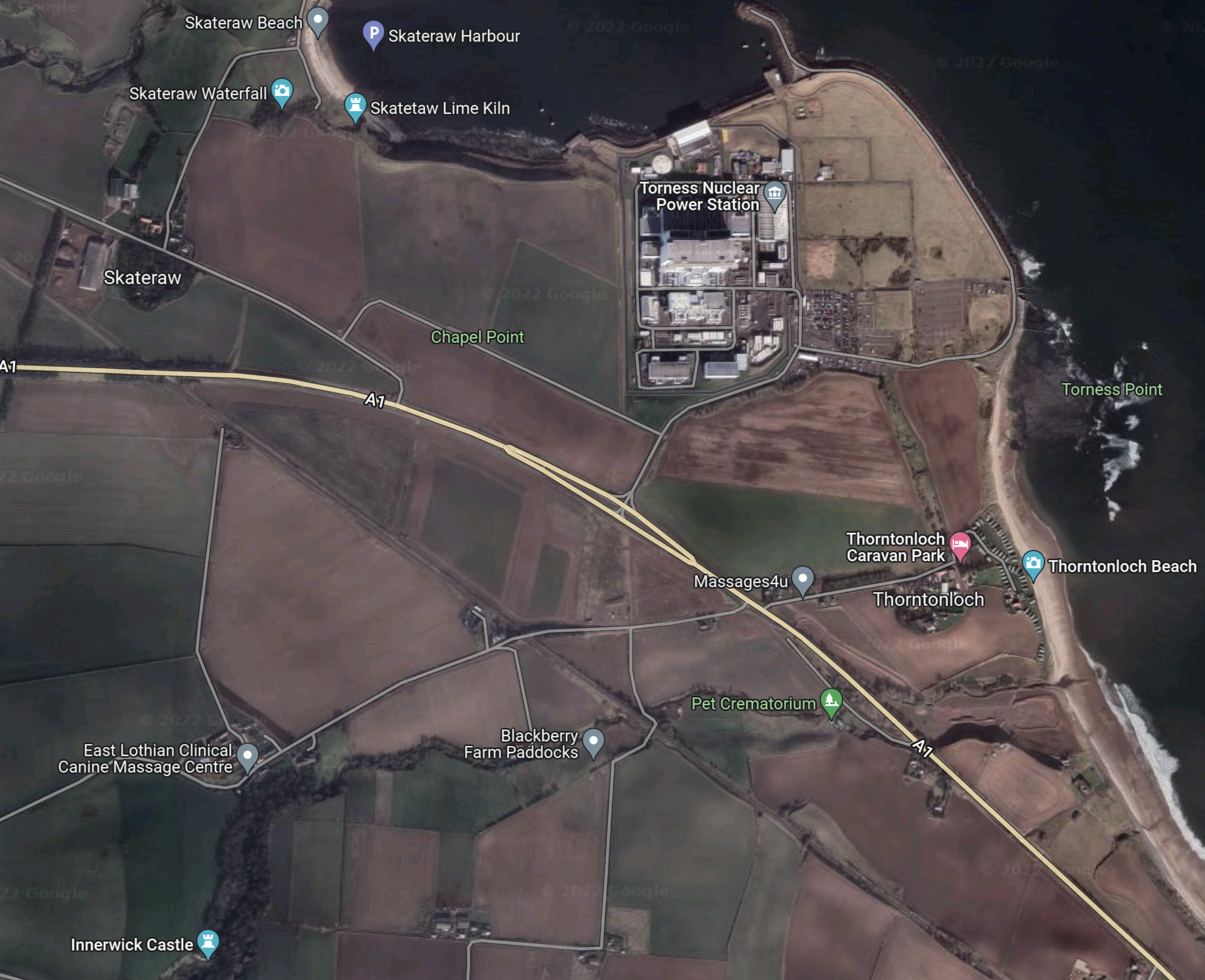
Note.
- Torness nuclear power station at the top of the map.
- The A1 road running across the map.
- The East Coast Main Line to the South of the A1.
- Innerwick Castle in the South-West corner of the map.
This Google Map shows the location of Branxton substation in relation to Innerwick Castle.
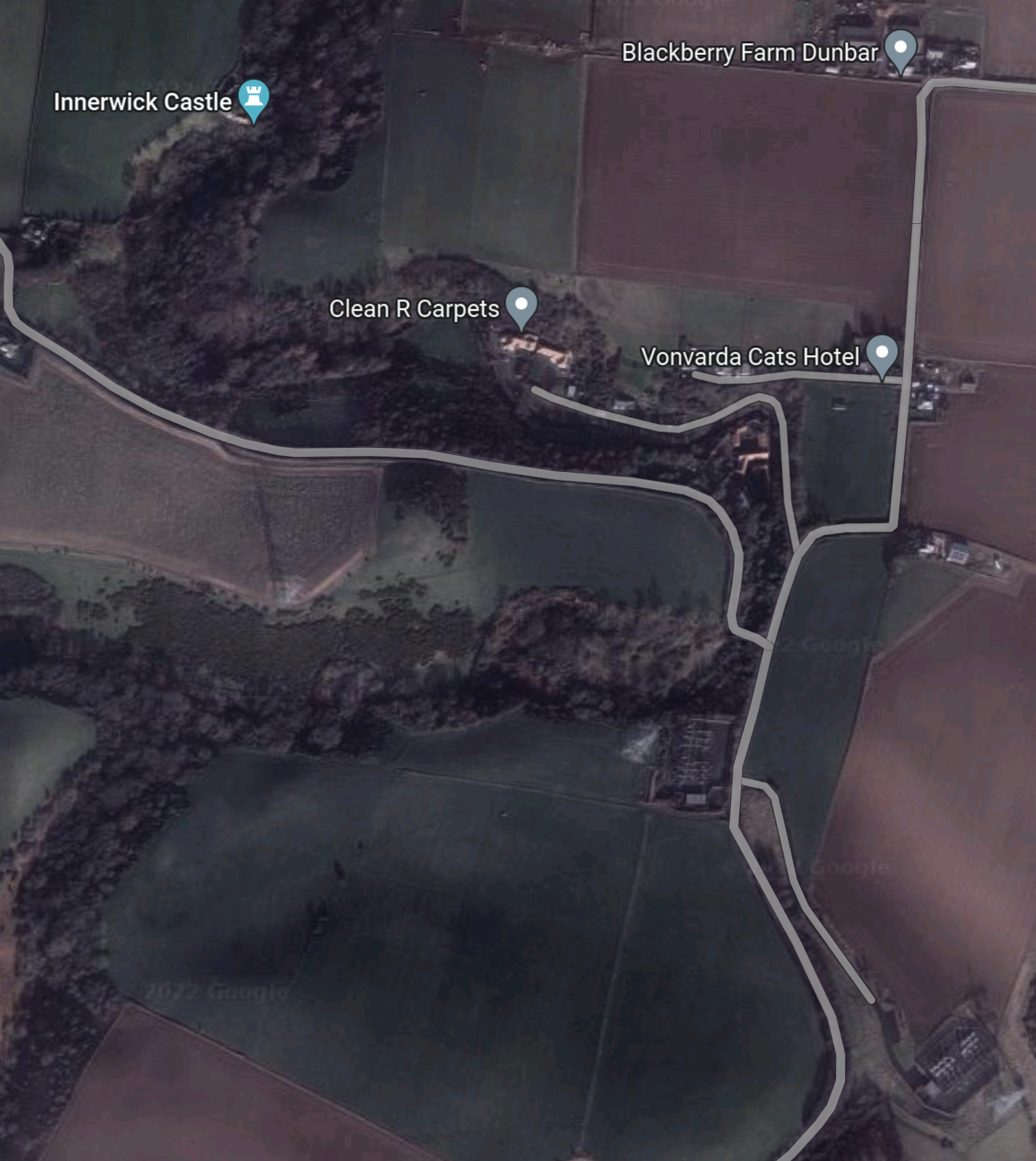
Note.
- Innerwick Castle is in the North-West corner of the map.
- Branxton substation is in the South-East corner of the map.
I estimate that the distance between Torness nuclear power station and Branxton substation is about five kilometres. The cable appears to be underground.
I have some thoughts.
Will The Connection Between Berwick Bank Wind Farm And Branxton Substation Be Underground?
If SSE follows the precedent of Torness nuclear power station, it will be underground.
Or will they use T-pylons?
This page on the National Grid web site is entitled What’s A T-Pylon And How Do We Build Them?.
From an engineering point of view, I suspect T-pylons could be used, but aesthetics and local preference may mean the cable is underground.
It should be noted that Torness nuclear power station will be shutdown in 2028. So will the current underground cable for the nuclear power station be repurposed after shutdown for the Berwick Bank wind farm?
This would mean, that the Southern connection cable to Blyth could be built first to support the first turbines erected in the wind farm.
When Will Berwick Bank Wind Farm Be Commissioned?
This page on the Berwick Bank wind farm web site is a briefing pack on the project.
The page gives construction and commission dates of 2026-2030.
Will There Be A Battery At Torness?
As we are talking about the latter half of the current decade for completion of the Berwick Bank wind farm, I believe that a substantial battery could be installed at Torness to smooth the output of the wind farm, when the wins isn’t blowing at full power.
One of Highview Power’s 2.5 GW/30 GWh CRYOBatteries could be about the right size if it has been successfully developed, but I am sure that other batteries will be of a suitable size.
If there is a case for a battery at Torness, there must surely be a case for a battery at Blyth.
Will Berwick Bank Wind Farm Be A Replacement For Torness Nuclear Power Station?
Consider.
- Torness nuclear power station is shutting down in 2028.
- Berwick Bank wind farm will be fully operational by 2030.
- Berwick Bank wind farm could use a repurposed connection to Branxton substation, if the nuclear power station no longer needs it.
- There is space on the Torness site for a large battery.
, it looks like Torness nuclear power station could be replaced by the larger wind farm.
 The Anonymous Widower