The Prototype Affordable Zero-Carbon Small Car Has Just Been Designed
The Wrightbus Ultroliner EU6, is their latest diesel bus.
The product page has this sub-heading.
A Choice Of The
UK’s Most Efficient
Diesel Buses
Two paragraphs give full details of the bus.
The StreetDeck Ultroliner EU6 is available with two ultra low emission efficient diesel engine choices: the new Cummins 6.7 litre 6 cylinder and the current Mercedes 5.1 litre 4 cylinder engine. Our StreetDeck EU6 Ultroliner and its engine choices remains the UK’s favourite. All these buses can be repowered at mid-life to zero-emission BEV technology with NewPower.
The new Cummins ISB6.7 litre six-cylinder diesel engine, married with the latest Voith DIWA.8 NXT 7-speed transmission. Two power options are available: 250Hp / 187Kw, 1000Nm and 300Hp / 224Kw, 1200Nm. With a large 245L fuel tank, this StreetDeck is ready to go the distance, wherever the journey takes it. Its MH3 technology helps lower fuel consumption during frequent stops on busy roads and improves the overall footprint and ride quality. Where ultra clean diesel buses are seen as the only option at this time, there is no better bus than the low emission StreetDeck Ultroliner range.
So you get a modern bus, that can be converted to zero-carbon at an appropriate time.
But nothing is said about conversion to hydrogen, which I believe is the ideal fuel for a large vehicle.
So I asked Google AI, if a Wrightbus Ultroliner can be converted to hydrogen-power, and received this answer.
Yes, the Wrightbus StreetDeck Ultroliner EU6 can be converted to hydrogen power. Wrightbus has engineered the diesel StreetDeck Ultroliner platform to be forward-looking, allowing operators to retrofit these vehicles mid-life with Cummins hydrogen internal combustion engines.
Here are the key details regarding this conversion and technology:
Adaptable Design: The StreetDeck Ultroliner was specifically designed to bridge the gap between traditional diesel and zero-emission options, making it possible to switch to hydrogen or battery-electric powertrains later in the vehicle’s life.
Hydrogen Internal Combustion: Instead of a fuel cell, this retrofit converts the diesel engine to run on hydrogen gas, providing a cost-effective route to zero emissions for existing operators.
Shared Platform: The diesel Ultroliner shares a similar “feel and features” with the purpose-built zero-emission Hydroliner (Hydrogen Fuel Cell) and Electroliner (Battery) buses, making the structural integration of alternative systems more straightforward.
Alternative Conversion Options: Third-party companies, such as Equipmake, specialize in “repowering” Wrightbus StreetDeck models to zero-emission, offering to convert diesel vehicles to electric in a short time frame, although the primary official pathway mentioned by Wrightbus for the Ultroliner is hydrogen-combustion.
The Wrightbus StreetDeck Hydroliner FCEV (Fuel Cell Electric Vehicle) was the world’s first production hydrogen double-decker bus, providing proven technology in cities like Aberdeen, Belfast, and London.
Note.
- The original Cummins diesel engine is converted to hydrogen fuel.
- In Cummins Fuel-Agnostic X Series Platform, I show a Cummins video, which explains their philosophy of convertible engines with trucks.
- Conversion to natural gas is also possible.
- It would appear that the Cummins ISB in the Ultroliner has a hydrogen version, that can be created by changing the fuel system and the cylinder head.
I wouldn’t be surprised, if Cummins told me, that they could make a convertible diesel, that could power a small hatchback.
Out of curiosity, I asked Google AI, “What is the power of a diesel Mini” and received this answer.
The power of a diesel Mini depends on the model (One D, Cooper D, or Cooper SD) and the generation, with power outputs ranging from approximately 88 bhp to 170 bhp. Diesel Minis are known for high torque and excellent fuel economy rather than just top-end speed.
Here is a breakdown of the power figures:
1. MINI Cooper SD (2.0L Diesel)
Power: Typically 143 bhp (105 kW) to 170 bhp (125 kW).
Torque: 305 Nm to 360 Nm (225–265 lb-ft).
Performance: The 170 hp 2.0-litre diesel in the 2015-2018 range is often called a “diesel hot hatch,” featuring a 0-62 mph time of around 7.3 seconds.
2. MINI Cooper D (1.5L – 1.6L Diesel)
Power: Usually between 110 bhp and 116 bhp.
Torque: 270 Nm (199 lb-ft).
Performance: Offers a good balance of fuel economy and punch, with a 0-60 mph time of around 9.4–9.7 seconds.
3. MINI One D (1.4L – 1.5L Diesel)
Power: Approximately 75 bhp to 95 bhp.
Performance: Designed for maximum fuel efficiency and lower tax bands, with lower power output compared to the Cooper models.
Key Takeaways:
Most Powerful: The 2.0L Cooper SD is the most powerful, often producing up to 170 hp.
Torque: Diesel Minis often have high torque at low revs (around 1750rpm), making them quick for overtaking and city driving.
Generation Differences: Older R56 models (2007-2014) often have 1.6L diesel engines, while newer F56 models (2014-2024) use 1.5L or 2.0L engines.
Reliability: These engines are BMW-sourced (N47 or B37/B47) and generally considered reliable.
As there are large numbers of companies around the world, who claim they can convert cars and other vehicles, and engines to hydrogen power.
Out of curiosity, I asked Google AI, “Has Anybody Built A Hydrogen-Powered Mini” and received this answer.
Yes, BMW built a hydrogen-powered MINI Cooper prototype in 2001.
Unveiled at the Frankfurt Motor Show in September 2001, this car was not a fuel-cell vehicle, but rather a hydrogen-burning internal combustion engine car.
Key details about the 2001 MINI Cooper Hydrogen:
Engine: It used a modified version of the MINI’s 1.6-liter four-cylinder engine designed to run on hydrogen.
Technology: It was unique because it used cryogenic liquid hydrogen and injected it while super-cooled, which increased engine efficiency and performance, setting it apart from other hydrogen experiments at the time.
Packaging: Engineers managed to place the contoured hydrogen tank under the rear seats, meaning it did not sacrifice cabin or cargo space compared to a standard Mini.
Legacy: While not mass-produced, it was a significant prototype in BMW’s long-standing research into hydrogen technology.
Other Hydrogen “Mini” Projects:
Mini Mirai RC Car: Toyota and Tamiya built a 1/10th scale hydrogen-fuelled remote-controlled car in 2021. It used a small fuel cell and hydrogen canisters to run for twice the duration of a conventional battery-powered RC car.
Small Engines: Israeli firm Aquarius Engines has developed a 10kg hydrogen-powered engine intended for use as a range extender, which has passed independent testing.
Conclusion
I believe that in the next few years, a serious manufacturer will release a diesel car that can be converted to hydrogen power.
Eventually, this will mean that government can withdraw fossil fuels for road vehicles.
Toyota Announce The Hydrogen Hilux
This article on MSN is entitled Toyota Just Revealed The New Hilux And It’s Changed In Every Way, Except One.
This is a paragraph.
First thing’s first: all of this is subject to change, as Toyota has stated. Toyota has issued several worldwide press releases detailing the specifics of the new Hilux, including a Toyota Australia-designed exterior and interior package, an arrival date for the hydrogen FCEV Hilux set for 2028, and sales scheduled in Europe and the U.K. for mid-2026 with diesel hybrid and all-new BEV variants available.
The 2028 date for the hydrogen FCEV Hilux gives Toyota three years to sort out the hydrogen supply.
Who Could Develop A Network Of Filling Stations For Hydrogen-Powered Vehicles?
By 2028, there could be several groups of hydrogen powered vehicles on the market.
- Toyota’s Hilux FCEV
- Wrightbus will have launched a hydrogen-powered coach.
- I suspect that JCB will have launched a hydrogen-powered digger.
- I also suspect, that at least one hydrogen-powered truck will have been launched in the UK.
- In an article on electrive, the Wrightbus CEO is pracmatic about hydrogen.
Someone will need to develop a network of hydrogen filling stations.
HiiROC claim they have scaleable technology to create an electrolyser, that can generate hydrogen, where it is needed from any hydrocarbon gas.
- The HiiROC electrolyser separates the carbon out as carbon black, so HiiROC can be considered zero-carbon, if the carbon black is used or stored.
- The long range of hydrogen vehicles probably means hydrogen filling stations don’t need to be as numerous as conventional filling stations.
- HiiROC could probably put one of their Thermal Plasma Electrolysers at any location with a natural gas supply.
- HiiROC is also well-backed by Centrica and others.
HiiROC is certainly one possibilities, but there may be others.
What Happened To The Toyota Hydrogen-Powered HiLux?
I wrote about this vehicle in Toyota Unveils Prototype Hydrogen Fuel Cell Hilux, but I’ve not heard any more.
So I asked Google AI, the question in the title of this post and received this reply.
The Toyota hydrogen-powered Hilux is currently in the demonstration and evaluation phase and has not been officially confirmed for mass production. Ten prototypes were built in the UK and are undergoing testing, with some being used for customer and media demonstrations at events like the Paris Olympics. Toyota is using this project to gather data, refine its hydrogen technology, and prepare for a future European market that could see the vehicle go on sale around 2028.
A simple Google search produced this YouTube video and this article in the Toyota UK magazine.
I don’t want to drive one, as that would be illegal, but I have just added riding in one of these beasts to my bucket list.
Toyota Have Gone To The Advanced Propulsion Centre For Their Latest Project
In Toyota Leads Multi-Million-Pound Micromobility Research Project, I write about another project, where Toyota have approached the Advanced Propulsion Centre for funding and technical help. So the Advanced Propulsion Centre must be doing something right, to attract another project from Toyota.
In CoacH2 – The Next Generation Coach, I write about how the Advanced Propulsion Centre are helping to develop the powertrain for Wrightbus’s upcoming hydrogen-powered coach.
It certainly looks like the Advanced Propulsion Centre are in the middle of the net-zero transport revolution.
Toyota Leads Multi-Million-Pound Micromobility Research Project
The title of this post, is the same as that of this news item from the Advanced Propulsion Centre.
These five paragraphs introduce the project.
he Advanced Propulsion Centre UK (APC) has announced the latest project funded through the UK Government’s DRIVE35 Collaborate programme.
Toyota will lead a consortium to research and develop a new lightweight battery electric vehicle in Derbyshire.
The project aims to meet the evolving needs of urban populations while accelerating the shift to zero tailpipe emission transport by validating a novel, lightweight battery electric vehicle (BEV) in the L6e category.
Underlining Toyota’s commitment to investing in the UK’s R&D capabilities, it will be manufactured at Toyota Manufacturing UK’s (TMUK) Burnaston site.
The vehicle addresses the growing demand for sustainable micro-mobility solutions and includes an integrated solar roof, increased connectivity, and lightweight sustainable materials supporting recovery and recycling.
Note.
- The vehicle will be light in weight.
- Toyota is investing in UK R & D.
- The vehicle will be built in Derbyshire at Burnaston.
I asked Google AI, what is an L6e Car and received this reply.
An L6e car is a light quadricycle in the EU vehicle classification system, defined as a light, four-wheeled vehicle with a maximum speed of 45 kph}) (28 mph)) and an unladen mass of no more than 425 kg. (excluding batteries for electric versions). It can be powered by small internal combustion engines or electric motors, and vehicles in this category are often used for urban commuting or small delivery tasks.
Note.
- Sir Alec Issigonis’s famous ADO15 Mini, which was launched in 1962, weighed 580 Kg, seated four and had an initial top speed of 75 mph.
- Sir Alec also designed racing cars and high performance Mini Coopers.
- Another partner in the project specialises in urban delivery vehicles.
I always wonder what sort of electric vehicle, the great car designer would have designed.
These are some further thoughts.
Do Toyota Build Microcars In Japan?
I asked Google AI, the question in the title of this section and received this answer.
Yes, Toyota builds microcars in Japan, and the Toyota C+pod is one example. While Toyota previously focused on larger vehicles, it now manufactures ultra-compact electric vehicles like the C+pod for the Japanese market to meet customer demand for small city cars.
The Toyota C+Pod has this Wikipedia entry, which gives these details.
- Two seats.
- 9.2 KW electric motor.
- 670-690 Kg weight.
- 37 mph.
- 93 mile range.
- The car has air conditioning, air-bags and heated seats.
The number of seats, speed and range would appear to be ideal for a city-car.
Could The Vehicle Be Hydrogen Powered?
I asked Google AI, if small lightweight hydrogen fuel cells exist and received this answer.
Yes, small, lightweight hydrogen fuel cells do exist and are commercially available for various applications, ranging from educational kits to power sources for drones and portable electronics.
I wouldn’t be surprised if the project needed a hydrogen fuel cell of a particular weight, size and power, someone could built it, by scaling an existing design.
Could The Vehicles Be Self Driving?
Not probably now, but as the technology gets more sophisticated, I suspect that it will happen.
Could The Vehicles Replace The Invacar?
This article in The Times is entitled Bring Back Three-Wheeled Cars For Disabled Drivers, Reform Urges.
I would expect that, if Toyota, the Advanced Propulsion Centre and their partners did a comprehensive job, then Toyota’s new car could serve the same purpose as an Invacar, much better in a zero-carbon manner.
There Is This Video Of A Toyota C-Pod.
Conclusion
I believe this project could come up with something special.
How Many Cars Can You Get In A Station?
This morning, I took this sequence of pictures in Denmark Hill station.




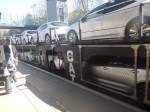
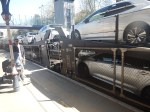
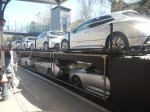




Note.
- The train had started at Toton
- The train was going to Dollands Moor in Kent.
- The train would then be transhipped through the Channel Tunnel.
- It will be a distance of 207.4 miles in the UK. Will that be classed as delivery mileage only?
I did think about calling this set of pictures – Japanese-designed cars, built in Derby, going between Toton and Europe, via Denmark Hill.
The End Of EVs Has Come, And It’s Toyota’s Fault – They’re Going To Change Everything, And It’s Going To Be Hydrogen
The title of this post, is the same as that of this article on El Diario 24.
These are the first two paragraphs.
The future of environmentally sustainable vehicles appears to be hydrogen based and Toyota is the frontrunner in developing this new technology.
The development of electric battery powered vehicles was a gamechanger for the industry and signified the first big shift since the introduction of fossil fuel powered vehicles all those years back. The current downside to electric vehicle, is of course, charging times as well as infrastructure to support charging stations. Japanese automaker, Toyota, has decided to switch lanes on the road to sustainability by investing research and funds into the development of a hydrogen powered system. This model has great potential in terms of environmental sustainability and user-friendliness but are the initial roll outs proving to be a success?
The article is from Argentina, which is a big country and range and charging could be a bigger factor, than in some countries.
But then Ricardo take a similar view to Toyota on hydrogen.
I also believe that hydrogen internal combustion engines will provide an alternative route to affordable zero-carbon vehicles, that are of all sizes.
I’m with Toyota on this one and the article is a must read.
Thoughts On Alstom At Derby
In the 1970s, I worked at ICI Plastics in Welwyn Garden City in a section called Computer Techniques.
We had a unique mandate from the Divisional Board, that allowed us to stick our nose into anybody’s business.
We certainly weren’t short of computing power, as in addition to the Division’s IBM 360 and dial-up services to GEISco, we had one of the handful of PACE 231R analogue computers in the UK.

Note.
- These machines didn’t use many semiconductors.
- These beasts could solve up to a hundred simultaneous differential equations and display the answers as graphs on the printers.
- Other UK companies and institutions with a PACE 231 R, included BMC, British Rail Research and Cambridge University.
- Two were linked together and these did the calculations for the Apollo flights.
- Their finest hour would surely have been to use their flexibility and power to bring home the stricken Apollo 13.
I got an interesting introduction to the industrial world in my three years at Welwyn.
One of our problems, was recruiting enough specialist engineers and programming staff.
So in the end, at one of our Monday morning meetings, we wrote our own advert for the Sunday Times.
We got all the staff we needed, but they weren’t the sort of recruits, you’d normally expect in the 1970s. Two were Indian and two were American, but all were recent immigrants. But they were certainly good enough to solve our problems.
I don’t think the Personnel Department were amused at our independent recruitment exercise.
I sometimes wonder if Bombardier (now Alstom) in Derby has a similar recruitment problem.
I am a Control Engineer and all these hybrid systems, that will power the transport of the future, be they trains, planes or automobiles, need lots of engineers with similar skills to myself and those of computer programmers. So do local companies; Rolls-Royce, JCB and Toyota, who probably have their own skill shortages in these areas, nick the best from Alstom.
It should be noted that in the railway press, it has been said that the Aventras from Derby were late because of software problems.
Toyota Unveils Prototype Hydrogen Fuel Cell Hilux
The title of this post, is the same as that of this article in The Engineer.
This is the sub-heading.
Toyota has today (September 5, 2023) unveiled a prototype hydrogen fuel cell-powered Hilux at Toyota Manufacturing UK’s Burnaston car plant in Derby.
This is the first paragraph.
The pick-up has been developed in a joint project with consortium partners Ricardo, ETL, D2H Advanced Technologies and Thatcham Research. and funding from the government via the Advanced Propulsion Centre (APC).
It would appear to be a consortium of some of the important great and good of British automobile engineering.
- Ricardo are a well-respected environmental and engineering consultancy, who probably know more about powering vehicles, than most companies have forgotten.
- Thatcham Research is the motor insurers’ automotive research centre.
- The Advanced Propulsion Centre collaborates with UK government, the automotive industry and academia to accelerate the industrialisation of technologies.
To my mind, the great advantage is that they are starting with a vehicle that has a formidable reputation.
When I outlined, the product to a friend, who had owned vehicles of this type, his reply was “Wow!”
Points from the article include.
- The expected driving range is more than 365 miles.
- The project began in early 2022 with a feasibility study undertaken by TMUK and Toyota Motor Europe with the consortium partners.
- Design and development started at July 1, 2022.
- Prototype construction began on June 5, 2023.
- The first vehicle was completed in three weeks.
- Ten preproduction examples will be produced before the end of the year.
- Ricardo supported preparations for the prototype build and will undertake complete evaluation of the vehicle over the coming months.
- Thatcham Research supported the project through the provision of sustainable repair consultancy and the preparation of hydrogen training for the repair market.
On paper, it looks like the consortium have taken an extremely useful vehicle and updated it for the 21st century.
Inly time will tell, if the design is right.
I have a few questions.
What Is The Towing Performance?
In my experience, many owners will want to tow heavy trailers, horse boxes or portable cafes and toilets for events like music festivals and agricultural and country shows.
If the towing performance matches that of a diesel Hilux, Toyota will probably have got it right.
How Many Miles Does The v Average Small Builder Or Smallholder Do In A Week?
Toyota must know this from servicing records of the diesel HiLux fleet.
I would suspect for many, 365 miles would allow a weekly or twice weekly refuelling!
Where Would Owners Refuel Their Hydrogen-Powered HiLux?
I suspect that Toyota dealerships Selling Hydrogen-Powered HiLux and Mirai, would make their own arrangements.
Would A Hydrogen-Powered HiLux Help To Decarbonise Work Sites?
I suspect it would and the electrical system could probably be used to power and charge small electrical tools.
Would A Hydrogen-Powered HiLux Be An Ideal Farm Runabout?
I am thinking about a friend of mine, who is a Suffolk farmer, who farms rare breed sheep.
He uses a big pick-up to tow a large trailer to take the sheep to market and shows and to move them around the country to other breeders. He has in the past used a golf buggy to check on his flocks and help with the welfare of the animals.
Some of his sheep are raised on the saltings, which gives them a unique flavour, but does involve the occasional accident, and sometimes needs a tricky recovery.
I spoke to him last night and he will be looking at this Toyota. His current vehicle does tend to frighten the sheep as it is too noisy.
Would A Hydrogen-Powered HiLux Work Well In Hot Countries?
The current HiLux is built in South Africa and those for Europe were generally made there.
So I would expect some African examples could have been made there.
Some hydrogen fuel cells need to be cooled, so would this be a problem in hot countries?
On the other hand , it does seem that hydrogen production in hot countries, with all that sun, might not be a problem.
Would A Hydrogen-Powered HiLux Make A Good Technical?
Diesel HiLux are popular as technicals and I suspect that the hydrogen-powered HiLux will be just as good.
Although the low-down mounting of the hydrogen tanks may make them susceptible to landmines.
Why Is It Not Called A HyLux?
I couldn’t resist asking that.
Conclusion
I like the hydrogen-powered HiLux and feel it will be a winner.
Toyota And VDL Groep To Convert Heavy-Duty Vehicles Into Hydrogen Fuel Cell Trucks
The title of this post, is the same as that of this article on Hydrogen Fuel News.
This is the first paragraph.
Toyota Motor Europe (TME) and Dutch VDL Groep have teamed up to covert VDL’s existing heavy-duty trucks into hydrogen fuel cell trucks using Toyota’s fuel cell modules, with a goal to accelerate decarbonizing the road logistics sector while also breaking into Europe’s zero-emission heavy duty H2 trucks market.
Note.
- According to their Wikipedia entry, VDL Groep seem to manufacture buses, coaches, chassis modules and vehicle components.
- In Ricardo Supports Toyota To Develop Its First UK-Based Hydrogen Light Commercial Vehicle, I wrote about conversion of the Toyota Hilux to hydrogen.
- There are a large number of companies all over the world, who will convert vehicles to hydrogen.
- It could be argued that Wrightbus and Alexander Dennis, have designed hydrogen buses, that could be conversions of existing designs.
- Cummins are selling diesel engines, that can be converted to hydrogen.
Could these points indicate, that one of the main routes to the decarbonisation of the heavier end of the commercial vehicle sector will be conversion of existing vehicles to hydrogen fuel?
And will this lead to smaller conversion kits to decarbonise vehicles like Land Rovers, Range Rovers, larger BMWs, Jaguars and Mercedes?
If you consider, that when I was growing up in the 1950s, you rarely saw a small diesel vehicle and how diesel came to grab a large market share, due to good engineering and some misguided tax changes from Gordon Brown, I don’t think it is unreasonable to believe that good engineering and perhaps well-thought out tax changes could create an affordable route to decarbonise a large proportion of vehicles.
If I was still driving and lived away from dreaded ULEZs, then I would be keeping my reliable diesel Jaguar estate.
Toyota Unveils AE86 Hydrogen Car Concept
The title of this post, is the same as that of this article on Hydrogen Fuel News.
The article is all about Toyota showing off, what they can do with hydrogen internal combustion engines.
It is an article that is very much worth a read.
This paragraph explains the work Toyota did to run the car on hydrogen.
Toyota explained that to create its new H2 burning internal combustion engine vehicle involved changing only “fuel injectors, fuel pipes, and spark plugs,” to make it possible to burn cleanly.
The article also suggests that conversion kits may be made available for older cars.
Hydrogen power is not one technology, but several that all might end up with sizeable shares of the market.
 The Anonymous Widower