Vestas and Vattenfall Sign 1.4 GW Preferred Supplier Agreement For UK Offshore Wind Project And Exclusivity Agreements For 2.8 GW For Two Other UK Projects
The title of this post, is the same as that of this press release from Vestas.
These are the first two paragraphs.
Vattenfall, one of Europe’s largest producers and retailers of electricity and heat, and Vestas have signed agreements to elevate the partnership between the two companies and their offshore wind business towards 2030. The agreements are another step in the right direction for offshore wind energy in the UK and follow the UK Government’s recent announcement about the parameters for the next Contracts for Difference Auction round, which sent a very positive signal to renewable energy investors.
The agreements for the three projects include a preferred supplier agreement (PSA) for the 1,380 MW Norfolk Vanguard West project, comprising 92 of Vestas’ V236-15 MW offshore wind turbine. Vattenfall and Vestas have further signed exclusivity agreements for the Norfolk Vanguard East and Norfolk Boreas projects with a total installed capacity of 2,760 MW. The two latter projects will potentially feature up to 184 V236-15 MW turbines. Once installed, the agreements also include that Vestas will service the projects under long-term Operations and Maintenance (O&M) service contracts. The agreements are another step forward for what will be one of the largest offshore wind zones in the world, with a capacity to power over 4 million UK homes.
It looks like Norfolk Boreas is back on Vattenfall’s list of active projects.
Vattenfall’s Norfolk zone now includes the following.
- Norfolk Vanguard West – 92 x V236-15 MW – 1380 MW
- Norfolk Vanguard East – 92 x V236-15 MW – 1380 MW
- Norfolk Boreas – 92 x V236-15 MW – 1380 MW
Note.
- All turbines appear identical.
- The deal includes long-term Operations and Maintenance (O&M) service contracts.
- 276 identical turbines plus service contracts looks like a good deal for Vestas.
Since I wrote Vattenfall Stops Developing Major Wind Farm Offshore UK, Will Review Entire 4.2 GW Zone in July 2023, which has this sub-heading.
Vattenfall has stopped the development of the Norfolk Boreas offshore wind power project in the UK and will review the way forward for the entire 4.2 GW Norfolk Zone, the Swedish energy company revealed in its interim report.
I have written the following posts.
- November 2023 – Aker Solutions Gets Vattenfall Nod To Start Norfolk Vanguard West Offshore Platform
- November 2023 – Norfolk Boreas Windfarm Work Could Resume After Energy Price Rise
- December 2023 – SeAH To Deliver Monopiles For Vattenfall’s 2.8 GW Norfolk Vanguard Offshore Wind Project
- Earlier in March 2023, I wrote Vattenfall Selects Norfolk Offshore Wind Zone O&M Base
It appears that with the deal announced with Vestas, Vattenfall now have everything they need to develop 4.2 GW of offshore wind.
- The O & M base will be Great Yarmouth.
- SeAH will build the monopile foundations on Teesside. Will all monopiles be identical?
- An energy price rise could change the cash flow of the project.
- Aker Solutions will build the offshore substations.Will all sub-stations be identical?
- Vestas will build the wind turbines.Will all turbines be identical?
Nothing has been said since July 2023 about how the power will be brought ashore.
In February 2022, I wrote Norfolk Wind Farms Offer ‘Significant Benefit’ For Local Economy, where I published this map from Vattenfall, which shows the position of the farms and the route of the cable to the shore.
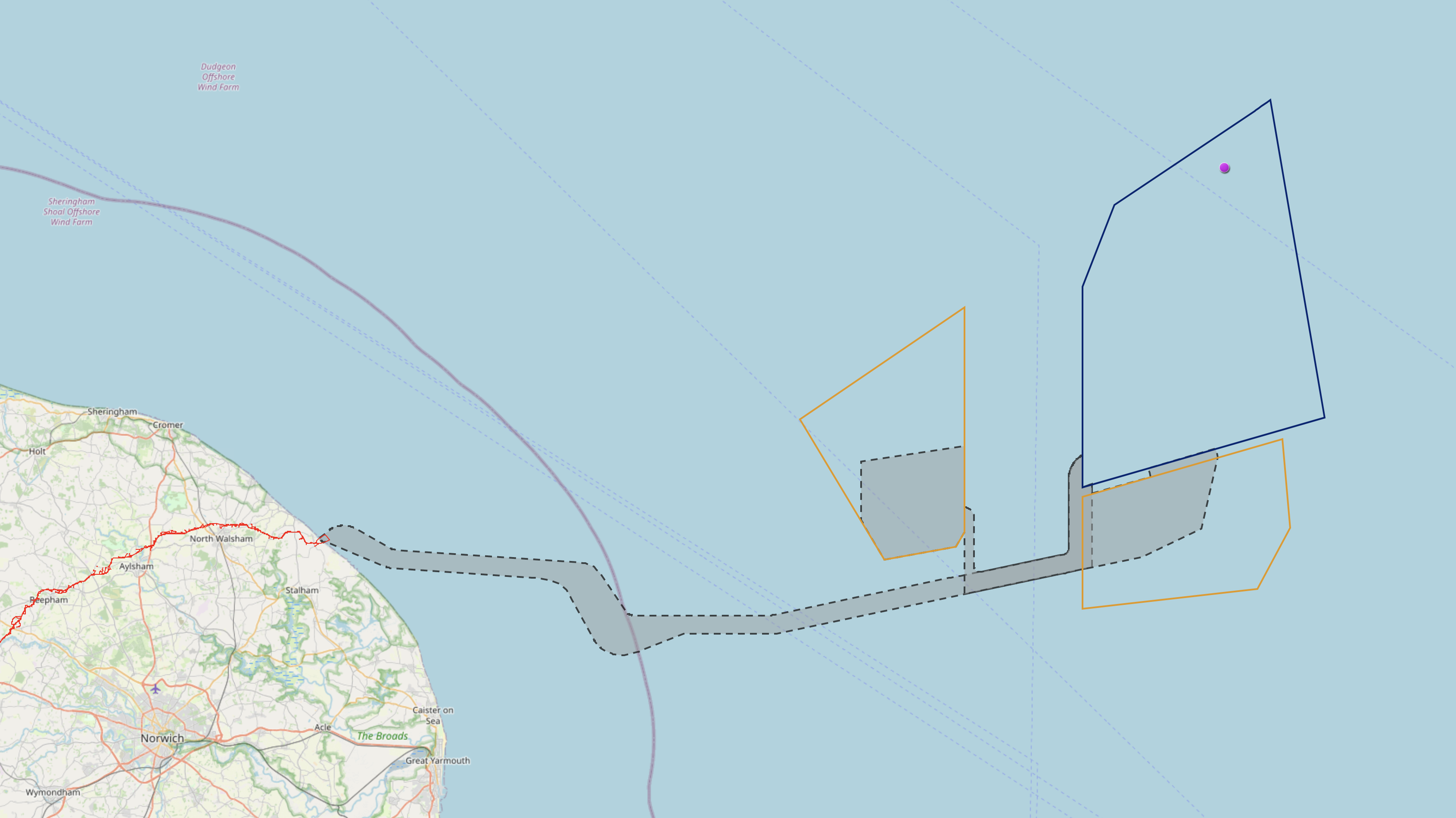
Note.
- The purple line appears to be the UK’s ten mile limit.
- Norfolk Boreas is outlined in blue.
- Norfolk Vanguard West and Norfolk Vanguard East are outlined in orange.
- Cables will be run in the grey areas.
- Cables to deliver 4.1 GW across Norfolk to the National Grid, will bring out the Nimbys in droves.
Landfall of the cables will be just a few miles to the South of the Bacton gas terminal.
In SeAH To Deliver Monopiles For Vattenfall’s 2.8 GW Norfolk Vanguard Offshore Wind Project, I asked if there could be an alternative approach.
Consider.
- If Vattenfall develop all three wind farms; Boreas, Vanguard East and Vanguard West, they will have 4.2 GW of capacity, when the wind co-operates.
- But East Norfolk is not noted for industries that need a large amount of electricity.
- I also feel, that the locals would object to a steelworks or an aluminium smelter, just like they object to electricity cables.
But would they object to a 4 GW electrolyser?
Could this be Vattenfall’s alternative approach?
- A giant electrolyser is built close to the landfall of the cable to the wind farms.
- The hydrogen could be piped to Bacton, where it could be blended with the UK’s natural gas.
- Bacton also has gas interconnectors to Balgzand in the Netherlands and Zeebrugge in Belgium. Could these interconnectors be used to export hydrogen to Europe?
- The hydrogen could be piped to Yarmouth, where it could be exported by tanker to Europe.
There would be only a small amount of onshore development and no overhead transmission lines to connect the wind farms to the National Grid.
There would be even less onshore development, if the electrolyser was offshore.
From their decisions, Vattenfall seem to have a new plan.
SeAH To Deliver Monopiles For Vattenfall’s 2.8 GW Norfolk Vanguard Offshore Wind Project
The title of this post, is the same as that of this article on offshoreWIND.biz.
This is the sub-heading.
Vattenfall has signed a contract with SeAH Wind to provide the monopiles for the 2.8 GW Norfolk Vanguard East and Norfolk Vanguard West offshore wind farms in the UK.
These two paragraphs outline the order.
The monopiles for the Norfolk Vanguard offshore wind farms will weigh up to around 2,200 tonnes and have a length of up to 96 metres.
Production is due to start in 2026 at SeAH Wind’s new under-construction facility in Teesside, northeast England.
Note.
- Norfolk Vanguard now appears to be two 1.4 GW wind farms; East and West, which adds up to a 2.8 GW Norfolk Vanguard wind farm.
- There is no mention of the 1.4 GW Norfolk Boreas wind farm in the article, except that it has a Contract for Difference (CfD), whereas I don’t think Norfolk Vanguard has a contract.
- Would anybody buy wind farm foundations without a contract?
It looks like there has been some very tough negotiations between Vattenfall, the Crown Estate and the UK Government.
Is There An Alternative Approach?
Consider.
- If Vattenfall develop all three wind farms; Boreas, Vanguard East and Vanguard West, they will have 4.2 GW of capacity, when the wind co-operates.
- But East Norfolk is not noted for industries that need a large amount of electricity.
- I also feel, that the locals would object to a steelworks or an aluminium smelter, just like they object to electricity cables.
But would they object to a 4 GW offshore electrolyser?
Could this be Vattenfall’s alternative approach?
- A giant electrolyser is built close to the landfall of the cable to the wind farms.
- The hydrogen could be piped to Bacton, where it could be blended with the UK’s natural gas.
- Bacton also has gas interconnectors to Balgzand in the Netherlands and Zeebrugge in Belgium. Could these interconnectors be used to export hydrogen to Europe?
- The hydrogen could be piped to Yarmouth, where it could be exported by tanker to Europe.
There would be only a small amount of onshore development and no overhead transmission lines to connect the wind farms to the National Grid.
There would be even less onshore development, if the electrolyser was offshore.
From their decisions, Vattenfall seem to have a new plan.
Norfolk Boreas Windfarm Work Could Resume After Energy Price Rise
The title of this post, is the same as that of this article on the BBC.
This is the sub-heading.
There are growing hopes that work on a £10bn windfarm off the Norfolk coast will resume after the government agreed to pay more for energy production.
The first three paragraphs, indicate how positions have changed,
Earlier this year, Swedish company Vattenfall paused work on Norfolk Boreas located 50 miles off the coast of Cromer.
But ministers have agreed to a 66% increase in the amount they will pay for offshore electricity generation.
Vattenfall described the move as “a very positive signal”.
It certainly looks like the Government is looking more favourably at wind power developers.
Aker Solutions Gets Vattenfall Nod To Start Norfolk Vanguard West Offshore Platform
The title of this post, is the same as that of this article on offshoreWIND.biz.
This is the sub-heading.
Aker Solutions has been awarded a limited notice to proceed contract from Vattenfall for the Norfolk Vanguard West offshore wind farm in the UK. The contract has a balanced risk-reward profile based on principles for long-term collaboration.
Vattenfall seems to be a bit stop and go on their two Norfolk wind farms; Norfolk Vanguard and Norfolk Boreas.
- In Vattenfall Selects Norfolk Offshore Wind Zone O&M Base, I talk about how Yarmouth has been selected as Vattenfall’s O&M Base.
- In Vattenfall Stops Developing Major Wind Farm Offshore UK, Will Review Entire 4.2 GW Zone, I talk about how Vattenfall have put Boreas on hold and they will be reviewing the whole Norfolk Zone.
These four paragraphs outline the work.
The scope of work for Aker Solutions includes the engineering, procurement, construction, and installation (EPCI) of the high voltage direct current (HVDC) offshore substation.
The fabrication of the topside will be executed in a joint venture with Drydocks World Dubai, and the substructure will be fabricated at Aker Solutions’ yard in Verdal, Norway.
Located more than 47 kilometres from the Norfolk coast and with an installed capacity of 1.4 GW, Norfolk Vanguard West will be the first phase of Vattenfall’s Norfolk Offshore Wind Zone, which also includes the Norfolk Vanguard East and Norfolk Boreas developments.
The Norfolk Vanguard West offshore wind farm is subject to regulatory approvals and Vattenfall’s final investment decision.
Note that Vattenfall are now talking about three wind farms; Norfolk Vanguard West, Norfolk Vanguard East and Norfolk Boreas.
These three paragraphs talk about finance and costs from Aker Solutions point-of-view.
According to Aker Solutions, the company will at this stage book a contract value of about NOK 4 billion (about EUR 334 million) in the fourth quarter of 2023 in the Renewables and Field Development segment, reflecting the compensated work that is to be performed until the expected final investment decision.
Following the award, the total contract value for Aker Solutions is estimated to be about NOK 6 billion.
“The development of the entire Norfolk Offshore Wind Zone could ultimately require up to three HVDC platforms in succession, which would improve the long-term predictability and give positive repeat effects and standardization within the supplier industry,” said Sturla Magnus, Executive Vice President of New Build at Aker Solutions.
Could it be that a 3 x NOK 6 billion or £1.3 billion order has convinced Aker Solutions to invest alongside Vattenfall in the three Norfolk wind farms?
This map shows the two farms in relation to the coast.
Note.
- The purple line appears to be the UK’s ten mile limit.
- Norfolk Boreas is outlined in blue.
- Norfolk Vanguard is outlined in orange and has two parts; West and East.
- Cables will be run in the grey areas.
This second map shows the onshore cable.
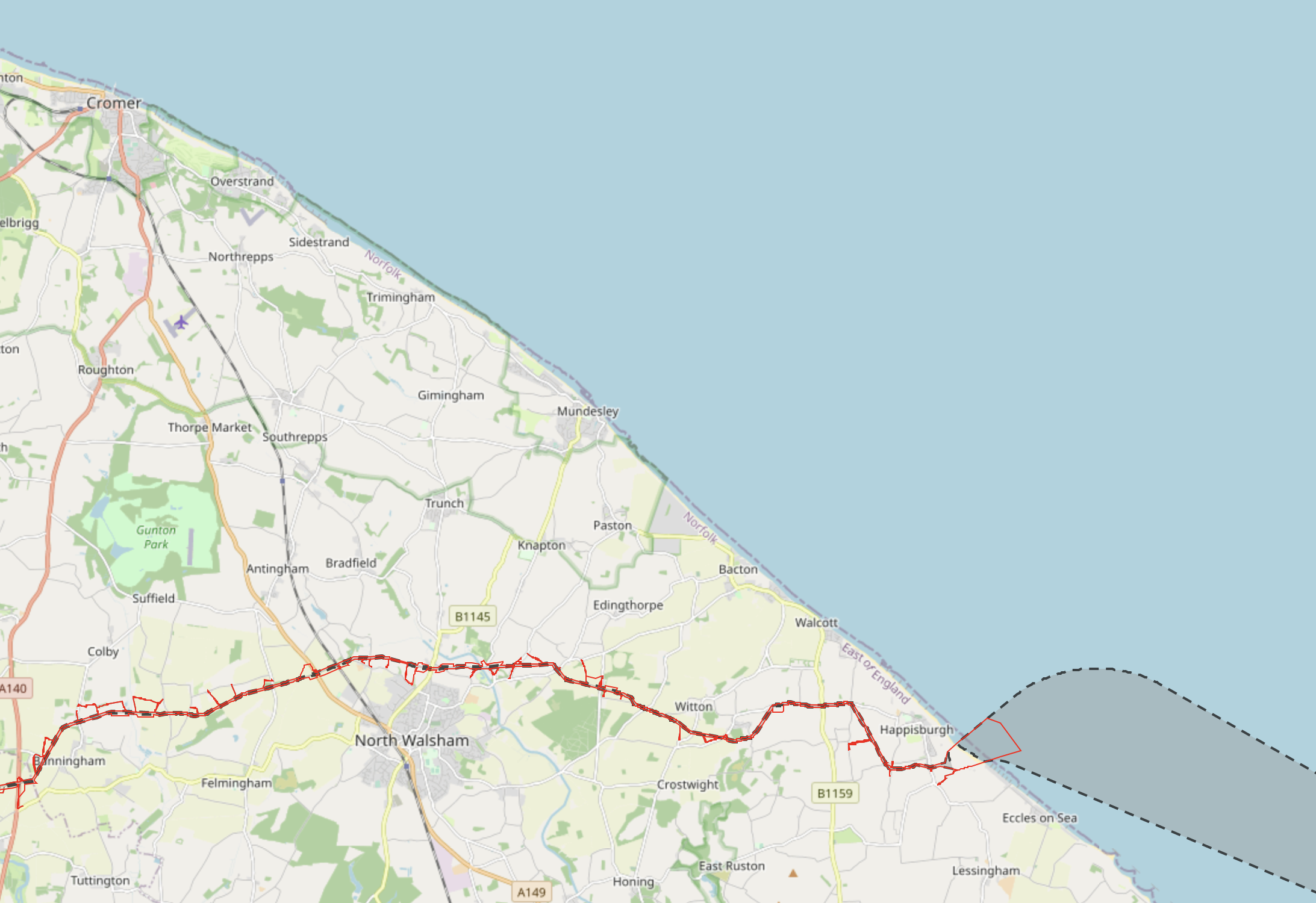
Note.
- The cables are planned to come ashore between Happisburgh and Eccles-on-Sea.
- Bacton is only a short distance up the coast.
- The onshore cable is planned to go from here across Norfolk to the Necton substation.
This layout would appear to need only one offshore cable for all three wind farms.
Conclusion
Has Aker stepped in to rescue Vattenfall’s 4.2 GW project?
Scotland’s 25 GWh Energy Storage Arriving By Stealth
In SSE Unveils Redevelopment Plans For Sloy Hydro-Electric Power Station, I introduced SSE Renewable’s plan to convert the UK’s largest hydro-electric power station into a pumped storage hydroelectric station, that can store 25 GWh of electricity and generate 152.5 MW of electricity.
After a public consultation in July, which unfortunately, I was unable to get to, SSE have now published a comprehensive document, which details their plans.
These are some points from the document.
- There will be no increase in the generating capacity of 152.5 MW, which is about half the size of a gas-fired power station.
- SSE designed a similar scheme for Sloy in 2009.
- Pumped storage systems need a lot of water. The Loch Sloy scheme has Loch Lomond.
- The development of pumped storage at Sloy would only require construction work to be carried out in the grounds of the existing power station.
- No permanent new works would be required at Sloy Dam or outside of the existing station boundary.
- A new above ground structure would be required which would contain a main hall with vehicular access, laydown areas, an overhead travelling crane, electrical switchgear and control systems.
- A new underground pump hall would be required to house two pumps. This would link to the intake structure and would be approximately 20m below the existing ground level.
- The existing tailrace to Loch Lomond, will be used to bring water to the pumps.
- Construction could start in 2025, with completion in 2027.
This redevelopment is a much less complex construction project, than building the original power station in the 1950s.
It also looks like the construction will not cause much disruption in the local area.
Hence my view, that this storage is arriving by stealth and won’t be noticed by those passing the power station.
After reading this SSE document, I wonder how many similar 1950s hydroelectric power stations have been upgraded to pumped storage stations in the last few years.
Also, if their Sloy scheme is successful, will SSE be looking for other hydroelectric power stations to convert to pumped storage?
This article on renews.biz is entitled Vattenfall Plans To Build 730MW Of Swedish Hydro Power, where this is a paragraph.
Vattenfall is also conducting a pilot study to investigate reinstating the Juktan power station on the Storjuktan lake adjacent to the Umeälven river in Västerbotten, to a pumped storage plant with a capacity of up to 380MW.
Note.
- Juktan power station was built as a pumped storage station and converted to a standard one.
- It has a web page.
- As the paragraph says it could be converted back!
So other companies and countries are thinking the same way!
Strathclyde University’s Prediction
This page on the Strathclyde University web site, gives these figures in GWh for the possible amounts of pumped storage that can be added to existing schemes.
- Errochty – 16
- Glasgarnock – 23
- Luichart – 38
- Clunie – 40
- Fannich – 70
- Rannoch – 41
- Fasnakyle – 78
- Tummel – 38
- Ben Lawers – 12
- Nant – 48
- Invermoriston – 22
- Invergarry – 41
- Quoich – 27
- Sloy – 20
That is a total of 514 GWh.
These figures must give SSE food for thought.
These new schemes are also being planned.
- Balliemeanoch – 1.5GW/45 GWh
- Coire Glas – 1.5 GW/30 GWh
- Corrievarkie – 600 MW/14.5 GWh
- Fearna – 1.8 GW/37 GWh
- Loch Earba – 900 MW/33 GWh
- Loch Kemp – 300 MW/9 GWh
- Loch Na Cathrach/Red John – 450 MW/2.8 GWh
These could bring the potential pumped storage in Scotland to 685.3 GWh.
Is Sizewell C Needed?
I am generally pro-nuclear, but I am not sure if building a large nuke at Sizewell is the right action.
Consider.
- East Anglia has 3114 MW of offshore wind in operation.
- East Anglia has 6772 MW of offshore wind under construction, with Contracts for Difference or proposed.
- Vattenfall are considering abandoning development of their large wind farms off the Norfolk coast, which are proposed to have a capacity of 3196 MW.
- If the two Vattenfall wind farms don’t get built, it is likely that East Anglia will have around 6700 MW of offshore wind capacity.
- Sizewell C has a proposed nameplate capacity of 3260 MW. Some might argue, that to back up East Anglia’s offshore wind power, it needs to be larger!
- Norfolk and Suffolk no large electricity users, so are Vattenfall finding they have a product no one wants to buy.
- National Grid is developing four interconnectors to bring power from Scotland to the Eastern side of England, which will back up wind power in the East with the massive Scottish pumped storage, that is being developed.
- National Grid and their Dutch equivalent; TenneT are developing LionLink to connect the UK and the Netherlands to clusters of wind farms between our countries in the North Sea.
- Kent and East Anglia have several gas and electric interconnectors to Europe.
- Sizewell is well-connected to England’s grid.
These are my thoughts.
Energy Storage At Sizewell
Consider.
- Sizewell is well connected to the grid.
- It has the sea on one side.
- It could easily be connected to the large offshore wind farms, thirty miles out to sea.
If large energy storage could be built on the Sizewell site or perhaps under the sea, then this energy could be recovered and used in times of low wind.
Perhaps the technology of the STORE Consortium, which I discussed in UK Cleantech Consortium Awarded Funding For Energy Storage Technology Integrated With Floating Wind, could be used.
In this system, energy is stored in 3D-printed concrete hemispheres under the sea.
A Small Nuclear Reactor Cluster At Sizewell
Rolls-Royce are proposing that their small modular reactors will have a capacity of 470 MW.
Perhaps a cluster of seven small modular reactors at Sizewell, with a building schedule matched to the need to back up wind farms would be better and easier to finance.
I also feel a cluster of SMRs would have less risk and would be less likely to be delayed.
Where Is Generating Capacity Needed In The UK?
These areas already have large amounts of offshore wind in operation or proposed to be built before 2030.
- Celtic Sea
- North Wales
- Liverpool Bay
- Cumbria
- Scotland
- Scotland’s Offshore Islands
- North East England
- Humberside
- Lincolnshire
- East Anglia
- Thames Estuary
- Kent
- Sussex
Amongst the back up for these wind farms, there are only two modern nuclear stations; Sizewell B and the still-to-open Hinckley Point C.
If you look at a map of England and its power generation, there is a tremendous gap of capacity South of a line between Hinckley Point and Brighton, with little or no offshore wind and no nuclear.
There is probably a need for a large nuke near Weymouth.
Alternatively, perhaps several SMRs could be built underneath places like Salisbury Plain, Dartmoor and Exmoor!
Conclusion
We probably need the nuclear electricity from another Hinckley Point C-sized nuclear power station, so that we have adequate back-up for offshore wind.
But I am not sure that Sizewell is the right place to build it.
AI Tech Tracking Seabirds At Aberdeen Bay Offshore Wind Farm
The title of this post, is the same as that of this article on offshoreWIND.biz.
This is the sub-heading.
Vattenfall, Norwegian AI technology start-up Spoor, and British Trust for Ornithology have teamed up on a project that will test AI technology in tracking 3D flight paths of seabirds flying near the wind turbine blades at the Aberdeen Bay Offshore Wind Farm in Scotland.
This is the first paragraph.
The project has already started, with four cameras already installed and collecting data on birds’ 3D flight paths throughout the wind farm and in the immediate vicinity of the turbine blades. Data on seabird movements has already started coming in and validation trials have been completed both offshore, with an observer present, and onshore, with a drone, according to Vattenfall.
This looks like a very neat piece of technology, that hopefully will solve how birds interact with wind turbines.
From my experience of landing and taking off light aircraft at the old Ipswich Airport, where there were a lot of seabirds, my money would be on that birds will learn to use their AI (Avian Intelligence) to avoid the blades of wind turbines.
Vattenfall Stops Developing Major Wind Farm Offshore UK, Will Review Entire 4.2 GW Zone
The title of this post, is the same as that of this article on offshoreWIND.biz.
This is the sub-heading.
Vattenfall has stopped the development of the Norfolk Boreas offshore wind power project in the UK and will review the way forward for the entire 4.2 GW Norfolk Zone, the Swedish energy company revealed in its interim report.
This is the first paragraph.
The developer said that the decision to stop the project was made due to ”challenging market conditions”, adding that ”financial frameworks have not adapted to reflect the current market conditions” so far.
Vattenfall are also complaining about inflation and cost increases if up to 40 %.
I have my thoughts.
Great Yarmouth Support Base
In some ways, I find this decision to pull out strange, as it was only in March this year that Vattenfall signed a contract with Peel Ports to build a support base for their Norfolk wind farms at Great Yarmouth.
I don’t think that Peel Ports will be too bothered, as they are a well-funded company and there are plenty of wind farm proposals in the sea around Norfolk, who could use a base at Great Yarmuth.
Cable Routes And Nimbys
These Norfolk wind farms have suffered opposition from Nimbys to the cable route, that will be taking the electricity away from the coast. This may have increased the cost of delivery of the electricity to market.
An Offshore Cable Route
In January 2022, I wrote Is There A Need For A Norfolk-Suffolk Interconnector?, where I analysed the amount of energy, that will be produce in Norfolk and Suffolk.
This was my conclusion.
I believe there are a lot of possibilities, that would meet the three objectives, I stated earlier.
-
- Avoid as much disruption on the land as possible.
- Create the capacity to deliver all the energy generated to customers, either as electricity or hydrogen.
- Create an expandable framework, that would support all the wind farms that could be built in the future.
In addition, simple mathematics says to me, that either there will need to be extra capacity at both Bicker Fen and Bullen Lane substations and onward to the rest of the country, or a large electrolyser to convert several gigawatts of electricity into hydrogen for distribution, through the gas network.
Note.
- An offshore Multiple Purpose Interconnector (MPI) could be built between Bicker Fen in Lincolnshire and the Isle of Grain.
- An electrolyser could be built offshore, joined to the MPI and connected to the Bacton gas terminal.
- There could be local offshore hydrogen storage.
- Bicker Fen is connected to the Viking Link to Denmark.
- An offshore link could have its Southern end at the Isle of Grain, from where the electricity can be exported to Germany, by the NeuConnect interconnector, that is under construction.
There must be sufficient capacity, so that all energy is delivered to customers, as either electricity or hydrogen.
I’ve always favoured delivering electricity from these and other East Anglian wind farms with an offshore cable route away from the coast between perhaps Bicker Fen in Lincolnshire and the the Isle of Grain, from where the electricity can be exported to Germany, by an interconnector, that is being built.
Competition From Scotland
National Grid are improving the offshore grid between Scotland and Humberside, so perhaps Vattenfall might have a competition problem, when it comes to selling their electricity.
If you have no market for a product, then the price drops.
Is East Anglia A Bad Place To Have Surplus Electricity?
Consider.
- It should also be remembered that East Anglia has no heavy electricity users.
- There are also no substantial mountains for building large pumped-storage hydro schemes, as Scotland is proposing to do.
- The construction of Sizewell C will add more electricity to the area.
In my view the best thing to do would be to build a giant electrolyser near the Bacton gas terminal.
Was It A Mistake For Vattenfall To Make A Bid?
Looking at the delivery problems for the Norfolk wind farms, I think that Vattenfall made a bad decision to bid for them.
- The wind farms are too far North to serve London and the South-East and to export the electricity to the Continent.
- They are also too far South to serve the industry in the North around the Humber and the Tees.
It looks an obvious case of wrong Location, Location and Location.
Could Norfolk Boreas And Norfolk Viking Work Economically?
I suspect these ideas could help.
- A Multiple Purpose Interconnector (MPI) would be built between Bicker Fen in Lincolnshire and the Isle of Grain.
- The MPI would connect to any wind farms on the route.
- An offshore electrolyser opposite Bacton would be connected to the MPI to use surplus electricity to generate hydrogen, which would be distributed through the gas grid.
The whole network of wind farms, interconnectors, electrolysers and storage needs to be comprehensively designed, so that it provides the South-East corner of England, with enough reliable electricity and hydrogen.
Cara Delevingne Champions Fossil Free Hydrogen In Dazzling Beauty Campaign
The title of this post, is the same as that of this article on Hydrogen Fuel News.
This is the sub-heading.
The eco-conscious Delevingne teamed up with Vattenfall to raise awareness about clean energy.
This is the first paragraph.
The English model and actress is no stranger to beauty campaigns, having experience as the face of Burberry, Chanel, and Yves Saint Laurent, but her latest campaign with Swedish multinational energy company Vattenfall, aims to raise awareness of clean power using fossil free hydrogen compared to burning fossil fuels.
There is also this video.
I suppose she was paid well for it and after her BBC series; Planet Sex With Planet Sex With Cara Delevingne, we all know she’s game for many things, but you wouldn’t catch me jumping into water like that, as I can’t swim, despite endless attempts to learn.
Dutch Stop Offshore Wind Turbines To Protect Migratory Birds In ‘International First’
The title of this post, is the same as that of this article on offshoreWIND.biz.
This is the sub-heading.
The wind turbines at Borssele and Egmond aan Zee offshore wind farms were stopped for four hours on 13 May, to help migrating birds pass by safely.
These three paragraphs outline the measures taken to protect the migrating birds.
According to the Dutch Government, this is the first time such a measure has been applied and is in line with the approach of the government and participating companies to increasingly focus on ecology and biodiversity in offshore wind farms.
The wind turbines’ speed will be reduced to a maximum of two rotations per minute during the predicted night-time peak migration to give the birds a safe passage.
The shutdown was part of a pilot phase, which could become standard this autumn and will also include wind farms that are still being built or will be constructed in the future.
I wonder how this Dutch action fits with research from Vattenfall, that I wrote about in Unique Study: Birds Avoid Wind Turbine Blades.
 The Anonymous Widower