Queens Park Station To Go Step-Free
This document on the Government web site is entitled Access for All: 73 Stations Set To Benefit From Additional Funding.
Queens Park station is on the list.
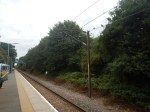
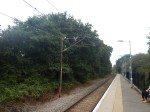
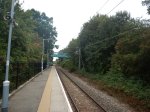
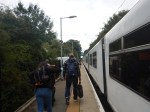
These pictures show the station and the current access.


This is one station, where the Bakerloo Line and Watford DC Lines have fairly good step-free access between train and platform.
The following needs to be done.
- Provide lifts from both platforms to the booking hall and the gateline.
- Extra services to Blackpool may terminate at the station and this would mean adding step-free access to the main line platforms.
I feel the most difficult part of the project will be adding the step-free access, whilst keeping the station fully open.
A Different Energy Storage Technology
Recently, two articles on the web have been caught in my Google alerts.
- This article on Energy Storage News, which is entitled ‘Flow Machine’ Maker RedT Gets £3.2m Funding Needed To Power Projects
- This article on Mining Review Africa, which is entitled Bushveld Minerals: A Large-Scale Battery Storage Contender
Both articles are about energy storage using a Vanadium Redox Flow Battery.
This is a paragraph from the Bushveld article.
The project will be implemented in two phases for a total of 1 400 MWh of energy storage capacity – 800 MWh in Phase 1 and an additional 600 MWh in Phase 2.
When you consider that with lithium-ion technology battery capacity is normally talked about in kWH, these are impressive amounts of stored energy.
Reading the Wikipedia post shows that the batteries rely on toxic chemicals like sulphuric acid and vanadium oxide, which would probably rule out mobile applications.
Conclusion
Having read all the two articles and the Wikipedia entry, I wouldn’t be surprised to see some form of technology like this emerge for large scale energy storage to back up intermittent power sources like solar, wind and wave.
Now It’s Thieves On The Line As Crooks Target Railway Cables
The title of this post is the same as that of an article in The Times on Tuesday.
I was involved in a similar project with British Rail, where they were looking at patterns in signalling cable faults on the East Coast Main Line. My software Daisy was used to display the patterns.
I know in this case British Rail got a solution.
I even have their internal report somewhere!
Britain Hoes A Record Five Days Without Burning Coal
The title of this post came from an article in Tuesday’s Times!
It says it all!
Good isn’t it!
Although it’s probably not true, as there must be a few blacksmiths, who used coke to shoe a few horses.
Greater Anglia’s Class 720 Trains
Greater Anglia have ordered a new fleet of Class 720 trains for their suburban routes.
- 22 x 10-car trains.
- 89 x 5-car trains.
What do we know about the formation of Aventra trains?
The Formation Of Class 345 Trains
In A Detailed Layout Drawing For A Class 345 Train, I detailed the formation of a Class 345 train as follows.
DMS+PMS+MS1+MS3+TS(W)+MS3+MS2+PMS+DMS
Several things can be said about the formation.
Lots Of Cars With Motors
The Class 345 train has a high-proportion of cars with motors.
This may seem to be the wrong way to go, as motors cost money and lots of them, may make a more complicated and unreliable train.
But think of a tug-of-war team, which applies the force over a large patch of ground!
Having lots of motors may have advantages.
- Force to move and accelerate the train is applied along the train.
- It may make regenerative braking smoother and more controlled.
- There is a greater contact area with the rail, so it may make train performance better with leaves on the line and other poor rail conditions.
- The redundancy may mean greater reliability.
A clever control system on the train, may be able to distribute power to extract the best performance from a train, for various rail conditions, passenger loading and perhaps with one motor out of action.
Two-Half Trains
The Class 345 train formation clearly shows two half-trains with this formation.
DMS+PMS
Are these like mini-locomotives with seats for passengers at each end of the train?
With respect to a Class 345 train, I have observed the following.
- The trains have two pantographs.
- In a seven-car train, there is just a TS(|W) car in the middle. This is a trailer car with four wheelchair spaces.
- A nine-car train has two extra motor cars inserted.
So are all seven-car and more trains, built as two half-trains with an appropriate number of cars in the middle to get the required length?
The concept surely means that in many scenarios of partial train failure, the remaining half-train can take passengers to a safe evacuation point, dragging the other half-train with it. This is obviously important in Crossrail’s long tunnel.
A Pair Of Power-Cars
In this article in Global Rail News from 2011, which is entitled Bombardier’s AVENTRA – A new era in train performance, gives some details of the Aventra’s electrical systems. This is said.
AVENTRA can run on both 25kV AC and 750V DC power – the high-efficiency transformers being another area where a heavier component was chosen because, in the long term, it’s cheaper to run. Pairs of cars will run off a common power bus with a converter on one car powering both. The other car can be fitted with power storage devices such as super-capacitors or Lithium-ion batteries if required. The intention is that every car will be powered although trailer cars will be available.
Unlike today’s commuter trains, AVENTRA will also shut down fully at night. It will be ‘woken up’ by remote control before the driver arrives for the first shift
This was published over eight years ago, so I suspect Bombardier have refined the concept.
But the concept of splitting the power components between two cars must be a good one, as there is twice the space underneath the cars, compared to a traditional single car with all the power components.
In the Class 345 train, it looks like the pair of cars are the DMS and PMS cars.
- So a nine-car Class 345 train has five cars between the two pairs of power-cars.
- Motored or trailer cars can be added to lengthen the train.
Shorter trains would only have one pair of power-cars and could be as short as three cars.
Greater Anglia’s Train Needs
Ten- and five-car trains may be OK for many of Greater Anglia’s routes, but there could be a few problems.
Hertford East Branch
These pictures show an eight-car Class 317 train at Hertford East station.
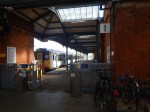
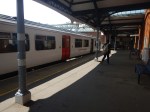
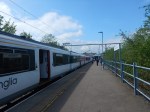
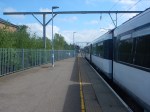
Note how both platforms are not much longer than the 160 metres of a pair of four-car Class 317 trains. Would the capacity of a five-car train be enough for the route?
Braintree Freeport Station
The pictures show Braintree Feeport station, which also seems to be sized to fit an pair of four-car Class 317 or Class 321 trains..
The same questions as with Hertford East station arise!
Wickford Station Bay Platform
This picture shows a Class 321 train parked in the bay platform at Wickford station, that is used for the Crouch Valley Line.
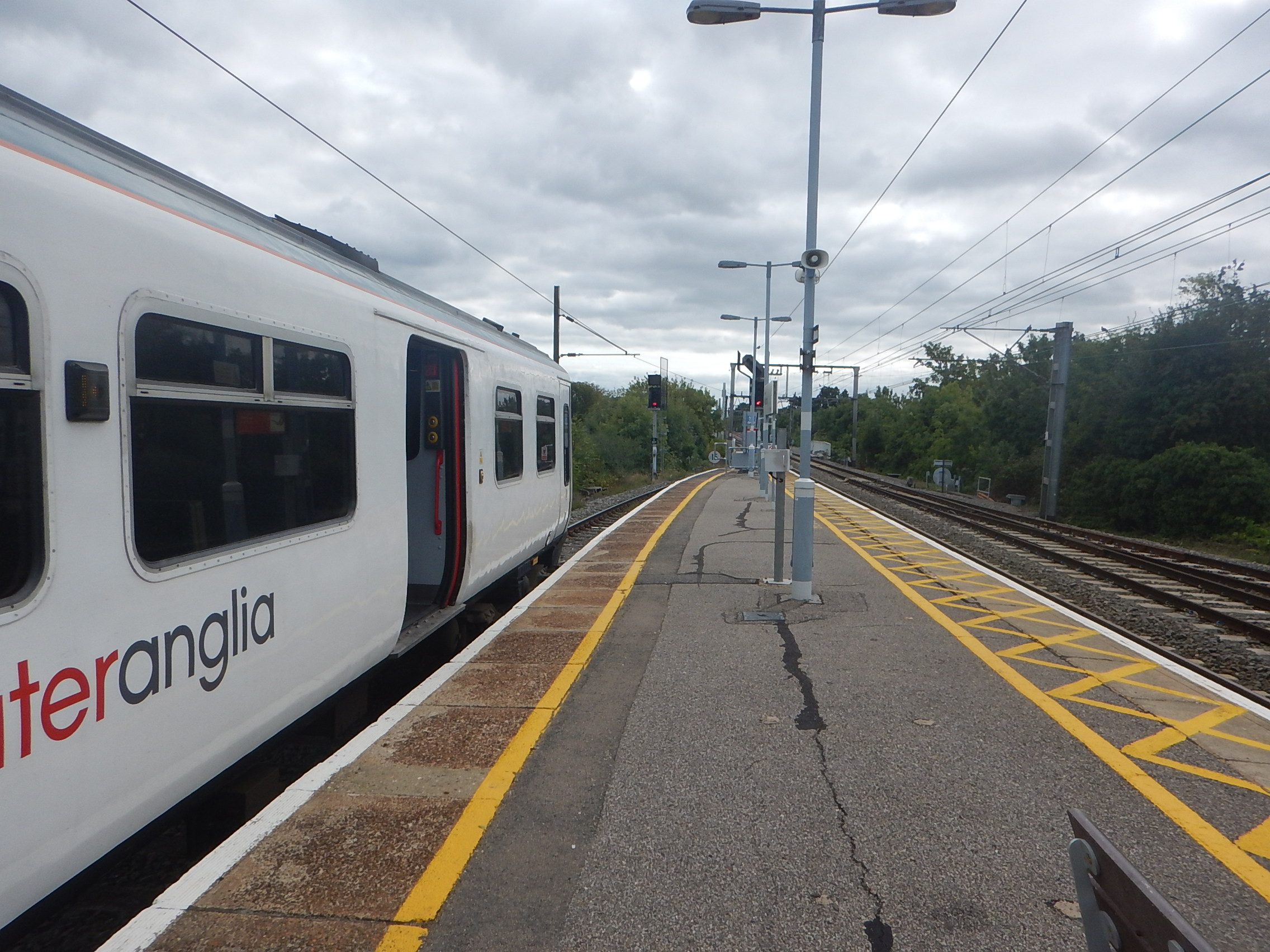
I would estimate that there is perhaps another twenty metres of space in the platform.
As a five-car Class 720 train is 122 metres long, as opposed to the eighty metres of the four-car Class 321 train in the picture, it will be a tight squeeze to get the new train in the platform.
But a four-car Class 720 train would probably fit.
Manningtree Station Bay Platform
Are there similar problems at Manningtree station, that a four-car Class 720 train would solve?
The Length And Capacity Of Different Trains
This table shows the length and capacity of different trains.
- Four-car Class 317 train – 80 metres – Standard – 267/234 – First – 22/24 – Total 289/258
- Eight-car Class 317 train – 160 metres – Standard 534/468 – First -44/48 – Total 578/516
- Four-car Class 321 train – 80 metres – Total 309
- Eight-car Class 321 train -160 metres – Total 618
- Twelve-car Class 321 train -240 metres – Total 927
- Four-car Class 360 train – 80 metres – Total 280
- Eight-car Class 360 train – 160 metres – Total 560
- Twelve-car Class 360 train – 240 metres – Total 840
- Five-car Class 720 train – 122 metres – Total 540 – Standing – 145
- Ten-car Class 720 train – 243 metres – Total 1100 – Standing – 290
Note that two five-car Class 720 trains, working as a ten-car formation have virtually identical length and capacity to a ten-car Class 720 train.
Ten-Car Services
We already know, that the ten-car Class 720 trains have been designed to replace twelve-car formations of Class 321 and Class 360 trains to places like Clacton, Ipswich and Southend.
- They are similar lengths within a few metres.
- The ten-car Class 720 trains give an 19% increase in seats over twelve-car Class 321 trains.
- The ten-car Class 720 trains give an 31% increase in seats over twelve-car Class 360 trains.
An advantage must surely be that with two fewer cars, the trains will need less maintenance.
Five-Car Services
But how does a five-car Class 720 train compare with an eight-car formation of Class 317 or Class 321 trains?
- Seat numbers are similar depending on the layout of the older train.
- Standees will probably have more handholds.
- The walk-through trains allow passengers to circulate around the train to find spare seats.
- The new trains will fit any platform that can be served by an existing eight-car service.
- With their better performance will the Class 720 trains be running faster services?
- There are three cars less to maintain.
I feel that Greater Anglia have done their sums and feel that more train capacity and extra services might be a better way to increase total capacity than run longer trains, which will need expensive platform lengthening.
I’ll take the Braintree Branch services as an example, where extra services could be better than longer trains.
Currently, service is hourly, but a combination of some of the following might allow a doubling of frequency.
- A passing loop.
- Faster modern trains with shorter dwell times.
- An improved timetable.
Two five-car Class 720 trains per hour as opposed to an hourly eight-car Class 321 train, would be around a doubling of capacity.
Four-Car Services
A four-car class 720 train would be ninety-six metres long and probably around 450 seats.
Bombardier and London Overground have shown recently, shortening a Class 378 train is a simple operation.
I think it is reasonable to expect that creating a four-car Class 720 train will be just as easy.
So if Greater Anglia need to run four-car Class 720 trains on certain routes, they can just take a car out of the required number of trains.
First Class
It should be noted that none of the services operated using Class 720 trains will have First Class after this year.
This article on the BBC, which is entitled Greater Anglia: First Class seats scrapped on most trains, gives details and an explanation of Greater Anglia’s thinking.
I have searched the Internet and can’t find any complaints.
But Greater Anglia are only putting themselves in line with c2c, who offer no First Class seats on any service.
Conclusion
I can’t wait to ride these trains, later in the year.
Where Have All The Cash Machines Gone?
After an excellent gluten-free breakfast in Le Pain Quotidien at Monument, I thought that my wallet needed a top-up of cash.
As I wanted to catch the DLR, I walked East to Tower Gareway station.
I didn’t see a single cash machine!
It’s not that I use much cash, but I do like to pay in chain restaurants, where tips are important to staff, and for newspapers in small shops and for taxis using cash!
I know that I can use contactless payments for most of these transactions, but I prefer cash sometimes!
I don’t trust some shops having had my card details stolen by a scam in what was a franchise of a well-known chain. As I walked through the door at home an hour later, my phone rung and it was the credit card company, asking if I’d spent a lot of money in the last couple of hours in Las Vegas. They said, that someone had and they’d refused all payments and stopped the card.
So I didn’t lose a penny and I only had all the inconvenience of waiting for a new card and changing details on a few regular payments.
The shop closed a week or so later!
But I am naturally cautious and prefer not to get caught again, by a clever piece of what looks like contactless technology. Even beggars and buskers are now using it!
Hence, my continued use of cash!
I don’t particularly worry about the disappearance of cash machines, as living close to the centre of London, there are plenty about. But as on Saturday, when I walked for a kilometre in a tourist area of the City, they are getting fewer and further apart.
Many stations now have cash machines and this surely should be the norm!
But with bank branches disappearing fast, it is all part of moving towards a cashless society!
Global Centre Of Rail Excellence Takes A Step Forward With Formal Partnership Arrangements
The title of this post is the same as that of this article on Wales Online.
This is the first two paragraphs.
The planned £100m Global Centre of Rail Excellence on the border of Neath Port Talbot and Powys will take a step closer to reality when councillors meet to formalise partnership arrangements next week.
Plans for the centre which were announced by the Welsh Government last summer involve a new facility to test trains in the UK.
In my view this centre is much needed, so that trains manufactured and modified in the UK, can be adequately tested in as short a time as possible.
Sending trains to be tested half-way across Europe, as currently sometimes happens, is not an efficient method of getting trains into service.
Alstom Coradia iLint Hydrogen-Powered Train Video
I’ve just found this video from Alstom.
Intriguingly, the video was filmed at Braunschweig Hauptbahnhof, which is in another part of Germany, about two hundred kilometres to the South-East of Hamburg.
There does seem to be several local services radiating from the City on lines without electrification.
 The Anonymous Widower