Extra Luggage Racks For Lumo
The title of this post, is the same as a small article in the November 2023 Edition of Modern Railways.
Thiese are the first two paragraphs.
Lumo is to remove eight seats from each of its five Class 803 EMUs to make way for additional luggage racks.
Two seats will be removed from four of the five vehicles in each unit to make space for the luggage racks. The move has required a variation of Lumo’s track access agreement, with the Office of Road and Rail, which as originally approved specified that each train must have 400 seats.
The article also states that Lumo has stopped carrying bikes and the bike areas are now used for luggage.
Batteries For Lumo?
The article finishes with this paragraph.
Lumo celebrated its second birthday in late October and was also set to mark the carriage of its two-millionth passenger. It is understood Lumo is interested in augmenting its fleet, such has been the success of the service; while many operators favour bi-mode units, Lumo is proud of its all-electric credentials so straight EMUs are still preferred, although the possibilities of including batteries which could power the trains may be pursued (the ‘803s’ have on-board batteries, but only to provide power to on-board systems if the electricity supply fails).
I find this development very interesting.
As an electrical engineer, I’ve always believed that the emergency batteries in the Class 803 trains are very similar to the traction batteries that Hitachi are developing for the Class 802 trains.
- One design of battery must surely save time and costs in design and testing.
- The difference between the two batteries might be only software and the total capacity of the lithium-ion cells.
- In service testing under real operating conditions can be carried out in Lumo’s Class 803 trains.
- Traction and emergency batteries would be interchangeable, so some operators, who didn’t always need traction but wanted emergency on-board power could be setup as required for the route.
If traction batteries gave the train a range of perhaps 15-20 miles, this might well be enough range, for the train to get through or to the next station, if there was to be an incident like catenary failure or a derailed freight train blocking the line. Obviously, Lumo will have records of all external failures that have affected them.
Consider.
- I have calculated that Peterborough and Doncaster via Lincoln is 88.5 miles.
- I also believe it is likely that in the future, there may be some electrification at Lincoln to charge battery-electric trains.
- Lincolnshire is flat.
Would it be possible for Lumo trains to use a single traction battery to take the Great Northern and Great Eastern Joint Line to get round engineering works on the East Coast Main Line?
What Length Of Trains Could Lumo Run?
In Ten-Car Hull Trains, I talked about Hull Trains running ten-car trains to Hull.
I would expect that all Lumo’s stops are possible with ten-car trains.
As the trains are all Plug-and-Play, Lumo could either run pairs of trains or perhaps lengthen all trains to any size between six and nine cars.
Could Lumo Piggy-Back An Aberdeen Service On An Edinburgh Train?
The line between Edinburgh and Ladybank is being electrified and Ladybank is just 91.4 miles South of Aberdeen.
- A pair of Class 803 trains could leave King’s Cross running as a ten-car formation.
- The leading train would be a Class 803 train equipped with a traction battery.
- The trailing train would be a Class 803 train equipped with the normal emergency battery.
- Aberdeen passengers would get in the leading train.
- The train would run as normal to Edinburgh.
- At Edinburgh the two trains would split with the leading train going on to Aberdeen and the trailing train getting ready to return to London.
The train going to Aberdeen would need sufficient battery range to cover the 91.4 miles to Aberdeen, where it would recharge to make the journey back to Ladybank, Edinburgh and the South.
What About Inverness?
Dunblane is the nearest electrified station to Inverness, but it is 146.2 miles away over a route with lots of steep climbs.
I doubt that a battery-electric train could handle that route.
Conclusions
Luggage seems to be getting more of a problem on trains and buses.
It does appear that a very innovative battery philosophy from Hitachi is emerging.
A Community Engagement App For The Hope Valley Line Upgrade
The Hope Valley Line Upgrade has its own web site.
This is the sub-heading.
We’re upgrading the railway between Manchester and Sheffield to provide more reliable and faster journeys for passengers
The first paragraph gives the project timeline.
The project started in Spring 2021 and is due to be completed in Spring 2024.
There is also a section, that is entitled Community Engagement, where this is said.
Communication is very important to us and we will be writing to local residents with plenty of notice before work starts, as well as holding public engagement events throughout the project to keep the local community informed on its progress.
For regular updates on the main improvement work, you can also download the Hope Valley Railway Upgrade community engagement app, which will contain details of upcoming work activities, news, and initiatives and events for the local community.
That is new territory for Network Rail or at least the first time, I’ve seen one.
Until proven otherwise, it looks like it could be a good idea.
‘Phantom’ Power Projects Are Holding Back The UK’s Energy Security – Centrica Report
The title of this post, is the same as that of this press release from Centrica.
These are the three bullet points.
- New report shows queue for new energy projects is blocked by developers that may not even have land rights and haven’t applied for planning consents
- Estimated size of these power projects in the queue is 62GW, roughly one fifth of all power in the queue
- Centrica CEO argues such ‘phantom’ projects should have Construction Agreements terminated if developers miss key milestones – and urges Ofgem to give National Grid ESO the power to remove projects from the existing grid queue
This is the first two paragraphs.
A new independent report, commissioned by Centrica, has revealed the extent of the power projects holding back the UK’s energy security and creating risk around hitting net zero.
The report examined the UK’s existing queue for Transmission Entry Capacity (TEC) – the queue for connecting new projects to the transmission grid – and discovered that it is up to four times oversubscribed. Not only that, but this oversubscription has become significantly worse in the last few years.
The report found these three totals.
- There are currently 371GW of projects in the queue, enough to significantly improve the UK’s energy security.
- Around 114GW worth of projects have listed their connection date as before 2029.
- But around 62GW of these projects are only in the scoping phase and developers may not even have secured land rights or applied for planning consent.
This is both good and bad news!
Here Is The Good News!
Currently, the UK is using 37 GW of electricity, of which 32 GW are generated in the UK, 5 GW is being imported through interconnectors and around 6 GW are coming from renewables.
So this means that when we build all the 371 GW in the queue, we’ll have around eleven times the electricity we are using today.
Of the 114 GW of projects listed for connection before 2029, it looks like 62 GW won’t be delivered, as they haven’t secured land rights or applied for planning consent.
But that still means that as much as 52 GW could be delivered by 2029.
Even this reduced level of new projects still increases the amount of electricity that can be generated by nearly 150 %.
If I’m being ultra pessimistic, I would say that the average capacity factor of the extra capacity was 50 %, so we’d only be adding 26 GW, so the electricity, that can be generated would only rise by around 70 %.
I suspect all in the UK can live with these paltry increases.
Here Is The Bad News!
This is a paragraph from the report.
The report suggests that the oversubscribed queue, and longer wait for connections. has a damaging effect on the investments that could drive the UK’s energy transition and energy security.
Developers and investors will decamp to countries, where they be sure of getting a return on their time and money.
Think of having two supermarkets close to you live, where one is professional and one is chaotic. Where would you shop?
The congestion caused by phantom projects must be solved.
Ofgem’s Solution
This is the solution in the press release.
Ofgem is exploring rule changes (CMP376) to address queue issues and is expected to decide these before 10 November. These rule changes would grant the ESO the ability to remove projects from the queue if they miss key milestones. Ofgem is currently considering whether to apply this rule change to just new projects entering the queue, or whether the rule change should also be applied to projects already in the queue.
They can probably come up with a solution.
An Alternative Method From My Past
In 1969, I worked for ICI, where one of my jobs was building specialist instruments for chemical plants.
Most instruments, that were designed by the group I belonged to, included a chassis on which the components and electronics were mounted. So we had a workshop and about seven or eight staff at our disposal to build the chassis and the parts outside of our skills. As they were used by several groups in the building, where we were all based, the workshop was very busy and everything was delivered late.
Eventually, a manager decided to get a grip on the situation.
He insisted, that the workshop would not do what you wanted if your delivery date was as soon as possible, rather than a date agreed by both parties.
The results were amazing and everything was delivered on the agreed date.
With the renewable energy connection queue, I am sure, that if a procedure was developed, that only allowed fully-planned projects with an agreed completion date to enter the queue, then the problems of phantom projects would be solved.
It might also reduce the cost of developing these renewable projects.
Trucks On Moorgate
I took these pictures of trucks on Moorgate this morning in one twenty minute period.
















Note.
- All of the large trucks were diesel-powered.
- Some smaller vans might have been electric.
- Six of the trucks were concrete mixer trucks.
- One of the concrete mixer trucks was advertising ECOPact The Green Concrete.
Surely, if large heavy good vehicles, like these were hydrogen-powered, it would cut carbon footprints and reduce pollution.
I doubt we’ll see many hydrogen trucks in London, until we have a Mayor, who has a hydrogen policy that isn’t to ignore hydrogen and hope it goes away.
Old Street Station – 25th October 2023
I took these pictures this morning, as my bus passed Old Street roundabout.
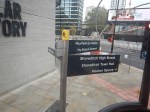





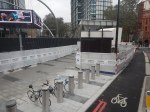





It does seem that it is at last approaching completion.
Singapore Nods To 1.2 GW Of Low-Carbon Electricity Imports From Vietnam
The title of this post, is the same as that of this article on offshoreWIND.biz.
This is the sub-heading.
Singapore’s Energy Market Authority (EMA) has granted conditional approval to Sembcorp Utilities (SCU), a wholly-owned subsidiary of Sembcorp Industries, to import 1.2 GW of low-carbon electricity, including offshore wind power, from Vietnam
This is the first paragraph.
The conditional approval means the project by SCU has been preliminarily assessed to be technically and commercially viable. The approval facilitates the process of obtaining necessary regulatory nods and licences for the project.
So now the real planning can begin.
This map shows Singapore and Vietnam.

The article says this about the electricity connection.
The low-carbon electricity is planned to be transmitted from Vietnam to Singapore via new subsea cables that will span a distance of around 1,000 kilometres.
My only worry about this project, is will China object to wind farms in the South China Sea, which they seem to increasingly regard as solely belonging to them.
I have a few thoughts.
Singapore’s Energy Import Policy
These last two paragraphs of the article describe Singapore’s energy import policy.
In 2021, Singapore unveiled its plans to import up to 4 GW of low-carbon electricity by 2035.
To date, EMA has granted conditional approvals to projects from various sources, comprising 2 GW from Indonesia, 1 GW from Cambodia, and 1.2 GW from Vietnam.
Note.
- 4.2 GW of interconnectors will be available from Indonesia, Cambodia and Vietnam.
- In 2022, Singapore’s total electricity consumption was 54.9 TWh, according to the Singapore government.
- 54.9 TWh averaged out over the year is 6.3 GW.
- According to Wikipedia, 95 % of their electricity is generated by gas.
It looks like Singapore will will be needing to import more energy.
Will Developing Countries Benefit From Energy Exports?
Singapore is purchasing electricity from its neighbours in this example.
I believe that there are many countries around the world, who will be able to develop energy exports based on renewable energy.
Conclusion
We will see lots more projects like this.
 The Anonymous Widower