SSE Comments On COP28
The title of this post is the same as that of this press release from SSE.
SSE Chief Executive, Alistair Phillips-Davies, said:
“We knew going into COP28 that the world wasn’t moving fast enough to decarbonise. The commitment to triple renewables by 2030 is welcome, as is the inclusion, for the first time, of explicit language on the need to transition away from fossil fuels.
“Codifying and securing international endorsement for ambitions like these is very welcome; however, the challenge now is to deliver the tangible actions needed to make them a reality.
“In the power sector, this means speeding up policy and decision-making so that it is easier to invest and build the infrastructure we need to actually deliver net zero, from offshore wind farms to electricity grids and flexible power plants.
“At COP28 there was no shortage of businesses willing to invest but there was a common frustration at the pace of progress on the ground, and this is something we need to address for all our sakes.”
I would agree with what he said.
- Especially about speeding up policy and decision-making and delivering more electricity grids.
- The last paragraph probably applies to a lot of countries.
Surprisingly, energy storage is not mentioned.
Could that be because SSE are going down the route, where hydrogen is created and that is either used in gas-guzzling industries to reduce their carbon-emissions or stored until needed?
SSE Thermal Acquires 50% Stake In H2NorthEast Hydrogen Project
The title of this post is the same as that of this press release from SSE Thermal.
These are the first three introductory paragraphs.
SSE Thermal has become joint owner of a blue hydrogen project in Teesside which is set to play a major role in supporting a reliable decarbonised power system by 2035 and accelerating industrial decarbonisation.
The partnership with Kellas Midstream will see the companies jointly develop H2NorthEast, a hydrogen production facility with carbon capture and storage that could help to kickstart a hydrogen economy in the Tees Valley. The agreement is for an initial consideration of <£10m to Kellas Midstream with further contingent consideration due should the project reach a financial investment decision.
In its first phase, H2NorthEast could deliver up to 355MW of blue hydrogen production capacity from 2028 with plans to scale up to more than 1GW. Offtakers would include heavy industry and power generation, either through blending into existing assets or in new hydrogen-fired plants.
Note.
- Production of 355 MW of hydrogen could start in 2028.
- Several existing processes have been converted from gas-firing to hydrogen-firing or a blend of natural gas and hydrogen firing. See Lime Kiln Fuelled By Hydrogen Shown To Be Viable.
- Teesside has quite a few industries, like steel and chemicals that theoretically could be converted to hydrogen or a hydrogen blend.
I have some thoughts.
Carbon Capture And Storage
This paragraph in the press release talks about the carbon capture and storage.
With an anticipated minimum carbon capture rate of 97%, H2NorthEast meets both UK and EU low-carbon standards. Specifically, the hydrogen produced via H2NorthEast would be fully compliant with both the UK’s Low Carbon Hydrogen Standard and is expected to be aligned with the EU Taxonomy for sustainable activities.
If the plant can achieve a carbon capture rate of 97 %, that is very good and it appears to meet the required standards.
- I also feel, that if it is of a high purity, then that could be a bonus, as it could be used in food manufacturing and other processes, where high purity is needed.
- I feel SSE should endeavour to use as much of the carbon dioxide, as it can to produce valuable by-products, which could include cement substitutes, building blocks, plasterboard and animal feed.
- Carbon dioxide can also be fed to soft fruit, salad vegetables, tomatoes, flowers and other plants in giant greenhouses or vertical farms.
- Polyester yarn can also be made from carbon dioxide.
It is my belief that this list of products will grow in the next ten years and carbon dioxide of a high purity will become an important chemical feedstock.
Replacement of Blue Hydrogen With Green
If SSE Renewables were to build an electrolyser near to H2NorthEast, they could use that to replace the blue hydrogen.
- From an offtaker’s point of view green and blue hydrogen would be identical.
- It’s just that the green hydrogen doesn’t produce any carbon dioxide.
- I can see the complex being run to produce enough carbon dioxide to supply the users that need it and producing blue and/or green hydrogen accordingly.
Hopefully, the more uses that can be found for the carbon dioxide, the less of it will need to use long-term storage.
Expanding The Plant
As blue and green hydrogen plants create an identical product, the decision of whether to add an extra blue hydrogen or green hydrogen plant can be taken solely on financial grounds.
Conclusion
This looks like it could be a very sensible decision by SSE.
SeAH To Deliver Monopiles For Vattenfall’s 2.8 GW Norfolk Vanguard Offshore Wind Project
The title of this post, is the same as that of this article on offshoreWIND.biz.
This is the sub-heading.
Vattenfall has signed a contract with SeAH Wind to provide the monopiles for the 2.8 GW Norfolk Vanguard East and Norfolk Vanguard West offshore wind farms in the UK.
These two paragraphs outline the order.
The monopiles for the Norfolk Vanguard offshore wind farms will weigh up to around 2,200 tonnes and have a length of up to 96 metres.
Production is due to start in 2026 at SeAH Wind’s new under-construction facility in Teesside, northeast England.
Note.
- Norfolk Vanguard now appears to be two 1.4 GW wind farms; East and West, which adds up to a 2.8 GW Norfolk Vanguard wind farm.
- There is no mention of the 1.4 GW Norfolk Boreas wind farm in the article, except that it has a Contract for Difference (CfD), whereas I don’t think Norfolk Vanguard has a contract.
- Would anybody buy wind farm foundations without a contract?
It looks like there has been some very tough negotiations between Vattenfall, the Crown Estate and the UK Government.
Is There An Alternative Approach?
Consider.
- If Vattenfall develop all three wind farms; Boreas, Vanguard East and Vanguard West, they will have 4.2 GW of capacity, when the wind co-operates.
- But East Norfolk is not noted for industries that need a large amount of electricity.
- I also feel, that the locals would object to a steelworks or an aluminium smelter, just like they object to electricity cables.
But would they object to a 4 GW offshore electrolyser?
Could this be Vattenfall’s alternative approach?
- A giant electrolyser is built close to the landfall of the cable to the wind farms.
- The hydrogen could be piped to Bacton, where it could be blended with the UK’s natural gas.
- Bacton also has gas interconnectors to Balgzand in the Netherlands and Zeebrugge in Belgium. Could these interconnectors be used to export hydrogen to Europe?
- The hydrogen could be piped to Yarmouth, where it could be exported by tanker to Europe.
There would be only a small amount of onshore development and no overhead transmission lines to connect the wind farms to the National Grid.
There would be even less onshore development, if the electrolyser was offshore.
From their decisions, Vattenfall seem to have a new plan.
Siemens Gamesa And Vestas Collaborate To Standardise Equipment For Transportation Of Wind Turbine Towers
The title of this post, is the same as that of this article on offshoreWIND.biz.
This is the sub-heading.
Building on a previous collaboration focused on tower foundations and lifting guidelines, Siemens Gamesa and Vestas, facilitated by Energy Cluster Denmark, have signed a new partnership agreement to increase standardisation within the wind industry.
Surely standard sizes and similar designs will help any industry. Look at how containerisation has helped freight transportation.
These four paragraphs illustrate the problem and detail the solution.
Initially, the partners will standardise equipment for the transportation of wind turbine towers.
“Currently, whenever a wind turbine tower is shipped out for offshore installation, the manufacturer welds a box onto the installation vessel to which the tower is then clamped. The process is costly in terms of tons of iron and labour on the quayside. Once installation offshore is completed, all the equipment is removed from the vessel, which is again costly in terms of hours, money and the green transition,” said Jesper Møller, Chief Engineer in Offshore Execution at Siemens Gamesa.
The new partnership agreement comprises a series of projects involving equipment for and the storage of huge components produced by wind turbine manufacturers.
The first project focuses on sea fastening, involving securing towers, blades, and nacelles to installation vessels.
The article finished with statements about why standardisation is important.
First German Zero-Subsidy Offshore Wind Farm Starts Taking Shape
The title of this post, is the same as that of this article on offshoreWIND.biz.
This is the sub-heading.
Offshore installation work has started at the 913 MW Borkum Riffgrund 3, the first subsidy-free offshore wind farm in Germany to reach this development phase, Ørsted, the developer of the project, said.
These two paragraphs introduce the project.
The first of the 83 monopile foundations have now been installed at the site some 53 kilometres off the island of Borkum in the German North Sea by Jan De Nul’s Lez Alizés.
The installation directly follows the foundation work in the adjacent 253 MW Gode Wind 3 project, which is being built in parallel by Ørsted in the North Sea.
Ørsted’s web site gives this history of Borkum Riffgrund 3.
Borkum Riffgrund 3 is expected to be fully commissioned in 2025. It comprises three offshore wind projects which were originally awarded to Ørsted in auctions in 2017 and 2018 under the names of Borkum Riffgrund West 1, Borkum Riffgrund West 2 and OWP West. The three projects were renamed in September 2019 and will be built as one joint project under the name of Borkum Riffgrund 3.
Borkum Riffgrund 3 was awarded without subsidies to Ørsted. A number of companies across IT, retail and the chemicals industry have signed corporate power purchase agreements for Borkum Riffgrund 3.
If Ørsted is doing this in Germany, how come, we are not seeing more subsidy-free wind farms in Europe?
These two paragraphs from the article give a partial explanation.
After commissioning in 2025, a large part of the electricity generated by the wind farm will be used for the decarbonization of the industry – through the so-called Corporate Power Purchase Agreements (CPPAs). For the project, long-term power purchase agreements were concluded with the companies Covestro, Amazon, the Energie-Handels-Gesellschaft/REWE Group, as well as BASF and Google.
Shares for Borkum Riffgrund 3 were also sold to an institutional investor well before construction. In October 2021, Nuveen signed an agreement with Glennmont Partners to sell 50 percent of the shares in Borkum Riffgrund 3.
The article also states that Borkum Riffgrund 3 will be the largest offshore wind farm in Germany to date.
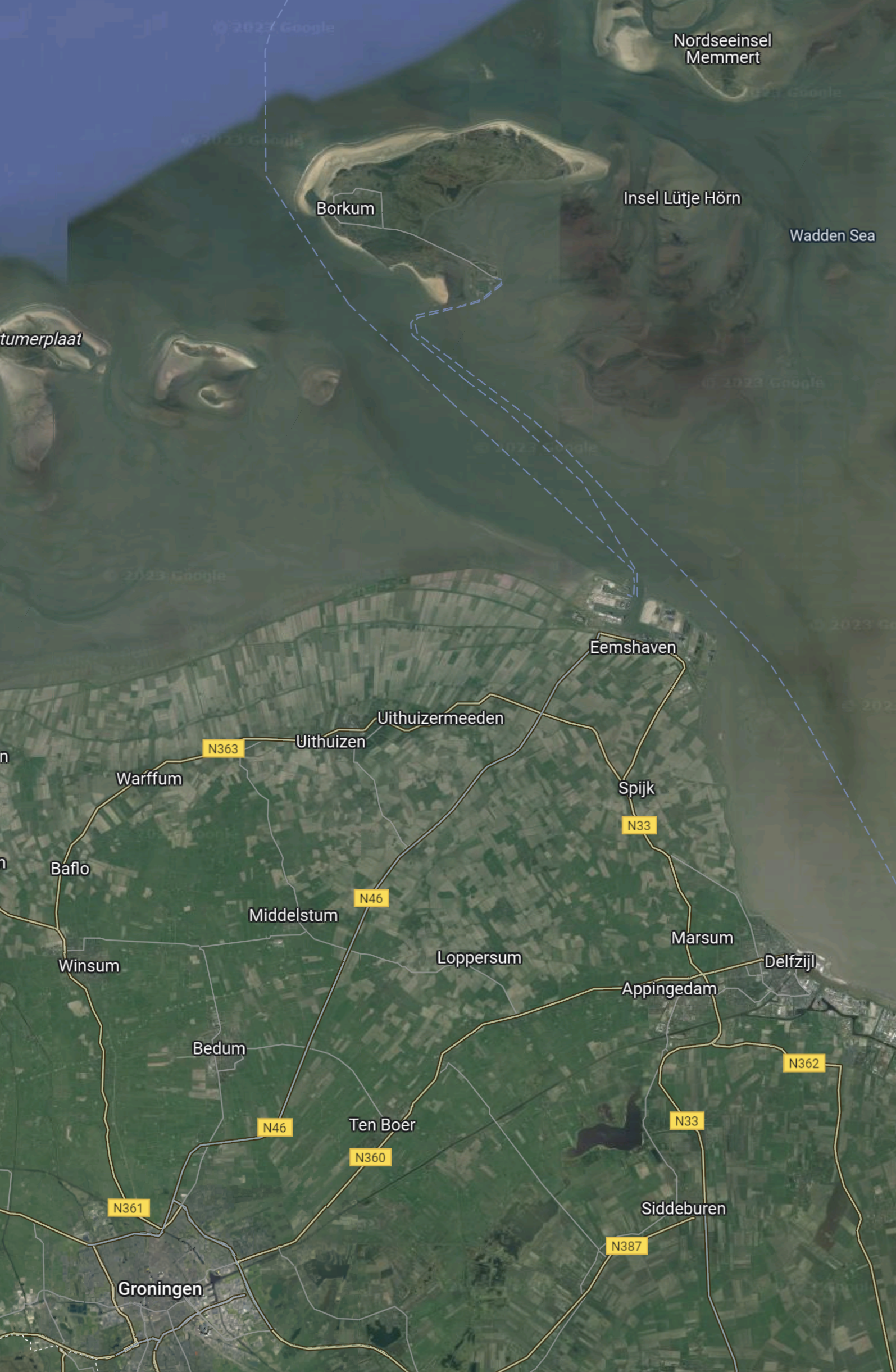
This Google Map shows the location of the German Borkum island to the North of the Dutch city of Groningen.
Note.
- Groningen is the city in the South-West corner of the map.
- Borkum is the horseshoe-shaped island at the top of the map.
There are a cluster of wind farms to the North of Borkum, which includes Borkum Riffgrund 1, 2 and 3.
Glasgow Subway’s New Trains Enter Service
The title of this post, is the same as that of this article on the BBC.
These two paragraphs outline the story.
New modernised trains have come into passenger service on Glasgow’s subway.
The first two trains were introduced by Strathclyde Partnership for Transport (SPT) on Monday.
Note.
- Modernised is probably the wrong word. Surely, it should be modern, as the others are nearly fifty years old.
- The new trains will have wheelchair spaces and air-conditioning.
- The BBC has a video in their article.
They look good and I can’t wait to get up to Glasgow to see them.
 The Anonymous Widower