SeaTwirl Partners With Local Firm To Bring Vertical-Axis Floating Wind Turbine To Japan
The title of this post, is the same as that of this article on offshoreWIND.biz.
This is the sub-heading.
Sweden-based SeaTwirl has signed a Memorandum of Understanding (MoU) with Sumitomo Corporation Power & Mobility (SCPM) to promote its vertical-axis offshore floating wind turbine in the Japanese market.
These two paragraphs detail the responsibilities.
Under the MoU, SCPM will be responsible for identifying, marketing, negotiating, and contracting potential clients.
The Swedish company will be in charge of promoting and offering the products and services to potential clients.
Note.
- In SeaTwirl And Verlume Join Forces To Drive Decarbonisation Of Offshore Assets, I talk about their MoU with Verlume.
- In SeaTwirl, Kontiki Winds To Explore Powering Oil & Gas Assets With Floating Wind, I talk about their MoU with Kontiki Winds.
SeaTwirl either likes using Memoranda of Understanding (MoU) or their technology is very good.
The article says this about the applicability of SeaTwirl to Japanese waters.
Japan has over 4,000 islands, and according to the Global Wind Energy Council (GWEC), it has approximately 128 GW of fixed-bottom offshore wind potential and 424 GW of floating offshore wind potential.
SeaTwirl said that its vertical-axis wind turbine is well-suited for the conditions in the Japanese offshore environment with its robust and flexible design and high serviceability.
That certainly looks to be a good match and I wonder, if this could end up as a three-way co-operation, with the inclusion of Verlume’s underwater batteries.
Will SeaTwirl and Sumitomo target other island nations or those with lots of islands like Croatia, Greece, the Caribbean, Italy, Micronesia and the Philippines?
RWE And Vattenfall Complete Multi-Gigawatt Offshore Wind Transaction In UK
The title of this post, is the same as that of this article on offshoreWIND.biz.
This is the sub-heading.
RWE and Vattenfall have completed the sale of three offshore wind projects in the UK. With the transaction completed, RWE has expanded its offshore wind portfolio in the UK by 4.2 GW.
There is also this RWE infographic, which shows the three wind farms in relation to the East Anglian coast.
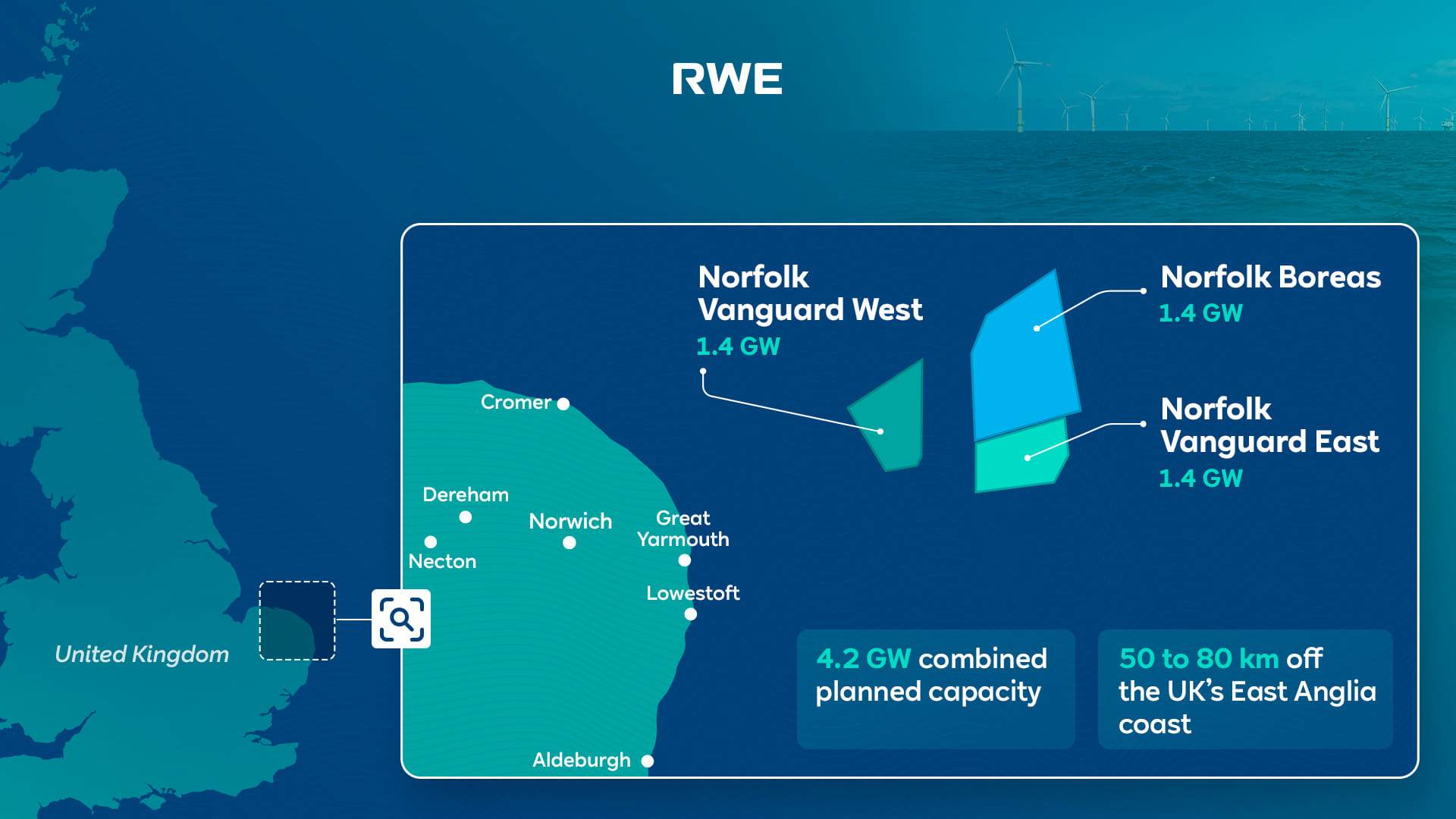
RWE are getting to be a big player in UK offshore wind, with these wind farm in operation or planned.
- Galloper – 353 MW – Operation
- Gwynt y Môr – 576 MW – Operation
- Rhyll Flats – 90 MW – Operation
- Triton Knoll – 857 MW – Operation
- Sofia – 1400 MW – Under Construction – Completion in 2026
- Norfolk Boreas – 1380 MW – Planned – Completion in 2027
- Norfolk Vanguard East – 1380 MW – Planned – Completion before 2030
- Norfolk Vanguard West – 1380 MW – Planned – Completion before 2030
- Dogger Bank South – 3000 MW – Planned
- Awel y Môr – 500 MW – Planned
- Five Estuaries – 353 MW – Planned
- North Falls – 504 MW – Planned
That is a total of 11,773 MW, of which 10,607 MW is on the German side of the UK.
With RWE likely to have some success in auctions this year, these figures, are likely to increase and some wind farms will start construction.
UK’s Sixth Contracts For Difference Round Open
The title of this post, is the same as that of this article on offshoreWIND.biz.
This is the sub-heading.
The UK Government has opened the sixth allocation round (AR6) of the Contracts for Difference (CfD) scheme on 27 March and will continue until 19 April 2024. The round will see a range of renewable technologies, including offshore wind compete for the government’s support.
This paragraph outlines how to apply and when the results will be published.
Applications may be submitted via National Grid ESO’s EMR Portal. The results are expected to be published at some point this summer.
The fifth round was a bit of a disaster for offshore wind and hopefully, it will be better this time, as the government will be upping prices.
At least it appears that Iberdrola will be bidding for two wind farm in their East Anglia Array, as I wrote about in Iberdrola Preparing Two East Anglia Offshore Wind Projects For UK’s Sixth CfD Round.
In The Crown Estate Refines Plans For Celtic Sea Floating Wind, I wrote about developments in the Celtic Sea, where contracts should be signed this year.
2024 could be a bumper year for new wind farm contracts.
Is This The World’s Smallest Hydrogen Car?
I typed “World’s smallest hydrogen car” into Google and found this web page.
This is the first paragraph of the product description.
The smallest hydrogen fuel-cell car ever commercialized. A small-scale model of a hydrogen fuel-cell application. A funny didactical toy for kids and… adults too!
But it only costs € 99 with the VAT included.
For something more useful, this web page details a ride-on hydrogen fuel-cell lawnmower.
When I find products, like these that can be bought on-line, it strengthens my belief, that at some time in the next few years, someone will demonstrate an Issigonis Mini-sized car that will run on hydrogen.
We must all remember, that engineering is the science of the possible, whereas politics is dreams of the impossible.
East West Rail To Hold Drop-In Events Ahead Of Statutory Consultation
The title of this post is the same as that of this article on RailUK.
These three paragraphs introduce the article.
East West Railway Company (EWR Co) has announced a series of information events in May to help people understand how the formal application process to build the railway works.
Nine information events will be held in May across the whole line of route between Oxford, Milton Keynes, Bedford and Cambridge.
These events are aimed at providing information about the statutory consultation process which will start in June. Details of the proposed design about the route will be shared when the statutory consultation begins.
These are the dates for the information events.
- Tuesday 7 May – Bedford Rowing Social Club, The Boathouse, Duck Mill Lane, Bedford, MK42 0AX, from 2pm-7pm.
- Wednesday 8 May – Cutteslowe Pavilion Hall, Cutteslowe Park, Oxford, OX2 8ES, from 2pm-7pm.
- Thursday 9 May – Weyland Hall, 8-10 North Street, Bicester, OX26 6ND, from 2pm-7pm.
- Friday 10 May – South Cambridgeshire Hall, Cambourne Business Park, Cambourne, CB23 6EA, from 2pm-7pm.
- Monday 20 May – Roxton Village Hall, High Street, Roxton, MK44 3EB, from 2pm-7pm.
- Tuesday 21 May – St Philip’s Church Centre, 185 Mill Road, Cambridge, CB1 3AN, from 2pm-7pm.
- Wednesday 22 May – Comberton Village Hall, Green End, Comberton, CB23 7DY, from 2pm-7pm.
- Thursday 23 May – Bletchley Masonic Centre, 263 Queensway, Bletchley, Milton Keynes, MK2 2BZ, from 2pm-7pm.
- Friday 24 May – Marston Moreteyne Community Centre, Great Linns, Marston Moreteyne, MK4 0DD, from 2pm-7pm.
They would appear to have the area covered.
I shall probably go to the Bedford event, as if I didn’t make it, I could go to another.
The Great Cadaver Shortage: Inside Doctors’ Latest Crisis
The title of this post, is the same as that of this article in The Times.
This is the sub-heading.
Faced with a dwindling supply of fresh bodies to train on, British medical schools are having to turn to America’s low-regulation ‘tissue trade’. Would you donate yours, asks Jenny Kleeman
My late wife, C; left her body to medical science and I may well choose to do the same with my body.
She left her body to St. George’s Medical School, mainly because one of her friend’s mother had done the same and there had been no problems.
Looking back on the nearly twenty years since she died, I remember a few months after her death, there was a multi-faith joint Memorial Service in Southwark Cathedral for all those who’d donated their bodies, in the previous year.
None of my family were or are religious, but I’m sure the service helped our grieving, as it was a very moving and inclusive service, that was the Church of England at its best, with assistance from other faiths.
Perhaps if donation were to be linked to support for the bereaved and perhaps a Memorial Service, this might increase the level of donations.
What sort of affect would it create in a city like Liverpool, if the yearly service alternated around the major places of worship in the city and was well-covered on local media?
Wembley: Swan Rescued From Supermarket Roof In Ikea Bag
The title of this post, is the same as this article on the BBC.
This is the sub-heading.
A swan has been rescued from a London supermarket roof in an Ikea bag by a London Fire Brigade (LFB) rescue team.
These are the first three paragraphs.
The brigade said a swan sanctuary volunteer called them at 11:08 GMT on Wednesday after a member of the public spotted the bird from a block of flats.
The team used a 13.5m (44.3ft) ladder to reach the swan, which they called Steve, and alongside the volunteer helped secure the bird in the blue bag.
Once Steve was brought down it was checked over and found to be unhurt.
Another use for the multi-purpose IKEA bag.
Porterbrook Acquires ‘379s’ For Lease To GTR
The title of this post, is the same as that of a small article in the April 2024 Edition of Modern Railways.
This is the first paragraph.
Porterbrook has successfully bid to acquire the fleet of 30 Class 379 Electrostar EMUs from Akiem and will lease them to Govia Thameslink railway, which will use them on Great Northern services.
Note.
- Will the Class 379 trains replace all or some of the 39 Class 387 trains currently used by Great Northern?
- The Class 379 trains are 25 KVAC overhead only trains, whereas the Class 387 trains are dual-voltage.
- If the Class 379 trains are not modified to run on 750 VDC third rail, they will be restricted to Great Northern routes.
- It may be a problem, that the Class 379 trains are only 100 mph trains, whereas the Class 387 trains are capable of 110 mph, but I suspect that the Class 379 trains can be upgraded to 110 mph.
It looks to me that it is likely that Govia Thameslink Railway will end up with thirty spare Class 387 trains.
The Wikipedia entry for the Class 387 train, says this about the differences between the two classes of Electrostar.
The Class 387 is a variation of the Class 379 with dual-voltage capability which allows units to run on 750 V DC third rail, as well as use 25 kV AC OLE.
This surely has three main ramifications for Govia Thameslink Railway.
- Third rail equipment can probably be fitted to the Class 379 train, if required.
- The Class 379 train can probably be uprated to the 110 mph of the Class 387 train.
- Retraining the drivers to use the new Class 379 trains, will not be a major exercise.
Govia Thameslink Railway will have the luxury of configuring the trains to run, the services their passengers need and want.
But Govia Thameslink Railway may have a collateral benefit.
In 2015, a Class 379 train was modified to do a trial as a battery-electric multiple unit.
This section in the Wikipedia entry for the Class 379 train, describes the trial.
During 2013, the national infrastructure owning company Network Rail announced that unit 379013 would be used as a testbed for a future Battery-Electric Multiple Unit. Following several months of conversion work and non-service testing, the unit was used to carry passengers for the first time on a Manningtree–Harwich Town service on 12 January 2015. Throughout its five-week trial period, data was gathered to assess its performance; it could reportedly operate for up to an hour on battery power alone, while charging via the pantograph took two hours.
Note.
- I feel it would be reasonable to assume, that a Class 387 train could be easily converted to battery electric operation.
- I’ve met commuters, who used the prototype every day between Harwich and Manningtree and it gave a good service.
- In an hour with stops, a typical Southern commuter service does just 35 miles.
Southern have two routes, where Class 171 diesel trains are still used.
- Ashford International and Ore – 25.4 miles
- Hurst Green Junction and Uckfield – 24.7 miles.
A battery-electric train with a range of 30 miles would surely decarbonise these routes.
- Batteries would be charged, where 750 VDC third-rail electrification is installed.
- As the Class 387 trains are dual-voltage, a short length of 25 KVAC overhead electrification, could be used to charge the train at Uckfield, if that was to be needed.
- Alternatively, the Vivarail Fast Charge system could be fitted.
A rough estimate is that ten battery-electric Class 387 trains would be needed to make Govia Thameslink Railway an all-electric railway.
- The now redundant Class 171 trains could be cascaded to someone, who needs them.
- The remaining twenty Class 387 trains could be used to replace twenty Class 377 trains, or converted to battery-electric operation and be cascaded to another operator.
Hopefully though, after all of the musical trains, there will be a reliable procedure to convert late model Electrostars into battery-electric trains.
The Definitive Battery-Electric Electrostar
It could have this specification.
- Based on a Class 377, Class 379 or Class 387 train.
- Three, four or five cars.
- I suspect the batteries would be spread around the cars.
- Dual-voltage or 25 KVAC overhead electrification only.
- Charging by 25 KVAC overhead electrification or Vivarail/GWR Fast Charge system.
Note.
- Battery range appropriate for the route.
- In GTR And Porterbrook Unveil £55 million Fleet Modernisation, I talk about an internal refurbishment of GTR’s trains.
It looks to me, that, whatever route Govia Thameslink Railway takes, there could be another twenty refurbished Class 377 or Class 387 trains, that could be available for conversion to four-car battery-electric trains.
Great Western Routes That Could Be Run By Battery-Electric Electrostars
Great Western Railway have 30 Class 387 trains, which are used on Thames Valley services around the London end of the Great Western Main Line.
Routes that could be suitable for Battery-Electric Electrostars include.
- London Paddington and Didcot Parkway – two trains per hour (tph) – 10 trains
- London Paddington and Oxford – one tph – 5 trains – 10.5 miles x 2
- London Paddington and Newbury – one tph – 5 trains
- Reading and Newbury – one tph – 2 trains
- Newbury and Bedwyn – one tph – 1 train – 13.3 miles x 2
- Reading and Basingstoke – two tph – 2 trains – 13.6 miles x 2
- Reading and Gatwick – two tph – 7 trains – 18.6 miles
Note.
- The number of trains is my rough estimate of the number, that would be needed to run each route.
- The miles is how much running would be needed on batteries.
My estimated total is 32, but there might be savings from more efficient routes. It looks like a range of around thirty miles would be sufficient.
Conclusion
It looks like after decarbonising Govia Thameslink Railway and the Thames Valley Services of Great Western Railway, there will be twenty high quality Electrostars available to decarbonise other routes.
Stadler’s FLIRT H2 Sets World Record For Hydrogen Powered Train
The title of this post, is the same as that of this article on Rail Technology Magazine.
These three paragraphs introduce the article.
Stadler’s FLIRT H2 has set the Guinness World Record for the longest distance achieved by a hydrogen-powered passenger train without refuelling or recharging.
The record attempt began on the evening of 20th March 2024 at the ENSCO test centre in Pueblo, Colorado, and concluded 46 hours later, with the train completing 2803 kilometres on a single tank filling.
A team of engineers from Stadler and ENSCO drove the vehicle in shifts during the attempt.
The journey is about the same distance as the crow flies between Edinburgh and Athens.
Stadler have also published this video.
The train appears to be a a Flirt, like Greater Anglia’s Class 755 trains or Transport for Wales’s Class 231 trains, with a power unit in the middle.

Note.
- The picture shows a Class 231 train at Cardiff Queen Street station.
- A Greater Anglia driver told me, these trains are 125 mph trains.
- The Flirt H2 has only two passenger cars, but UK Flirts are have three or four cars.
Perhaps we should buy a few of these trains for long routes like Liverpool and Norwich or Cardiff and Holyhead!
They would surely be ideal for CrossCountry
 The Anonymous Widower