Maiden Lane And York Road Stations
These two disused stations are in the area of Kings Cross Central to the North of Kings Cross and St. Pancras stations.
- Maiden Lane station used to be on the North London Line and closed in 1916.
- York Road station used to be on the Piccadilly Line and closed in 1932.
This map from carto.metro.free.fr shows the layout of the lines and stations.
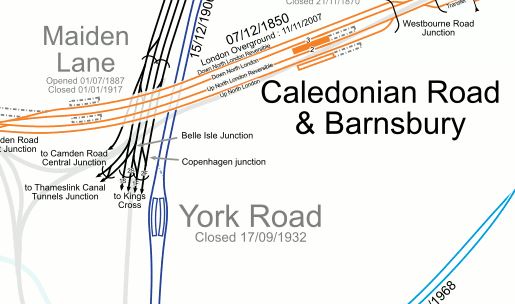
Note.
- The lines into Kings Cross station shown in black.
- The North London Line shown in orange.
- The Piccadilly Line shown in blue.
It would appear that York Road station has been designed to generous proportions.
Ian Visits
ThIs article on the Ian Visits web site, is entitled Reopening The Piccadilly line’s Disused York Road Tube Station.
Ian comes to the following conclusions.
A rebuilt Maiden Lane station on the Overground would be much cheaper to build, at around £8 million, and have much lower running costs. The site for the Overground station would be around 100 yards further to the north of York Road Station, roughly where a Camden Council maintains a bus garage.
Replacing that with the usual generic block of flats may generate the cash to fund a rebuilt Maiden Lane station.
However, York Road tube station is unlikely to ever reopen to the public again.
I very much agree.
However, there is a set of circumstances, where the building at York Road station may get reopened.
Look at this picture of York Road station.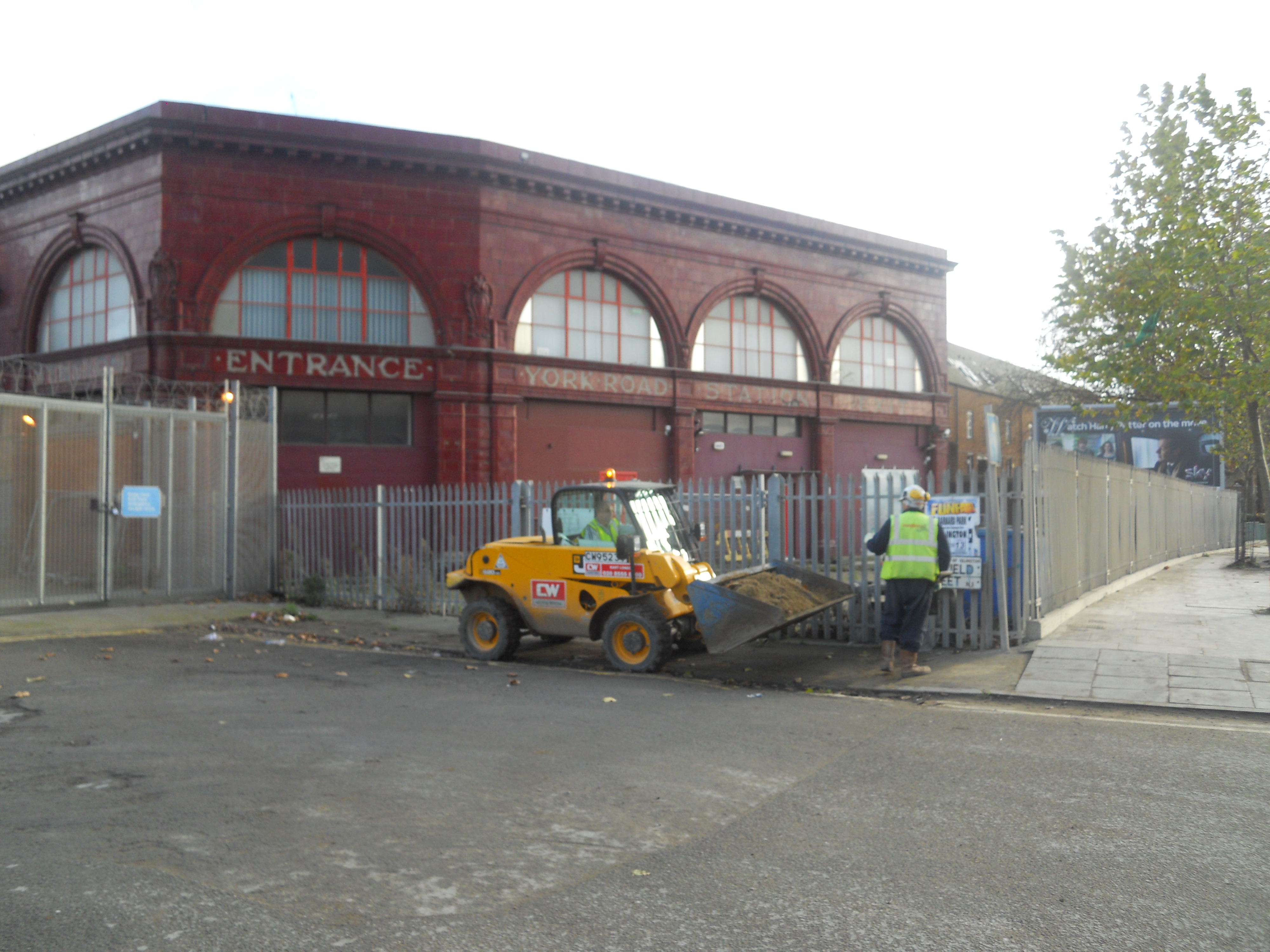
The station building is a classic design by Leslie Green and just across the road from Central St. Martins, which is a constituent college of the University of the Arts London. So surely, if the college were to have, it’s own station, it should be to one of London’s iconic designs.
Ian gives a lot of reasons, why York Road would be an expensive station to add to the Piccadilly Line, despite the fact that it could have lifts like Caledonian Road descending to the platforms.
But suppose the Docklands Light Railway were to be extended from Bank station as has been proposed.
This map shows a possible route.
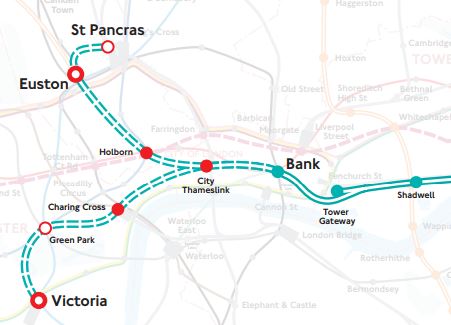
But why stop at S. Pancras.? It could be extended under Kings Cross station, stopping where required to finish at York Road station.
- Only the building would be used.
- There would be no connection to the Piccadilly Line.
- The Docklands Light Railway tunnels would be several metres down to travel under buildings and the stations.
- An underground passage could be built to a reopened Maiden Lane station.
A worthwhile use would have been found for an iconic building and Kings Cross Central would have much better public transport connections.
Was It Wrong To Cancel The Northern Heights Plan?
The Northern Heights Plan was a pre-Second World War project to extend the Northern Line onto the steam-haled suburban lines of the London and North Eastern Railway.
This map from Wikipedia shows the Northern Heights routes North of Archway station.
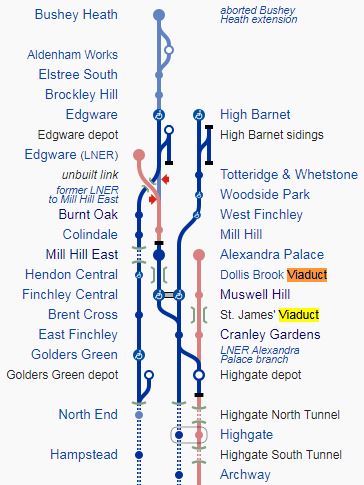
Note.
- The branches would have been converted to electric operation.
- Terminals would be Alexandra Palace, Bushey Heath, Edgware and High Barnet.
- A new deep-level Highgate station would be created.
But the war broke out and the much-simplified layout, that we have today was opened during and after the war.
- The extension to Bushey Heath didn’t fit in with post-war Green Belt plans, so was scrapped.
- Traffic on the Alexandra Palace branch suffered badly through competition with the new electrified High Barnet branch, buses and cars.
- Mill Hill East became the end of a single-track branch instead of a station on a double-track line between Finchley Central and Edgware.
- Eventually the Alexandra Palace branch was turned into a Parkland Walk.
As a teenager cycling around the Barnet and Edgware area, you sometimes came across the remains of the network.
I particularly remember, the remains of a half-completed viaduct sitting by then A41 in Edgware.
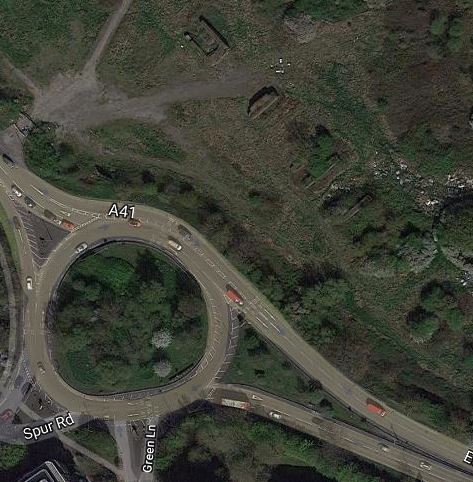
Note the series of holes to the North East of the roundabout. These are the remains of the viaduct.
Green Lane at the bottom of the map, was the road where my Uncle Leslie and Auntie Gladys lived.
Intended Service Levels
Wikipedia has a section, which gives the Intended Service Levels.
The peak-hour service pattern was to be 21 trains an hour each way on the High Barnet branch north of Camden Town, 14 of them via the Charing Cross branch and seven via the Bank branch. 14 would have continued on beyond Finchley Central, seven each on the High Barnet and Edgware branches. An additional seven trains an hour would have served the High Barnet branch, but continued via Highgate High-Level and Finsbury Park to Moorgate, a slightly shorter route to the City. It does not seem to have been intended to run through trains to the ex-Northern City branch from Edgware via Finchley Central. Seven trains an hour would have served the Alexandra Palace branch, to/from Moorgate via Highgate High-Level. In addition to the 14 through trains described, the ex-Northern City branch would have had 14 four-car shuttle trains an hour.
As I read it, this surely means that the following services would have been run in the Peak.
- Twenty-one trains per hour (tph) between Camden Town and Finchley Central, of which seven tph continued to each of Edgware and High Barnet, with presumably the other seven tph terminating at Finchley Central.
- Of these twenty-one tph, fourteen would have used the Charing Cross Branch and seven would have used the Bank Branch.
- Seven tph would have run from both Alexandra Palace and High Barnet via Highgate High-Level and Finsbury Park to Moorgate.
- A fourteen tph shuttle on the Northern City Branch.
- As it is not mentioned, should it be assumed, that an independent service with an appropriate frequency serves the Edgware Branch directly from Camden Town.
It looks to me that two aims of the service levels were to provide.
- A 28 tph service from Moorgate to Finsbury Park.
- A by-pass to the East of Camden Town.
It looks to have been a well-thought out plan.
My Recent Experiences
Over the last couple of months, I’ve had cause to visit the Northern Heights’ territory on a number of occasions.
Going to and from Central London, from areas like Barnet, Edgware and the Western parts of Enfield and Harringey has much improved since I lived in Cockfosters as a child.
- Trains and Underground have a higher frequency.
- Northern City services provided a big improvement in the late 1970s.
- Thameslink and Northern City will provide extra services in the next few years.
- There appear to be more bus feeder services.
- Modern ticketing is probably much more convenient and affordable.
Circular routes were the real problem, as I wrote about in The Cross Barnet And Enfield Express.
So would a full Northern Heights Plan helped my journeys?
The Bushey Heath Branch
This Google Map shows where the Bushey Heath Branch would have run.
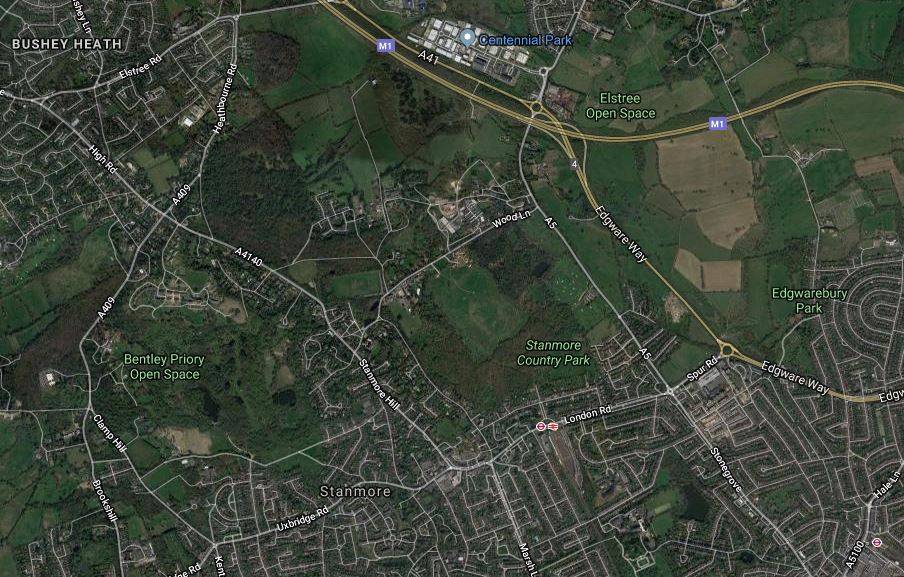
Note.
- Bushey Heath in the North West corner of the map.
- Centenial Park is on the site of the Aldenham Works, where the trains would have been stabled.
- Edgware station in the South East corner of the map.
- Stanmore station is also incorrectly shown with both rail and Underground logos.
The change of Green Belt policy probably did most to kill off the branch, but improvements in public transport and the growth of car ownership since the 1950s, have probably squashed any need for revival of the plan for the Bushey Heath Branch.
Finchley Central To Edgware Via Mill Hill East And Mill Hill (The Hale)
This short route was probably never completed, as after cancellation of the Bushey Heath Branch, it was an easy way to cut costs.
This map from carto.metro.free.fr shows the route.
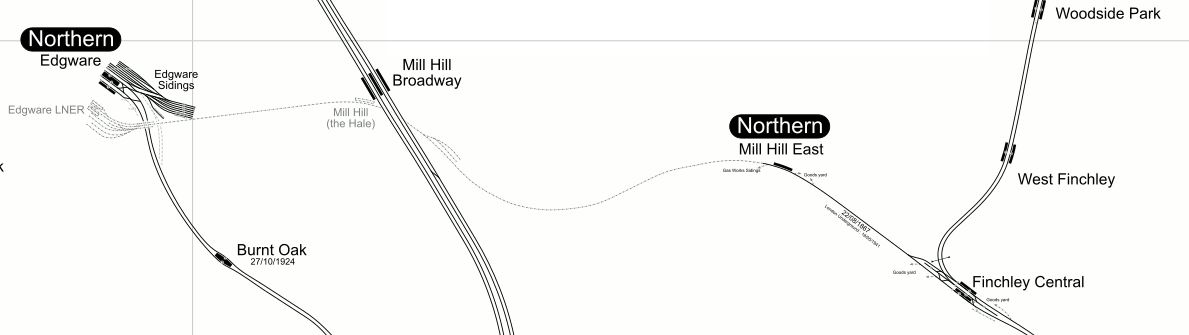
Note.
- The sidings at Edgware station.
- The closeness of Mill Hill (The Hale) station to Mill Hill Broadway station.
It could prove a useful link between the two branches.
From the service levels given earlier, it would appear that this route would have been served with seven tph, which is better than the current train every 11-15 minutes.
I doubt that the connection will ever be completed, but various plans involving property development arise from time to time.
The Alexandra Palace Branch
As with the Finchley Central to Edware route, much of this route is still visible on Google Maps.
But housing and other developments probably mean that reinstatement is impossible.
As with the previous link, I doubt it will ever be completed.
A Very Light Rail Alternative
Perhaps the only transport system that might work would be a very light rail system, such as is used between Stourbridge Junction and Stourbridge Town stations.
Why I’m Not Sorry About Kentucky Fried Chicken
The troubles of Kentucky Fried Chicken don’t bother me one smallest of an iota.
In fact as a coeliac, I think it is huge laugh.
This page on their web site is the allergy and nutrition list of their menu.
It is probably the most coeliac-unfriendly list, I’ve ever seen from a restaurant chain and treats our gluten-free dietary needs with contempt.
It says to me that KFC believe, that anybody who doesn’t eat gluten is a Grade A Pain-In-The-Arse, and deserves to be poisoned.
The people I feel sorry for are kids, who are coeliac, who probably miss out on a few parties.
I’ve never knowingly eaten any Kenchucky Fried Chicken products in the past and never will in the future, unless the chicken-free problems brought about by DHL, result in a menu that doesn’t try to kill me!
Enlightening Facts On Battery Trains
This article In Rail Magazine is entitled Vivarail Targets Summer Running For New Battery Unit.
The article says some enlightening things about the battery version of the Class 230 train.
- Four batteries are provided on the two-car train.
- The total battery capacity is 106 kWh. (Note: It has since been disclosed that the total battery capacity is 424 kWh!)
- An eight minute recharge is needed at the end of each run.
- A ten minute recharge gives a range of fifty miles.
Nothing is said of the speed and acceleration of the train on battery power.
How would these figures fit Vivarail’s order for three trains from West Midlands Trains to serve the Marston Vale Line?
- The route is approximately twenty-five miles long.
- Trains currently take forty-three minutes with ten stops.
- Overhead electrification could be available at both ends of the line, as both Bedford and Bletchley station are on 25 KVAC main lines.
Do the sums!
Alstom Seem To Be Stepping Up The Pressure To Get Hydrogen-Powered Trains Into The UK
This article on Rail Technology Magazine is entitled Alstom: Industry must start work bringing hydrogen trains to UK immediately.
This is said.
In an exclusive interview with RTM, Mike Muldoon, who leads on hydrogen for Alstom in the UK, also warned that if the British rail industry did not start trying to bring in hydrogen trains as quickly as possible, the country’s market could become less attractive.
Could it be that Alstom see the opportunity for hydrogen-powered trains closing and want to make sure that the UK Government comes on-side?
Would The Coradia iLint Be Able To Run In The UK?
This document on the Alstom web site is a data sheet for the Coradia iLint.
Unfortunately, the data sheet doesn’t give the height and width of the iLint, but I suspect that these and other dimensions are not much different to typical UK values.
Even if the current iLint is wider and taller, I suspect that on a lot of routes a Coradia iLint would be able to run.
Development Of A UK Hydrogen-Powered Train
The Alstom Coradia iLint was developed from an existing train in a few months, in much the same way that Bombardier’s Class 379 BEMU prototype was created.
There would be the following differences between a UK and a German version.
- Adjusted height, with and platform height.
- Would a different pantograph reach be required?
- 25 KVAC instead of 15 KVAC.
- Would a third-rail 750 VDC version be needed?
Notes.
- Point 1 is probably covered by the way modern trains are built.
- Point 2 is down to the pantograph manufacturer.
- Point 3 is covered by developing an electrical system that handles both voltages. After all 25 KVAC will be needed for France.
- Point 4 just needs the appropriate third-rail shoe and electrical system.
I think that all this could mean that a UK version of the iLint could be developed within a reasonable time and budget.
Have Alstom Said Anything Else About For The UK?
This article on the Engineer web site is entitled Alstom Eyes Liverpool Hydrogen Train Trials.
It would appear to be a good choice for the following reasons.
Location
Alstom’s UK base is at Widnes, which is in the South-East of the Liverpool City Region.
Test Partner
Merseyrail have shown in recent years, that they can think out of the box, about using trains and would be a very able partner.
Test Route
The article suggests that Liverpool to Chester via the Halton Curve could be the test route.
- The route is partly electrified from Runcorn to Liverpool.
- The route passes close to Alstom’s base.
- The section without electrification from Runcorn to Chester is probably about twenty miles long, which is a good test, but not a very difficult one.
- I don’t think that there are too many low over-bridges that would need to be raised.
There would also be good opportunities for publicity and photographs.
Availability Of Hydrogen
Hydrogen is available locally from the various petro-chemical industries along the Mersey.
Incidentally, I used to work in a chlorine plant at Runcorn, where brine was split into hydrogen and chlorine by electrolysis. There were hydrogen tankers going everywhere! Does the industry still exist?
Further Routes
If you look at a map of the railways in the area, there are several other possibilities of other services.
- Liverpool to Manchester via Warrington
- Chester to Manchester
- Serving new stations like Middlewich
The trains might be a possibility for the Borderlands Line.
Conclusion
Hydrogen trains would seem to be a possibility for running services in the Liverpool area and especially over the Halton Curve.
- Liverpool to Crewe via Runcorn is electrified.
- Hydrogen-powered trains could easily handle the routes without electrification.
- There is a plentiful local supply of hydrogen.
- There will be no great difficulty in updating the track and signalling.
Services could be run by existing diesel trains, until the new trains are available.
I also feel that Stadler’s new Class 777 trains for Merseyrail, when fitted with the ability to run on 25 KVAC overhead electrification and batteries could be able to handle Halton Curve routes.
Although, it is obviously very feasble to run hydrogen-powered trains, I have a feeling that the finances might not be as simple. Especially if Stadler make sure that their new Merseyrail trains can extend the Merseyrail network to town along routess without electrification.
Are Alstom stepping up the pressure, as they can see other trains arriving?
Don’t Stay In The Metro One Hotel By The Hauptbahnhof In Berlin!
The only thing to recommend it, is the distance from the station, but I found it totally unfit for my purpose as I wrote in A Hotel To Avoid.
I will not be taking any chances in future and will avoid Metro One hotels.
Riding Docklands Light Railway Trains In Essen
This may seem an unusual title, but look at these pictures.
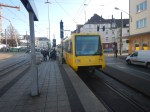
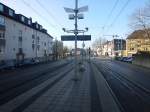
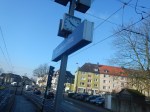
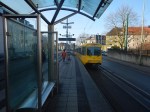
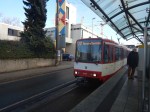

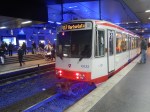
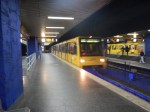
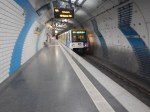



These are the original Docklands Light Railway trains, that were sold to Essen, who rebuilt them for the Essen Stadtbahn.
Note how they have been converted from third-rail to overhead electrification.
Some of our trains will be scrapped when they retire, like probably the Class 314 trains in Scotland and the Class 315 trains in London, but many like London Underground’s D78 Stock, which are being converted into Class 230 trains will find new jobs to do.
This article on Trains Magazine is entitled Pittsburgh-based Company Looks To Test ‘pop-up’ Transit Options In The UK And US.
It describes how they plan to use Class 230 trains, to develop rail services in the US.
This is the first paragraph.
U.S. Railroad investor Henry Posner III and his Railroad Development Corp. have plans to bring rebuilt self-powered former London subway cars to the U.S. to enable cities to introduce low cost rail transit on existing, lightly used freight routes.
I wish Henry well!
But I do think, that a lot of older trains will be recycled to other profitable and worthwhile uses, away from the UK.
Most people would sniff at driving to wor every dayk in a 1980s-built car, but many travel to work in a quality train of the same era.
The difference is that most cars are built for a life of perhaps ten years, so you will buy another,
UK trains, (Pacers excepted!) were built with a design lifetime of forty or even fifty years.
Some mid-life updates and refurbishments have confused passengers into thinking they were new trains.
We should think of trains much more like houses than cars, when it comes to refurbishment.
Over the next few years, we will see some inteesting recycling of redundant British rolling stock.
When Will The United States Learn That Guns Kill People?
Trump may blame mental health for the shootings in Florida, but then anybody can vere from their normal safe state to a dangerous one!
Stuttgart Hauptbahnhof
Stuttgart Hauptbahnhof is going through a controversial rebuilding called Stuttgart 21, so I had to choose to change trains there, between Karlsruhe and Essen.

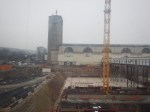
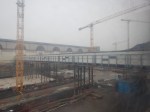






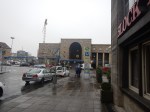

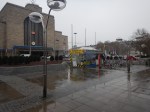
The building opened in 1922 and was designed by Paul Bonztz. So it is almost the same age as Waterloo station.
The project is also costing about the same as the Thameslink Programme.
They all make an interesting comparison.
I can’t say that I understand what all the fuss is about.
This article on Deutsche Welle is entitled Stuttgart 21 – Germany’s Other Engineering Fiasco Goes Off The Rails.
This is the first paragraph.
Everyone in Germany has heard the jokes and seen the social media memes about Berlin’s BER airport. But the Stuttgart 21 railway project has also developed into a logistical nightmare — and a sinkhole for public money.
It doesn’t look to be a happy project.
Gluten Not Optional
I spent last night in the Ibis hotel at Karlsruhe and had a very good supper in Baden-Baden.
This morning, I’m on my way to Stuttgart, so I thought I’d pick up something at the station.
Usually, on German stations, I can find something like fruit, but here there were nothing gluten-free except a bag of McDonald’s fries, coffee etc and water.
I assume all German coeliacs are stick-thib, as they aren’t allowed to collect snacks on the run!
 The Anonymous Widower