Is A Microsoft Surface Pro, Windows 10 and OneDrive A Toxic Combination For This WordPress User?
I have now got a brand-new Microsoft Surface Pro and quite frankly except for the large screen, it is a load of old crap!
I run Office 365 and store my files on OneDrive and I have done for nearly a year, but the combination seems to lock me out of my Excel files on the OneDrive all the time.
- I can’t seem to Autosave like I used to, as it says that I am blocked.
- It also keeps showing me non-responsive login buttons to OneDrive.
- It tells me I am required to sign in to save the file, but won’t let me sign in.
Knickers and twist come to mind!
And then there’s WordPress.
I am trying to change a picture, which I want to upload into a post.
I get the Select File page, but it is totally unresponsive.
Luckily, I could change the picture using a Windows 7 laptop.
I Need Help To Get This Surface Pro Computer Working
I was always a software man and this computer is showing that up.
Any offers of help, paif for or free in the London N1 area gratefully accepted.
AI ‘Outperforms’ Doctors Diagnosing Breast Cancer
The title of this post is the same as that of this article on the BBC.
This is the first two paragraphs.
Artificial intelligence is more accurate than doctors in diagnosing breast cancer from mammograms, a study in the journal Nature suggests.
An international team, including researchers from Google Health and Imperial College London, designed and trained a computer model on X-ray images from nearly 29,000 women.
I have rarely worked with healthcare data, so I can’t comment on the accuracy of this trial.
However, over fifty years ago, I was able to make a lot of progress in the analysis of mass spectrometry data, by observing operators and asking how they identified various chemicals in the scan from the mass spectrometer.
I wouldn’t be surprised to find some detailed observation of the working methods of radiologists, formed the foundation data for this research.
The research seems to have done it well, judging by the published results.
Should we trust ourselves to methods like this in healthcare?
Undoubtedly! Yes!
Many systems like this are starting to be used in the maintenance of complex entities, as diverse as trains, planes, chemical works and advanced automated distribution depots.
But every fault, is always tested by a trained person.
This is a paragraph from the BBC article.
Prof Ara Darzi, report co-author and director of the Cancer Research UK (CRUK) Imperial Centre, told the BBC: “This went far beyond my expectations. It will have a significant impact on improving the quality of reporting, and also free up radiologists to do even more important things.”
I very much feel we will see very much more of this automated testing of the human body! And not just for cancer!
I already know of groups working on automatic diagnosis of arthritis!
Class 755 Trains Are Now Running Between Ipswich And Cambridge
According to this article on the East Anglia Daily Times, the new Stadler Class 755 trains are now running between Ipswich and Cambridge stations.
The article also makes these points.
- The Class 153 trains will be retired at the end of this week.
- More Class 755 trains wll come into service in the coming weeks.
There is a software problem that restricts full operation, which should be fixed in a couple of weeks, which is described like this.
A new piece of software is due to be installed within a few weeks – but until then passengers heading east from Elmswell and west from Kennett are being taken by bus to the next station.
Both Elmswell and Kennett are simpler stations, with short platforms.
This Google Map shows Elmswell station.
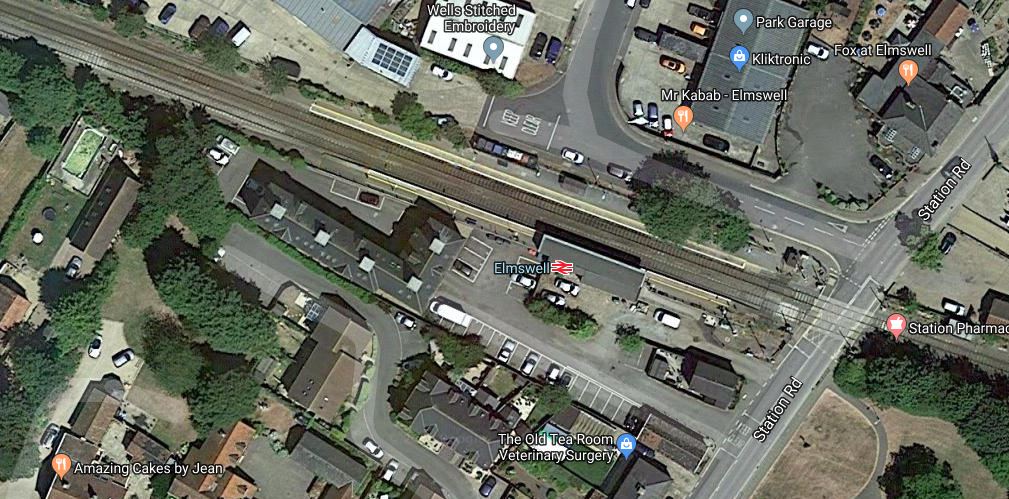
And this Google Map shows Kennett station.

I wonder, if with these stations, selective door opening is needed the on one platform and the layout doesn’t fit the original software.
When you write software to work in a large number of situations, it’s difficult to make sure you cover everything.
Greater Anglian’s solution of a bus to get around the problem is not an ideal solution, but it should work, until the software is fixed.
Will Business Trust Ultra-Marxist Labour?
This is a paragraph from an article in today’s copy of the Times, which is entitled Labour’s Big Call Has BT Hanging By A Wire.
Only two weeks ago Mr Jansen, 52, had dismissed the threat of Labour nationalisation, saying that BT was “not on the list” and taking comfort from comments from John McDonnell over the summer and made personally. Labour’s shadow chancellor had said in an interview in July that there were “no tricks up my sleeve” and that the “limit of our ambition” was taking the power networks, Royal Mail, rail and water companies into state ownership.
It appears John MacDonnell has either changed his mind, or was doing something rather devious.
Will business at any level from the smallest corner shop to the largest FTSE 500 company ever trust what this ultra-Marxist Labour party says?
Nationalised British Broadband
Labour’s plans to nationalise broadband and provide it free to homes and small business is a cracker!
Advantages For Labour
It would have one big advantage for Labour!
It’s a great way of listening in to all their political opponents. They only have to ask the Chinese how to do it!
How for instance, would another political party, with a radical agenda organise?
But!
Consider these points.
- Mobile phone traffic uses the same Internet backbone as broadband.
- Internet tech giants like Amazon, Facebook and Google wouldn’t pay up without a fight
- Everybody’s pension fund would suffer, as BT is often there and shares would be replaced by junk bonds.
- Virgin Media and other broadband suppliers would be nationalised as well or could become worthless.
- A lot of American Internet companies would go running to the US President and just as Trump has applied tariffs willy-nilly in his trade war with China, a future President wouldn’t take it lying down.
- The high-tech industry has already said they don’t like it.
The biggest problem is that Internet usage will grow exponentially with 5G broadband and all the connected devices, like
- Driverless cars.
- Automated warehouses and delivery systems.
- Connected smart household and other appliances.
- Connected massive screens, which every business, school or home will have.
- Every child watching content on mobile devices.
- Collectinbg operating data from cars, trucks and trains to make them more reliable.
- Automated care assistance for the ill, frail and elderly.
Can any government afford the cost of continual upgrading of capacity, which will not be like anything seen before?
It certainly, is a cracker!
And if it is implemented, it will blow up in the ultra-Marxists’ faces.
Ultrasound On A Chip
The latest episode of BBC Click is a must-watch.
One section is about a new ultrasound device from Butterfly Network.
Their product called Butterfly iQ; is an ultrasound sensor on a chip, that converts a smart phone into a full function medical ultrasound machine.
But as an engineer, who knows a bit about this sort of technology, I doubt that all the applications are medical ones.
Typical hospital ultrasound machines cost tens of thousands of pounds, but the price of the sensor on the Butterfly Network web site is in the order of a couple of grand. Software is probably extra, but even so, Southampton Hospital has bought four and one is in their paediatric ambulance.
I have one big question.
Is the device open source? This would enable, an imaginative programmer, as I once was, to convert the device, so that it is able to perform an important application.
I would be very disappointing if it wasn’t!
To get a snapshot of the power of ultrasound, read the Wikipedia entry for ultrasound.
A Video
I found this on the Internet.
As you can see, it’s not very big.
Conclusion
This is an amazing development and it will revolutionise so much of healthcare and other fields.
The Chilling Power Of Drones And Software
This article on the BBC is entitled Saudi Oil Attacks: Images Show Detail Of Damage.
Read this article and then say, that drones can’t be used to create death ad destruction or merely havoc, like flight disruption at a major airport.
Consider.
- Automation is such, that drones can now be launched on a fire-and-forget basis.
- You can’t jam an autonomous drone!
- There is nothing to stop a top quality programmer creating evil software.
- Much of the software, used for evil purposes, is probably also used to write business, research, engineering, scientific, educational and other types of software.
- The genie is well and truly out of the bottle!
14/09/2019 will become a notorious date in history.
‘Digital Twin’ To Support More Robust Timetable Planning
The title of this post is the same as that of this article on Railway Gazette.
When I saw the title of this post, I was surprised that it was a newsworthy story.
I have been doing scheduling of people, machines and other resources since the late 1960s and creating print outs and graphs to help people to manage businesses from the early 1970s.
In so many cases, I’ve found digital models have given a great insight into the interactions between factors affecting the system.
So I would have expected train companies to all have a digital twin from at least 1980, especially as I know BT and other phone companies had digital models of their networks by that time.
If they don’t have a digital model of their network, how do train companies plan their timetables?
By trial and error!
Or do they start with marketing ideas like four trains per hour and then fit the timetable together like a jigsaw?
Does Anybody Know Of An On-Line Bank Account, Where You Can Annotate The Statement?
I have looked at several on-line bank accounts and none offers me a feature I want.
I check my statement every morning, as this is one of the best ways to guard against fraud.
- If there is an unexpected transaction, you spot it early.
- If banks used AI to classify your access, then it might be possible for them to flag-up possible illegal access.
So what feature is missing?
Imagine if against each line in the statement, there was the ability to add extra data.
Two fields come to mind.
- A comment.
- A costcode, such as Gas, Electricity, StatePension etc.
You could also add fields of your own, like say CustomerNumber, SupplierNumber or InvoiceNumber.
The bank statement would show the extra data, when you displayed or printed the statement.
I would use it every day!
But it would also allow you to total values against against any cosde field between two dates.
If you used standard costcodes and other fields, the bank could even calculate your accounts.
I first talked about such a system with an accountant in the 1970s, where you would have entered the cost code on a cheque or bank deposit.
Banks! bGrrrr! \They haven’t changed their mindset since the 1870s! Or should that be the 1570s?

