UK’s Iconic Jodrell Bank Telescope Faces Axe In Science Cuts
The title of this post, is the same as that of this article on the BBC.
This is the sub-heading.
The Jodrell Bank Observatory, which has housed the UK’s largest telescope for nearly 70 years, has lost its funding and could now close, the BBC understands.
These two paragraphs add more details.
The observatory and its network of telescopes have been pivotal to the country’s study of distant galaxies and training future astronomers. Scientists have described the decision as “heartbreaking” and “scientifically misguided”.
All scientific observations at Jodrell are expected to cease on the 1 April 2028 unless alternative funding can be found.
I consider the government decision to be vandalism of the highest order.
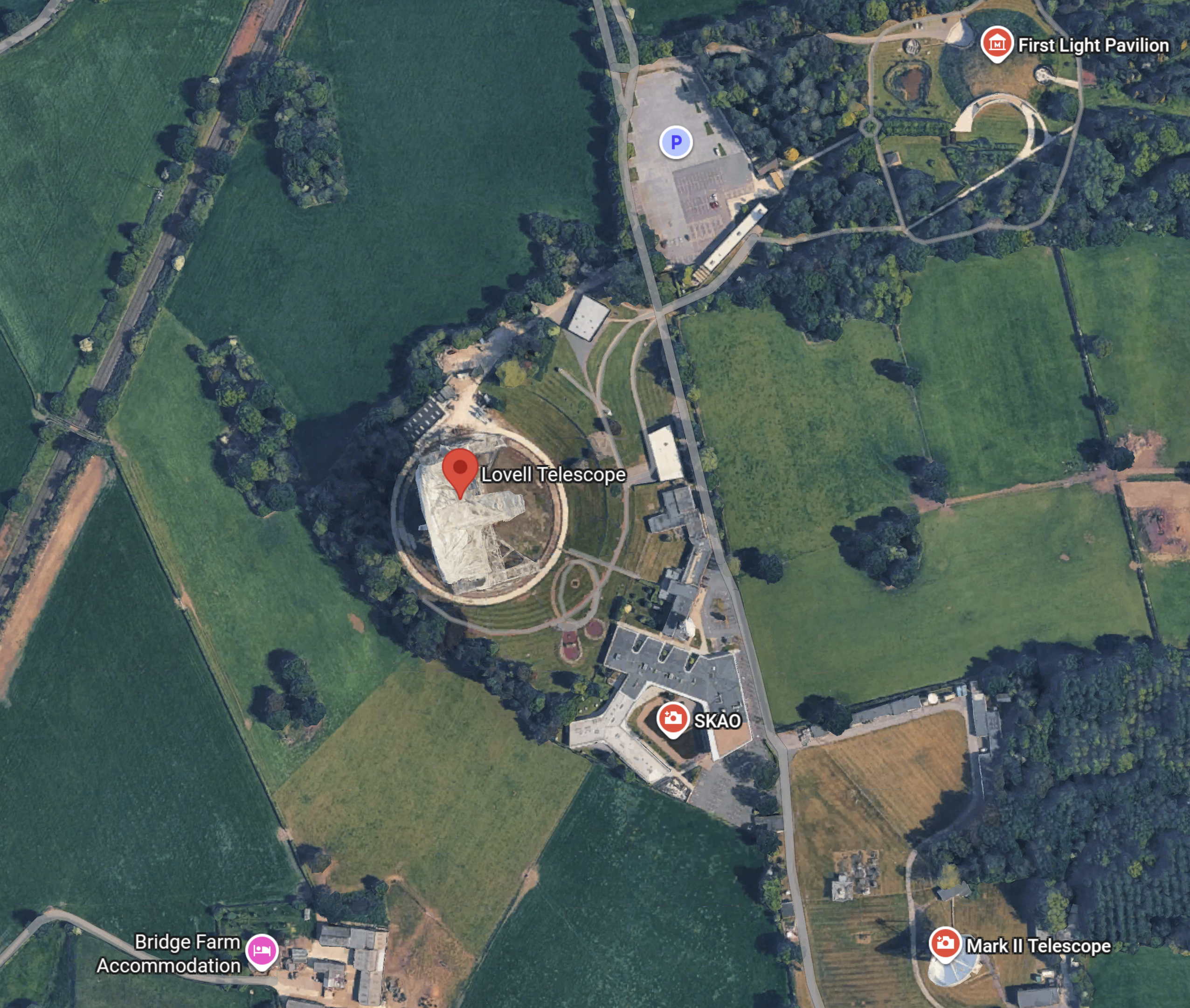
This Google Map shows the Jodrell Bank site.
Note.
- The radio telescope is indicated by a red arrow.
- Going across the North-West corner of the map is the West Coast Main Line between London and Manchester Piccadilly.
- The red dot, which is labelled SKAO indicates the SKA Observatory, which has this web site.
This is on the home page.
Building the two largest telescope arrays in the world, located in South Africa and Australia, made possible through a global collaboration.
Jodrell Bank is a UNESCO World Heritage Site.
I have some thoughts.
I Was A Keen Amateur Astronomer At School
I went to Minchenden Grammar School in North London, where the school had Prince Albert’s six-inch refracting telescope for observations.
I can also remember a smaller reflecting telescope being setup outside the cricket pavilion to observe a partial eclipse of the sun.
Google AI lists three partial solar eclipses in London in the 1960s.
February 15, 1961: A deep partial dawn eclipse showing 92% to 95% coverage of the Sun in Southern England. It featured early television coverage and coincided with the exact day the movie Barabbas filmed its crucifixion scene during totality in Southern Europe.
September 22, 1968: A daytime partial eclipse where about one-third of the Sun was blocked. Skies over London cleared after 11:00 a.m., prompting the Junior Astronomical Society to set up projection telescopes in St. James’s Park.
May 20, 1966: Another visible partial solar event tracked across the UK, though with lighter public observation in the capital.
As the eclipse wasn’t 92 % to 95 % coverage and I would have been in Liverpool in 1968, I suspect it was the eclipse of May 20, 1966.
I Was Of The Generation That Grew Up With Jodrell Bank
The iconic Jodrell Bank Radio Telescope opened in 1957, which would be about the time, I started Minchenden Grammar School and was able to have access to their optical telescope.
So I grew up with Jodrell Bank Radio Telescope, although I’ve never visited.
I Feel Very Strongly That Jodrell Bank Needs A Convenient Rail Connection
This page on the Jodrell Bank web site, gives these instructions on how to get there by rail.
The most convenient station is at Macclesfield, which is on the West Coast Mainline from London Euston to Manchester. On arrival at Macclesfield you will then need to take a 20-minute taxi ride to the Jodrell Bank. The taxi rank is directly outside the main exit from Macclesfield station.
There is also a station in the nearby village of Goostrey, on the line between Manchester and Crewe. It is a 2.5 mile walk from there along narrow country lanes and so we advise booking a taxi for this part of the journey. Note, you’ll need to do this in advance as there is no taxi rank at the station.
The Wikipedia entry for Goostrey station says this about the train service at the station.
There is an hourly service between Manchester Piccadilly, Stockport and Crewe on Monday – Saturday, which is every two hours on Sunday.
I don’t know much about scheduling buses, but I don’t think it would be too difficult to have an electric shuttle bus, ferry visitors between Goostrey station and the telescope site.
If the rail route to the telescope proved popular, it might even be possible to arrange that the occasional express stopped at Goostrey station.
Could Jodrell Bank Be Developed Into An Astronomy Experience For The North?
Real Time Trains reveals that to and from Goostrey station, you can reach a range of stations including.
- Birmingham New Street
- Bournemouth
- Cardiff Central
- Crewe
- London Euston
- Manchester Airport
- Manchester Piccadilly
- Milford Haven
- Reading
- Shrewsbury
- Swansea
The hourly services to Manchester Piccadilly and Crewe add a lot more destinations with a single change.
I Suspect Jodrell Bank Creates Work For SMEs In The Area
It is my experience that universities, research organisations and scientific establishments create networks of SMEs around their location, to do specialist jobs, they feel are best done by specialist contractors.
Jodrell Bank is close to the three large cities of Liverpool, Manchester and Sheffield and I suspect, that most sub-contracts can be handled in the area.
Conclusion
I believe that with input from the Mayors and University Vice-Chancellors of the North, Jodrell Bank could be developed into an engine of growth for the North of England.
Was Storm Franklin Named By An Old Minchendenian?
This press release from the Met Office is entitled Storm Franklin Named.
When I first heard yesterday, that the storm was to be named, I must admit, that I allowed myself a small smile.
I went to Minchenden Grammar School in Southgate, leaving in 1965.
One teacher, that we looked upon with a degree of affection was our German teacher, who was Frank J Stabler, who some pupils referred to as Franklin J Stabler. I don’t know whether that was his real name or whether it was fellow pupils making it up.
But he did have one story, that he used to liven up one of the lessons, where he taught me enough German to get by in the country.
Apparently, he was returning from France to the UK on the night of Saturday, the 31st of January in 1953, using the ferry from Dieppe in France to Newhaven in Sussex.
That ferry route used to have a reputation for being rough and on one bad crossing around 1975, my five-year-old son fell and cut himself just above his eye. He was skillfully cleaned up and plastered by one of the chefs. Luckily the chef had been a soldier, who had been well-trained in first aid.
Back in 1953, Mr. Stabler could have chosen a better night for his trip, as that day was the night of devastating East Coast Floods, which killed over five hundred people in the UK.
The captain of the ferry decided to sit the storm out and crew and passengers spent twenty-four hours being tossed about like a cork in the English Channel, which was a tale Mr. Stabler told with great drama.
He finished the tale, by saying that in the end, he prayed for the boat to go down to put everybody out of their misery.
Conclusion
I have to ask if someone on the committee that decides storm names, either directly or indirectly, has heard this tale and decided that Franklin would be an appropriate name for a storm beginning with F.
Covid Leaves Wave Of Wearied Souls In Pandemic’s Wake
The title of this post, is the same as that as this article on The Times.
It is the usual excellent article by Tom Whipple and it discusses long covid.
I haven’t knowingly had long covid or even common-or-garden short covid for that matter.
The Asian Flu of 1957-1958
But go back to 1957-1958 and the outbreak of Asian Flu.
This was another present from China to the world. Wikipedia says this about its severity.
The number of excess deaths caused by the pandemic is estimated to be 1-4 million around the world (1957–1958 and probably beyond), making it one of the deadliest pandemics in history.
According, to this page on Wikipedia, deaths from Covid-19, were approaching 5,500,000 at the first of January 2022.
But then the world population is now 7.9 billion as opposed to 2.8 billion in 1957. This is 2.8 times bigger.
If the Asian Flu of 1957-1958 had had a Covid-19 death rate around two billion would have died.
Was There A Long Form Of The Asian Flu?
In Long Covid And Coeliac Disease, I started the post like this.
I recently heard an interview with Adrian Chiles on Radio 5 about the so-called long covid
I am 73 and the more I read about Long Covid, the more I think I had something similar around 1958, when I had just started Minchenden Grammar School, where I missed most of the Spring Term. This was at the time of the 1957-8 flu pandemic., which killed between one and four million people worldwide.
This article on New Decoder is a personal memory of that pandemic, from an experienced journalist called Harvey Morris.
Last night, I was listening to another program about kids with long covid and they seemed to be describing how I felt all those years ago.
One of those two programs, also said that one doctor tested patients for coeliac disease.
So did I have a long form of Asian Flu which kept me off school for a long time?
I can remember a conversation between my late wife and my mother that took place before we got married in 1968.
My mother described how I was badly ill at around ten and how our GP, the excellent Dr. Egerton White kept coming to see me, whilst I was recovering at home, as he couldn’t fathom out what was wrong with me.
But he did seem to take particular care of me, even coming to visit me in hospital, when I had my tonsils out at around five. Could it be, that as he had brought me into this world, that he felt differently about me? It should be noted that he was probably from the Caribbean and either black or mixed-race.
Is Long Covid Linked To Undiagnosed Coeliac Disease?
As I said earlier that one doctor tested long covid patients for undiagnosed coeliac disease, at least one doctor must believe so.
Looking at the statistics in The Times article, I can make the following deductions.
- 42 % of sufferers from long covid are over fifty?
- 58 % of sufferers from long covid are female?
- It is not stated how many sufferers had been diagnosed as coeliac and were on a long-term gluten-free diet.
These statistics would fit roughly with the statistics for coeliac disease.
- According to the NHS, there are more female coeliacs as male.
- There was no test for coeliac disease in children until 1960, so it is likely, that many undiagnosed coeliacs are over 60.
- Since around 2000, coeliac disease is tested for by means of a simple blood test.
- Doctors understand coeliac disease better now, so I suspect more coeliacs under about thirty have been diagnosed.
I am certainly led to the conclusion, that undiagnosed coeliac disease could be a factor in long covid.
Treating Long Covid
The article on The Times has a section which is entitled How Do We Deal With It (1)?, where this is said.
One of the great challenges of pathology is that you have to know what you are looking for before you can find it.
“People with long Covid go to the clinician, give blood, and none of the results that come back show that these individuals are sick,” says Resia Pretorius, from Stellenbosch University. The doctors look through the metabolites in their blood, seeking something unusual, and find nothing. “The end result is their clinician tells them it’s psychology — go for a run or whatever. Some of these patients can’t even walk up a set of stairs. They think: are we mad?”
She had an idea. What if it was about the blood structure, as much as its composition? Her laboratory has looked at the blood of both acute Covid patients and long Covid sufferers. They have found tiny clots.
Something in the disease seems to cause malformation, and they can’t be removed.
They have also found preliminary evidence that treating patients with antiplatelet and anticoagulants leads to significant improvement. Although, she stresses, it’s a risky procedure that requires careful monitoring, in case people bleed dangerously.
When I read the bit about anticoagulants, the bells in my head started ringing.
I am a coeliac on a long-term gluten-free diet, who suffered a serious stroke in 2011, from which I made a remarkable recovery. I am now on Warfarin, which is the old-fashioned anti-coagulant and test myself regularly with a meter, so I don’t bleed dangerously.
Note remarkable is not a word of my choosing, but one that has been used several times by doctors referring to the recovery in my stroke. But then there are masses of Jewish, Huguenot and Devonian survival genes in my cells.
At the time of the panic about blood clots and the AstraZeneca vaccine I wrote A Danish Study On Links Between Coeliac Disease And Blood Clots, of which this is an extract.
This morning I found on the Internet, a peer-reviewed Danish study which was entitled
Coeliac Disease And Risk Of Venous Thromboembolism: A Nationwide Population-Based Case-Control Study
The nation in the study was Denmark.
This was the introductory paragraph.
Patients with coeliac disease (CD) may be at increased risk of venous thromboembolism (VTE), i.e. deep vein thrombosis (DVT) and its complication pulmonary embolism (PE), because they are reported to have hyperhomocysteinaemia, low levels of K-vitamin-dependent anticoagulant proteins, and increased levels of thrombin-activatable fibrinolysis inhibitor.
One thing in this summary screams at me. The mention of vitamin-K!
Ten years ago, I had a serious stroke, that because of modern clot-busting drugs failed to kill me.
I am now on long-term Warfarin and know I have to eat a diet without Vitamin-K.
There are too many coincidences in all this for me not to shout, “Do More Research!”
The Britons Who Played For The Moon
The title of this post, is the same as that of an article on page 15 of today’s copy of The Times.
This is two paragraphs – – .
The team was organised by John Hodge, who was born in Leigh-on-Sea, Essex and who had previously worked for Vickers Armstrong, which during the Second World War built the Supermarine Spitfire.
Mr. Hodge, now 90, would become a flight director at mission control – the one time that ‘Houston’ spoke with a British accent.
I’ve heard of John before.
Like me, John Hodge went to Minchenden Grammar School and one of our maths’ teachers; George Bullen,when I was doing Further Maths in the Sixth Form, told us the full story of one of his brightest students.
If John had a problem, it was that he couldn’t get a language O-level, which was needed to get to University in the late 1940s.
So he went to Northampton Engineering College, which is now the City University, where the qualification wasn’t needed.
I think George Bullen, with his John Arlott Hampshire accent, probably told us the story of John Hodge for motivation.
This is another paragraph in the article.
Peter Armitage, 90, who grew up in Hable-le-Rice, Hampshire, was also in the Avro group. In 1969 he oversaw the simulator that Neil Armstrong used to learn how to touch down on the moon.
As I remember it, the simulator was a hybrid digital-analogue computer using two PACE 231-R computers as the analogue half.

This picture shows the similar computer, that I worked on at ICI in Welwyn Garden City.
These machines could each solve up to a hundred simultaneous differential equations, in real time, so were ideal for calculating the dynamics of complex systems.
They were some beasts!
From what I read at the time, they were key in bringing the Apollo 13 astronauts home, as they could be quickly reprogrammed, if you were familiar with the dynamic model., as undoubtedly NASA’s engineers were.
Next Year It’ll Be Fifty Years Since I Left Minchenden
It was in June or July 1965, that I walked out of Minchenden Grammar School in Southgate for the last time.
A lot has happened to me since, some of which is in this blog. Although some tales have been left out to protect the squeamish and the innocent.
I wonder if anybody is organising a fifty years reunion for the Class of 1965 from Minchenden?
Surely, in the true spirit that we learned at the school, we should make 2015 a year to remember!
The Problems In Schools
There has been several stories recently about the problems in schools in places like Birmingham, Bradford and Luton.
What worries me, is that religion is getting in the way of good education.
I went to a mixed non-religious state school, which took a very practical approach to religion and gave everybody who wanted it, a first class education. Science and history, were taught correctly and not with regard to fictitious religious texts.
So in my view religion should only be a lesson in a school and anybody with strong religious beliefs should not be allowed to influence the policy of the school. Schools are for education and not for indoctrination and repression.
The school should be co-educational, as in my view, this is to the benefit of every pupil. Could it be that the reason for the low divorce rate amongst my fellow pupils at Minchenden, is because of the healthy interaction there was at the school between the sexes.
I wonder what would have happened in Northern Ireland if all schools were not allowed to be affiliated to a particular religion!
Swastikas Everywhere
There is this article about the traditional use of swastikas on the BBC web site. Here’s the first paragraph.
Swastika. The word is a potent one. For more than one billion Hindus it means “wellbeing” and good fortune. For others, the cross with arms bent at right angles will forever symbolise Nazism. Yet England is seemingly awash with swastikas. Why?
I first came across their use in perhaps 1963. Several of us at Minchenden Grammar School were looking at old school magazines from the 1920s and 1930s. We were surprised to see swastikas used to separate paragraphs in some of the articles, in just the same way that you might use asterisks today.
I remember asking my father, who was a letterpress printer about this and he said it was common to use swastikas for this purpose before the symbol’s adoption by the Nazis. But he also said, nobody used it now, so he’d sent all his swastikas to be melted down, as they weren’t needed any more.
Murder At Minchenden
My old school; Minchenden Grammar School in Southgate was a fairly peaceful place most of the time, but last night just down from the school, a murder was committed, as is reported here. When I went to see the Olympic Torch in Southgate, we walked through the area.
To Southgate For a Cup Of Tea
This morning, I took the Piccadilly line to Southgate to try out one of the new Tesco-financed coffee-shops called Harris and Hoole.




The tea was excellent and properly served in a pot. Note the triple-barrelled tea timer, which could time your tea to exactly 3, 4 or 5 minutes. If they’d sold them in the shop, I’d have bought one, but they don’t at present. But they are available on-line from here!
The staff were attentive and if they can replicate this style, the company may have created something like an updated traditional coffee shop, that you still see occasionally in places like Harrogate. It certainly has a better ambience than Starbucks and is laid out with quite a bit of space.
At present, they don’t have any gluten-free offerings, but apparently, they’re working on it. They do though have EatNakd bars.
Overall it’s a good concept and I wish them well, despite the Tesco connection. My allergy to the supermarket chain stems from a business run-in years ago and where there are alternatives I go elsewhere.
In the 1950s and 1960s, when I was at Minchenden Grammar School just up the road, the only coffee bar was the Mayfair a few doors towards Cockfosters from where Harris and Hoole is now. That place was beloved of teddy-boys and served coffee in those shallow Pyrex cups. It was off-limits during school hours!
Dwelling On Loneliness
I do think that people will admit that my life can be rather lonely.
Although, as someone, who has often worked alone in his life, my state is little different to where I have been before.
As a child, I used to spend hours with my Meccano or just with my father down at his print works in Wood Green.
I was also very much a solitary programmer for much of my working life. Or if I did work with someone, it was just with one person. The only time I really had someone to work with was when I was writing software in the few years after I’d left ICI. And that was our third son, George, who used to sit in his chair, whilst I bashed away on an old Teletype. Occasionally, he’d get taken over to Time Sharing in Great Portland Street and sometimes, the girls in the office would take him away and play with him.
I sometimes wonder what happened to all those girls; Maeve, Maggie and and the Australians; Crystal Hendricks and Marie Thorpe.
But then I’ve always discarded friends throughout my life. only a couple of my school friends are still in touch. But what happened to Sheena Findley, Susan Portch, Caroline and the other girls from my year at Minchenden? C was just as clumsy with friends, as her best friend from school, Ruth Mason, is just a name in the past. She got married and moved to Ruislip, but where is she now?
I did bump into my first girlfriend at Liverpool; Marilyn Garland, once at Swiss Cottage, a few years after leaving University. She had a baby then and is probably a granmother now.
Some of the Metier people I still know, as I must have got better at keeping in touch as I got older.
But I never really was a team player, and that has stood me in good sense, since the death of C.
I do many things I want to on my own. And in some ways, I like it that way.Although I do miss the company of a good woman. A bad one would probably be good to!

