Japanese Offshore Wind And Battery Storage Project Begins Commercial Operation
The title of this post, is the same as that of this article on offshoreWIND.biz.
This is the sub-heading.
On 1 January 2024, JERA and Green Power Investment Corporation (GPI) began commercial operations at the 112 MW Ishikari Bay New Port Offshore Wind Farm in Japan, which they own through Green Power Ishikari GK, a special-purpose corporation (SPC).
The most significant thing about this wind farm, is that it has been designed from Day One to operate with a battery, which is detailed in the last paragraph.
The project also features a battery storage component with 100 MW x 180 MWh of capacity.
Note that the output of the battery is 89 % of that of the wind farm. Is that the ideal ratio between battery and wind farm capacities?
Conclusion
Because of my training, as an Electronics and Control Engineer, I belief that most renewable energy can be smoothed with the adding of a battery.
UK Transmission-Connected 100MW BESS Online At Former Coal Plant Site
The title of this post, is the same as that of this article on Energy Storage News.
These are the first three paragraphs.
A 100MW battery storage project in the UK connected to National Grid’s transmission network has gone online, developed by Pacific Green on the former site of a coal plant.
UK transmission system operator (TSO) National Grid has plugged in the 100MW/100MWh battery energy storage system (BESS) project to its 400kV Richborough substation.
The project, dubbed the Richborough Energy Park battery, is owned by asset manager Sosteneo Infrastructure Partners which acquired it from developer Pacific Green in July 2023.
A Transmission-Connected Battery
Thye Energy Storage News article says this about transmission-connected batteries.
Most BESS projects in the UK connect into the lower-voltage networks run by distribution network operators (DNOs) rather than National Grid’s high-voltage network. Benefits of the latter include a more reliable connection and better visibility in National Grid control rooms.
This would look to be a better way to connect a battery to the grid, but the battery must be able to supply electricity at 400 kV.
This Google Map shows the location of Richborough Energy Park.

Note.
- Richborough Energy Park is marked by the red arrow.
- The coast is the East Coast of Kent.
- The Prince’s Golf Club lies between the Energy Park and the sea.
This second Google Map shows the energy park in more detail.

Note.
- Richborough Energy Park is marked by the red arrow.
- The 336 MW coal-fired Richborough power station used to occupy the site.
- To its West is Richborough 400kV substation.
- There is a large solar park to the North.
- The 1 GW Nemo Link connects to the grid at the energy park.
- The 300 MW Thanet Wind Farm connects to the grid here.
It looks like an ideal place to put a 100MW/100MWh battery energy storage system, so that it can balance the wind and solar farms.
Sheaf Energy Park
This page on the Pacific Green web site is entitled Delivering Grid-Scale Energy Storage With A Global Reach.
Four battery projects are shown.
- Richborough Energy Park – In Operation
- Sheaf Energy Park – In Construction
- Limestone Coast Energy Park – In Origination
- Portland Energy Park – In Origination
The first two projects are in Kent and the others are in Australia. That is certainly global reach by Pacific Green.
I then found this page on the Pacific Green web site, that is entitled Pacific Green Acquires Sheaf Energy Limited – 249 MW / 373.5 MWh Battery Energy Storage Development In The UK.
These two paragraphs describe the acquisition and development of Sheaf Energy Park.
Pacific Green Battery Energy Parks 2 Limited, a wholly-owned subsidiary of Pacific Green Technologies, Inc. has acquired 100% of the shares in Sheaf Energy Limited (“Sheaf Energy Park”) for £7.5 million (US$9.1 million) from UK-based energy originator, Tupa Energy (Holdings) Limited.
Sheaf Energy Park will be a 249 MW / 373.5 MWh battery energy storage system (“BESS”) located next to the Richborough Energy Park in Kent, England. Design and construction will begin in the first half of 2023, with the energy park commencing its 35-year operating life in April 2025.
It looks to me that Pacific Green have found the figures for the construction and operation to their liking at Richborough Energy Park and have decided that to more than triple their investment in energy storage at the site will be very much to their advantage.
Conclusion
I suspect we’ll see other locations in the UK and around the world, with wind, solar, interconnectors and batteries working in harmony to make the most of the electricity available.
Would You Buy A Battery Energy Storage System From Rolls-Royce?
I don’t often click on adverts that appear in web pages.
But I had to click on one from Rolls-Royce mtu, which advertised Battery Energy Storage Systems.
I wonder what the Honourable Charles Rolls would have thought of adverts on the Internet for the company he jointly founded?
I suspect he would have liked the idea, as Rolls was very much a promoter of motoring and aviation and opened one of the first car dealerships in the UK, according to his Wikipedia entry.
The Wikipedia entry for his business partner; Sir Henry Royce starts with this sentence.
Sir Frederick Henry Royce, 1st Baronet, OBE (27 March 1863 – 22 April 1933) was an English engineer famous for his designs of car and aeroplane engines with a reputation for reliability and longevity.
He is also described as a perfectionist.
This sentence from the Wikipedia entry, describes how he started the design of the legendary “R” engine.
In October 1928, he began design of the “R” engine while walking with some of his leading engineers on the beach at West Wittering, sketching ideas in the sand. Less than a year later, the “R” engine, designed in his studio in the village, set a new world air speed record of 357.7 miles per hour and won the Schneider Trophy of 1929.
Later with help from the maddest person my father ever met (his words, not mine!) ; Lady Houston, the Supermarine S.6B won the trophy in 1931 and then broke the world speed record at over 400 mph. Not bad for a seaplane. Take the floats off an S.6B and you almost have a Spitfire.
The Wikipedia entry also describes how the “R” engine was developed into what many engineers believe was the finest internal combustion engine of all time; the Rolls-Royce Merlin.
Following the success of the “R” engine, it was clear that they had an engine that would be of use to the Royal Air Force. As no Government assistance was forthcoming at first, in the national interest they went ahead with development of what was called the “PV-12” engine (standing for Private Venture, 12-cylinder). The idea was to produce an engine of about the same performance as the “R”, albeit with a much longer life. Rolls-Royce launched the PV-12 in October 1933 and the engine completed its first test in 1934, the year after Royce died. The PV-12 became the Rolls-Royce Merlin engine.
Where would we have been in the Battle of Britain without the Merlin engine?
Since 1969, the engineers at Rolls-Royce have followed Sir Henry’s example of perfection and developed the revolutionary RB-211 into the modern day Trent, which is now about to take a big leap into a low-carbon future with the UltraFan.
If the quality of Rolls-Royce mtu’s Battery Energy Storage System matches the levels of perfection Rolls-Royce achieved with the Merlin and the Trent, then I suspect that Sir Henry would have given his approval.
This picture is shown on the web page for the Battery Energy Storage System.

These two paragraphs introduce, what Rolls-Royce mtu are calling the mtuEnergyPack.
In today’s world of economic growth and increasing populations, the demand for electricity is soaring. Governments and industries globally shift to distributed renewable energy, challenging centralized grids. To adapt to this changing energy landscape, the mtuEnergyPack offers an ideal solution.
It integrates renewable sources like solar and wind power, paving the way for future-ready sustainable power systems. The mtu EnergyPack is a scalable, all-in-one solution for autonomous off-grid facilities. It ensures reliable power through peak shaving, load-shifting, and grid stabilization, making it suitable for various applications.
These are my thoughts.
What Is The Output And The Storage Capacity?
This paragraph on this page gives this answer.
It efficiently stores electricity from distributed sources and delivers on demand. The mtu EnergyPack is available in different sizes: The QS and the QL, ranging from 200 kVA to 2,000 kVA, and from 312 kWh to 2,084 kWh, and the QG for grid scale storage needs, ranging from 4,400 kVA and 4,470 kWh to virtually any size.
It seems that you specify your requirements and Rolls-Royce mtu should be able to satisfy it.
What Devices Can Be Connected?
This paragraph on this page gives this answer.
The mtu EnergyPack serves as a key component in enhancing the reliability and profitability of microgrids and energy systems. It stores electricity generated by distributed power sources, including gensets, wind turbines, or solar panels, and delivers it when needed.
In the 1970s, when I was working at ICI, others in the section were working on a system called MEDIA, where every sensor on a chemical plant was connected to the central computer, through its own analog-to-digital computer. It would now be called plug-and-play by some.
I believe that Rolls-Royce mtu are using similar ideas to connect equipment to the control computer.
These are my thoughts about connecting various equipment.
- Hydrogen-powered generators and electrolysers as Rolls-Royce mtu are using at Duisburg, which I wrote about in Rolls-Royce Makes Duisburg Container Terminal Climate Neutral With MTU Hydrogen Technology.
- Could Rolls-Royce’s beer keg-sized 2.5 MW electrical generator based on a Super Hercules engine, be connected?
- Could a Rolls-Royce Trent be connected?
- Could one of Rolls-Royce’s small modular nuclear reactors be connected?
- In Rolls-Royce To Play Key Role In US Department Of Defense Nuclear Microreactor Program, I talk about developing a 1-5 MW nuclear reactor for US Department of Defense. Could these be connected?
I don’t see why every device can’t work to the same protocol.
What Is The Power Density Like?
This paragraph on this page gives this answer.
The mtu EnergyPack’s compact battery system designs suit projects with limited space and logistical restrictions.
In ‘Spirit of Innovation’ Stakes Claim To Be The World’s Fastest All-Electric Vehicle, I talked about Rolls-Royce’s record-breaking electric plane called Spirit of Innovation.
Has what has been learned about energy storage in the confined spaces of an aeroplane been applied to a Battery Energy Storage System?
What Do Rolls-Royce mtu Consider To Be Important Features?
On this page, they list these features.
- Power Density
- Digitally Connected
- Multilevel Safety
- Black Start Capability
- Scalability
- Ultra-Fast Response
- Flexible Use
- Plug-And-Play Installation
The design seems to have everything covered.
Can Similar Systems Be Designed By Others?
I would expect that similar systems can be designed, as technology like batteries is available to all and the operation is only as good as the software controlling the various components of the system.
But similar systems will be without the famous Rolls-Royce logo.
Could One Of These Systems Decarbonise A Village?
I once lived in a village with about fifty houses and perhaps a hundred inhabitants.
- There was an old World War Two airfield, that could probably accommodate a small wind farm of perhaps 20 MW.
- There were a couple of barns and large sheds, that could have solar panels similar to those I described in Bedford Depot’s Massive Solar Roof Helps Thameslink On Way To Net Zero.
I suspect an mtuEnergyPack could control all these inputs and provide the village with the following.
- Enough electricity to power all the needs of the inhabitants, businesses and their vehicles.
- If an electrolyser were to be provided, it could probably produce enough hydrogen to power every boiler and hydrogen-powered vehicle.
Note.
- Farmers would like the local availability of hydrogen, as it will be ideal for tractors and agricultural machinery.
- I actually believe that if a village had a reliable and affordable hydrogen supply, that a large proportion of the inhabitants would switch to hydrogen-powered vehicles.
There would still be the National Grid there for backup.
Conclusion
If I needed an mtuEnergyPack, I’d certainly give one a close look.
Pipeline Of UK Energy Storage Projects Grows By Two-Thirds Over Last 12 Months
The title of this post, is the same as that of this press release from RenewableUK.
These four paragraphs summarise the data.
A new report released today by RenewableUK shows that the pipeline of energy storage projects which are operational, under construction, consented or being planned has increased by more than two-thirds over the last year in terms of capacity.
Batteries play a key role in our modern flexible energy system, helping grid operators to finely balance the supply of electricity to meet demand at all times.
Our EnergyPulse Energy Storage report shows that the total pipeline of battery projects has increased from 50.3 gigawatts (GW) a year ago to 84.8GW, an increase of 68.6% (34.5GW).
Operational battery storage capacity has grown to 3.5GW, and the capacity of projects under construction has reached 3.8GW. A further 24.5GW has been consented, 27.4GW has been submitted in the planning system and 25.7GW is at an early stage of development but yet to be submitted. This chart shows the total UK battery portfolio in megawatts (MW).
Note.
- I find the bare statistics very heartening, as how often do you find any industry, that will be positive for the future of the planet, that increases in size in a year by 68.6 %.
- Having been involved a couple of times in my life, with funding high growth markets, I suspect that in part this growth is happening, because banks, insurance and other financial companies are prepared to fund schemes that are proposed.
It is worth reading the press release in full, as it flags up are several interesting points.
InterGen’s Two Huge Batteries
InterGen are developing two huge lithium-ion batteries, which seem to be rather under the radar of the mainstream media.
InterGen are an energy company, of which few people have heard.
On the About InterGen page, this is the sub-heading of a section describing their business.
InterGen is a uniquely independent energy company. We support the journey to a stable, dependable, net zero energy system through delivering the flexible electricity solutions that underpin it.
These four paragraphs introduce the business.
Founded in 1995, we have decades of experience in the GB market.
Our power stations provide secure, flexible energy to consumers, and help the grid to take on more and more renewables.
Our expert trading team in Edinburgh sells electricity and services to help utilities, system operators and the wider energy market deliver secure power to homes and businesses across the country, whilst our pipeline of new developments includes some of the world’s largest battery storage assets, an essential component in the future energy system.
The world is changing, and we’re proud to be playing an active role in the unfolding energy story for generations to come.
Batteries are very much for generations to come.
These four paragraphs on this page says this about their batteries.
Developing a large-scale energy storage capability will help to resolve the challenge of the intermittency of renewable generation. At InterGen, we’re managing the delivery of one of Europe’s largest battery storage portfolios, with over 2GW of grid scale projects, having dedicated grid connections and proceeding through the permitting process.
The share of wind and solar power is increasing in the UK’s energy mix, but these sources only generate power when the wind blows or the sun shines. The use of batteries to store the excess power generated can help provide low carbon power to balance supply and demand with renewable power during periods of low output.
InterGen’s UK battery projects are world-leading in this kind of technology deployment. The facilities will use proven lithium-ion technology which has zero emissions, has superior flexibility, and will complement the increasing amounts of renewable energy generation in the UK.
In Essex, our project at London Gateway Port to create up to 900MWh of energy received planning permission in January 2023, and when complete will be large enough to provide power for up to 450,000 homes. At Spalding, we have consent to develop up to 1.1GWh of storage capability, adjacent to our existing operational CCGT and OCGT plants. Both of these developments are world-class in terms of size. It’s all part of our goal to support the transition to low carbon generation through the provision of flexible capacity.
Gateway Energy Centre
This page describes the Gateway Energy Centre, where this is said.
InterGen is in late stage development of a world leading battery storage project in the London Gateway Logistics Park, next to the DP World London Gateway Port on the north bank of the River Thames in Essex. InterGen built and continues to operate the existing 800 MW Coryton gas-fired combined cycle power station which is located approximately one kilometre from the proposed Gateway Energy Centre site.
The Gateway project will consist of a Battery Energy Storage System (BESS) with a rated electrical output of up to 900MWh (up to 450MW).
InterGen received Town and Country Planning Permission in January 2023, making the Gateway project the largest battery in the UK once operational. The £300m project will provide power for over 450,000 homes once fully complete.
Note.
- I assume they mean this battery is a 450 MW/900 MWh battery, that will provide 450 MW for two hours.
- It is close to the 732 MW Coryton gas-fired combined cycle power station.
I would assume that one of its tasks will be to make sure the London Gateway complex gets rnough reliable power.
Spalding Energy Park
This page describes the Spalding Energy Park, where this is said.
The Spalding Energy Park, adjacent to InterGen’s existing combined and open cycle gas plants at Spalding, has received Town and Country Planning Permission in June 2023 for one of Europe’s largest battery storage projects. The battery development could deliver up to 1,100MWh of electricity once operational, providing power for up to 500,000 homes.
Spalding Energy Park received planning consent in January 2018 from the Department of Business, Energy and Industrial Strategy. The project is carbon capture ready.
As at Gateway Energy Centre, the battery is located close to a large 860 MW gas-fired power station.
Co-location of a gas-fired power station and a battery must make the grid connection simpler.
Conclusion
A total of 2 GWh of storage is a good start and I’ll suspect we’ll hear more about these two batteries in the next couple of years.
Statkraft To Acquire Major Loch Ness Pumped Storage Hydro Project From Intelligent Land Investments Group
The title of this post, is the same as that of this press release from Statkraft.
This is the sub-heading.
The acquisition demonstrates Statkraft’s latest commitment to helping Scotland meet its renewable energy targets and strengthening UK energy security
These two paragraphed outline Red John and the deal.
Statkraft, Europe’s largest renewable power generator, has agreed to acquire the Red John Pumped Storage Hydro Scheme, from Intelligent Land Investments Group (ILI).
The 450MW scheme, first conceived in 2015, was granted consent by Scottish Government ministers in June 2021. The acquisition demonstrates Statkraft’s latest commitment to helping Scotland meet its renewable energy targets and strengthening UK energy security.
Note.
I wrote about Red John in Red John Pumped Storage Hydro Project.
I have also found a web site for the project, where this is said.
- The scheme has an output of 450 MW.
- The storage capacity is 2,800 MWh or 2.8 GWh.
- The scheme has planning consent.
- The project is budgeted to cost £550 million.
- The construction program indicates that the scheme will be completed by the end of 2025.
It looks to me, that the ILI Group have done all the hard work in getting the project shovel-ready and are passing the project to a bigger developer.
Energy Storage Outranks Solar In Company Investment Plans
The title of this post, is the same as that of this article on Reuters.
These two paragraphs outline the findings of a survey.
Rising renewable energy capacity and the deployment of electric vehicles will make energy storage the priority technology for energy transition investments in the coming years, according to the 2023 Reuters Events Energy Transition Insights report.
Batteries are spearheading growth in energy storage but a wider range of technology types will be deployed commercially in the coming years.
580 energy professionals were surveyed in Q1 2023.
I am not surprised at these findings, as storing surplus renewable energy must be beneficial.
Copenhagen Infrastructure Partners Takes FID On 1,000 MWh Battery Energy Storage Project
The title of this post, is the same as that of this press release from Copenhagen Infrastructure Partners.
This is the sub-heading.
The battery energy storage system Coalburn 1 will be one of the largest battery storage projects in Europe. Construction has commenced in November 2023 and the project will be 500 MW / 1,000 MWh once complete.
These two paragraphs outline the project.
Copenhagen Infrastructure Partners (CIP) through its Flagship Funds has taken final investment decision and commenced construction on a 500 MW / 1,000 MWh energy storage system in Coalburn, Scotland, which will be one of the largest of its kind in Europe.
The facility is the first project to be developed from the partnership between CIP and Alcemi to deploy 4 GW of energy storage assets across the UK. CIP aims to take final investment decision on two other projects next year with a combined capacity above 1 GW. The portfolio will provide vital support to the UK’s energy network, accelerating the integration of renewable energy and the transition to net zero by 2050.
Note.
- FID means final investment decision.
- 500 MW / 1,000 MWh could become a common size as it is two hours of power and easy for politicians to add up.
- CIP and Alcemi seem to be planning a total amount of energy storage, eight times bigger than Coalburn 1.
This battery could be the largest in the UK, when it is commissioned.
Who Are Copenhagen Infrastructure Partners (CIP)?
Their About CIP web page gives a lot of details.
Who Are Alcemi?
Their Who We Are web page gives a lot of details.
Environmental Considerations
The press release says this about environmental considerations.
The Coalburn 1 facility has been developed with extensive landscaping and ecological mitigation measures, including the maintenance of peat reserves, tree and wildflower planting, and new habitats, promoting biodiversity across the site.
I’ll agree with that, but add that I hope that they look after the hares. It will be interesting to see how big batteries and big bunnies co-exist. As co-exist they will!
Operation
The press release says this about operation.
The scheme will reduce the need for fossil fuel power generation during periods of peak demand leading to a decrease in CO2 emissions but also provide balancing services to help lower the costs for end consumers to manage the UK Power system.
As a Control Engineer, I suspect, it will act in a little-and-large mode with Scotland’s pumped storage.
Location
This page on the SP Energy Networks web site is entitled Coalburn Connection – South Lanarkshire.
There is this introductory paragraph.
SP Energy Networks own and maintain the electricity network in central and southern Scotland. As part of our infrastructure, Coalburn Grid Substation is a key installation in the transmission network situated to the south of Lesmahagow in South Lanarkshire.
Underneath is this map.
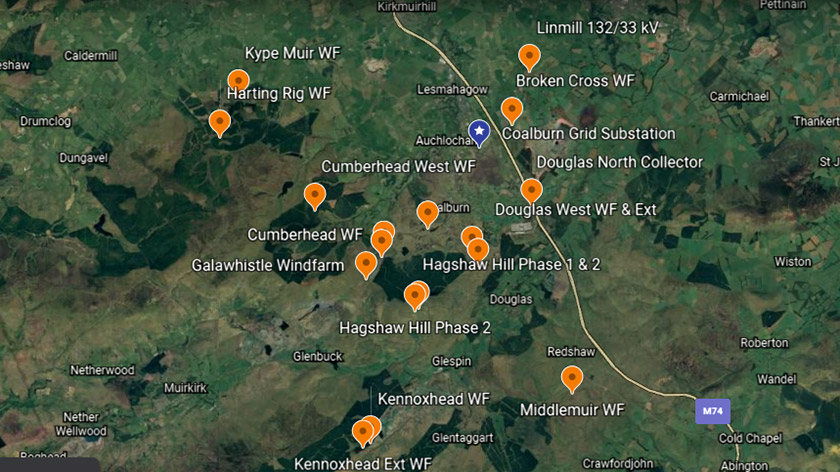
Note.
- The orange arrows are wind farms and there appear to be around a dozen of them.
- The blue arrow is Coalburn Grid Substation.
- Running through the area is the M74 between Glasgow and Carlisle.
- There are some remains of opencast coal-mines in the area, which have been restored and turned into wind farms.
- I have found the capacity of fourteen of the existing wind farms and it totals 946 MW, which is an average capacity for each wind farm of 67 MW.
- During my search for capacity, I found a couple of wind farms that were being upgraded with larger turbines.
- The SP Energy Networks page gives a date of Q3 2025 for connection of the Coalburn battery to the sub-station.
With the 500 MW/1000 MWh Coalburn 1 battery, I wouldn’t be surprised that this massive onshore wind farm complex has been designed to provide a guaranteed 1000 MW to the grid.
Vertical Farming Consortium Secures UK Government Funding To Advance Low-Emission Food Production Using Energy Storage
The title of this post, is the same as that of this article on Renewable Energy Magazine.
This is the sub-heading.
A consortium of four British companies, comprising UK Urban AgriTech (UKUAT), Intelligent Growth Solutions Ltd, RheEnergise and James Hutton Institute has received a grant from the UK Government to advance the development of low-carbon and low-cost food production by co-locating renewable energy with vertical farms.
These paragraphs outline the project.
The V-FAST consortium’s £488,000 project will explore how co-locating RheEnergise’s HD Hydro Energy Storage system with vertical farms can support a low-emission route to growing protein-rich crops in a controlled environment.
Last year, V-FAST – Vertical Farming And Storage Technologies – started investigating sites in Scotland’s Central Belt for the location of Scotland’s next generation of hectare+ scale vertical farms, powered by 100 percent renewables and using RheEnergise’s High-Density Hydro energy storage system. These farms would provide locally produced fresh foods (salads and fruits) to over 60 percent of the Scottish population and help meet the Scottish Government’s ambitions to produce more homegrown fruit and vegetables. These site investigations in Scotland continue.
Now, with the Innovate UK and BBSRC funding as part of the Novel Low Emission Food Production Systems competition, V-FAST will broaden the area for its site feasibility studies to across the UK, using GIS to identify and rate suitable locations for vertical farms that are co-located with renewables and High-Density Hydro energy storage. As part of the project, V-FAST will also undertake crop trials to establish optimal climate recipes in terms of their energy efficiency relative to produce metrics (e.g. protein per kWh or kg of CO2e).
It certainly sounds unusual to pair vertical farming with energy storage, but if it works, why knock it?
RheEnergise’s HD Hydro Energy Storage system is effectively pumped storage hydroelectricity using a fluid with a specific gravity of 2.5.
So instead of needing mountains to store energy, it can use medium-sized hills.
The Wikipedia entry for vertical farming, introduces the concept like this.
Vertical farming is the practice of growing crops in vertically stacked layers. It often incorporates controlled-environment agriculture, which aims to optimize plant growth, and soilless farming techniques such as hydroponics, aquaponics, and aeroponics. Some common choices of structures to house vertical farming systems include buildings, shipping containers, tunnels, and abandoned mine shafts.
As both HD Hydro Energy Storage system and vertical farming seem to need some form of vertical space, can colocation be advantageous in terms of cost?
Wikipedia also says that vertical farms also face large energy demands due to the use of supplementary light like LEDs.
So could V-FAST be an unusal marriage made in heaven of plant science and energy storage?
Highview Power, Ørsted Find Value In Integrating Offshore Wind With Liquid Air Energy Storage
The title of this post, is the same as that of this article on offshoreWIND.biz.
This is the sub-heading.
Highview Power and Ørsted have completed their joint investigation into how combining the technologies of Liquid Air Energy Storage (LAES) and offshore wind could unlock greater value for investors and consumers.
These three paragraphs outline the findings.
The results show that there is value in combining offshore wind with LAES to support reducing wind curtailment, increasing productivity, and helping the move to a more flexible, resilient zero-carbon grid, according to Higher Power.
The two companies have carried out analysis of technical performance, route to planning approval, and route to market with a regulatory and economic assessment.
As a result of this study, the companies believe a project can be developed and built aligned with the timeline of an offshore wind farm.
I feel very strongly, that putting the two technologies together is a good idea.
In the simplest cases, the storage could be built into the offshore sub-station.
Could LAES Be Used With Hornsea 4 Wind Farm?
The Wikipedia entry for the Hornsea Wind Farm says this about Hornsea 4.
In July 2023, British government officials gave the final approval for Hornsea Four, the fourth phase of the wind project. Hornsea Four is expected to generate 2.6GW, have 180 giant wind turbines, and has the capability to generate enough renewable energy to power 1 million homes in Britain.
The Wikipedia entry also says this about Hornsea 3.
Project 3 will be to the east of Projects 1 and 2, with an estimated maximum capacity of 2.4 GW over 696 square kilometres (269 sq mi). DONG Energy (which in November 2017 changed its name to Ørsted) began consultation on the project’s development in May 2016. Ørsted submitted a Development consent application in 2018 and consent was granted on 31 December 2020.[69] In early 2023, consent was also given to a battery storage power station at Swardeston. The project is expected to begin construction in 2022, and be completed by 2025.
If Ørsted are adding a battery to the 2.4 GW Hornsea 3 wind farm, I would feel, that Ørsted would think about a battery on the 2.6 GW Hornsea 4 wind farm.
The Energy Storage The UK Needs
This is the last paragraph of the article.
The UK will need up to 100 GWh of energy storage by 2050 according to the estimates from National Grid ESO’s Future Energy Systems Scenario.
SSE Renewables are planning two large pumped-storage hydroelectric power stations in Scotland.
- Coire Glas – 1.5 GW/30 GWh – Possible completion in 2031.
- Loch Sloy – 152.5 MW/25 GWh – See SSE Unveils Redevelopment Plans For Sloy Hydro-Electric Power Station.
A quick calculation, says we’d need seven pumped-storage hydroelectric power stations, which need a lot of space and a handy mountain.
I don’t think pumped-storage hydroelectric would be feasible.
Highview Power say this about their next projects on this page of their web site.
Highview Power’s next projects will be located in Scotland and the North East and each will be 200MW/2.5GWh capacity. These will be located on the national transmission network where the wind is being generated and therefore will enable these regions to unleash their untapped renewable energy potential and store excess wind power at scale.
Note.
- This is more like the size.
- Work is now underway at Carrington – a 50MW / 300MWh plant at Trafford Energy Park near Manchester.
- Highview’s technology uses liquid air to store energy and well-proven turbo-machinery.
They are a definite possibility, as only eighteen 200MW/2.5GWh systems would be needed.
 The Anonymous Widower