Two-Hour Energy Storage Offers Better Value As UK Frequency Response Market Saturating, Investor Gresham House Says
The title of this post, is the same as this article on Energy Storage News.
I would agree with what Gresham House says and it is my view that we need a lot more energy storage.
I like the system that Highview Power are building at Carrington near Manchester.
- It has an output of 50 MW.
- It has a capacity of 250 MWh.
This means it can supply 50 MW for five hours.
As they have sold other systems to Chile, Spain and the United States, I wouldn’t be surprised to see more of their systems sold in the UK.
Cap And Floor Mechanism The ‘Standout Solution’ For Long Duration Storage, KPMG Finds
The title of this post, is the same as that of this article on Current News.
These are the first two paragraphs.
A cap and floor regime would be the most beneficial solution for supporting long duration energy storage, a KPMG report has found.
Commissioned by Drax, the report detailed how there is currently no appropriate investment mechanism for long duration storage. Examining four investment mechanisms – the Contracts for Difference (CfD) scheme, Regulated Asset Value (RAV) model, cap and floor regime and a reformed Capacity Market – it identified cap and floor as the best solution.
Cap and floor has been used successfully in the financing of interconnectors, so perhaps to apply it to long duration energy storage, will lead to greater use of such storage.
Goldman Sachs Invests $250 million In Hydrostor To Advance Compressed Air Energy Storage Projects
The title of this post, is the same as that of this article on pv Magazine.
This is the introductory paragraph.
The investment is planned to support development and construction of Hydrostor’s 1.1GW, 8.7GWh of Advanced Compressed Air Energy Storage projects that are well underway in California and Australia, and help expand Hydrostor’s project development pipeline globally.
It certainly seems that the big beasts of finance are starting to back innovative energy storage.
Drax’s Plans For Cruachan
Cruachan Power Station is a pumped-storage hydroelectric power station in Argyll and Bute, Scotland.
- It can generate 440 MW of power.
- It has a storage capacity of 7.1 GWh.
- The power station is owned by Drax.
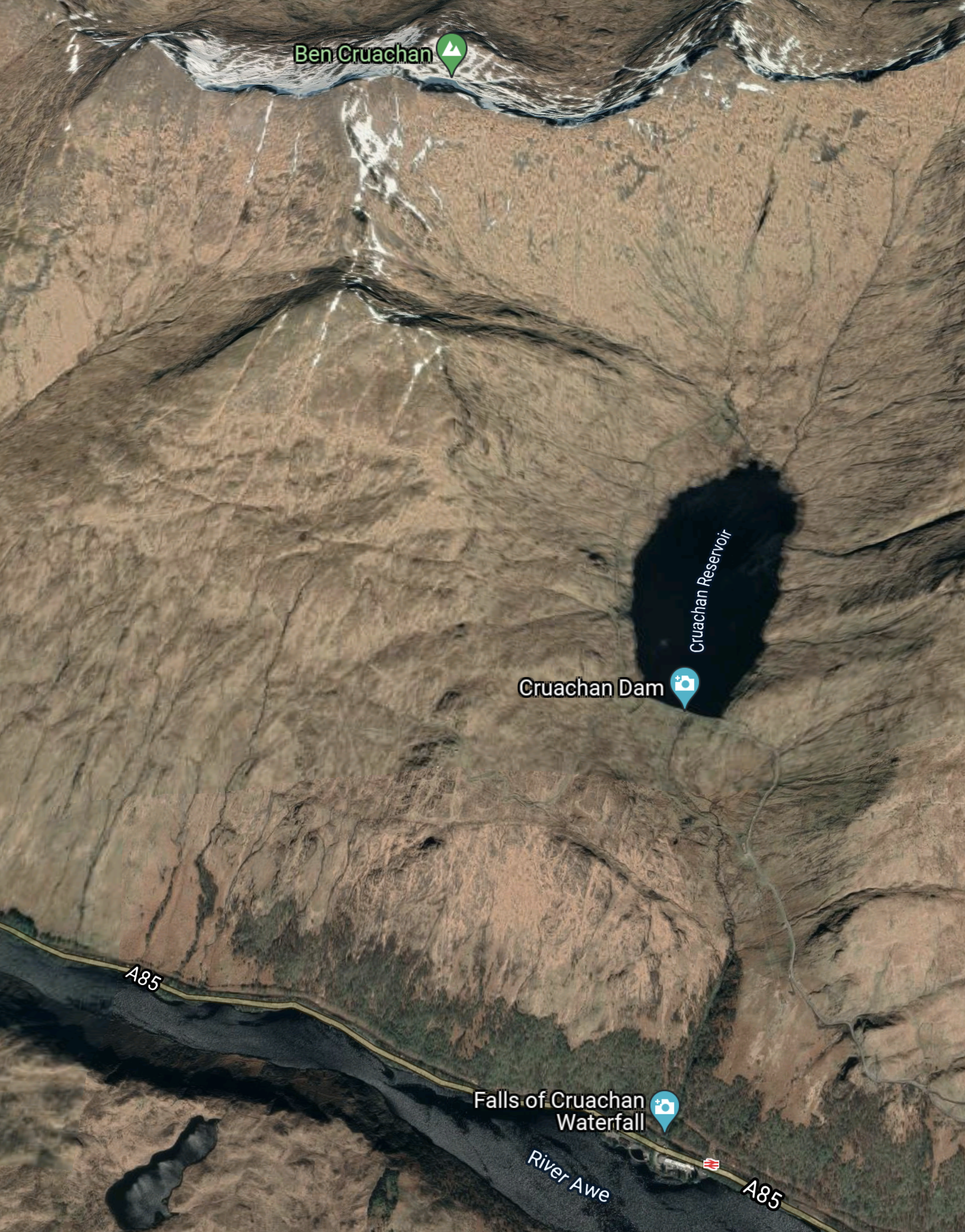
This Google Map shows the area around the power station.
Note.
- Cruachan Reservoir is the upper reservoir for the power station.
- The River Awe is the lower reservoir.
- The turbines for the power station are in a hollowed-out Ben Cruachan.
- There is a visitor centre, which is two-hundred metres from the Falls of Cruachan station, that can be seen on the map, by the river.
More information on visiting can be found at the Visit Cruachan web site.
This second map shows the Southern part of the Cruachan Reservoir to a larger scale.
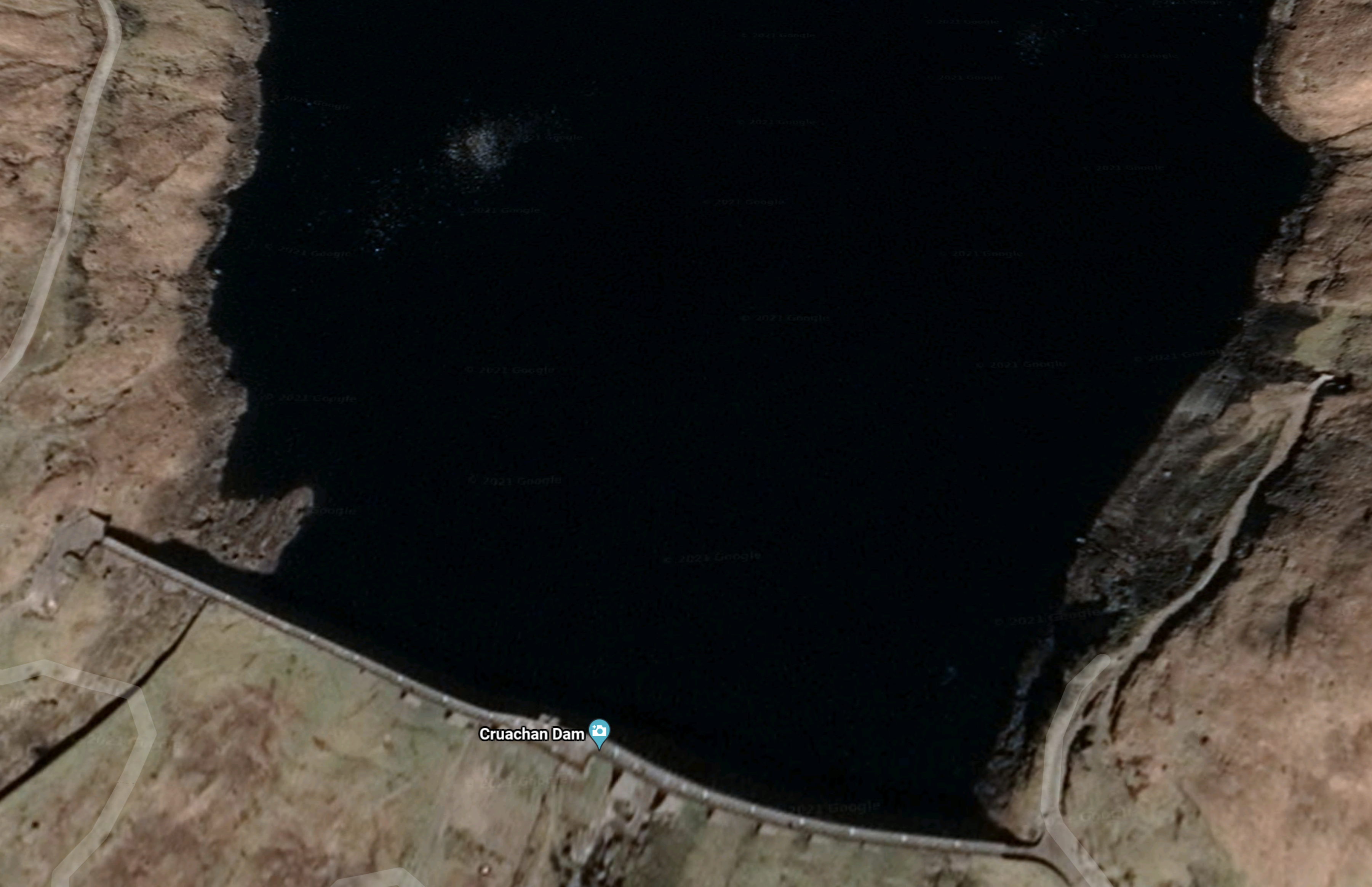
Note the strength of the dam.
The Operation Of Cruachan Power Station
Wikipedia says this about the operation of Cruachan power station.
The station is capable of generating 440 megawatts (590,000 hp) of electricity from four turbines, two of 100 megawatts (130,000 hp) and two of 120 megawatts (160,000 hp) capacity, after two units were upgraded in 2005. It can go from standby to full production in two minutes, or thirty seconds if compressed air is used to start the turbines spinning. When the top reservoir is full, Cruachan can operate for 22 hours before the supply of water is exhausted. At full power, the turbines can pump at 167 cubic metres (5,900 cu ft) per second and generate at 200 cubic metres (7,100 cu ft) per second.
What I find surprising, is that they only upgraded two turbines to 120 MW. I would suspect that there was some other factor that stopped all turbines from being upgraded.
So I would be very surprised if Drax upgraded the power of the existing station.
The Wikipedia extract claims that the Cruachan power station can provide power for 22 hours, if the reservoir, which has a capacity of 7.1 GWh is full. A simple calculation gives an average output in 323 MW. Does that indicate an efficiency of 73.4 %, by dividing 323 by 440.
But no pumped storage system of the 1950s is 100 % efficient. The Ffestiniog Power Station, which opened two years before Cruachan has an efficiency of 73 %. , which appears to be in line with the figures for Cruachan.
Cruachan Power Station And Nuclear Power
Wikipedia says this about Cruachan power station and Hunterston A nuclear power station.
Construction began in 1959 to coincide with the Hunterston A nuclear power station in Ayrshire. Cruachan uses cheap off-peak electricity generated at night to pump water to the higher reservoir, which can then be released during the day to provide power as necessary.
Note.
- Hunterston A power station closed in 1990.
- Hunterston B power station closed a few days ago.
- Scotland now only has one nuclear station at Torness.
It looks like the method of operation will have to change.
Cruachan Power Station And Wind Power
The obvious replacement source of energy at night to replace the nuclear power is wind power.
As I write this the UK is generating 8.5 GW of power from wind turbines.
Surely, enough can be diverted to Cruachan to fill the Cruachan Reservoir.
Cruachan 2
Drax’s plans for Cruachan are based around the building of a second underground power station, which is not surprisingly called Cruachan 2. This page on the Drax web site describes Cruachan 2.
- It will be a 600 MW power station.
- It will be to the East of the current power station.
- More than a million tonnes of rock would be excavated to build the power station.
The existing upper reservoir, which can hold 2.4 billion gallons of water, has the capacity to serve both power stations.
I think it is reasonable to assume the following about Cruachan 2.
- Design of the turbines will have improved in the sixty years since the Francis turbines for the original power station were ordered and designed.
- The turbines will now be precisely computer-controlled to optimise the operation of the power station.
- The turbines will have a faster response, than even that of Cruachan 1, which will help to match output to demand.
But most importantly, I suspect that the efficiency will be higher due to improved turbine design.
I can do a simple calculation, where I will assume the following figures for the two power stations.
- Cruachan 1 – 440 MW – Efficiency – 73 % – Full Power – 323 MW
- Cruachan 2 – 600 MW – Efficiency – 80 % – Full Power – 480 MW
It looks to me that 1040 MW can be used to store water in the reservoir and at this rate it would take 6.8 hours to fill the reservoir. With just Cruachan 1 in operation, filling the reservoir would take sixteen hours.
It looks like with moderate winds generating sensible amounts of electricity, it should be possible to fill the reservoir overnight using both Cruachan 1 and Cruachan 2.
When running flat-out, the combined station can generate 803 MW. At that rate it will generate the power for just under nine hours.
The Wikipedia entry for Francis turbines says this.
Francis turbines are the most common water turbine in use today, and can achieve over 95% efficiency.
Applying 95 % Efficiency to Cruachan 2 would give the following.
- An output of 570 MW for Cruachan 2.
- A total output of 1010 MW for the combined station.
- This would mean the combined station could deliver 1.01 GW for just over seven hours.
Modern control technology would probably be used to ensure that the output of the combined Cruachan station filled in the gaps between demand and supply.
Could The Size Of Cruachan Reservoir Be Increased?
This would increase the amount of energy stored.
I suspect that it probably can’t be increased, as any increases would have been done by now.
Conclusion
It looks like very good engineering to me.
- There is a good chance, that on most nights, the reservoir will be filled using wind energy
- The maximum output of the Cruachan power station has been more than tripled from 323 to 1010 MW.
- There has been no increase in the size of the Cruachan reservoir.
Scotland will now have a GW-sized hydro-electric power station.
Catalyst Capital Makes First Move In GBP 300m Battery Storage Strategy
The title of this post, is the same as that of this article on Renewables Now.
This is the first paragraph.
Fund manager Catalyst Capital has acquired a site to build a 100-MW battery in Yorkshire, northern England, in the first of a series of planned deals under a GBP-300-million (USD 406.1m/EUR 358.9m) strategy to develop diversified UK battery energy storage systems (BESS) facilities.
£300 million, says to me that the finance industry, now finds battery storage to be a worthwhile investment.
Skelton Grange Power Station
This Google Map shows the location of the Skelton Grange power station site, where the battery will be developed.

And this second Google Map shows the site in more detail.

Note that there is still a sub-station on the site.
The article states that planning permission was received in 2021 and they hope to have the facility on-line in the first quarter of this year.
That appears quick to me. Is it because the electrical connection already in situ?
It should also be noted, that the battery output of 100 MW is much less than that of the former coal-fired power station in the mid-1980s, which was at last 480 MW.
I also wonder, if the site could host a hydrogen fuelling station for buses.
- It is not far from the centre of Leeds.
- It has a good connection to the National Grid.
- An electrolyser like the one built by ITM Power at Tyseley Energy Park uses 3 MW of electricity to produce around 1.5 tonnes of hydrogen per day.
I also feel that the site could host a wind turbine up to about 10 MW.
Conclusion
Catalyst Capital seems to have made a big entry into the market. They won’t be the last to do this, as the returns are there and the battery storage is needed.
Why Use A Hydrogen Pipeline Rather Than A Electricity Cable To Bring Electricity Ashore From A Windfarm?
A comment to the post entitled Siemens Gamesa Partners On Offshore Wind-to-Hydrogen, was as follows.
Trying to get my head around this concept. Build an electrolysis plant in the North Sea and run a hydrogen pipeline to shore, rather than generating electricity and transferring the power by undersea cable to a shore based electrolysis plant. Can it really be better technically and economically? Someone convince me.
The reasons probably all come down to saving money and hassle.
Reusing Existing Infrastructure
Supposing, you have an offshore gas field, which is on the point of being worked out.
- It has a well-maintained platform on top.
- It has a pipe to an onshore terminal that handles the natural gas and distributes it to end-users.
Supposing the following are possible.
- Building a large wind farm in the vicinity of the platform.
- Using the gas field for hydrogen storage.
- Converting the gas terminal from natural gas to hydrogen.
- The end-users can convert to hydrogen.
In some cases the end-users might even prefer hydrogen to natural gas, to help their own decarbonisation.
I would suspect that there will be a sound economic case to use hydrogen, where wind farms are developed, in the same areas as worked-out gas fields.
- Platform demolition costs are deferred.
- No HVDC link is needed, with an expensive converter station at the shore end.
- The new system comes with energy storage.
The only extra cost might be that an offshore electrolyser is more expensive than an onshore one.
Engineering Resources
The engineering resources needed for a gas pipeline are different to those needed for an electrical system.
But because gas pipelines are a declining industry, they will be readily available.
Less Planning Hassle
There have been some objections to the development of wind farm terminals by Nimbies.
If a terminal is converted from natural gas to hydrogen, I suspect there will be fewer objections.
Better Control Of Wind Farms
There have been stories of wind farms having to be switched off because there is no-one to buy the electricity.
If some form of offshore hydrogen storage is possible, then the electricity can be used to generate hydrogen, which can be piped ashore, when it is needed.
It Won’t Be One Type Fits All
I suspect we’ll see some hybrid systems and other innovative engineering.
Conclusion
I believe that in a drive to cut costs, we’ll see a lot of energy brought ashore as hydrogen gas.
I
Carlton Power, Stag Pool Knowledge For UK Energy Storage, Green H2
The title of this post, is the same as that of this article on Renewables Now.
This is the introductory paragraph.
British energy infrastructure developers Carlton Power and Stag Energy are merging their operations with plans to develop projects that will help improve energy storage, grid stability and green hydrogen production in the UK.
The article says this about Carlton Power.
Yorkshire-based Carlton has delivered more than 6 GW of thermal and renewables generation in the past 30 years. It is the lead developer of the Trafford Energy Park in Manchester, which foresees a 50-MW/250 -MWh liquid air energy storage plant to be built in partnership with Highview Power, a 200-MW hydrogen electrolyser and commercial hydrogen hub for use in transport and heating as well as a 250-MWe battery energy storage facility. Carlton also plans to expand its Langage Energy Park near Plymouth with the addition of energy storage and electrolyser facilities.
They certainly seem to have a history, that will be worth extending into the future, with energy storage and hydrogen production.
The article says this about Stag Energy.
Edinburgh-headquartered Stag Energy, for its part, has previously developed open-cycle gas-turbine (OCGT) plants in England and Wales and has a joint venture with Lundin to build the Gateway offshore underground gas storage facility in the Irish Sea using salt caverns. Stag Energy is also part of the National Grid’s Pathfinder process to uncover ways to improve electricity system stability.
This article on Hydrocarbons Technology is entitled Gateway Gas Storage Facility and starts with these two paragraphs.
The Gateway Gas Storage Company (Gateway) is developing an underground natural gas storage facility, Gateway Gas Storage Facility (GGSF), 25km offshore south-west Barrow-in-Furness, UK, in the East Irish Sea.
The GGSF plant has a strong locational advantage for developing offshore salt cavern gas storage facilities, according to the British Geological Survey.
In my time at ICI in Runcorn, I learned a lot about salt caverns and once had a memorable trip into their salt mine under Winsford, which was large enough to accommodate Salisbury cathedral. A couple of years later, I worked with a lady, who arranged for ICI’s historic documents to be stored in the dry air of the mine.
Natural Gas Storage In Salt Caverns
This section in Wikipedia describes how caverns in salt formations are used to store natural gas.
In the 1960s, ICI used to create boreholes into the vast amount of salt, that lay below the surface and then by pumping in hot water, they were able to bring up a brine, which they then electrolysed to obtain chlorine, hydrogen, sodium hydroxide and sodium metal.
When they had taken as much salt out of a borehole, as they dared, they would move on.
Provided the salt stayed dry, it didn’t cause any problems.
It sounds like the Gateway Gas Storage Facility will use new caverns carefully created under the Irish Sea.
This document from the Department of Energy and Climate Change is an environmental impact assessment of the project.
It has a full description of the project.
The proposed gas storage facility will be located southwest of Barrow-in-Furness, approximately 24 km. offshore from Fylde, North West England. It will comprise 20 gas storage caverns created in the sub-seabed salt strata. A single well will be drilled at each cavern location, and the salt will be removed using seawater pumped down the well. The dissolved salt, or brine, will then be discharged directly to the sea. The size and shape of the caverns will be controlled using an established technique known as Solution Mining Under Gas (SMUG). At each well location, a monopod tower facility will be installed, to house the solution mining equipment required during the construction phase, and the gas injection and extraction wellhead equipment that will be required for the storage operations. It is proposed that the monopod towers will be drilled into position, although there is a contingency for them to be piled into place if drilling is not feasible.
A short pipeline and methanol feeder pipe will connect each wellhead facility to an 8 km. ‘ring main’ linking all the caverns. The ‘ring main’ will consist of a single 36″ diameter gas pipeline with a ‘piggy-backed’ 4″ methanol feeder line. Two 36″ diameter carbon steel pipelines will connect the ‘ring main’ to the onshore gas compressor station at Barrow. A 4″ methanol feeder line will be ‘piggy-backed’ on one of these pipelines. Power for the offshore facilities will be provided via a single cable laid alongside the more southerly of the two pipelines, with individual connections to each monopod tower. The offshore sections of the pipeline and cable systems up to the point of connection with the ‘ring main’ will be approximately 19 km. in length. The pipeline and cable systems will be trenched, and the trenches allowed to backfill naturally. Where necessary this will be supported by imported backfill. The trenches for the two 36″ pipelines will be approximately 20 metres apart, and the trench for the power cable will be approximately 10 m from the more southerly of the two pipelines. The two pipelines will cross the Barrow Offshore Windfarm power cable and the ‘ring main’ will cross the Rivers Field export pipeline and the Isle of Man power cables. All crossings will be suitably protected.
Note.
- The multiple cavern structure would surely allow different gases to be stored. Natural Gas! Hydrogen? Methanol? Carbon Dioxide?
- On this page of the Stag Energy web site, they state that forty caverns could be created, with each having the capability of storing around 75 million cubic metres of working gas.
- Converting that amount of natural gas to gigawatt-hours (GWh) gives a figure of around 800 GWh per cavern.
- This page on the Statista web site, shows that we used 811446 GWh of gas in 2020, so we will need around a thousand of these caverns to store our gas needs for a year.
It sounds just like the sort of gas storage project we need for a harsh winter.
In Do BP And The Germans Have A Cunning Plan For European Energy Domination?, I talked about BP’s plans for wind farms in the Irish Sea and speculated that they would create hydrogen offshore for feeding into the UK gas network.
The Gateway Gas Storage Facility would be ideal for holding the hydrogen created by electrolysis offshore.
Conclusion
The deal does seem to be one between equals, who have an enormous amount of practical knowledge of the energy industry.
I also think, that it will see full development of the Gateway Gas Storage Facility.
Mine Water Heat
The title of this post, is the same as that of this press release from the Coal Authority.
This is the introductory paragraph.
The Coal Authority is working with partners to unlock the heat within our historical coal mine network, to transform the homes and workplaces of the future.
The Coal Authority doesn’t have much of a historic product, so selling the heat from the mines could be an environmentally-friendly revenue scheme.
These four paragraphs are the heart of the press release.
As part of our work to make a better future for people and the environment in mining areas, we’re exploring opportunities to use mine water to heat and cool homes and businesses.
Water within the mines is warmed by natural processes and can, if sustainably managed, provide a continuous supply of heat. Mine water temperatures are not affected by seasonal variations and, subject to the right support, mine water can provide renewable, secure, low carbon heating for buildings in coalfield areas.
With heating accounting for 40% of energy use in the UK, mine water heat could improve the sustainability of the places where we live and work. Mine water heat could also play a part in the UK’s efforts to tackle climate change and support its net zero future.
The Coal Authority are working with academics, local authorities, central government and others to help realise the potential of mine water heat. We’re supporting the delivery of mine water heat projects and working with others to make them happen.
The press release then adds more details and describes specific projects.
Mines For Storing Electricity
We also mustn’t forget other uses for abandoned coal mines.
I particularly like Gravitricity’s idea of used abandoned deep mines to store energy, that I wrote about in Gravitricity Explores Czech Coal Mine For MW-Scale Storage.
I hope the Coal Authority has its eyes on this ball.
Conclusion
I first became aware of the ability to extract heat from abandoned coal mines at a lecture at the Geological Society of London, after which I wrote Can Abandoned Mines Heat Our Future?.
I believe that for some parts of the country, this could become the preferred technology for heating homes and businesses.
The technology was even featured on the BBC tonight.
Decommissioned Audi EV Batteries Used In 4.5MWh Stationary Energy Storage System In Germany
The title of this post, is the same as that of this article on Energy Storage News.
These are the first two paragraphs of the article.
Used lithium-ion batteries taken from carmaker Audi’s electric vehicles (EVs) have been repurposed into a ‘second-life’ stationary energy storage system by energy company RWE at a project in Herdecke, Germany.
RWE has deployed the system, which has a capacity of around 4.5MWh, at the site of its pumped hydro energy storage (PHES) plant at Hengsteysee reservoir in the North-Rhine Westphalia region of north-west Germany.
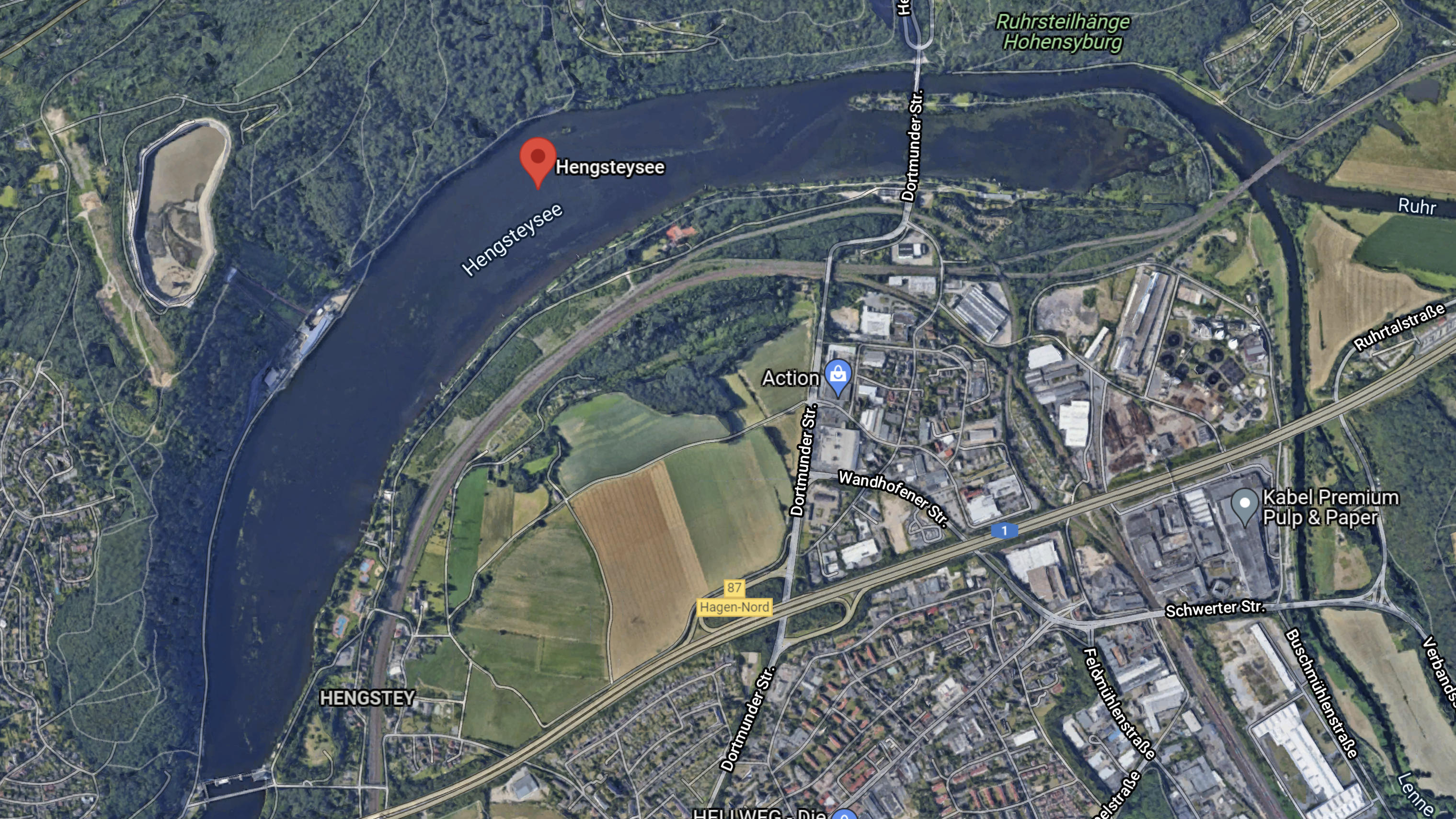
The Hengsteysee looks to be a well-designed reservoir, as it provides four functions.
- Functions as the lower reservoir of the Koepchenwerk pumped-storage plant
- Performs biological purification of water from the Lenne
- Deposit of sediment from the Lenne
- Venue for water sports and tourism
This Google Map shows the Hengsteysee.
More details of the Koepchenwerk pumped-storage plant is given on this page on Power Technology.
- It has a generating capacity of 153 MW.
- The gross head is 145.5 metres.
- The storage capacity is around 0.6 GWh.
It is not the largest of pumped-storage plants, but Germany seems to have a lot of smaller ones like this and in total they have more than we do.
What Happens When The Wind Doesn’t Blow?
In Future Offshore Wind Power Capacity In The UK, I analysed future offshore wind power development in the waters around the UK and came to this conclusion.
It looks like we’ll be able to reap the wind. And possibly 50 GW of it!
The unpredictable nature of wind and solar power means that it needs to be backed up with storage or some other method.
In The Power Of Solar With A Large Battery, I describe how a Highview Power CRYObattery with a capacity of 500 MWh is used to back up a large solar power station in the Atacama desert in Chile.
But to backup 50 GW is going to need a lot of energy storage.
The largest energy storage system in the UK is Electric Mountain or Dinorwig power station in Wales.
- It has an output of 1.8 GW, which means that we’d need up to nearly thirty Electric Mountains to replace the 50 GW.
- It has a storage capacity of 9.1 GWh, so at 1.8 GW, it can provide that output for five hours.
- To make matters worse, Electric Mountain cost £425 million in 1974, which would be over £4 billion today, if you could fine a place to build one.
But it is not as bad as it looks.
- Battery technology is improving all the time and so is the modelling of power networks.
- We are now seeing large numbers of lithium-ion batteries being added to the UK power network to improve the quality of the network.
- The first Highview Power CRYObattery with an output of 50 MW and a capacity of 250 MWh is being built at Carrington in Manchester.
- If this full size trial is successful, I could see dozens of CRYOBatteries being installed at weak points in the UK power network.
- Other battery technology is being developed, that might be suitable for application in the UK.
Put this all together and I suspect that it will be possible to cover on days where the wind doesn’t blow.
But it certainly will need a lot of energy storage.
Gas-Fired Power Stations As A Back Up To Renewable Power
Last summer when the wind didn’t blow, gas-fired power stations were started up to fill the gap in the electricity needed.
Gas-fired power-stations normally use gas turbines similar to those used in airliners, which have a very fast startup response, so power can be increased quickly.
If you look at the specification of proposed gas-fired power stations like Keadby2, they have two features not found in current stations.
- The ability to be fitted in the future with carbon-capture technology.
- The ability to be fuelled by hydrogen.
Both features would allow a gas-fired power-station to generate power in a zero-carbon mode.
Carbon Capture And Storage
I am not in favour of Carbon Capture And Storage, as I believe Carbon Capture and Use is much better and increasingly engineers, researchers and technologists are finding ways of using carbon-dioxide.
- Feeding to tomatoes, salad vegetables, soft fruits and flowers in greenhouses.
- Producing meat substitutes like Quorn.
- Producing sustainable aviation fuel.
- An Australian company called Mineral Decarbonation International can convert carbon dioxide into building products like blocks and plasterboard.
This list will grow.
Using or storing the carbon-dioxide produced from a gas-fired power station running on natural gas, will allow the fuel to be used, as a backup, when the wind isn’t blowing.
Use Of Hydrogen
Hydrogen will have the following core uses in the future.
- Steelmaking
- Smelting of metal ores like copper and zinc
- As a chemical feedstock
- Natural gas replacement in the mains.
- Transport
Note that the first four uses could need large quantities of hydrogen, so they would probably need an extensive storage system, so that all users had good access to the hydrogen.
If we assume that the hydrogen is green and probably produced by electrolysis, the obvious place to store it would be in a redundant gas field that is convenient. Hence my belief of placing the electrolyser offshore on perhaps a redundant gas platform.
If there is high hydrogen availability, then using a gas-fired power-station running on hydrogen, is an ideal way to make up the shortfall in power caused by the low wind.
Conclusion
Batteries and gas-fired power stations can handle the shortfall in power.
 The Anonymous Widower