Long-Duration Energy Storage Milestones Achieved By Lockheed, Eos And Form Energy
The title of this post, is the same as that of this article on Energy Storage News.
Lockheed
I find it significant that Lockheed Martin have developed a new redox flow battery, which is a 500kW / 2.5MWh system.
Last year, the company had revenue of nearly sixty billion dollars, with a net income of over six billion dollars. They certainly have the resources and the name to make a big impression on the long-duration storage market.
Their GridStar Flow technology is also detailed on this page on the Lockheed Martin web site.
The page lists these features.
- Optimized for 6+ hours of flexible discharge
- Flexibility to switch between products to maximize revenue
- 100 percent depth-of-discharge with minimal degradation
- A design life of 20 years
- Ability to size energy and power independently
- Mildly alkaline, aqueous electrolytes that are safe (nonflammable, noncorrosive, stable)
- Competitive total cost of ownership
It looks impressive.
EOS Energy
EOS Energy can’t be doing badly, as they’re preparing to list on NASDAQ.
Form Energy
Form Energy are also reported to have had a $70 million investment.
Conclusion
It appears long duration energy storage is doing well across the pond.
My money would be on Lockheed to produce the most successful product.
M&G To Invest £150m In UK Battery Start-Up Zenobe
The title of this post, is the same as that of this article on the Financial Times.
Good to see M & G getting involved in funding batteries.
Holy Grail Of Energy Storage Receives Two Grants
The title of this post, is the same as that of this article on Off Grid Energy Independence.
This is the introductory paragraph.
RheEnergise is one of only a select handful of businesses to have been awarded grants under both the Sustainable Innovation Fund & the Small Business Research Initiative.
So what have RheEnergise developed?
The home page of their web site, is surprisingly detailed, unlike those of some other companies with new ideas, and not just energy storage companies!
This is the first paragraph on their home page.
RheEnergise is bringing innovation to pumped hydro storage. We call our new solution High-Density Hydro ™.
I think that is a good start, as although pumped hydro storage is well proven and the UK has the 1,728 MW Dinorwig Power Station, which has a storage capacity of 9.1 GWh, building new large pumped storage systems is fraught with difficulties and the technology has seen only modest innovation in the last few decades.
The next paragraph on their home page describes their innovation.
HD Hydro ™ uses our proprietary HD Fluid R-19 ™, which has 2.5x the density of water. R-19 gives RheEnergise projects 2.5x the power and 2.5x the energy when compared to water.
This means that for the same size of pumped hydro storage power station, you get 2.5 times the amount of energy storage.
Alongside a diagram of the system, the advantages of their systems is stated.
Projects can be installed on hills 2.5x lower than a project using water and still achieve the same power – for example, there are so many more hills at 150m than at 375m.
2.5x smaller, by volume, meaning dramatically lower construction costs, faster build times, easier reinstatement and easier landscaping – projects can be entirely hidden.
A very simple innovation has greatly increased the possibilities of pumped hydro storage.
The home page also gives a typical capacity.
RheEnergise projects provide 10MW to 50MW power and 2 to 10 hours of storage capacity.
These systems are in the same range as those of Highview Power, who are building a 50 MW system, with a five hour capacity at Carrington near Manchester, that I wrote about in Highview Power Breaks Ground on 250MWh CRYOBattery Long Duration Energy Storage Facility.
Both have the advantage, that they are easily scalable.
With RheEnergise’s HD Hydro ™, the size of the upper reservoir would need to be increased and with Highview Power’s CRYOBattery, more tanks for the liquid air would need to be added.
The Technology
I certainly agree with the principle behind ReEnergise, both mathematically and practically.
My interest scientifically, is what is the fluid they use?
- Pure water has a specific gravity of one and everything else is measured with respect to this.
- So aluminium, which has a specific gravity of 2.7, is 2.7 times as heavy as water.
- Many of us will be familiar with mercury, which is a metal, that is liquid at room temperature.
- Mercury has a specific gravity of 13.56.
It puzzles me, how someone has created a liquid, almost as heavy as aluminium, that can be pumped and handled like water, as it would need to be, to make a pumped storage system work.
Highview Power Breaks Ground on 250MWh CRYOBattery Long Duration Energy Storage Facility
The title of this post, is the same as that of this News page on the Highview web site.
The page shows this picture of diggers doing, what they do.
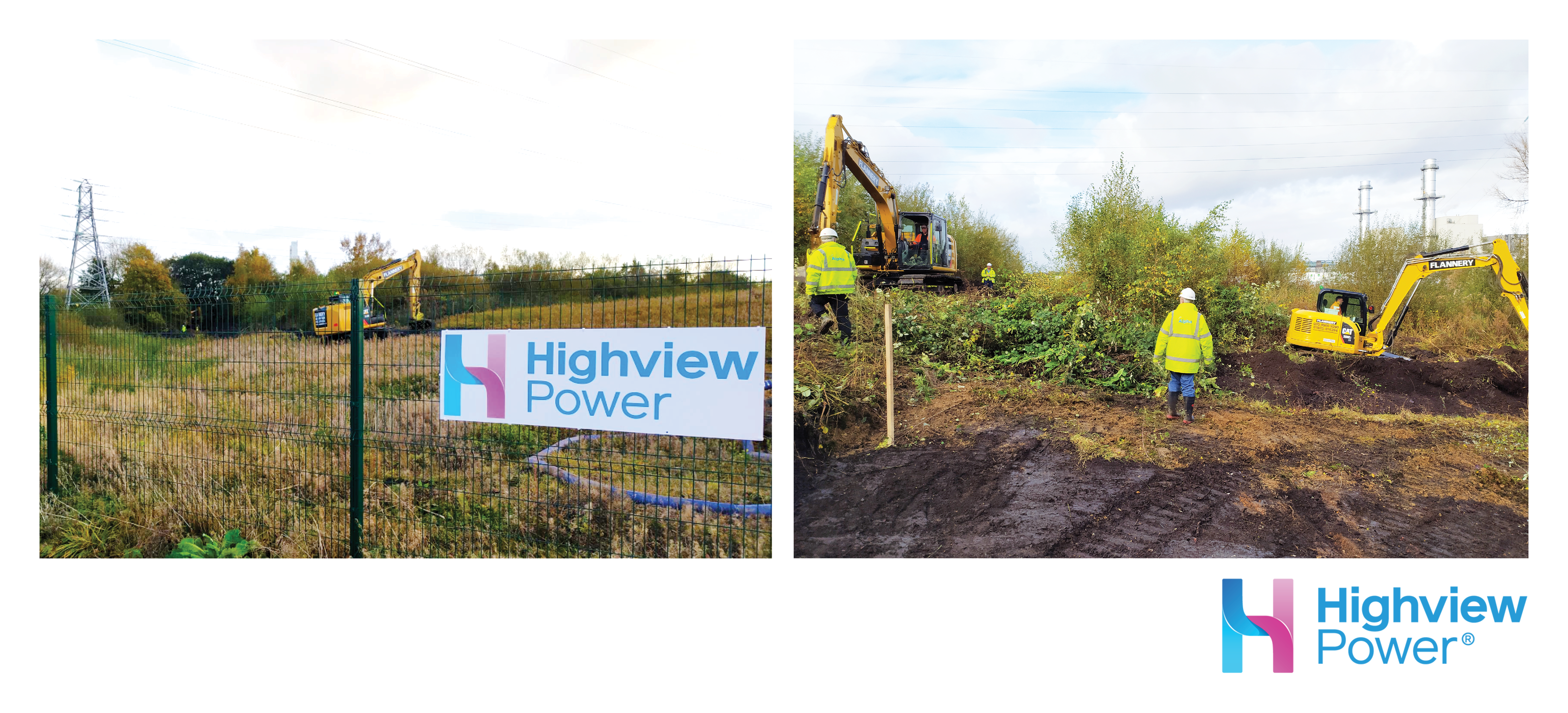
Note the two towers in the background of the image on the right. They look like the towers of Carrington power station, which are shown on this page on the FK Group web site, who built the 884 MW CCGT power station.
This Google Map shows the site of the power station.
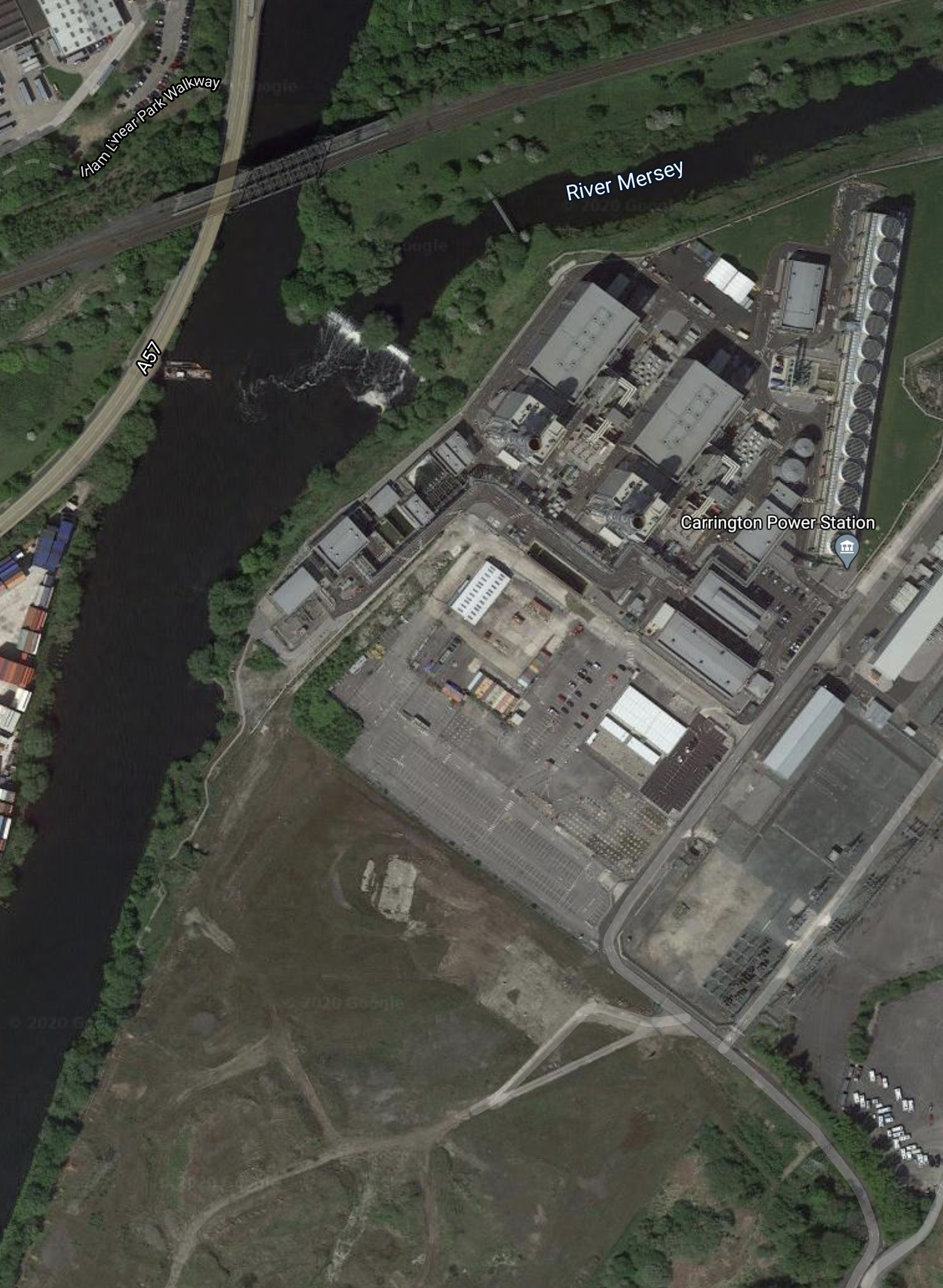
On a larger scale map, you can pick out the towers from their shadows and it looks to me, that Highview’s 250MWh CRYOBattery is being built on the vacant site to the South of the power station.
Consider.
- The vacant site looks large.
- I’ve read somewhere that Highview’s CRYOBatteries are expandable by adding more tanks.
- They certainly have space to add lots of extra tanks and a 884 MW power station on the doorstep to fill them.
- All the heavy equipment and components to build Carrington power station were brought in by barge using the River Mersey and the Manchester Ship Canal. Will this method be used again?
This seems to be a site that would be ideal for a very large battery.
UK Energy Plant To Use Liquid Air
The title of this post, is the same as that of this article on the BBC.
This article about the technique is different, as it details some of the human back-story in these three paragraphs.
The system was devised by Peter Dearman, a self-taught backyard inventor from Hertfordshire, and it has been taken to commercial scale with a £10m grant from the UK government.
“It’s very exciting,” he told BBC News. “We need many different forms of energy storage – and I’m confident liquid air will be one of them.”
Mr Dearman said his invention was 60-70% efficient, depending how it is used.
Mr. Dearman is now a passive shareholder in Highview Power, who are building the plant.
The Most Important News Of The Day
It has nothing to do with that soon-to-be-ex President across the Pond, except that he would brand it a waste of money and a fantasy.
If he did call it a fantasy, he’d at least know something about fantasy.
This article on Recharge is entitled Work Starts To Build World’s First Commercial Liquid-Air Energy Storage Plant.
These are the first two paragraphs.
Work has started to build the world’s first commercial liquid-air energy storage facility near Manchester, northern England, along with a visitor centre that aims to turn the pioneering project into a tourist attraction.
A joint venture between UK-based Highview Power and independent solar/natural-gas plant developer Carlton Power will build and operate the 50MW/250MWh “CRYObattery” — which may later be expanded to add more storage — in the village of Carrington, close to Manchester United’s training ground.
The visitor centre will open in the first quarter of 2021, with the plant planned to start operation in 2023.
- That seems to me to be an ambitious time-scale.
- On the other hand, the plant appears to be composed of well-proven readily-available components, so it will not be too challenging.
Whether Trummkopf likes it or not, construction of the second plant in the Democratic-voting state of Vermont, will surely be starting in the near future.
- He would like the fact that at 50MW400 MWh, the American battery is larger.
- He wouldn’t like the fact, that it is replacing a coal-fired power station.
- It will give eight hours of full-power as opposed to Manchester’s five.
- As both plants are rated at 50 MW, I suspect the two plants are identical on the energy generation side.
- Vermont would just have more tanks to store the liquid air.
It is my view, that these two, will be the first of many.
Plans For £45m Scottish Green Hydrogen Production Plant Revealed
The title of this post, is the same as that of this article on H2 View.
This is the opening paragraph.
UK-built hydrogen buses powered by Scottish-made green hydrogen, transporting COP26 delegates around Glasgow in 2021: that’s the vision of a new £45m project unveiled today (3rd Nov).
Some details of the plant are also given.
- It will be built at Lesmahagow.
- It will be co-located with wind turbines and solar panels.
- It will have an initial capacity of 9 MW, with a possible increase to 20 MW.
- It will produce 800 tonnes of hydrogen per annum.
- The company behind it, is called Hy2Go
It sounds like the electrolyser is the one mentioned in Green Hydrogen For Scotland, which was announced in a press release from ITM Power.
Although, that electrolyser may be situated at Whitelee Wind Farm, which is a few miles closer to the coast.
Will Scotland Have Two Electrolysers To the South Of Glasgow?
Consider.
- Whitelee is the UK’s largest onshore wind farm with a capacity of 539 MW.
- It is planned to install a large battery at Whitelee. See Super Battery Plan To Boost UK’s Biggest Onshore Windfarm on this page on the Scottish Power web site.
- Lesmahagow’s turbines and solar panels have not been installed yet.
- Much of the wind power in the South of Scotland and the North of England is mainly onshore, rather than onshore.
- The location of the Lesmahagow electrolyser will be close to the M74.
- The location of the Whitelee electrolyser will be close to the M77.
- There is a good motorway network linking the electrolysers’ to the major cities in the South of Scotland and the North of England.
- Newcastle might be a bit difficult to supply, but that may receive hydrogen from Teesside or the Humber.
Perhaps, the economics of onshore wind, with electrolysers nearby, makes for an affordable source of plentiful green hydrogen.
I would expect that if Scotland built two large electrolysers South of Glasgow, they wouldn’t have too much trouble using the hydrogen to reduce the country’s and the North of England’s carbon footprint.
Have These Two Projects Merged?
Consider.
- The Lesmahagow site is stated in the article to possibly have two electrolysers with a total capacity of 20 MW.
- The Lesmahagow site is in an excellent position close to a junction to the M74 motorway, with easy access to Edinburgh, Glasgow and England.
- The Lesmahagow site could probably have a pipeline to a hydrogen filling station for trucks and other vehicles on the M74.
- The Whitelee wind farm is huge.
- Lesmahagow and Whitelee are about twenty miles apart.
- More wind turbines might be possible between the two sites.
- There must also be a high-capacity grid connection at Whitelee.
Combining the two projects could have advantages.
- There could be cost savings on the infrastructure.
- It might be easier to add more wind turbines.
There may be time savings to be made, so that hydrogen is available for COP26.
Conclusion
Scotland is making a bold green statement for COP26.
A network of very large hydrogen electrolysers is stating to emerge.
- Glasgow – Lesmahagow.
- Herne Bay for London and the South East – Planning permission has been obtained.
- Humber – In planning
- Runcorn for North West England – Existing supply
- Teesside – Existing supply
Joe Bamford’s dream of thousands of hydrogen-powered buses, is beginning to become a reality.
Could A Gravitricity Energy Storage System Be Built Into A Wind Turbine?
On Thursday, I watched the first programme in a BBC series called Powering Britain. This programme was about wind power.
The program had close-up views of the inside of a turbine tower in the Hornsea Wind Farm in the North Sea. The spacious tower enclosed a lift for engineers to access the gubbins on the top.
In the Wikipedia entry for wind turbine, there is a section, with is entitled Most Powerful, Tallest, Largest And With Highest 24-Hour Production, where this is said.
GE Wind Energy’s Haliade-X is the most powerful wind turbine in the world, at 12MW. It also is the tallest, with a hub height of 150 m and a tip height of 260m. It also has the largest rotor of 220 m and largest swept area at 38000 m2. It also holds the record for the highest production in 24 hours.
Two certainties about wind turbines are that they will get larger and more powerful, if the progress over the last few years is continued.
So could a Gravitricity energy storage system be built into the tower of the turbine?
A lot would depend on the structural engineering of the combination and the strength of the tower to support a heavy weight suspended from the top, either inside or even outside like a collar.
To obtain a MWh of storage, with a height of 150 metres, would need a weight of 2,500 tonnes, which would be over three hundred cubic metres of wrought iron.
Gravitricity are talking of 2,500 tonnes in their systems, but I suspect the idea of a wind turbine, with a practical level of storage inside the tower, is not yet an engineering possibility.
Megawatt Charging System Set To Rapidly Reduce Fuelling Time For Commercial EVs
The title of this post, is the same as that of this article on Electric Autonomy Canada.
This is the sub-title.
An international task force says their recent high power “charge-in” event has yielded promising results with successful testing of novel connector prototypes that could overhaul the long-haul industry.
The problem of charging heavy freight trucks is a big market in North America and it seems that the event attracted some big players, like ABB, Daimler and Tesla.
- In the trucking industry, speed and range count for a lot.
- Trucks need to be charged during a driver’s rest break of about thirty minutes.
- In the U.S., transport made up 28 per cent of greenhouse gas emissions.
- Charging lots of trucks on typical state-of-the-art car chargers would probably crash the system.
The Megawatt Charging System aims to solve the problems.
How Would It Work?
This paragraph from the article, outlines the problems.
But how, one may ask, could such a massive electrical draw — as much as 4.5 megawatts — be supported by a grid, especially when the usage scale is not just one truck charging up, once a day, but thousands of 18-wheelers rolling and charging across the country.
The MCS Task Force seem to be suggesting that these systems will work as follows.
- A large battery or energy storage system will be trickle charged.
- The truck will be connected and the electricity will flow into the truck.
- It could all be automated.
It sounds very much like Vivarail’s Fast Charge system, which uses batteries as the intermediate store.
As an Electrical and Control Engineer, I would use a battery with a fast response.
I think I would use a Gravitricity battery. This page on their web site describes their technology.
Gravitricity™ technology has a unique combination of characteristics:
- 50-year design life – with no cycle limit or degradation
- Response time – zero to full power in less than one second
- Efficiency – between 80 and 90 percent
- Versatile – can run slowly at low power or fast at high power
- Simple – easy to construct near networks
- Cost effective – levelised costs well below lithium batteries.
Each unit can be configured to produce between 1 and 20MW peak power, with output duration from 15 minutes to 8 hours.
So, What Exactly Is Long-Duration Energy Storage?
The title of this post is the same as that of this article on Greentech Media.
This is the sub-title.
Everyone’s talking about it, and Californians are buying in. Here’s what you need to know about this emerging grid sector.
It describes what California is doing and the sector, with particular reference to Hydrostor, Form Energy and Highview Power.
The article finishes with a section entitled What’s The Catch?
This is the first two paragraphs.
The obvious barrier to a thriving long-duration storage industry is convincing generally conservative power plant customers that emerging technologies quite unlike anything the grid currently uses are safe bets for decades of operation.
Lab tests can reduce the risk, but nothing beats operational, megawatt-scale installations for proving that something works. That’s why the Form deal with Great River Energy is so crucial, as are early projects by Highview Power and Hydrostor. The big exception to technology risk is pumped hydro, which has been used at scale for decades. Those projects grapple instead with high capital expense and environmental concerns.
The article is a must-read and hopefully, this and more articles like it, will convince conservative energy company owners, regulators and governments, that long duration energy storage is the missing link between renewable power and electricity consumers.
At least, the current UK Government has backed two of the most promising British long duration energy storage companies; Gravitricity and Highview Power.
 The Anonymous Widower