Gresham House Plots £58million Raise To Pursue Energy Storage Pipelines
The title of this post is the same as this article on Solar Power Portal.
The article shows how increasingly the City of London is moving to increase the energy storage capacity we need as more wind and solar power comes on-line.
I wouldn’t invest my money in something like this directly, but I wouldn’t object if my pension provider placed money in energy storage.
Energy Vault Receives $110 Million From SoftBank For Gravity-Assisted Power Storage
The title of this post is the same as that of this article on Forbes.
Energy Vault is a company, that is developing gravity-assisted power storage.
You don’t invest £110million in a company, even if you are as rich as Softbank, unless you are certain, that you’ll get a return!
So I suspect Energy Vault may have a working system for storing energy
Read the article and see what your think! It also links to a video.
This is an interesting quote from the company.
We knew we needed to be around three to four cents levelized cost per kWh ($30 – $40 per MWh) to add to PV or wind in order to be competitive below fossil. This took a lot of innovation.
I shall be following the company.
British Start-Up Beats World To Holy Grail Of Cheap Energy Storage For Wind And Solar
The title of this post is the same as that of this article on the Daily Telegraph.
If you think it sounds too good to be true, then watch this video from the company behind the technology; Highview Power.
The basic principle is very simple.
- Electricity is used to turn air into liquefied air using refrigeration technology, that has been around for donkeys years.
- This is stored in tanks under pressure.
- To retrieve the energy, the liquid air is allowed to evaporate and creates electricity through a turbine and generator.
These engineers have taken several pieces of readily available industrial equipment, put it together in a novel way. to create an energy storage system.
I believe that this could be the Holy Grail of energy storage!
Why?
In World’s Largest Wind Farm Attracts Huge Backing From Insurance Giant, I discussed how Aviva have invested a billion pounds in wind farms, as it gives them the sort of long-term return they need to provide pensions and pay out insurance claims.
But if you own a Gigawatt-sized wind farm in the North Sea, one thing is missing; the ability to store that energy in an affordable way.
So by investing in this type of energy storage and coupling it with their own wind farms, Aviva can control the output of the wind farms to what the National Grid needs.
All it needs is some more money, that needs a home. And Aviva have lots of that!
It’s also an investment with an ethical and green profile.
- No polluting technology.
- Proven technology.
- Zero-carbon technology.
- Non-toxic technology.
- No use of exotic and scant resources.
- No expensive or dangerous fuel
- Affordable technology
Systems can also be distributed to where they are needed or where there is surplus electricity.
If you want to know more, watch the video and then look at other videos for Highview Power.
How Much Energy Can Highview Power’s Systems Store?
The biggest energy storage system in the UK is Electric Mountain, which has a power output of 1,728 MW and an energy storage capacity of 9.1 GWh.
That is some battery and it was built in the 1970s for a cost of £425 million, which would be £1.3billion today.
In a video it is claimed that Highview Power are designing a storage system, which has a power output of 200 MW and an energy storage capacity of 1.2 GWh.
You would only need to build nine and you’ve got another Electric Mountain!
Perhaps to maximise security of supply and obtain a fast response, the systems could be placed in Cumbria, Essex, Humberside, Kent, Merseyside, Norfolk, Suffolk, Thurso and Yorkshire.
Would We Need Nuclear Power?
Probably not!
For the same amount of money as a large nuclear power station, you’d get an awful lot of offshore wind farms and the storage thrown in.
Conclusion
This technology could solve the world’s energy problems.
I
Thoughts On Last Week’s Major Power Outage
This article on the BBC is entitled Major Power Failure Affects Homes And Transport.
This is the first two paragraphs.
Nearly a million people have been affected by a major power cut across large areas of England and Wales, affecting homes and transport networks.
National Grid said it was caused by issues with two power generators but the problem was now resolved.
This second article on the BBC is entitled UK power cut: Why it caused so much disruption, and gives these details.
It started with a routine blip – the gas-fired power station at Little Barford in Bedfordshire shut down at 16:58 BST due to a technical issue.
Then, a second power station, the new Hornsea offshore wind farm, also “lost load” – meaning the turbines were still moving, but power was not reaching the grid.
These are my thoughts on the incident.
Power Stations Do Fail
Any complex electro-mechanical system like Little Barford gas-fired power station or Hornsea offshore wind farm can fail.
- Little Barford gas-fired power station was built in 1994 and is a 746 MW gas-fired power station.
- Hornsea offshore wind farm obtained planning permission in 2014 and is being built in phases. It will eventually have a maximum capacity of 8 GW or 8,000 MW.
Compare these figures with the iconic coal-fired Battersea power station, which had a maximum output of 503 MW in 1955.
I will not speculate as to what wet wrong except to say that as the Hornsea wind-farm is relatively new, it could be what engineers call an infant mortality problem. Complex systems or even components seem to fail in the first few months of operation.
Why Do We Have Gas-Fired Stations?
According to this page on Wikipedia, there are around forty natural gas fired power stations in England.
Most gas-fired stations are what are known as CCGT (Combined Cycle Gas Turbine), where a Jumbo-sized gas-turbine engine is paired with a steam turbine powered by the heat of the exhaust from the engine.
This form of power generation does produce some carbon dioxide, but to obtain a given amount of electricity, it produces a lot less than using coal or ioil.
By combining the gas turbine with a steam turbine, the power station becomes more efficient and less carbon dioxide is produced.
Power stations of this type have three various advantages.
- They have a very fast start-up time, so are ideal power stations to respond to sudden increases in electricity demand.
- As they are a gas-turbine engine with extra gubbins, they are very controllable, just like their cousins on aircraft.
- They are relatively quick, easy and affordable to build. The Wikipedia entry for a CCGT says this. “The capital costs of combined cycle power is relatively low, at around $1000/kW, making it one of the cheapest types of generation to install.”
- They don’t need a complicated and expensive transport infrastructure to bring in coal or nuclear fuel.
- They can also be powered by biogas from agricultural or forestry waste, although I don’t think that is a comm practice in the UK.
The carbon dioxide produced is the only major problem.
Gas-Fired Power Stations In The Future
If you read the Wikipedia entry for combined cycle power plants, there is a lot of information on CCGTs, much of which is on various ways of improving their efficiency.
I believe that one particular method of increasing efficiency could be very applicable in the UK.
Under Boosting Efficiency in the Wikipedia entry, the following is said.
The efficiency of CCGT and GT can be boosted by pre-cooling combustion air. This is practised in hot climates and also has the effect of increasing power output. This is achieved by evaporative cooling of water using a moist matrix placed in front of the turbine, or by using Ice storage air conditioning. The latter has the advantage of greater improvements due to the lower temperatures available. Furthermore, ice storage can be used as a means of load control or load shifting since ice can be made during periods of low power demand and, potentially in the future the anticipated high availability of other resources such as renewables during certain periods.
The UK is the world’s largest generator of power using offshore wind and as we are surrounded with sea and wind, the UK is only going to produce more of the power it needs in this or other way.
This method could be used to store the wind energy produced when the demand is low and recover it, when it is needed.
Could The UK Develop A Chain Of Carbon-Neutral Gas-Fired Power Stations?
In parts of the UK, there is a unique mix of resources.
- A plentiful supply of natural gas, either from offshore fields or interconnectors to Norway.
- Large amounts of electricity generated by offshore wind, which will only get larger.
- Worked out gas-fields still connected to the shore, through redundant platforms and pipes.
- Closeness to agricultural areas.
Technologies under development or already working include.
- Offshore creation of hydrogen using electricity generated by offshore wind and then using the redundant gas pipes to bring the hydrogen to the shore.
- Using a hydrogen-fired CCGT power station without producing any carbon-dioxide.
- Feeding carbon dioxide to plants like salad and fruit to make them grow better.
- Using excess electricity from renewable sources to cool the air and improve the efficiency of CCGT power stations.
I can see all these technologies and development coming together in the next few years and a chain of carbon-neutral gas-fired power stations will be created
- Hydrogen produced offshore on redundant gas platforms, using electricity from nearby wind farms, will be turned back into electricity, where it is needed by onshore hydrogen-fired power stations.
- Redundant gas platforms will be refurbished and reused, rather than demolished at great expense.
- Some natural gas will still be used for power generation
- I’m not quite sure, but I think there could be dual-furled CCGTs, that could run on either hydrogen or natural gas.
- Any carbon dioxide generated will be stored in the worked out gas fields or fed to the crops.
- Gas storage onshore will ensure that the gas-fired power station can respond quickly.
I also believe that there is no technological and engineering challenges, that are too difficult to solve.
This strategy would have the following advantages.
- It should be carbon-neutral.
- Because there could have as many as two hundred individual power stations, the system would be very reliable and responsive to the loss of say a cluster of five stations, due to a tsunami, a volcanic eruption or a major eathquake.
- If power from renewable sources like offshore wind is low, extra stations can be quickly switched in.
- It is not dependent on fuel from dodgy dictators!
- It would probably be more affordable than developing nuclear power stations.
There is also the possibility of bringing more hydrogen onshore to be used in the decarbonisation of the gas-grid.
Conclusion
A chain of carbon-neutral gas-fired power stations, linked to hydrogen created offshore by wind farms is very feasible.
Last week, after the double failure, extra stations would have immediately been switched in.
Energy Storage
The fastest response system is energy storage, where a giant battery holds several gigawatt-hours of eklectricity.
Electric Mountain
The biggest energy storage facility in the UK is Dinorwig Power Station.
This is the introduction to its Wikipedia entry.
The Dinorwig Power Station , known locally as Electric Mountain, is a pumped-storage hydroelectric scheme, near Dinorwig, Llanberisin Snowdonia national park in Gwynedd, northern Wales. The scheme can supply a maximum power of 1,728-megawatt (2,317,000 hp) and has a storage capacity of around 9.1-gigawatt-hour (33 TJ)
It is large and has a rapid response, when more electricity is needed.
We probably need another three or four Electric Mountains, but our geography means we have few suitable sites for pumped-storage, especially in areas, where large quantities of electricity are needed.
There are one other pumped-storage system in Wales and two in Scotland, all of which are around 350 MW or a fifth the size of Electric Mountain.
In the Wikipedia entry entitled List Of Power Stations In Scotland, this is said.
SSE have proposed building two new pumped storage schemes in the Great Glen; 600 MW at Balmacaan above Loch Ness, and 600 MW at Coire Glas above Loch Lochy, at £800m. Scotland has a potential for around 500 GWh of pumped storage
I’m sure the Scots will find some way to fill this storage.
If all else fails, there’s always Icelink. This is the description from Wikipedia.
Icelink is a proposed electricity interconnector between Iceland and Great Britain. As of 2017, the project is still at the feasibility stage. According to current plans, IceLink may become operational in 2027.
At 1000–1200 km, the 1000 MW HVDC link would be the longest sub-sea power interconnector in the world.
The project partners are National Grid plc in the UK, and Landsvirkjun, the state-owned generator in Iceland, and Landsnet, the Icelandic Transmission System Operator (TSO)
Plugging it in to Scotland, rather than London, probably saves a bit of money!
Conclusion
Increasing our pumped-storage energy capacity is feasible and would help us to survive major power failures.
Batteries In Buildings
Tesla have a product called a Powerwall, which puts energy storage into a home or other building.
This was the first product of its kind and there will be many imitators.
The Powerwall 2 has a capacity of 13.5 kWh, which is puny compared to the 9.1 GWh or 9,100,000 kWh of Electric Mountain.
But only 674,074 batteries would need to be fitted in the UK to be able to store the same amount of electricity as Electric Mountain.
The big benefit of batteries in buildings is that they shift usage from the Peak times to overnight
So they will reduce domestic demand in the Peak.
Conclusion
Government should give incentives for people to add batteries to their houses and other buildings.
Could Hydrogen Work As Energy Storage?
Suppose you had a hydrogen-fired 500 MW hydrogen-fired CCGT with a hydrogen tank that was large enough to run it at full power for an hour.
That would be a 0.5 GWh storage battery with a discharge rate of 500 MW.
In an hour it would supply 500MWh or 500,000 kWh of electricity at full power.
In Hydrogen Economy on Wikipedia, this is said, about producing hydrogen by electroysis of water.
However, current best processes for water electrolysis have an effective electrical efficiency of 70-80%, so that producing 1 kg of hydrogen (which has a specific energy of 143 MJ/kg or about 40 kWh/kg) requires 50–55 kWh of electricity.
If I take the 40 KWh/Kg figure that means that to provide maximum power for an hour needs 12,500 Kg or 12.5 tonnes of hydrogen.
Under a pressure of 700 bar, hydrogen has a density of 42 Kg/cu. m., so 12.5 tonnes of hydrogen will occupy just under 300 cubic metres.
If I’ve got the figures right that could be a manageable amount of hydrogen.
Remember, I used to work in a hydrogen factory and I had the detailed guided tour. Technology may change in fifty years, but the properties of hydrogen haven’t!
Gas-Fired Versus Coal-Fired Power Stations
Consider.
- The problem of the carbon dioxide is easier with a gas-fired power station, than a coal-fired power station of the same generating capacity, as it will generate only about forty percent of carbon dioxide.
- Gas-fired power stations can be started up very quickly, whereas starting a coal-fired power station probably takes all day.
- Coal is much more difficult to handle than gas.
Using hydrogen is even better than using natural gas, as it’s zero-carbpn.
Conclusion
I believe we can use our unique geographic position and proven technology to increase the resilience of our power networks.
We need both more power stations and energy storage.
Bombardier Doesn’t Seem Too Disappointed On Missing Out On The Abellio East Midlands Railway Order
This article on the Derby Telegraph is entitled Derby’s Bombardier Misses Out On Big Contract To Supply Trains For The East Midlands.
This is two paragraphs from the article.
In a statement, Bombardier said: “Bombardier is clearly disappointed that we have not been selected to supply bi-mode trains for the East Midlands franchise.
“We believe we submitted a competitive bid – on technology, strength of product, deliverability and cost, and will seek formal feedback from Abellio.”
There certainly hasn’t been any published threat of legal action.
The Abellio East Midlands Railway Order From Hitachi.
The order placed was as follows.
Thirty-three five-car AT-300 trains.
- 25 KVAC overhead electrification.
- Four cars have underfloor diesel-engines.
- 125 mph running.
- 24 metre cars.
- Ability to work in pairs.
- Evolution of a Class 802 train.
- A new nose.
It is a £400 million order.
No Trains For Corby
In How Will Abellio East Midlands Railway Maximise Capacity On The Midland Main Line?, I calculated that the current timetable to Derby, Nottingham and Sheffield would need thirty-two trains.
So thirty-three trains would only be enough trains for the bi-mode services to the three Northern termini.
So it looks like Hitachi are not providing any trains for the Corby services! Surely, to have a compatible fleet from one manufacturer would be of an advantage to Abellio East Midlands Railway.
An Ideal Fleet For Corby
Trains between London and Corby take around 70-75 minutes, with a round trip taking three hours.
This means that to run a one train per hour (tph) service to Corby needs three trains and a two tph service will need six trains.
As trains go wrong and also need servicing, I would add at least one spare train, but two is probably preferable.
It would have the following characteristics.
- All electric.
- 125 mph running, as they will need to keep out of the way of the Hitachi bi-modes.
- 240 metres long.
- A passenger-friendly interior, with loys of tables.
- Energy efficient
If the last point s to be met, I and many other engineers believe that to save energy, trains must have regenerative braking to batteries on the train.
In Kinetic Energy Of A Five-Car Class 801 Train, I calculated that the kinetic energy of a Class 801 train, with every seat taken was 104.2 kWh
This calculation was performed for a half-length train, so a full electric train for London and Corby would have a kinetic energy of 208.4 kWh, if it was similar to one of Hitachi’s Class 801 train.
The reason the kinetic energy of a train is important, is teat if a train brakes from full speed and has batteries to handle the energy generated by regenerative braking, the batteries must be big enough to handle all the energy.
So a ten-car train similar in capacity and weight to a Class 801 train would need batteries capable of handling 208.4 kWh.
I’ll give a simple example.
A train similar to a Class 801, is full and running using electrification at 125 mph. It is approaching a station, where it will stop.
- The train’s computer knows the mass and velocity of the train at all times and hence the kinetic energy can be calculated.
- The train’s computer will constantly manage the train’s electricity supply, so that the batteries always have sufficient capacity to store any energy generated by braking.
- As the train brakes, the energy generated will be stored in the batteries.
- As the train moves away from the station, the train’s computer will use energy from the overhead electrification or batteries to accelerate the train.
Energy will constantly be recycled between the traction motors and the batteries.
I don’t know what battery capacity would be needed, but in my experience, perhaps between 300-400 kWh would be enough.
Any better figures, gratefully accepted.
When you consider that the battery in a Tesla car is around 60-70 kWh, I don’t think, there’ll be too much trouble putting enough battery power underneath a ten-car train.
Onward To Melton Mowbray
This page on the Department for Transport web site is an interactive map of the Abellio’s promises for East Midlands Railway.
These are mentioned for services to Oakham and Melton Mowbray.
- After electrification of the Corby route there will continue to be direct service each way between London and Oakham and Melton Mowbray once each weekday, via Corby.
- This will be operated with brand new 125mph trains when these are introduced from April 2022.
This seems to be a very acceptable minimum position.
Surely, in a real world driven by marketing and finance and more and more passengers wanting to travel regularly by train to places like London, Luton Airport and Leicester, there will come a time, when an hourly service on this route is needed.
Could a Corby service be extended to Melton Mowbray using battery power, at perhaps a slower speed of 90 mph?
Accelerating away from Corby, the train would need 108 kWh of energy to get to 90 mph with a full train.
- There would be a continuation of the electrification for perhaps a couple of hundred metres after Corby station.
- The train would probably leave Corby with a full battery, which would have been charged on the journey from London.
Once at cruising speed, the train would need energy to maintain line speed and provide hotel power.
In How Much Power Is Needed To Run A Train At 125 mph?, I calculated the figure for some high-speed trains.
This was my conclusion.
In future for the energy use of a train running at 125 mph, I shall use a figure of three kWh per vehicle mile.
So I will use that figure, although I suspect the real figure could be lower.
I will also assume.
- Corby to Melton Mowbray is 26.8 miles.
- It’s a ten-car train.
- Regenerative braking is seventy percent efficient.
- The train is running at 90 mph, between Cotby and Melton Mowbray, with an energy of 108 kWh
Energy use on a round trip between Corby and Melton Mowbray, would be as follows.
- Accelerating at Corby – 108 kWh – Electrification
- Stop at Oakham – 32.4 kWh – Battery
- Corby to Melton Mowbray – 804 kWh – Battery
- Stop at Melton Mowbray – 32.4 kWh – Battery
- Stop at Oakham – 32.4 kWh – Battery
- Melton Mowbray to Corby – 804 kWh – Battery
This gives a total of 1705.2 kWh
The battery energy need gets a lot more relaxed, if there is a charging station at Melton Mowbray, as the train will start the return journey with a full battery.
Energy use from Corby to Melton Mowbray would be as follows.
- Accelerating at Corby – 108 kWh – Electrification
- Stop at Oakham – 32.4 kWh – Battery
- Corby to Melton Mowbray – 804 kWh – Battery
This gives a total of 836.4 kWh.
Energy use from Melton Mowbray to Corby would be as follows.
- Accelerating at Melton Mowbray- 108 kWh – Battery
- Stop at Oakham – 32.4 kWh – Battery
- Melton Mowbray to Corby – 804 kWh – Battery
This gives a total of 944.4 kWh.
The intriguing fact, is that if you needed a train to go out and back from Corby to Melton Mowbray, it needs a battery twice the size of one needed, if you can charge the train at Melton Mowbray., during the stop of several minutes.
Charging The Train
This page on the Furrer + Frey web site, shows a charging station..
It might also be possible to erect a short length of 25 KVAC overhead electrification. This would also help in accelerating the train to line speed.
This Google Map shows Melton Mowbray station.
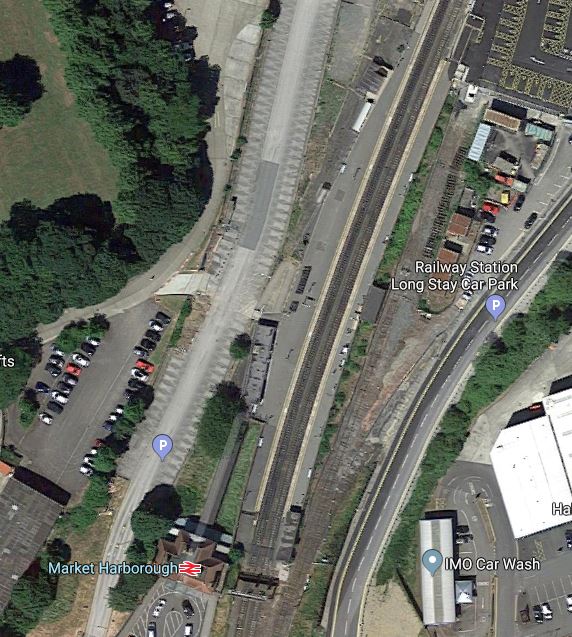
It looks to be a station on a large site with more than adequate car parking and I suspect building a bay platform with charging facilities would not be the most difficult of projects.
More Efficient Trains
I also think that with good design electricity use can be reduced from my figure of 3 kWh per vehicle mile and the regenerative braking efficiency can be increased.
Obviously, the more efficient the train, the greater the range for a given size of battery.
Onward To Leicester
If the train service can be extended by the 26.8 miles between Corby and Melton Mowbray, I wonder if the electric service can be extended to Leicester.
Under current plans the Northern end of the electrification will be Market Harborough.
In Market Harborough Station – 11th July 2019, I wrote about the station after a visit. In my visit, I notices there were a lot of croaaovers to the North of the station.
As it was a new track alignment, I suspect that they were new.
So is it the interntion to turnback services at Market Harborough or are the crossovers preparation for links to stabling sidings?
It got me asking if battery-electric trains could reach Leicester.
- Leicester and Market Harborough are only fourteen miles apart.
- There are no stops in between.
- Using my three kwH per vehicle mile, this would mean that a ten car train would use 420 kWh between the two stations at 125 mph.
I certainly believe that a Northbound train passing Market Harborough with fully-charged batteries could reach Leicester, if it had an adequate battery of perhaps 700 kWh.
As at Melton Mowbray, there would probably need to be a charging station at Leicester.

The picture shows the station from the Northern bridge.
The platforms shown are the two main lines used by most trains. On the outside are two further lines and one or both could be fitted with a charging station, if that were necessary.
An Example Electric Service Between London And Leicester
If they so wanted, Abellio East Midlands Railway could run 125 mph battery-electric services between London and Leicester.
The Current Timings
The fastest rains go North in around 66-67 minutes and come South in seventy.
So a round trip would take around two and a half hours.
Five trains would be needed for a half-hourly service.
I feel it would be very feasible, if Abellio East Midlands Railway wanted to increase services between London and Leicester, then this could be done with a fleet of zero-carbon battery-electric trains, using battery power between Leicester and Market Harborough.
A Non-Stop London And Leicester Service
I wonder what would be the possible time for an electric express running non-stop between London and Leicester.
- Currently, some diesel Class 222 trains are timetabled to achieve sixty-two minutes.
- Linespeed would be 125 mph for much of the route.
- There is no reason, why the fourteen mile section without electrification North of Market Harborough couldn’t be run at 1235 mph on battery-power, once the track is upgraded to that speed.
- iIn the future, modern digital signalling, as used by Thameslink, could be applied to the whole route and higher speeds of up to 140 mph may be possible.
I wouldn’t be surprised to see a battery-electric train travelling between London and Leicester in fifty minutes before 2030.
A fifty-minute service would result in a two-hour round trip and need just two trains for a frequency of two tph.
It would surely be a marketing man’s dream.
It should be noted that Abellio has form in this area and have introduced Norwich-in-Ninrty services on the slower London and Norwich route.
London And Leicester Via Corby, Oakham And Melton Mowbray
I have been very conservative in my calculations of battery size.
With real data on the terrain, the track profile, the train energy consumption, regenerative braking performance and the passengers, I do wonder, if it would be possible to run on battery power between Corby and Leicester via Oakham and Melton Mowbray.
- The distance would be 62 miles on battery power.
- Trains could serve Syston station.
- Using times of current services London and Leicester would take two hours fifteen minutes.
I suspect it would be possible, but it would be a slow service.
Would These Services Be An Application For Bombardier’s 125 mph Bi-Mode Aventra With Batteries?
Could Bombardier’s relaxed reaction to not getting the main order, be because they are going to be building some of their proposed 125 mph bi-mode trains with batteries, that will be able to work the following routes?
- London and Melton Mowbray via Corby and Oakham.
- London and Leicester via Market Harborough.
But I think that the main emphasis could be on a non-stop high-speed service between London and Leicester.
I have been suspicious that there is more to Bombardier’s proposed train than they have disclosed and wrote Is Bombardier’s 125 mph Bi-Mode Aventra With Batteries, A 125 mph Battery-Electric Aventra With Added Diesel Power To Extend The Range?
Since I wrote that article, my view that Bombardier’s train is a battery-electric one, with diesel power to extend the range, has hardened.
These Midland Main Line trains will run in two separate modes.
- On the Southern electrified sections, the trains will be 125 mph electric trains using batteries for regenerative braking, energy efficiency and emergency power in the case of overhead line failure..
- On the Northern sections without electrification,the trains will be battery-electric trains running at the maximum line-speed possible, which will be 125 mph on Leicester services.
There will be an optimum battery size, which will give the train the required performance.
Is there any need for any diesel engines?
Quite frankly! No! As why would you lug something around that you only need for charging the batteries and perhaps overhead supply failure?
- Batteries would only need to be charged at the Northern end of the routes. So use a chasrging station, if one is needed!
- Batteries can handle overhead supply failure, automatically.
Who needs bi-modes?
How Big Would The Batteries Need To Be?
A full train would have a kinetic energy of around 200 kWh and I said this about battery capacity for handling the energy from regenerastive braking.
I don’t know what battery capacity would be needed, but in my experience, perhaps between 300-400 kWh would be enough.
Any better figures, gratefully accepted.
To handle Corby to Melton Mowbray and back, I estimated that 1,800 kWh would be needed, but if the train had a top-up at Melton Mowbray a capacity of 1,000 kWh would be sufficient.
Pushed, I would say, that a battery capacity of 2,000 kWh would be sufficient to run both routes without a charging station, at the Northern end.
I also believe the following will happen.
- Trains will get more efficient and leighter in weight.
- Batteries will increase their energy density.
- Charging stations will charge trains faster.
- Battery costs will fall.
This would mean that larger battery capacities can be achieved without the current weight and cost penalty and the achievable range after the end of the wires will increase.
I wouldn’t be surprised to see ranges of over fifty miles in a few years, which with a charging station at the destination, means battery-electric trains could venture fifty miles from an electrified line.
A few other suggested routes.
- Ashford and Southampton
- Birmingham and Stansted Airport
- Carliswle and Newcastle
- Doncaster and Peterborough via Lincoln (CS)
- Edinburgh and Tweedbank (CS)
- London Euston and Chester
- London St. Pancras and Hastings
- London Waterloo and Salisbury (CS)
- Manchester and Sheffield (CS)
- Norwich and Nottingham (CS)
- York and Hull via Scarborough (CS)
Note.
- Stations marked (CS) would need a charging station.
- Some routes would only need 100 mph trains.
I think that a 125 mph battery train will have a big future.
Conclusion
I have a feeling that Bombardier are right to be not too disappointed.
« Previous | Next »
Battery Answer To Schleswig-Holstein’s Diesel Replacement Question
The title of this post, is the same as that of this article on Railway Gazette International.
It is a good explanation of why there is so much interest in battery-powered trains.
This paragraph from the article, describes how the trains will operate in Schleswig-Holstein.
They will have range of 150 km under optimal conditions, although the longest non-electrified route they will operate on is around 80 km. The batteries will be recharged from the existing 15 kV 16·7 Hz overhead electrification at Kiel, Neumünster, Flensburg, Lübeck and Lüneburg stations and on the Osterrönfeld – Jübek line. Charging facilities will also be provided in other locations, and there will be some extensions to the existing overhead power supply.
Consider.
- These trains can run on routes of up to eighty kilometres or around fifty miles.
- Greater Anglia and Transport for Wales will be running the UK versions of the Stadler Flirts, that will be used in Schleswig-Holstein.
- Transport for Wales will also be running a tri-mode Flirt with electric, diesel and battery power.
- The Continental loading gauge, probably allows more batteries than the smaller UK loading gauge.
I think it could be reasonable to assume, that a UK-sized battery-electric Stadler Flirt could have a range of forty miles on batteries.
These could be possible routes for Greater Anglia.
- Norwich and Sheringham – 30 miles
- Norwich and Lowestoft – 23.5 miles
- Norwich and Great Yarmouth – 18 miles
- Ipswich and Felixstowe – 16 miles
- Colchester Town and Sudbury – 20 miles
In addition some partially-electrified routes have gaps less than forty miles. Think Cambridge and Ipswich!
I would not be surprised to see battery trains, quietly gliding around East Anglia.
Would they attract passengers and tourists?
Perhaps Germany and Stadler will give us the Schleswig-Holstein Answer, which will be much more interesting than the Schleswig-Holstein Question.
Economics Of Battery Trains
The article also has this quote from the CEO of Stadler Germany about the economics of battery trains.
It makes us very proud that with the battery-powered Flirt we have not only managed to find an ecological and innovative solution, but have also enabled a clear economic improvement. If we consider the average life of a rail vehicle of around 30 years, battery-operated vehicles are more cost-effective than diesel’.
I think it can also be said, that battery technology will improve continuously in the next thirty years and we should see a corresponding improvement in range and performance.
You don’t get that with diesel.
Hydrogen Or Battery Power?
I would think that Alstom are not happy about this order for battery-powered trains.
- Only a hundred kilometres or so to the West, they are supplying Alstom Coradia iLint trains for a similar network.
- These trains are working well.
- They have teamed up with Linde to supply the hydrogen.
I wouldn’t have been surprised if Schleswig-Holstein had chosen hydrogen trains.
So why did Schleswig-Holstein, choose battery rather than hydrogen trains?
- Provided, the driver or a computer, raises and lowers the pantograph appropriately, there is no difference between an electric train and its battery-electric sibling.
- Systems to charge battery trains can be installed anywhere, there is an electricity supply.
- The electricity supply could be local wind or solar.
- Charging battery trains could be automatic and require no more action from the driver, than checking everything is as it should be and perhaps pushing a button or two. On a bleak miserable day, the driver would remain in the warm and comfortable cab.
- Hydrogen would need to be loaded on the train at a depot or another place with the necessary safety clearance.
- The iLint seats 160 and the Flirt Akku seats 124, so I suspect capacity isn’t much of a problem.
- The Flirt Akku is a train designed for battery-electric operation, whereas the iLint is a modified diesel train, with a noisy and harsh mechanical transmission. It’s like comparing Class 710 trains, with their predecessors on the Gospel Oak to Barking Line; the Class 172 trains.
- I suspect most Germans have talked to a relative or older person, who remembers the Hindenburg.
There is probably little to choose between the two trains, but I believe that the operation of the hydrogen-powered train will be more complicated.
I also don’t know the cost of each train.
As I said earlier, Stadler claim long-term ownership of battery-powered trains is more economic than diesel. Does the same apply to battery against hydrogen power.
Conclusion
I believe we’ll see lots more battery trains.
Airport Plans World’s Biggest Car Parks For 50,000 Cars
The title of this post, is the same as that of an article in Wednesday’s copy of The Times.
This is the first two paragraphs.
The biggest car parks in the world will be built as part of a £14 billion expansion of Heathrow amid fresh claims that the scheme will be an “environmental disaster”.
Parking for almost 53,000 vehicles will be built as part of a 30-year masterplan, even though the airport insists that expansion can be achieved without any extra cars on the road.
This sounds to be contradictory, as why would you need to build extra car parking, if there were no more extra cars on the road?
Perhaps there is a clue later in the article, where this is is a paragraph.
Heathrow said that the overall number of parking spaces would “not change materially from today”, insisting that spaces were simply being consolidated on bigger sites. It pointed out that car parks would allow for 100 per cent electric vehicle usage in the future. In total, the number of parking spaces, including those for staff and spaces at nearby offices, will grow from 64,000 today to 67,000.
Admittedly, it only says allow, but Heathrow are future-proofing themselves for the day when everyone is driving electric cars.
Heathrow and others are also planning to do the following.
- Charge a congestion charge of up to £15 a day will be imposed by 2026 to dissuade passengers from travelling to the airport by car.
- A “green loop” — a 12-mile pedestrian and cycle network — will also circle the airport.
- Finish Crossrail.
- Improve Heathrow Express.
- There will be a rail link to Reading.
- There will be a second rail link to Waterloo via Clapham Junction.
- There could be a rail link to Basingstoke, Guildford and Woking, possibly by extending Heathrow Express.
Will these measures nudge travellers in one of two positive directions?
- Using public transport to get to the Airport.
- Cycling or walking to the airport.
- Using an electric car to get to and from the Airport.
I am a Control Engineer, who spent a working life of nearly fifty years analysing data and doing mathematical calculations, hopefully to improve little bits of the world.
So What Would I Do?
It is absolutely essential that it is known, where all the vehicles to the airport are travelling to and from.
No-one is going to stop using their car, if there is no creditable alternative.
The ultimate aim must also be that, all transport within a certain distance of the Airport must be zero-carbon.
- All vehicles used by travellers and workers to get to and from the Airport.
- All vehicles bringing supplies to the Airport.
- All airside vehicles.
What will happen to those that lived in the zone?
This Google Map shows Hanwell Village to the South-West of the Airport.
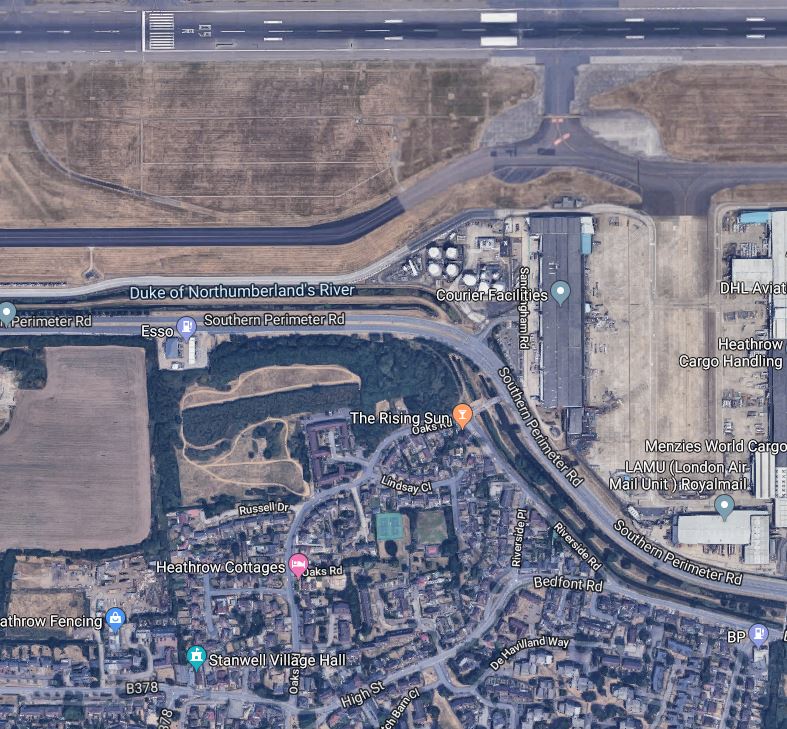
Will all those residents pay the congestion charge?
But suppose Heathrow could get ninety percent of all cars travelling to the Airport and using the car parks, to be electric vehicles.
This would be 45,000 vehicles, each with a battery of between 30-60 kWh. Let’s call it, 30 kWh.
This would mean that the total of energy storage on a typical day at the Airport would be 1.35 GWh.
Compare that to the 9.1 GWh capacity of Electric Mountain.
Electric Mountain would be bigger, but intelligent control of the batteries of these electric vehicles could create a massive electricity storage resource at the Airport.
- Vehicles would be connected to a two-way vehicle-to-grid charger (V2G), when the driver went about their business at the Airport, after telling the vehicle when they would return.
- On return to the vehicle, it would have enough charge for the next journey.
- The driver would also have an app on their phone, so they could alter their expected return time.
- Whilst the driver was away, the grid would borrow electricity from the vehicle’s battery if required.
All the technology exists and National Grid are looking at ways to use electric vehicle batteries for energy storage.
National Grid have suggested, that they might even pay for the use of your battery.
I suspect that all parking for electric vehicles in the future, will work using something like this model.
Note the following calculation.
In December 2018, there were 31.5 million cars and four million light goods vehicles in the UK.
In a few years time, suppose half of these vehicles are electric with a 20 KWh battery.
That works out at an astronomical 355 GWh or nearly forty Electric Mountains.
- Electric Mountain cost £425 million in 1984.
- Applying a web inflation calculator means it would cost around £1350 million today.
- So forty Electric Mountains would cost £54 billion.
That is a lot of money and we have no place to put them.
But we have this massive storage capability in the millions of electric vehicles, that will be on the roads in a few years.
Conclusion
All future large car parks must be built to be large storage batteries, when drivers plug in their electric cars using vehicle-to-grid (V2G) technology.
If you were to be paid for the use of your car’s battery, would that ease the expense of owning an electric car?
The Shape Of Solar Farms To Come
This article on Renew Energy is entitled Gannawarra Battery-Integrated Solar Farm – Australia’s Largest – Officially Opened.
These are the first two paragraphs.
The Gannawarra solar and energy storage project near Kerang in western Victoria has had its official launch on Friday, to mark the largest pairing of a solar farm and a grid-scale battery system in Australia.
State energy minister Lily D’Ambrosio officially anointed the landmark project, which has combined 60MW of PV panels and a 25MW/50MWh battery system – Tesla’s second-biggest battery in the country so far.
Form the video in the areticle, it appears that there are 120 hectares of solar panels and the farm provides enough electricity for 25,000 homes.
It is an interesting concept and I’m sure it will be repeated around the world.
Ausralia has lots of sun, but there is no reason, why a similar system can’t be developed with tidal, wave or wind power.
Heathrow Plans Runway Over M25 In 30-Year Expansion
The title of this post, is the same as that of an article in Saturday’s copy of The Times.
This picture, which I downloaded from this page on the Heathrow web site, shows the proposed expansion.
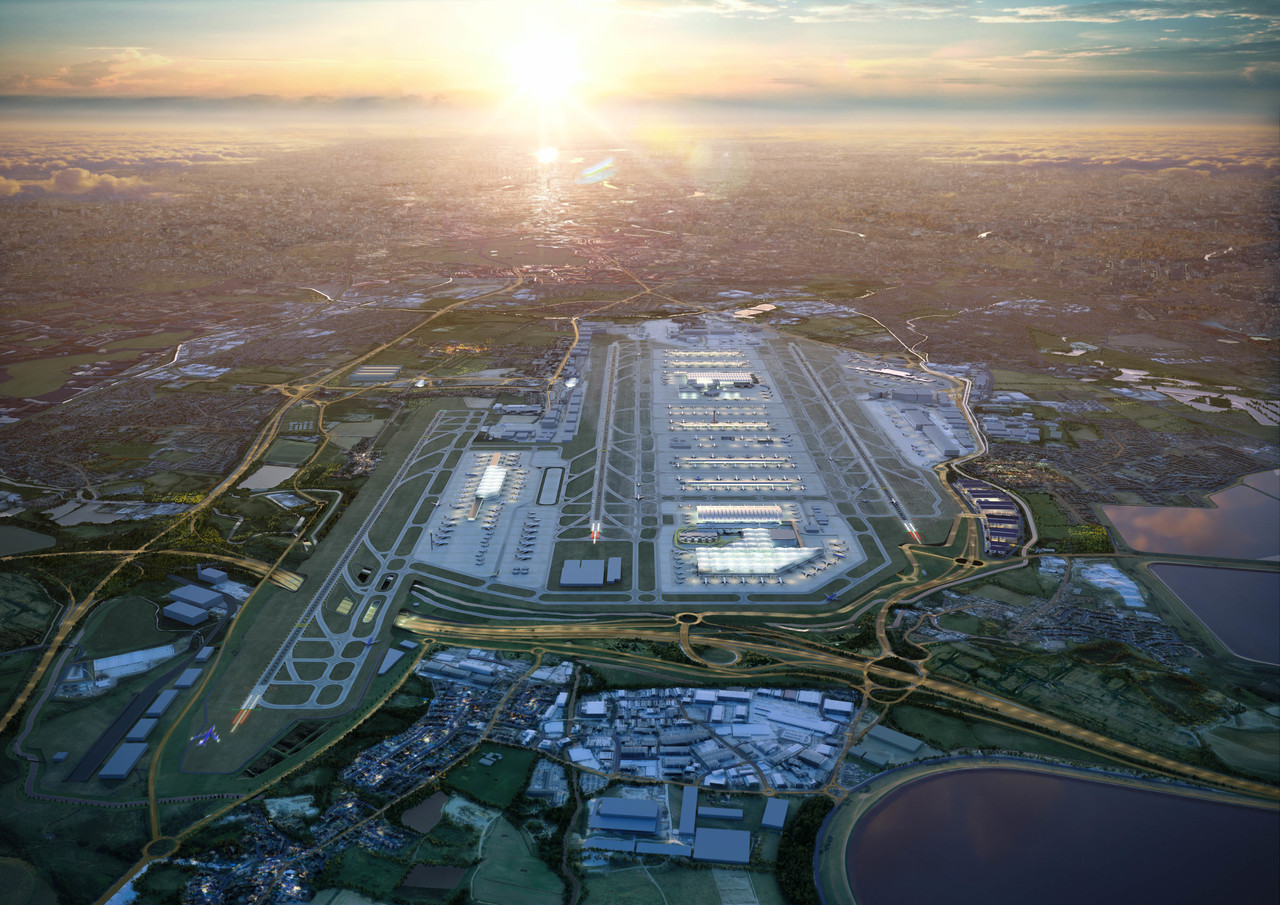
For comparison this Google Map shows the Airport recently.

These are some of my thoughts.
The Position Of The Third Runway
As can be seen, the new third runway is to the North-West of the North Runway.
- It will extend all the way to the M25.
- The M25 will be lowered and the new runway and two parallel taxiways will cross the road on a series of bridges.
This enlargement from the first image shows the crossing of the M25 and two other roads.

Note.
- The runway is on the left, which increases the spacing with the North Runway
- How openings between the runway and the taxiways will allow natural light onto the motorway.
- In the picture you can see five angled taxiways joining the runway from the two taxiways. Does this design mean that aircraft spend a minimum of time queuing for take-off? Similar but not so extreme layouts can also be seen on the two existing runways.
What intrigues me, is what looks to be a hole in front of the ends of the taxiways.
Could it be rail or road access to the airport?
This map from Network Rail shows the route of the proposed Western Rail Approach To Heathrow.
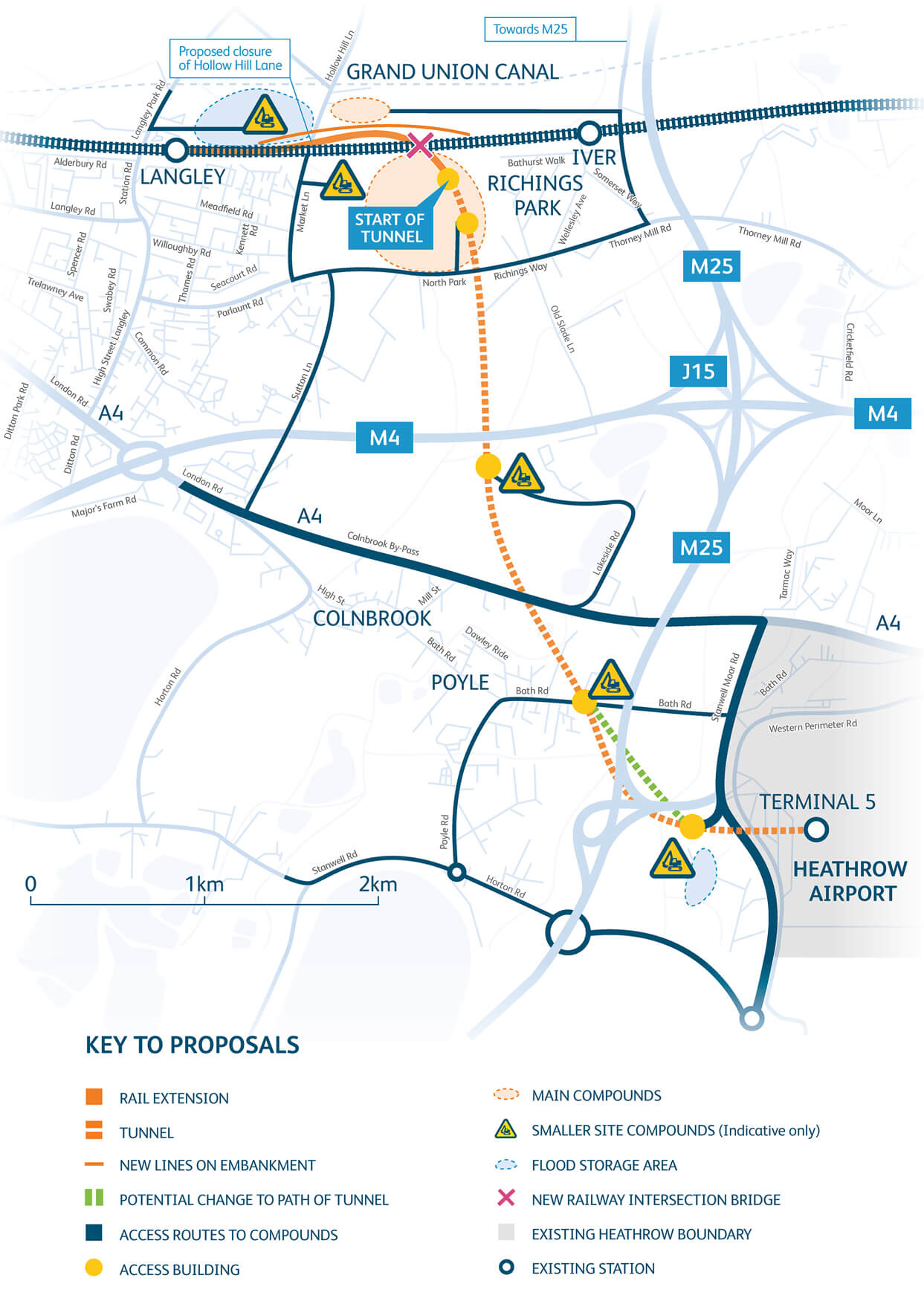
It looks like the dark holes could be the railway, between Langley and Terminal 5.
This section of the rail link is supposed to be in tunnel, but I wonder if costs could be saved if it is in a buttressed cutting, designed in cooperation between Heathrow and Network Rail.
Obviously, it will need to be in tunnel to cross under the M25.
I think that rather cleverly, the runway has been slotted in with the best use of the limited land available.
A Phased Construction Program
The Times says this about the construction program.
Only the runway would be built by the opening date of early 2026.
Other facilities such as new terminals, car parks, hotels and transit systems would open from 2030, with an expansion of Terminal 5 the priority
This means that the extra runway capacity can be used initially to better accommodate the same number of flights.
If Heathrow get it right passengers. should see the following.
- They would suffer less from construction.
- Fewer taxi delays on the ground.
- Less long fuel-burning taxiing between gate and runway.
- More flights leaving on time.
It might also enable air traffic controllers to allocate aircraft noise in a fairer manner.
Car Psrking
Two huge new car parks are to be built North and South of the Airport, which in conjunction with new hotels would be connected to the terminals by an underground transit system.
This article on International Airport Review is entitled Heathrow To Launch First Airport Ultra Low Emission Zone.
So doesn’t the building of large car parks contradict this policy.
It would unless, the car parks are designed for the future.
- Electric cars only.
- Intelligent chargers for every parking space.
- Whilst the cars are parked and connected, they would be a massive energy storage battery for the National Grid.
When you arrived back to your car after a week in Greece, there would be enough power in the battery for your next journey.
By 2030, there will be a substantial need for parking for electric cars at railway stations and airports. Parking solutions like this will help reduce the carbon footprint of airports.
Conclusion
2030 is ten years away and Heathrow will have to work hard to build an airport fit for those times.
 The Anonymous Widower