Windar Taps PORR To Build Wind Tower Factory In Poland
The title of this post, is the same as that of this article on offshoreWIND.biz.
This is the sub-heading.
Spain’s Windar Renovables has selected PORR to build a new factory in Szczecin, Poland, that will produce towers, masts, and foundations for the next generation of wind turbines.
This Google Map shows the position of Szezecin.
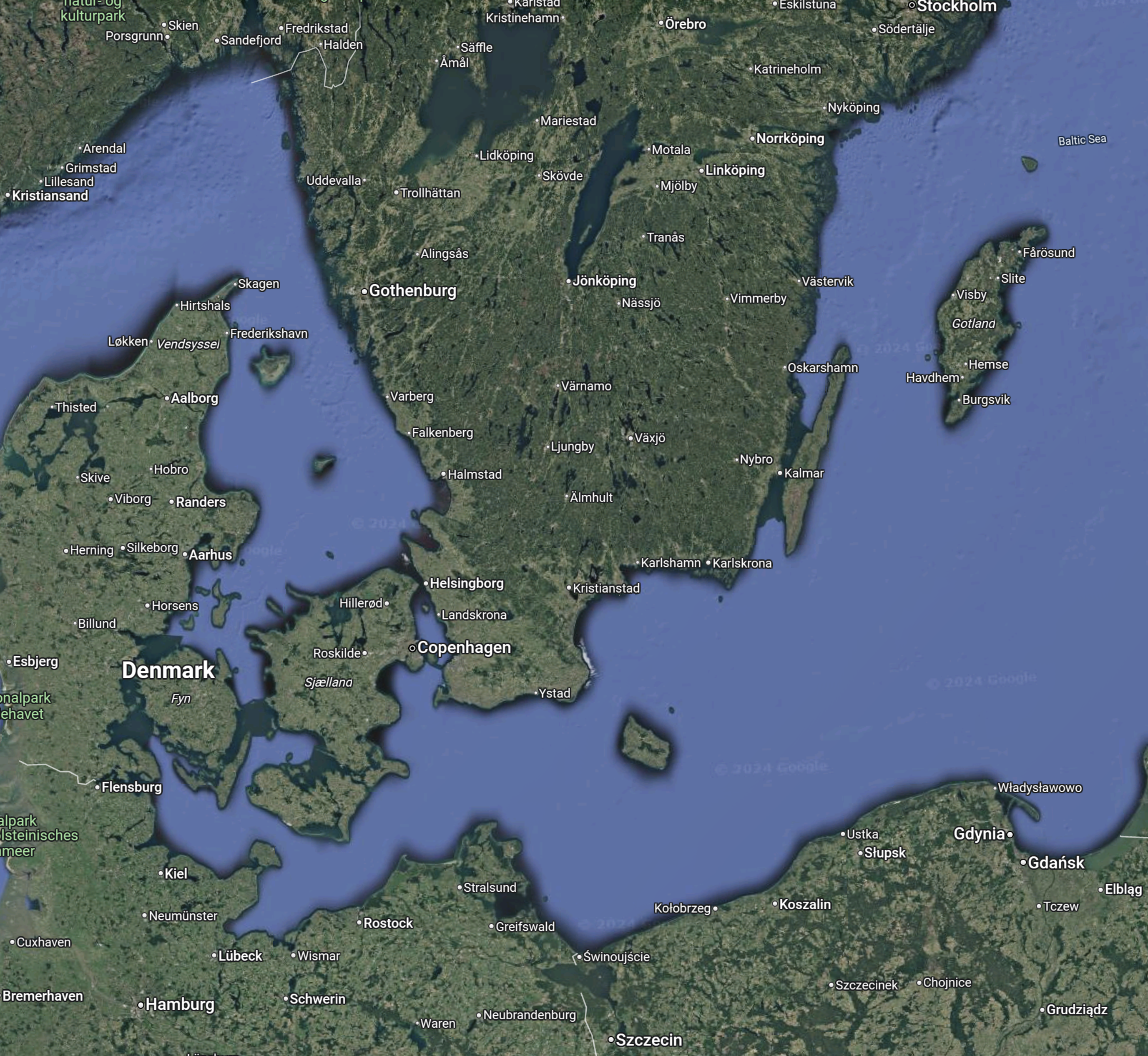
Note.
- The small island to the South of Sweden is the Danish island of Bornholm.
- Szczecin is on an inlet to the South of Bornholm.
- Gdynia and Gdansk are in a bay on the Polish coast to the East.
It looks like there will be several places along the coast, that will be suitable for the building and assembly of wind turbines and their components.
It will surely be easy to transport the turbines and their components up the Kattegat and down the Skagerrak into the North Sea.
This second Google Map shows the Port of Szczecin in more detail.
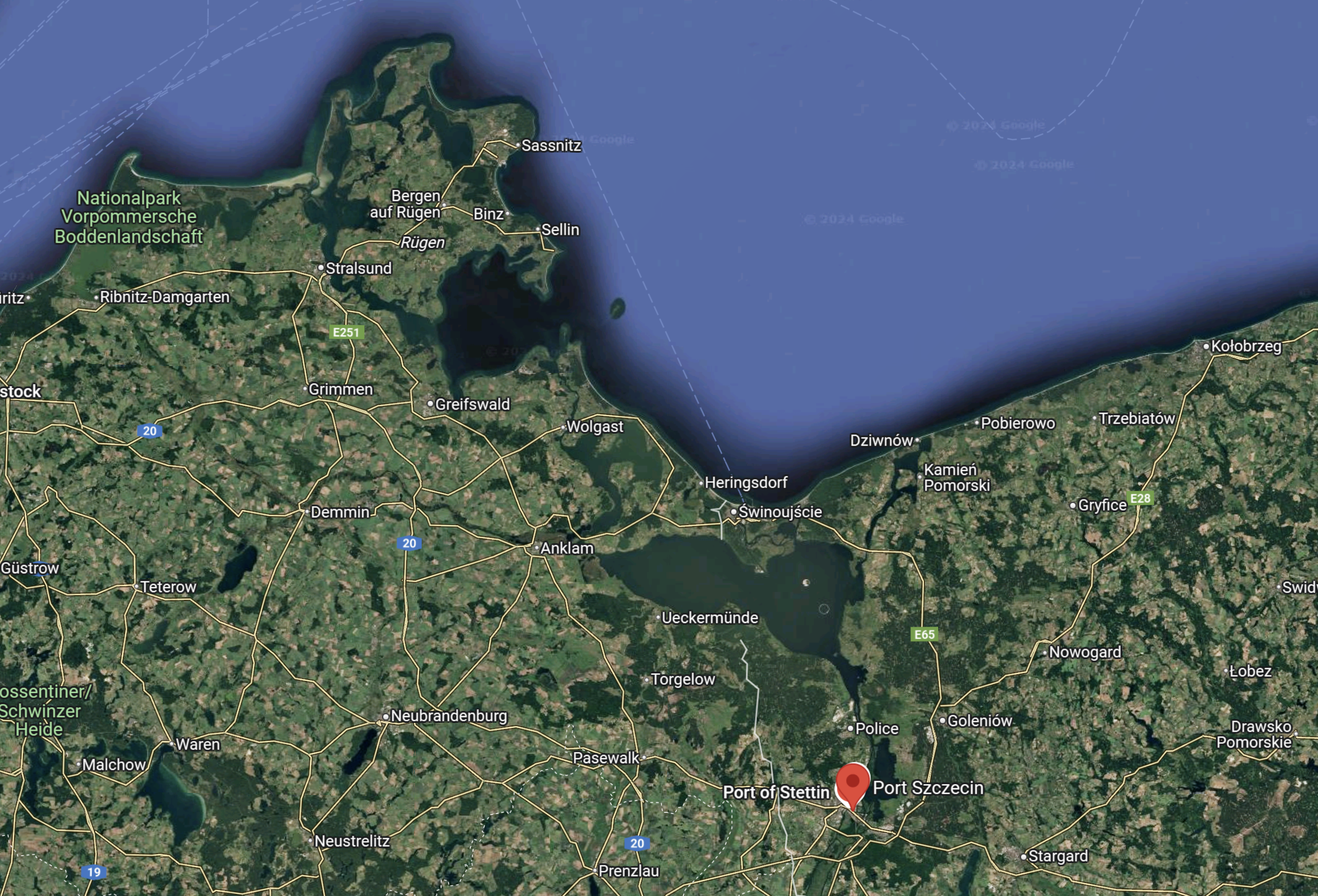
The location of the port is indicated by the red arrow.l
Conclusion
It looks to me to be an ideal place to build the components for wind turbines like towers, masts and foundations.
Agrivoltaics Deal To Bring 9,000 Sheep To 1GW Solar Park
The title of this post, is the same as that of this article on Solar Power Portal.
When I saw the title, I felt I just had to call it out.
A 1GW Solar Park
Normally, a 50-100 MW solar farm is considered large for the UK, so a 1 GW solar farm must be truly enormous, by any standards.
According to the heading of the Great North Road Solar and Biodiversity Park web site, which says this.
Elements Green is developing proposals for a new solar and energy storage park located to the northwest of Newark-on-Trent, Nottinghamshire.
With a potential generation capacity of around 800 megawatts (MW) AC of solar energy, the scheme has the potential to provide enough clean, affordable energy to meet the power needs of approximately 400,000 homes while avoiding more than 250,000 tonnes of CO₂ emissions every year.
The size appears to be around 800 MW.
But that is still large!
The Project Area
This article on the BBC is entitled Survey Suggests Opposition To Major Solar Farm, has this as a caption to the first picture.
The solar project is made up of around 1.5 million panels covering 7,000 acres.
That is around eleven square miles or a 3.3 mile square.
A Map Of The Project
This map of the project was clipped from the Elements Green web site.
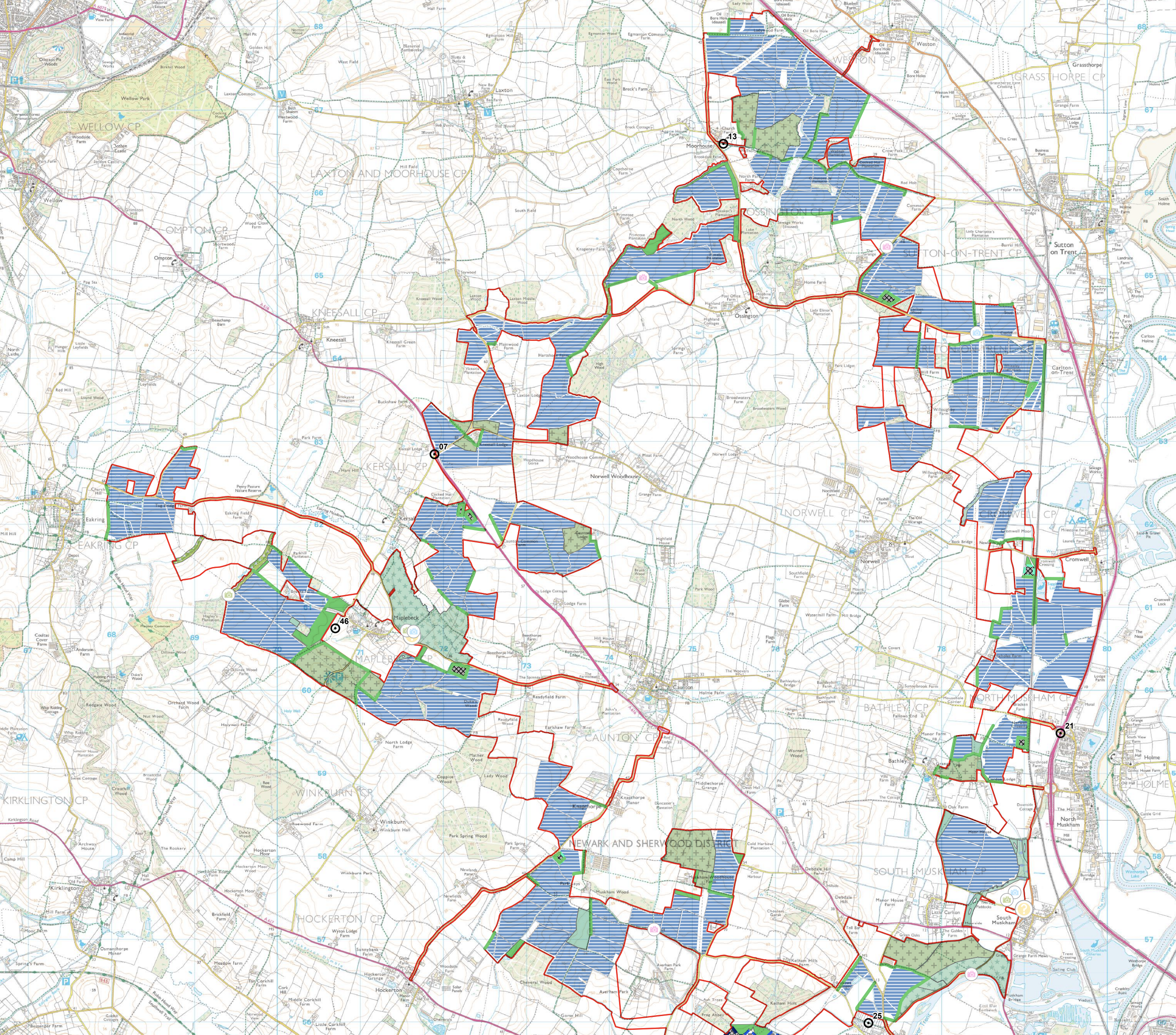
Note.
- The blue areas are solar panels.
- The red line at the right hand side is the A1 Great North Road.
- There is a lot of space for more solar panels.
It could be even bigger than 1 GW.
There Is Opposition To The Wind Farm
This article on the BBC is entitled Survey Suggests Opposition To Major Solar Farm.
This is the sub-heading,
A consultation about a major solar farm in Nottinghamshire has shown the scale of the opposition it faces to being built.
These two paragraphs detail the scale of the opposition.
The consultation, held in January and February, found 54% of respondents opposed the scheme, with 16% supporting the current plan.
Among the main reasons people gave for opposing the scheme were its visual and ecological impact.
The reasons for opposition are typical.
These two paragraphs describe the actions of the developer.
Having received the backing in principle of several key nature charities and trusts, the Great North Road Solar Park project will be renamed ‘Great North Road Solar and Biodiversity Park’, with a new logo to reflect this.
Communities who were consulted on the original proposals in early 2024 expressed a strong desire to protect and enhance their natural environment. Acting upon this feedback, developer Elements Green has formed partnerships with the RSPB, Sherwood Forest Trust, Nottinghamshire Wildlife Trust, and The Trent Rivers Trust, to ensure that nature benefits from their ambitious project.
I suspect that some of the opposition groups have labelled the last paragraph as green-washing.
Nine Thousand Sheep!
Usually, when large numbers of sheep are mentioned on the Internet, it’s usually something a bit coarse.
But in this project, it’s only letting sheep, do what they do well ; act as green lawnmowers, have lambs and provide meat and wool to increase the bottom line.
Where Is The Connection To The Grid?
The FAQs section of the Great North Road Solar and Biodiversity Park web site has this question.
Why has Elements Green chosen this location for the solar park?
This answer is given.
A key factor influencing the location of GNR Solar and Biodiversity Park is the availability of a connection at National Grid’s Staythorpe substation. The closure of fossil fuel power stations has created capacity on the grid. This would enable GNR Solar and Biodiversity Park to continue the tradition of power generation in the area using a clean, renewable resource.
In addition, a range of planning and environmental factors such as the existing land use, quality of land, as well as designations and planning and technical constraints have also informed our choice of location for the scheme.
So if you’re near the site of a disused coal- or gas-fired power station, don’t expect it to be developed as agricultural land, woodland or housing.
The Wikipedia entry for Staythorpe power station, reveals there is a 1,850 MW gas-fired power station on the site.
The Great North Road Solar and Biodiversity Park would appear to have a very able gas-fired back-up,
No Battery Or Energy Storage Is Mentioned
In an idealised day, there is a period of light and a period of darkness.
A battery would allow any excess electricity generated in the day to be used at night.
Google searches reveal energy storage could be fitted.
One of Highview Power’s environmentally-friendly 200 MW/3.25 GWh liquid-air batteries could be a starting point for a one GW solar or wind farm.
Could A Wind Farm Be Added To The Solar Farm?
In An Excursion To Retford And Worksop, I noticed a large hybrid solar and wind farm alongside the railway.






As the Great North Road Solar and Biodiversity Park uses a lot of land, would some be available for a sprinkling of wind turbines?
Conclusion
Looking at the map, you can understand some peoples’s enthusiasm for large solar farms and large onshore wind farms, as they can be so easily connected to the infrastructure of a decommissioned coal- or gas-fired power station.
The Areas Where Labour Wants To Build Onshore Wind Farms, Mapped
The title of this post, is the same as that of this article on inews.
This is the sub-heading.
Ten onshore wind projects have been proposed to help keep UK on track to have at least 95 per cent clean power by 2030.
This is the first paragraph.
The Government is bracing for its biggest nimby battle yet as onshore wind farm companies work on a flurry of proposals after an effective ban on development was lifted in England.
I suggest you take the time to read the well-written informative article, if you are worried about onshore wind farms being parked on the hill behind your house.
The first ten are provocative and there is a map of their locations, which are mainly in Scotland and Wales, on the Pennines and in Lincolnshire.
This paragraph in the article, quotes government data on the cost of various forms of energy.
They estimate that over the entire course of a project’s life, onshore wind costs £38 per mega watt hour of energy, compared to £44 for offshore and £41 for solar. Gas, meanwhile, is £114, while nuclear is £128.
I don’t have any other real data, but it does appear that floating offshore wind farms have a higher capacity factor, which should tip the cost comparison back in its favour.
But I do suspect that Ed Miliband will use these figures to increase the amount of onshore wind in the ?UK and especially n England.
As larger turbines are being tested by the Chinese and Siemens, I suspect too, that we’ll see larger turbines installed onshore.
I also believe as a Control Engineer, that as the number of large turbines increases, we will see more energy storage built alongside wind farms.
My First Trip On The Northumberland Line – 18th December 2024
Yesterday, I took Lumo to Newcastle and took my first ride to Ashington on the Northumberland Line.
These are some of the pictures I took.






































































































Note.
- Much of the route is double-track.
- Bridges over the tracks indicate, that some stations will have two platforms.
- I suspect some stations could take a five-car train.
- One guy said that there is a lot of landscaping to do.
- The standard is very similar to the Borders Railway.
I have some other thoughts.
The Blyth Valley Is Well Supplied With Electricity
Several high-capacity connections to wind farms and Norway are planned to come ashore at Blyth and it appears from the pictures that the area is well connected to the grid.
This must have nudged Britishvolt to put their battery plant at Blyth.
But no matter for those jobs, as with a rail service to Greater Geordieland and lots of electricity, there must be other energy-hungry businesses like datacentres or small modular reactor factories, who would want the site.
The Long Platforms
I am fairly sure that some of the platforms have been sized to take a five-car Hitachi Class 80x train, which are only 130 metres long and can carry around 400 passengers.
This must enable the ability to use the Northumberland Line as a diversion for the East Coast Main Line.
Some services could perhaps stop at Blyth for the large factories and/or Northumberland Park for the Metro.
It looks to me, that the Northumberland line was designed for large factories or businesses with lots of workers, that needed lots of electricity.
Development North Of Ashington
This OpenRailwayMap shows the area North of Ashington.
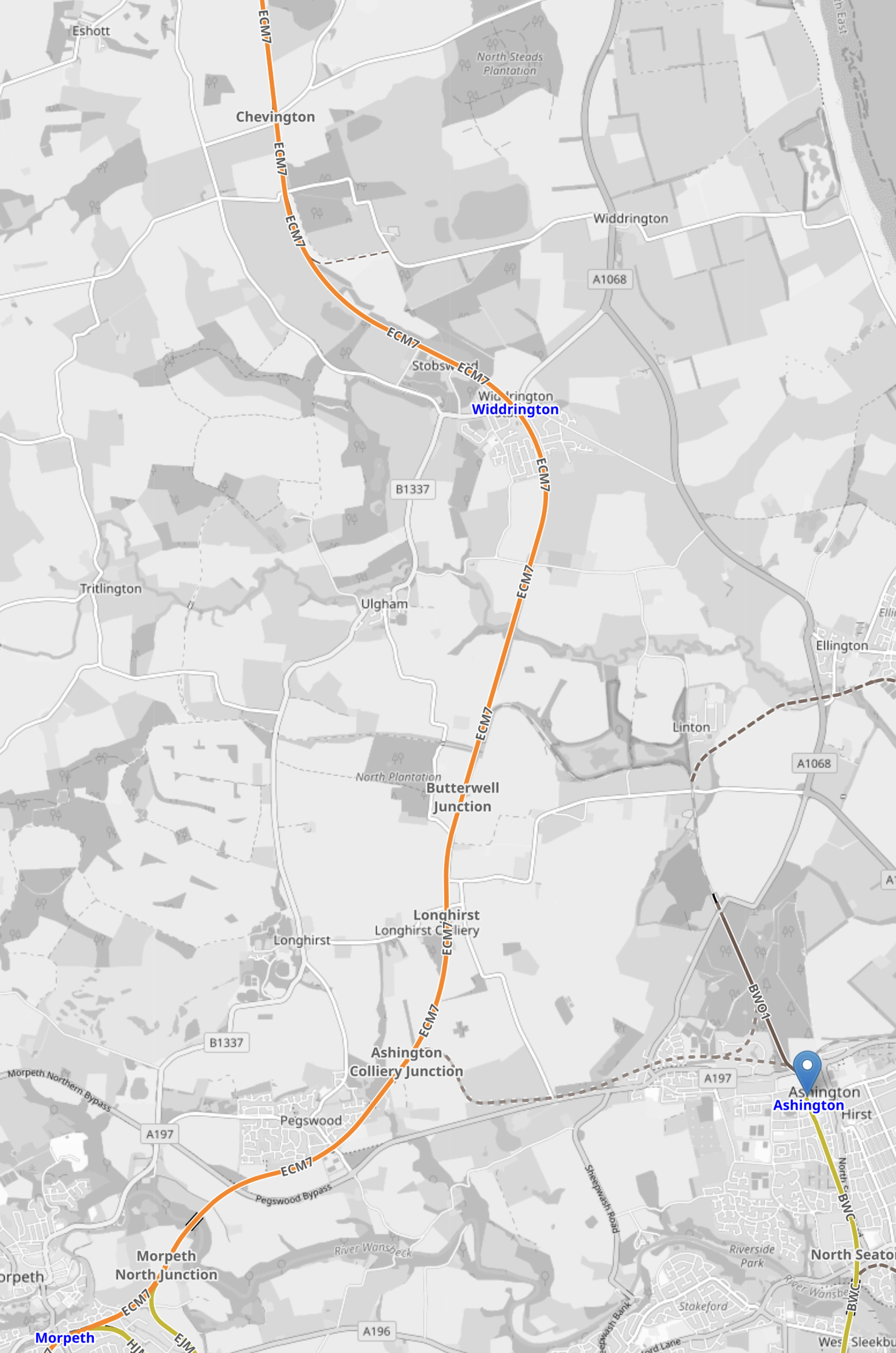
Note.
- The orange line going up and down the map is the East Coast Main Line.
- Morpeth station is in the South-West corner of the map.
- Ashington station is in the South-East corner of the map.
I think there might be scope to develop this area to make the heavy components needed for wind farms and small modular reactors,
British Gas Partners With Strata And Daikin To Launch Eco-Tech Low Bill Homes
The title of this post, is the same as that of this press release from Centrica.
This is the sub-heading.
British Gas is set to supercharge sustainable living across the UK with the launch of Low Carbon Homes – a ground-breaking pilot in partnership with Strata and heat pump manufacturer, Daikin.
These are the first four paragraphs, which fill out a bit of detail.
In anticipation of The Future Homes Standard, customers will move into new build homes which have been fitted with a full range of the latest low-carbon technology at no extra cost to the housebuilder or owner. The homes will be equipped with a 6-8 kWh Daikin air source heat pump, 4 kWh solar panels, 5 kWh battery storage, Hive electric vehicle charger and thermostat. These items will be integrated into Hive’s award-winning app, providing customers with one-stop visibility and control of their energy usage.
The first trial phase will launch at a Strata’s “Breathe” development site in Kiveton, Rotherham. As a thank you for participating in the pilot, British Gas is giving homeowners access to a fixed rate tailored British Gas tariff. Participants in the trial will also have access to a dedicated British Gas energy manager to help them optimise the technology and keep bills as low as possible, while still meeting their desired comfort levels.
Each home will be fitted with a Hive hub, which connects to the WIFI network and acts as the home’s operating system, integrating all the sustainable technology. The customers energy and heat schedules and budget will be optimised by the Hive Hub for further savings.
When the customer connects to Hive’s app they will be able to control and maximise efficiency by setting schedules and spending budgets and allowing the Hub to help them reduce their bills.
Note.
- As a Control Engineer, this to me is a good start.
- I suspect that a 6-8 kWh Daikin air source heat pump, 4 kWh solar panels and 5 kWh battery storage will keep the average house warm.
- I would expect that the three companies have optimised the ratios between the sizes of the components to give the best performance.
It is amazing to think that it was in the early seventies, that in the two sections, where I worked at ICI, engineers had just started controlling and optimising flows, pressures and temperatures in complex chemical plants.
If you’d asked any of us, when our houses heating systems would be as fully controlled, we’d have given twenty years at most.
What kept the world so long?
I have a few thoughts.
Could The Housing Have Gas For Cooking??
Yes! Centrica owns a big share with Hyundai, Kia and others of a start-up company called HiiROC.
- This is the HiiROC web site.
- HiiROC can take any hydocarbon gas and split it into green hydrogen and carbon black.
- Green hydrogen is obviously useful and the carbon black can be used for making tyres for vehicles, anodes for lithium-ion batteries and in agriculture for soil improvement.
- Waste off-gas from a chemical plant can be split into green hydrogen and carbon black.
- Biomethane from a sewage plant can be split into hydrogen and carbon black. Could a sewage plant on an estate be used to create biomethane for cooking and feeding to the HiiROC plant? Yes!
- Could green hydrogen produced on the estate be used to drive vehicles like cars, vans and ride-on-mowers. Yes! If the manufacturer of the vehicle allows it!
- How convenient would it be to have Hydrogen-at-Home?
How Much Does A British Gas Hive Save On My Energy Bill?
I asked Google and I got this answer from Home Hive.
£119. A smaller carbon footprint and a smaller bill – our award-winning smart thermostat could cut your energy bills by up to £170 a year. Join Hive Plus to boost your thermostat’s savings – and get exclusive access to £60 bill credit with any fixed British Gas dual fuel tariff.
At present, I have no intention of changing my energy supplier, but come the summer or if my health or energy circumstances change, I might see what is available.
Will British Gas Develop A Hive For a Smaller Dwelling?
I suspect in ten years, if I’m still of this world, I shall be living in the following circumstances.
- Alone.
- In a two bedroom house, cottage or flat.
- Some form of probably electric central heating or perhaps even hydrogen.
- No car.
- A short walk to the bus stop and/or train station.
- Communal gardens to sit in.
- An Ocado style delivery for food, groceries and other essentials.
- A local gluten-free cafe.
- Full Wi-Fi
Perhaps, British Gas and others will develop a community for people like me?
Siemens Gamesa To Soon Install 21 MW Offshore Wind Turbine Prototype At Danish Test Site — Reports
The title of this post, is the same as that of this article on offshoreWIND.biz.
This is the sub-heading.
Siemens Gamesa is transporting a nacelle from its facility in Brande, Denmark, to the Østerild wind turbine test centre, a company spokesperson confirmed to offshoreWIND.biz. The spokesperson declined to reveal any specifics about the wind turbine but Danish media writes that it is the new prototype which Bloomberg reported earlier this year to have a capacity of 21 MW.
These first two paragraphs give a few more details.
DR (Danish Broadcasting Corporation) reported on 6 December that lamp-posts and traffic signs were being dismantled, and roundabouts widened last week to make room for an 11×11-metre nacelle to pass through on its way to Hvide Sande, starting last Friday. From there, the nacelle will be shipped to Hanstholm and then transported to Østerild, where it will be mounted on an already installed 170-metre tower, according to DR.
In June, Bloomberg reported sources familiar with the matter said that Siemens Energy had told customers it planned to build the largest wind turbine in the world by the end of the decade and the new offshore model would have an output of 21 MW, 40 per cent more than the company’s current largest turbine, the 14 MW platform that can reach up to 15 MW with the company’s feature called Power Boost.
I have a few thoughts.
Will Bigger Be Better?
Going back to the days of North Sea Oil and Gas, I can remember project managers saying that platform installation took off dramatically, as larger platforms, barges, cranes and equipment became available.
I can particularly remember one project manager extolling the virtues of giant 3000 tonne cranes.
Do We Need A Test Centre For Giant Turbines In The UK?
The question has to be asked, as we certainly have large open spaces of sea to put a 40 MW or larger turbine.
The Crown Estate Awards GBP 5 Million In First Supply Chain Accelerator Round
The title of this post, is the same as that of this article on offshoreWIND.biz.
This is the sub-heading.
The Crown Estate has awarded nearly GBP 5 million in funding to 13 organisations across England, Wales, and Scotland in the first round of its Supply Chain Accelerator.
These three paragraphs add more details.
According to The Crown Estate, the funding will help kick-start projects drawing down from a GBP 50 million fund established in May this year to accelerate and de-risk the early-stage development of UK supply chain projects that service the offshore wind sector.
The Crown Estate’s match funding will contribute to a combined development investment of over GBP 9 million, which, if the opportunities successfully conclude their respective development stages, could lead to more than GBP 400 million of capital investment, said the UK body.
Projects receiving funding include those enabling floating wind platforms, anchoring and mooring systems, operations and maintenance facilities, test facilities, and those supporting the skills
The grants have been widely spread in both the public and private sectors and appear to be supporting a variety of technologies.
What About Project Management?
When the four of us started Metier Management Systems to develop Artemis in the 1970s, we got no help from the Government or any agency.
I wonder what difference, government support of this nature would have made?
I don’t know whether any project management development is being supported, but it is my view, that each new generation of projects will bring forward new challenges.
ScottishPower Renewables Picks Port For East Anglia Two Pre-Assembly
The title of this post, is the same as that of this article on offshoreWIND.biz.
This is the sub-heading.
ScottishPower Renewables, Iberdrola’s UK arm, has selected Peel Ports Great Yarmouth as the staging ground for pre-assembly works for its 960 MW East Anglia Two offshore wind project.
This is the introductory paragraph.
The companies have signed a reservation agreement that will see the Siemens Gamesa turbine components and sections come together for assembly at the Norfolk site before installation in the southern North Sea in 2028.
Note.
- The Port of Great Yarmouth was used for this task with East Anglia One.
- The turbine blades will be manufactured at Siemens Gamesa’s offshore wind blade factory in Hull.
- The monopiles will come from Sif in Rotterdam.
This is the first sentence of the Wikipedia entry for the East5 Anglia Array.
The East Anglia Array is a proposed series of offshore wind farms located around 30 miles off the east coast of East Anglia, in the North Sea, England. It has begun with the currently operational East Anglia ONE, that has been developed in partnership by ScottishPower Renewables and Vattenfall. Up to six individual projects could be set up in the area with a maximum capacity of up to 7.2 GW.
These articles on offshoreWIND.biz indicate that ScottishPower Renewables has been busy signing contracts for East Anglia Two.
- December 4th, 2024 – Nexans Lands Export Cable Contract For East Anglia Two Offshore Wind Farm.
- November 28th, 2024 – Hitachi Energy to Integrate 960 MW East Anglia Two Wind Farm into UK Grid.
- November 12th, 2024 – Siemens Gamesa Bags GBP 1 Billion Turbine Contract For East Anglia Two.
- November 6th, 2024 – Seaway7 Wins East Anglia Two Inter-Array Cable Contract.
- October 31st, 2024 – Sif, Smulders to Deliver Monopiles and TPs For ScottishPower’s East Anglia Two Offshore Wind Farm.
They must have employed lawyers on roller skates to get five contracts signed in just over a month.
Conclusion
East Anglia Two appears to be definitely under way and the Wikipedia extract says there could be a lot more, if all the other wind farms are developed in the same way using the Port of Great Yarmouth.
A total capacity in the East Anglia Array of 7.2 GW will surely be good for both East Anglia and the UK as a whole, but will the natives be happy with all the onshore infrastructure?
I wouldn’t be surprised to see further wind farm developed to generate hydrogen offshore, which will be either brought ashore to the Bacton gas terminal, using existing or new pipelines or distributed using tanker ships to where it is needed.
Where Will Lumo Strike Next?
Yesterday, First Group reported that they had added more possible services to their network of open-access services.
I gave my view in FirstGroup Acquires London – South Wales Open Access Business And Plans Lumo To Devon.
Their list of possible services and destinations include.
- Hull Trains – London King’s Cross and Beverley via Stevenage, Grantham, Retford, Doncaster, Selby, Howden, Brough, Hull Paragon and Cottingham
- Hull Trains – London King’s Cross and Hull Paragon via Stevenage, Grantham, Retford, Doncaster, Selby, Howden and Brough
- Hull Trains – London King’s Cross and Sheffield via Worksop and Woodhouse
- Lumo – London Euston and Rochdale via Warrington Bank Quay, Newton-le-Willows, Eccles and Manchester Victoria
- Lumo – London King’s Cross and Edinburgh/Glasgow via Stevenage, Newcastle and Morpeth
- Lumo – London Paddington and Carmarthen via Bristol Parkway, Newport, Severn Tunnel Junction, Cardiff Central, Gowerton and Llanell
- Lumo – London Paddington and Paignton via Bath Spa, Bristol Temple Meads, Taunton, Exeter St David’s and Torquay
I believe that all services could be run by identical versions of Hitachi’s high speed Intercity Battery Electric Train, which are described in this page on the Hitachi web site.
The London Paddington and Paignton service would require the longest running without electrification at 210 km. and I don’t believe First Group would have put in a bid, unless they were certain zero-carbon trains with sufficient performance would be available.
Other possible open access services could be.
Hull And Blackpool Airport
Note.
- This could be the first half of a Green Route between the North of England and the island of Ireland, if zero-carbon aircraft can fly from Blackpool Airport.
- Trains would call at Selby, Leeds, Bradford, Huddersfield, Manchester Victoria, Blackburn and Preston.
- Blackpool Airport has good access from Squires Gate station and tram stop, which could be improved.
- Blackpool Airport could be well supplied with green electricity and hydrogen from wind power.
These are distances to possible airports.
- Belfast City – 111 nm.
- Belfast International – 114 nm.
- Cardiff – 143 nm.
- Cork – 229 nm.
- Donegal – 200 nm.
- Derry/Londonderry – 163 nm.
- Dublin – 116 nm.
- Inverness – 228 nm
- Ireland West Knock – 204 nm.
- Kerry – 253 nm.
- Ronaldsway, IOM – 59 nm.
- Shannon – 220 nm.
Note.
- The Wikipedia entry for the all-electric Eviation Alice, gives the range with reserves as 250 nm.
- The Belfast and Dublin airports could be within range of a round trip from Blackpool without refuelling.
- ,Cork, Kerry and Shannon airports may need to go by another airport, where a small battery charge is performed.
- The Isle of Man is surprisingly close.
Blackpool has reasonably good coverage for the island of Ireland.
London Euston And Holyhead
This could be the first half of a Green Route to Dublin, if the trains met a high speed hydrogen-powered catamaran to speed passengers across to Dun Laoghaire.
London King’s Cross And Aberdeen Or Inverness
Why not? But these routes would probably be best left to LNER.
London King’s Cross And Grimsby Or Cleethorpes
In Azuma Test Train Takes To The Tracks As LNER Trials Possible New Route, I talked about how LNER had run a test train to Grimsby and Cleethorpes.
The Government might prefer that an open access operator took the risk and got all the blame if the route wasn’t worth running.
Humberside is very much involved in the energy industry, with several gas-fried power-stations at Keadby.
It might be more efficient in terms of trains and infrastructure, if this service was an extension of the Lincoln service.
London King’s Cross And Scarborough Via Beverley
This would probably be one for Hull Trains, but it would also serve Bridlington and Butlin’s at Filey.
The BBC was running a story today about how holiday camps are making a comeback. Surely, one on a direct train from London wouldn’t be a bad thing. for operators, train companies or holidaymakers.
London King’s Cross And Middlesbrough, Redcar Or Saltburn
As with the Grimsby and Cleethorpes service, the government might think, that this might be a better service for an open access operator.
Teesside is heavily involved in the offshore wind industry and may add involvement in the nuclear industry.
London Paddington And Fishguard, Haverfordwest, Milford Haven Or Pembroke Dock
Note.
- This could be the first half of a Green Route to Southern Ireland, if the trains met a high speed hydrogen-powered catamaran to speed passengers across to Rosslare or an electric or hydrogen-powered aircraft from Haverfordwest Airport.
- These three ports and one airport will feature heavily in the development of offshore wind power in the Celtic Sea.
- RWE are already planning a hydrogen electrolyser in Pembrokeshire, as I wrote about in RWE Underlines Commitment To Floating Offshore Wind In The Celtic Sea Through New ‘Vision’ Document.
- According to the Wikipedia entry for Fishguard Harbour station, it was built as a station to handle ship passengers and is now owned by Stena Line, who run the ferries to Rosslare in Ireland.
- I can see a tie-up between FirstGroup and Stena Line to efficiently transfer passengers between Lumo’s planned service to Carmarthen and Stena Line’s ships to Ireland.
All four secondary destinations would be a short extension from Carmarthen.
Summing Up
Note how energy, a Green Route to Ireland and other themes keep appearing.
I do wonder if running a budget train service to an area, is an easy way of levelling up, by attracting people, commuters and industry.
Have the budget airlines improved the areas they serve?
They’ve certainly created employment in the transport, construction and hospitality industries.
Zero-Carbon Ferries And Short-Haul Aircraft
These will be essential for Anglo-Irish routes and many other routes around the world.
I will deal with the ferries first, as to create a zero-carbon ferry, only needs an appropriate power unit to be installed in a ship design that works.
But with aircraft, you have to lift the craft off the ground, which needs a lot of energy.
This article on Transport and Environment is entitled World’s First ‘Carbon Neutral’ ship Will Rely On Dead-End Fuel, with this sentence as a sub-heading.
The Danish shipping giant Maersk announced it will operate the world’s first carbon-neutral cargo vessel by 2023. The company had promised a carbon-neutral container ship by 2030 but now says it will introduce the ship seven years ahead of schedule following pressure from its customers. While welcoming Maersk’s ambition, T&E says the company is betting on the wrong horse by using methanol which may not be sustainable and available in sufficient amounts.
Note.
- I’d not heard of this ship.
- Pressure from customers brought the date forward by seven years.
- As always, it appears that the availability of enough green hydrogen and methanol is blamed.
Perhaps, Governments of the world should put more teeth in green legislation to ensure that companies and governments do what they say they are gong to do?
But worthwhile developments in the field of shipping are underway.
For instance, I estimate that this Artemis Technologies hydrofoil ferry could take passengers across the 54 nautical miles between Dun Laoghaire and Holyhead in around 90 minutes.
This ferry is being designed and built in Northern Ireland and I can’t believe, it is the only development of its type.
A Fast Green Route To Ireland
I have talked about this before in High-Speed Low-Carbon Transport Between Great Britain And Ireland and I am certain that it will happen.
- Air and sea routes between the UK and the island of Ireland carry a lot of traffic.
- Some travellers don’t like flying. Especially in Boeings, which are Ryanair’s standard issue.
- It is the sort of trip, that will appeal to a lot of travellers and most probably a lot with Irish connections.
- An electric or hydrogen-powered aircraft or a fast surface craft will be able to cross the Irish Sea in a quick time.
- High speed trains and then High Speed Two will consistently reduce the travel times on the UK side of the water.
Cross-water travel routes, be they by aircraft, ferries, bridges or tunnels are generally popular and successful.
Conclusion
Given the opportunity at Fishguard, I can see that FirstGroup next move would be to extend the Carmarthen service to Fishguard Harbour.
Permission Granted For Ayrshire Renewables Hub
The title of this post, is the same as that of this article on Scottish Construction Now.
This is the sub-heading.
Planning consent has been granted for a £150 million upgrade to an Ayrshire marine yard, paving the way for increased offshore wind power off the UK’s west coast.
These are the first three paragraphs.
Peel Ports Clydeport has secured permission for the complete redevelopment of the Hunterston marine yard as it prepares the site for major renewables infrastructure. The redevelopment works – which are expected to start in early 2025 and last for around two years – will include substantial upgrades to the marine yard, including infilling the current dry-dock basin and the creation of a new quay wall.
Highview Power recently announced it is to construct the world’s largest Liquid Air Energy Storage (LAES) facility at Hunterston, the latest in a string of renewables projects that are either underway, or in the pipeline, at the site.
The overall redevelopment of Hunterston is expected to attract £3.5 billion in inward investment and create over 5,000 jobs.
Note.
- The Highview Power battery will be 200 MW/3.25 GWh.
- There is also a 400 MW/400 MWh BESS being built at Hunterston.
- The 2 GW MacHairWind project is planned off the coast of Islay.
- According to their web site, MacHairWind will export its first power in the early 2030s.
More renewable infrastructure will surely follow.
 The Anonymous Widower