Vestas’s 15 MW Wind Turbine Up At Danish Port of Thyborøn
The title of this post, is the same as that of this article on offshoreWIND.biz.
This is the sub-heading.
Vestas has completed the installation of its V236-15.0 MW offshore wind turbine in the Port of Thyborøn in Denmark, only three months after the port ordered the company’s flagship model.
This is the first paragraph.
On 8 June, the wind turbine produced its first kWh of power, a crucial step in the final verification campaign, Vestas said in a social media post.
I suspect that soon, Vestas will be accepting orders for these large turbines.
RWE Orders 15 MW Nordseecluster Offshore Wind Turbines At Vestas
The title of this post, is the same as that of this article on offshoreWIND.biz.
This is the sub-heading.
Vestas has now revealed the name of the project and the client for a conditional contract the company signed in May as an unconditional order came in from RWE for the first phase of its 1.6 GW Nordseecluster offshore wind development in Germany.
This is the first paragraph.
The Denmark-based wind turbine OEM has received a firm order for 44 of its V236-15.0 MW offshore wind turbines for the 660 MW Nordseecluster A, the first phase of RWE’s two-phased Nordseecluster project in Germany.
Note.
- The V236-15.0 MW offshore wind turbine would appear to be Vesta’s largest turbine.
- On the Internet RWE’s Norfolk Vanguard West wind farm is shown as using the same turbine.
Does this mean that the Vestas V236-15.0 MW offshore wind turbine, is now RWE’s standard offshore turbine? This would surely have manufacturing, installation, operation and maintenance advantages.
These wind farms in the UK could use the V236-15.0 MW offshore wind turbines.
- Norfolk Boreas – 1380 MW – 92 turbines
- Norfolk Vanguard East – 1380 MW – 92 turbines
- Norfolk Vanguard West – 1380 MW – 92 turbines
- Dogger Bank South – 3000 MW – 200 turbines
- Awel y Môr – Up to 1100 MW – 73 turbines
- Five Estuaries – up to 1185 MW – 79 turbines
- North Falls – up to 504 MW – 34 turbines
Notes.
- The capacity us as sown on the RWE web site for each wind farm.
- The turbine numbers assume 15 MW turbines.
- The total capacity is 9929 MW.
- The number of turbines is 662.
The Nordseecluster will generate 1600 MW from 107 turbines.
Conclusion
I don’t see any reason, why all these wind farms couldn’t use the V236-15.0 MW offshore wind turbines.
UK Infrastructure Bank, Centrica & Partners Invest £300M in Highview Power Clean Energy Storage Programme To Boost UK’s Energy Security
The title of this post, is the same as that of this news item from Highview Power.
This is the sub-heading.
Highview Power kickstarts its multi-billion pound renewable energy programme to accelerate the UK’s transition to net zero in Carrington, Manchester.
These three paragraphs outline the investment.
Highview Power has secured the backing of the UK Infrastructure Bank and the energy industry leader Centrica with a £300 million investment for the first commercial-scale liquid air energy storage (LAES) plant in the UK.
The £300 million funding round was led by the UK Infrastructure Bank (UKIB) and the British multinational energy and services company Centrica, alongside a syndicate of investors including Rio Tinto, Goldman Sachs, KIRKBI and Mosaic Capital.
The investment will enable the construction of one of the world’s largest long duration energy storage (LDES) facilities in Carrington, Manchester, using Highview Power’s proprietary LAES technology. Once complete, it will have a storage capacity of 300 MWh and an output power of 50 MWs per hour for six hours. Construction will begin on the site immediately, with the facility operational in early 2026, supporting over 700 jobs in construction and the supply chain.
Note.
- The backers are of a high quality.
- The Carrington LDES appears to be a 50 MW/300 MWh battery.
It finally looks like Highview Power is on its way.
These are my thoughts on the rest of news item.
Centrica’s Involvement
This paragraph talks about Centrica’s involvement.
Energy leader Centrica comes on board as Highview Power’s strategic partner and a key player in the UK’s energy transition, supporting Carrington and the accelerated roll-out of the technology in the UK through a £70 million investment. The programme will set the bar for storage energy systems around the world, positioning the UK as the global leader in energy storage and flexibility.
I suspect that Centrica have an application in mind.
In Centrica Business Solutions Begins Work On 20MW Hydrogen-Ready Peaker In Redditch, I talk about how Centrica is updating an old peaker plant.
In the related post I refer to this news item from Centrica Business Systems.
This paragraph in the Centrica Business Systems news item, outlines Centrica’s plans.
The Redditch peaking plant is part of Centrica’s plans to deliver around 1GW of flexible energy assets, that includes the redevelopment of several legacy-owned power stations, including the transformation of the former Brigg Power Station in Lincolnshire into a battery storage asset and the first plant in the UK to be part fuelled by hydrogen.
As Redditch power station is only 20 MW, Centrica could be thinking of around fifty assets of a similar size.
It seems to me, that some of these assets could be Highview Power’s LDES batteries of an appropriate size. They may even be paired with a wind or solar farm.
Larger Systems
Highview Power’s news item, also has this paragraph.
Highview Power will now also commence planning on the next four larger scale 2.5 GWh facilities (with a total anticipated investment of £3 billion). Located at strategic sites across the UK, these will ensure a fast roll-out of the technology to align with UK LDES support mechanisms and enable the ESO’s Future Energy Scenario Plans.
Elsewhere on their web site, Highview Power say this about their 2.5 GWh facilities.
Highview Power’s next projects will be located in Scotland and the North East and each will be 200MW/2.5GWh capacity. These will be located on the national transmission network where the wind is being generated and therefore will enable these regions to unleash their untapped renewable energy potential and store excess wind power at scale.
So will the four larger systems have a 200MW/2.5GWh capacity?
They could, but 200 MW may not be an appropriate output for the location. Or a longer duration may be needed.
Highview Power’s design gives the flexibility to design a system, that meets each application.
Working With National Grid
Highview Power’s news item, also has this sentence.
Highview Power’s technology will also provide stability services to the National Grid, which will allow for the long-term replacement of fossil fuel-based power plants for system support.
Highview Power’s technology is also an alternative to Battery Energy Storage Systems (BESS) of a similar capacity.
How does Highview Power’s technology compare with the best lithium-ion systems on price, performance and reliability?
Curtailment Of Wind Farms
Highview Power’s news item, also has these two paragraphs.
This storage will help reduce curtailment costs – which is significant as Britain spent £800m in 2023 to turn off wind farms.
Highview Power aims to accelerate the roll-out of its larger facilities across the UK by 2035 in line with one of National Grid’s target scenario forecasts of a 2 GW requirement from LAES, which would represent nearly 20% of the UK’s long duration energy storage needs. By capturing and storing excess renewable energy, which is now the cheapest form of electricity, storage can help keep energy costs from spiralling, and power Britain’s homes with 24/7 renewable clean energy.
I can see several wind farms, that are regularly curtailed would have a Highview Power battery installed at their onshore substation.
Receently, I wrote Grid Powers Up With One Of Europe’s Biggest Battery Storage Sites, which described how Ørsted are installing a 300 MW/600 MWh Battery Energy Storage Systems (BESS) at Swardeston substation, where Hornsea Three connects to the grid.
I would suspect that the purpose of the battery is to avoid turning off the wind farm.
Would a Highview Power battery be better value?
What’s In It For Rio Tinto?
I can understand, why most companies are investing, but Rio Tinto are a mining company. My only thought is that they have a lot of redundant holes in the ground, that cost them a lot of money and by the use of Highview Power’s technology, they can be turned into productive assets.
Collateral Benefits
Highview Power’s news item, also has this paragraph.
Beyond contributing to the UK’s energy security by reducing the intermittency of renewables, Highview Power’s infrastructure programme will make a major contribution to the UK economy, requiring in excess of £9 billion investment in energy storage infrastructure over the next 10 years – with the potential to support over 6,000 jobs and generate billions of pounds in value add to the economy. It will also contribute materially to increasing utilisation of green energy generation, reducing energy bills for consumers and providing significantly improved energy stability and security.
If Highview Power can do that for the UK, what can it do for other countries?
No wonder companies of the quality of Centrica, Rio Tinto and Goldman Sachs are investing.
Grid Powers Up With One Of Europe’s Biggest Battery Storage Sites
The title of this post, is the same as that of this article in The Times.
This is the sub-heading.
Orsted’s huge facility in Norfolk will store energy generated by its offshore wind farm
These three paragraphs give more details of the project.
The world’s largest developer of offshore wind farms is planning to build a vast battery storage facility near Norwich.
Orsted will install the energy storage system, which will be one of the largest in Europe, on the same site as the onshore converter station for its Hornsea 3 wind farm in Swardeston, Norfolk.
The project will store energy generated by Hornsea 3 when weather conditions are windy and when electricity supply exceeds demand so that it can be discharged later to help to balance the nation’s electricity grid.
Note.
- There is also a visualisation and a map.
- Tesla batteries will be used.
- The The battery will have an output of 300 MW, with a capacity of 600 MWh. So it is another two-hour BESS.
- It should be operational in 2026.
- The battery is on a 35-acre site.
- Cost is given as £8.5 billion, but that would appear to include the 2852 MW Hornsea 3 wind farm.
The BBC is reporting that local residents are worried about fire safety.
I have some thoughts of my own.
The Location Of The Swardeston Substation
This Google Map shows the location of the Swardeston substation, which will also host the Swardeston BESS.
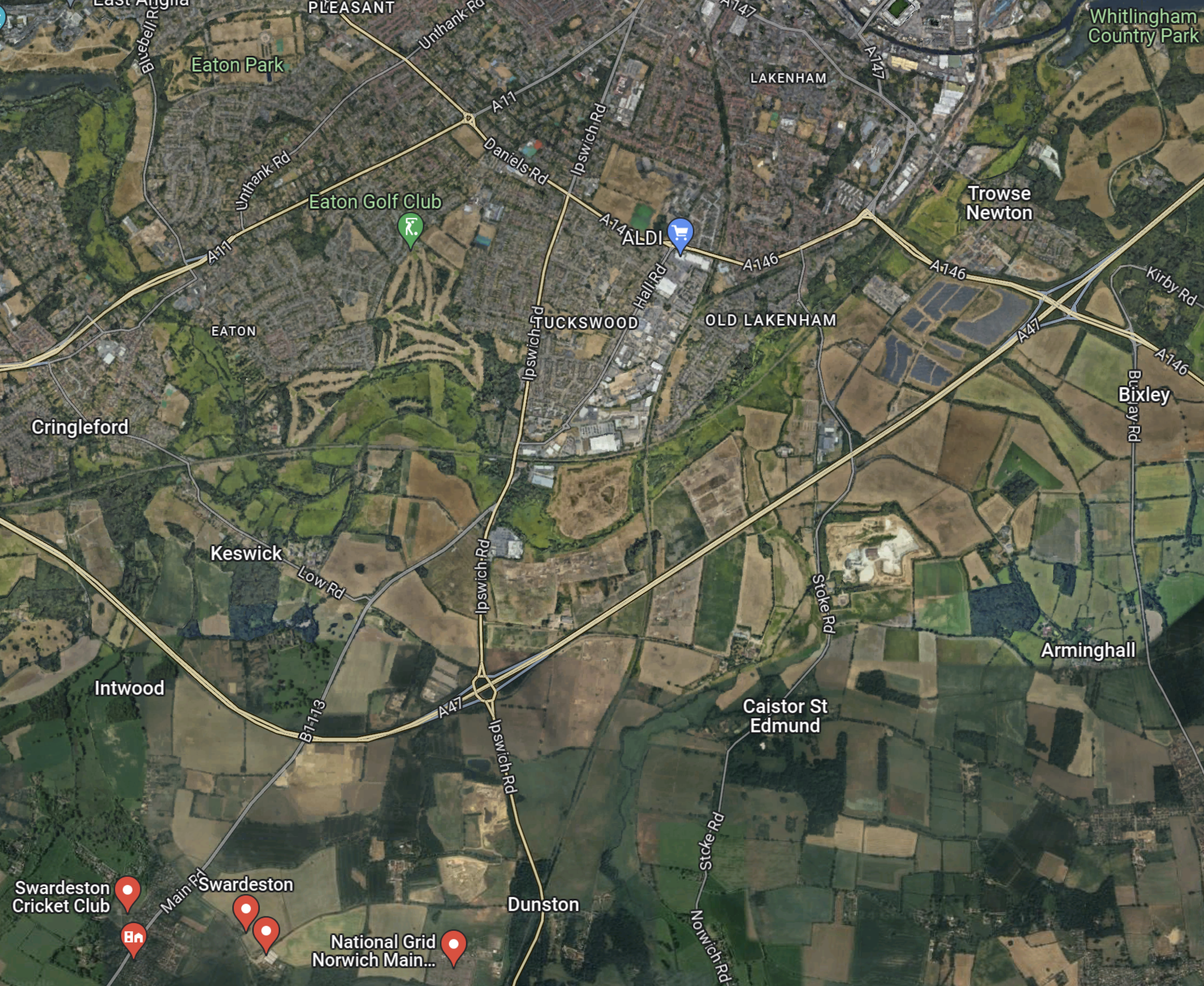
Note.
- The East-West road is the A 47 Norwich by-pass.
- Norwich is to the North of the by-pass.
- Just to the left-centre of the map, the main A 140 road runs between Norwich and Ipswich, which has a junction with the A 47.
- The A 140 passes through the village of Dunston, which is to the East of the National Grid sibstation, which will host the connection to the Hornsea Three wind farm.
This second Google Map shows the A 140 in detail from the junction to the A 47 to the Swardeston substation.
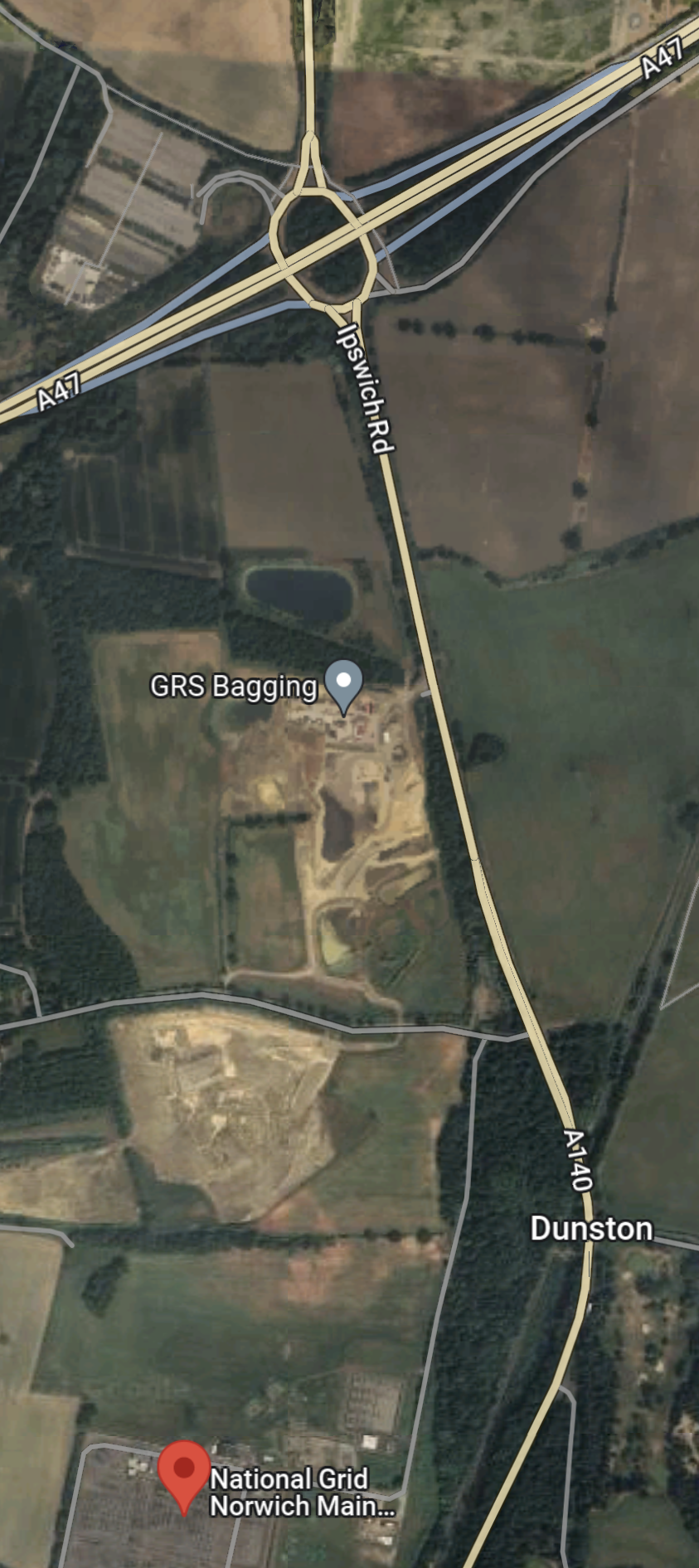
Note.
- The Swardeston substation is on a substantial site.
- The Norwich to Tilbury transmission line will have its Northern end at Swardeston substation.
- Once the infrastructure is complete at Swardeston substation, Hornsea Three wind farm will be connected to the electricity infrastructure around London.
There would appear to be plenty of space at the site for all National Grid’s plans.
Capital Cost Compared To Big Nuclear
Hornsea Three is a 2852 MW wind farm, that will cost with the battery and a few extras £8.5 billion or around around £ 3 billion per gigawatt.
Hinckley Point C on the other hand will cost between £ 31-35 billion or £ 9.5-10.7 billion per gigawatt.
Conclusion
National Grid would appear to be using a BESS at Swardeston substation to improve the reliability and integrity of the Hornsea Three wind farm.
How many other big batteries will be placed, where large wind farms connect to the National Grid?
As an Electrical and Control Engineer, I certainly, believe that energy storage at major substations, is a proven way to improve the grid.
RWE Goes For An Additional 10 GW Of Offshore Wind In UK Waters In 2030
This press release from RWE is entitled RWE And Masdar Join Forces To Develop 3 Gigawatts Of Offshore Wind Projects Off The UK Coast.
This is the last paragraph.
The UK plays a key role in RWE’s strategy to grow its offshore wind portfolio RWE is a leading partner in the delivery of the UK’s Net Zero ambitions and energy security, as well as in contributing to the UK build-out target for offshore wind of 50 GW by 2030. RWE already operates 10 offshore wind farms across the UK. Following completion of the acquisition of the three Norfolk offshore wind projects from Vattenfall announced at the end of 2023, RWE is developing nine offshore wind projects in the UK, representing a combined potential installed capacity of around 9.8 GW, with RWE’s pro rata share amounting to 7 GW. Furthermore, RWE is constructing the 1.4 GW Sofia offshore wind project in the North Sea off the UK’s east coast. RWE’s unparalleled track record of more than 20 years in offshore wind has resulted in 19 offshore wind farms in operation, with a goal to triple its global offshore wind capacity from 3.3 GW today to 10 GW in 2030.
Note.
- Nine offshore wind projects in the UK, representing a combined potential installed capacity of around 9.8 GW
- RWE are saying they intend to add 6.7 GW in 2030.
The eight offshore wind farms, that RWE are developing in UK waters would appear to be.
- Sofia – 1,400 MW
- Norfolk Boreas – 1380 MW
- Norfolk Vanguard East – 1380 MW
- Norfolk Vanguard West – 1380 MW
- Dogger Bank South – 3000 MW
- Awel y Môr – 500 MW
- Five Estuaries – 353 MW
- North Falls – 504 MW
This is a total of 9897 MW, which ties in well with RWE’s new capacity figure of 9.8 GW.
The Location Of RWE’s Offshore Wind Farms
RWE’s wind farms seem to fit in groups around the UK.
Dogger Bank
This wind farm is on the Dogger Bank.
- Dogger Bank South – 3000 MW – Planned
This wind farm would appear to be rather isolated in the middle of the North Sea.
RWE could have plans to extend it or even link it to other wind farms in the German area of the Dogger Bank.
Lincolnshire Coast
This wind farm is along the Lincolnshire Coast.
- Triton Knoll – 857 MW – 2022
As there probably isn’t much heavy industry, where Triton Knoll’s power comes ashore, this wind farm can provide the power needed in the area.
But any excess power in the area can be exported to Denmark through the Viking Link.
Norfolk Coast
These wind farms are along the Norfolk Coast.
- Norfolk Boreas – 1380 MW – Planned
- Norfolk Vanguard East – 1380 MW – Planned
- Norfolk Vanguard West – 1380 MW – Planned
These three wind farms will provide enough energy to provide the power for North-East Norfolk.
North Wales Coast
These wind farms are along the North Wales Coast.
- Awel y Môr – 500 MW – Planned
- Gwynt y Môr – 576 MW – 2015
- Rhyl Flats – 90 MW – 2009
- North Hoyle – 60 MW – 2003
These wind farms will provide enough energy for the North Wales Coast.
Any spare electricity can be stored in the 1.8 GW/9.1 GWh Dinorwig pumped storage hydroelectric power station.
Electric Mountain may have opened in 1984, but it is surely a Welsh giant decades ahead of its time.
Suffolk Coast
These wind farms are along the Suffolk Coast.
- Five Estuaries – 353 MW – Planned
- Galloper – 353 MW – 2018
- North Falls – 504 MW – Planned
These wind farms will provide enough energy for the Suffolk Coast, which except for the Haven Ports, probably doesn’t have many large electricity users.
But if the area is short of electricity, there will be Sizewell B nuclear power station to provide it.
Teesside
This wind farm is along the Teesside Coast
- Sofia – 1,400 MW – Planned
Teesside is a heavy user of electricity.
These six areas total as follows.
- Dogger Bank – 3,000 MW
- Lincolnshire Coast – 857 MW
- Norfolk Coast – 4140 MW
- North Wales Coast – 1226 MW
- Suffolk Coast – 1210 MW
- Teesside – 1,400 MW
Backup for these large clusters of wind farms for when the wind doesn’t blow will be provided as follows.
- Dogger Bank – Not provided
- Lincolnshire Coast- Interconnectors to Denmark and Scotland
- Norfolk Coast – Not provided
- North Wales Coast – Stored in Dinorwig pumped storage hydroelectric power station
- Suffolk Coast – Sizewell B and Sizewell C
- Teesside – Interconnectors to Norway and Scotland and Hartlepool nuclear power stations
Note.
- The interconnectors will typically have a 2 GW capacity.
- The 1.9 GW/9.1 GWh Dinorwig pumped storage hydroelectric power station must be one of the best wind farm backups in Europe.
There is a very solid level of integrated and connected assets that should provide a reliable power supply for millions of electricity users.
How Will Dogger Bank And The Norfolk Coast Wind Clusters Work Efficiently?
The Dogger Bank and the Norfolk Coast clusters will generate up to 3 and 4.14 GW respectively.
So what purpose is large amounts of electricity in the middle of the North Sea?
The only possible purpose will be to use giant offshore electrolysers to create hydrogen.
The hydrogen will then be transported to point of use by pipeline or tanker.
Feeding H2ercules
I described H2ercules in H2ercules.
H2ercules is an enormous project that will create the German hydrogen network.
The H2ercules web site, shows a very extensive project, as is shown by this map.

Note.
- Hydrogen appears to be sourced from Belgium, the Czech Republic, The Netherlands and Norway.
- RWE’s Dogger Bank South wind farm will be conveniently by the N of Norway.
- RWE’s Norfolk cluster of wind farms will be conveniently by the N of Netherlands.
- The Netherlands arrow points to the red circles of two hydrogen import terminals.
For Germany to regain its former industrial success, H2ercules will be needed to be fed with vast amounts of hydrogen.
And that hydrogen could be in large amounts from the UK sector of the North Sea.
Uniper’s Wilhelmshaven Hydrogen Hub
This page on the Uniper web site is entitled Green Wilhelmshaven: To New Horizons
This Uniper graphic shows a summary of gas and electricity flows in the Wilhelmshaven Hydrogen Hub.

Note.
- Ammonia can be imported, distributed by rail or ships, stored or cracked to provide hydrogen.
- Wilhelmshaven can handle the largest ships.
- Offshore wind energy can generate hydrogen by electrolysis.
- Hydrogen can be stored in underground salt caverns.
I suspect hydrogen could also be piped in from an electrolyser in the East of England or shipped in by a hydrogen tanker.
All of this is well-understood technology.
Sunak’s Magic Money Tree
Rishi Sunak promised a large giveaway of tax in his manifesto for the 2024 General Election.
As we are the only nation, who can provide the colossal amounts of hydrogen the Germans will need for H2ercules, I am sure we will be well paid for it.
A few days ago we celebrated D-Day, where along with the Americans and the Canadians, we invaded Europe.
Now eighty years later, our hydrogen is poised to invade Europe again, but this time for everybody’s benefit.
This document on the Policy Mogul web site is entitled Rishi Sunak – Conservative Party Manifesto Speech – Jun 11.
These are three paragraphs from the speech.
We don’t just need military and border security. As Putin’s invasion of Ukraine has shown, we need energy security too. It is only by having reliable, home-grown sources of energy that we can deny dictators the ability to send our bills soaring. So, in our approach to energy policy we will put security and your family finances ahead of unaffordable eco zealotry.
Unlike Labour we don’t believe that we will achieve that energy security via a state-controlled energy company that doesn’t in fact produce any energy. That will only increase costs, and as Penny said on Friday there’s only one thing that GB in Starmer and Miliband’s GB Energy stands for, and that’s giant bills.
Our clear plan is to achieve energy security through new gas-powered stations, trebling our offshore wind capacity and by having new fleets of small modular reactors. These will make the UK a net exporter of electricity, giving us greater energy independence and security from the aggressive actions of dictators . Now let me just reiterate that, with our plan, we will produce enough electricity to both meet our domestic needs and export to our neighbours. Look at that. A clear, Conservative plan not only generating security, but also prosperity for our country.
I believe that could be Rishi’s Magic Money Tree.
Especially, if the energy is exported through electricity interconnectors or hydrogen or ammonia pipelines and tankers.
Will This Be A Party Anyone Can Join?
Other wind farm clusters convenient for the H2ercules hydrogen import terminals on the North-West German coast include.
- Dogger Bank – SSE, Equinor – 5008 MW
- East Anglian – Iberdrola – 3786 MW
- Hornsea – Ørsted – 8056 MW
That totals to around 16.5 GW of wind power.
I can see offshore electrolysers producing hydrogen all around the coasts of the British Isles.
What Happens If Sunak Doesn’t Win The Election?
RWE and others have signed contracts to develop large wind farms around our shores.
They didn’t do that out of the goodness of their hearts, but to make money for themselves and their backers and shareholders.
Conclusion
I believe a virtuous circle will develop.
- Electricity will be generated in the UK.
- Some will be converted to hydrogen.
- Hydrogen and electricity will be exported to the highest bidders.
- European industry will, be powered by British electricity and hydrogen.
- Money will be paid to the UK and the energy suppliers for the energy.
The more energy we produce, the more we can export.
In the future more interconnectors, wind farms and electrolysers will be developed.
Everybody will benefit.
As the flows grow, this will certainly become a Magic Money Tree, for whoever wins the election.
H2ercules
H2ercules is a project that will create the German hydrogen network.
The H2ercules web site, introduces the project with these two paragraphs.
A faster ramp-up of the hydrogen economy in Germany is more important than ever in order to drive forward the decarbonisation programme, put the German energy system on a more robust footing, and thus contribute towards a green security of supply. What this needs is a geographical realignment of the infrastructure for energy in gas form: Instead of flowing from the east of Germany to the west and south of the country, the gas – natural gas now, hydrogen in the future – will have to make its way in future from generation locations in the north-west to centres of consumption located mainly in the west and south. That also means that new sources will have to be connected, and gaps in existing pipeline networks will have to be closed. To speed up this vital process, OGE and RWE have developed the national infrastructure project “H2ercules”, which is intended to supply consumers in Germany’s south and west with domestically produced green hydrogen from the north of the country, in addition to imported sources. This will involve connecting up the electrolyser capacities that are currently being planned and developing more besides. RWE wants to create up to 1 GW of additional electrolyser capacity as part of the H2ercules project. For the connection component, OGE is planning to put 1,500 km of pipelines in place. For the most part, this will mean converting pipelines from the existing natural gas network to hydrogen, supplemented by newly constructed facilities. Converting natural gas pipelines is not only the more cost-efficient solution, but it also allows for a faster schedule. The system is expected to be supplemented by the planned hydrogen storages of RWE.
The current plan is to complete the project in three stages between 2026 and 2030, in order to connect industries to the hydrogen supply as soon as possible. The aim of this collaboration across multiple value levels is to resolve the chicken-and-egg problem on a super-sized scale and also smooth the way forward for other projects.
Note.
There will be a lot of conversion of the existing natural gas network to hydrogen.
RWE wants to create up to 1 GW of additional electrolyser capacity as part of the H2ercules project.
The second paragraph indicates to me, that they want to move fast.
This map from the H2ercules web site, indicate the proposed size of the network in 2030.
These three paragraphs describe how H2ercules will be developed.
OGE and RWE are both strong companies that aim to combine forces as part of the H2ercules project in order to overcome this Herculean task. While the task for OGE will be to convert the required gas pipelines to hydrogen and construct new pipelines, RWE will expand its electrolyser capacity and import green hydrogen in addition. Gas-fired power stations with a capacity of at least 2 GW will be converted to hydrogen, and new H2 -storages as well as H2-storages repurposed from gas storages on the Dutch border will be connected to the hydrogen supply system.
H2ercules also opens up new opportunities to connect Germany’s future centres of hydrogen consumption to key import routes, first via pipelines from Belgium and the Netherlands, and later via Norway and also from southern and eastern Europe, with the added prospects of import terminals for green molecules in Germany’s north. The project is thus contributing significantly to the creation of a European hydrogen market.
The first additional companies and organisations have already indicated their interest in this project, and it is expected that in the future smaller businesses will benefit in addition to large-scale customers, as the entire industry is guided towards a decarbonised future.
These are my thoughts.
Why Is It Called H2ercules?
I suspect, it’s nothing more, than the Germans wanted a recognisable and catchy name.
- Name selection is not helped by the German for hydrogen, which is wasserstoff.
- Hercules is Herkules in German, which doesn’t really help.
- Projekt Wasserstoff isn’t as memorable as H2ercules, which at least isn’t English.
It looks to me, that the Germans have come up with a good acceptable compromise.
The Wilhemshaven Hydrogen Import Terminal
German energy company; Uniper is building a hydrogen import terminal at Wilhemshaven to feed H2ercules and German industry with hydrogen from places like Australia, Namibia and the Middle East. I wrote about this hydrogen import terminal in Uniper To Make Wilhelmshaven German Hub For Green Hydrogen; Green Ammonia Import Terminal.
Wilhelmshaven and Great Yarmouth are 272 miles or 438 kilometres apart, so a pipeline or a tanker link would be feasible to export hydrogen from Notfolk to Germany.
I suspect RWE will build a giant offshore electrolyser close to the Norfolk wind farms and the hydrogen will be exported by tanker or pipeline to Germany or to anybody else who pays the right price.
RWE’s Norfolk Wind Farms
What is interesting me, is what Germany company; RWE is up to. Note they are one of the largest UK electricity producers.
In December 2023, they probably paid a low price, for the rights for 3 x 1.4 GW wind farms about 50 km off North-East Norfolk from in-trouble Swedish company; Vattenfall and have signed contracts to build them fairly fast.
In March 2024, I wrote about the purchase in RWE And Vattenfall Complete Multi-Gigawatt Offshore Wind Transaction In UK.
This map from RWE shows the three wind farms, with respect to the Norfolk coast.
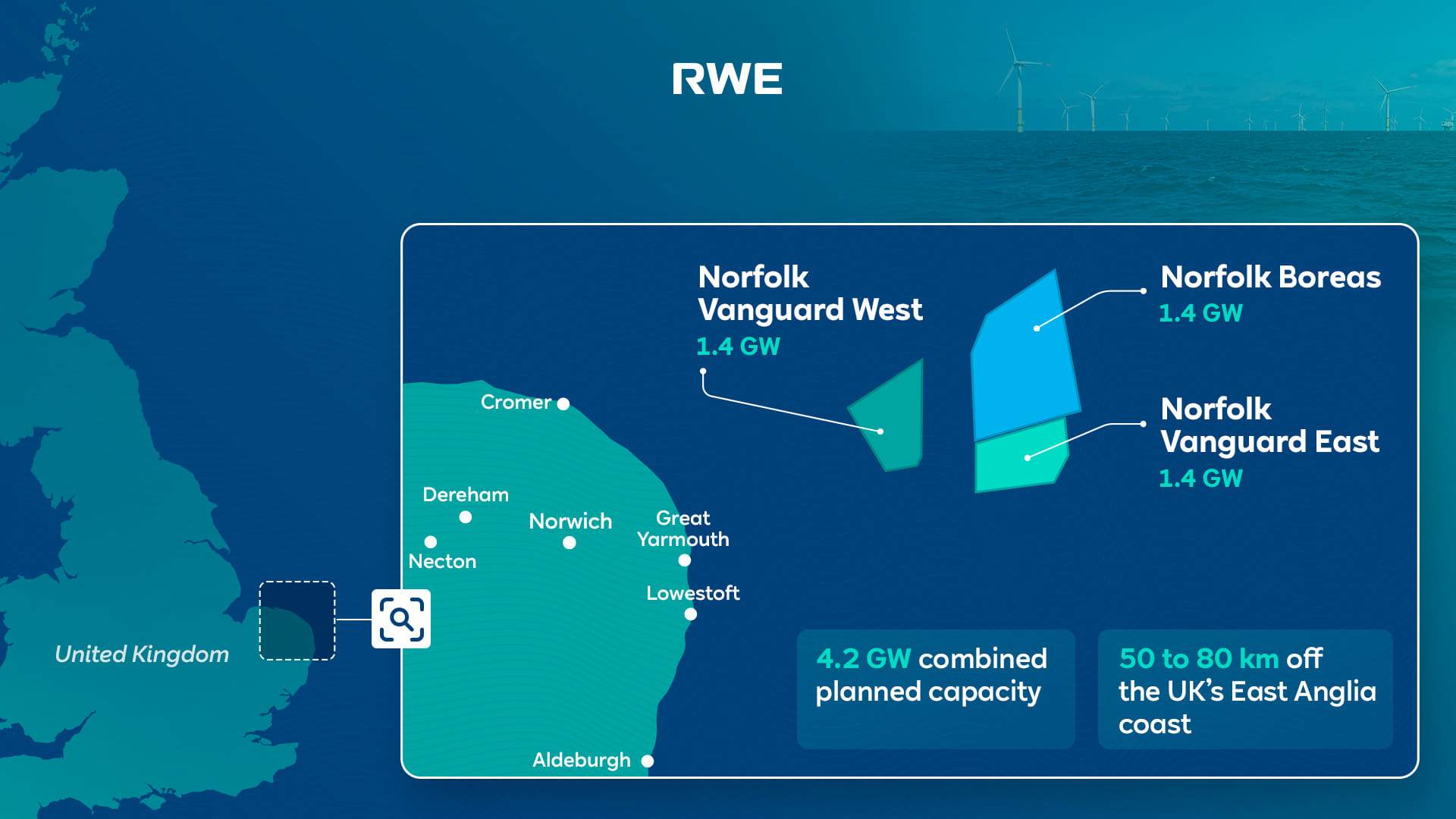
Could it be, that RWE intend to build a giant offshore electrolyser to the East of Great Yarmouth?
- The planning permission for an electrolyser, which is eighty kilometres offshore, would be far easier, than for one onshore.
- The hydrogen pipeline between Norfolk and Germany would be less than 400 kilometres.
- Hydrogen could also be brought ashore in Norfolk, if the price was right.
- The Bacton gas terminal is only a few miles North of Great Yarmouth.
But the big advantage, is that the only onshore construction could be restricted to the Bacton gas terminal.
Adding More Wind Farms To The Electrolyser
Looking at the RWE map, the following should be noted.
South of Norfolk Vanguard East, there is the East Anglian Array wind farm, which by the end of 2026, will consist of these wind farms.
- East Anglia One – 714 MW – 2020
- East Anglia One North – 800 MW – 2026
- East Anglia Two – 900 MW – 2026
- East Anglia Three – 1372 MW – 2026
Note.
- The date is the commissioning date.
- There is a total capacity of 3786 MW
- All wind farms are owned by Iberdrola.
- There may be space to add other sections to the East Anglian Array.
I doubt, it would be difficult for some of Iberdrola’s megawatts to be used to generate hydrogen for Germany.
To the East of Norfolk Boreas and Norfolk Vanguard East, it’s Dutch waters, so I doubt the Norfolk cluster can expand to the East.
But looking at this map of wind farms, I suspect that around 4-5 GW of new wind farms could be squeezed in to the North-West of the the Norfolk Cluster and South of the Hornsea wind farms.
The 1.5 GW Outer Dowsing wind farm, which is being planned, will be in this area.
I can certainly see 8-10 GW of green electricity capacity being available to electrolysers to the North-East of Great Yarmouth.
Conclusion
UK offshore electricity could be the power behind H2ercules.
- The hydrogen could be sent to Germany by pipeline or tanker ship, as the distance is under 400 kilometers to the Wilhelmshaven hydrogen hub.
- Extra electrolysers and wind farms could be added as needed.
- The hydrogen won’t need to be shipped halfway round the world.
The cash flow won’t hurt the UK.
.
Highland Council Greenlights West Of Orkney Windfarm Onshore Plans
The title of this post, is the same as that of this article on offshoreWIND.biz.
This is the sub-heading.
The Highland Council has approved the onshore plans of the 2 GW West of Orkney Windfarm project, being developed by TotalEnergies, Corio Generation, and Renewable Infrastructure Development Group (RIDG) in Scotland.
These are the first three paragraphs.
The onshore application for planning permission in principle was approved on 4 June and outlines the underground cables and electrical infrastructure required to connect the offshore wind farm to the national transmission network.
Last year, the project became the first ScotWind proposal to submit both its offshore consent application to Scottish Ministers and its onshore planning application to The Highland Council.
The onshore application provides information on proposed cable landfalls on the north Caithness coast, the project’s substation at Spittal in Caithness, and the underground cables which will extend around 25 kilometres and connect to the substation.
According to the project page of the West of Orkney wind farm web site, the target for commissioning of the wind farm is 2029.
This wind farm appears to be making a play to be the first of the ScotWind Leasing developments to be commissioned.
I have some thoughts.
Converting The Flotta Oil Terminal To The Flotta Hydrogen Hub
This first paragraph of the Wikipedia entry for the Flotta Oil Terminal, describes it like this.
The Flotta oil terminal is a major crude oil reception, processing, storage and export facility on the island of Flotta, in the south of Scapa Flow in the Orkney Islands. It receives and processes crude oil delivered by a subsea pipeline from the Piper, Claymore, Tartan and Golden Eagle platforms and associated fields. The terminal includes facilities for exporting stabilised crude oil (and formerly liquefied petroleum gases) by tanker.
It is now proposed to add the Flotta Hydrogen Hub to the Flotta Oil Terminal.
This document on the Repsol web site, describes the Flotta Oil Terminal.
- This page is the Flotta Hydrogen Hub web site.
- This page discusses, what will be done with the green hydrogen produced by electrolysis.
- The green hydrogen page, has an excellent map of the hydrogen and electricity flows to and from the Flotta Hydrogen Hub.
The Flotta Oil Terminal will be developed into a major hydrogen production and distribution facility.
UK Offshore Wind In 2030
The next general election is likely to be held in 2029, so how much wind energy will be added during the next Parliament?
The Current Position
The Wikipedia entry for the list of operational wind farms in the UK, says this.
In October 2023, there were offshore wind farms consisting of 2,695 turbines with a combined capacity of 14,703 megawatts.
Due To Be Commissioned In 2024
It would appear these wind farms will come on-line in 2024.
- Neart Na Gaoithe – 450 MW – Fixed
- Doggerbank A – 1235 MW – Fixed
- Doggerbank B – 1235 MW – Fixed
This would add 2920 MW to give a total of 17,623 MW.
Due To Be Commissioned In 2025
It would appear these wind farms will come on-line in 2025.
- Moray West – 882 MW – Fixed
- Doggerbank C – 1218 MW – Fixed
This would add 2100 MW to give a total of 19,723 MW.
Due To Be Commissioned In 2026
It would appear these wind farms will come on-line in 2026.
- Sofia – 1400 MW – Fixed
- East Anglia 3 – 1372 MW – Fixed
- East Anglia 1 North – 800 MW – Fixed
- East Anglia 2 – 900 MW – Fixed
- Pentland – 100 MW – Floating
This would add 4572 MW to give a total of 24,295 MW.
Due To Be Commissioned In 2027
It would appear these wind farms will come on-line in 2027.
- Hornsea 3 – 2852 MW – Fixed
- Norfolk Boreas – 1380 MW – Fixed
- Llŷr 1 – 100 MW – Floating
- Llŷr 2 – 100 MW – Floating
- Whitecross – 100 MW – Floating
This would add 4532 MW to give a total of 28,827 MW.
Due To Be Commissioned In 2028
It would appear these wind farms will come on-line in 2028.
- Morecambe – 480 MW – Fixed
This would add 480 MW to give a total of 29,307 MW.
Due To Be Commissioned In 2029
It would appear these wind farms will come on-line in 2029.
- West Of Orkney – 2000 MW – Fixed
This would add 2000 MW to give a total of 31,307 MW.
Due To Be Commissioned In 2030
It would appear these wind farms will come on-line in 2030.
- Ramplion 2 Extension – 1200 MW – Fixed
- Norfolk Vanguard East – 1380 MW – Fixed
- Norfolk Vanguard West – 1380 MW – Fixed
- Awel y Môr – 1100 MW – Fixed
- Berwick Bank – 4100 MW – Fixed
- Outer Dowsing – 1500 MW – Fixed
- Hornsea 4 – 2600 MW – Fixed
- Caledonia – 2000 MW – Fixed
- N3 Project – 495 MW – Fixed/Floating
This would add 15755 MW to give a total of 47.062 MW.
Capacity Summary
- 2023 – None – 14703 MW
- 2024 – 2920 MW – 17,623 MW
- 2025 – 2100 MW – 19,723 MW
- 2026 – 4572 MW – 24,295 MW
- 2027 – 4532 MW- 28,827 MW
- 2028 – 480 MW – 29,307 MW
- 2029 – 2000 MW – 31,307 MW
- 2030 – 15755 MW – 47,062 MW
Note that capacity has increased more than threefold.
If we assume the following.
- New wind farms are commissioned throughout the year.
- 14703 MW of wind power, with all our gas-fired, nuclear and onshore wind farms is enough to power the UK.
- The average capacity factor is 45 %.
- The strike price is £35/MWh.
The levels I have set are deliberately on the low side.
The amount of energy and cash flow generated by new wind farms in a year can be calculated as follows.
{Average New Capacity In Year}= ({Capacity at Year Start}+{Capacity at Year End})/2-14703
{Extra Electricity Generated In Year}= {Average New Capacity In Year}*365*24*{Capacity Factor}
{Cash Flow}={Extra Electricity Generated In Year} * {Strike Price}
The following figures are obtained.
- 2024 – 1460 MW – 5,755,320 MWh – £ 201,436,200
- 2025 – 3970 MW – 15,649,740 MWh – £ 547,740,900
- 2026 – 7306 MW – 28,800,252 MWh – £ 1,008,008,820
- 2027 – 11858 MW – 46,744,236 MWh – £ 1,636,048,260
- 2028 – 14,364 MW – 56,622,888 MWh – £ 1,981,801,080
- 2029 – 15,604 MW – 61,510,968 MWh – £ 2,152,883,880
- 3030 – 23,931.5 MW – 94,337,973 MWh – £ 3,301,829,055
Nate.
- The first column is the cumulative amount of new capacity about the 14,703 MW in December 2023.
- The second column is the extra electricity generated in the year over December 2023.
- The third column is the extra cash flow in the year over December 2023.
As the installed base of wind farms increases, the cash flow increases.
It should also be noted that there are a large number of wind farms, already pencilled in for 2031-2035.
What Will We Do With All This Extra Electricity?
We need more industries that will consume a lot of electricity, like cement, chemicals and steel.
But I suspect that the easiest thing to do, is to convert the excess electricity to hydrogen and export it to the Continent and especially the Germans by pipeline or tanker.
Conclusion
Whoever wins this year’s General Election, should have a growing source of revenue for the life of the parliament and beyond.
Recurrent Energy’s Middle Road Project Sold To Centrica
The title of this post, is the same as that pf this article on Solar Power Portal.
These are the first two paragraphs.
Recurrent Energy, a global solar and energy storage developer and a subsidiary of Canadian Solar, announced the sale of its 49.9 MWp Middle Road solar project in Harbury, Warwickshire, to Centrica Business Solutions. The subsidy-free project, slated for construction this summer, will commence operations in 2025.
The Middle Road project is just one piece of Recurrent Energy’s expanding UK pipeline, which boasts over 2.6 GWp of solar PV and 6.7 GWh of battery storage projects. This mirrors the broader trend of increased investment in UK solar. Indeed, Recurrent announced €1.3 billion of financing for EU and UK solar projects earlier this week.
This 49.9 MW solar project shows three ways to make money from a solar project.
The Developer
Recurrent Energy would appear to have developed the expertise to put together these solar farms and do all the legals and administration to connect them to the National Grid.
They obviously can show their financial backers, the cash flow, that the farms generates.
So if you’re good at building solar farms, I suspect you can develop a substantial pipeline of projects, each with their own case flow.
The Operator
Initially in the early days, Recurrent Energy will probably be the operator, so they can sort out any teething problems and build the financial profile of the site.
The Owner
But as at Middle Road, they may decide to cash in their investment.
Centrica have now taken over the ownership and they can operate the farm themselves or pay, Recurrent Energy a fee.
Note.
- Developer, operator and owner all have ways of making money from this solar farm.
- Developer and owner can use the solar farm, as an asset on which to raise money.
- Similar cash flows and inside probably apply to batteries and wind farms.
By buying, selling and updating the various assets, a financial operator, can use their assets to make money.
As Centrica are also an electricity supplier, they can probably suggest to developers, where a solar farm or battery-electric storage system is needed.
Are Centrica Developing A Pipeline Of Projects?
In Centrica Set For Solar Boost With Acquisition Of Two Projects In South-West England, I talked about how Centrica had acquired two projects in South-West England.
The Middle Road project is the third project that Centrica has purchased this year.
As a Control and Electrical Engineer, I know, that by careful management of the assets, Centrica can achieve the following.
- Delivery of electricity to their customers at a competitive price.
- If a battery is included in the local grid, higher supply reliability can be achieved.
- Batteries also allow the local network to carry out other tasks, like frequency stabilisation.
The flexibility of the local network should allow other assets to be added.
Teesworks Joins Forces With NatPower On 1GW UK BESS
The title of this post, is the same as that of this article on Solar Power Portal.
These are the first two paragraphs.
Teesworks, the UK’s largest industrial zone, has revealed plans for a 1GW battery energy storage system (BESS) in partnership with renewables developer NatPower.
The project will be constructed over 50 acres of the Long Acres section of the 4500-acre Teesworks site. Construction costs are expected to total around £1 billion. While the main plan for the BESS is focused on renewable energy storage, the company also noted that the system could also support electric vehicle (EV) charging in the future.
The article then lists several large BESS projects, that are under development.
It also suggests that investment in batteries is in a healthy state.
 The Anonymous Widower