Start-Up’s Plan To Convert Food Waste Into Green Fuel
The title of this post, is the same as that, of this article in The Times.
This is the sub-heading.
Dark Green wants to build biogas production plants to supply local authorities and businesses
These three paragraphs give some detail to the plans.
A Nottingham-based start-up wants to become the first company to build a fleet of plants that would convert food waste into green energy in urban centres across Britain, producing an alternative fuel for businesses and local authorities attempting to shrink their carbon footprints.
Dark Green expects to submit planning applications for six biogas production plants, including one each in Birmingham and Huddersfield, with a further six in the pipeline.
The facilities, which are more usually sited on farms, will be capable of handling 60,000 tonnes of organic waste a year, saving the same amount of carbon dioxide as taking 65,000 cars off the road, the company estimates, and will produce seven megawatts of energy, capable of powering around 6,000 homes.
I have a feeling that Dark Green fit a theme, that this blog has been following for a couple of years now.
I have been commenting on a company called HiiROC.
- I first became aware of HiiROC and their new method of generating hydrogen in this news item from Centrica, which is entitled Centrica And HiiROC To Inject Hydrogen At Brigg Gas-Fired Power Station In UK First Project.
- HiiROC is a Hull-based startup-up, that is backed by Cemex, Centrica, Hyundai, Kia, Siemens and other big names.
- HiiROC can take any hydrocarbon gas from something like chemical plant off-gas, through biomethane to natural gas and split it into hydrogen and carbon black.
- HiiROC call their process thermal plasma electrolysis.
- The carbon black has uses in the manufacture of tyres and rubber products, anodes for lithium-ion batteries and other materials and in agriculture, it can be used to improve soils.
HiiROC claim that their method uses a fifth of the energy to create hydrogen, than electrolysis.
It looks to me that if you pipe Dark Green’s methane-rich gas into one of HiiROC’s thermal plasma electrolysers, you’ll get two valuable products; hydrogen and carbon black.
Centrica have also been active with an energy storage company called Highview Power recently, in the company of Goldman Sachs and Rio Tinto.
Centrica seem to have a cunning plan!
Is Dark Green going to be part of it?
A New Metier
This article in The Times today is entitled Too many Sir Humpreys are stopping London from taking a punt.
The article is about one of Britain’s most successful private investors ; John Gunn.
The article also introduces a new company to me, with this paragraph.
His latest enthusiasm is for Metier, a company that aims to leapfrog electric vehicle power to convert buses and heavy trucks to hydrogen fuel cells. Several big firms such as Volvo are making new hydrogen-powered vehicles, but Gunn and his partners reckon there is more money in reconfiguring existing ones.
It was Metier, that caught my eye.
In the 1970s, with three others, I started a company called Metier Management Systems, which developed a project management system called Artemis.
We were very successful, in that we sold the company for a nine figure sum and won two Queen’s Awards for Exports.
Since then, there have been several successful companies named Artemis, but we haven’t seen a Metier.
Until now that is and I hope that the hydrogen vehicle company is as successful worldwide as we were.
Strangely, my first job on leaving Liverpool University was in a hydrogen factory and I am a great believer in using the gas as a source of energy.
Metier have a web site, if you want to find out more about the company.
UK, Netherlands To Connect Grids via Nederwiek 3 Offshore Wind Farm
The title of this post, is the same as that of this article on offshoreWIND.biz.
This is the sub-heading.
Dutch Climate and Green Growth Minister Sophie Hermans has included LionLink, said to be the first direct-current hybrid interconnector, in the country’s latest Offshore Wind Energy Development Framework. LionLink will use the offshore grid connection of Nederwiek 3 offshore wind farm in the Netherlands to connect to both the Dutch and the UK onshore high-voltage grids.
These are points from the article.
- The interconnector can also be used as an additional high-voltage link to exchange electricity between the countries.
- With LionLink now added to the offshore wind development framework, TenneT may now make investments in the project, which the Dutch transmission system operator (TSO) is realising in close cooperation with UK partner National Grid Ventures (NGV).
- Nederwiek 3 is planned to be launched in 2026.
The offshore grid between the UK and Europe is on its way.
£10bn Investment In AI Data Centre Confirmed
The title of this post, is the same as that of this article on the BBC.
This was the sub-heading.
A £10bn investment in a new artificial intelligence data centre will create about 4,000 jobs, the government has said.
These two paragraphs add more details.
The site in Cambois, near Blyth, Northumberland, will become one of Europe’s biggest AI data centres.
The land was bought by private equity giant Blackstone earlier this year, after the collapse of Britishvolt which had planned to build an electric car battery factory on the site.
In My First Trip On The Northumberland Line – 18th December 2024, I said this after my first trip to the line.
The Blyth Valley Is Well Supplied With Electricity
Several high-capacity connections to wind farms and Norway are planned to come ashore at Blyth and it appears from the pictures that the area is well connected to the grid.
This must have nudged Britishvolt to put their battery plant at Blyth.
But no matter for those jobs, as with a rail service to Greater Geordieland and lots of electricity, there must be other energy-hungry businesses like datacentres or small modular reactor factories, who would want the site.
The Long Platforms
I am fairly sure that some of the platforms have been sized to take a five-car Hitachi Class 80x train, which are only 130 metres long and can carry around 400 passengers.
This must enable the ability to use the Northumberland Line as a diversion for the East Coast Main Line.
Some services could perhaps stop at Blyth for the large factories and/or Northumberland Park for the Metro.
It looks to me, that the Northumberland line was designed for large factories or businesses with lots of workers, that needed lots of electricity.
Trump Calls On UK To ‘Get Rid’ of Offshore Wind Farms In Favour Of Oil & Gas; Gets Invited To Hull
The title of this post, is the same as that of this article on offshoreWIND.biz.
This is the sub-heading.
Donald Trump has urged the UK government to “get rid of windmills” in the North Sea and open it up for oil & gas, which earned the US president-elect an open invitation from Humber Marine and Renewables, a UK regional industry organisation, to visit Hull and witness the effects of offshore wind on the economy first-hand.
This paragraph sums up Trumps views on wind farms, which he incorrectly calls windmills.
According to global media, on 3 January, Donald Trump said via his social media platform Truth Social that the UK was “making a very big mistake” with wind energy and that it should “open up the North Sea”, accompanying the post with a link to news about US oil company Apache saying it would exit the North Sea, citing the windfall tax in the UK. The news on Apache’s UK exit followed the UK government’s announcement on raising the tax from 35 per cent to 38 per cent and using the profit for renewable energy.
But then he wouldn’t realise that a windmill grinds corn and a wind turbine generates electricity.
This paragraph describes the invitation of Trump to Hull.
After the incoming US president’s social media post, director of the UK industry organisation Humber Marine and Renewables, Dave Laister, said in a comment to BBC: “I’d like to invite Donald Trump, or a representative here in the UK, to come to Hull and take in Offshore Wind Connections 2025. He needs to hear what those ‘windmills’ have done for the economy, for our maritime heritage and for the region’s sense of purpose. I’d like him to understand the appetite for working in this clean, green sector from those at our schools and colleges, to sample the hunger to be part of a climate emergency solution.”
I doubt he’ll go to the city.
One problem, he’ll have getting to Hull, is that the city doesn’t have an airport, so he’ll have to go into Humberside, Leeds or Robin Hood.
If you would like to go to Offshore Wind Connections 2025, then this is the web site.
Enjoy the party!
Windar Taps PORR To Build Wind Tower Factory In Poland
The title of this post, is the same as that of this article on offshoreWIND.biz.
This is the sub-heading.
Spain’s Windar Renovables has selected PORR to build a new factory in Szczecin, Poland, that will produce towers, masts, and foundations for the next generation of wind turbines.
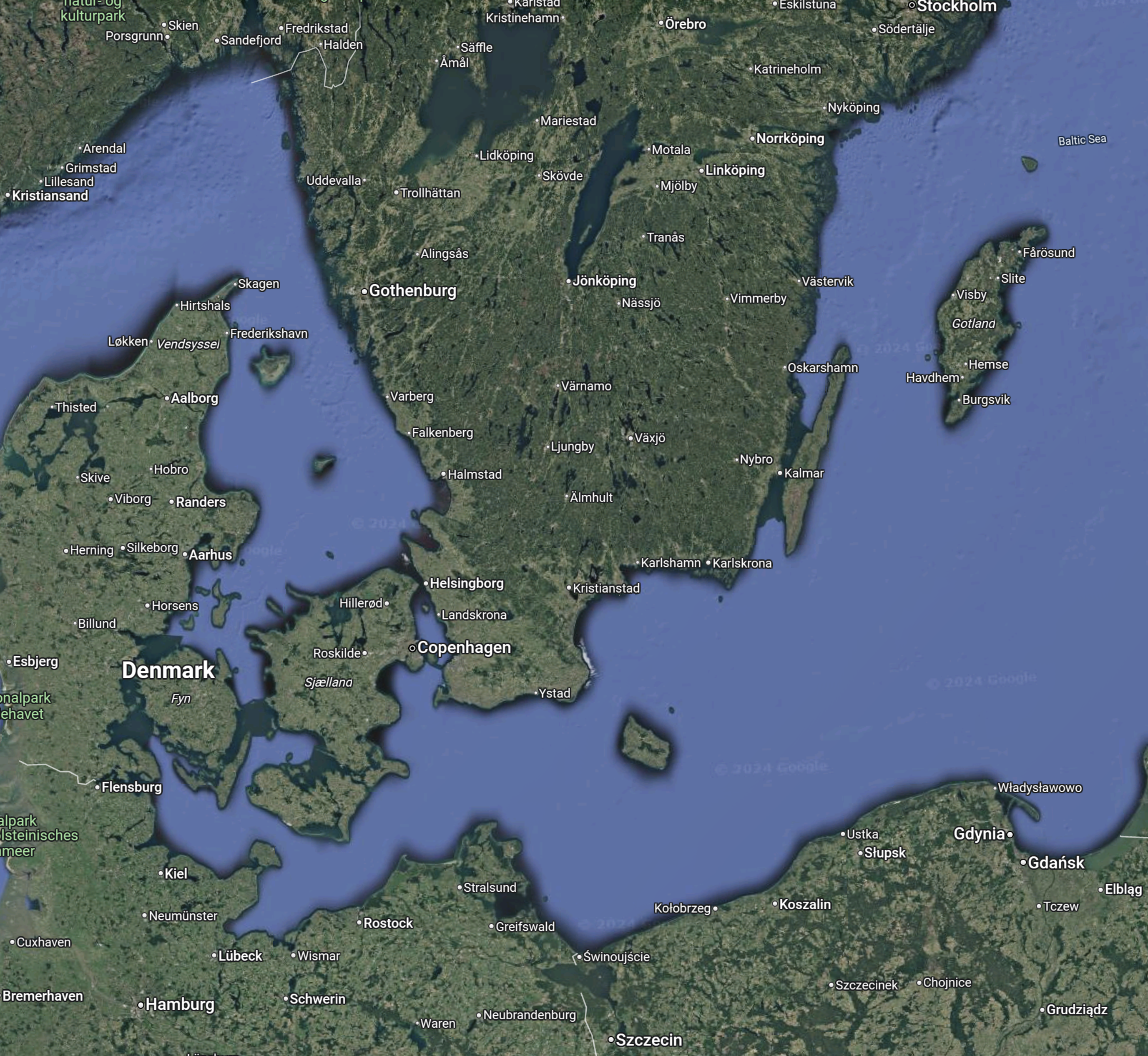
This Google Map shows the position of Szezecin.
Note.
- The small island to the South of Sweden is the Danish island of Bornholm.
- Szczecin is on an inlet to the South of Bornholm.
- Gdynia and Gdansk are in a bay on the Polish coast to the East.
It looks like there will be several places along the coast, that will be suitable for the building and assembly of wind turbines and their components.
It will surely be easy to transport the turbines and their components up the Kattegat and down the Skagerrak into the North Sea.
This second Google Map shows the Port of Szczecin in more detail.
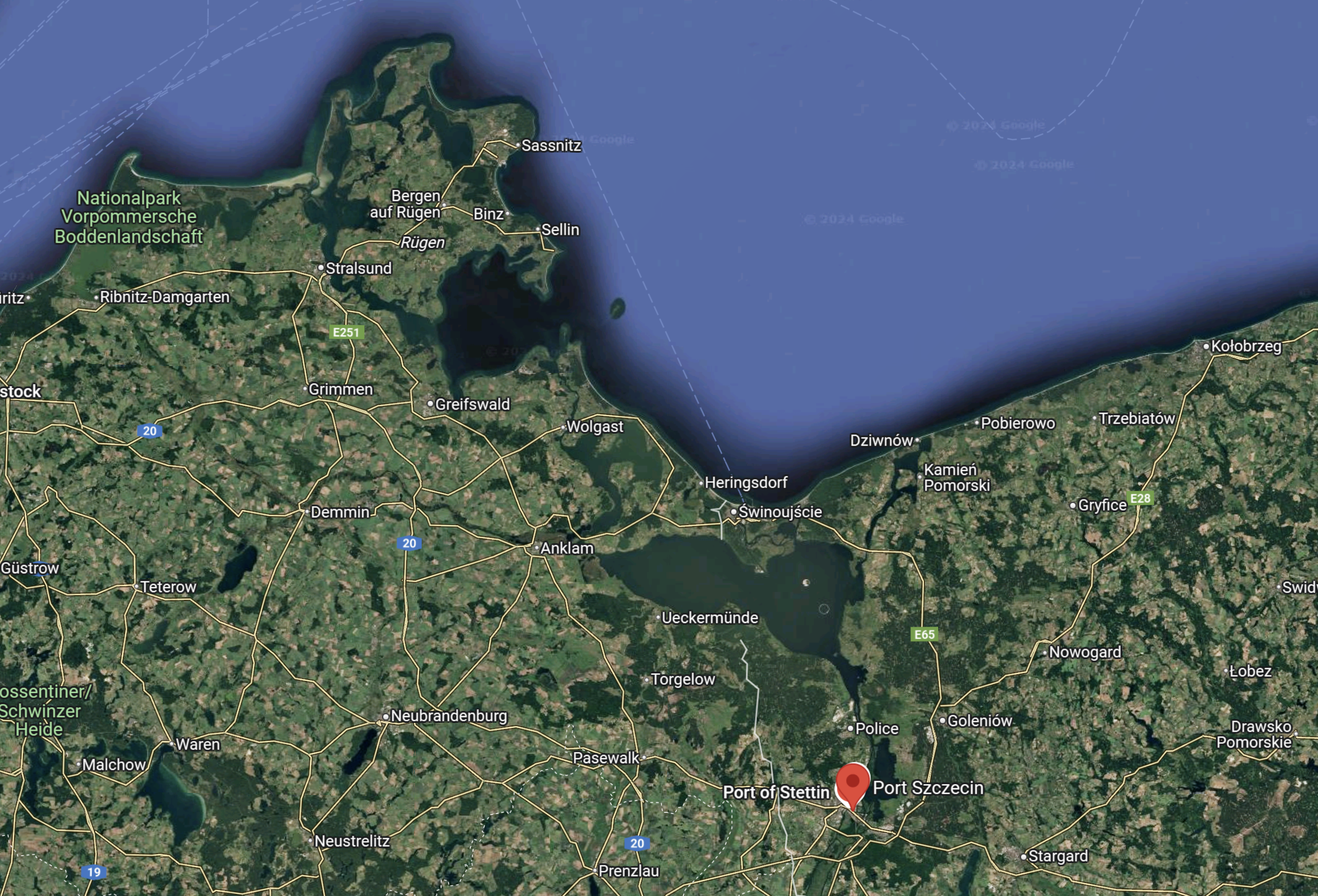
The location of the port is indicated by the red arrow.l
Conclusion
It looks to me to be an ideal place to build the components for wind turbines like towers, masts and foundations.
Agrivoltaics Deal To Bring 9,000 Sheep To 1GW Solar Park
The title of this post, is the same as that of this article on Solar Power Portal.
When I saw the title, I felt I just had to call it out.
A 1GW Solar Park
Normally, a 50-100 MW solar farm is considered large for the UK, so a 1 GW solar farm must be truly enormous, by any standards.
According to the heading of the Great North Road Solar and Biodiversity Park web site, which says this.
Elements Green is developing proposals for a new solar and energy storage park located to the northwest of Newark-on-Trent, Nottinghamshire.
With a potential generation capacity of around 800 megawatts (MW) AC of solar energy, the scheme has the potential to provide enough clean, affordable energy to meet the power needs of approximately 400,000 homes while avoiding more than 250,000 tonnes of CO₂ emissions every year.
The size appears to be around 800 MW.
But that is still large!
The Project Area
This article on the BBC is entitled Survey Suggests Opposition To Major Solar Farm, has this as a caption to the first picture.
The solar project is made up of around 1.5 million panels covering 7,000 acres.
That is around eleven square miles or a 3.3 mile square.
A Map Of The Project
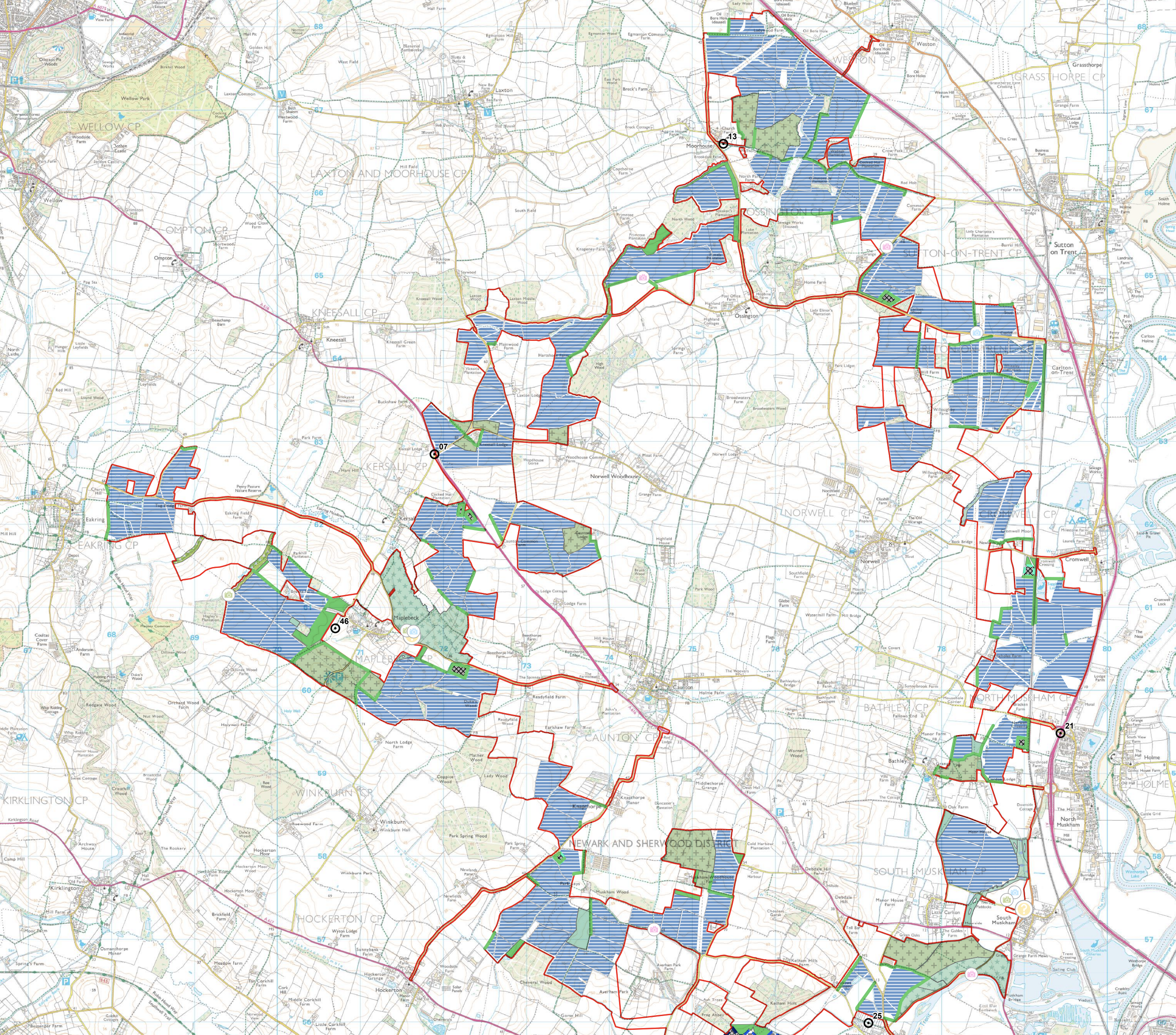
This map of the project was clipped from the Elements Green web site.
Note.
- The blue areas are solar panels.
- The red line at the right hand side is the A1 Great North Road.
- There is a lot of space for more solar panels.
It could be even bigger than 1 GW.
There Is Opposition To The Wind Farm
This article on the BBC is entitled Survey Suggests Opposition To Major Solar Farm.
This is the sub-heading,
A consultation about a major solar farm in Nottinghamshire has shown the scale of the opposition it faces to being built.
These two paragraphs detail the scale of the opposition.
The consultation, held in January and February, found 54% of respondents opposed the scheme, with 16% supporting the current plan.
Among the main reasons people gave for opposing the scheme were its visual and ecological impact.
The reasons for opposition are typical.
These two paragraphs describe the actions of the developer.
Having received the backing in principle of several key nature charities and trusts, the Great North Road Solar Park project will be renamed ‘Great North Road Solar and Biodiversity Park’, with a new logo to reflect this.
Communities who were consulted on the original proposals in early 2024 expressed a strong desire to protect and enhance their natural environment. Acting upon this feedback, developer Elements Green has formed partnerships with the RSPB, Sherwood Forest Trust, Nottinghamshire Wildlife Trust, and The Trent Rivers Trust, to ensure that nature benefits from their ambitious project.
I suspect that some of the opposition groups have labelled the last paragraph as green-washing.
Nine Thousand Sheep!
Usually, when large numbers of sheep are mentioned on the Internet, it’s usually something a bit coarse.
But in this project, it’s only letting sheep, do what they do well ; act as green lawnmowers, have lambs and provide meat and wool to increase the bottom line.
Where Is The Connection To The Grid?
The FAQs section of the Great North Road Solar and Biodiversity Park web site has this question.
Why has Elements Green chosen this location for the solar park?
This answer is given.
A key factor influencing the location of GNR Solar and Biodiversity Park is the availability of a connection at National Grid’s Staythorpe substation. The closure of fossil fuel power stations has created capacity on the grid. This would enable GNR Solar and Biodiversity Park to continue the tradition of power generation in the area using a clean, renewable resource.
In addition, a range of planning and environmental factors such as the existing land use, quality of land, as well as designations and planning and technical constraints have also informed our choice of location for the scheme.
So if you’re near the site of a disused coal- or gas-fired power station, don’t expect it to be developed as agricultural land, woodland or housing.
The Wikipedia entry for Staythorpe power station, reveals there is a 1,850 MW gas-fired power station on the site.
The Great North Road Solar and Biodiversity Park would appear to have a very able gas-fired back-up,
No Battery Or Energy Storage Is Mentioned
In an idealised day, there is a period of light and a period of darkness.
A battery would allow any excess electricity generated in the day to be used at night.
Google searches reveal energy storage could be fitted.
One of Highview Power’s environmentally-friendly 200 MW/3.25 GWh liquid-air batteries could be a starting point for a one GW solar or wind farm.
Could A Wind Farm Be Added To The Solar Farm?
In An Excursion To Retford And Worksop, I noticed a large hybrid solar and wind farm alongside the railway.






As the Great North Road Solar and Biodiversity Park uses a lot of land, would some be available for a sprinkling of wind turbines?
Conclusion
Looking at the map, you can understand some peoples’s enthusiasm for large solar farms and large onshore wind farms, as they can be so easily connected to the infrastructure of a decommissioned coal- or gas-fired power station.
The Areas Where Labour Wants To Build Onshore Wind Farms, Mapped
The title of this post, is the same as that of this article on inews.
This is the sub-heading.
Ten onshore wind projects have been proposed to help keep UK on track to have at least 95 per cent clean power by 2030.
This is the first paragraph.
The Government is bracing for its biggest nimby battle yet as onshore wind farm companies work on a flurry of proposals after an effective ban on development was lifted in England.
I suggest you take the time to read the well-written informative article, if you are worried about onshore wind farms being parked on the hill behind your house.
The first ten are provocative and there is a map of their locations, which are mainly in Scotland and Wales, on the Pennines and in Lincolnshire.
This paragraph in the article, quotes government data on the cost of various forms of energy.
They estimate that over the entire course of a project’s life, onshore wind costs £38 per mega watt hour of energy, compared to £44 for offshore and £41 for solar. Gas, meanwhile, is £114, while nuclear is £128.
I don’t have any other real data, but it does appear that floating offshore wind farms have a higher capacity factor, which should tip the cost comparison back in its favour.
But I do suspect that Ed Miliband will use these figures to increase the amount of onshore wind in the ?UK and especially n England.
As larger turbines are being tested by the Chinese and Siemens, I suspect too, that we’ll see larger turbines installed onshore.
I also believe as a Control Engineer, that as the number of large turbines increases, we will see more energy storage built alongside wind farms.
My First Trip On The Northumberland Line – 18th December 2024
Yesterday, I took Lumo to Newcastle and took my first ride to Ashington on the Northumberland Line.
These are some of the pictures I took.






































































































Note.
- Much of the route is double-track.
- Bridges over the tracks indicate, that some stations will have two platforms.
- I suspect some stations could take a five-car train.
- One guy said that there is a lot of landscaping to do.
- The standard is very similar to the Borders Railway.
I have some other thoughts.
The Blyth Valley Is Well Supplied With Electricity
Several high-capacity connections to wind farms and Norway are planned to come ashore at Blyth and it appears from the pictures that the area is well connected to the grid.
This must have nudged Britishvolt to put their battery plant at Blyth.
But no matter for those jobs, as with a rail service to Greater Geordieland and lots of electricity, there must be other energy-hungry businesses like datacentres or small modular reactor factories, who would want the site.
The Long Platforms
I am fairly sure that some of the platforms have been sized to take a five-car Hitachi Class 80x train, which are only 130 metres long and can carry around 400 passengers.
This must enable the ability to use the Northumberland Line as a diversion for the East Coast Main Line.
Some services could perhaps stop at Blyth for the large factories and/or Northumberland Park for the Metro.
It looks to me, that the Northumberland line was designed for large factories or businesses with lots of workers, that needed lots of electricity.
Development North Of Ashington
This OpenRailwayMap shows the area North of Ashington.
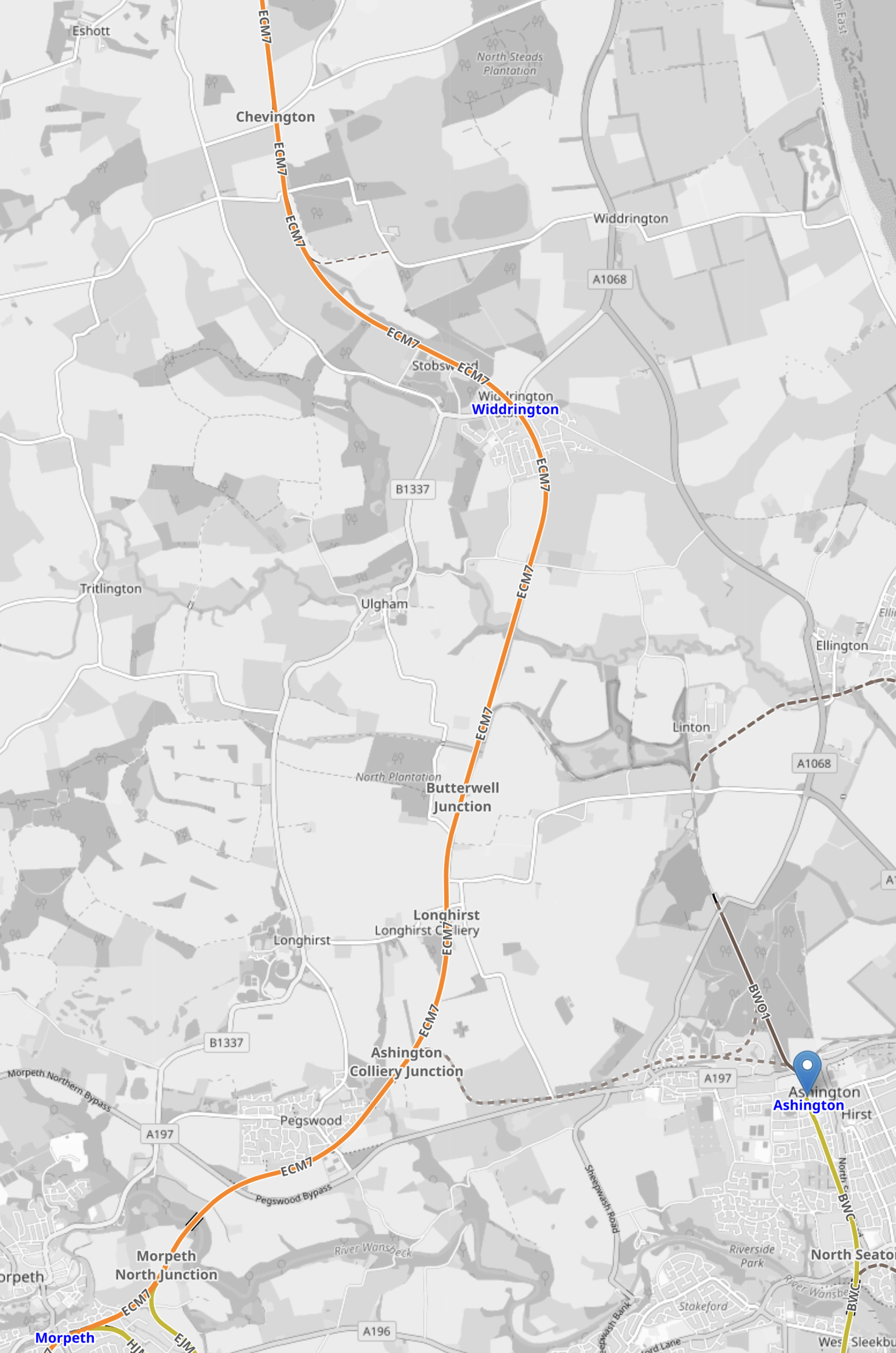
Note.
- The orange line going up and down the map is the East Coast Main Line.
- Morpeth station is in the South-West corner of the map.
- Ashington station is in the South-East corner of the map.
I think there might be scope to develop this area to make the heavy components needed for wind farms and small modular reactors,
British Gas Partners With Strata And Daikin To Launch Eco-Tech Low Bill Homes
The title of this post, is the same as that of this press release from Centrica.
This is the sub-heading.
British Gas is set to supercharge sustainable living across the UK with the launch of Low Carbon Homes – a ground-breaking pilot in partnership with Strata and heat pump manufacturer, Daikin.
These are the first four paragraphs, which fill out a bit of detail.
In anticipation of The Future Homes Standard, customers will move into new build homes which have been fitted with a full range of the latest low-carbon technology at no extra cost to the housebuilder or owner. The homes will be equipped with a 6-8 kWh Daikin air source heat pump, 4 kWh solar panels, 5 kWh battery storage, Hive electric vehicle charger and thermostat. These items will be integrated into Hive’s award-winning app, providing customers with one-stop visibility and control of their energy usage.
The first trial phase will launch at a Strata’s “Breathe” development site in Kiveton, Rotherham. As a thank you for participating in the pilot, British Gas is giving homeowners access to a fixed rate tailored British Gas tariff. Participants in the trial will also have access to a dedicated British Gas energy manager to help them optimise the technology and keep bills as low as possible, while still meeting their desired comfort levels.
Each home will be fitted with a Hive hub, which connects to the WIFI network and acts as the home’s operating system, integrating all the sustainable technology. The customers energy and heat schedules and budget will be optimised by the Hive Hub for further savings.
When the customer connects to Hive’s app they will be able to control and maximise efficiency by setting schedules and spending budgets and allowing the Hub to help them reduce their bills.
Note.
- As a Control Engineer, this to me is a good start.
- I suspect that a 6-8 kWh Daikin air source heat pump, 4 kWh solar panels and 5 kWh battery storage will keep the average house warm.
- I would expect that the three companies have optimised the ratios between the sizes of the components to give the best performance.
It is amazing to think that it was in the early seventies, that in the two sections, where I worked at ICI, engineers had just started controlling and optimising flows, pressures and temperatures in complex chemical plants.
If you’d asked any of us, when our houses heating systems would be as fully controlled, we’d have given twenty years at most.
What kept the world so long?
I have a few thoughts.
Could The Housing Have Gas For Cooking??
Yes! Centrica owns a big share with Hyundai, Kia and others of a start-up company called HiiROC.
- This is the HiiROC web site.
- HiiROC can take any hydocarbon gas and split it into green hydrogen and carbon black.
- Green hydrogen is obviously useful and the carbon black can be used for making tyres for vehicles, anodes for lithium-ion batteries and in agriculture for soil improvement.
- Waste off-gas from a chemical plant can be split into green hydrogen and carbon black.
- Biomethane from a sewage plant can be split into hydrogen and carbon black. Could a sewage plant on an estate be used to create biomethane for cooking and feeding to the HiiROC plant? Yes!
- Could green hydrogen produced on the estate be used to drive vehicles like cars, vans and ride-on-mowers. Yes! If the manufacturer of the vehicle allows it!
- How convenient would it be to have Hydrogen-at-Home?
How Much Does A British Gas Hive Save On My Energy Bill?
I asked Google and I got this answer from Home Hive.
£119. A smaller carbon footprint and a smaller bill – our award-winning smart thermostat could cut your energy bills by up to £170 a year. Join Hive Plus to boost your thermostat’s savings – and get exclusive access to £60 bill credit with any fixed British Gas dual fuel tariff.
At present, I have no intention of changing my energy supplier, but come the summer or if my health or energy circumstances change, I might see what is available.
Will British Gas Develop A Hive For a Smaller Dwelling?
I suspect in ten years, if I’m still of this world, I shall be living in the following circumstances.
- Alone.
- In a two bedroom house, cottage or flat.
- Some form of probably electric central heating or perhaps even hydrogen.
- No car.
- A short walk to the bus stop and/or train station.
- Communal gardens to sit in.
- An Ocado style delivery for food, groceries and other essentials.
- A local gluten-free cafe.
- Full Wi-Fi
Perhaps, British Gas and others will develop a community for people like me?

