Will 2025 Be A Bumper Year For Solar?
The title of this post, is the same as that of a sub title of this this article on Solar Power Portal, which is entitled Two Solar NSIPs Granted Development Consent.
This is the sub heading of the main article.
The Department for Energy Security and Net Zero (DESNZ) has granted development consent orders (DCOs) to the Heckington Fen Solar and West Burton Solar solar PV power plants.
This paragraph, gives a brief description of the two projects.
The two developments, both located in Lincolnshire, England, are classified as Nationally Significant Infrastructure Developments (NSIPs) as their proposed generation capacity is over 50MW. Combined, the Heckington Fen Solar and West Burton Solar projects will have a generation capacity of almost 1GW.
But it was the prominent sub-title in the article, that prompted me to write this post.
These were the three paragraphs, the author used to answer their question.
This year so far has already seen significant movement on several large-scale solar projects, with more to come throughout 2025.
Last week, international renewable energy developer Ørsted announced proposals for a 320MW solar PV power plant in East Yorkshire, the Kingfisher Solar Farm, for which public consultations are set to begin on 3 February. Meanwhile, Elements Green has opened the second phase of statutory consultations for its 800MW Great North Road Solar and Biodiversity Park, which will run until 20 February.
Plans for another proposed 800MW development, EDF Renewables UK’s Springwell Solar Farm, will be examined by the planning inspectorate following the successful submission of a DCO application for the project.
I also wrote UK Solar Deployment Poised To Increase 50% YoY, Following Rapid Growth In The Second Half Of 2024, just over a week ago, where I predicted a large growth in steel aolar panels on industrial and architect-designed buildings.
Conclusion
There may be a lot of new solar power generated in the UK in 2025, but because some of it will be roof-mounted and structural, we won’t see as much as we have in the past.
How To Keep The Lights On When The Wind Doesn’t Blow
The title of this post, is the same as that of this article in The Times.
This is the sub-heading.
Britain came close to a blackout this month. Gas is being phased out and renewables are intermittent, so can energy storage stop us going dark?
These are the first two paragraphs.
It was 8.29pm on the first Tuesday in January when the alert was issued by the electricity control room. Freezing temperatures had coincided with unusually low wind speeds, and it was making the National Energy System Operator (Neso) jittery.
Engineers forecast a 1.6GW shortfall — the requirement for about 1.5 million homes — for a three-hour period from 4pm the following afternoon. “System operators are requested to notify Neso of any additional megawatt capacity,” the message said.
Luckily, the plea worked.
The article then goes on to describe the various technologies that are being deployed.
The article starts by talking about pumped storage hydroelectricity.
This paragraph gives a superb illustration about how things have changed in energy and energy storage in the UK in the last few decades.
In the past, when coal provided the bulk of British power, this system was used to meet fluctuating demand levels. But now it is also required to meet fluctuating supply levels from renewable sources. Martin Pibworth, chief commercial officer at SSE, started with the company as a trainee in 1998. “Back then, at our Foyers pumped storage plant [at Loch Ness] we would switch modes, from pumping to not pumping and back again, maybe 600 to 700 times a year. Last year we switched modes there 6,500 times. It’s an insight into how the market has changed and how much more flexibility is needed, and how responsive that has to be.”
We have to be more agile, with our handling of storage to back up the various methods of generation.
1.1 GW Inch Cape Wind Farm Entering Offshore Construction Phase
The title of this post, is the same as that of this article on offshoreWIND.biz.
This is the sub-heading.
ESB and Red Rock Renewables have reached a financial close on the 1,080 MW Inch Cape offshore wind farm in Scotland, and the project will now progress into its offshore construction phase.
Inch Cape will be a 1.1 GW wind farm, which as this web site/data sheet shows could be capable of generating enough green energy to power more than half of Scotland’s homes.
Highlights from the data sheet include.
- Represents an around £3 billion investment in the UK’s electrical infrastructure
- Will contribute significantly to the UK Government’s target of 50 gigawatts (GW) of offshore wind installed capacity by 2030
- Constitutes 10% of the Scottish Government’s ambition of 11 GW of offshore wind installed by 2030
- As at Q1 2025, has already invested almost £300 million with 300 UK companies (more than £100 million in Scotland with 120 Scottish companies)
- Is set to spend a further (approx.) £700 million with UK supply chain (and create associated direct and indirect jobs)
- Efficient re-use of a brownfield site in East Lothian (of former coal-fired power station) including existing grid capacity and established transmission infrastructure
- The offshore substation is being built by Siemnens and Smulders at Wallsend on Tyneside.
- On track to deliver at least 50% UK content over life cycle of the project
- Will mean large investment in a new facility in the Port of Montrose and more than 50 long-term skilled local jobs
- Once operational the wind farm will reduce carbon emissions by 2.5 million tonnes per year compared to using fossil-fuels.
I like this project.
- It has a capacity of 1.1 GW.
- The turbines are 15 MW Vestas units.
- The connection to the grid is at the site of the demolished Cockenzie coal-fired power station.
- 50 % of the content of the £ 3 million project is British, spread among three hundred companies. That is certainly spreading the money around.
- I calculate that, when the turbines are fully turning, the Inch Cape wind farm will generate £ 44, 201.38 per hour or just over a million pounds per day.
I suspect we will be seeing lots more wind farms like this in the next thirty or forty years.
These are currently under construction.
- Neart Na Gaoithe – Scotland – 450 MW
- Sofia – England – 1400 MW
- Dogger Bank A – England – 1235 MW
- Dogger Bank B – England – 1235 MW
- Dogger Bank C – England – 1218 MW
- Moray West – Scotland – 882 MW
- East Anglia 3 – England – 1372 MW
- Total – 7792 MW
These are pre-construction.
- Hornsea 3 – England – 2852 vMW
- Inch Cape – Scotland – 1080 MW
- Total – 3932 MW
These are proposed wind farms – Contracts for difference Round 4
- Norfolk Boreas – Round 1 – 1380 MW
- Total – 1380 MW
These are proposed wind farms – Contracts for difference Round 6
- Hornsea 4 – England – 2400 MW
- East Anglia 2 – England – 963 MW
- Greeen Volt – Scotland – 400 MW
- Total – 3763 MW
These are proposed wind farms – Early Planning
- East Anglia 1 North – England – 800 MW
- Rampion 2 Extension – England – 1200 MW
- Norfolk Vanguard East – 1380 MW
- Norfolk Vanguard West – 1380 MW
- Dogger Bank South – England – 3000 MW
- Awel y Môr – Wales – 500 MW
- Five Estuaries – England – 353 MW
- North Falls – England – 504 MW
- Dogger Bank D – England – 1320 MW
- Berwick Bank – Scotland – 4100 MW
- Seagreen Phase 1A – Scotland – 500 MW
- Outer Dowsing – England – 1500 MW
- Morecambe – England – 480 MW
- Mona – England – 1500 MW
- Morgan – England – 1500 MW
- Morven – England – 2907 MW
- Ossian – Scotland – 3610 MW
- Bellrock – Scotland – 1200 MW
- CampionWind – Scotland – 2000 MW
- Muir Mhòr – Scotland – 798 MW
- Bowdun – Scotland – 1008 MW
- Ayre – Scotland – 1008 MW
- Broadshore – Scotland – 900 MW
- Caledonia – Scotland – 2000 MW
- Stromar – Scotland – 1000 MW
- MarramWind – Scotland – 3000 MW
- Buchan – Scotland – 960 MW
- West of Orkney – Scotland – 2000 MW
- Havbredey – Scotland – 1500 MW
- N3 Project – Scotland – 495 MW
- Spiorad na Mara – Scotland – 840 MW
- MachairWind – Scotland – 2000 MW
- Sheringham Shoal and Dudgeon Extensions – England – 719 MW
- Llŷr 1 – Wales – 100 MW
- Llŷr 2 – Wales – 100 MW
- Whitecross – England – 100 MW
- Total – 48262 MW
- Grand Total – 57337 MW
57337 MW would have enough electricity left over to replace Germany’s gas.
Could Highview Power’s Batteries Be Used Offshore?
When I first saw Highview Power’s Liquid Air batteries or Long Duration Energy Storage (LDES), I liked them.
This was partly because I’d investigated large tanks for chemical reactions and I like their mathematics.
But it was mainly because the concept had been developed by a lone inventor in Bishops Stortford.
In Could A Highview Power CRYOBattery Use A LNG Tank For Liquid Air Storage?, I bcalculated, that a 5,000 cubic metre tank could hold about a GWh of electricity as liquid air.
So just as steel and concrete tanks were placed on the sea floor to hold oil and gas, could they be placed on the sea floor to hold compressed air?
I don’t see why not!
I suspect, that it’s all fairly standard offshore engineering.
If you want more storage, you would just add more tanks.
Could They Be Combined With Electrical Substations?
I don’t see why not!
There may be advantages with respect to safety and noise.
Haventus Chosen To Accelerate Opportunities For Floating Offshore Wind In Scotland
The title of this post, is the same as that of this press release from Cerulean Winds.
These three bullet points, act as sub-headings.
- The under-construction Ardersier Energy Transition Facility owned by Haventus, is selected by Cerulean, the floating wind company with 3GW under development in the Central North Sea
- Announcement marks major boost to future of offshore floating wind in Scotland, as UK floating offshore wind supply chain takes shape
- Cerulean Winds to leverage its unique experience in floating infrastructure from oil and gas sector, in particular, Alliance Contracting
These four paragraphs add detail to the post.
Haventus, owner of the under-construction Ardersier Energy Transition Facility, located near Inverness, Scotland, has been selected by Cerulean Winds, the lead developer of 3GW+ UK floating offshore wind, as its chosen deployment port.
Ardersier Energy Transition Facility, which has secured £400 million of funding, including a £100 million credit facility from the UK National Wealth Fund & Scottish National Investment Bank, will be Scotland’s largest offshore wind facility on the North Sea coast. Cerulean’s commitment to using the facility marks a major step toward realising the UK and Scottish governments’ vision of creating a world-leading floating offshore wind (FLOW) industrial base.
By 2050, FLOW could contribute more than £47 billion to the UK economy and employ 100,000 people. Ardersier will support achieving these targets by deploying and servicing offshore wind installations, providing green jobs and establishing a UK supply chain to rival international competitors.
The Cerulean alliance’s first project will be the Aspen development, a 1 GW wind farm in the Central North Sea approximately 100km from shore, that is targeting first power between 2028-29. The project is designed to enable Scotland’s supply chain and direct more than £1 billion of investment in FLOW manufacturing and service support in the country, with the Ardersier Energy Transition Facility acting as a strategic hub. This early investment will help establish the industrial foundation needed to maximise domestic economic benefits from ScotWind’s planned buildout from 2030.
The numbers are huge and hopefully the initial returns will provide the capital to develop the later wind farms.
In some ways, I’m disappointed, as this is the sort of project, I’d love to be writing the software for.
I also these days have no family responsibilities and only need to look after myself.
UK Solar Deployment Poised To Increase 50% YoY, Following Rapid Growth In The Second Half Of 2024
The title of this post, is the same as that of this article from Solar Power Portal.
This is the sub-heading.
Josh Cornes, analyst at Solar Media Market Research, looks at what 2025 might hold for the solar industry.
The first four paragraphs give some interesting statistics.
The UK is forecast to add between 3-3.5GWp-dc of capacity in 2025, just shy of the huge numbers seen in 2015 and huge growth on 2024.
The UK added around 2.3GWp-dc in 2024, exceeding original expectations with the help of a push in ground mounted projects toward the back end of the year. This equates to around 20% growth on the 1.9GW that was added in 2023.
Approximately 20% of the 2.3GW deployed in 2024 came from residential rooftop installations, continuing the boost in this sector, first highlighted by the near 200% year-on-year (YoY) increase from 2022 to 2023. Commercial rooftops also contributed 20% of installations in 2024 with a slight increase of 10% YoY.
Large-scale ground-mount installations in 2024 saw the largest growth, making up 60% of the annual capacity. This uptick has continued to be driven by projects with Contracts for Difference (CfD), with rounds AR4 and AR5, and even AR6, accounting for nearly 850MW of the 1.3GW added.
It is a well-written article, that should be read in full.
Summarising 2024
In 2024 solar installations broke down as follows.
- Ground-mounted -1.38 GW
- Residential rooftops – 0.46 GW
- Commercial rooftops – 0.46 GW
Which adds up to the total installed solar capacity of 2.3 GW.
3.5 GW of total solar is scheduled to be installed in 2025, which at that rate until the end of 2030 would add 21 GW of total solar power.
But the UK will get help from what I think is one of the best solar ideas, which surprisingly comes from The University of Swansea in Wales.
This Google Map shows the three large solar roof panels on Denmark Hill station in London.
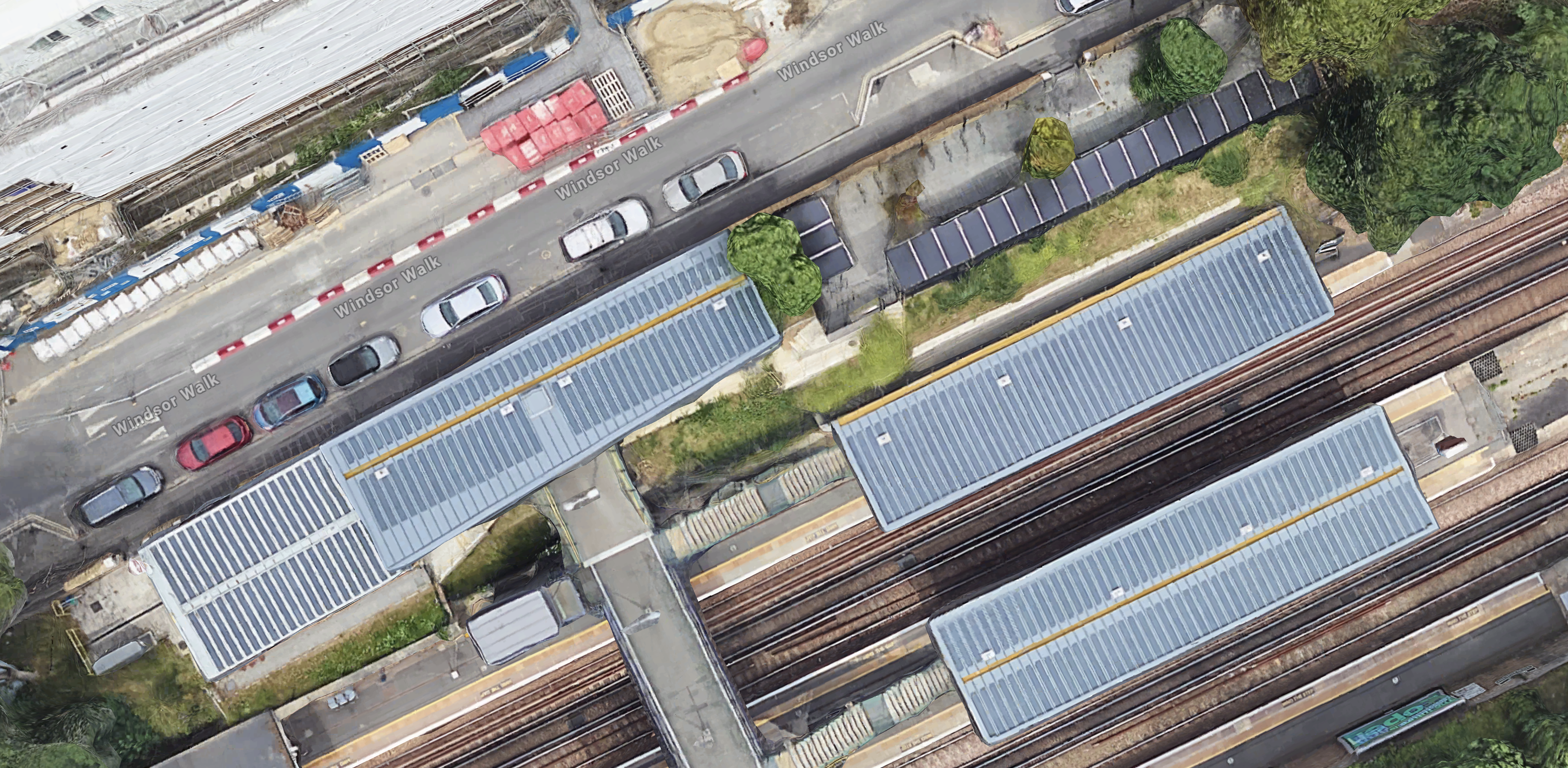
Note.
- The three large panels are flat.
- The panels are built on a steel substrate.
- Two provide shelter for three platforms.
- The third panel provides shelter for entering passengers.
These pictures show the panels from various angles.



















So often, a small improvement opens up a large opportunity.
This page on the Kalzip web site which is entitled Modernisation of Denmark Hill Station, gives more details of the station project.
Over the years, I put up a few steel-roofed buildings in my time and I helped design a few with a client in the 1970s, that could have benefited from solar panels like these.
Project Fortress
Project Fortress is described like this in its Wikipedia entry.
Project Fortress (formerly Cleve Hill Solar Farm) is a photovoltaic power station under construction on the Graveney marshes between Faversham and Whitstable, Kent in the UK.
Once operational, it will be the largest solar farm in the UK, generating 373 MW of electricity from 900 acres (360 ha) of vertical solar panels and will also include 700 MWh of battery storage. Because of its size, it is a nationally significant infrastructure project so outside the standard local planning procedure.
Electricity will be exported from the project via the 400 kV National Grid substation at Cleve Hill, constructed to serve the London Array offshore wind farm that lies to the north. Here, a battery array will be placed, that will charge from the sunlight during the day and release the energy at night when it is needed.
It is one of the very few co-located solar farms and lithium ion batteries that are co-located with a wind farm in the UK.
We need more of these to balance our power supplies and improve their quality.
US President Trump Issues Executive Order Suspending Offshore Wind Leasing
The title of this post, is the same as that of this article on offshoreWIND.biz.
This is the guts of the article.
US President Donald Trump has issued an Executive Order pausing offshore wind leasing on the US Outer Continental Shelf (OCS) and mandating a review of the federal government’s leasing and permitting practices for wind projects. The Order also stops all relevant agencies from issuing approvals, either new or renewed, for both onshore and offshore wind projects until the review is completed.
The following was the response from someone with intelligence, sense and authority.
After the White House issued the Executive Order, Liz Burdock, founder and CEO of the US offshore renewable energy industry organisation, Oceantic Network, said.
Today’s executive order pausing offshore wind leasing and permitting is a blow to the American offshore wind industry and hurts the hundreds of U.S. supply chain companies and thousands of workers already building more American energy. While under a National Energy Emergency created by an unprecedented rise in energy demand, we should be working to quickly bring generation online instead of curtailing a power source capable of providing base load generation and creating new jobs across 40 states.
I wouldn’t be surprised to see some of those companies and their equipment ending up in the UK and Scotland in particular.
Offshore Wind Innovation Hub in New York Opens Third Call For Applications
The title of this post, is the same as that of this article on offshoreWIND.biz.
This is the sub-heading.
The Offshore Wind Innovation Hub in New York, led by Equinor in collaboration with Urban Future Lab at NYU Tandon School of Engineering and National Offshore Wind Research & Development Consortium (NOWRDC), opened the 2025 application process on 15 January, issuing the third call for its accelerator programme since the Hub was officially launched in January 2023.
These two paragraphs describe the work of the innovation hub.
“We look forward to building on the strong foundation of the Innovation Hub and supporting the next round of entrepreneurs and emerging technologies”, said Molly Morris, President, Equinor Renewables Americas. “The solutions identified by the innovators will play a critical role in advancing the offshore energy industry, developing supply chains, and strengthening energy security for future generations of New Yorkers.”
Last year, six companies were selected to join the Hub’s accelerator programme and receive support to develop further their solutions that could help advance offshore wind in New York and the US: Boxkite Software, Claviate, Indeximate, Pliant Energy Systems, Sensatek, and Triton Anchor. Through the first call for applications in 2023, the Innovation Hub selected Benchmark Labs, Flucto, Heerema Engineering Solutions, RCAM Technologies, OSC, and VinciVR.
Note.
- Many countries have innovation hubs like these based on research institutions and universities.
- Molly Morris, with her Norwegian support, seems the sort of woman, who can keep Trumkopf under control.
- The Offshore Wind Innovation Innovation Hub certainly seems to spread their support around.
- I don’t think the Innovation Hub’s philosophy fits with Trump’s ‘Drill, Baby, Drill’
I can see Molly Morris, Equinor and The Innovation Hub really annoying Trump.
Let the battle commence!
Moment Energy Secures US$15 Million Series A Funding To Build World’s First Second-Life Gigafactory in the U.S
The title of this post is the same as that of this article on Cision.
This is the sub-heading.
Funding co-led by Amazon Climate Pledge Fund and Voyager Ventures to accelerate production of high-performing Battery Energy Storage Systems (BESS) from repurposed EV batteries
Series A brings Moment Energy’s financing in the last three months alone to over US$40 Million with US$52 million raised to date
This introductory paragraph gives more details.
Moment Energy’s battery energy storage systems (BESS) can be deployed in projects ranging from 400 kilowatt hours (kWh) to 10 megawatt hours (MWh), targeting an intermediate market segment that is currently underserved but crucial to the clean energy transition. Designed to serve commercial and industrial sectors, EV charging infrastructure, and renewable energy integration, the company is strategically positioned to capitalize on the convergence of rising EVs and renewable energy sources.
Sounds like a sensible way of handling old lithium-ion batteries.
Moment Energy has a web site.
Are we getting a second-life gigafactory in the UK?
We probably will need one.
As Moment Energy is Canadian, they might supply it.

