Scientists Set To Make A Bang In Nuclear Fusion ‘Breakthrough’
The title of this post, is the same as that of this article on The Times.
This is the caption under the very research looking picture at the top of the page.
Scientists at the Lawrence Livermore National Laboratory are expected to publish results of a controlled nuclear fusion experiment.
I shall report more, when the Lawrence Livermore National Laboratory publishes their official press release.
NET9 Open Ocean Aquaculture Demonstrator Design Unveiled
The title of this post, is the same as that of this news item on the Impact9 web site.
Landmark CCS Project In Humber Becomes UK’s First To Gain Planning Consent
The title of this post, is the same as that of this news item on the SSE web site.
This is the first paragraph.
SSE Thermal and Equinor’s Keadby 3 Carbon Capture Power Station in the Humber has become the first power CCS project in the UK to receive planning permission.
Note.
- This will be one of four power stations at Keadby with Keadby 1, Keadby 2 and Keadby Hydrogen Power Station.
- Keadby 3 will have a capacity of 910 MW.
- It will capture up to 1,500,000 tonnes of carbon per year.
- It could be operational as early as 2027.
The news item, also says this about SSE’s other power stations and hydrogen storage.
SSE Thermal and Equinor are also collaborating on Peterhead Carbon Capture Power Station in the north-east of Scotland. In addition, they are developing Keadby Hydrogen Power Station, which could be the world’s first large-scale 100% hydrogen-fuelled power stations, and Aldbrough Hydrogen Storage, which could provide vital storage to balance intermittent supply and demand.
This all fits nicely with the proposed strategy I wrote about in Increased CCS Can Decarbonise GB Electricity Faster On Route To Net Zero.
I think we can expect more new gas-fired power stations with carbon capture to be built by SSE.
Metocean, Wind Measurement Campaigns Starting At Two More ScotWind Sites
The title of this post, is the same as that of this article on offshoreWIND.biz.
UK Space Agency And NNL Work On World’s First Space Battery Powered By British Fuel
The title of this post, is the same as that of this press release from the UK Government.
This is the sub-title.
The UK Space Agency and the National Nuclear Laboratory (NNL) are to collaborate on the world’s first space battery powered by Americium-241.
And these three paragraphs outline the project.
This work, commissioned and funded by the UK Space Agency from NNL, will be delivered in a new £19 million laboratory in Cumbria equipped with next-generation equipment and technology. It will deliver a sovereign supply of fuel for space batteries in the context of a global shortage, enabling the UK and its partners to pursue new space science and exploration missions.
Creating new highly-skilled jobs in the North West of England, it will drive innovation in radiochemistry and separations science and open a new market for the UK space sector.
Atomic space batteries, also known as Radioisotope Power Systems (RPSs), release heat as the radioactivity within them decays. The heat can be used directly to prevent spacecraft from freezing and it can be converted into electricity to power onboard systems. The batteries go on working for decades, without need for maintenance over the many years in which a spacecraft could be travelling.
These two paragraphs explain, why there is a need for a new type of atomic space batteries.
Considered ‘mission critical technologies’ by space agencies in the UK and around the world, all the Apollo missions had an atomic battery in tow, as has every rover that has gone to Mars. Until now, these have been powered by Plutonium-238, a radioisotope produced only in the US, where supply is limited, and Russia, so an alternative is urgently needed.
NNL, the UK’s national laboratory for nuclear fission, has been working on this endeavor since 2009, when its researchers first discovered that Americium-241, an alternative to Plutonium-238, is produced during the radioactive decay of used fuel from nuclear reactors and that it emits power for over 400 years.
With the supply plentiful – the new laboratory is being opened at NNL’s flagship Central Laboratory on the Sellafield site, home to the largest resource of Americium-241 available for extraction in the world – the new collaboration will turn a proven scientific concept into a fully-realised technology. It will be operational within the next four years and is expected to be first used on the European Space Agency’s Argonaut mission to the Moon and for future missions into deep space.
It would appear that Americium-241 has several advantages over Plutonium-238.
- Plutonium-238 has supply problems
- Who in their right mind, would buy a product like this from Russia or China?
- The batteries have a life of 400 years.
- There is plenty of suitable nuclear waste at Sellafield, from which Americium-241 can be extracted.
It looks like the first batteries could also be available in four years.
Aunt Margery
My late wife; C’s Aunt Margery was a lady, who needed a pacemaker. I seem to remember that after several of her pacemakers had run out of power and were replaced, and eventually she was fitted with a nuclear-powered pacemaker in the 1970s or 1980s.
This page on the Stanford University web site is entitled The History Of Nuclear Powered Pacemakers. It was written by Matthew DeGraw.
Many of these pacemakers in the 1960s and 1970s, were powered by Plutonium-238.
The last paragraph is entitled The Rise Of Lithium Battery Pacemakers And Fall Of Nuclear Pacemakers, where this is said.
Despite the often longer life-expectancies, nuclear pacemakers quickly became a part of the past when lithium batteries were developed. Not only did the technology improve, allowing for lighter, smaller, and programmable pacemakers, but doctors began to realize that this excessive longevity of nuclear pacemakers was excessive. Lithium pacemakers often last 10-15 years allowing for doctors to check in on their patients and replace either the batteries or the pacemakers themselves with new and improved technology as it is develops in those 10-15 year spans. While there are still several remaining patients with nuclear-powered pacemakers functioning in their bodies, it is likely that in the next few decades as these patients pass away, so will the once promising nuclear pacemakers.
Would the use of Americium-241 to power a nuclear pacemaker transform the economics of these devices?
I wonder, if there’s a cardiologist out there, who by chance reads this blog, who could answer my question!
Global Port Services Wins Pre-Assembly Contract For Scottish Offshore Wind Farm
The title of this post, is the same as that of this article on offshoreWIND.biz.
These are the first two paragraphs.
Global Port Services, owned by Global Energy Group alongside the Port of Nigg, has secured multiple contracts to support Seagreen Wind Energy Limited (SWEL) with site-enabling works for the pre-assembly construction of wind turbine components at its Port of Nigg facility.
The news comes as the final turbine foundations for the Seagreen offshore wind project arrive at Nigg to be prepared for installation 27 kilometres off the coast of Angus.
Note.
- Nigg is a village in the Highlands to the North of Inverness.
- The Port of Nigg has a busy Marine Fabrication Yard.
- There is a very interesting BBC documentary called Rigs of Nigg, which tells some of the stories of the port from the 1970s.
- As the article indicates, the yard is now very much involved in the wind power industry.
- SSE have invested in the yard.
This Google Map shows the port.
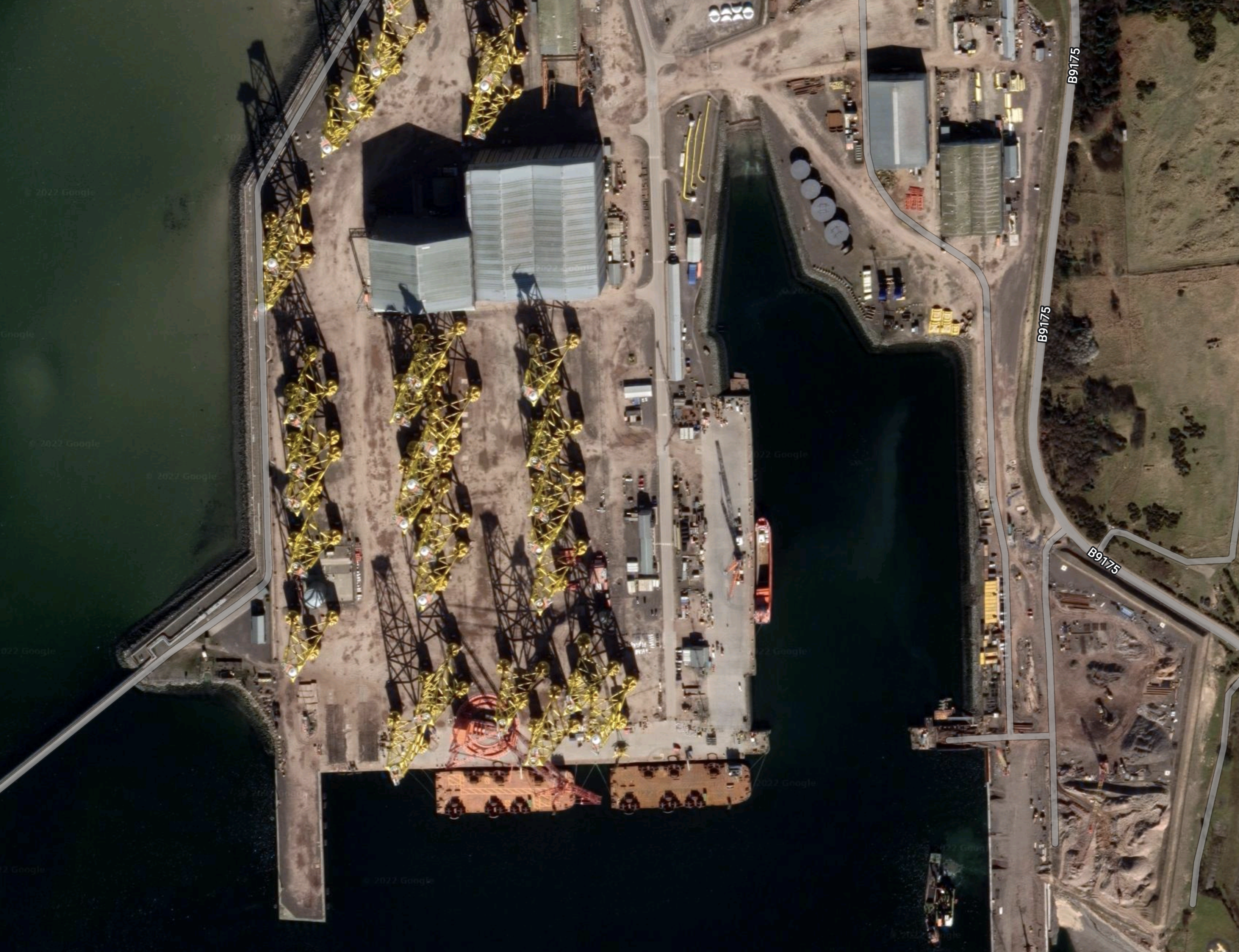
Note. all the yellow steel structures, which look like the fixed foundations for the Seagreen Wind Farm.
I am a bit surprised that foundations for Seagreen are being assembled a fair distance from Angus.
Is there not a fabrication yard on the Firth of Forth?
71 Offshore Wind Applications Now Filed In Brazil, Proposals Total 176.6 GW
The title of this post, is the same as that of this article on offshoreWIND.biz.
Netherlands Plans Its Biggest Offshore Wind Tender Next Year with Four IJmuiden Ver Sites Likely to Be Auctioned Off In One Go
The title of this post, is the same as that of this article from offshoreWIND.biz.
Three Steps To Unlocking The Potential Of High-Power Wind Turbines
The title of this post is the same as that of this article on offshireWIND.biz.
This is the first paragraph.
The critical role of wind in the world’s future energy needs is clear: the Ocean Renewable Energy Coalition states that 1,400 gigawatt (GW) of offshore wind power will sustain one tenth of global electricity demand by 2050. Key to achieving this is the upward power rating of wind turbines, which we anticipate will reach an individual turbine capacity of 20 GW within the next five years.
The article is a must-read.
After reading the article, I am convinced that there will be 20 MW turbines in five years.
When turbines of this size are readily available, it is likely that the rate of installation of wind turbines will increase.
 The Anonymous Widower