Was Storm Franklin Named By An Old Minchendenian?
This press release from the Met Office is entitled Storm Franklin Named.
When I first heard yesterday, that the storm was to be named, I must admit, that I allowed myself a small smile.
I went to Minchenden Grammar School in Southgate, leaving in 1965.
One teacher, that we looked upon with a degree of affection was our German teacher, who was Frank J Stabler, who some pupils referred to as Franklin J Stabler. I don’t know whether that was his real name or whether it was fellow pupils making it up.
But he did have one story, that he used to liven up one of the lessons, where he taught me enough German to get by in the country.
Apparently, he was returning from France to the UK on the night of Saturday, the 31st of January in 1953, using the ferry from Dieppe in France to Newhaven in Sussex.
That ferry route used to have a reputation for being rough and on one bad crossing around 1975, my five-year-old son fell and cut himself just above his eye. He was skillfully cleaned up and plastered by one of the chefs. Luckily the chef had been a soldier, who had been well-trained in first aid.
Back in 1953, Mr. Stabler could have chosen a better night for his trip, as that day was the night of devastating East Coast Floods, which killed over five hundred people in the UK.
The captain of the ferry decided to sit the storm out and crew and passengers spent twenty-four hours being tossed about like a cork in the English Channel, which was a tale Mr. Stabler told with great drama.
He finished the tale, by saying that in the end, he prayed for the boat to go down to put everybody out of their misery.
Conclusion
I have to ask if someone on the committee that decides storm names, either directly or indirectly, has heard this tale and decided that Franklin would be an appropriate name for a storm beginning with F.
The Big Beast In Your Electric Bus
This article on electrive.com is entitled BAE Systems Takes Orders For 340 Hybrid Drive Systems.
This is the first paragraph.
The Southeastern Pennsylvania Transportation Authority (SEPTA) has selected BAE Systems to supply up to 340 hybrid electric drive systems for its new fleet of low emission transit buses. BAE Systems will provide 220 electric drive systems to New Flyer of America, with an option for 120 additional systems, over the next three years.
The article also reveals that the company is working with AlexanderDennis.
The system appears to be hybrid, with a lot of intelligent choosing of when to use a polluting engine.
LNER Launches International Website Making Travel Simpler For Overseas Tourists
The title of this post, is the same as that of this press release on LNER.
These four paragraphs describe the new website.
The new website coincides with the removal of pre-departure testing and quarantine rules for vaccinated people arriving in England or Scotland from 11 February 2022.
In a move that expands LNER’s global market, customers in 10 countries, including China, Japan, Spain, South Korea and Italy, are among the first to benefit when booking directly online.
LNER’s new search and booking engine offers international customers in those countries an option to purchase train tickets using their language and currency. The LNER.co.uk website will automatically detect those customers who are searching outside of the UK and will redirect them to the customised site to improve their online booking experience. The website launch comes as LNER reintroduces its full timetable, excluding pre-planned engineering works, meaning customers can discover destinations across the full 956-miles of East Coast route.
LNER has been working with travel tech company and rail retailer, Omio, to develop the site, which has the capability to operate in up to 20 languages and 26 currencies, including Euros, Korean Won and Japanese Yen or by using a payment method recognised in the home country.
Surely, if you run a travel company, your web site must be accessible to buy tickets from everywhere.
A Thought On The Prospects For Crossrail
Someone asked the question, in a discussion group, that I visit, if Crossrail will be a success.
I believe that you only have to look at the success of the London Overground to realise that Crossrail will be a success.
When the North London Line reopened as the first route of the London Overground with new Class 378 trains, it used to run four-car trains at a frequency of six trains per hour (tph) between Stratford and Willesden Junction stations.
Now the line runs eight tph on that route and the trains are five cars.
That is a capacity increase of 66% in terms of cars per hour.
And still at times, the trains are full and Transport for London are looking at ways of adding extra trains and/or cars.
Crossrail will have the factors going for it, which helped to make the Overground that success. It is new and has a novelty value, but above all like the Overground, it is built for full-sized people, who could be pushing bikes and buggies and trailing baggage.
Crossrail, also increases options for alternative routes for Londoners , who are World Champions at ducking-and-diving.
Crossrail has also been designed so that the trains can be extended.
If Crossrail has a problem, other than the lateness and budget overrun, it is that it doesn’t connect to the Victoria or Piccadilly Lines.
Embraer, Widerøe And Rolls-Royce Announce Partnership To Research Innovative Technologies For Sustainable Regional Aircraft
The title of this post, is the same as that of this press release from Rolls-Royce.
This is the body of the press release.
Embraer, Widerøe and Rolls-Royce have today announced plans to study a conceptual zero-emission regional aircraft.
The 12-month cooperation study – in the context of pre-competitive research and development – will address passenger requirements to stay connected in a post Covid-19 world, but do so sustainably, and seeks to accelerate the knowledge of the technologies necessary for this transition. Such technologies will allow national governments to continue to support passenger mobility while reusing most of the existing infrastructure in a more sustainable way.
Advances in scientific research can make clean and renewable energy a major enabler of a new era of regional aviation and the three companies will share their combined in-depth knowledge of aircraft design, market demand, operations and propulsion solutions to further develop their understanding of zero-emission technologies and how they can be matured and applied to future regional aircraft.
Among other topics, the study will cover a wide range of applications for new propulsion technologies to examine a range of potential solutions – including all-electric, hydrogen fuel cell or hydrogen fueled gas turbine powered aircraft.
These are my thoughts.
An Aircraft For Existing Infrastructure
This is an extract from the press release.
Such technologies will allow national governments to continue to support passenger mobility while reusing most of the existing infrastructure in a more sustainable way.
If I was the CEO of an airline, I’d want an aircraft that fitted the airports and their facilities, where I wanted to fly.
No Propulsion System Is Ruled Out
This is an extract from the press release.
Among other topics, the study will cover a wide range of applications for new propulsion technologies to examine a range of potential solutions – including all-electric, hydrogen fuel cell or hydrogen fueled gas turbine powered aircraft.
It would appear no propulsion system is ruled out.
In LNER Seeks 10 More Bi-Modes, where I talked about LNER ordering ten new trains, they also said they would accept any type of power, that was suitable.
Embraer
Embraer are a successful Brazilian aerospace company, who according to Wikipedia, are the third largest producer of civil aircraft, after Boeing and Airbus.
I first flew in one of their EMB 110 Bandeirantes in the 1970s from Norwich to Stavanger and I’ve flown on several of their aircraft since.
Embraer’s current jet aircraft line-up includes.
- Embraer E-Jet – Twin-jet regional airliner – 66-124 passengers – 1596 produced
- Embraer E-Jet E2 – Twin-jet regional airliner – 88-146 passengers – 50 produced
Note.
- The E-Jet E2 is the successor to the E-Jet with new engines, new avionic, fly-by-wire controls and other improvements.
- Production numbers are as of 31st March 2021.
- Embraer don’t seem to produce turboprop aircraft any more, although a lot of their former products are still flying.
I certainly wouldn’t avoid flying in Embraer products, as I would in other aircraft and on some airlines.
Have Embraer identified a market for a smaller sustainable or even zero-carbon aircraft that could extend their product range below the jets?
Widerøe
Widerøe are a long-established and well-respected Norwegian airline.
Their fleet consists of forty De Havilland Canada Dash 8 turboprop aircraft of various variants and three Embraer E-Jet E2 jet airliners.
Wikipedia says this about their fleet.
Widerøe plans to replace most of its Dash-8 by 2030.
Given that the Dash 8 seats between 40 and 80 passengers, I wonder if a sustainable or even zero-carbon aircraft with an appropriate number of seats and the STOL performance of the Dash 8, would suit Widerøe’s route network, which includes many small airfields.
Rolls-Royce
In What Does 2.5 MW Look Like?, I talked about Rolls-Royce’s development of a 2.5 MW Generator.
I am inserting the start of the linked post.
This press release on the Rolls-Royce web site is entitled Rolls-Royce Generator Delivered For Most Powerful Hybrid-Electric Propulsion System In Aerospace.
This Rolls-Royce picture shows the generator installed on a test bed.
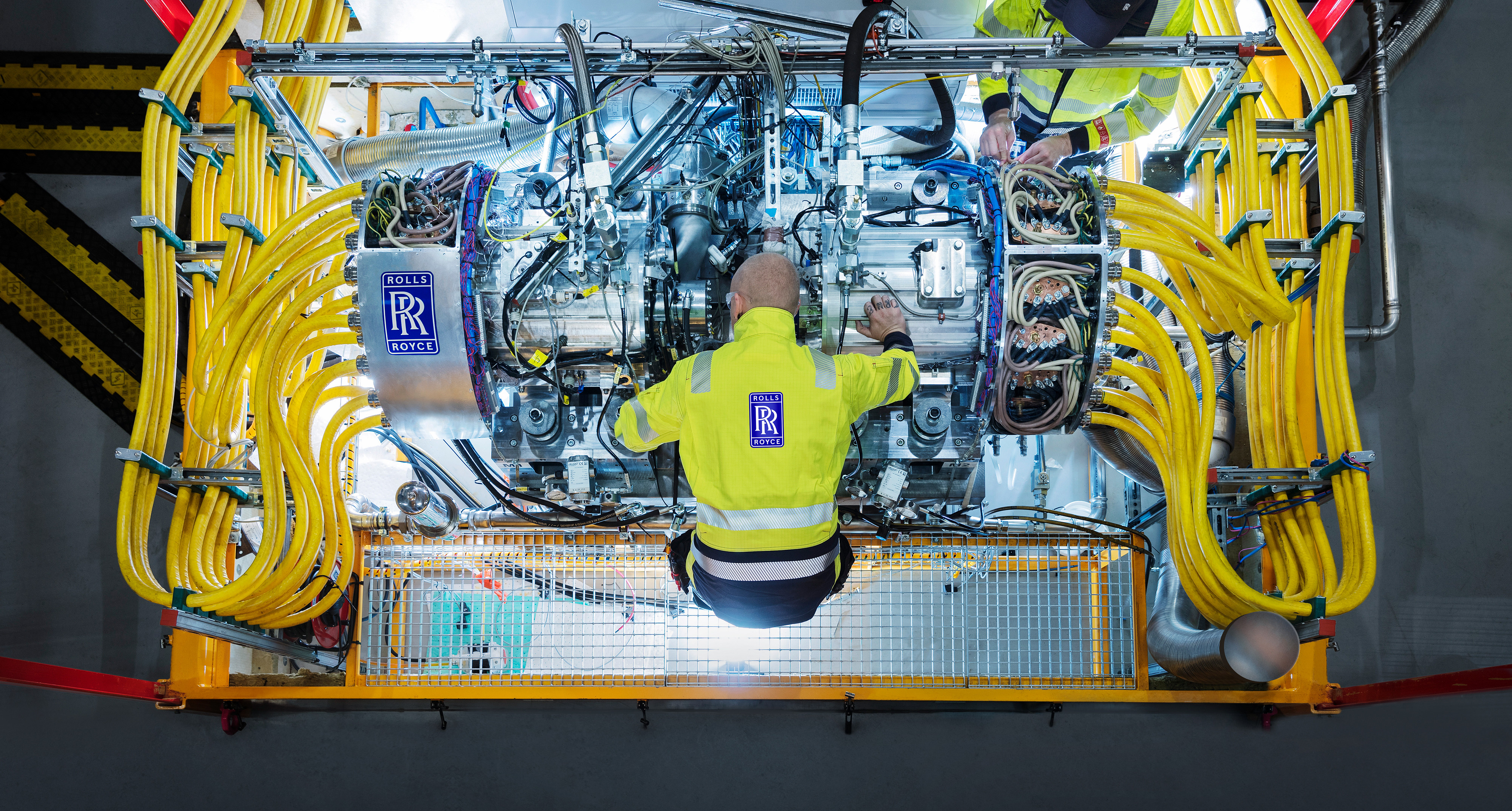
These are the first three paragraphs of the press release.
The generator that will be at the heart of the most powerful hybrid-electric aero power and propulsion system in aerospace has arrived for installation at our specialist testbed.
The generator, and related power electronics, was delivered to the newly-renovated Testbed 108 in Bristol, UK, from the Rolls-Royce facility in Trondheim, Norway, having completed an extensive development test programme. It will form part of the 2.5 megawatt (MW) Power Generation System 1 (PGS1) demonstrator programme, for future regional aircraft. In addition to hybrid-electric propulsion, the generator could also be used as part of a “more-electric” system for larger aircraft or within future ground or marine applications.
PGS1 forms an important element of our sustainability strategy, which includes developing innovative electrical power and propulsion systems.
I must say that as an engineer this 2.5 MW generator really excites me, as I see so many possibilities.
Could this engine become the power unit of a hydrogen-powered regional airliner?
Rolls-Royce, Tecnam And Widerøe
In Rolls-Royce And Tecnam Join Forces With Widerøe To Deliver An All-Electric Passenger Aircraft Ready For Service In 2026, a similar deal to the Embraer, Widerøe and Rolls-Royce deal is discussed.
I am inserting the start of the linked post.
The title of this post, is the same as that of this press release from Rolls-Royce.
This is the first paragraph.
Rolls-Royce and airframer Tecnam are joining forces with Widerøe – the largest regional airline in Scandinavia, to deliver an all-electric passenger aircraft for the commuter market, ready for revenue service in 2026. The project expands on the successful research programme between Rolls-Royce and Widerøe on sustainable aviation and the existing partnership between Rolls-Royce and Tecnam on powering the all-electric P-Volt aircraft.
This picture from Rolls-Royce shows the proposed aircraft.

The P-Volt aircraft is based on the Tecnam P2012 Traveller.
Conclusion
Perhaps, the first deal is progressing so well, Rolls-Royce and Widerøe decided to repeat the exercise.
Battery Train And Fast Charger To Be Tested In London
The title of this post is the same as that of this article on Railway Gazette.
This is the first paragraph.
Great Western Railway has signed an agreement to test Vivarail’s Class 230 battery multiple-unit and fast charging technology under real-world conditions on the 4 km non-electrified branch between West Ealing and Greenford in West London.
As an engineer, who started designing control systems for rolling mills in the mid-1960s and went on to get a Degree in Control and Electrical Engineering from Liverpool University, before working for ICI applying computers to a variety of problems, I can’t look at a railway line like the Greenford Branch without wanting to automate it.
I had one amateurish attempt in An Automated Shuttle Train On The Greenford Branch Line. I was trying to get four trains per hour (tph) on the branch and I don’t think that is possible, with the Class 230 trains.
Now we know the train we are dealing with, I could plan an automated system, that would drive the train.
- Each journey on the branch takes around 11-12 minutes.
- Two tph would take between 44 and 48 minutes shuttling between the two stations in an hour.
- The article states that recharging takes ten minutes.
- If the train charged the batteries once per hour, that would leave between two and six minutes for the other three stops.
- Any freight train using the branch seems to take about six minutes, so they could sneak through, when the shuttle is having a fast charge.
- I would also use a similar system to that originally used on the Victoria Line. After the driver has closed the doors and ascertained that there were no problems, they would press a button to move the train to the next station and then automatically open the doors.
From this rough calculation to run a two tph service, I suspect that the train needs to be able to go between West Ealing and Greenford stations in ten minutes. Assuming one ten minute Fast Charge per hour, this would give three minutes and twenty seconds to turn the train, at the three terminal station stops.
I certainly feel, that an automatic shuttle would be possible.
Does London Need High Capacity Bus Routes To Extend Crossrail?
If Crossrail has a major problem, it is that some areas of the capital will find it difficult to access the new line.
Up to the age of sixteen, I used to live half-way between Oakwood and Cockfosters stations on the Piccadilly Line.
There are a large number of people who live along the Northern reaches of the Piccadilly Line, who might want to use Crossrail to perhaps go to Heathrow or places in East London.
But the journey will need a double change as there is no interchange between the Piccadilly Line and Crossrail.
I suspect that many will link to Crossrail by taking the Piccadilly Line to Wood Green, Turnpike Lane or Manor House and then get a 141 bus to Moorgate. It is a route, I use if I want to go to Southgate or Cockfosters from my house, which has a 141 stop opposite.
But then as a child to go to Harringay, where my father had an uncle, my mother would use a 641 trolley bus from Wood Green or Turnpike Lane.
Do people follow the public transport habits of their parents?
I know I do!
My father never went on a deep tube. As he several times mentioned the terrible Bank station bombing in the Blitz, which killed 56 people, I always thought that was his problem. But now living as I do along the Northern and Northern City Lines, I suspect it was more to do with air quality, as we were or are both bad breathers.
I suspect that when Crossrail opens, the 141 bus will be heavily used by travellers going between the Northern reaches of the Piccadilly Line and Crossrail at Moorgate.
The 141 bus goes between London Bridge station and Palmers Green and it has a route length of about nine miles.
Currently, buses run every fifteen minutes or so, but I doubt it will be enough in future as Transport for London are rerouting the closely-related 21 bus.
I suspect any route seen as an extension of Crossrail needs to have the following characteristics.
- High frequency of perhaps a bus every ten minutes.
- Interior finish on a par with the Class 345 trains.
- Wi-fi and phone charging.
I would also hope the buses were carbon-free. Given that some of these routes could be quite long, I would suspect hydrogen with its longer range could be better.
Other Routes
According to me, the 141 bus route needs improvement!
But how many other routes could need similar improvement?
A Plea From Michael Portillo
In the latest episode of his Great British Coastal Railways – Helensburgh to Connel, Michael Portillo made a plea to train makers.
Travelling along the scenic West Highland Line, he asked train manufacturers to build a train with a glass roof.
Should The Great Northern And Great Eastern Joint Line Be Electrified?
The Great Northern And Great Eastern Joint Line was created in the Nineteenth Century by the Great Northern Railway and the Great Eastern Railway.
- The main purpose was to move freight like coal, agricultural products and manufactured goods between Yorkshire and Eastern England.
- It originally ran between Doncaster and Huntington via Gainsborough, Lincoln, Sleaford, Spalding and March.
- It had a full length of almost 123 miles.
- There was a large marshalling yard at Whitemoor near March.
Over the years the line has been pruned a bit and now effectively runs between Doncaster and Peterborough.
- Trains between Lincoln and March are now routed via Peterborough.
- It carries upwards of twenty freight trains per day in both directions through Lincoln Central station.
- Many of the freight trains are going to and from the East Coast ports.
- The distance between Doncaster and Peterborough is 93.7 miles, as opposed to the 79.6 miles on the East Coast Main Line.
- The line is not electrified, but it connects to the electrified East Coast Main Line at both ends.
There have been some important developments in recent years.
2015 Freight Upgrade
Wikipedia says this about the major 2015 freight upgrade.
In 2015 a £280 million upgrade of the Joint Line by Network Rail was substantially complete, enabling two freight trains per hour to be diverted from the congested East Coast Main Line; gauge enhancements to enable the passage of 9 ft 6 in (2.90 m) containers were included in the work.
The Sleaford avoiding line had been substantially downgraded since the 1980s and was reinstated to double track as part of the 2015 scheme. Resignalling and modernisation of level crossings was included.
This means that freight trains have an alternative route, that avoids the East Coast Main Line.
Doncaster iPort
Over the last few years the Doncaster iPort has been developed, which is an intermodal rail terminal.
- It has a size of around 800 acres.
- The site opened in early 2018.
- There is a daily train to the Port of Southampton and two daily trains to both Teesport and Felixstowe.
- The Felixstowe trains would appear to use the Joint Line.
I feel that as the site develops, the Doncaster iPort will generate more traffic on the Joint Line.
This Google Map shows the Doncaster iPort.

There would appear to be plenty of space for expansion.
The Werrington Dive Under
The Werrington Dive Under has been built at a cost of £ 200 million, to remove a bottleneck at the Southern end of the Joint Line, where it connects to the East Coast Main Line.
The Werrington Dive Under was built, so that it could be electrified in the future.
LNER To Lincolnshire
LNER appear to have made a success of a one train per two hours (tp2h) service between London King’s Cross and Lincoln station.
- LNER have stated, that they want to serve Grimsby and Cleethorpes in the North of the county.
- North Lincolnshire is becoming important in supporting the wind energy industry in the North Sea.
- Lincoln is becoming an important university city.
- Several towns in Lincolnshire probably need a service to Peterborough and London.
- In 2019, the Port of Grimsby & Immingham was the largest port in the United Kingdom by tonnage.
I can see an expanded Lincolnshire service from LNER.
Full Digital Signalling Of The East Coast Main Line To The South Of Doncaster
This is happening now and it will have a collateral benefits for the Joint Line.
Most passenger and freight trains will also use the East Coast Main Line, if only for a few miles, which will mean they will need to be fitted for the digital signalling.
This could mean that extending full digital signalling to Lincolnshire will not be a challenging project.
Arguments For Electrification
These are possible arguments for electrification.
Electric Freight Trains To And From The North
It would be another stretch of line, that could accommodate electric freight trains.
An Electrified Diversion Route For East Coast Main Line Expresses
Currently, when there is engineering blockades between Doncaster and Peterborough on the East Coast Main Line, the Hitachi Class 800 and Class 802 trains of Hull Trains and LNER are able to divert using their diesel power.
But the electric trains of LNER and Lumo have to be cancelled.
An electrified diversion route would be welcomed by passengers and train companies.
It would also mean that any trains running from King’s Cross to electrified destinations would not to have any diesel engines.
An Electrified Spine Through Lincolnshire
If there was an electrified spine between Doncaster and Peterborough via Gainsborough, Lincoln, Sleaford and Spalding, these stations would be these distances from the spine.
- Boston – 16.8 miles
- Cleethorpes – 47.2 miles
- Grimsby Town – 43.9 miles
- Market Rasen – 14.8 miles
- Skegness – 40.7 miles
Note.
- These distances are all possible with battery-electric trains.
- Charging would be on the electrified spine and at Skegness and Cleethorpes stations.
All of South Lincolnshire and services to Doncaster would use electric trains.
London Services
London services would be via Spalding and join the East Coast Main Line at Werrington.
- Boston and Skegness would be served from Sleaford, where the train would reverse.
- Market Rasen, Grimsby Town and Cleethorpes would be served from Lincoln, where the train would reverse.
This would enable Cleethorpes and Skegness to have at least four trains per day to and from London King’s Cross.
North Lincolnshire Services
There are two train services in North Lincolnshire.
Cleethorpes and Barton-on-Humber.
Cleethorpes and Manchester Airport via Grimsby Town, Scunthorpe, Doncaster, Sheffield and Manchester Piccadilly.
Note.
- Cleethorpes would need to have a charger or a few miles of electrification, to charge a train from London.
- Doncaster, which is fully electrified is 52.1 miles from Cleethorpes.
- Barton-on-Humber is 22.8 miles from Cleethorpes.
Battery-electric trains should be able to handle both services.
Arguments Against Electrification
The only possible arguments against electrification are the disruption that the installation might cause and the unsightly nature of overhead gantries.
Conclusion
The Great Northern and Great Eastern Joint Line should be electrified.
Rolls-Royce And Porterbrook Agreement Will Drive Rail Decarbonisation
The title of this post, is the same as that of this press release from Porterbrook.
This is the important part of the press release.
Rolls-Royce is teaming up with Porterbrook to identify and develop technological innovations to reduce carbon emissions and improve air quality across the rail network. The two companies, who have signed a memorandum of understanding, will investigate the potential for the use of synthetic and net zero fuels, including hydrogen, both in fuel cells and internal combustion engines. Building on their recent success of jointly introducing hybrid battery-diesel railcars into passenger service, the two companies will also explore the potential for advanced hybridisation.
The relationship also includes considering the role of the wider rail ecosystem in decarbonisation, including fuel chain supply, infrastructure and operational models that can aid innovation and the transition to net zero.
The UK’s railway accounts for approximately 1% of all domestic greenhouse gas (GHG) emissions* and the Government’s ambition is to remove all diesel-only trains – both passenger and freight – from the network by 2040 and achieve a net zero rail network by 2050. The UK Government has identified a number of different routes to this target including alternative forms of power such as hydrogen, fuel cells, batteries, hybrid-electric and sustainable fuels.
Rolls-Royce have issued a similar press release.
I believe this agreement could result in significant benefits to the UK rail industry, in respect to reduction in diesel consumption, noise and carbon emissions.
Examples could include.
- Conversion of Bombardier Turbostars to hybrid operation. I covered this in UK’s First 100mph Battery-Diesel Hybrid Train Enters Passenger Service.
- Conversion of Class 66 locomotives to hydrogen power.
- Conversion of Class 43 power-cars to hydrogen power.
Unfortunately, I can’t add more examples as there is no Porterbrook fleet list on their web site.
 The Anonymous Widower