Euston Station – 8th May, 2020
I had walked to Euston station from Kings Cross along the back roads, which is a much better route than along the polluted Euston Road.


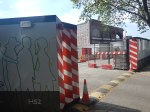



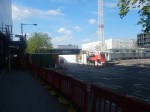



Note, that the train part of the station seemed to be functioning normally.
The Abandoned Tube Entrance At Euston
These pictures show the abandoned tube entrance at Euston station.


The station was built to serve the Charing Cross, Euston and Hampstead Railway, which is now part of the Northern Line.
- It opened in 1907.
- The building will now be demolished to make way for High Speed Two.
- I can’t ever remember using the entrance.
It looks to be a station, which are typical of many, that were created by Leslie Green.
- Wikipedia has a list of over forty stations, that were designed by Leslie Green.
- Many are Grade II Listed
- His designs inspired the look of the fictional Walford East Underground station in EastEnders.
I would reckon, the one I use most is Oxford Circus.
A Hydrogen Mobility Roadmap For North-West England
In the last few days, the North West Hydrogen Alliance has published a document entitled A Hydrogen Mobility Roadmap.
Some information from a well-written and very informative document.
Vehicle Types Covered In The Roadmap
A composite picture at the start of the document shows the following hydrogen-powered vehicles.
- A double-deck bus.
- A heavy goods vehicle.
- A passenger car.
- A passenger train.
Other vehicles, which exist or are under development, could have been added.
- A refuse truck.
- A high capacity fork lift or dump truck.
- A freight locomotive.
- The availability of hydrogen fuel in an area, must encourage the use of hydrogen-powered vehicles.
Comparison Of Electric And Hydrogen
The document gives a comparison between electric and hydrogen power.
Speed Of Refuelling
- Electric – The current long duration of battery recharges rules out many forms of transport
- Hydrogen – Hydrogen refuelling speed is largely similar to current petrol and diesel fuelling
Distance On Single Charge/Tank
- Electric – At the present time, cars will travel 150-250 miles per charge, but current battery weight means they are unsuitable for HGVs
- Hydrogen – Vehicles can travel 500+ miles on a single tank of hydrogen, which can be scaled up to suit vehicle size
Availability Of Fuel
- Electric – Growing network of charge points, but this is creating problems for power networks
- Hydrogen – Only 12 refuelling stations in the UK
Availability Of Vehicles
- Electric – Various cars to choose from, buses and trains readily available, with HGVs and ships in development
- Hydrogen – Cars, buses and trains largely available. HGVs and ships in development
Note.
- The speed of refuelling and the range for hydrogen.
- The need for more hydrogen refuelling stations.
- Both battery and hydrogen ships are in development.
I think their points are fair.
Road, Rail And Marine
The document discusses the various modes of transport and how hydrogen can help, with respect to both carbon-emissions and pollution.
The Alstom Breeze Trains
This picture is a visualisation of the Alston Breeze.
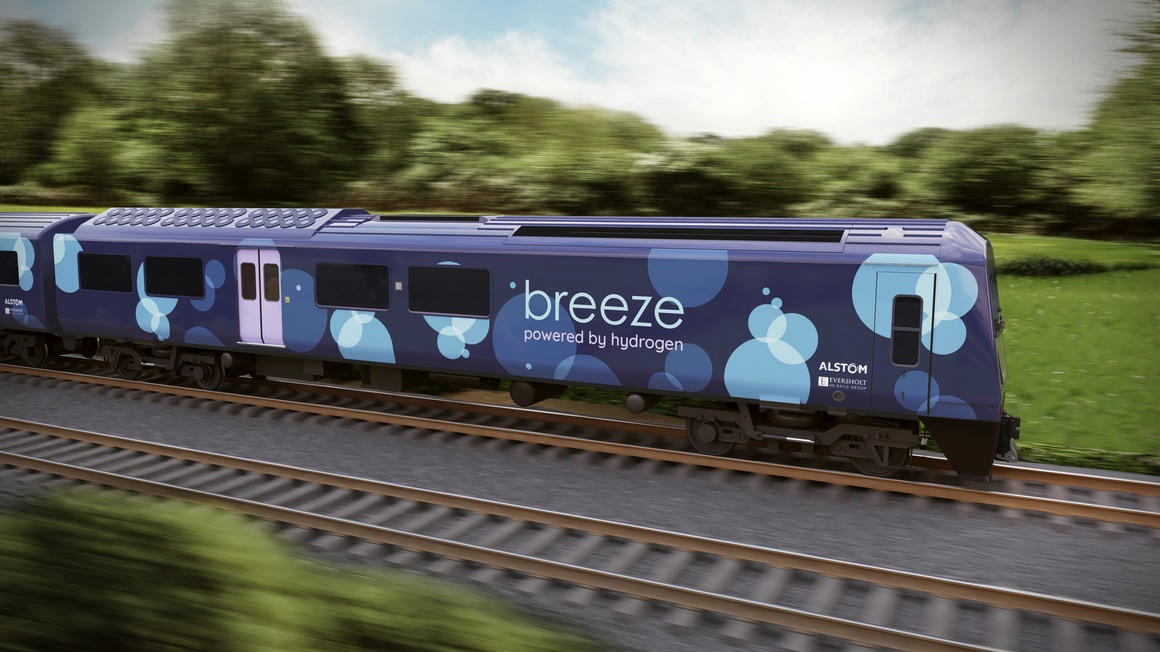
This is said about the Alstom Breeze trains.
Alstom in Widnes is ready to deploy its new Breeze trains and is working with Northern Rail to identify routes that are suitable for conversion to hydrogen.
A map also shows hydrogen train symbols on the Liverpool and Manchester Line, that goes via Widnes and Warrington and conveniently passes the Alstom factory at Widnes.
I wonder, if we’ll see an acceleration of this project?
Consider.
- Northern Rail is now directly controlled by the Government.
- Some Class 321 trains for conversion, will surely be available this summer.
- The updating of the trains, except for the hydrogen system has been developed in the Renatus project.
- Alstom have the experience of the successful hydrogen-powered Alstom Coradia iLint from Germany.
- Supplying the Alstom factory with hydrogen, shouldn’t be too difficult.
- I doubt any extra infrastructure is needed to run the trains.
- Alstom have sold two or three fleets of iLints on the back of a successful introduction into service of two prototype trains.
I don’t think, Alstom and all the various partners and stakeholders would object if the project were to be accelerated.
What’s Already Happening In The North West?
These hydrogen-powered projects are mentioned.
- Twenty double-deck buses for Liverpool City Centre.
- Alstom Breeze trains.
- storengy refuse trucks for Cheshire.
- ULEMCo are converting trucks and ferries.
- Port of Liverpool air quality.
It does seem to be that if you give an area a hydrogen network, possible users will find ways to use it to their advantage.
Rising To The Challenge
This section answers these questions.
Where Will The Hydrogen Come From?
Initially from INEOS at Runcorn, where I used to work around 1970 and BOC at St. Helens.
How Will It Be Transported?
Mainly by innovative use of new and existing pipelines.
How Do We Get To Critical Mass?
It looks like they’ll start slowly with hydrogen from Runcorn and St. Helens and build from there.
I would add a further question.
Will They Be Adding Hydrogen Filling Stations To The Network?
The North West needs them!
Hydrogen Storage
This is said about storing hydrogen.
Geologically, Cheshire is one of the few places in the UK where major underground gas storage in salt caverns has been delivered, paving the way for potential hydrogen storage, which is already done at scale elsewhere.
When I worked at ICI, I was given a tour of one of salt caverns. One is rumoured to be large enough to enable a full-size replica of Salisbury cathedral to be built inside.
Research
This is said about research.
Esteemed universities, and a wealth of innovative research companies, mean the region can deliver new hydrogen technologies. With academia working side-by-side with industry, the North West’s institutions can equip the next generation of skilled workers to support the hydrogen economy.
As a graduatev of one of those esteemed universities, how can I disagree?
Carbon Capture And Storage
This is said about carbon capture and storage.
Offshore reservoirs in the East Irish Sea can store carbon dioxide (CO2) produced from hydrogen production. Carbon Capture Utilisation and Storage (CCUS) is essential technology to help the UK in its fight against climate change. CCUS can capture up to 95% of the CO2 emissions associated with producing hydrogen from natural gas.
Whether you want to produce hydrogen this way is another matter. But the oil refineries and chemical plants along the Mersey are surely prime candidates for CCUS.
An Alliance
Not for nothing is the project called the North West Hydrogen Alliance!
Sixteen partners are mentioned at the end of the document.
Braving The London Underground
I took these pictures today, in a short Underground trip between Angel and Kings Cross St. Pancras tube stations.




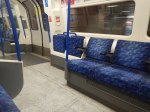

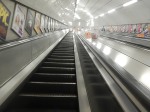

It’s not very busy! Is it?
- There was no-one else in the tunnel as I walked between the escalators at Angel station.
- There was only two other people in my carriage on the train.
- There were few people in the tunnels at Kings Cross.
Isuspect that I travelled during lunchtime helped.
Germany’s 83rd Hydrogen Station Opens
The title of this post, is the same as that of this article on H2 View.
This is the introductory paragraph.
H2 Mobility, along with its partners Shell and Air Liquide, has opened Germany’s 83rd hydrogen refuelling station in Dortmund in the North Rhine-Westphalia region.
The Germans now have eighteen hydrogen stations in Dortmund alone, which is more than we have in the whole of the UK.
Plans For Brandon Rail Station Upgrade Deemed Lawful By Local Council
The title of this post, is the same as that of this article on Rail Advent.
This is the introductory paragraph.
Train operator Greater Anglia has been allowed to press ahead with plans to complete £1m of improvements at Brandon railway station.
Work at Brandon station will include.
- Demolishing of redundant buildings, that are not in the best of condition.
- Install new shelters, LED lights, CCTV cameras and better drainage.
- Increase car parking spaces from six to a hundred.
- It looks like accessible car parking will be provided.
- Provide a new bat roost.
The overall cost will be a million pounds.
This Google Map shows the station.
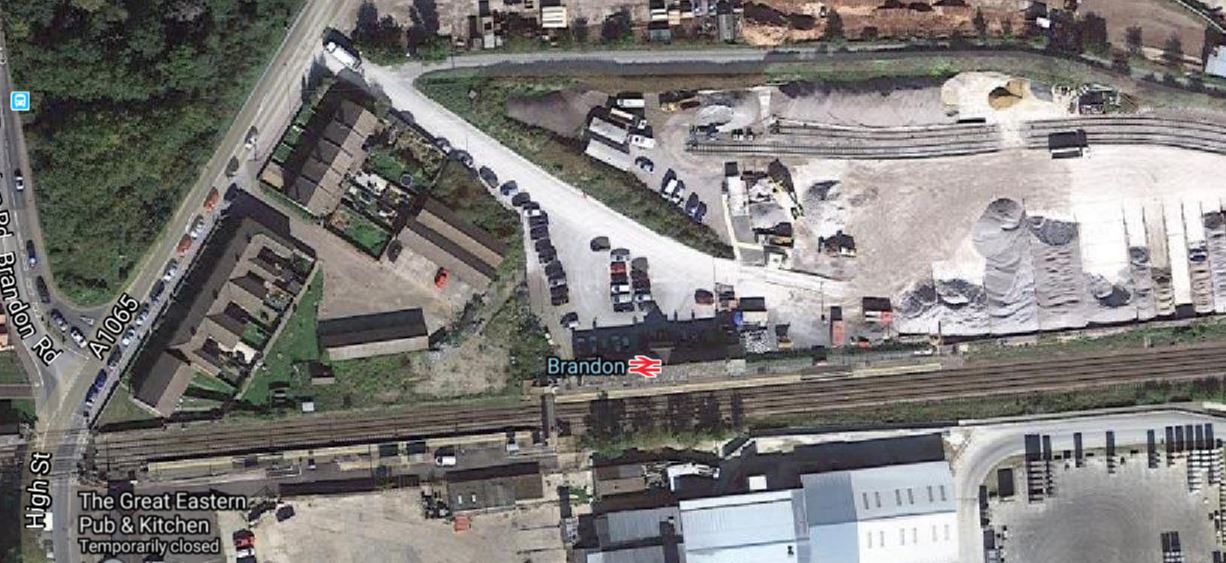
Note.
- Cambridge and Ely is to the West and Norwich is to the East.
- The queues at the level crossing at the Western end of the station.
- I seem to remember, that it’s a Council Depot on the North side of the tracks.
At some time in the future the station will need a step-free footbridge.
Greater Anglia’s Norwich And Stansted Service
This is the main passenger service at Brandon station.
- Trains are four-car Class 755 trains.
- The service is hourly.
- Trains take about thirty minutes between Brandon and Cambridge stations.
- Trains take about an hour between Brandon and Stansted Airport stations.
- Trains take forty-five minutes between Brandon and Norwich stations.
Will there be enough car parking spaces?
Could Brandon Station Ever Have A Half-Hourly Service?
If there’s one city that will dominate the economy of East Anglia, it is Cambridge and its need for premises and housing for workers, will mean that there will be increasing numbers of passengers using the trains into Cambridge.
So I wouldn’t be surprised to see a half-hourly service between Norwich and Cambridge.
Could We See More Brandon Stations?
As I travel round the country, I’ve visited several stations like Brandon. Many could be improved by a radical restructuring or a comprehensive refurbishing.
Go Ahead For West Midlands Interchange Development
The title of this post, is the same as that of this article on Rail Technology Magazine.
This is the introductory paragraph.
Expansion for a new Strategic Rail Freight Interchange and other supporting infrastructure works near Junction 12 of the M6 motorway in South Staffordshire District has been given development consent.
This Google Map shows the location of the West Midlands Interchange.
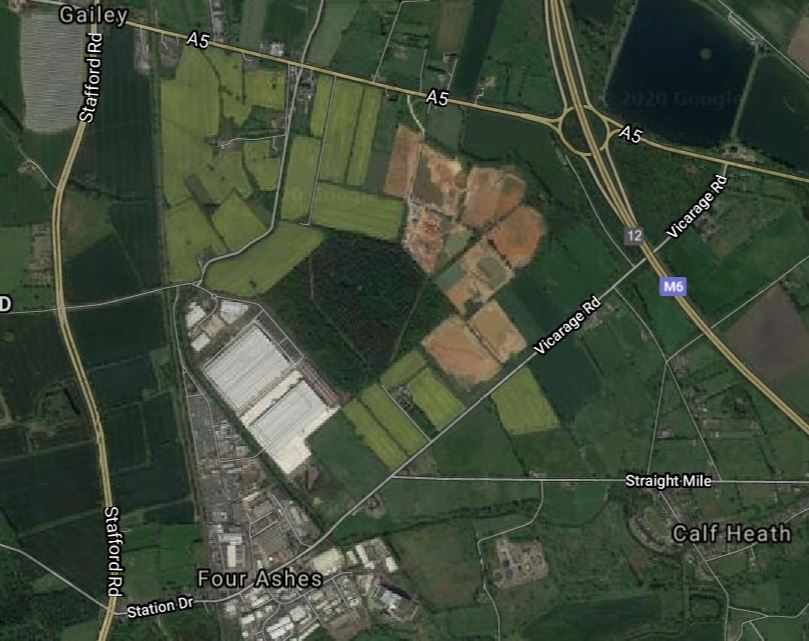
Note.
- Junction 12 of the M6, where it connects with the A5 is in the North-East corner of the map.
- The village of Four Ashes is in the South-West corner of the map.
- The Birmingham Loop of the West Coast Main Line runs North-South between Four Ashes and Gailey.
- The railway is double-track and electrified.
- There are typically about four passenger trains per hour (tph) in both directions along the railway.
The developers of the West Midlands interchange have ambitious plans according to this extract of their home page.
West Midlands Interchange is a proposed Strategic Rail Freight Interchange (SRFI) with warehousing and other associated development that would be built on land west of Junction 12 of the M6 in South Staffordshire.
West Midlands Interchange will be linked directly to the West Coast Main Line, one of the country’s principal rail freight routes, and will be well placed to serve the West Midlands, the Black Country, Staffordshire, Birmingham, the northern M6 corridor and parts of Warwickshire.
When built, it will provide up to 743,200 square metres (sq m) of new rail-served and rail-linked warehousing allowing the region’s important logistics industry to grow. The scheme will create 8,550 direct jobs boosting opportunities for people in South Staffordshire, the Black Country, the West Midlands and other surrounding areas.
As the railway is electrified, they also have the chance to use electric haulage for freight trains serving the interchange.
Equipmake And HiETA Developing New Motor With 20kW/kg Power Density With Additive Manufacturing
The title of this post is the same as that of this article on Green Car Congress.
This is the introductory paragraph.
UK-based electrification company, Equipmake, has teamed up with additive manufacturing organization HiETA to develop a next-generation motor as part of a project grant-funded by Innovate UK.
Additive manufacturing is 3D-printing by another name. This has come to the fore in the COVID-19, where schools, colleges and individuals have been using it to produce PPE.
Equipmake and HiETA are printing exotic alloys in intricate shapes to create the powerful motor.
Additive manufacturing is starting an amazing revolution. How many other common products can be redesigned to be more efficient and manufactured at lower cost.
Equipmake Opens New Electric Bus Factory In Snetterton
The title of this post, is the same as that of this press release from Equipmake.
This is the introductory paragraph.
Expert electrification company, Equipmake, has opened a brand-new factory in Snetterton, Norfolk, which will design and manufacture its fully-integrated electric bus chassis for an increasingly international customer base.
This paragraph sums up their marketing philosophy for their bus chassis.
Equipmake’s innovative electric bus chassis allows any bus coachbuilder to become a full electric bus manufacturer almost overnight. Such is the demand from bus makers wishing to go zero emissions that Equipmake has forged partnerships with companies in Brazil, Argentina and India and grown its UK staff from 15 employees to 52 in a little over two years.
Equipmake certainly seem to be doing something right.
- They make their own electric motors.
- They claim to make the world’s most power dense electric motors.
Perhaps, it’s all down to good design?
This paragraph from the press release gives more details of the bus chassis.
Thanks to efficient management of its onboard heating and cooling system, the bus – a 12m single deck model capable of carrying 70 passengers – will have enough electric range for one day’s running without the need for charging. To charge the vehicle, the operator simply needs access to a standard three-phase supply, which will fully charge it in around five hours.
That seems impressive to me!
The Proposed MSG Sphere At Stratford
I have been reading about the proposed MSG Sphere at Stratford in East London.
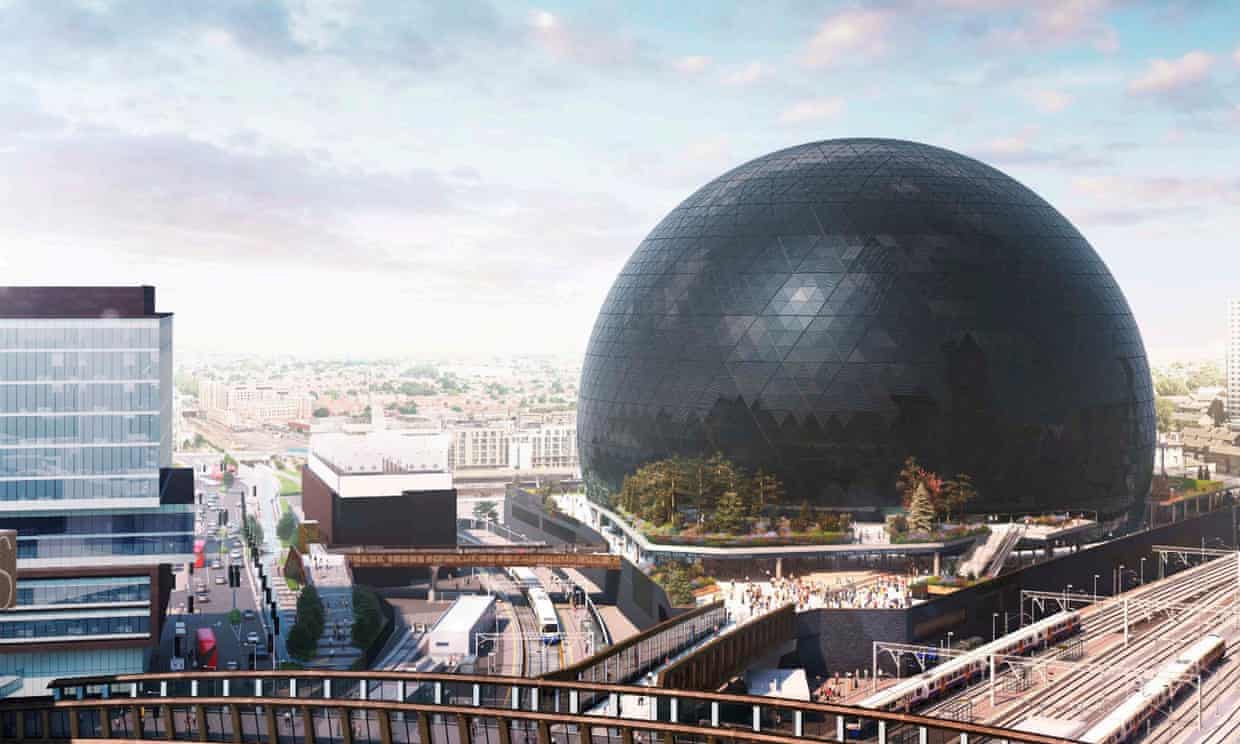
Note.
- The railway lines to the left of the sphere are platforms 11 and 12 of Stratford station on the West Anglia Main Line.
- The Great Eastern Main Line goes off to the right.
This article in the Guardian gives a good outline of the building and its promoters and backing.
But it won’t be plain sailing to get planning permission, as this paragraph explains.
Worries have already been voiced by local residents. A petition launched four months ago argues that the building will block sunlight, create light pollution and increase traffic in the area. Others have opposed MSG, whose executive chair, James Dolan, has donated funds to Donald Trump, and was on the board of the Weinstein Company from 2015-16. Beverley Whitrick, strategic director of the Music Venue Trust, has argued< that some audiences would feel uncomfortable in a venue from a Trump backer.
Protestors also believe the site should be used for housing, as Newham has over 25,000 households on the housing waiting list.
This Google Map shows the site.
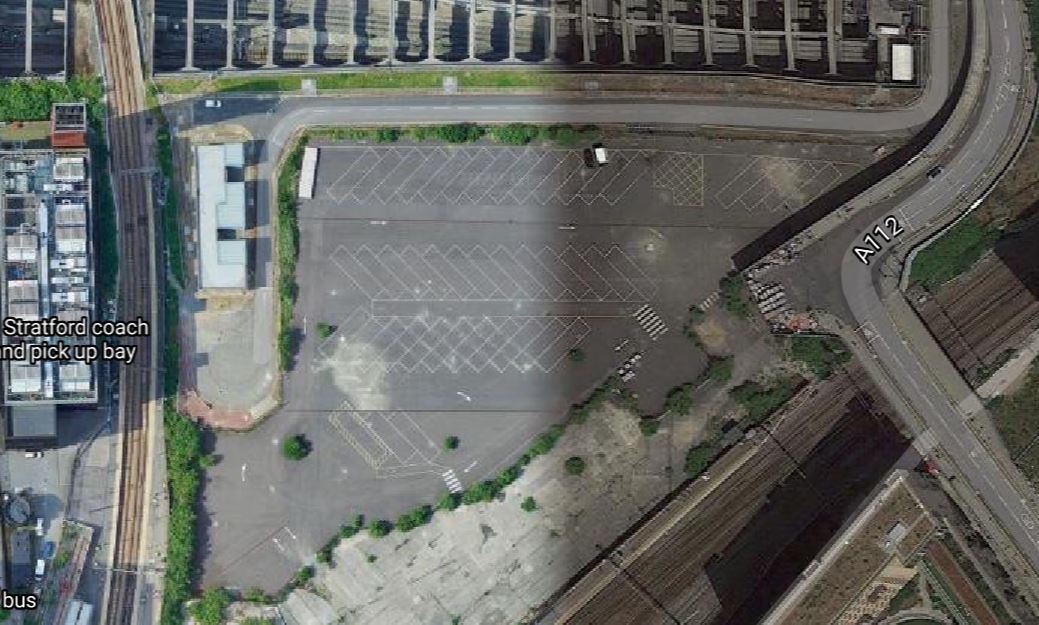
Note.
- The site was used as a coach park during the 2912 Olympics.
- The Channel Tunnel Rail Link runs across the Northern edge of the site.
- The Great Eastern Main Line runs along the South-Eastern edge of the site.
As the sphere will be five hundred feet across, it must almost fill the site.
And then there’s this article in The Telegraph, which is entitled Crossrail Objects To Plan For London Mega-Venue.
This is the introductory paragraph.
Crossrail’s operator is seeking to block plans for a “second O2” in London, over concerns flashing lights from the proposed entertainment venue could cause crashes, with trains travelling at up to 80mph.
Crossrail have a serious point.
 The Anonymous Widower