Hackney Downs Station To Go Step-Free
This document on the Government web site is entitled Access for All: 73 Stations Set To Benefit From Additional Funding.
Hackney Downs station, which I use regularly is on the list.
In Is Hackney Downs Station A Suitable Case For Treatment?, I mused at the possibilities for the station, after a chance meeting with an architect, surveyor or planner from Transport for London at the station, who had just had a look behind the locked doors at the station.
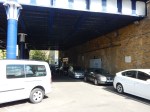
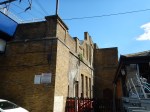

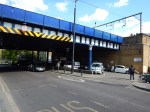
Let’s hope that if there is something worth preserving behind those forbidding brick walls!
Other than the obvious step-free access, my ideas for the station would include.
- Better use of the rooms on the platforms.
- A couple of enclosed waiting rooms.
- Improved bus stop locations.
- A light-controlled crossing outside the station.
But the biggest opportunities would surely be opened up, if London Overground’s services were reorganised.
At present, the station has the following services in trains per hour (tph)
- Liverpool Street and Chesthunt – two tph
- Liverpool Street and Chingford – four tph
- Liverpool Street and Enfield Town – two tph
Plans also exist to increase the Enfield Town services to four tph.
These are not overly high frequency services compared to some services in London.
In Could London Overground Extend To Hertford East Station?, I speculated on a rumour that Hertford East services would be given to the London Overground.
If this does happen, I believe that some local services would have to terminate in the High Meads Loop under the Eastfield shopping centre at Stratford.
In the other post I say this.
If as I proposed the following trains run through Seven Sisters station.
- Two tph between Liverpool Street and Cheshunt/Broxbourne or Hertford East.
- Two tph between Stratford and Cheshunt/Broxbourne or Hertford East.
- Two tph between Liverpool Street and Enfield Town.
- Two tph between Stratford and Enfield Town.
This means that Hackney Downs would have the following services.
- Two tph between Liverpool Street and Cheshunt/Broxbourne or Hertford East.
- Two tph between Liverpool Street and Enfield Town.
- Four tph between Liverpool Street and Chingford.
Would it not be more efficient, if all of these services used the slow tracks into Liverpool Street?
This would give the expresses exclusive use of the fast lines into Liverpool Street.
It’s probably a naive analysis, but I believe services at Hackney Downs station could well include regular services between Liverpool Street and Broxbourne/Hertford East.
Conclusion
Step-free access at Hackney Downs station could be part of a package, that sees extra services and destinations added to the station.
France, Denmark Eye Hydrogen Future
The title of thid post is the same as that of this article on Energy Reporters.
A few points from the article.
- EDF has launched a hydrogen production and distribution company called Hynamics.
- EDF is now the largest shareholder in McPhy, a electrolyses, hydrogen storage and charging station provider.
- European gas-fired power stations will run on twenty percent hydrogen.
- Hydrogen will be used to decarbonise the gas network by 2050.
- Hynamics said it was planning 40 projects in France, Belgium, Germany and Britain.
- In Denmark, Ørsted, is working on plans to convert electricity from its wind turbines into hydrogen.
The article is a must-read.
Meridian Water Station – 4th April 2019
Meridian Water station appears to be not far away from completion.

It looks like it could meet the planned opening date of the 19th May!
A Toilet On A London Underground Train
On my short journey between City Thameslink, and London Bridge stations, I sat next to one of the toilets.
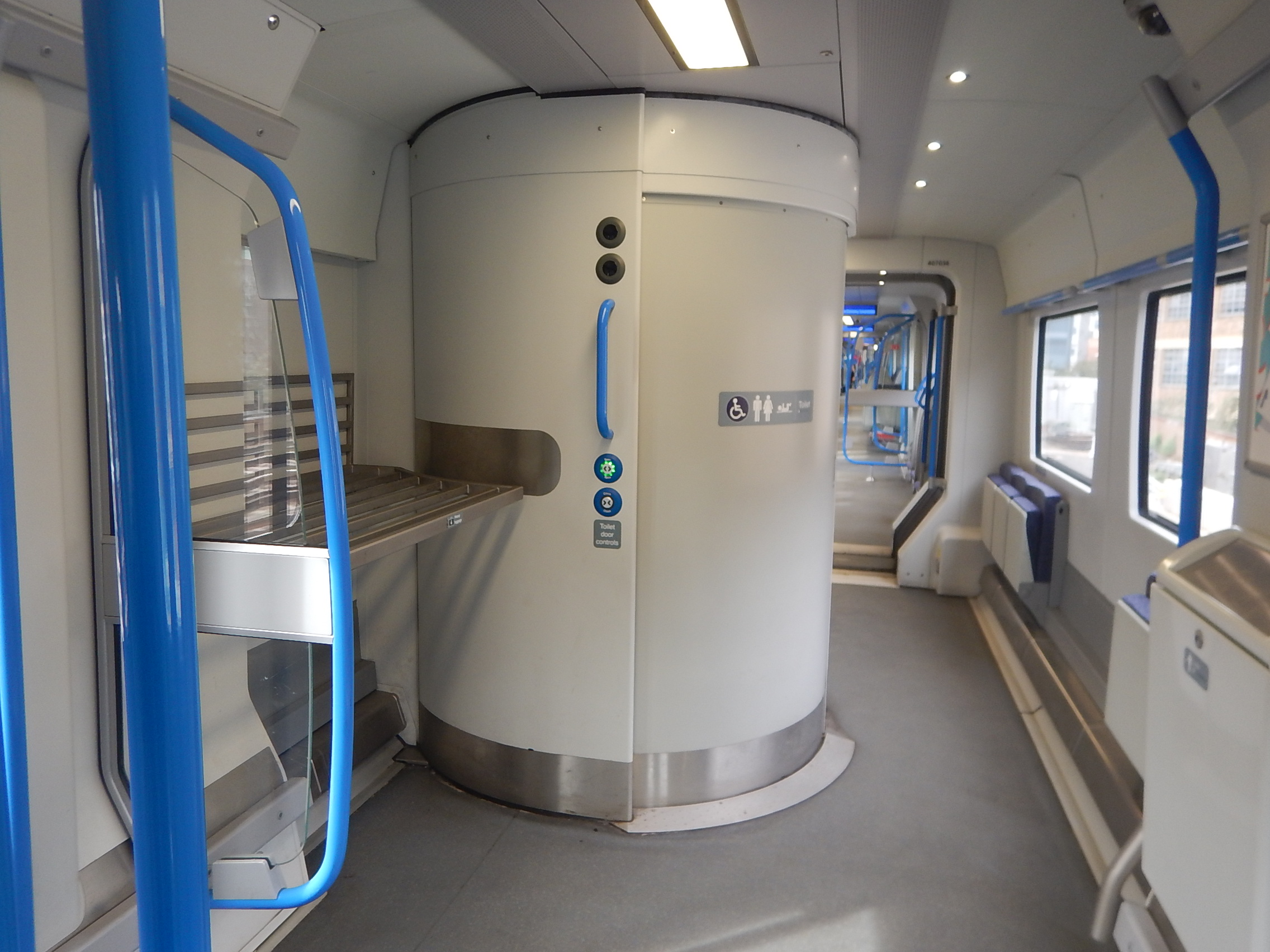
I also made use of the facility.
As there is a lot of pressure to show Thameslink on the Tube Map, will these trains become the only trains on the Underground to have toilets?
As modern controlled emission toilets, don’t throw anything on the tracks, they can be safely used anywhere.
Automatic Door Opening On Thameslink
This morning I used Thameslink between City Thameslink and London Bridge stations.
On the three stations on this short route, the doors opened automatically, without passengers having to push any buttons.
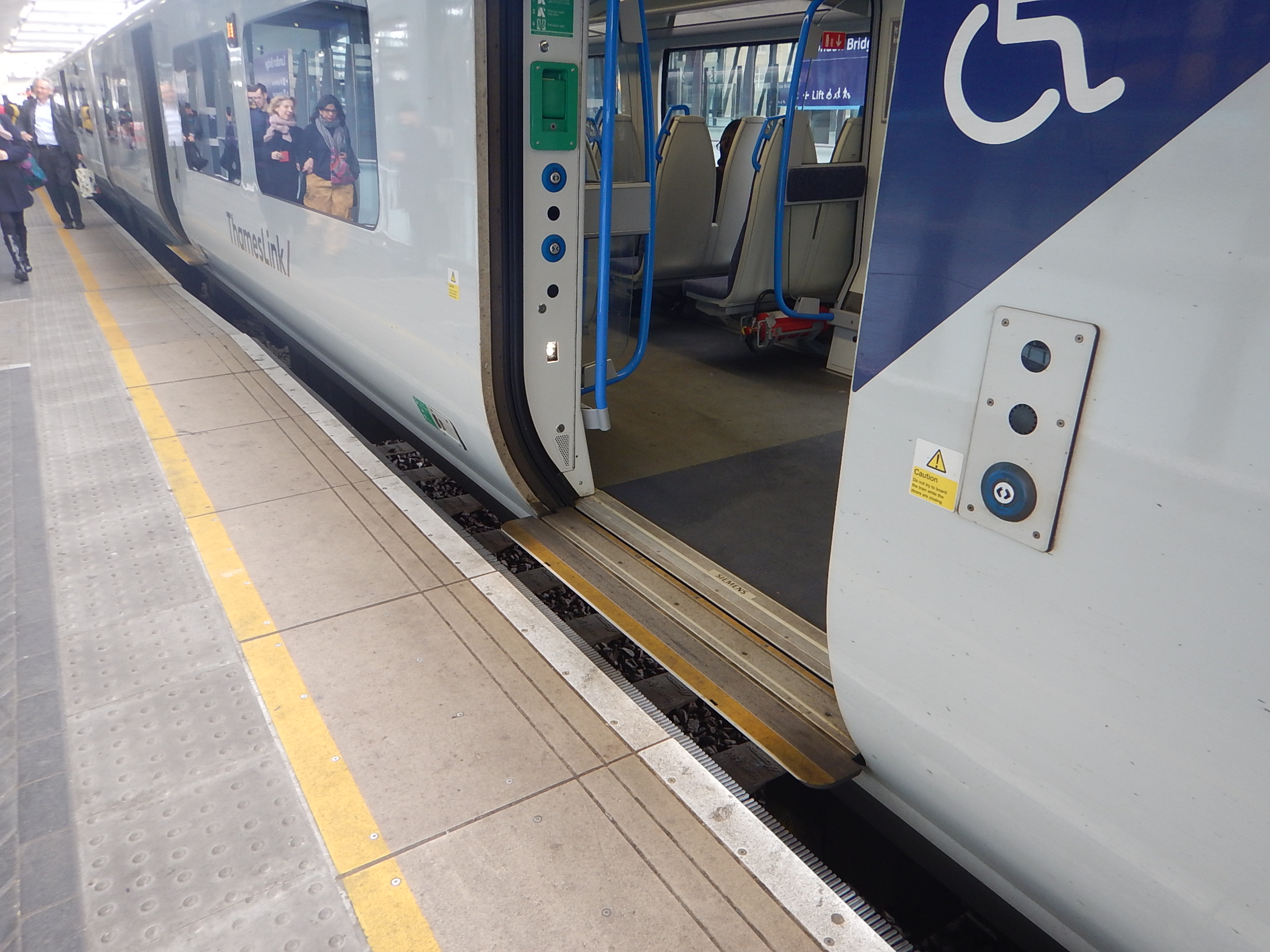
This is normal London Underground practice and will it be used on the tunnel stations on Crossrail.
But it struck me, as I got on the train at City Thameslink station, where there is a large gap for passengers to fall into, that automatic opening may well be safer, as passengers don’t have to lean across.
Matched Seats And Roof At London Bridge Station
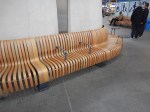
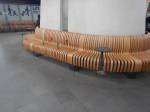
These pictures show the recently-built roof and the newly-installed seats at London Bridge station.





Note.
- The first picture shows the seats that were installed on a temporary basis.
- The second picture shows a section of roof.
- The remaining pictures show the seats in various places in the station.
- I like the tables for your coffee, tea or chocolate.
- I like the randomness of the placement on the entry to the station.
- They also stand out against the stone floor.
They are very different and brought a smile to my face.
How Many Welshmen And Welshwomen Can You Fit In A Million Pound Park-And-Ride?
This article on Insider Media, which is entitled Work On £1m Park-And-Ride Site Completes.
The Park-and-Ride facility is at Abercynon station, which is the station, where the Merthyr Line splits into two branches to Metryr Tydfil and Aberdate stations.
- The facility has 310 parking spaces.
- It has been built in six months after a November start.
- Bus access will be provided at the original car park.
- I hope they’ve increased cycle capacity for the Geraint Thomas effect.
My only worry is that with eight trains per hour to start between Abercynon and Cardiff in 2023, will the facility be big enough?
Economics
This is obviously and a much-needed scheme and each parking space has cost around £3,000. If on 250 working days, each generate around five pounds in revenue, that must mean that the car park should be viable.
Conclusion
If this Park-and-Ride facility has been built so quickly and should be viable, why is it that so few similar parking schemes are proposed for railway stations?
Especially, where at Abercynon station, there will be a massive improvement in capacity and quality of the train service.
- A doubling of frequency
- Faster, electric tram-trains.
- Trains that can hold more passengers.
How many other stations are getting this improvement?
as to finance, I think this could be the sort of investment, infrastructure funds, run by the like of L & G and Aviva will be looking at..
- Not a large investment.
- Could be constructed to n efficient design.
- Guaranteed return.
But in the future, when electric vehicles make up say half of all those on the road, it could become a large energy supply and storage facility.
Rip-Off Ticketing At Bremen Hauptbahnhof
I am experienced user of Deutsche Bahn and generally buy my tickets at one of their reliable machines.
Note that queuing up at a Ticket Office sometimes takes up to thirty minutes and quite frankly I have better and more important thingfs to do with my life.
This picture shows a typical German ticket.

The two stations; Buxtehude and Cuxhaven are clearly shown.
But imagine my surprise at Bremen Hauptbahnhof, when the ticket machine dispensed this.
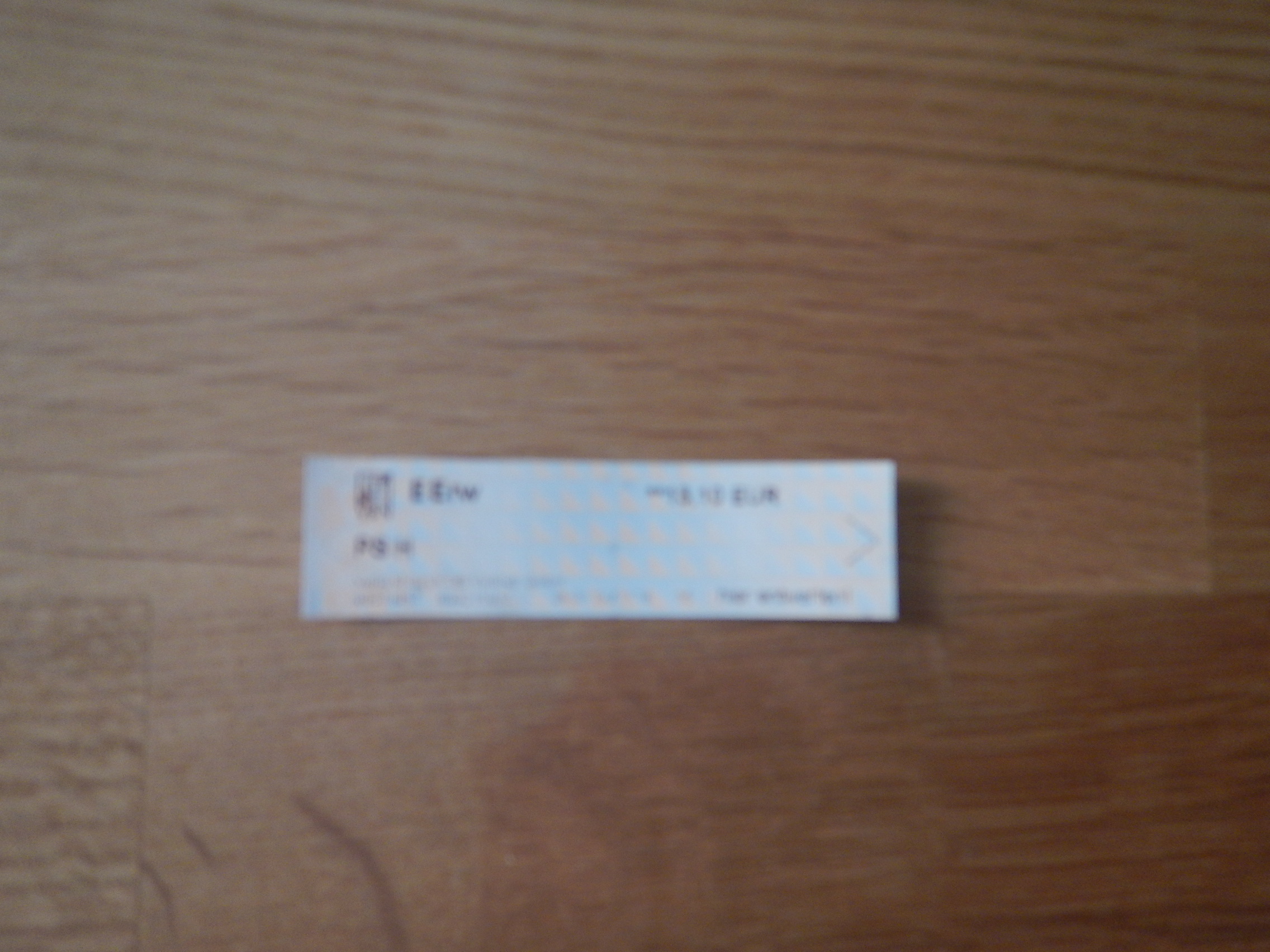
It is about one by four centimetres and the only readable writing on the front is EErw.
- Does it look like a ticket to you?
- There were no notices up about the change of ticket.
- How do you sort out today’s ticket from yesterday’s?
- What if you’re partially sighted?
I thought the machine had failed and curt off the ticket early.
So I tried again. With the same result!
I then tried the Ticket Office for an explanation, but the guy just played stumm, as Deutsche Bahn employees always do, when they know, there’s been a customer relations failure.
I did ascertain, that I had to put the ticket in a machine to validate it before travelling.
I did think about not doing this, so that I would get arrested on the train, but in the end, I can’t remember whether I did.
However, as tickets were not checked on the train, it didn’t matter.
It is the most arrogant system of ticketing I’ve ever found.
When I got home, I found I had been charge for two tickets.
My bank;Nationwide are trying to refuse one of the psyments.
I’ll update this post, to give you the result of their argument.
The Dutch Plan For Hydrogen
The Dutch Plan For Hydrogen
I have cut this out of The Train Station At The Northern End Of The Netherlands, so don’t read if if you’ve read it before.
Searching Google for hydrogen around Groningen, I found this document on the Internet, which is entitled Green Hydrogen Economy In The Northern Netherlands.
It is a fascinating read about what you can do with hydrogen generated from wind and biomass.
This is a sentence from the document.
Large scale green hydrogen product.ion together with harbor transport and storage facilities will be located at Eemshaven, with green chemicals production in Delfzijl
It is an ambitious statement.
Eemshaven
It also appears that Eemshaven will be the main connection point for electricity from offshore wind farms. This is said.
In the Eemshaven an offshore electricity cable from Norway, the NorNed cable with a capacity of 700 MW, comes on land. The Cobra cable, with a capacity of 700 MW, from Denmark is foreseen to connect at the Eemshaven to the onshore grid. The Gemini wind farm is connected to the grid in the Eemshaven with a capacity of 600 MW. Within 10 years it is foreseen that another 4.000 MW offshore wind will have their electricity cable to the Eemshaven.
Does all this explain, the building of a station at Eemshaven? Delfzijl station was built in 1883 and has its own connection to Groningen.
The following proposed actions are from the document
Build A 1,000 MW Electrolysis Plant
This is an extract from the of the document.
A 1.000 MW electrolysis plant that runs 8.000 hours a year, uses 8 billion kWh and 1,5 million m3 pure water to produce 160 million kg Hydrogen. A reverse osmosis plant has to produce the 1.5 million m3 pure water, using sea water or surface water as input. If an electricity price of 2‐2,5 €ct/kWh and a total investment between 500 million and 1 billion Euro with a 10 year life time is assumed, a green hydrogen cost price around 2‐3 €/kg will be the result. This is about competitive with present hydrogen prices, produced from natural gas by steam reforming.
How much energy is contained in a Kg of hydrogen?
This page on IdealHY says the following.
Hydrogen is an excellent energy carrier with respect to weight. 1 kg of hydrogen contains 33.33 kWh of usable energy, whereas petrol and diesel only hold about 12 kWh/kg.
At three euros for a kilogram of hydrogen, that works out at nine euro cents for a kWh.
Build A 1000 MW Biomass Gasification Plant
The title is a section in the document and this is an extract from the section.
Green hydrogen can be produced by electrolysis using green electricity, but can be produced also from biomass via gasification. Biomass gasifiers use solid biomass as an input and deliver a green syngas, a mixture of hydrogen, carbon‐monoxide (CO) and carbon‐dioxide (CO2), and char as an output. The CO could be used, together with water (H2O), to produce extra hydrogen. The resulting products from biomass gasification are green hydrogen and CO2. However, from CO2 and green hydrogen every chemical product could be produced. Therefore, the combination of green hydrogen and CO2 or green syngas creates the opportunity for a fully green chemical industry in the Northern Netherlands.
The process is still being developed. My first question, is can you use animal manure as a feedstock? It should be noted that The Netherlands used to have a very large and smelly manure problem.
Offshore Hydrogen Production From Far Offshore Wind Farms
The title is a section in the document and this is an extract from the section.
Offshore wind farms produce electricity which can be brought onshore via an electricity cable. Such an offshore electricity cable is expensive. The farther offshore the wind farm is located the more expensive the electricity cable cost. At the North Sea, an alternative solution for these wind farms is to convert the electricity into hydrogen at an existing oil/gas platform and to transport this hydrogen eventually mixed with gas via an existing gas pipeline. Onshore the hydrogen is separated from the natural gas and cleaned to be transported via pipeline, ship or truck to the markets.
I think that the technology and existing infrastructure could be made to work successfully.
- Europe has over fifty years experience of handling offshore gas networks.
- Recent developments have seen the emergence of floating wind turbines.
- Would it be easier to refurbish redundant gas platforms and use them to collect electricity and create hydrogen, rather than demolish them?
- Hydrogen is only produced when the wind blows.
- There is no need to store electricity and we’ve been storing gas since the Victorians.
There will be problems, like the integrity of an ageing pipeline, but I suspect that the expertise to solve them exists.
Will there be a North Sea, where every part has a large wind farm?
Note that the Hornsea Wind Farm has an area of 1830 square miles and could generate around 6 GW, when fully developed.You could fit 120 wind farms of this size into the North Sea. Even if only a small proportion could be developed, a sizeable amount of hydrogen could be produced.
A Market For 300,000‐tonnes Green Methanol + 300,000‐tonnes Green Ammonia
The title is a section in the document and this is an extract from the section.
Hydrogen (H2) and Carbon‐dioxide (CO2) can be used in chemical processes to produce a wide variety of chemical products. Two of the main building blocks in chemistry are methanol and ammonia. Methanol can be produced from H2 and CO2. Ammonia is produced from H2 and nitrogen (N2), captured from the air.
Wind power and biomass have been used tp create the basic chemicals for the petro-chemical industry.
The Construction Of Green Hydrogen Fuel Cell Balanced Data Centres
The title is a section in the document and this is an extract from the section.
Google builds a very large data center in the Eemshaven, see picture below. The reasons for Google to choose for the Eemshaven are the existence of an offshore data cable, enough space and green electricity. Google as well as other companies that install and operate data centers wants to run on green electricity. Therefore, Google has signed a power purchase agreement with Eneco to buy green electricity for 10 years. For this reason, Eneco builds an onshore wind farm nearby. On a yearly average this wind farm produces enough electricity to meet the data center demand.
However, supply and demand are not at every time in balance. At moments that there is no wind, other power plants must take over the electricity supply. Now, these are fossil fired power plants.In future, these power plants will be closed and supply and demand needs to be balanced in another way. And of course, that needs to be done with renewable electricity. This can be done by fuel cells fueled with green hydrogen. Fuel cells can follow demand and supply variations very fast with high efficiencies. Fuel cells are quiet and have no emissions, except very clean, demineralized, water.
I like this concept.
Surely, we could build a few data centres in places like Lincolnshire.
Build A Pipeline To Rotterdam And Germany
The Dutch have ambitious plans to export the hydrogen.
Other Ideas
The report is full of clever ideas and I suggest you take the time to read it fully!
Hydrogen Trains In The Northern Netherlands
The document says this about trains powered by hydrogen fuel cells.
In the Northern Netherlands, 50 diesel trains are daily operated on non‐electric lines. These trains, operated by ARRIVA have two or three carriages and a power of 450‐600KW supplied by Diesel‐Electric engines. Fuel cell‐electric hydrogen trains could replace these diesel trains. Alstom is a company that builds these fuel cell hydrogen trains and will perform a test next year on the line Groningen‐Bremen. Because the depreciation time for trains is 25 years, not all trains will be bought new. Some trains may need to be retrofitted with fuel cell‐electric power supply, which is technically feasible. When all these 50 diesel trains are replaced an investment in new and retrofitted trains of about …? Million Euros is needed. The total hydrogen consumption of these trains is about 5,000 ton.
These points are shown in a table.
- Total (diesel) trains in the Northern Netherlands is 50 units
- Hydrogen consumption approximately 25 kg H2/100km
- Train operations average 6 days per week. Train is operated approximately 1.200 km per day, based on two times per hour per trajectory of 50km.
- Train operations average 6 days per week. 330 days per year.
- Capital expenditure per train approximately …. ? 50 Units …? Million Euro
- 50,000 tonnes of hydrogen will be needed.
- The fuel bill at three euros a Kg will be 150 million euro.
Would this be economic?
From various comments, I suspect that Stadler are working on a hydrogen-powered GTW.
But failing that, as Stadler are developing a diesel/electric/battery Flirt for the South Wales Metro and some of the routes from Groningen are only about 30 km, I wouldn’t be surprised to see diesel/electric/battery GTWs running across the flat lands of the North.
Battery trains could be fitted with pantographs and recharge in Groningen, where most of the platforms are electrified.
There are a lot of possibilities and engineers will come up with the best solution with regards to operation and economics.
Conclusion
Thr Dutch have big plans for a hydrogen-based economy in the North of the Netherlands.
Where is the UK Government’s master plan for hydrogen?
Should The Borders Railway Be Extended To Carlisle Before The Opening Of High Speed Two?
The UK and Governments seem to be moving on extending the Borders Railway.
This article on the BBC is entitled Borders Railway Extension Study Supported.
This is the first two paragraphs.
The UK government has announced its backing for a feasibility study into extending the Borders Railway.
It could see the line from Edinburgh to Tweedbank taken to Hawick and Newcastleton and then on to Carlisle.
The promoters of High Speed Two have insisted that the High Speed Rail Line, is a line for all the UK.
By High Speed Two Between London And Carlisle
High Speed Two will have one train per hour between London and Glasgow, which will use the West Coast Main Line, to the North of Crewe.
This page on The Guardian is entitled How Will HS2 Change Journey Times To And From London?
The current time between Euston and Preston is two hours and eight minutes, which High Speed Two will reduce to one hour and twenty-four minutes.
Currently, the fastest trains between Preston and Carlisle take an hour and five minutes, so Carlisle is reached in three and a quarter hours.
I think it is a reasonable assumption to make that when High peed Two opens, Carlisle could be reached in two and a half hours, either direct or with a change at Preston.
West Coast Main Line Improvements
At the present time, the maximum speed on the West Coast Main Line, which is used by all trains between Preston, Carlisle and Glasgow is 125 mph.
But Virgin’s Class 390 trains could run at 140 mph with digital in-cab signalling. This improvement could reduce the time between Preston and Carlisle to an hour.
It is likely that before High Speed Two opens to Crewe in 2027, the Class 390 trains will be replaced.
As the West Coast Main Line and High Speed Two, will have the same operator, It would surely be sensible to replace the Pendolinos, with the High Speed Two classic-compatible rolling stock.
This is said in Wikipedia about High Speed Two rolling stock.
Alstom, one of the bidders for the contract to build the trains, proposed in October 2016 tilting HS2 trains to run on HS2 and classic tracks to increase overall speeds when running on classic tracks.
I wouldn’t be surprised to see the following.
- A single class of trains on High Speed Two handling all services.
- Classic services on the West Coast Main Line using High Speed Two rolling stock.
This approach has advantages.
- One type of train, must be more economic to operate.
- There would be timing improvements on West Coast Main Line services, due to the faster trains running under digital signalling.
- Trains could be introduced on West Coast Main Line services first.
, The trains might cost more, as Wikipedia points out.
But this will be a very large and important order for whoever wins the contract to build trains for High Speed Two and the West Coast Main Line!
So expect the bidders to submit some very innovative solutions for these trains!
No-one would change the fleet on the West Coast Main Line for a new fleet of faster trains, without doing the following.
- Removing some or all of the known problems with junctions and stations on the route.
- Installing digital signalling on the whole route and all trains.
- Introducing 100 mph freight locomotives and trains.
What would happen to timings to Carlisle?
I think the following would not be impossible, with new trains, digital signalling and selective route improvements.
- London and Carlisle in three hours using the West Coast Main Line.
- London and Carlisle in two hours using the High Speed Two to Crewe and then the West Coast Main Line.
Considering, that these trains could probably go between Carlisle and Glasgow in an hour, there could be some impressive times to Glasgow.
Extending The Borders Railway To Carlisle
As I said in the previous section, there will be a lot of improvement in the times between London and Carlisle in the next few years, with times possibly dropping to around two hours in 2027, when High Speed Two opens to Crewe.
Before 2027, it looks like there will be a steady reduction in journey times between London and Carlisle.
This will mean that increasingly the residents of the Borders will go to Carlisle, when they want to go South.
So I come to the conclusion, that it is absolutely essential, that the Borders Railway be extended to Carlisle as soon as is possible.
Improving The West Coast Main Line North Of Carlisle
To make best use of the new trains between Carlisle and Glasgow, there will probably be improvements to the West Coast Main Line through and to the North of the City.
The old MOD Depot at Longtown has been proposed as a new freight depot and this too will also require improvements, to the West Coast Main Line.
As the rebuilt Borders Railway will join the West Coast Main Line in the Longtown area, it looks to me, that a proper plan, would incorporate the Borders Railway connection in the West Coast Main Line improvements, that probably must be done.
Conclusion
High Speed Two will turn Carlisle into an important rail hub with links all over the Borderlands.
I believe it is essential that the Borders Railway should be extended to Carlisle as soon as possible and certainly before 2027.
With good planning, the Southern section could even be done as part of West Coast Main Line improvements for High Speed Two.
 The Anonymous Widower