50,000 Journeys Made On Northumberland Line In First Month
The title of this post is the same as that of this press release on the Northumberland County County.
These are the first few paragraphs of the press release.
Passengers have made more than 50,000 journeys on Northumberland Line services in the first month after the opening.
The line reopened to passengers – for the first time in 60 years – in December, thanks to a £298.5m project involving the Department for Transport, Network Rail, Northumberland County Council and Northern.
Services now call at Newcastle, Manors, Seaton Delaval and Ashington, with a journey along the entire 18-mile route taking around 35 minutes and a single ticket costing no more than £3.
Tickets for more than 50,000 journeys have been bought since the opening and Saturdays have been particularly popular.
That includes more than 3,500 journeys made on the opening day (Sunday, 15 December), when the platform in Ashington was packed with people waiting to catch a glimpse of the first service.
That is what I would call a good start.
But after I wrote Dartmoor Line Passes 250,000 Journeys On Its First Anniversary, As Rail Minister Visits To Mark Official Opening Of The Station Building, a year after that line opened, I don’t think 50,000 for the Northumberland line is a high figure.
At 50,000 in the first month with only four stations, they must be on course for well over half a million passengers, when the line is fully open.
Figures like these show that enthusiasts for rail closures like Richard Beeching and Harold Wilson were so very wrong.
We need several reopened and new railway lines like this!
Why Do Major Rail Projects Go Over Budget?
The title of this post, is the same as that of this article on Rail Technology Magazine.
This is the sub-heading.
Experts from the National Infrastructure Commission (NIC) will be questioned by the Transport Committee on their work advising the Government on planning major transport projects this week.
This is the introductory paragraph.
The cross-party Committee will ask witnesses, including NIC Chair Sir John Armitt, why infrastructure projects such as HS2 go over budget, how the Department for Transport can manage them more successfully, and the Government’s ability to learn from mistakes or from positive examples in other countries.
In my time, I have written a lot of project management software and it has generally sold well, especially in the fields of aerospace, construction, defence, oil & gas and vehicles. It has also sold well in Australia, France, Korea, Norway, The Netherlands and the United States.
In the UK, two major areas of Government ; rail and the NHS did not use any of my software, despite having large numbers of suitable projects, whereas nationalised companies like British Aerospace, British Leyland and Ferranti were big users. The Chevaline project, which was the refurbishment of the UK’s nuclear deterrent by the Callaghan Government also used my software.
I do find this split strange. A retired MP once told me, that it is traditional.
But Rail and the NHS always seem to get it wrong! Is it because, they are two government departments that deal a lot with the General Public?
On the other hand, the Inland Revenue seem to do better. But my planning software was used to plan the move to Telford!
Perhaps, there is a lot less traditional thinking in the Inland Revenue.
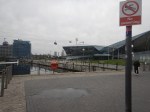
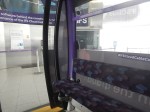
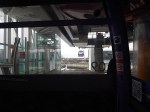
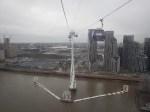
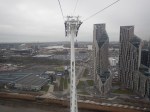
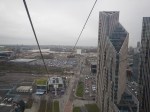
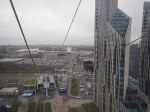
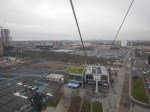
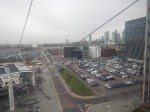
Silvertown Tunnel Works From The Cable Car – 8th January 2025
I took the pictures in Silvertown Tunnel Works – 1st January 2025 from the Docklands Light Railway.
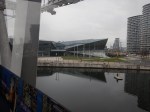
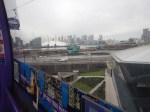
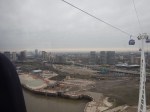
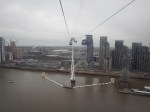
I took these pictures from the Emirates Air Line or whatever it is called today.


















































Heights And Me
I find a ride on the Cable Car to be very refreshing.
I also used to like being at height in an unpressurised light aircraft.
Is this unusual? A doctor, who has appeared in mountaineering documentaries on the BBC thinks so, but then doctors have a good laugh about my skin, which doesn’t seem to need a plaster after a blood test or injection.
Five-Car Class 710 Train On The North London Line
I had my first ride on a five-car Class 710 train on the North London Line, this week.
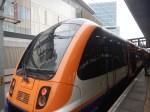
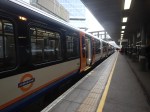
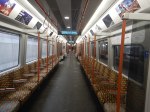
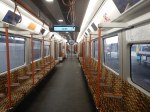
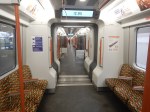
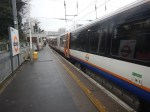
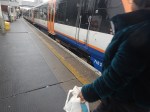
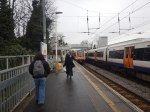
I just took the train from Stratford to Hackney Central stations, so I could get the 38 bus home.
Is FirstGroup’s Order For Fourteen Trains For Lumo And Hull Trains More Identical Than Is Generally Assumed?
Currently, Hull Trains operate Class 802 trains and Lumo operate Class 803 trains.
Both trains are five-car Hitachi A-Trains and appear to be similar in size, although there are other differences.
- Hull Trains have a two-class layout, whereas on Lumo everybody sits in the same class.
- Hull Trains are a true bi-mode with the 700 kW Rolls-Royce mtu diesel generators.
- Lumo only have a battery for emergency hotel power.
- Hull Trains currently operate a route, where up to a hundred miles in each round trip can be on diesel.
- Lumo’s current route is all electric.
However, the differences in train specification doesn’t stop the two operators using each other’s trains.
This is from an article in the November 2023 Edition of Modern Railways, that is entitled Extra Luggage Racks For Lumo.
The co-operation between sister East Coast mail line open access operators Lumo and Hull Trains continues, with one recent move, being the use of a Hull Trains ‘802’ on Lumo services to cover for a shortage of the dedicated ‘803s’ while one unit was out of action for repairs following a fatality. Although the two types are similar, there are notable differences, most obviously that the Hull Trains units are bi-modes while the Lumo sets are straight EMUs and a training conversion course is required for Lumo drivers on the ‘802s’. There are also challenges from a passenger-facing perspective – The Hull Trains units have around 20 % fewer seats and a First Class area.
A future Chief Executive of FirstGroup might at some future date decide to convert all trains to the same specification.
Drive Systems Of The Five-Car Class 80x Trains
I’m writing them down for all the five-car Class 80x trains to make it easier to understand.
- Class 800 train – DPTS–MS-MS-MC–DPTF – (LNER) 3 x 560 kW or (GWR) 3 x 700 kW diesel generators.
- Class 801 train – DPTS–MS-MS-MC–DPTF – 1 x 560 kW diesel generators
- Class 802 train – DPTS–MS-MS-MC–DPTF – (LNER) 3 x 700 kW diesel generators.
- Class 803 train – DPTS–MS-MS-MS–DPTF
- Class 805 train – DPTS–MS-MS-MC–DPTF – 3 x 700 kW diesel generators.
- Class 810 train – DPTS–MS-MS-MC–DPTF – 4 x 735 kW diesel generators.
Note.
- All these five-car trains have the same drive configuration.
- Traction motors are on cars 2 and 4.
- Trains with one diesel generators have them under car 3.
- Trains with three diesel generators have them under cars 2/3/4.
- Trains with four diesel generators have them under cars 1/2/4/5.
- The traction battery in the Class 802 battery-electric test train was 750 kW, according to The Data Sheet For Hitachi Battery Electric Trains.
It is all a very balanced design.
A Standard Basic Train For Hull Trains And Lumo
This may be possible and could be the following.
- A Class 802 or Class 803 train to the latest specification.
- Five cars.
- Interior to the customers specification.
- Ability to work in pairs.
- A standard size traction battery in car 3.
The battery could be changed according to route.
- Carmarthen – 75.3 miles – See Thoughts On Lumo’s Proposed Paddington And Carmarthen Service.
- Edinburgh – 100 miles – To cover the Lincolnshire Diversion.
- Hull – 100 miles – To cover the Lincolnshire Diversion.
- Paignton – 128.2 miles – See Thoughts On Lumo’s Proposed Paddington And Paignton Service.
- Rochdale – 100 miles to cover reverse at Rochdale.
- Sheffield – 100 miles – To cover Retford and Sheffield both ways.
- Stirling – Possibly no batteries required.
I can see a battery range of 100 miles covering most routes.
There could be two or three batteries close together in cars 2, 3 and 4, driving the traction motors in cars 2 and 4 and being charged by them.
These are my thoughts on individual Hull Trains and Lumo routes.
Beverley And Hull
In Could Hull Station Be Electrified?, I put forward my view that if Hull station were to be electrified, it opens up various possibilities of running battery-electric trains to Hull and Beverley.
Hull Trains services would charge the battery, every time they went through Hull station.
Distances needed on battery power to electrification would be.
- Beverley – 16.7 miles for return trip.
- Bridlington – 31.1 miles
- Doncaster – 40.8 miles
- Scarborough – 53.8 miles
- Temple Hirst – 36.1 miles
Except for Scarborough, a single battery would probably suffice.
Beverley and Hull are handled without a battery at present, but Hull Trains might like to carry sufficient power in batteries to be able to handle the Lincoln Diversion.
Carmarthen
Cardiff and Carmarthen via Gowerton is 75.3 miles, which probably means two batteries would be needed.
See Thoughts On Lumo’s Proposed Paddington And Carmarthen Service, for more details.
Edinburgh
Edinburgh is handled without a battery at present, but Lumo might like to carry sufficient power in batteries to be able to handle the Lincoln Diversion.
Paignton
Paignton is the longest route at 128.2 miles and I doubt, it would be talked about if it wasn’t technically possibly.
See Thoughts On Lumo’s Proposed Paddington And Paignton Service, for more details.
Rochdale
Sheffield
Stirling
Stirling could be handled without a battery, but Lumo might like to carry sufficient power in batteries to be able to handle a small diversion.
Thoughts On Lumo’s Proposed Paddington And Carmarthen Service
Lumo have permission for an open access service between London Paddington and Carmarthen.
- Stops will be Bristol Parkway, Newport, Severn Tunnel Junction, Cardiff Central, Gowerton and Llanelli
- It will be run under the Lumo brand.
- There will be five services per day.
Lumo hope services will start in 2027.
I would suspect that the train would run between London Paddington and Carmarthen like this.
- Run between London London Paddington and Cardiff Central using the 25 KVAC overhead electrification.
- Whilst running between London Paddington and Cardiff Central, the train’s batteries will be fully charged using the overhead electrification.
- Run between Cardiff Central and Carmarthen using the onboard battery power.
- Charge the train as required at Carmarthen.
Note.
- London Paddington and Cardiff Central is 145.2 miles or 233.7 km.
- Cardiff Central and Carmarthen via Gowerton is 75.3 miles or 121.2 km.
- In case of disruption, trains could wait at Cardiff Central, until the batteries had enough charge.
A battery capability of 75.3 miles or 121.2 km will be needed to reach Carmarthen.
A Fast Run Between London Paddington And Bristol Parkway
Consider.
- Currently, the fastest trains to Bristol Parkway take one hour and thirteen minutes between London Paddington and Bristol Parkway.
- The route is fully electrified.
- But the trains do make as many as three stops at Reading, Didcot Parkway and Swindon, before they stop at Bristol Parkway.
- London Paddington and Bristol Parkway are 111.7 miles apart.
This is an average speed of 91.8 mph.
Lumo will be making Bristol Parkway the first stop.
- 60 mins will be 111.7 mph.
- 54 mins will be 125 mph.
It could be a very fast time from London Paddington, if the trains can hold their operating speed of 125 mph for long periods to Bristol Parkway.
I would expect that a fast service between London Paddington and Bristol Parkway could attract passengers, if there were lots of parking.
A Fast Run Between Bristol Parkway And Cardiff Central
Consider.
- Currently, the fastest trains take thirty-five minutes between Bristol Parkway and Cardiff Central.
- The route is fully electrified.
- The speed limit varies between 75 and 90 mph.
- The train makes a single stop at Newport.
- Bristol Parkway and Cardiff Central are 34.2 miles apart
This is an average speed of 58.7 mph.
Lumo will be stopping at Severn Tunnel Junction and Newport.
The time may be a couple of minutes slower.
But I still expect that Cardiff Central will be reached in ninety minutes from London Paddington.
A Battery Run Between Cardiff Central and Carmarthen via Gowerton
Consider.
- Cardiff Central and Carmarthen via Gowerton is 75.3 miles or 121.2 km.
- The route has no electrification
- The train makes stops at Gowerton and Llanelli
- Cardiff Central and Carmarthen via Gowerton has a speed limit of mainly 75 mph, although there are sections up to 90 mph.
Times between Cardiff Central and Carmarthen via Gowerton would be.
At 75 mph the trip would be 60 minutes.
At 80 mph the trip would be 56 minutes.
I would estimate a time between London Paddington and Carmarthen of two hours and 35 minutes, as opposed to an hour longer by Great Western Railway, but that train makes eleven stops, as opposed to the six that Lumo intend to make.
Conclusion
It looks like Lumo will make most of their time savings to Camarthen by cutting stops and high speed running to betweeen London Paddington and Bristol Parkway stations.
Fast Battery-Electric Hitachi Trains Between Paddington And Bristol Temple Mead Stations
It was when I was writing Thoughts On Lumo’s Proposed Paddington And Paignton Service, that I realised how significant Hitachi’s battery-electric high speed trains will be.
This page on the Hitachi web site gives this overview of their Intercity Battery Trains.
A quick and easy application of battery technology is to install it on existing or future Hitachi intercity trains. Hitachi Rail’s modular design means this can be done without the need to re-engineer or rebuild the train and return them to service as quickly as possible for passengers.
Replacing one diesel engine with just one battery reduces emissions by more than 20% and offers cost savings of 20-30%. Our intercity battery powered trains can cover 70km on non-electrified routes, operating at intercity speeds at the same or increased performance.
For the purpose of this exercise, I will assume the following.
- All trains are five-car trains.
- They were all originally manufactured as Class 800, 802 or 805 trains.
- They were all originally manufactured with three 750 kW Rolls-Royce mtu diesel generators.
- One diesel generator in each train has been replaced by a 750 kW battery-pack of the same size, weight and performance.
According to Hitachi’s web page, that I quote above, this gives intercity speeds at the same or increased performance, for 70 km. on non-electrified routes.
I will now look at how a Hitachi battery-electric high speed train would handle the line between London Paddington and Bristol Temple Mead stations.
This OpenRailwayMap shows the electrification between Chippenham and Bath Spa stations.
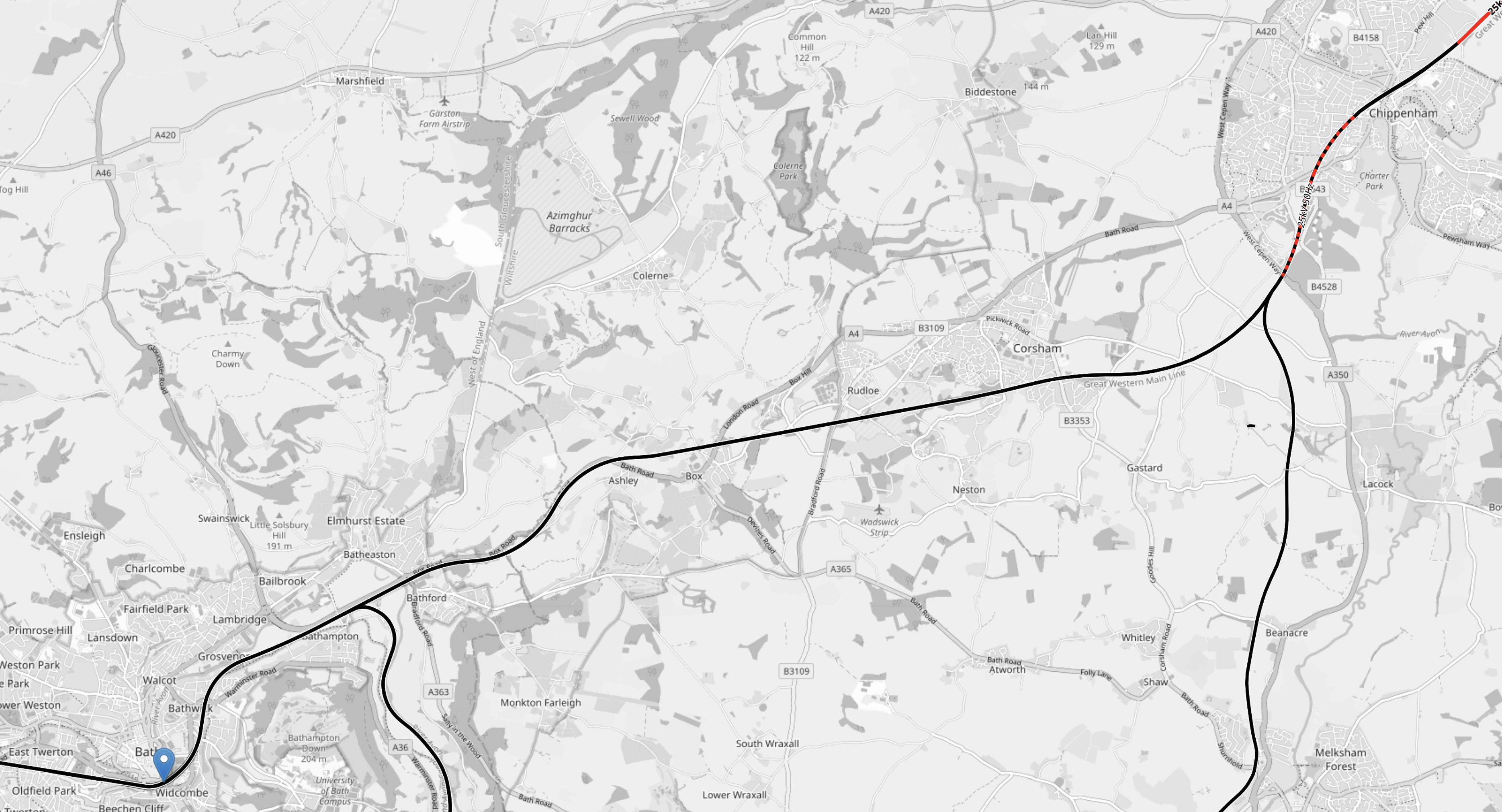
Note.
- London Paddington and Bristol Temple Mead stations are 118.3 miles apart.
- The blue arrow indicates Bath Spa station.
- Bristol Temple Meads station is 11.5 miles to the West of Bath Spa station.
- Chippenham station is in the North East corner of the map.
- Black lines are not electrified.
- Red lines are electrified with 25 KVAC overhead wires.
- The 93.9 miles betweeen London Paddington and Chippenham is fully-electrified.
- Red and black dotted lines are being electrified.
- The 24.4 miles between Chippenham and Bristol Temple Mead stations is not electrified.
- The residents of Bath Spa are not keen for the railway through Bath to be electrified.
The single battery-pack in the train, will have to propel the train between Chippenham and Bristol Temple Mead stations.
- On arrival at Chippenham, the battery will have been fully charged on the 93.9 miles from London Paddington.
- The train will be switched to battery power and proceed through Bath Spa station to Bristol Temple Meads station.
- The 24.4 miles between Chippenham and Bristol Temple Mead stations is only 39.26 km. so it is well within range of a single battery pack.
- The trains will be able to reach Bath, as fast as the track allows, so they could have come much of the way from London Paddington at speeds approaching 125 mph.
Hence my belief that Bath Spa could be reached in around an hour without any stops from London Paddington and Bristol Temple Meads in a very fast time.
There may be a need to top up the battery at Bristol Temple Meads station for London trains to return to the electrification at Chippenham or for other trains to continue their journey through Bristol.
This could be handled by some lengths of electrification in platforms in Bristol Temple Meads station, where the Hitachi trains terminate.
However, I feel Network Rail will be able to avoid the sensitive and possibly very challenging electrification through Bath.
Conclusion
London Paddington and Bristol Temple Meads via Bath Spa trains would be substantially speeded up. Especially, if the first stop out of London Paddington were to be Bath Spa station.
Great Western Railway would only cut out the stops if they wanted to speed up services.
Who’d have thought, that powering services by batteries, would speed up services?
Thoughts On Lumo’s Proposed Paddington And Paignton Service
Modern Railways says this about Lumo’s proposed new service between Paddington and Paignton.
Under the plans for Paignton, announced on 5 December, there would be five return Lumo trains running between Paddington and Paignton, serving Bath Spa, Bristol Temple Meads, Taunton, Exeter St David’s and Torquay. These could start in May 2028. A sixth path is planned between Highbridge & Burnham and London Paddington.
Modern Railways says that currently there are only three direct trains between Torbay and London and that rail has a 29% modal share on that route compared to 71% for road.
Modern Railways tell us that GWR current run three trains per day to Paignton and these call at Reading, Newbury, Hungerford, Pewsey, Westbury, Castle Cary, Taunton, Tiverton Parkway and Exeter St. David’s and Torquay.
Note.
- Lumo will be taking five stops using a longer route.
- GWR currently take ten stops using a shorter route via Westbury.
- GWR currently take ten stops between London Paddington and Bristol Temple Meads.
- The fastest GWR service I can find takes three hours and four minutes between London Paddington and Paignton.
- The fastest GWR service I can find takes one hour and thirty-five minutes between London Paddington and Bristol Temple Meads.
- The fastest service I can find takes one hour and thirty-nine minutes with five stops between Bristol Temple Meads and Paignton.
- Lumo’s trains will probably be fitted with traction batteries rather than diesel engines, so it is likely, that the fewer stops they execute will be done quieter and faster.
I would not be at all surprised to find that Lumo’s journey times would be of this order.
- London Paddington and Bath Spa – One hour
- London Paddington and Bristol Temple Meads – One hour and thirty minutes
- London Paddington and Taunton – Two hours
- London Paddington and Exeter St. David’s – Two hours and thirty minutes
- London Paddington and Torquay – Two hours and fifty minutes
- Paddington and Paignton – Three hours
These sections would not be electrified.
- Chippenham and Bristol Temple Meads – 24.4 miles
- Bristol Temple Meads and Paignton – 103.8 miles
In Fast Battery-Electric Hitachi Trains Between Paddington And Bristol Temple Mead Stations, I discuss how Lumo and Great Western Railway will speed trains to Bristol Temple Meads via Bath Spa and Chippenham.
If 128.2 miles on batteries sounds a tough ask, remember that a similar-sized Stadler Addu ran 139 miles on one charge in 2021. Lumo, Hitachi and their battery makers from Sunderland didn’t enter this contest to come a distant second.
Paignton has a big advantage, as this OpenRailwayMap shows.
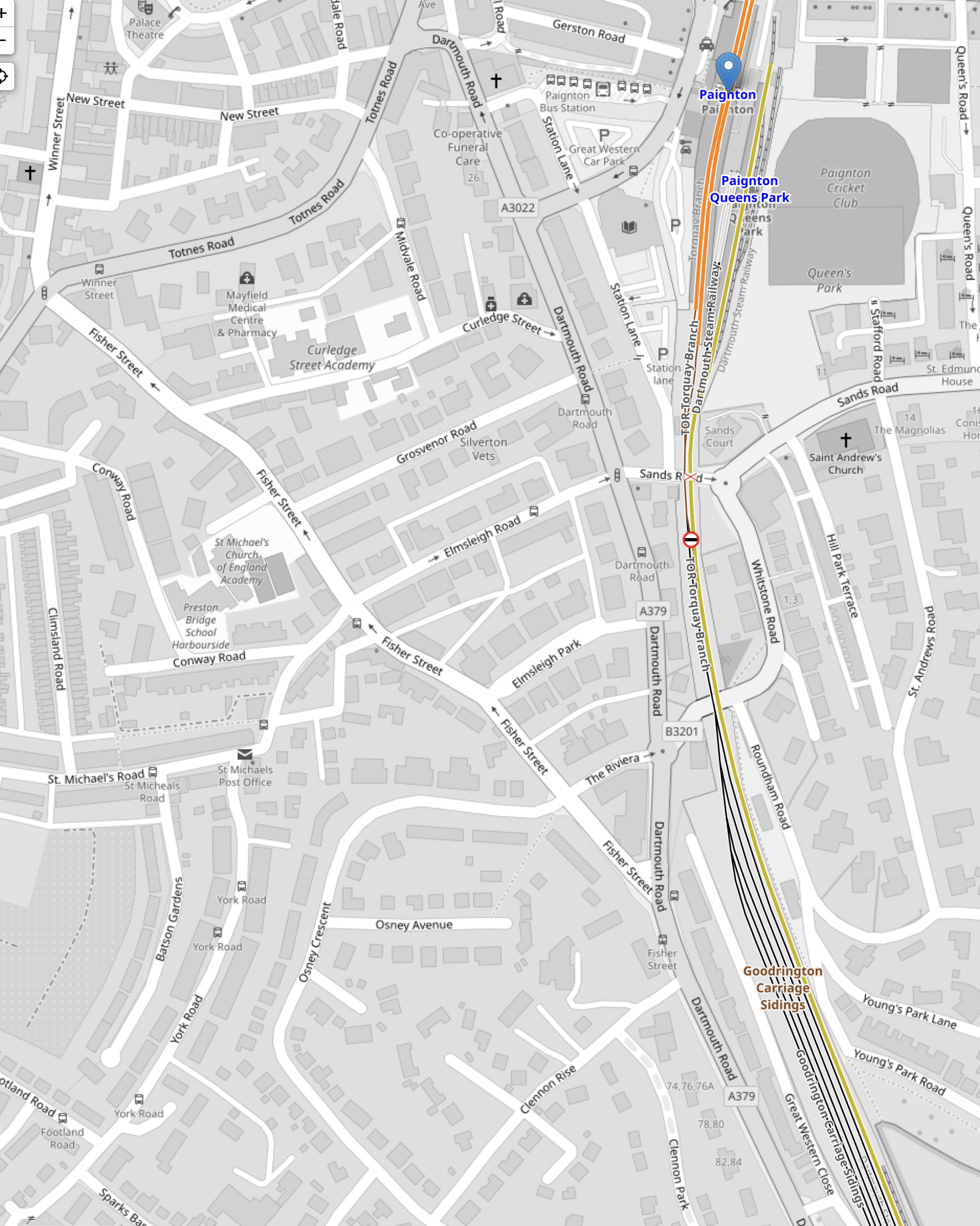
Note.
- Paignton station is marked by the blue arrow and writing at the top of the map.
- There are two platforms, one of which normally handles arrivals and the other departures.
- There are the Goodrington Carriage sidings to the South of the station.
I’m sure Hitachi will electrify some of the sidings, so that Lumo’s trains can leave Paignton with full batteries. But they only need enough charge to cover the 128.2 miles to Chippenham!
I have a few extra thoughts.
The Train’s Batteries Will Get Bigger
Hitachi must have access to the best battery chemistry, that the world and especially Japan can offer.
I feel very strongly, that the performance of Hitachi’s trains will get better, as the years progress.
Pairs Of Trains Could Be Used
I suspect all the stations that will be used by the service ; Paddington, Bath Spa, Bristol Temple Meads, Taunton, Exeter St David’s, Torquay and Paignton can handle a pair of five-car Hitachi trains on a busy day.
The Goodrington Carriage sidings at Paignton station would certainly appear to be long enough.
This could be useful.
An Early Bath
Consider.
- Currently, the fastest trains to Bath Spa take one hour and fourteen minutes from London Paddington.
- But the trains do make as many as three stops at Reading, Swindon and Chippenham, before they stop at Bath Spa.
- London Paddington and Bath Spa are 106.8 miles apart.
- The route is fully electrified between London Paddington and Chippenham.
This is an average speed of 86.6 mph.
Lumo will have two advantages
- They will be making Bath Spa the first stop.
- They will be able to maintain at least 100 mph for a large part of the route between London Paddington and Bath Spa, by the use of traction batteries, where there are no wires.
- To go between London Paddington and Bath Spa in an hour, requires an average speed of 106.8 mph
If they could average 100 mph, the time would be 66 minutes.
Bath Spa may not be an hour from Paddington, but it will be very close to it.
I would expect that a fast service to Bath could fill up with day-trippers.
How Long Will A Round Trip Take?
If I’m right that Lumo’s battery-electric high speed trains will be able to do one-way in three hours, then adding in half-an-hour to turn and charge the train at Paignton would suggest a six-an-a-half hour round trip.
How Many Trains Will Be Needed For A Full Service?
Lumo are talking of five round trips per day to Paignton and one to Highbridge & Burnham, so this would probably need two trains to run the service.
The Wikipedia entry for Highbridge & Burnham station says this.
A loop on the west side of the line south of the station can be used by goods trains in either direction, southbound trains crossing over to run wrong line through the northbound No.2 platform to do so. This crossing also allows terminating passenger trains from the north to reverse here if required.
Perhaps this loop will be used to allow one train to start from here in the morning and at the end of the day stable here overnight.
The loop could be electrified to make sure that the first train of the day gets to Chippenham.
Trains could follow a schedule like this.
- Train 1 – Leaves Highbridge & Burnham – 06:00
- Train 1 – Arrives London Paddington – 08:00
- Train 1 – Leaves London Paddington – 08:30
- Train 1 – Arrives Paignton – 11:30
- Train 1 – Leaves Paignton – 12:00
- Train 1 – Arrives London Paddington – 15:00
- Train 1 – Leaves London Paddington – 15:30
- Train 1 – Arrives Paignton – 18:30
- Train 1 – Leaves Paignton – 19:00
- Train 1 – Arrives London Paddington – 22:00
- Train 2 – Leaves London Paddington – 06:30
- Train 2 – Arrives Paignton – 09:30
- Train 2 – Leaves Paignton – 10:00
- Train 2 – Arrives London Paddington – 13:00
- Train 2 – Leaves London Paddington – 13:30
- Train 2 – Arrives Paignton – 16:30
- Train 2 – Leaves Paignton – 17:00
- Train 2 – Arrives London Paddington – 20:00
- Train 2 – Leaves London Paddington – 20:30
- Train 2 – Arrives Highbridge & Burnham – 22:30
Someone with more experience of writing timetables could make this work.
But it does appear to me, that using Highbridge & Burnham station for an early start and an overnight charge of one of the trains could mae the whole service work.
Northumberland Rail Campaigners Say East Coast Main Line Timetable ‘Bad For Our Region’
The title of this post, is the same as that of this article on MSN.
These three paragraphs explain the campaigners worries and point out some of the expected benefits.
Northumberland rail campaigners remain critical of the new East Coast Main Line timetable which is to be implemented from the end of this year.
LNER revealed the new industry-wide timetable, which has been in the works since 2021, had been given the green light by the Department for Transport on Wednesday, December 18. The timetable sees LNER services increased from two to three trains per hour between Newcastle and London King’s Cross.
It also shaves journey times between the Scottish and English capitals, with predictions that faster journeys could see rail’s share of the travel market between the cities rise to 60%. However, shorter journey times mean that there will be fewer stops at smaller stations, with Northumberland stations Berwick, Alnmouth and Morpeth all losing LNER services.
In My First Trip On The Northumberland Line – 18th December 2024, I made this observation about the long platforms on the Northumberland Line.
I am fairly sure that some of the platforms have been sized to take a five-car Hitachi Class 80x train, which are only 130 metres long.
This must enable the ability to use the Northumberland Line as a diversion for the East Coast Main Line.
Some services could perhaps stop at Blyth for the large factories and/or Northumberland Park for the Metro.
In Scotland To Get New Intercity Fleet, I laid down my views on ScotRail’s new Inter7City fleet.
- Could a few extra new trains for Scotland’s Intercity fleet be used to provide a long-distance service through the Northumberland Line?
- It would call at all the smaller stations between Newcastle and Edninburgh.
- It would take the Northumberland Line on occasions.
- It could stop at Blyth for the large factories.
- It could stop at Northumberland Park for the Metro.
- They would be 125 mph trains, so they kept out of the way of the expresses.
- Digital signalling would ensure safe separation.
A friend of mine in the Borders told me, that Border Scots were looking for well-paid employment at the Britishvolt factory. Britishvolt may have gone, but I’m sure a company will build a factory near Blyth, that needs large amounts of elecxtricity and workers.
Paris – Berlin Direct High Speed Train Service Launched
The title of this post, is the same as that of this article on the Railway Gazette.
This was the sub-heading.
A daily high speed train service linking Paris Est and Berlin Hbf was launched on December 16.
These four paragraphs outline a few details of the service.
It is operated through the Alleo partnership of SNCF Voyageurs and DB, with both French and German onboard staff and using DB Class 407 Velaro D trainsets built by Siemens Mobility.
The journey time is just over 8 h, using high speed lines from Paris to Strasbourg and from Frankfurt to Berlin, and calling at Strasbourg, Karlsruhe, Frankfurt Süd and Berlin-Spandau.
The service is targeted at both leisure and business travellers, with the operators highlighting the environmental benefits of the rail journey producing 2 kg of CO2, compared to 200 kg when flying.
Fares start at €59·99 in standard class and €69·99 in first.
Those prices seem good value.
I have just looked up going on the direct trains from Paris to Berlin on 19th Feb and coming back on the 21st.
These were the two trains.
- Paris Est – Berlin HBf 19th Feb – 09:55-18:03 – 8:08 – £52:00
- Berlin HBf – Paris Est 21st Feb – 11:54 – 20:00 – 8:06 – £86:50
Note.
- Why is it cheaper to go to the East?
- The Berlin HBf – Paris Est should allow you to catch a late Eurostar to London.
- easyJet could get you fast and affordably between Gatwick and Berlin Brandenburg Airport.
- Lumo can get you between London and Edinburgh for under £25:00.
New train services are opening up interesting trips.
Consider.
- I’ve not been to Berlin by train except from the East.
- I’ve not been to the new Brandenburg Airport.
- I’ve not done an eight-hour East-West daytime train trip across Europe.
- I want to look at Karlruhe and Chemnitz, and their new tram-trains.
I might organise my trip like this.
- Eurostar from London to Brussels
- Train from Brussels to Karlsruhe
- Overnight in Karlsruhe
- Train from Karlsruhe to Chemnitz
- Overnight in Chemnitz
- Train from Chemnitz to Berlin
- Overnight in Berlin
- Train from Berlin to Paris
- Walk between Paris Est and Paris Nord
- Eurostar from Paris to London
Note.
- I’ve done London to Karlsruhe in a day via Brussels.
- There will be three nights in hotels.
- It should be possible to do Berlin and London via Paris in a day.
I think I’ll at least plan it.
 The Anonymous Widower