Heavyweight Backing Expected For £1.5bn Crossrail Extension
The title of this post, is the same as that of this article on New Civil Engineer.
This is the first paragraph.
Government infrastructure tsar Sir John Armitt is this week expected to throw his weight behind a £1.5bn extension to Ebbsfleet.
The article also says.
- Circumstances have changed greatly since the 2008 Crossrail Act.
- Canary Wharf Group, who contributed £150million to the building of Canary Wharf station, may be prepared to contribute, as this will give access from their site to Eurostar.
- The extension could support the construction of 55,000 new homes and 50,000 jobs.
The extension would take ten years to design and construct.
Eurostar
After my forays to and from Europe recently by Eurostar, I feel that a Crossrail link to Ebbsfleet will be heavily used.
- As more destinations are served by trains from St. Pancras, more passengers will find Ebbsfleet a more convenient station for the Continent.
- Ebbsfleet will be linked directly to Canary Wharf, the City of London, the West End and Heathrow.
- Crossrail will give an easy Undergound-free link between Wales and the West Country and Ebbsfleet stations with a single change at Paddington station.
- When HS2 opens, there will be an easy Underground-free link between the Midlands and the North and Ebbsfleet stations with a single change at Old Oak Common station.
- St. Pancras only has four platforms with no space to expand, but it could be relatively easy to add capacity at Ebbsfleet.
If I was in charge of designing and building the Crossrail extension, I’d make sure that Eurostar made a contribution, as they will be big winners from the extension.
The City Of London
The extension may be beneficial to the City of London.
- The extension would add more stations within easy reach of terminal stations in the City.
- The extension might give an easier route to and from the City.
- After Brexit, I suspect the institutions of the City will want more good connections to Amsterdam, Brussels, Frankfurt and Paris.
,Perhaps one of the big City companies might like to finance construction and charge a royalty on each rain?
London City Airport
Should the project to build the extension also include building a Crossrail station at London City Airport?
This would mean that passengers between places like Aberdeen, Belfast, Dublin, Edinburgh, Glasgow, the Isle of Man and Manchester, and Continental destinations served by train would have a more convenient interchange in London.
Ebbsfleet Valley
Ebbsfleet Valley is a proposed new town of 16,000 homes being built on brownfield land close to Ebbsfleet station.
£300million of government money has been pumped into the project. But according to Wikipedia, there has been criticisms of the project.
London Paramount Entertainment Resort
London Paramount Entertainment Resort is described like this in Wikipedia.
London Paramount Entertainment Resort (commonly referred to as London Paramount) is a proposed theme park for the London Resort in Swanscombe, Kent. The project was announced on 8 October 2012 and it was estimated to open by around 2023.. In June 2017, it was announced that Paramount had pulled out of the project[2]. However, London Resort Company Holdings still insist the project is going ahead.
I’ve never been to a theme park, as I prefer the real thing!
But others will like it!
Conclusion
The beneficiaries of extending Crossrail to Ebbsfleet, include a lot of big players with possibly large financial resources.
I would suspect that some could be persuaded to fund particular parts of the project.
After all, if a housing developer invested say £10 million, in a new station for a development and then found it easier to sell the houses, there comes a point, where they make more profit and house buyers get a much better place to live.
Has The Queen Ever Ridden In a Battery-Powered Train?
Countryfile this evening had a special program about the Queen’s Scottish house and estate at Balmoral.
One archive film, showed her arriving at Ballater station in a train hauled by a locomotive with a number that looked slightly familiar. Looking it up, it was a B1 Class locomotive, which I must have seen regularly, when I went train-spotting on the West Anglia Main Line in the 1950s.
So I looked up Ballater station in Wikipedia.
The station, which was on the 43 mile long Deeside Railway from Aberdeen, is now closed but there was this paragraph on Wikipedia under Services.
When the battery multiple unit was introduced, services were doubled to six trains a day from 21 April 1958, and Sunday service reinstated. The line was chosen for testing the unit because the stations were well spaced and the 1 in 70 ruling gradients would require substantial discharge rates.
As someone very interested in railways at the time, I’d never heard of British Rail’s use of battery trains.
Remarkably, the battery electric multiple train, is still in existence and is being preserved at the Royal Deeside Railway, not far from Balmoral.
It looks to me. that a lot of engineers at Derby, made sure that this train survived.
So what was it like?
- It was based on the Derby Lightweight diesel multiple unit.
- The North of Scotland Hydro-Electric Board initiated the design and was a joint sponsor.
- The train had an operating speed of 60 mph.
- The train was powered by two 100 kW traction motors.
- Power was provided by 416 lead-acid cells, giving a total of 440 V and 1070 A hour capacity.
- The batteries weighed nine tonnes.
- There were seats for twelve First Class passengers and a hundred and five in Second Class.
It couldn’t been that bad a train, as it ran between Aberdeen and Ballater station from 1958 to 1962.
There’s more about the train here.
Conclusion
But I can’t help wondering, if the Queen ever used the train!
Are The UK’s Train Troubles Caused By A Perfect Storm?
I have wondered, why this year we have had such troubles over the May timetable change.
Let’s consider various factors.
The Average Train Driver
I would suspect that the demographics of the average train driver are very much like the average working person, who earns about the same salary.
They would be quite likely to be married or living with a partner and to have 2.4 children, some of whom could still be at school.
Like many of us, they probably enjoy a responsible drink, supporting and watching sport, especially football, and having the occasional holiday in the sun.
Some train drivers have had a more stressful winter than many, due to the Beast From The East and other bad weather.
Remember too, that not all drivers work in warm, air-conditioned trains.
So I suspect that like most of us, many were or still are looking for a holiday to blow away the winter.
The Late May Bank Holiday On May 28th
Next year it’s the 27th and in 2020 it’s the 25th.
Is this too close to the timetable change?
The Massive Timetable Change On May 20th
Normally, the May timetable change is much smaller and I can’t remember one that has caused so much disruption.
But this year, there was completely knew services for three major pieces of new infrastructure; Blackpool |Electrification, Thameslink and the Ordsall Chord.
Living in London, I don’t have day-to-day observations on the Northern services, but Thameslink has meant changes to many other services in the South East. Some of these new services seem to have a very high incidence of cancellation, which have been put down to driver shortage.
It also appears that here in the South East, the second week of the new timetable, could have been worse than the first week.
Surely, things should get better, with each week!
The Late Publishing Of The May 20th Timetable
This surely didn’t help and until we get a definitive view as to why Network Rail were so late with publishing it, I will not speculate.
The Beast From The East
This obviously had various effects on the railway industry.
As I said earlier, it probably contributed to the need for drivers to have a week off.
But did it also interrupt the training of drivers for the new routes?
Non-Delivery Of New Trains
The North was also due to get some extra trains.
Some Class 170 trains were supposed to be cascaded from ScotRail, but due to non-delivery of their replacements, they didn’t arrive.
Some Class 769 trains were supposed to be in service in December 2017, but they have not arrived.
The World Cup In Russia
This stretches from the 14th of June to the 15th of July.
This is the same length as 2014 in Brazil, but does the late May Bank Holiday put pressure on where working people can take a much needed holiday?
Conclusion
This year all these factors came together and the result was chaos!
I suspect, that a lot of drivers and other staff took a much-needed and well-deserved holiday after the May Bank Holiday!
Perhaps, it would be better to have the timetable change in June?
Scotland’s New Railway Race
There have been five railway races involving Scotland over the years.
- London To Edinburgh in 1888
- London To Aberdeen in 1895
- London To Edinburgh in 1901
- LNER and LMS
- British Rail
This article in Rail Engineer is entitled Full Glasgow To Edinburgh Electric Service In July.
The article suggests this could be another railway race with Scotland involved.
In the red corner are the devious English, who are entering a series of redundant Class 365 trains, that nobody else wants.
- They are thirty-year-old trains
- They were built by British Rail.
- To improve their relationship with drivers, WAGN fitted them with cab air-conditioning. Marketing then named them Happy-Train, as the air-conditioning inlet, had given them a smile.
- It has also been rumoured that their class number was chosen to give the air of year-round reliability.
To gain an advantage, the first train was actually sneaked into Glasgow by road, as no-one was sure that they could fit the routes to Scotland.
To get the trains ready for Scotland, work is being done by the German company; Knorr-Bremse Rail Services at Springburn in Glasgow.
The Scottish entry in the blue corner, is the Hitachi Class 385 train, which is manufactured mainly in Japan and screwed together at Newton-Aycliffe.
Unfortunately, the train was designed for drivers with Asian eyesight and the curved windows in the cabs, give unreliable images at night, with the average Scottish driver, even if they’ve been training hard on Irn-Bru!
It is hoped that new windscreens will be approved for use soon!
So the race is on to see who can get their train into service first.
As to the verdict on which train is better, I think we could be seeing a split decision.
Glasgow will prefer one train and Edinburgh will prefer the other!
Where Are The New Trains For The Aosta Valley?
One of the reasons I went to Northern Italy this week was to get a glimpse and a possible ride in the new Stadler Flirt trains for the Aosta Valley.
This article in the Railway Gazette is entitled Electro-Diesel Flirt Unveiled.
This is the first two paragraphs.
The first electro-diesel version of the Flirt multiple-unit family was unveiled at Stadler’s Bussnang plant in Switzerland on June 15, two years after the Valle d’Aosta region awarded a €43m contract for the supply of five units and the provision of five years of maintenance.
The Flirt3 units are scheduled to enter service on the Aosta – Torino route in May 2018. Bimode operation will remove the need for passengers to change trains at Ivrea to reach Torino Porta Susa station, where diesel operation is not permitted.
I didn’t see any sign of the trains, as I rode between Turin, Ivrea, Novara and Aosta, which were supposed to start services last month!
Perhaps, the trains have software problems?
The Last Leg Across Paris
I had arranged that I would take the 18:43 Eurostar back to England, so that gave me time for lunch in Paris.
I always eat in Cafe Breizh, when changing between Gare du Lyon and Gare du Nord, as it’s conveniently on the Metro from both stations.
It is a high-class Breton Creperie, which is gluten free and also has a nice line of ciders.
The only problem, is that at times you have to queue.
I took these pictures on the Metro.

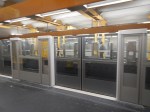


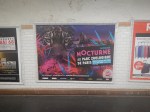
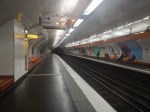

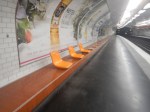
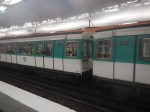
Note.
- The unusual half-height platform edge doors on Line 1.
- Paris Zoo does nights, like London.
- It did appear that Bastille station had been spruced up.
For Cafe Breizh, I went to Saint-Sébastien – Froissart station.
Returning to the station after an excellent meal, I came across this shop.



I would have investigated further, but they were very busy.
From Novara To Paris
These pictures give a glimpse of my journey from Novara to the Gare du Lyon in Paris.
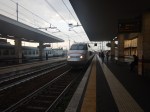
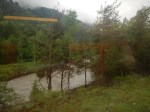



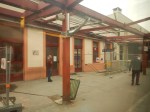

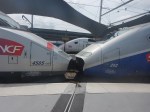
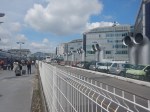
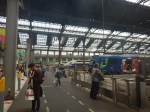
These are a few observations.
The Route
The trip took twelve minutes short of seven hours.
But some of the scenery was excellent.
It should also be noted that there is only one train per day and I’m not sure it runs every day.
As the pictures show, the Milan train joined uip with another train en route and this meant an incredibly long walk at Gare du Lyon.
Choosing A Seat
I paid £54 on loco2.com for a Standard Class ticket.
I should have paid the extra nine pounds for a First Class ticket.
But make sure you have a window seat.
Milan To London In A Day
The arrival time of 13:19 in Paris, means it is possible to go from Milan to London within a day.
I estimate that a direct service between London and Milan going via Roissy Charles de Gaulle Airport, Lyon and Turin would take about ten hours.
But then the French and the Italians are building a Turin-Lyon High Speed Railway, which could knock a couple of hours from the journey time.
As it passes Roissy, it would be an ideal route for masochists!
Conclusion
I’m glad to say, I’ve done this trip, but next time, I come back from Northern Italy, I’ll spend a night in Geneva, Lyon or Paris.
Riding The Frecciarossa
After I left Aosta, I took a train to Turin Porta Nuova station.
The journey involved a change of trains at Ivrea station and then a reverse at Chivasso station.
Reverses, where a train stops in a station and the driver changes ends, to drive it out, are surely one of the most inefficient parts of passenger train operation.
Surely, automation could do better.
From Turin Porta Nuova station, I took one of Italy’s high-speed trains; a Frecciarossa to Milan. Centrale station.


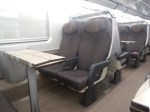


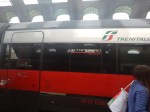


Some of my observations.
The Route
Note that for a lot of the route, the Turin-Milan High Speed Railway runs alongside the Milan-Turin Autostrada (A4).
I wonder why HS2 is not being built alongside the M1 between London and Birmingham, with possibly a stop at Milton Keynes.
After all, HS1 follows the M2 and M20 in Kent.
Multi-Class Seating
I saw one train with four classes; Standard, Premium, Business and Executive.
Do Italians, really need that many classes?
Ticketing
I bought the ticket from a machine, which also sells the tickets for the slower classic route trains.
As you pick a train, when you buy a ticket in Italy, so you can have reserved seats, you can choose a fast or slow train.
I hope HS2 is the same, so that if say you want to go from London to Birmingham or Manchester, you can choose your route.
There’s only one problem with Italian ticket machines. Often, when you start to buy a ticket, a beggar will appear and try to help or scam a few euros out of you. Some ticket machines are now in separate rooms off the concourse.
Exploring Aosta
The city of Aosta is a short walk up the hill from Aosta Railway station.
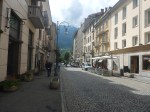
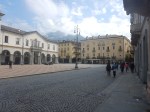
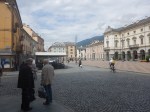
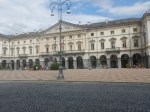
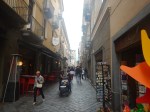
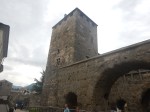

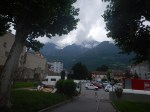
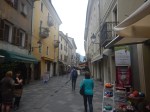
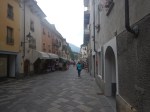
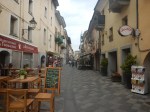
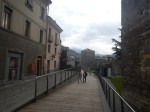
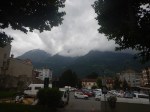

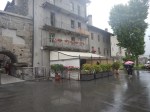
It is a typical up-market resort with good shops, cafes and restaurants.
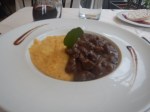
My lunch was a local speciality of beef, red wine and polenta. It didn’t look that appetising, but it tasted excellent. And of course it was gluten-free.
 The Anonymous Widower