Thoughts On Midland Main Line Electrification
I have been thinking about how the method of electrifying the Midland Main Line might change if the Aventra IPEMU was available.
These are thoughts in no particular order.
The Battery High Speed Train
An Aventra uses a modern version of the same bogies that are used in the Class 222 trains, which are capable of 200 kph. As the Class 387 train, which is a version of the Electrostar, can travel at 110 mph, I wouldn’t rule out that the more modern Aventra could run at 200 kph or 125 mph.
Acceleration on batteries would be the problem, not maintaining a high speed. that had been built up whilst running under the wires.
Also, when the train comes to the end of its northward journey at say Corby, it has to brake. With regenerative braking on the Aventra IPEMU, all of this energy would go back into the batteries.
So does this mean that no charging would need to be provided at say Corby?
I’m not totally sure of the mathematics and physics, but I’m certain that a battery electric train with regenerative braking, would put a significant part of the electricity it would need to accelerate away from a station, into the batteries as it stopped.
This would mean that stops at Wellingborough and Kettering would not stop Corby services from reaching their destination.
St. Pancras to Corby
I estimate that the distance from the end of the electrification at Bedford and Corby station is about thirty five miles.
This would mean that this route out of St.Pancras could be covered by an Aventra IPEMU.
Would this release a Class 222 train for use elsewhere? Or would the Aventra IPEMUs enable East Midlands Trains to offer more capacity or an increased frequency on this service?
St. Pancras to Leicester
I estimate that the distance from the end of the electrification at Bedford and Leicester station is about fifty miles.
This would mean that this route out of St.Pancras to Leicester could be covered by an Aventra IPEMU, especially if it were possible to recharge the train at Leicester, using the sort of short electrification, I wrote about at Rugeley Trent Valley station in Up And Down The Chase Line.
Leicester has problems as a station, as this extract from Wikipedia says.
Train operators using the station include CrossCountry and East Midlands Trains. Due to a 15 mph maximum speed to the south of the station, all passenger trains stop at the station. Up until the winter 2008 timetable, the morning southbound The Master Cutler express from Leeds to London St Pancras was an exception although this now also calls.
Leicester is a bottleneck station as it has only four platforms. All platforms are well utilised, especially platforms two and three which receive freight as well as passenger trains. A freight loop goes to the east of the station alongside the carriage sidings which run adjacent to platform four.
This Google Map of the station shows the platforms and the freight loop.

Leicester Station
It does look that there would be space to expand the station and from this section in Wikipedia, I’m sure Network Rail are working on an upgrade to the area to address all the problems.
It would appear to be stating the obvious to say, that Leicester station must be sorted first before any electrification in the area.
An extra bay platform would probably allow Aventra IPEMUs to run an electrified service to St. Pancras, if East Midlands Trains felt this was needed. Because of the regenerating braking of the train, it might not be necessary to provide a means of charging the trains at Leicester.
Creating A High Speed Route To Chesterfield and Sheffield
A few years ago, much of the Erewash Valley Line was upgraded ready for electrification and high speed running. On the Future of this line, Wikipedia says this.
Network Rail as part of a £250 million investment in the regions railways has proposed improvements to the junctions at each end, resignalling throughout, and a new East Midlands Control Centre.
As well as renewing the signalling, three junctions at Trowell, Ironville and Codnor Park will be redesigned and rebuilt. Since the existing Midland Main Line from Derby through the Derwent Valley has a number of tunnels and cuttings which are listed buildings and it is a World Heritage Area, it seems that the Erewash line is ripe for expansion. As the new signalling is rolled out, train detection is moving away from the traditional Track circuit detection of trains to Axle counting.
So could we see all of the very fastest services from St. Pancras to Chesterfield and Sheffield using this route?
Is the route from Trent Junction in the South to Chesterfield and Sheffield in the North ready for electrification?
Network Rail must ensure that as much of the line is capable of 125 mph running and that all bridges and tunnels have sufficient clearance from London to Sheffield via Chesterfield.
Creeping The Electrification North
From Bedford the electrification would be crept north at a sensible pace, which would be designed to cause minimum disruption to services.
Every mile it went north would increase the reach of the new electric trains, but only after the bottleneck of Leicester was eased to allow high speed running through the station.
The Electric Spine
If the Electric Spine was to be implemented in full from Southampton to Sheffield and Doncaster, then the electrification must be completed North of Bedford.
But as there are a lot of places where the electrification will not be completed elsewhere, will we see a shift towards electro-diesel freight locomotives like the Class 88.
So although freight would take advantage of an electrified Midland Main Line, it may not be as important as many think.
Completing The Electrified Routes to Sheffield, Nottingham and Derby
These three important cities all have extensive local rail networks, that could benefit from an electrified hub, so that Aventra IPEMUs could be used to bring benefits to all the communities served by diesel multiple units and in Sheffield’s case, quite a few Pacers.
So as a minimum, this electrification must be completed.
- East Midlands Parkway to Derby
- East Midlands Parkway to Nottingham
- East Midlands Parkway to Chesterfield and Sheffield via the Erewash Valley Line.
Chesterfield to Derby would probably be filed in the Too Difficult box, but would be an easy run for an Aventra IPEMU.
Note that I would start the electrification from East Midlands Parkway, as this station and the Airport are talked about as destinations for tram-train services.
Obviously to complete the Electric Spine, the following electrification would also need to be done.
- Complete the electrification between Bedford and East Midlands Parkway.
- Sheffield to Doncaster.
But once Sheffield station is electrified none of the many local lines reaching out from the city would need to be electrified, as most services could be run using Aventra IPEMUs. Obviously, if there was a special reason like freight or tram-trains, this wiring would only help the Aventra IPEMUs.
New Elecric Services
Once electrification has been installed up the Erewash Valley Line to Sheffield, lots of important places become within range of Aventra IPEMUs running from St. Pancras.
- Barnsley
- Bradford
- Huddersfield
- Leeds
- Manchester
It would also mean that several existing cross-country services could be run using electric trains.
- Liverpool to Norwich
- Nottingham to Cardiff
- Bristol to Newcastle
Remarkable in some ways as a lot of electrification has been dropped.
The Cost Of Aventra Trains
In various posts, I’ve given a figure for the cost of new Aventra trains as ordered by the London Overground.
London Overground hacve ordered forty five, four-car sets or 180 carriages.
This press release from Bombardier about the order says that the cost of the contract to design, manufacture, commission and service the trains for thirty-five years will be approximately £358million or just under £8million a train.
The press release also says trains will be delivered between December 2017 and October 2018. This means a production rate of sixteen carriages or four trains a month.
A lot of this cost of these trains will be the servicing and maintenance, so we don’t get near the capital cost of the train.
But the figure which works out at £2million a carriage is in line with the cost of Crossrail trains at £2.22million a carriage.
Compare this cost with the purchase of the Class 378 trains by Transport for London in 2008 to run on the London Overground. Read the section on History, which says that 152 individual cars cost £223million or £1.4million each. Which is probably in line with the cost of the Aventra given the seven years that have elapsed.
The \wikipedia aricle also gives details on the sort of leasing arrangement that London has set up.
These costs will be for standard Aventra trains and so any estimate about the extra cost of the energy storage, that I make will be a stab in the dark. Especially, as I doubt all carriages would need batteries.
How Long Before I Get A Message About The Jokeswagen Scandal?
Now that the PPI calls seem to have run their course, Jokeswagen have presented the cold calling merchants with manna from heaven.
How long before they start targeting the owners of Jokeswagen diesels to offer to sue the company at no expense to you for compensation?
They might also decide to phone and contact everybody, as Jokeswagen could surely be considered responsible for all the pollution in our cities and the increaee in asthma.
Transport for London Are Leading The Contactless Revolution
This article from Rail Magazine is entitled Contactless Ticketing Booms In London.
It states the following.
- In the first year, 180 million journeys have been made using contactless cards.
- This accounts for a fifth of all pay-as-you-go journeys.
But what isn’t said is the fact that despite the predictions of some left-wing and green politicians, there has been no hint of any problems. If there had been, the various tabloids would have had a field-day.
When are the rest of the large cities of the UK going to copy London, so I don’t need to use that nineteenth century technology of paper tickets?
Thoughts On Electrification
This document is for your eyes only and is to brief you for Monday.
By chance, a few days ago, I happened to go to Manchester with two guys from one of the big insurance companies, who are in to financing infrastructure like housing, office complexes, ports and shopping centres.
Their thoughts led me to this way of thinking.
The Problems Of Electrification
We all know of the problems of electrification and the related one of too few independent powered multiple units.
A few things I have seen and thought.
- Northern Rail has cut back the service between Liverpool and Blackpool to Preston, except for a couple of services. Have they given up temporarily on Blackpool ever getting electrified?
- I feel that electrification is suffering from a lack of resources.
- Electrification in the North West is suffering terrible ground problems.
- The October edition of Modern Railways is saying that there is uncertainty over the start date for the Gospel Oak to Barking electrification.
- If I was looking for conspiracy theories, all references to Midland Main Line electrification has been removed from Wikipedia.
- When a few weeks ago I visited all work between Preston and Blackpool had ceased and they’d tidied it all up. But bridges and platforms looked like they were ready for new four-car electric trains. I wrote What’s Gone Wrong With The Blackpool To Preston Electrification?
- Then today, I went to look at the electrification on the Chase Line and wrote Up And Down The Chase Line.
In both the Blackpool and Chase Lines electrification, they would have appeared to have rebuilt the bridges and lengthened the platforms, but had then tidied up and gone away. There were no piles of uninstalled steelwork for the overhead lines, you see up and down the GWR.
Electrification is said to be paused. These looked very much like long ones to have a serious think about it.
But both lines would accept a four-car diesel multiple unit immediately.
The Aventra IPEMU
Help is at hand in the shape of the new Aventra IPEMU train. ( IPEMU stands for Independently Powered Electric Multiple Unit)
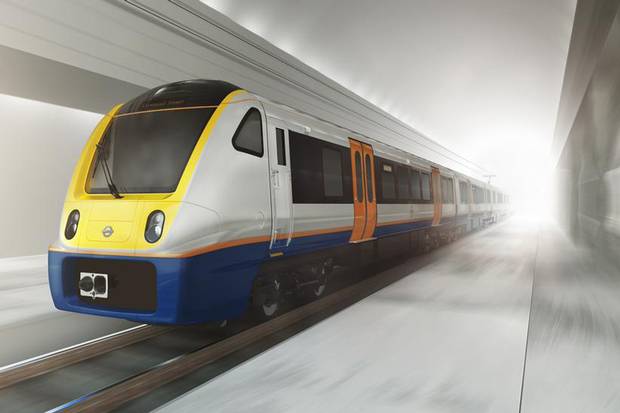
An Artist’s Impression Of The Proposed Aventra
These are facts about the Aventra and its IPEMU variant.
- The Aventra should be a modern train, to as high a standard as any train anywhere.
- Aventras will start to be delivered by the end of 2017.
- All the train and manufacturing technology has been proven for years or is running in the latest Electrostars.
- There has not been one adverse comment on the Class 379 IPEMU Demonstrator, that I can find.
- The Class 379 IPEMU Demonstrator was financed by Abellio Greater Anglia, Bombardier and Network Rail.
- I rode the test train and the on-board engineer told me the performance on battery was the same as an unmodified train and that it had a range of up to 60 miles without overhead power.
- Bombardier have sent me documents that say that all Aventra trains will have the capacity to run as IPEMUs by the addition of an appropriate energy storage device like a battery or supercapacitor.
- Aventras can be introduced on to any line that can handle a modern four car diesel multiple unit, where there is enough electrification at one or both ends.
- Aventras can be changed from standard to IPEMU variant to fit the numbers required for schedules.
- I do wonder if all Aventras would have an IPEMU capability, as this must make operation easier for train companies. If all trains had energy storage, would depots be wire-free for a start?
- There will certainly be 110 mph Aventras, but will they go even faster to say 125 mph?
- Aventras have regenerative braking and may be lighter than Electrostars.
- An engineer who worked on the InterCity 125 said to me, that aerodynamic drag on trains is one of the biggest problems. It also goes up with the square of the speed. An Aventra with its smooth front end will need less power than a corresponding Electrostar.
- There is also a paradox with rolling resistance of steel wheels on steel rails. The more heavily-loaded a train, the less the rolling resistance!
Various rumours are circulating that train operating companies are considering ordering IPEMUs.
- GWR were mentioned in the September Modern Railways.
- Merseyrail were mentioned in the October Modern Railways.
So the concept must have impressed people with cheque-books.
With my electrical engineering hat on, I would add.
- BAe Systems, GKN and others are experimenting with flywheels as energy storage devices for buses and other large road vehicles and specialist applications like KERS in Formula One. I suspect that the technology will end up in trains. Modern Railways is also talking this month about KERS for the Class 230.
- Retrofiting new and improved energy storage systems will be a very simple operation.
- Switching from overhead line or third rail power to battery could be totally automatic and controlled by GPS and ERTMS.
- Some routes like York-Scarborough, may be a bit long for the Aventra IPEMU, as although the train could easily do one-way on batteries, going out and back would not be possible. Some form of charging system, whilst in the terminal platform must be possible. A modern third-rail system in stations? Or a short length of overhead wiring as has been installed at Rugeley Trent Valley.
- Say an Aventra IPEMU was going at 100 mph towards a terminal station, as trains do on many unelectrified lines in the UK. How much energy would be put into the battery by regenerative braking as the train stopped in the station. So calculations of an out-and-back range are complicated and could be much longer than expeced.
- Smart driving systems linked to GPS, ERTMS and people counting and weight calculating software will improve range. As a control engineer, I would never underestimate how far the perfect automatic driver might take a train on a full charge on a predictable route.
Overall, I think that the range of an Aventra IPEMU on batteries will grow! At present all published range figures are based on a cobbled-together prototype, based on an Electrostar built using ten-year old technology. Bombardier have probably created a computer simulation of a definitive Aventra IPEMU, with fully integrated systems running over known routes, which would give true figures.
When the final figure is announced prepare to be surprised!
Where Could An Aventra IPEMU Be Used?
Basically anywhere, where one or both ends of the line are electrified. How about?
- Gospel Oak to Barking – There is enough electrification at the Barking end, especially if the extension to Barking Riverside was built first. It would immediately release eight Class 172s.
- Manchester to Leeds by all routes including Huddersfield and Caldervale. – It’s well under 60 miles and could give Liverpool to Newcastle in under two and a half hours without any more expensive electrification.
- Cardiff Valleys Lines – Electrification has been costed at £350million. At £8million or so for an Aventra IPEMU, it must be cheaper to cut back on the electrification and buy some new trains. No more London cast-offs!
- Hexham to Middlesbrough – It would need some electrification at Middlesbrough.
- Bristol and Teesside Metros and expansion and modernisation of local train services in Birmingham, Edinburgh, Glasgow, Liverpool, Leeds and Newcastle.
- Edinburgh to Tweedbank
- St. Pancras to Hastings and Eastbourne via Ashford.
- Salisbury to Exeter – Probably too long now, but once the technology is proven and a small amount of electrification was put in at Exeter and Salisbury, I think this line will go electric.
- St.Pancras to Corby and Leicester. – This is probably possible and could lead to an interesting philosophy for electrifying the Midland Main Line.
Many routes would need little or no modification, other than to allow four-car trains and adjustments to track and signalling, most of which could be done without too much inconvenience to passengers and train companies.
I am going to see what proportion of the country can be served by Aventra IPEMUs. I suspect, it’s upward of more than fifty percent.
The places that can’t be served are not very many.
- The South-West
- Chiltern
- North Wales
- North of Scotland
- Cumbria
- Lincolnshire
- Around Derby, Nottingham and Sheffield – Until Midland Main Line Electrification.
Some of these like the Devon lines, could be served by Class 230s. Unless it was decided to install a short stretch of third-rail electrification at Exeter, to charge the Aventra IPEMUs.
I think that until proven otherwise,Class 230s trains may join the pile of heroic failures. The Aventra IPEMU can do many of its routes and would be so much better.
Would you prefer a refurbished Ford to a new Jaguar?
Property Development
This may seem a long way from electric trains, but my travelling companions and their eyes like cash registers, got me thinking.
Let’s take an isolated town or city served by a tired branch line or crap trains. Lowestoft, Scarborough, Bury St. Edmunds, Weston Super Mare or Barrow-in-Furness for example. One of my companions suggested the latter!
In many cases, there is a package to be put together of new electric trains, rebuilding the area around the station with new commercial and residential development, that the local authority would find attractive. If the trains were sexy new electric ones, that could take you a lot further than the next large town, they would up the value of the package to the local authority considerably.
These packages would be very easily funded by say large insurance companies, as all the risks are well known and predictable. Once Aventra IPEMUs have proved themselves in service, they will have a risk profile on investment.
Political Considerations
Not my field!
But consider.
- Replacing Pacers in many places is just putting in new trains. In others, it’s using the better examples of the displaced diesel multiple units.
- There are arguments to perform electrification in a series of smaller projects, that minimise disruption to passengers, train companies and services.
- Will any politician object to new British-built trains appearing in large numbers? Especially in his or her patch!
- Some people object to all of money spent on the railways. Reducing the money spent can only give political advantage!
- New trains are visible, schemes like Great Northern Great Eastern Joint Line or ERTMS are not!
- In many parts of the UK, there is a perception that London gets all the investment . With Aventra IPEMUs the investment is spread around.
But surely the biggest political factor, is that elected representatives will get much greater control of the railways in their area.
Problems
Would politicians and people think that their train service couldn’t possibly be improved by a Mickey Mouse concept of large milk-floats with seats?
Bombardier have financial problems and probably not enough capacity in Derby.
Conclusion
I think the concept could be mind-blowing and could transform the UK.
I can’t believe that all this has not been put together before and this led me to the trial of the Class 379 BEMU, which I thought until I rode it and looked at the maths and physics would be a total disaster. There’s a BBC video.
What do the three partners get out of it?
- Bombardier are hoping the technology will sell more trains, other than the few trams, they’ve sold to Nanjing.
- Network Rail remove a lot of difficult lines from the need for electrification. No more dealing with Nimbys, bats, newts, terrible ground conditions and the militant wing of the heritage lobby.
- Abellio at present have three franchises with a lot of lines that could use trains able to run for sixty miles without an external power source. They must know the likely benefits of introducing a new electric service and how much new trains would return.
It does seem that using Aventra IPEMUs is one of these things that just seems too good to be true!
But then if you understand the physics of rolling resistance of steel wheels on steel rails, the improving capabilities of modern energy storage and what modern automatic control systems can perform, it all looks to be not magic but superb engineering from many different fields coming together.
It has all the aura of one of those brilliant concepts put together in a pub, whilst under the influence of copious amounts of alcohol and drawn and written down on the back of those special fag packets and envelopes that engineers use.
I must admit, that I can’t understand, why someone hasn’t done it before.
The only reason I can think of, is that countries like France, Germany, Italy and Japan have had electrified railways for years and so they don’t have the problems we have of unelectrified railways.
Up And Down The Chase Line
I went up the Chase Line to look at the progress of the electrification from Walsall to Rugeley Trent Valley.

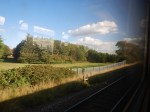
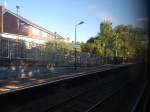
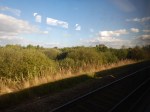
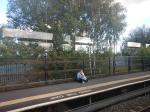
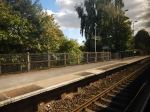

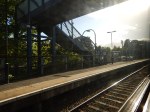
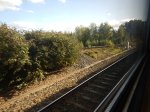
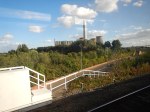


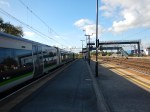
The train was an improvised three-car consisting of a two-car Class 170 train attached to a Class 153 train.
So I have to assume that most of the platforms are probably now long enough for four-car trains. It also looked to my untrained eye, that all the signalling had been renewed and the all the stations were up to a high standard, as they usually are around Birmingham.
The line is fully electrified between Birmingham and Walsall and Rugeley Trent Valley station has a fully electrified bay platform, from where the electrification stretches a couple of hundred metres down the Chase Line.
There was no sign of any electrification work and it was almost if they had tidied everything up and gone away, just leaving a few builders putting the finishing touches to the new and raised bridges on the route. There was no piles of steelwork for the overhead lines or yellow special-purpose vehicles anywhere! I didn’t see them on my last visit to Blackpool, which I wrote about in What’s Gone Wrong With The Blackpool To Preston Electrification?
As the target for introducing electric trains on the route between Rugeley Trent Valley and Birmingham New Street is December 2017, they would seem to be cutting it fine, to get the work done in time. Especially as so many of Network Rail’s projects like the Todmorden curve have been delayed.
A short time ago, I wrote Electrification May Be In Trouble Elsewhere, But The Brummies Keep Marching On, which was based on this article in Rail Engineer, which said it was going so well.
What’s happened?
I have come to the conclusion, that this line could almost have been specially prepared so that it could be run by Aventra IPEMUs.
The length of the section without electrification is only perhaps a dozen miles, so an Aventra IPEMU that charged up on the existing electrification between Birmingham and Walsall, could easily make Rugeley Trent Valley, where it could charge itself again on the new electrification at the station, if it was thought necessary.
I have found this article in the Wolverhampton Express and Star which is entitled Walsall railway bridge rebuild begins in £30m line electrification.
So how much of that cost is electrification of the dozen miles of double-track between Walsall and Rugeley? In this press release from the Green Party, they give the cost of railway electrification at £3million a mile. If that includes bridge and track modification, then that figure ties up well with the £30million for the whole project from the Express and Star, given that as there is electrified lines at both ends, the major cost of bringing power to the new section is probably not very large.
In The Cost Of Aventra Trains, I said that a standard four-car Aventra train will all the extras and servicing costs around £8million. So conservatively, I would suspect that a four-car Aventra IPEMU would come in at a little bit more.
So long as all platforms and the signalling could accept a four-car train, the extra costs of introducing an Aventra IPEMU, should not be much more than training drivers and other staff.
Would the savings on not completing the electrification, pay for the purchase of the probable two Aventra IPEMUs needed to provide a half-hourly service on the lines? As the trains would be faster over the route, two trains might be able to provide a three trains an hour service, which is what Redditch on the other side of Birmingham gets.
Are the clever engineers in Derby, going to give the good citizens of Walsall, a brand new, but very affordable electric train service to Birmingham and Rugeley?
A John Lewis With Its Own Station
John Lewis didn’t have a store in Birmingham, but they opened one in the Grand Central Shopping Centre on Thursday above the reopened New Street station.







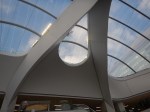
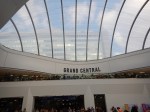








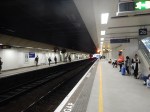


It is pretty spectacular to say the least.
The comedians will start to be calling the West Midlands, the White Country, if stations of this style appear all over the area.
I wonder when you last saw the sun in the main Birmingham station!
Manchester United 3 – Ipswich 0
These pictures document the match.


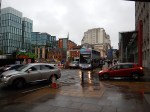












It was all very disappointing, but then Mick has his priorities of getting out of the Championship.
Old Trafford is not the sort of stadium, I thought it would be. It had a rather tired air and compared to the Emirates or the Amex at Brighton, it was very second-rate.
New Zealand v Namibia At The Olympic Stadium
These pictures document my visit.

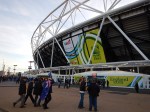


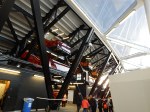

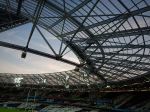


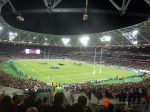


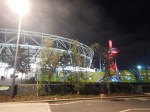
Compare the Olympic Stadium with Old Trafford of the previous night.
The final sporting effect of this stadium will be to propel West Ham up the League, as this is a stadium that would fill, if it was staging Leyton Orient against Accrington. Apologies to both teams and their fans, but spectators would go for the experience!
One of the stadium’s best features is getting to and from the venue.
Going, I went early and easily met my friend in Eastfield, which was uncrowded ninety minutes before the match.
My friend had taken one train from Suffolk ans we bought some snacks in Marks & Spencer. How many stadia are served by long-distance trains?
Coming back, I walked out the back of the stadium and took the DLR from Pudding Mill Lane station. I could even have walked the other way to cross the site on the Greenway to get a 30 bus direct to my door.
When Crossrail opens in 2019, the stadium and the Olympic Park will be at one of the best transport interchanges in the UK.
The Olympic stadium, its setting in an enormous park and its transport links, is in a totally different class.
Manchester Has Ways Of Dealing With Cyclists
I took these pictures in Manchester City Centre.
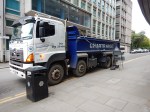

These trucks with no sideguards wouldn’t be allowed in London. Why does Manchester allow them?
 The Anonymous Widower