Booking A Train From London To The Hague
Just out of curiosity, I looked at how much it would cost me to go from St. Pancras to The Hague next Wednesday, the 30th of January.
So I looked up on the Belgian Rail web site called b-europe.co.uk. They offer two routes.
You can go to Brussels Midi, where you take a train to Essen in Germany and then another one to Rosendaal in The Netherlands, from where you get a Dutch train to The Hague. For this Grand Tour of the Low Countries you will pay £114.42.
Alternatively, you can take the Thalys from Brussels to Rotterdam and then take the train to The Hague. It will be 17 minutes quicker, but you can’t book it in Second Class, so it’ll cost you £188.75 in First.
I have done the single leg in the past for under £100 and I can book it for about £60 by means of easyJet.
So who would use the train from London to The Hague?
Not this enthusiast for rail travel, for a start!
It’s all double-Dutch to me!
High Speed Trains Compared
out of curiosity, I thought I put the various speeds and size of some of the high-speed trains in Europe.
Fyra – V250 – 8 car trains seating 546, running at a maximum speed of 250 km/hr.
UK – IC 225 – 9 car trains running at a maximum speed of 225 km/hr. Although they are limited to 201 km/hr. because of signalling.
Eurostar – 373 – 20 car trains seating 750, running at a maximum speed of 300 km/hr.
ICE 1 – 12 car trains seating 743, running at a maximum speed of 280 km/hr.
ICE 2 – 8 car trains seating 391, running at a maximum speed of 280 km/hr.
ICE 3 – 8 car trains seating 441, running at a maximum speed of 320 km/hr.
Although, they are all different, it’s surprising how with the exception of Eurostar, they are all fairly shortish trains.
The IC 225 is slower, but also as they run on normal lines with other traffic, and generally stop a few times on their journeys out of London, their performance isn’t as slow as you would think.
It may lead you to the conclusion, that on shorter high-speed services with stops, 200 km/hr may well be fast enough.
But as the French like to show, there is quite a lot of pride, that your trains run very fast. But then France and Spain are probably the only countries in Western Europe, that have the space for long high speed lines.
We have had only a few details about HS2, the line from London to the Midlands, North and eventually to Scotland. They seem to be planning for speeds of up to 400 km/hr., but how much is that to just prove they can do what the French do?
Putting an engineering hat on, it’s well known that the faster you go, the more energy you need and the more noise and damage to the track you make. And if you go at 400 km/hr instead of 200 km/hr, you don’t do the journey in half the time, as you have to accelerate and brake for longer.
We also get the old chestnut, of why don’t we have double-deck trains like they do in many places on the continent. Having travelled on a TGV Duplex to the South of France, I am very sceptical about them on short high speed distances, as loading and unloading can be a nightmare, given the excess baggage people take with them these days.
So I am veering towards shorter nimble trains with superb acceleration. Taking the HS2 route to Birmingham, which has two stops between Euston and Birmingham, they might even be as quick as a faster heavier train.
But then the trouble with a slightly slower service, is that it doesn’t polish the egos of politicians, who love to say they have things like the fastest or biggest in the world.
Obviously, past Birmingham, where there is more space, the service could go faster towards the North and Scotland.
You have to remember that most of the saving in journey times from high speed trains come from taking a direct flat route. Brunel and those that built the East Coast Main Line, knew that and were able to create tracks that now allow trains to run at 200 km/hr. The West Coast Main Line had to be threaded through country estates of the landed gentry and over quite a few hills, so it is much slower.
Looking at my target of Fyra, the Dutch don’t really need a 400 km/hr. line and in fact, limit the speed of trains to 300 km/hr., although they’re not going as fast as that yet.
So there would appear to be good reasons for not building short high-speed lines capable of 400 km/hr. But by all means build them capable of 200 km/hr.
Dutch MPs Show Their Confidence In Fyra
This story about the Dutch Aunt Sally, just adds to the mess the of the high speed train.
But as Fyra doesn’t actually go to The Hague, where the Dutch parliament sits, they would have to change at Rotterdam or drive there anyway.
The Flexibility Of Public Transport In East London
After my tea, I had to get home. To get from Pudding Mill station to where I live halfway between Highbury and Islington, and Dalston Junction stations, there are many possibilities.
So I resorted to the Monte Carlo method and took the first train that arrived. It was going to Stratford. I could have walked through the station to the overground, but noticed that despite it almost being the rush hour, the Central line trains towards Central London were fairly empty.
So I took the first one, intending to go to Bank, to take the `141 bus to my house. But at Mile End station, where the Central and sub-surface lines have a cross platform interchange, I decided to get a Metropolitan line train to Moorgate to pick up the bus there. I waited just a minute before I was on my way.
In the end, I went just two stops to Whitechapel station, where I used the quick interchange to get an Overground train to Dalston Junction, where I caught one of innumerable 38 buses down the Balls Pond Road.
I may have used five different modes of transport, but I had a seat all the way and never waited more than a minute anywhere.
Incidentally, CrossRail will change all this, as the simplest route, would be to take CrossRail to Moorgate and then get the 141 bus. Let’s hope they get the bus connection right.
Tea At The Olympic Park
After visiting Custom House Station, I decided to go for a tea at the ViewTube, by the Olympic Park. I went via Stratford rather than Poplar to Pudding Mill Lane station for the cafe, so that I could pick up a Standard at Stratford station.
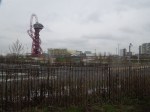
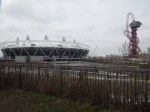
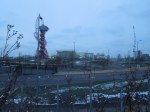
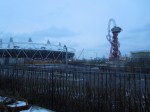
The pictures show how the park is changing. The most noticeable change is probably the removal of the extra seats in the Aquatic Centre.
Lots Of Orange At Custom House Station
I took these pictures at the site of the new Custom House Station for CrossRail today.

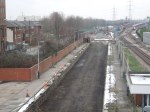
It doesn’t look as if there has been much progress, since I last visited, but then buildings are always slow to start as foundations have to be done correctly.
As you can see right into the construction works from an overbridge linked to the DLR platforms, it is one of those few building sites, where the public gets a good look at what is going on.
A Unique Station Indicator
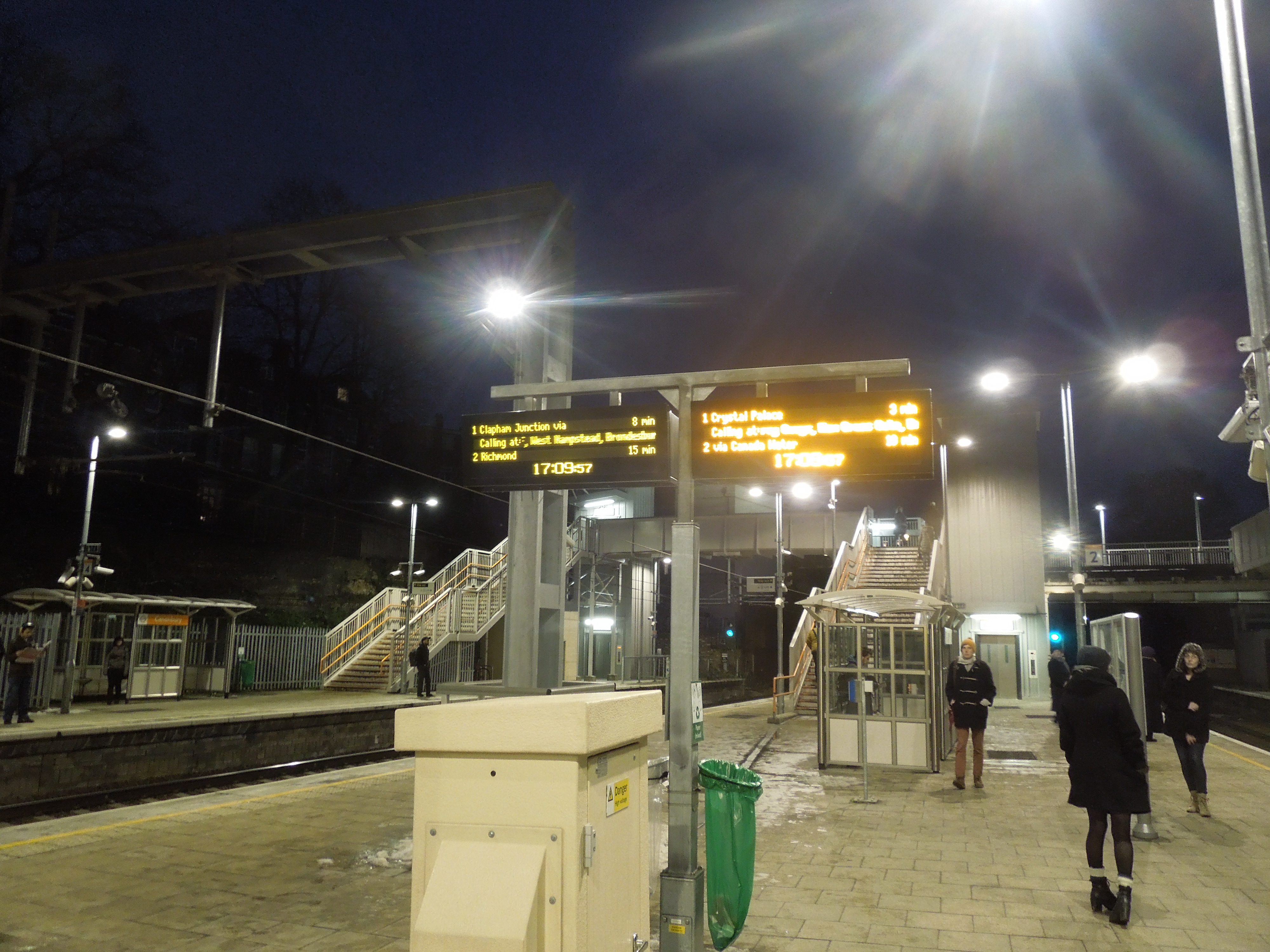
I didn’t quite get the picture correct, as the display change was too quick for me.
A Unique Station Indicator
The sign is at Canonbury station and is between the two platforms; 2 and 3. Platform 3 is on the left and takes North London line trains towards Highbury and Islington station and the west, whereas Platform 2 takes East London line trains towards Dalston Junction station and the south.
When I got the camera out. it was showing trains to Clapham Junction station on both platforms. One has since changed to “Via Canada Water” to indicate the direction. I must get a better picture in the future.
I wonder how many places this happens regularly? But with a circular railway like the Overground, it will happen all the time, as half the trains at this station, go to Clapham Junction.
London Underground Stations To Avoid
Londoners all have the Underground stations they don’t use. Here’s a few of my list.
Green Park – I was talking with a friend last night about my experience here yesterday and she also said she doesn’t use the station either, although she has to when she goes to the Royal Academy. I don’t as I will use a 38 bus from the stop just around the corner from my house. Outside of the rush hour, it’s almost as quick and I have to get a bus to Highbury and Islington station to get the Underground anyway.
Kings Cross St Pancras – It may be fully step-free, but it’s another station with endless subterranean passageways and I still get caught out by going to the wrong end of the platform, when getting off a train. If you want to exit, it’s better to go to the Euston Road exits, as that way it’s generally a short walk and an escalator. Following the recommended route puts you in the endless passageways. But again, I have the luxury of a 30 bus direct to the station. When they finish the plaza in front of the station, bus access will get much better, so this station, should improve overall later this year.
On the other hand changing between the deep lines isn’t too bad, which can’t be said for Green Park.
London Bridge – This is another station, designed by an architect with shares in a shoe company. I would never change Underground trains here and avoid getting on them as well. It used to be much easier, when the 141 bus ran from the new bus station. It doesn’t at the moment, as after they’d built it, the sewer collapsed, but in a few weeks it will be different.
Victoria – This is another on the list at present, but probably only until the station and the Underground interchange has been rebuilt in a few years.
Bank – This is another station that I avoid at weekends to change onto the DLR, but it is much better during the week. It’s also improved over the last few ears, with several extra escalators. It will also get better in the future, as I believe it’s getting some more lifts.
Camden Town – It’s just so busy with all the markets and the tourists they attract. It had been slated for rebuilding completely, but nothing is on the cards at the moment. I either use a bus or the Overground to Camden Road station to get there.
I’ve already had a couple of suggestions from a friend.
Mile End – I know this one well and used to use it a lot, when my son lived round the corner. My friend suggests you should avoid it because it is a suicide hot-spot and because of it’s depressing decor. But I’ve always found it a good way to get onto the District or Metropolitan lines from the Central or vice-versa. It also has a very useful black cab rank outside the station, which is rare on the Underground.
Edgware Road – This is the subsurface station, which can be a nightmare as it is the gap in the Circle line. I’ve waited there in the past for a lot more than several minutes to turn the corner to the south. I was talking to station staff at Kings Cross and the new Circle line layout generates a lot of queries, especially from those, who are visiting London after several years.
You will notice, that I often do a split journey using a bus at one end. I also know the bus stops pretty well, so for example, if I was returning home from say Paddington on the Metropolitan line, I’d go to Moorgate station and get a 141 bus from there, as the stop is by the station. In a similar way, say if I was going to Wembley, I’d take a 56 bus to Barbican station and get the Metropolitan from there.
I do hope that Crossrail doesn’t muck up the bus connections too much. After all, it would be easy to go to Heathrow, by getting a 141 bus to Moorgate and then getting Crossrail direct to the airport.
You will also notice that two of the stations I avoid are on the Jubilee line. I don’t think, it was the best designed of the Underground lines and we are paying the price that shoddy design. Spectacular some of the stations like Canary Wharf , Westminster and North Greenwich might be, but couldn’t a proportion of the money been better spent at the interchanges like Green Park, London Bridge and Bond Street.
Westminster always amazes me, as I walk through its subterranean structures. But then it is in effect the foundation of Portcullis House; that grandiose monument to Parliamentary excess.
The Fyra Farce Goes Worldwide
I’ve just been notified of two articles about Fyra; the Dutch/Belgium high-speed train from Business Traveller and Cleveland.com.
I’ve also had a look on the Eurostar web site. They’re saying this.
To travel to the Netherlands book your Eurostar to Brussels first and then your Thalys train from Brussels to Amsterdam, Schiphol or Rotterdam.
I suppose they’re only telling you what is possible.
Let’s face it London to Amsterdam is probably only a similar distance, as London to say Perth in Scotland. I haven’t done that journey but I know it would be one web purchase not two, as incidentally so would London to Geneva on Eurostar’s web site, changing in Paris.
It’s a complete mess and it seems to be getting worse, with little leadership or common sense being shown.
Step Free In Name, But Not Spirit!
Transport for London is rather proud of the work it has done at Green Park station, judging by this page on their web site. Here’s a key section.
The £48m project to provide step-free facilities at Green Park Tube station has been completed ahead of schedule and under budget by Tube Lines and London Underground.
Passengers with restricted mobility, as well as people with heavy luggage or buggies, are now able to use the new lifts at Green Park Tube station to access the Piccadilly, Victoria and Jubilee line platforms.
Other work includes new flooring, ceiling, lighting, tiling and signage in the ticket hall plus new entrances and lift lobbies.
In common with I suspect many others, I rarely if ever use the station as an interchange, as to get from one line to another means a long walk underground.
I do use it though, if I want to come home from the western reaches of the Piccadilly line, as the stop for my local 38 bus is just outside the station and at most times of the day, the upstairs of these buses isn’t full. I’d far rather use an uncrowded bus, than play sardines on the Underground.
So today, as I was coming home, I decided to check out the step-free access at this important station. I arrived on the Jubilee line and wanted to use the lift to get to the surface. I found the lift easily enough on a cross tunnel between the two Jubilee line platforms. I didn’t wait long and the lift whisked me and an elderly couple up to the next level.
To get to the exit, you have to walk miles to the lifts that connect you to the booking hall. So the design fault, that I always hated about this station, is still there. My fellow passengers at this point gave up, as the lady was walking with a single crutch and returned to the Jubilee line platforms.
I walked on and eventually arrived in the newly redecorated booking hall, after coming up two levels. I mentioned to station staff, that this couple were a bit lost and one said he’d check them out on the CCTV. So at least the staff know about the problems down below.
I crossed to the north side of Piccadilly and then walked up the steps to get my 38 bus. The lift is on the south side, which is only useful if I want to catch a bus to the west, which would be unlikely in my case, because of where I live.
It may have all cost £48million, but I do think, the money for the lifts could have been better spent. Perhaps even elsewhere!
 The Anonymous Widower