East-West Rail: Oxford And Bedford
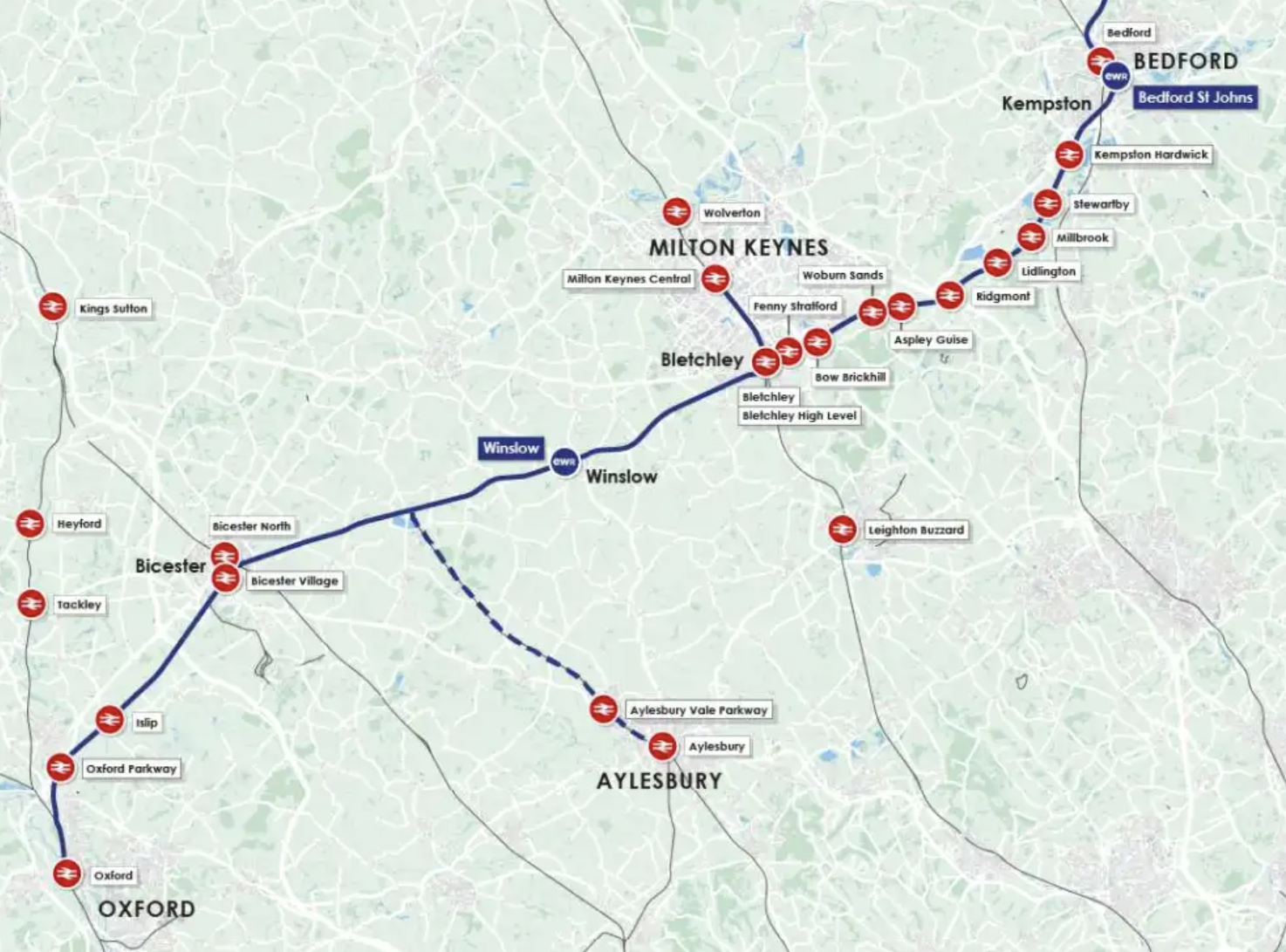
This map from East West Rail shows the route between Oxford and Bedford.
Note.
- The proposed route is shown in blue.
- The possible Southern extension to Aylesbury is shown dotted.
- The route between Bicester and Bletchley is rebuilt track along a former alignment.
- The route between Bletchley and Bedford will surely be rebuilt track along the Marston Vale Line.
- The Bicester and Bedford sections of track will be joined by the Bletchley Flyover, which is well on the way to completion.
This Google Map shows Bletchley station.

Note.
- Bletchley Station has six platforms.
- The double-track Bletchley Flyover runs North-South at the Eastern side of the station.
- There are the beginnings of two platforms on the flyover, which will increase the number of platforms at Bletchley station to eight.
- There is a junction at the Northern end of the flyover, where one pair of tracks go North to Milton Keynes Central and the other takes the Marston Vale Line to Bedford.
The track-layout at Bletchley station allows trains between Oxford and Bedford and Oxford and Milton Keynes Central to call at Bletchley station.
Proposed Passenger Trains Between Oxford and Bedford
According to the Wikipedia entry for the East West Railway, these service will run on the railway between Oxford and Bedford.
- East West Railway – Oxford and Milton Keynes Central via Oxford Parkway, Bicester Village, Winslow and Bletchley – 2 tph
- East West Railway – Oxford and Bedford via Oxford Parkway, Bicester Village, Winslow, Bletchley, Woburn Sands and Ridgmont – 1 tph
- East West Railway – Aylesbury and Milton Keynes Central via Aylesbury Vale Parkway, Winslow and Bletchley – 1 tph
- West Midlands Trains – Bletchley and Bedford via Fenny Stratford, Bow Brickhill, Woburn Sands, Aspley Guise, Ridgmont, Lidlington, Millbrook, Stewartby, Kempston Hardwick and Bedford St Johns – 1 tph
Note.
- tph is trains per hour.
- All larger stations get at least a half-hourly service.
- There are three tph between Oxford and Bletchley via Oxford Parkway, Bicester Village and Winslow.
- There a fast train and a stopping train between Bletchley and Bedford.
- It is still undecided, whether provision will be made for the Aylesbury service.
I think that this service pattern is achievable, with or without the Aylesbury service.
East-West Rail: Route For £5bn Bedford To Cambridge Link Announced
The title of this post, is the same as that of this article on the BBC.
This is the sub-heading.
The preferred route of part of £5bn railway line connecting Oxford and Cambridge has been announced.
The first two paragraphs summarise the route.
The East-West Rail (EWR) project confirmed details of the section between Bedford and Cambridge.
It will include new stations at Tempsford and Cambourne, and enter Cambridge via the south of the city.
This map from East West Rail shows the route.

Note.
- The proposed route is shown in blue.
- The possible Southern extension to Aylesbury is shown dotted.
- The Wikipedia entry for East West Rail has conflicting information, as to when trains can run between Bicester and Bedford.
These related posts describe and discuss various parts and issues of the route.
East-West Rail: Along The Marston Vale Line
East-West Rail: Aylesbury Spur
East-West Rail: Electrification
East-West Rail: Oxford And Bedford
East-West Rail: Through Bedford
Peckham Rye Station – 26th May 2023
The roof of the station now appears to be complete.



This article on Ian Visits, describes the use of real gold in the work.
Hitachi Rail Names Preferred Supplier For Battery System Development For UK Trial
The title of this post is the same as that of this article on Rail Technology Magazine.
These are the first two paragraphs.
Hitachi Rail UK is continuing its commitment to electrification and sustainability as it has teamed with a UK based Technology firm to design and supply its traction and battery systems for its intercity battery train trial which it hopes to run in the future.
Working with the North East England Partnership and Turntide Technologies, Hitachi UK Rail are working towards a UK trial for its battery technology which is engineered to reduce emissions and fuel costs. It is hoped, that if successful, it’ll advance the UK’s position as a global leader in battery train technology.
Note.
- Turntide Technologies took over Hyperdrive Innovation.
- Turntide Technologies have designed and built systems for JCB.
Up until now, we have been told very little about the batteries.
I have the following questions.
Is The Battery System In The Class 803 Trains For Lumo By Turntide Technologies/Hyperdrive Innovation?
The Wikipedia entry for Lumo, says this about the design of the Class 803 train.
Services are operated by a fleet of 125 mph (200 km/h) Class 803 electric multiple unit trains, ordered in March 2019 at a cost of £100 million, financed by the rail leasing company Beacon Rail.[15] While based on the same Hitachi AT300 design as the Class 801 Azuma trains operated on the East Coast Main Line by franchised operator London North Eastern Railway (LNER), they are not fitted with an auxiliary diesel engine, but instead feature batteries intended solely to power onboard facilities in case of overhead line equipment failure.
The maker of the batteries has not been disclosed.
If they have been made by Turntide, then they would certainly have had a good vibration testing.
Is The Battery System In The Class 803 Trains Similar To That Proposed For Class 800/802/805/810 Trains?
It would seem sensible, as this would mean that Hitachi would only be introducing one type of battery into the various fleets.
Supporting structures and wiring harnesses would then be identical in all trains, whether diesel engines or batteries were to be fitted.
Are The Batteries Plug Compatible With Similar Performance To The Diesel Engines?
I have never driven a train, but I have ridden in the cab of an InterCity 125, as I wrote about in Edinburgh to Inverness in the Cab of an HST.
The driver controls the two locomotives individually, just like I controlled the two engines in my Cessna 340 with two separate throttles.
So how does a driver control all the three engines in a five-car Class 800 train or the five engines in a nine-car?
Put simply, the driver just tells the computer, what speed or power is required and the train’s computer adjusts al the engines accordingly.
I believe it would be possible to design battery packs that are plug-compatible with similar performance to the diesel engines.
Hitachi could be playing an old Electrical/Electronic Engineer’s trick.
As a sixteen-year-old, I spent a Summer in a rolling mills, building replacement transistorised control units for the old electronic valve units. They had been designed, so they were plug-compatible and performed identically.
The great advantage of this approach, is that no changes were needed to the rolling mill.
So if Hitachi are using a similar approach, there should be very few or even no changes to the train.
What Range Will A Class 800 Train Have On Batteries?
This article on Focus Transport is entitled 224-kilometre Battery Range For FLIRT Akku – Stadler Sets World Record For Guinness Book Of Records.
I would be very surprised if Hitachi don’t break that record of 224 kilometres or 139 miles.
Conclusion
I belive we’re going to see a real revolution in rail transport.
Do Network Rail Have A Cunning Plan To Run Battery Electric Trains To Wigan Wallgate And Blackburn?
This news story, which is entitled £72 million Boost For Train Services In Manchester And The North, was released by the government today.
This is the sub-heading.
This package will improve the passenger experience by having more reliable trains and fewer delays.
These two paragraphs describe the work.
The funding will deliver a third platform at Salford Crescent station and track improvement work across north Manchester to help reduce delays, bottlenecks and station overcrowding, meaning passengers will enjoy more comfortable and reliable journeys.
Manchester Victoria Station will also benefit from extra entry and exit points to platforms, making it easier for passengers to travel through the station during busier periods.
These are my thoughts.
Battery-Electric Trains
New Merseyrail Train Runs 135km On Battery says a lot about the capabilities of modern battery-electric multiple units.
135 km is 84 miles and if you look at services in the Wigan and Blackburn area, these are the services, currently run by diesel trains on lines without electrification.
- Blackburn and Bolton – 13.9 miles
- Blackburn and Manchester Victoria – 39.4 miles
- Hindley and Salford Crescent – 16.2 miles
- Southport and Wigan Wallgate – 17.4 miles
- Kirkby and Wigan Wallgate – 12 miles
- Clitheroe and Bolton – 23.7 miles
- Manchester Piccadilly and Buxton – 19 miles
I believe that a modern battery-electric train would be able to handle all these routes, with assistance from regenerative braking and Newton’s friend.
I also believe that CAF, Hitachi, Siemens and Stadler would be capable of building a battery-electric train for these routes.
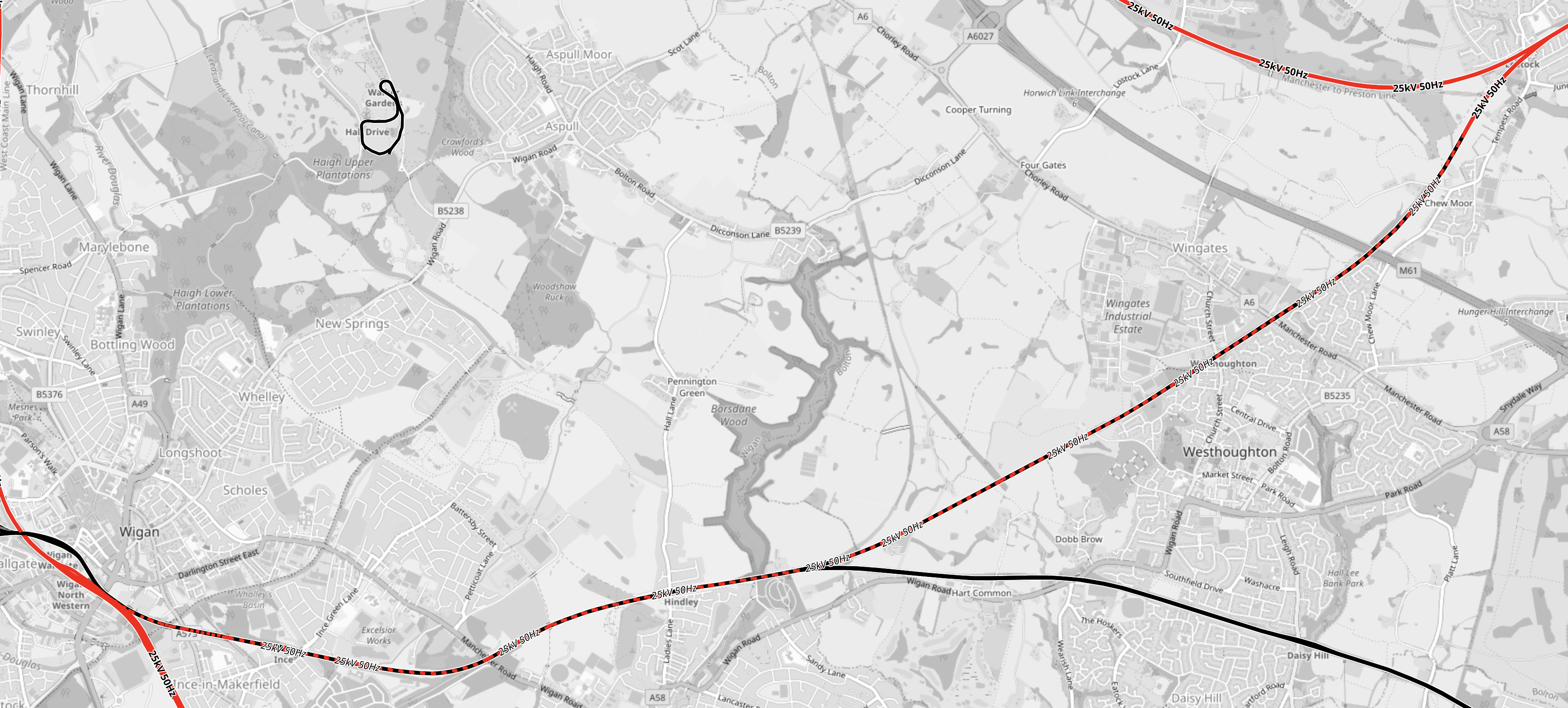
This OpenRailwayMap shows the electrification between Wigan and Lostock Junction.
Note.
- Wigan is in the South-West corner of the map.
- Lostock Junction is in the North-East corner of the map.
- The black and red line between Wigan and Lostock Junction indicates the track is being electrified with 25 KVAC overhead electrification.
- The black line going East to the South-East corner of the map is the unelectrified line to Salford Crescent via Atherton.
- At Lostock Junction the line joins the electrified Manchester and Preston Line via Bolton.
Network Rail’s layout means that trains to Kirkby, Southport and Salford Crescent via Atherton can all charge their batteries in a convenient station before embarking to their destination without electrification.
The Third Platform At Salford Crescent Station
Three platforms at Salford Crescent will give capacity advantages.
But it will also mean, that if all battery-electric trains for Wigan Wallgate via Atherton can have a dedicated platform, that if necessary, they can use to top up the batteries.
Northern’s Trans-Pennine Services
Northern Trains run four hourly trains across the Pennines.
- York and Blackpool North via Church Fenton, Garforth, Leeds, New Pudsey, Bradford Interchange, Halifax, Sowerby Bridge, Hebden Bridge, Burnley Manchester Road, Accrington, Blackburn, Preston, Kirkham & Wesham and Poulton-le-Fylde.
- Leeds and Manchester Victoria via Bramley, New Pudsey, Bradford Interchange, Halifax, Hebden Bridge, Todmorden and Rochdale.
- Leeds and Wigan Wallgate via Morley, Batley, Dewsbury, Ravensthorpe, Mirfield, Brighouse, Sowerby Bridge, Mytholmroyd, Hebden Bridge, Todmorden, Walsden, Littleborough, Smithy Bridge, Rochdale, Manchester Victoria, Salford Central, Salford Crescent, Swinton, Moorside, Walkden, Atherton, Hag Fold, Daisy Hill, Hindley and Ince.
- Leeds and Chester via Bramley, New Pudsey, Bradford Interchange, Low Moor, Halifax, Sowerby Bridge, Mytholmroyd, Hebden Bridge, Todmorden, Rochdale, Manchester Victoria, Newton-le-Willows, Earlestown and Warrington Bank Quay.
Note.
- All routes are partly electrified.
- Hebden Bridge gets four trains per hour (tph).
- Bradford Interchange, Halifax, New Pudsey Rochdale, Sowerby Bridge, Todmorden and Manchester Victoria get three tph.
- It is a comprehensive set of routes serving nearly fifty stations in the North.
Stretches of line without electrification include.
- Chester and Earlstown – 23 miles
- Leeds and Manchester Victoria – 49.8 miles
- Leeds and Blackburn – 50.2 miles
- Hindley and Salford Crescent – 16.2 miles
There may be a need to electrify Blackburn and Preston or some other short sections.
Conclusion
I have a feeling that most of the diesel services in Manchester could be replaced by battery-electric trains.
Could Hydrogen Trains Be Used As Pathfinders?
I must admit, I have a soft-spot for hydrogen transport, but I suppose most people look back on their first real job with a certain affection.
The only new hydrogen train under development for the UK Is the Alstom Hydrogen Aventra, which was announced in this press release in November 2021 and is entitled Alstom And Eversholt Rail Sign An Agreement For The UK’s First Ever Brand-New Hydrogen Train Fleet.
Little is known about these trains, except what is in the original press release.
- Ten trains have been ordered.
- Each will be three-cars.
- Contracts will be signed in 2022, which didn’t happen.
Nothing is said about the following important features.
- What will be the operating speed?
- What will be the range on a fill of hydrogen?
- Will the trains have a pantograph, so they can be run on electrified lines with 25 KVAC overhead electrification?
All are important to train operating companies, who along with the Department for Transport need to be able to plan.
What Do I Mean By A Pathfinder?
I will look at the service between Reading and Basingstoke.
- It is 15.4 miles long.
- There are four stops, which will soon be five, with the addition of Reading Green Park.
- The line is partly-electrified.
- The service is only hourly and probably needed to be two trains per hour (tph).
- It is currently run by diesel trains.
In a decarbonised railway, there are only two options for running this line.
- Use hydrogen trains.
- Electrify and use electric trains.
Note.
- The cost of the two options will be different.
- If the hydrogen and electric trains are both quality trains, the passenger experience will be similar.
- To run two tph, track and signalling modifications will be needed.
- These modifications would also allow a two tph diesel service.
- There is no way to accurately determine, how many passengers would use a two tph hydrogen and electric service.
So suppose the following plan were to be enacted.
- Upgrade the track and signalling to allow a two tph service.
- Run the two tph service with diesel trains.
- Install hydrogen infrastructure for the route. In this case, it would probably be at the nearby Reading depot.
- Run the two tph service with hydrogen trains.
Hopefully on the completion of some months of successful running of the hydrogen trains, the number of passengers to be expected will have been predicted to a better accuracy than UK railways normally manage.
Then the decision between hydrogen and electric trains can be taken.
If hydrogen trains are the decision, the trains could stay in service, but if electrification is the solution, then once the electric service is operating, the hydrogen trains would move on to the next line to be decarbonised.
Why The Alstom Hydrogen Aventra’s Need To Be Able To Use Electrification
If you look at routes, where hydrogen trains could be used as Pathfinders, they could include, some partially-electrified routes.
- Reading and Bedwyn
- Reading and Oxford
- Reading and Gatwick
- London Bridge and Uckfield
- Ashford and Eastbourne
- Preston and Blackpool South
- Wisbech and Cambridge
- Dereham and Norwich
- Basingstoke and Exeter
- Romsey and Salisbury
- York and Scarborough
This list includes both routes with both types of electrification; 25 KVAC overhead and 750 VDC third rail.
But if the electrification is there and not used, the exercise will be labelled as greenwashing, by some.
Mercedes eCitaro Fuel Cell Will ‘See The Light’ At UITP Summit 2023
The title of this post, is the same as that of this article on Sustainable Bus.
This is the first paragraph.
Daimler Buses will unveil the Mercedes eCitaro fuel cell at UITP Global Public Transport Summit in early June. At the group’s stand, visitors will have the opportunity to see the first series-production eCitaro electric bus with a fuel cell as a range extender. First order for the vehicles dates back to October 2022.
This paragraph describes the bus.
The Mercedes eCitaro in fuel cell bus version offers a stated range of approximately 350 kilometers without the need for recharging. This goes together a passenger capacity, on the articulated version, of up to 128 passengers. The difference between the eCitaro fuel cell project and most of the fuel cell buses on the market stay in the battery capacity: while it’s common to feature a small LTO battery (below 50 kWh) accompanying the fuel cell module, the eCitaro is equipped with a battery capacity similar to its battery-electric counterpart (up to 392 kWh for the 18-meter).
It looks an impressive bus with a generous capacity and range.
But I doubt we’ll see many in the UK.
- Motorists object to their blocking of junctions.
- They were easy for dodging fares.
- In London, they were dubbed Ken’s Chariots of Fire.
I don’t think politicians will chance them in the UK!
Is This The Solution To The Train Tea-Bag Problem?
One of the biggest problems on a train, is disposal of a tea-bag without getting tea everywhere.
This sequence of pictures, shows my tea on the trip to Cardiff.








At least this worked.
But then British rail catering has form, as years ago, they invented the small carrier bag to bring drinks and snacks back to your seat.
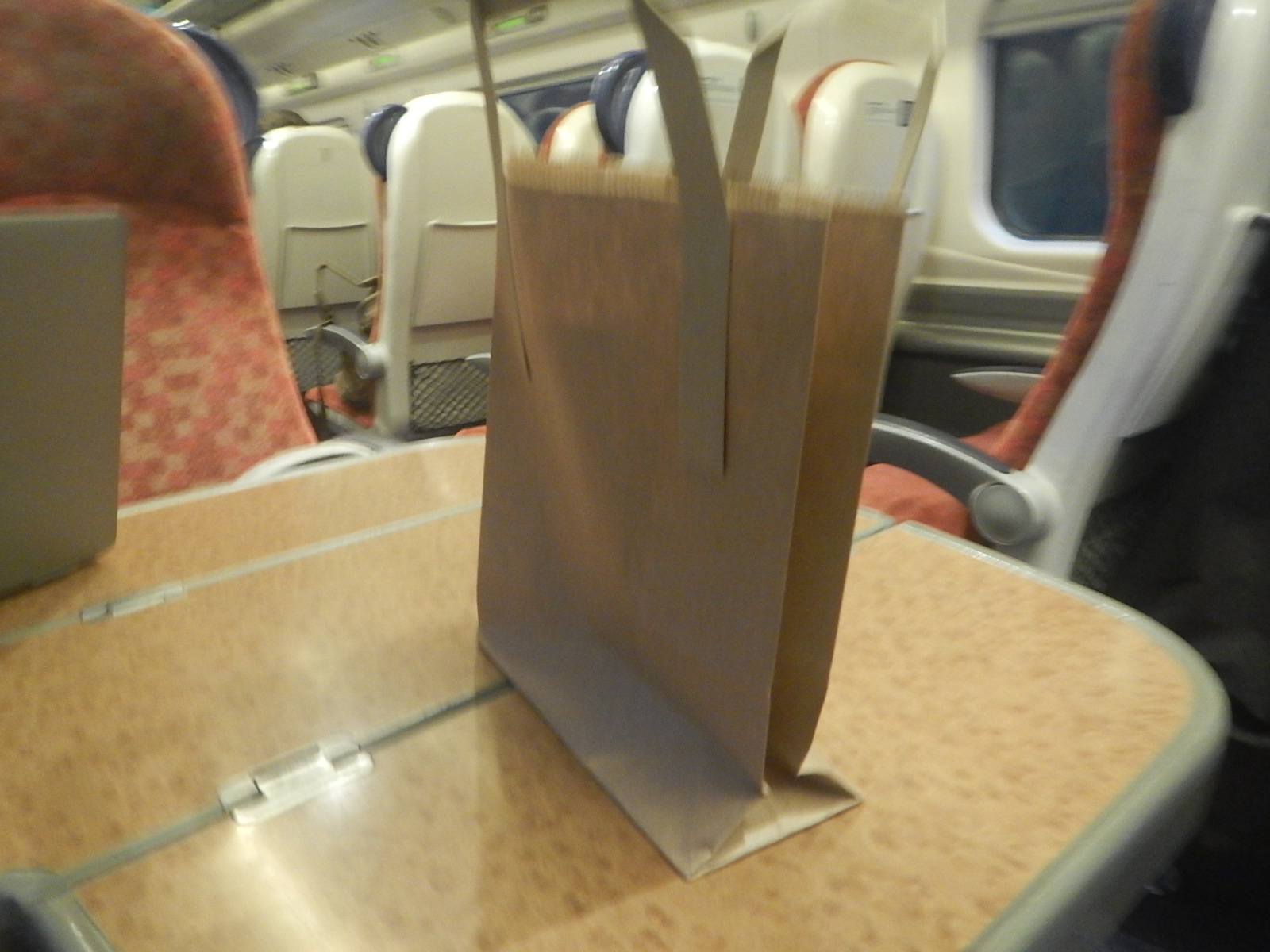
I’m always surprised, that you don’t see them more often in non-travelling takeaways.
Merseyrail Saw Over 90,000 Extra Journeys Made As Eurovision Revellers Travelled Across The Region
The title of this post, is the same as that of this article on Rail Advent.
These two paragraphs outline the story.
Merseyrail has reported an approximate increase of 24% in journeys made when compared to the same period in 2022 with an extra 90,000 trips made with the rail operator whilst Liverpool hosted Eurovision.
Special strategies were put in place to facilitate the increase in passengers, including late-night services to support the two busiest nights with trains running into the early hours following the Grand Final.
Sounds like Liverpool had a result, even if the UK didn’t.
 The Anonymous Widower