British Coal In A British Grate
This phrase was quoted in an article in The Times today by David Aaronovitch, where he likens the arguments of those who don’t believe in climate change, global warming and renewable energy, with those who were against the Clean Air Act of 1956. The MP for Bromsgrove, Michael Higgs was the opponent of the Act, who Aaronovitch quoted.
I can remember the smogs of that time and they weren’t pleasant. The only good thing was that we got sent home early from my primary school; de Bohun in Southgate. Teachers would organise us into groups and put a responsible ten or eleven year old in charge. Our parents didn’t know we were coming home, but then most mothers didn’t work in the 1950s.
I don’t think they’d do that now!
English Councils Have Large Reserves
This article on the BBC shocked me. I always get the impression that councils are strapped for cash, but the Audit Commission says that they have £13 billion in reserves.
The councils should take a leaf out of this widower’s book and put it into peer-to-peer lending in their own area. I proposed putting a regional element into something like Zopa here.
They might lose the odd bit, but it would be safer than putting the money in an Icelandic bank.
Farewell To Central London’s Biggest Eyesore
Years ago, I wrote a silly but quite funny love letter to C. At least she told me it was funny. In it I mentioned Battersea Power Station and how it was used as a last line of defence, with platforms on the chimneys. That must have been about 1966 or so, and in those days the power station was still generating electricity as it did until 1983.
It has not been a lucky building since!
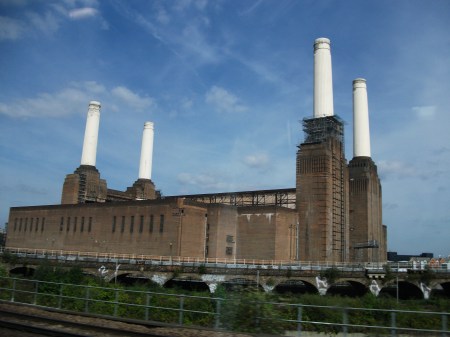
London’s Biggest Eyesore
Like many power stations of the era, it was built for a short life and a productive one. I remember going over Cliff Quay power station in Ipswich, and being told that these buildings were built in brick without the soundest of foundations. Often though, like Battersea and Cliff Quay, they were designed by good architects and often featured decorative features inside. Strangely, the one building of this type, we have left, Bankside power station, doesn’t have an elaborate interior, although now it is the superb Tate Modern. Although according to Wikipedia, that could have gone to Battersea.
Scott’s other London power station is at Battersea and is widely considered a more iconic design, with its four towers. Battersea Power Station was proposed for the Tate Modern but, due to financial constraints and less dilapidation, the smaller Bankside building was chosen.
Scott was Sir Giles Gilbert Scott, the designer of the red telephone box and the architect of Liverpool Cathedral. So perhaps it s fitting that one of his more utilitarian buildings is a home for modern art and design.
Does anybody know if there are any good examples of reusing power stations buildings around the world?
I can find two; one called The Power Plant in Toronto, Canada and another called The Power Station of Art in Shanghai.
But Battersea Power Station has not been served well by fate. It is almost falling down these days and I do wonder if it can be rebuilt economically. It seems to have disastrous affects on its developers.
But at least with George Osborne’s announcement of funding for the Northern Line Extension in the Autumn Statement, its days as an eyesore may well be numbered. But don’t uncross your fingers!
A Predictable Autumn Statement
Predictable in that it was more of the same, even if you don’t like one or more of bankers, large corporations, benefit claimants, pensioners, unions or drivers. I don’t like at least three!
Some taxes and allowances went up and some went down. Was it ever any different?
We need some radical ideas to get the economy going?
Take these statements which are more or less agreed policy between all the major parties.
1. Banks should lend more to individuals and businesses, so that they purchase capital goods and services.
2. Savers should get a better return on their money.
3. The banks should have more capital reserves.
Point 3 is the elephant in the room, as any money the banks get goes on salaries or to improve their balance sheet rather than more lending.
So let’s leave it out and go to peer-to-peer lending, where borrowers and savers are put in touch by intelligent computer systems.
The Chancellor didn’t take the radical route and help peer-to-peer lending at the expense of the banks. After all if he did, the price of all those Government bank shares would drop. So as they will continue to lose value, wouldn’t it have been better if Gordon Brown had done the prudent thing and put them down, when they went bust?
But then Labour would never have got another vote in Scotland. As it is, Labour doesn’t seem to get many!
Is This Proof That The Lottery Is A Tax On The Stupid?
This story from the BBC says it all. Someone bought a lottery ticket and then failed to claim a multi-million prize.
That makes them doubly stupid in my book.
All the lottery does is encourages more people to waste money they don’t have.
If you want to give a little to charity through the lottery, you are probably better to give it directly to a suitable charity.
I do gamble occasionally, but only where some degree of knowledge or mental skill is involved.
Starbucks And Glasgow Rangers
I’ve been reading about the tax avoidance measures of Starbucks over the last few days and it looks like they are doing a few things to normalise the situation, according to this article on the BBC.
This could be due to the protests and boycotts mounted by the good old British public.
Now some might think, that Glasgow Rangers have also cheated the tax man, by the use of Employee Benefit Trusts. According to this article on the BBC, the HMRC thinks so and is pursuing what they think should have been paid.
But surely the issue in both cases is fairness. Does their tax situation give Starbucks an advantage over their rivals? Many argue that it does.
And if it is true in Starbucks case, it must be true in that of Glasgow Rangers, as they can pay their players more money.
I would like to see one set of rules applied equally to all companies and individuals.
The Alternative Finance Routes Are Coming
I found this article on a website called Bridging and Commercial.
It talks about how Funding Circle are trying to bridge the gap in the market left by the withdrawal of ING, by paying an increased commission of 4% to intermediaries.
It is an article that should be read.
My reservations about Funding Circle is that they are very small in the overall scheme of things. They have currently lent about fifty million pounds, as against five times that amount by Zopa, which lends to individuals.
A Rather Forlorn, Cold And Manky Fox
I walked through De Beauvoir Town about five o’clock tonight.
I thought at first it was a bit of an overweight moggy, but my path in the square was crossed by a fox, who definitely looked the worst for wear and absolutely freezing in this cold night, judging by his gait.
The life of the urban fox is not as comfortable as many would like to think.
A Hat-Pin On The Overground
It’s strange what you see if you keep your eyes open.
I was travelling between Highbury & Islington and Dalston Junction stations, when I noticed a little round knob sticking out of the arm of the seat.
I pulled at it and it was a rather nice old-fashioned hat-pin.
All I can think is that it fell to the floor and someone found it. For safety they then stuck it into padding of the arm.
I handed it in at my destination and they seemed just as puzzled as I was.
But at least, it didn’t seem that it had done any damage.
And Now The Royal Baby Mug!
Today, the ultimate Christmas present for your Republican friends has been launched – The Royal Baby Mug.
Read about it here.
 The Anonymous Widower