SSE Becomes First Utility To Trial First Hydrogen Fuel Cell EV Van
hydrThe title of this post, is the same as that of this article on Hydrogen Central.
This is the first two paragraphs.
The low-carbon energy infrastructure company will be the first utility to trial the hydrogen-powered vehicle – and the first to put it to the test in real-life fleet operations by deploying the vehicle with SSE engineers.
The project will enable First Hydrogen’s team to gather data on fuel consumption, usage, and efficiency. The trials are being used to inform development of First Hydrogen’s Generation II series, currently in development, and will help enhance Total Cost of Ownership (TCO) data.
The deployment will take place in Aberdeen, as the city has some of the UK’s best hydrogen infrastructure.
The Mayor of London please note how being a hydrogen denier causes London to have more pollution.
Goodyear Releases New EV Tire For Electric Metro Buses
The title of this post, is the same as that of this article on The Buzz EV News.
This is the sub-heading.
The new Urban Max BSAEV tire was designed in partnership with heavy-duty transit bus manufacturer Gillig.
This is the first paragraph.
The Goodyear Tire & Rubber Company has introduced its newest EV-ready tire for buses and transit fleets. The new Urban Max BSAEV (bus service all-position) tire was designed in partnership with Gillig, a manufacturer of American-built heavy-duty transit buses. The Urban Max BSAEV is the first Goodyear tire engineered specifically with low rolling resistance for EV transit and metro buses to help extend range and handle the increased load capacity, the company says.
This is an idea that could roll a long way.
Does your EV have low rolling resistance tyres?
Airbus To Trial In-flight Auxiliary Power Entirely Generated By Hydrogen
The title of this post, is the same as that of this press release from Airbus.
Airbus UpNext has launched a new demonstrator programme to explore, on the ground and in flight, a new architecture for the generation of non propulsive energy through the use of hydrogen fuel cells.
On conventional airliners, the APU (Auxiliary Power Unit), a small additional engine that runs on traditional jet fuel, provides together with the engines the energy required to power a number of non-propulsive aircraft functions, such as air conditioning, onboard lighting and electric power for avionics. With this new technology demonstrator, led from its facilities in Spain, Airbus UpNext will replace the actual APU of an A330 with a hydrogen fuel cell system that will generate electricity. Known as HyPower, the hydrogen fuel cell demonstrator also aims to reduce the emissions of CO2, nitrogen oxides (NOx) and noise levels associated with a traditional APU.
New design features and integration techniques will also contribute to maturing the safety and operations of future hydrogen-powered aircraft and will demonstrate the stable operation of a fuel cell in-flight, including its restart.
This Airbus infographic describes the system.
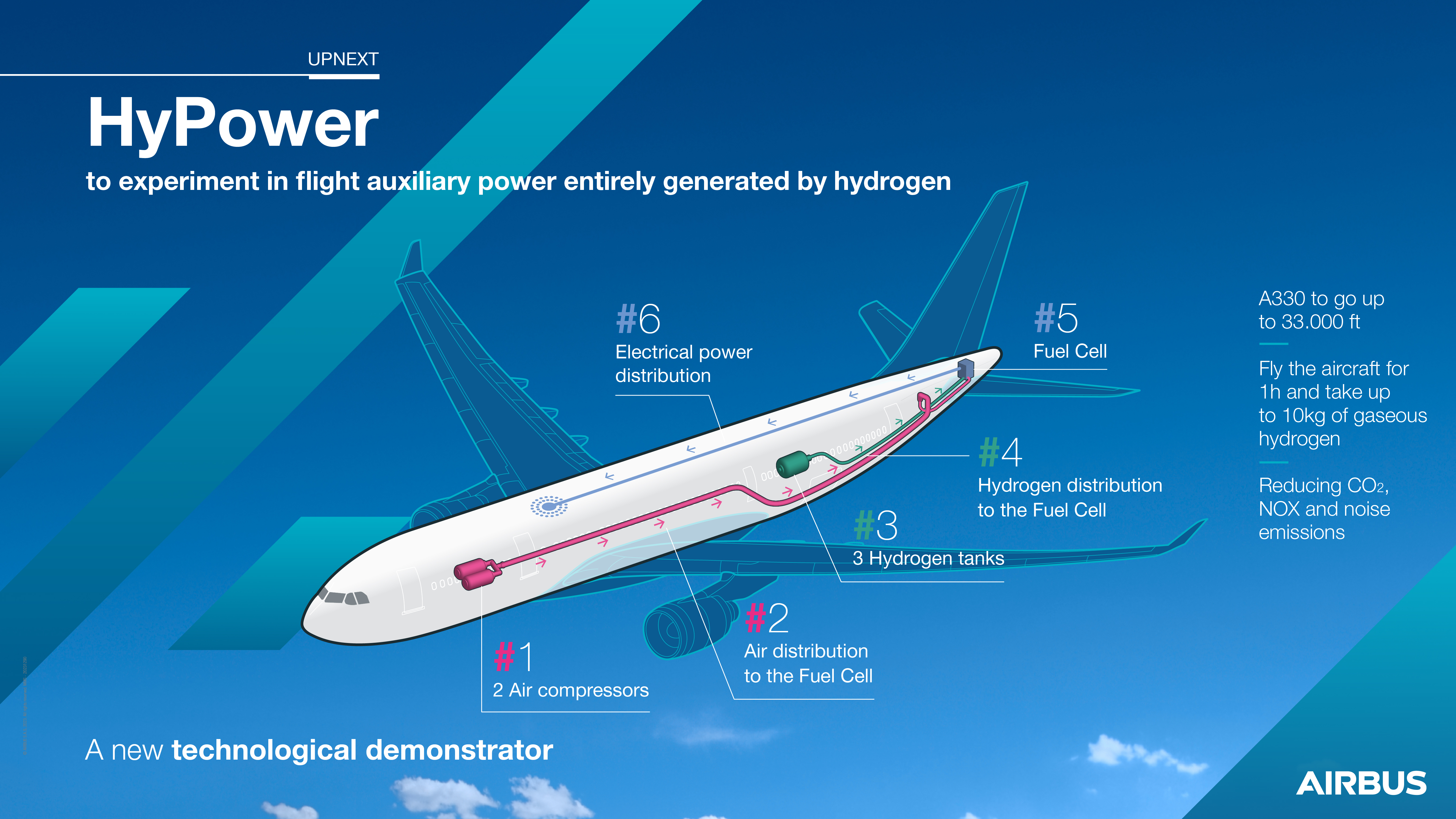
This looks to be a well-thought out project and I suspect Airbus will learn a lot about hydrogen and how to use it.
I have some thoughts.
The Noise Factor
Reduction of noise is mentioned in both the text and the infographic, so it must be important.
Years ago, I remember a take-off from St. Lucia, where on the previous day, there had been an engine failure on the flight from London. This meant we were treated to the view of a rare site of a five-engined Jumbo Jet, as the next day’s flight brought in a spare engine on the spare mounting under the wing. Engineers then worked all night to put this engine on the previous day’s stricken plane, whilst we had an extra night in the Carribean.
When it eventually came to leaving, we were on the absolutely crammed-full rescue plane, which was an almost new 747-300.
I remember the plane being positioned at the very Western end of the runway and we waited a long time before take-off. From our position towards the rear of the plane, I couldn’t see if they topped up the fuel tanks but they may have done. The pilot then gave us the good news, that we would be going to Heathrow without the usual intermediate stop at Barbados to take on fuel.
We had no problems, but I suspect the airport’s neighbours on the island didn’t like the screaming noise of the APU (Auxiliary Power Unit) disturbing the peace, whilst we waited for take-off.
A hydrogen fuel cell-powered APU could have advantages in some take-offs from perhaps smaller airports. The plane would be towed into position for take-off by a battery-electric aircraft tug, with all aircraft systems running on the hydrogen-powered APU. When everything was ready, the first engine would be started by the power from the APU and then after all engines were started and everything was ready, the plane would take off.
It looks to me, that a hydrogen-powered APU and a zero-carbon aircraft tug, could work together to reduce pre-take off pollution, carbon-dioxide emissions and noise at airports.
The Inflight Restart
Two air incidents, illustrate the need for an inflight restart of the APU.
The Wikipedia entry for the flight describes the crash like this.
British Airways Flight 38 was a scheduled international passenger flight from Beijing Capital International Airport in Beijing, China, to London Heathrow Airport in London, United Kingdom, an 8,100-kilometre (4,400 nmi; 5,000 mi) trip. On 17 January 2008, the Boeing 777-200ER aircraft operating the flight crashed just short of the runway while landing at Heathrow. No fatalities occurred; of the 152 people on board, 47 sustained injuries, one serious. It was the first time in the aircraft type’s history that a Boeing 777 was declared a hull loss, and subsequently written off.
Wikipedia gives this as the cause of the accident.
Ice crystals in the jet fuel were blamed as the cause of the accident, clogging the fuel/oil heat exchanger (FOHE) of each engine. This restricted fuel flow to the engines when thrust was demanded during the final approach to Heathrow.
Suppose this problem had occurred earlier and shut the engines down in the middle of Russia. At the 40,000 feet, they were flying, they could have probably been able to glide into the nearest suitable airport and land without main engine power. But the APU would have been needed to power the aircraft’s systems like instruments and air-conditioning.
One of my favourite books is All Four Engines Have Failed by Betty Toothill, who was a passenger on BA 009 on the 24th June 1982.
The Wikipedia entry of the flight starts like this.
British Airways Flight 009, sometimes referred to by its callsign Speedbird 9 or as the Jakarta incident, was a scheduled British Airways flight from London Heathrow to Auckland, with stops in Bombay, Kuala Lumpur, Perth, and Melbourne.
On 24 June 1982, the route was flown by the City of Edinburgh, a Boeing 747-200 registered as G-BDXH. The aircraft flew into a cloud of volcanic ash thrown up by the eruption of Mount Galunggung around 110 miles (180 km) south-east of Jakarta, Indonesia, resulting in the failure of all four engines. Partly because the event occurred at night, obscuring the cloud, the reason for the failure was not immediately apparent to the crew or air traffic control. The aircraft was diverted to Jakarta in the hope that enough engines could be restarted to allow it to land there. The aircraft glided out of the ash cloud, and all engines were restarted (although one failed again soon after), allowing the aircraft to land safely at the Halim Perdanakusuma Airport in Jakarta.
In this incident, the APU would have been needed to start the engines.
These incidents show how important the APU is to safe flying.
Some might even argue that a hydrogen fuel cell-powered APU running on its own independent hydrogen supply would be preferable than an APU based on a small gas turbine using the same fuel as the main engines.
Irish Offshore Wind Developer Teams Up With Norwegian Seaweed Farming Company
The title of this post, is the same as that of this article on offshoreWIND.biz.
This is the sub-heading.
Ireland-headquartered Simply Blue Group and Norwegian seaweed farming company, Arctic Seaweed, have signed a memorandum of understanding (MoU) under which they will jointly explore solutions for co-locating seaweed farms and offshore wind farms.
Simply Blue Group has an informative web site.
This news item on the Simply Blue Group web site gives full details of the project.
Arctic Seaweed has a web site, with this philosophy on the home page.
At Arctic Seaweed, our philosophy revolves around leveraging disruptive technology to revolutionize the seaweed cultivation industry.
We believe that by embracing scale and cutting-edge innovations, we can drive a transformative shift in the market.
Through our commitment to pushing boundaries and fostering collaborations, we are paving the way for a future where disruptive technology creates unprecedented opportunities in seaweed cultivation.
Both companies seem to be very professional.
Scotland’s Largest Offshore Wind Farm Stands Complete
The title of this post, is the same as that of this article on offshoreWIND.biz.
This is the sub-heading.
The final turbine has been installed at Scotland’s largest offshore wind farm, Seagreen, off the coast of Angus.
These two paragraphs describe the wind farm.
Once fully operational, the Seagreen project, owned by TotalEnergies and SSE Renewables, will reach almost 1.6 GW.
76 of the 114 Vestas V164-10.0 MW turbines are now energised at the site, which is located 27 kilometres from the Angus coast.
The article also says, that the units are now producing more than two-thirds of Seagreen’s full capacity power to the grid.
It seems like the Seagreen wind farm has got off to a good start.
Riveting Television
I’ve just watched an episode of Fred Dibnah’s Made In Britain, which was entitled Mechanics and Riveters.
It was fascinating stuff, but how do you decarbonise an industry like the making of rivets without using hydrogen?
30 MW Offshore Wind Turbines Being Considered For New Project In Sweden
The title of this post, is the same as that of this article on offshoreWIND.biz.
This is the sub-heading.
Freja Offshore, a joint venture between Hexicon and Mainstream Renewable Power, has submitted an application for an offshore wind farm in Sweden that could have an installed capacity of between 2 GW and 2.5 GW and, according to the project’s consultation document, could feature wind turbines of up to 30 MW per unit.
This paragraph, indicates how turbines have grown over the last two decades.
The wind turbines in the future will probably be taller, the rotor diameter larger and the turbines more powerful, the joint venture says in the consultation document, and compares the largest wind turbines launched in 2011, which have a rotor diameter of 164 metres and an installed capacity of 8 MW, with those launched 10 years later, featuring a rotor diameter of 236 metres and an output of 15 MW.
Moving on a few years to 2030 and it doesn’t seem unreasonable that turbine size will double again to 30 MW.
I could see them becoming the standard turbine, providing they aren’t too heavy for the fixed foundations or floats.
It would be an interesting exercise to model the costs of wind farms, as the turbines get bigger.
With North Sea oil and gas, I was told several times, by Artemis users, that as cranes got larger, which allowed bigger lifts, the costs of offshore infrastructure decreased.
Note.
Eviation Still Progressing Even As Alice Remains Earthbound
The title of this post, is the same as that of this article on Flight Global.
The article is a full summary of the status of the Eviation Alice project and very much a must-read.
This article on Skies Magazine, which is entitled Eviation Announces New Order For Up To 50 Alice All-Electric Commuter Aircraft, also gives this information about the order status.
In addition to the latest order from Aerolease, Eviation has also received orders from U.K.-based regional aircraft lessor MONTE (30 aircraft), U.S.-based Cape Air (75 aircraft), U.S.-based Global Crossing Airlines (50 aircraft), Germany-based EVIA AERO (25 aircraft), Australia’s Northern Territory Air Services (20 aircraft), Mexico-based Aerus (30 aircraft), Air New Zealand (up to 23 aircraft), and DHL Express for 12 Alice planes in the eCargo configuration.
Whatver, your view on electric aircraft, the total of 315 orders is impressive for a start-up.
Why Should I Pay For The ULEZ Scrappage Scheme?
The Mayor’s pet anti-pollution project the ULEZ scheme is controversial to say the least.
This article on the BBC is entitled ULEZ: Labour MPs In London Call For ULEZ Scrappage Scheme Review.
So even MPs in his own party don’t agree with the current policy!
Consider.
- I am a non-driver after a stroke ruined my eyesight.
- The only possible benefit, that I might get, is slightly less pollution around where I live.
- But the jury is out on that and the current evidence is dubious, as the Mayor has paid for it to be collected.
- In 2021, the population of London had the chance to remove Sadiq Khan, but decided to re-elect him, despite his ULEZ policy.
- So I have no sympathy for those, who have to rely on a non-compliant car or van to go about their daily business.
- They knew they had to either get a compliant vehicle, pay the £12.50 per day or move to somewhere with a friendlier transport policy.
- If the Mayor wanted to cut pollution in London, he could at least have a hydrogen policy, which allowed large trucks based in London to use this clean fuel.
We have another Mayoral election in 2024!
I shall not be voting for any candidate, who proposes to use London taxpayers’ hard-earned money for a scrappage scheme or who doesn’t have a feasible hydrogen policy.
Train Frequency Focus In North Wales Transport Commission’s Interim Recommendations
The title of this post, is the same as that of this article on Railway Gazette International.
This is the first paragraph.
The North Wales Transport Commission chaired by Lord Burns has published its interim recommendations for the development and delivery of an integrated multi-modal transport system in the region.
The following sections, outline the recommendations for rail services.
Chester Station Improvements
The North Wales Transport Commission (NWTC) supports proposed improvements at Chester station to enable additional services to operate.
This page on Transport for Wales detailed the improvements at Chester station, where this is said.
Transport for Wales is delivering significant improvements to Chester Station. The project primarily focuses on customer improvements within the station, with work to include new branding and signage, a new passenger assist point, cycle stands, roaming mics and hearing loop systems, a new full station CCTV system, toilet refurbishments on the concourse and platforms 4 and 7, a new changing place toilet, customer waiting room upgrade, water refill unit, platform and concourse seating and waste facilities.
New Customer Information Screens will be installed throughout Chester station increasing the train service information available on the platforms and within the station waiting rooms. We’ll also be installing new screens for onward journeys, including bus, and an interactive screen which will be installed on the concourse.
Improvement works in the concourse also include, repurposing of the ticket office to create a new retail unit for the future, a new rental unit, a new customer service desk with ticket selling facilities, additional ticket vending machines, a repositioned gate line with additional standard and wide aisle gates. A new quiet room will also be introduced as a place for customers who require a safe, isolated space whilst waiting for their train.
TfW is working closely with industry partners to minimise disruption during these works for both customers and the local community. Customers are encouraged to plan in extra time to allow for potential disruption during this work. Signage and hoardings will be erected at the station in advance of and throughout, these significant improvement works, and communications will be provided at the station, onboard services and online, to advise of any temporary changes to accommodate the work on site at the station.
Note.
- It looks a serious level of improvement for customers.
- The Chester and Wrexham Line was improved in 2017, with full double-tracking and higher maximum speeds.
- It looks like completion is some time in 2024.
Nothing is said about extra train services.
North Wales Main Line
The NWTC says this about the North Wales Main Line.
On the North Wales Main Line, it says the priority should be service frequency improvements and supporting infrastructure works between Crewe and Llandudno. Improvements to signalling and line capacity from Llandudno to Bangor and Holyhead would require larger scale works, which should be planned so that they are ready to progress as and when funding is available.
I went to Holyhead earlier in the year and more trains would be welcome.
Borderlands Line
The NWTC says this about the Borderlands Line.
Signalling and line capacity improvements are required along the Borderlands Line, the commission believes. A key constraint is the sidings for the Hanson site at Padeswood, where freight trains block the line for up to an hour, and the commission says this needs to be resolved before other work to improve the line can proceed.
There should be investment to reduce journey times and increase service frequencies between Wrexham and Liverpool to significantly increase the attractiveness of the route.
I talked about the freight problem in New Trains Could Be Operating Through Flintshire From May But No Green Light For Two An Hour Service.
This map from OpenRailwayMap shows the track layout at Padeswood site.
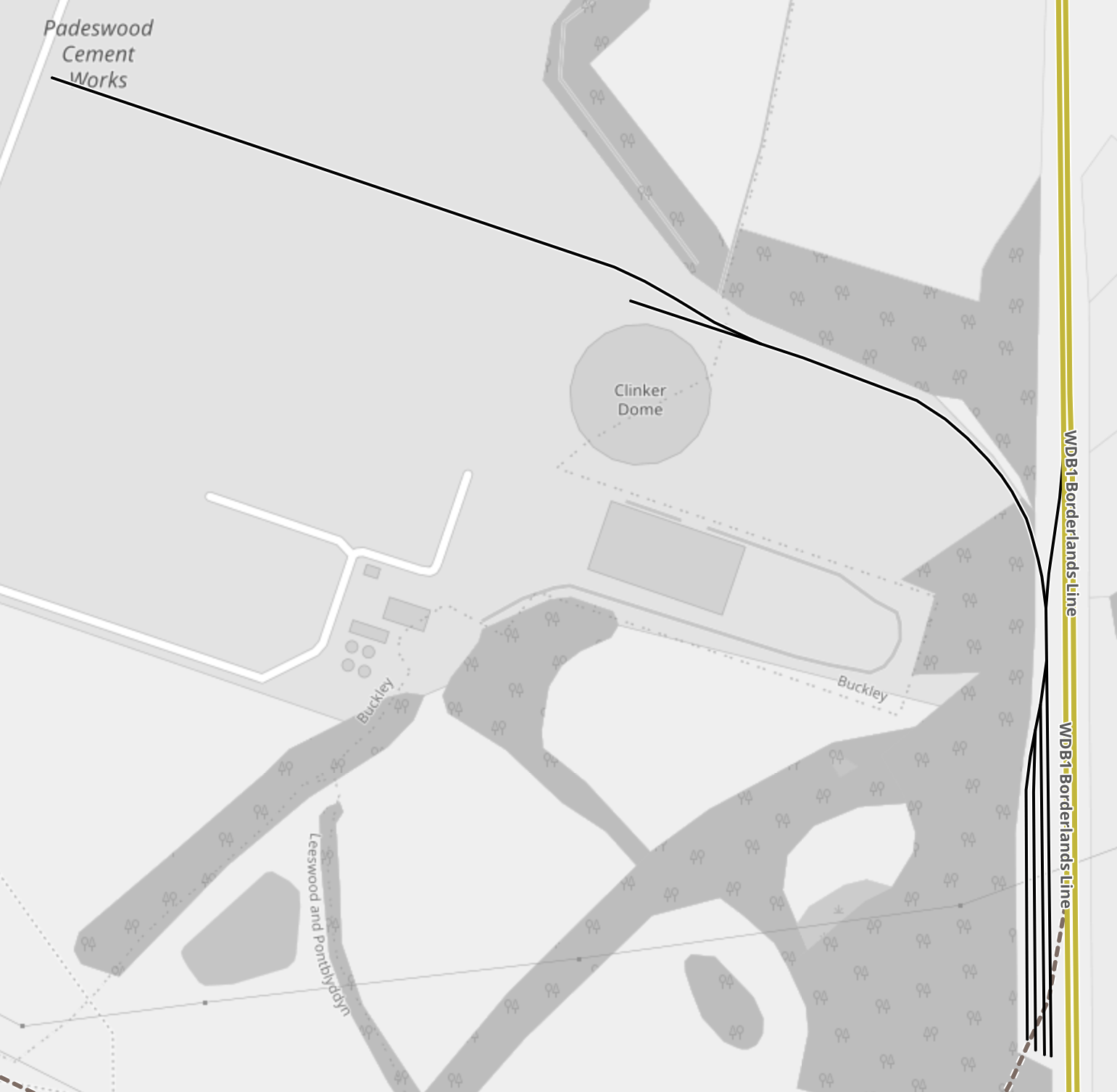
I was able to follow a train on Real Time Trains, as it left Padeswood Cement Works.
- It moved to the sidings alongside the Borderlands Line.
- It then joined the Borderlands Line and went Northwards through Buckley, Hawarden, Shotton and Hawarden Bridge stations before stopping in Dee Marsh Sidings.
- The engine then changed ends and brought the train back down the Borderlands Line to Wrexham.
- The train then continued to its destination via Ruabon, Gobowen and Shrewsbury.
This movement doesn’t seem too bad, so has there been some signalling and track improvements?
Shrewsbury And Chester Line
The NWTC says this about the Shrewsbury and Chester Line.
The commission says it has not seen a pressing case for full electrification of the Shrewsbury to Chester line, and the priority should be signalling improvements at Gobowen.
I thought that Shrewsbury and Chester might have been electrified, as it could be used to charge battery-electric going between England and Wales. But it will be some years before Transport for Wales get a battery-electric train strategy together.
On the other hand the two cities are only 42 miles apart, which is in range of battery-electric trains.
Conwy Valley And Cambrian Coast Lines
The NWTC says this about the Conwy Valley Line and the Cambrian Coast Line.
There could be merit in introducing increased frequencies on the Conwy Valley and Cambrian Coast lines during the peak season. Service enhancements and infrastructure improvements such as passing loops may be beneficial, ‘as has happened to similar lines in Devon and Cornwall’, but ’in the immediate future, those communities served by stations along the route should have access to enhanced bus services to reduce dependence on car use’.
This seems like a sensible and non-disruptive plan.
Anglesey Central Railway
The NWTC says this about the Anglesey Central Railway to Amlwch.
NWTC ‘is not persuaded’ that there is a case for opening the line to Amlwch, and says ’more urgent improvements to existing lines and services should take a higher priority’.
The Anglesey Central Railway reopening would appear to be a fairly simple project as the track is mostly already there, so this might be the sort of project, that finds itself moving up the list, if related housing or commercial developments are proposed.
This Google Map shows Amlwch and the surrounding area.
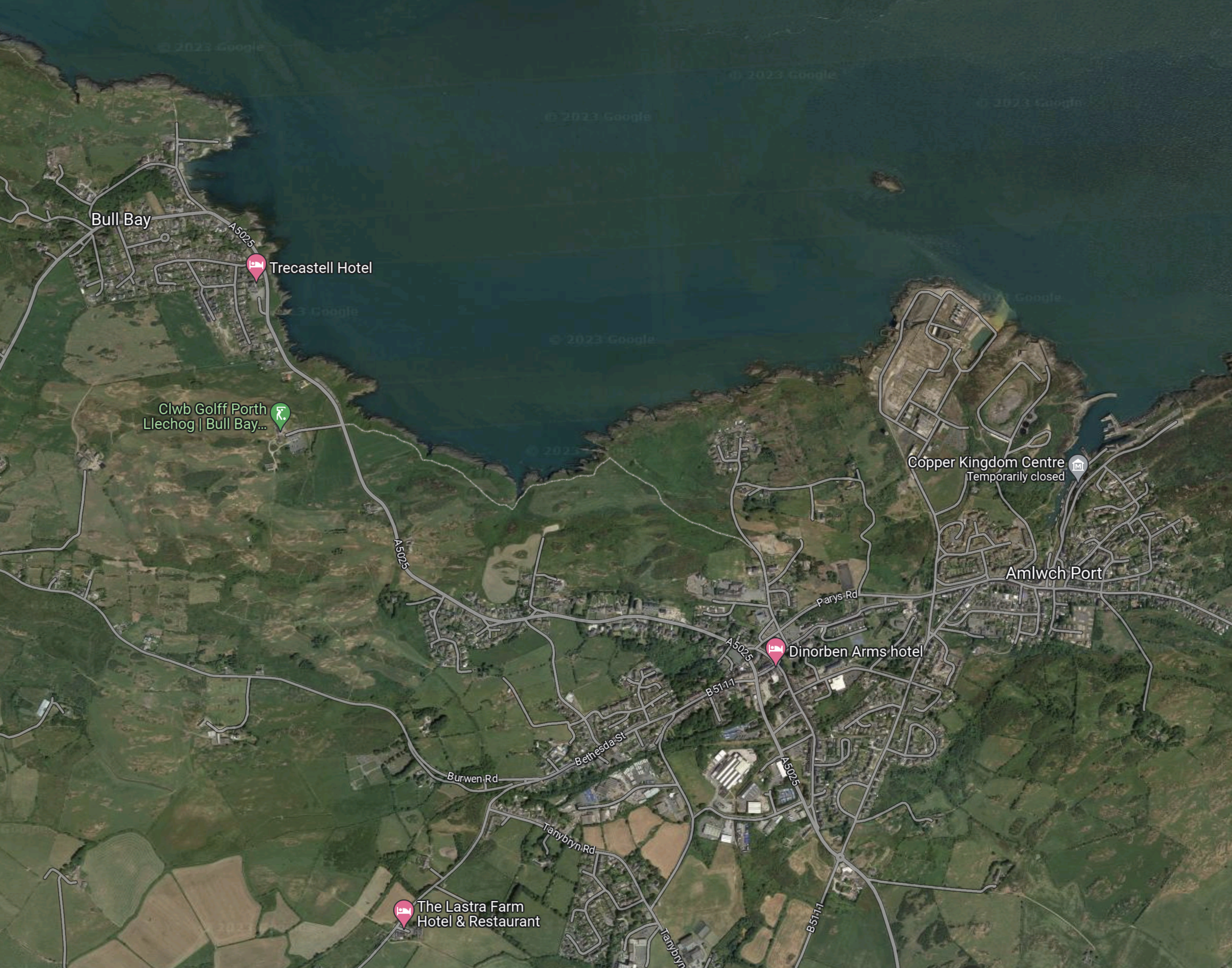
With all the tidal, nuclear and wind energy possibilities in the area, I would never rule out the rail link to Amlwch being restored.
Associated Octel used to have bromine works in Amlwch and more details can be found in this web site.
I’ve worked in chemical works with chlorine, fluorine and bromine and my advice is be very careful with them.
Criccieth And Bangor
NWTC says this about reopening the route between Criccieth and Bangor.
NWTC ‘is not persuaded’ that there is a case for opening the line between Criccieth and Bangor, and says ’more urgent improvements to existing lines and services should take a higher priority’.
This OpenRailwayMap shows the area of the reopening.

Note.
- The orange line going across the top of the map is North Wales Coast Line between Chester in the East and the Port of Holyhead on Anglesey.
- Towards the North-East corner of the map, Bangor station is indicated by the blue lettering.
- The Menai Strait runs between the Welsh mainland and the Island of Anglesey.
- The important town of Caernarfon can be picked out.
- The orange line at the bottom of the map is the Cambrian Line, which connects to Shrewsbury and Aberystwyth.
- This line terminates at Pwllheli on the Lleyn Peninsular in the South-West corner of the map.
A dotted line indicates a disused railway between the Southern coast of the peninsular and Bangor via Caernarfon, which I assume is the railway that has been proposed for reinstatement.
It could be a valuable addition to the railways of North Wales and could help to promote tourism.
Station And Other Improvements On The Borderlands Line
This is said about station and other improvements on the Borderlands Line.
The commission supports a new station at Deeside Industrial Park, and enhancements at Shotton to improve connectivity between the high and low-level platforms.
It says frequency enhancements should be prioritised over new stations, and fleet improvements should facilitate the frequency enhancements. It endorses the proposed use of Merseyrail’s Class 777 battery-electric trainsets on the Borderlands Line.
I feel that the Class 777 trains, which could travel under Liverpool are a shoe-in.
Conclusion
North Wales will be getting the railway it need to promote education, employment, leisure and tourism.
 The Anonymous Widower