And Then There Were Three!
This morning, I went to Gospel Oak station to look at what was running on the Gospel Oak to Barking Line.
I’d just watched two Class 710 and two Class 378 trains run the 10:10, 10:35, 10:50 and 11:05 trains to Barking, when another Class 710 train come through, by-passing Platform 3 and going straight on towards Barking.
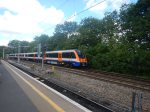
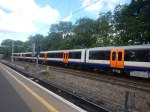
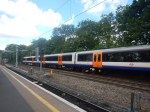
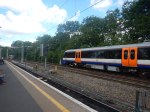
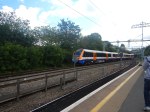
So that must mean there’s at least a third Class 710 train, either being tested, training drivers or accumulating mileage.
Checking on Real Time Trains, it appears that the train passed Gospel Oak station at 11:11 and then ran all the way to Barking station, where it arrived at 11:53, which would have been the time that the missing 11:20 train would have arrived in Barking.
I can’t find any trains disappearing, but it looks like a train joined the service in the missing 11:20 slot and another train disappears back to Willesden Depot, thus creating a slot for another train.
The outcome is the following.
- Passengers seem to be getting at least three trains in every hour in each direction.
- London Overground have at least two and possibly three Class 710 trains running between Gospel Oak and Barking.
Baldrick would be proud!
Is It Illegal To Discriminate Against Diesel Black Cabs?
I probably take one or two black cabs a week.
Usually, this is from a rank at a main line station or from outside Marks & Spencer on Finsbury Pavement, when I have a lot of shopping.
A couple of days ago, I was waiting outside Moorgate station for a 21 or 141 bus to travel home, as these conveniently stop within a hundred metres of my house.
Note that I prefer the 21 bus, as its’s a New Routemaster, which are more spacious.
But as no bus seemed due and I was in a hurry, I decided to take a black cab.
So I made a deal with myself. Whichever cam first of a 21 bus or a battery electric taxi would take me home. The bus came first and I got in.
I think now, that there are more battery electric taxis on the streets, in Central London, the chances of being picked up by one are increasing significantly.
But is it illegal to discriminate, as I now appear to be doing?
I would argue, that my choice of a battery electric taxi is not environmental but selfish! These new taxis are more comfortable, spacious and quieter, making the journey experience much more pleasurable.
After all, why would you travel in a Ford or Vauxhall, when you have the comfort of a Jaguar? Especially, as the cost of both vehicles is the same!
A Trip Around The West Midlands
Today, I did a trip around the West Midlands, using five different trains.
Tain 1 – 19:10 – Chiltern – London Marylebone To Leamington Spa
This was one of Chiltern’s rakes of Mark 3 coaches hauled by a Class 68 locomotive.
I like these trains.
- They are comfortable.
- Everybody gets a table and half sit by a big window.
- There is more space than Virgin Train’s Class 390 trains.
- They may be slower, but they are fast enough for most journeys I make.
The train arrived seven minutes late at Leamington Spa at 11:32.
Train 2 – 12:02 – West Midlands Trains – Leamington Spa To Nuneaton
This is a new West Midlands Trains service, via the new station at Kenilworth and Coventry.
The trains are Class 172 trains, that used to run on the Gospel Oak to Barking Line.
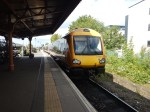


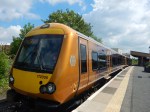


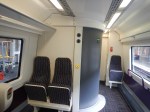


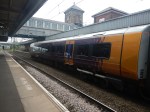

Note.
- The have been repainted and refreshed.
- The seat cover on the driver’s seat is a relic of the London Overground.
- The train now has a toilet.
The train was about half-full and I got the impression, that the new service had been well-received.
The train arrived on time at Nuneaton at 12:38.
Train 3 – 12:54 – West Midlands Trains – Nuneaton to Rugeley Trent Valley
The train was a Class 350 train and it arrived eight minutes late at 13:29.
These pictures show Rugeley Trent Valley station.

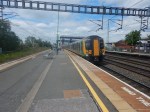
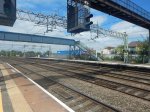
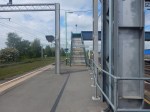
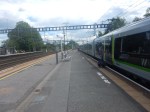
It is very minimal with just a shelter, a basic footbridge and no information on how or where to buy a ticket.
Passengers deserve better than this!
Train 4 – 13:43 – West Midlands Trains – Rugeley Trent Valley to Birmingham New Street
This is a new West Midlands Trains electric service.
Compared to the Leamington Spa to Nuneaton service, passengers were spread rather thinly in the train.
The train was a Class 350 train and it arrived five minutes late at 14:44.
Train 5 – 15:55 – Chiltern – Birmingham Moor Street to London Marylebone
Another comfortable Chiltern Railways train back to London, which arrived four minutes late at 17:47.
Customer Service
Customer service and especially that from West Midlands Trains was rather patchy.
- Leamington Spa station was rebuilding the entrance, but staff were around.
- Nuneaton station was very quiet.
- Rugeley Trent Valley station needs a lot of improvement.
- The two Birmingham City Centre stations were much better.
I actually had to travel ticketless from Rugeley Trent Valley to Birmingham New Street, as the Conductor on the train didn’t check the tickets.
But Virgin Trains were very professional at Birmingham New Street.
Service Pattern
I have some observations on the service patterns.
- For comfort reasons, I would prefer that Chiltern ran Mark 3 coaches and Class 68 locomotives on all Birmingham services.
- In the future, it looks like Leamington Spa and Nuneaton needs at least a half-hourly service.
- There definitely needs to be more services on the Chase Line.
There also is a serious need for staff and better facilities at Rugeley Trent Valley station.
No-one even a hardened member of the SAS would want to spend thirty minutes changing trains there on a blustery and cold winter’s day.
Conclusion
I tried two new services today, that started on the May 2019 timetable change.
- A diesel service between Leamington Spa and Nuneaton via Kenilworth and Coventry.
- An electrified service between Rugeley Trent Valley and Birmingham New Street.
The first would appear to be what passengers want, but the second needs a bit of promoting.
Egypt To Power Europe By Underwater Cable
The title of this post is the same as that of a short news item on page 32 of today’s Times.
Egypt appears to be using gas from four new offshoregas fields to generate the power.
But surely, they could also use solar, as I’ve heard Egypt gets a lot of sun!
I do think though, that countries like Egypt, Libya, Tunisia and Morocco, which are all reasonably close to Europe could generate substantial amounts of solar power, which could then be exported to the North, through undersea cables, which are not very long using today’s technology.
I also think, that solar power will grow Southwards from the countries bordering the Mediterranean.
Will these basket case countries like Sudan, Mauritania, Somalia and Chad, acquire both an income and the electricity they need to improve the lot of their people?
Whether, their people will benefit, is another question, but Europe’s need for green energy could be the need, that these countries will fill, using unproductive desert.
I also think, there’s scope to combine solar farms with agriculture in the shade to create the food they need.
Read Solar Farms And Biodiversity on Solar Power Portal.
Stop It! Phone App Cries Out To Deter Japan Subway Gropers
The title of this post, is the same as that of an article on page 31 of today’s Times.
An app has been developed and deployed in Japan, where if a lady being groped on the Subway if she presses a button on the app, it displays an appropriate message on her phone.
If the groper persists, then another button, shouts out a message.
As a regular traveller on crowded London Underground and Overground trains, I know groping goes on, but I have never seen it happen, except between obviously consenting couples, who arrived and left together.
Although, you do get the odd bumping at times, but usually smiles and a sorry, say it is a genuine accident.
Tell Patients To Ditch Diesel, Doctors Urged
The title of this post is the same as that of an article on the front page of today’s Times
It may be a sensible idea, but a lot of patients wouldn’t like it.
I suspect too in Inner London, where I live, the message has got through, as you meet more and more people, who are deciding that driving is not for them!
Abbey Line Passing Loop Proposed
The title of this post is the same as that of an article in the June 2019 Edition of Modern Railways.
Bricket Wood station used to be an important station on the Abbey Line, with grand buildings and a passing loop to allow trains to run a teo trains per hour (tph) service as opposed to the current inconvenient train every forty-five minutes.
Consultants have now said that a traditional passing loop, with a second platform and a bridge would cost up to £10million, which is probably not viable.
The Penryn Solution
The article says this about the consultants’ alternative solution.
The platform at Bricket Wood be lengthened such that trains stop at different ends of a single platform, similar to the solution adopted in Penryn on the branch line from Truro to Falmouth, which would help to minimise costs.
This Google Map shows Penryn station.
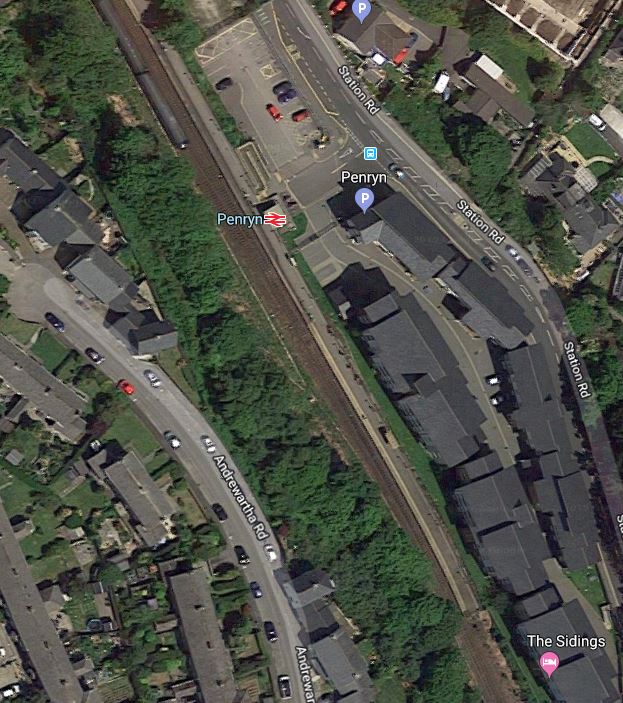
Note the long single platform in the station.
This section in the Wikipedia entry called Signalling, gives a full explanation of the method of operation at Penryn.
Truro-bound trains use the northern end of the station (Platform 2), arriving before the Falmouth-bound train, which will pass through the new loop and to the southern end of the platform (Platform 1), allowing the Truro-bound train to continue its journey north. This gives a rare situation in the United Kingdom where trains run on the right, instead of on the left as is usual in this country. Trains are scheduled to depart simultaneously for Truro and Falmouth.
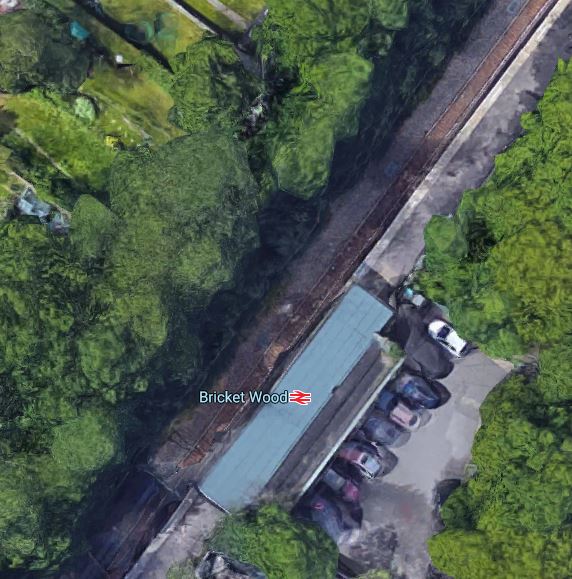
Bricket Wood station already has a platform, that can take a comfortably take a four-car Class 319 train, as this Google Map shows.
Consider.
- I estimate from Google Maps, that the single platform at Bricket Wood station is currently around 190 metres long.
- Looking at the map, it might be possible to add another ten metres or so to the platform length.
- The current Class 319 trains are 79.5 metres long or 159 metres for a pair.
- It wouldn’t matter, if for reasons of safety, the front of the trains were allowed to extend for perhaps ten metres past the end of the platform.
- There also appears to be space to put a second track alongside the current single track.
I also suspect, that Network Rail have track design software, that can precisely calculate the size and position of the points, so that the manoeuvre can be safely executed every time.
I very much feel, that a design can be produced, that will staff, passengers and regulators.
Can This Proposal Handle More Than Two tph?
If you look at the timings of the train, it takes eight minutes to run these legs.
- Watford Junction and Bricket Wood
- Bricket Wood and St. Albans Abbey
The times are identical, irrespective of direction.
If times are the same after installation of the novel loop. A train will take sixteen minutes plus however much time, it takes to turnback the train to get back to Bricket Wood.
As trains will be running every thirty minutes and both trains will leave Bricket Wood at the same time, the train must be able to run the out-and-back journey from Bricket Wood in thirty minutes or less.
- The out and back legs both take eight minutes.
- This means that the turnback time must be less than fourteen minutes.
Currently, turnback times are fourteen minutes or less.
- If you look at four tph, there is a train every fifteen minutes. As each leg is eight minutes long, it would appear another method of operation will have to be used.
- If you look at three tph, there is a train every twenty minutes. Would it be possible to turn back the trains in under four minutes? It might be possible, but it would be a tough call.
I would suspect, that for a reliable service, the proposed method of operation has a maximum frequency of two tph.
I suspect, that the only way to get more than two tph, would be to fully double track the route, with two platforms at all stations on the route.
Does The New Track Need To Be Fully-Electrified?
There would be around two hundred metres of new track and if electrification were to be installed, a pair of the current Class 319 trains could provide a two tph service.
Surely Network Rail can manage to put up this amount of new electrification without massive cost and time overruns?
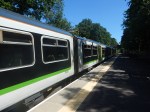
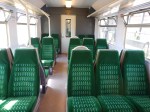
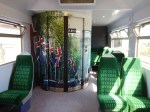
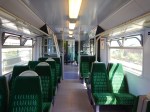
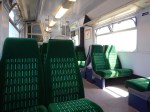
Despite being over thirty years old, the Class 319 trains scrub-up well as these pictures show.
But what could be done if electrification was deemed to be outside the budget? Or it was decided that new zero-carbon trains should be used on the Abbey Line?
Battery trains are coming and there are several trains that can use both electric and battery power under development, in the UK, Europe, China and Japan.
Battery Power On The Abbey Line
Bricket Wood station is 3.5 miles from the Watford Junction end of the Abbey Line and perhaps three miles from the St. Albans end.
In an article in the October 2017 Edition of Modern Railways, which is entitled Celling England By The Pound, Ian Walmsley says this in relation to trains running on the Uckfield Branch, which is not very challenging, as is the Abbey Line.
A modern EMU needs between 3 and 5 kWh per vehicle mile for this sort of service.
So if a four-car electric-battery hybrid train was to handle the whole of the 6.5 mile route, it would need a battery of between 156-260 kWh to go between Watford Junction and St. Albans Abbey stations and back. It would also need charging at one or both ends of the route.
But supposing trains used the current electrification between Watford Junction and Bricket Wood stations to both power the train and charge their batteries.
- The trains would only be doing six miles on batteries, so the battery would be between 72-120 kWh.
- Trains would raise and lower their pantographs at Bricket Wood station.
- No new electrification would be required.
- If trains needed to top-up their batteries, they would do this using the electrification in the two terminal stations.
It might even be preferential to remove electrification between St. Albans Abbey and Bricket Wood stations to save maintenance costs and improve safety.
Could West Midlands Trains’ Class 730 Trains Be Used?
The current franchise holder; West Midlands Trains has ordered a large fleet of Class 730 trains for services between London and the West Midlands and for local electric services in the West Midlands.
Included are thirty-six three-car trains for working suburban services across Birmingham. These have twenty-four metre long cars, so are eight metres shorter than the four-car Class 319 trains, so they are another possibility, unless their longer car length would cause problems in the Bricket Wood manoeuvre.
Should The Abbey Line Be Transferred To Transport for London?
There have been suggestions in the past, that the route be transferred to Transport for London.
I’ll leave the politics aside, but electric-battery hybrid versions of London Overground’s Class 710 trains, which will soon be serving Watford Junction station would probably be ideal.
As they are dimensionally similar to the Class 319 trains, they may also be able to work the route under electric power.
Conclusion
There are certainly, several affordable ways to improve the Abbey Line.
My preferred solution would be go for the Penryn solution, using a fleet of Class 319 trains.
- Penryn seems to be working well.
- Track would need to be re-laid through Bricket Wood station, to add the passing loop.
- About two hundred metres of extra electrification would need to be erected.
- There would probably need to be some modification to the signalling, as there was at Penryn.
- Three trains as a minimum, would be needed, two for the service and one as a spare or as maintenance cover.
- West Midlands Trains already have fifteen Class 319 trains, so finding a viable fleet in top-class condition, shouldn’t be difficult.
- If slightly shorter trains could be needed, the trains might be able to be shortened to three-car trains.
- Staff training would be minimal.
- The current trains are liked by drivers.
- The trains would be zero-carbon.
- The current trains are in very good condition.
- The current trains even have toilets, which are probably not needed on a six-and-a-half mile journey
- If say in ten years time, new trains are needed, I suspect there will be fleets of suitable electric multiple units, less than eighty metres long.
It is probably the most affordable solution.
North West Hydrogen Alliance Focuses On Low-Carbon Transportation
The title of this post is the same as that of this article on Gasworld.
This is an extract.
A study is currently underway to look at the feasibility of using hydrogen produced at chemical company INOVYN’s Runcorn site to power buses on the street of Liverpool.
It was also recently announced the Liverpool City Region will become the first area in the North of England to trial hydrogen buses following a £6.4m government funding bid, with a new refuelling station at BOC’s hydrogen plant in St Helens.
INOVYN is owned by INEOS, so are they getting involved with hydrogen?
I knew that site well in the late 1960s, when I worked there in the chlorine cell rooms, that made hydrogen and chlorine by electrolysing brine.
Life goes round in circles.
I heard some in those days, say hydrogen was a bit of a problem! Now it’s a valuable resource.
But I always remember a senior engineer, saying the only waste products that should come out of a chemical plant was pure water.
And Finally!
They have been a long time coming, but today two Class 710 trains, started running on the Gospel Oak to Barking Line.
I took these pictures.
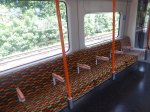
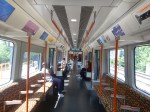
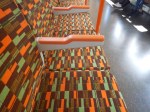
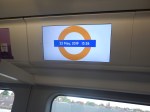

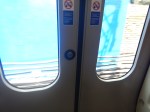
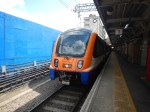
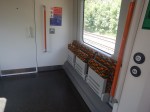
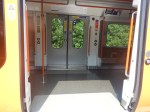
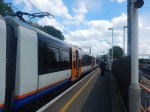
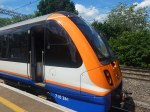
They certainly stand out with their large orange noses.
A few thoughts on various topics.
Doors And Controls
The doors are all double and wide as they should be for easy entry.
There are also full door controls on each side of the door and a door opening button in the door itself.
So on a crowded train, there won’t be the problem, you get on some trains, that the buttons are blocked by a large person standing in the way.
Information Displays
They are clear and very much follow the style of the displays on the Crossrail trains.
Although, they do have a clock, that seemed to be liked by other passengers and myself.
I also suspect the displays can be used advertising.
Noise
Like the Class 345 trains, they are quiet inside.
Seats
The longitudinal seats are as comfortable as those of their elder siblings; the Class 378 trains.
There are also lots of armrests.
As on those trains, passengers find their own place to put their legs and the passage up the middle of the train seems to stay free.
There are also no perches either side of the door, as in the Class 378 trains. It this to cut out canoodling?
USB Sockets
There isn’t a large number and they are only accessible from a few seats.
This picture shows the sockets on a Vivarail Class 230 train.
I think each armrest should have one.
Wi-Fi
I tested it and it worked
The Train Software
If I was designing something like a train, a tram, a bus or a car, the vehicle would have a backbone, that was compatible with the Internet.
The train software, that seems to have caused the delay could even be an operating system, like the one on your computer or phone.
In my experience, operating systems are very difficult to write, but once they are working, the following is possible.
- They work for all compatible computers, phones or trains.
- They can analyse the hardware to see what they’ve got connected.
- A large team of programmers can write compatible additions, just like thousands write apps for mobile devices.
I also believe that testing operating systems work as they should is one of the most difficult things to do in computing.
I don’t believe that the delay to the Class 710 trains because of software problems has been overly long in my experience.
Complex systems just take an awful long time to get write.
The good news though, is that if Bombardier have got their design right, they may well have cracked the computer systems for all other Aventras.
Conclusion
They tick a lot of boxes and I like the design.
I also feel that if Bombardier have solved the software problems, then Aventras could be delivered in a steady stream.
 The Anonymous Widower