Class 230 Trains On The Conwy Valley Line
I suspect to some people, the use of Class 230 trains, which are rebuilt London Underground D78 Stock on the Conwy Valley Line is a challenge to far.
Class 230 Trains
I wrote about these trains in First D-Train With Transport for Wales In March 2019, where I stated that the train formation will be.
- DM – Driving Motor with battery
- T – Trailer with four generators
- DM – Driving Motor with battery
As the trains will have regenerative braking, this will be used to help charge the batteries.
Note that batteries and traction motors are only in the Driving Motor cars.
The Conwy Valley Line
The route of the single-track Conwy Valley Line can be summsarised as follows.
- From Llandudno to Llanrwst it is a fairly level route alongside the River Conwy.
- From Llanwrst the line climbs to a 240 metre summit in the Ffestiniog tunnel, with gradients as steep as 1-in-47.
- From the summit, the train descends into Blaenau Ffestiniog with gradients as steep as 1-in-43.
It has some of the characteristics of a roller-coaster.
Class 230 Trains On The Conwy Valley Line
Provided the trains can handle the gradients either side of the summit, they can just roll down the other side. During the descent, the regenerative braking will charge the batteries.
This will have the following effects.
- Trains on the downhill sections will not need to use their diesel engines.
- Trains waiting in Blaenau Ffestiniog station, won’t need to use their diesel engines until they start back to Llandudno.
- I suspect some Northbound services, trains would be able to reach Llandudno without using their diesel engines.
Gravity is being used as an energy store to create an efficient railway!
Energy Of A Class 230 Train On The Conwy Valley Line
I am curious to know how much energy is needed to get a fully-loaded train up the hill from Llandudno to Blaenau Ffestiniog.
Consider the following.
- A D78 Driving Motor car weighs 27.5 tonnes
- A D78 Trailer car weighs 19 tonnes
- Wikipedia says “For the Country layout, each D-train unit is to be a three-car formation, which would accommodate 163 seats along with a total capacity of 291.”
- I assume each passenger weighs 90 Kg with baggage, buggies and bicycles.
- I think it is fair to say that each generator and battery weighs about a tonne.
- The summit of the line in the Ffestiniog Tunnel is 240 metres above sea level.
- I will assume that the coastal end of the route is at sea level.
This means that the empty train weighs eighty tonnes and a full load of passengers weighs twenty-six tonnes.
Using Omni’s Potential Energy Calculator, this gives a potential energy for the train of seventy kWh, at the summit with a full load of passengers.
This figure means that if two 55 kWh batteries from a New Routemaster bus were used on the train and they were fully-charged, then they could power the train to the summit and on to Blaenau Ffestiniog.
It should be noted that Vivarail talk about using 106 kWh battery rafts on the Class 230 train.
A Few Questions
I have these questions.
Are These Class 230 Trains Serial Hybrids?
I ask this question, as it could be key to making the operation of the trains more efficient on this line.
The train would always be powered directly from the batteries.
- The diesel engines would cut in to charge the batteries, when the battery charge level got to a certain low level.
- The diesel engines would cut out, when the battery charge level, got to a certain high level.
As the train has four generator sets, an appropriate number could be used as required.
A well-trained driver or an intelligent control system could make these trains very efficient.
In this article on RAIL Magazine, this is stated.
Shooter told RAIL that the trains will save around 20% on fuel consumption.
Adrian Shooter is Chairman of Vivarail, who are creating the Class 230 trains.
Possible Electrification Of The Ffestiniog Tunnel
The Class 230 trains are created from London Underground D78 Stock and I suspect it would be possible for the Class 230 trains to be powered by third-rail electrification.
The Ffestiniog Tunnel is the summit of the Conwy Valley Line.
- It is a single-track.
- It is 3.5 kilometres long.
- One end of the tunnel is close to Blaenau Ffestiniog.
Would it be a sensible idea to electrify the tunnel either fully or partially, to top up the batteries?
Consider.
- The third-rail electrification would be no intrusion in the landscape.
- The electrification could only be switched on when a train is present.
- I don’t think supplying power would be difficult.
- There could be less need to run on diesel.
The electrification could even be extended to wards Blaenau Ffestiniog station, so that trains leaving the station could have electrical power to climb to the summit.
Will The Class 230 Trains Attract Passengers?
I think that the Class 230 trains have several passenger-friendly features.
- All new interiors.
- Ten percent more seats and almost twice the capacity.
- Lots of space for bicycles
- Large windows
- Wi-fi and power sockets
- Accessible toilet
Hopefully, there will also be step-free access between train and platform.
This package of improvements should encourage more to travel.
I also suspect, that having a decent train with a novelty appeal that connects to the Ffestiniog Railway will tap a new market of travellers.
Conclusion
I have no doubt, that Class 230 trains will be able to provide a successful service on the Conwy Valley Line.
Between Liverpool Lime Street And Chester Stations
Currently, using Merseyrail‘s Wirral Line, a journey between Liverpool Lime Street and Chester stations takes around forty-five minutes.
This time will improve by several minutes, when the new Class 777 trains come into service in a couple of years.
In Slow Trains Outside The South-East, I calculated that this time could be as low as 35 minutes.
Using The Halton Curve
But how fast could a train go between Liverpool Lime Street and Chester stations, using the Halton Curve, when that comes into use in December 2018?
Consider.
- West Midlands Trains take nineteen minutes to go between Liverpool Lime Street and Runcorn stations with a stop at Liverpool South Parkway station.
- The current parliamentary train takes twenty-one minutes between Chester and Runcorn stations using the Halton Curve.
- Transport for Wales will run the route with their new 100 mph CAF trains.
It should be possible for the direct trains to do the trip between Liverpool Lime Street and Chester in under forty minutes, with stops at Liverpool South Parkway, Runcorn, Frodsham and Helsby stations.
As to the frequency of the service between Liverpool Lime Street and Chester stations via the Halton Curve, under Improvements in the Wikipedia entry for KeolisAmey Wales, these services are listed.
- Introduction of a new hourly Liverpool to Chester service from December 2018
- Introduction of a new hourly Liverpool to Llandudno and Shrewsbury service from December 2022
- Introduction of a new two-hourly Liverpool to Cardiff service from December 2022
So it looks like there will be at least a train every half-hour between Liverpool Lime Street and Chester.
Liverpool Airport
One advantage of using the Halton Curve, is that as trains can call at Liverpool South Parkway station, it would be possible to provide a direct link to Liverpool Airport.
Merseyrail are looking into the possibility of using tram-trains on this route.
Direct Services Between Liverpool Lime Street And North Wales
Consider.
- Virgin Trains take forty-eight minutes between Chester and Llandudno Junction stations.
- Virgin Trains take ninety-nine minutes between Chester and Holyhead stations.
- Currently, Liverpool to Llandudno takes between 110-120 minutes with a change at Chester station.
I wouldn’t be surprised to see timings of direct trains between Llandudno and Liverpool Lime Street stations in the order of an hour-and-a half.
Electrification
Electrification is the big question, hanging over railways in this area.
Merseyrail already runs electrified services to Chester on the Wirral Line and the following routes have been earmarked for electrification.
- Chester to Crewe
- Chester to Manchester
If the latter were to be electrified, then only the relatively short Halton Curve would need to be electrified to create another all-electric route between Liverpool and Chester.
Bi-Mode Trains For KeolisAmey Wales
If Chester station, were to be electrified, this will have possible consequences for KeolisAmey Wales, as all their services Eastwards from Chester to Birmingham, Liverpool and Manchester would be running on fully-electrified routes.
So will KeolisAmey Wales order some of new CAF trains with a bi-mode capability.
This capability could also be useful in South Wales.
A Day Out From Liverpool
I was staying at the Premier Inn close to Moorfields station in Liverpool and decided to go to Blaenau Ffestiniog for the day, with hopefully, a ride from there on the Ffestiniog Railway to Porthmadog on the coast.
The following sections describe the route I took.
Moorfields To Chester
After buying a Day Return from Liverpool Stations to Blaunau Ffestiniog with my Senior Railcard for £20.40, I took one of Merseyrail‘s four trains per hour (tph) from Moorfields station, that goes direct to Chester station.

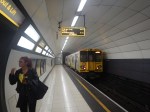
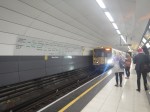
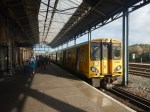
The train was one of Merseyrail’s Class 508 trains, which are nearly forty years old. Although, they were refurbished a few years ago and get much better TLC. I’ve yet to see a Merseyrail train, that has suffered from spray painters!
It always surprises me, how many people I’ve met, who’ve been for a weekend to Liverpool and haven’t used the Merseyrail system, that has four stations in the City Centre and connects to attractions in the North, South and on the Wirral.
Over the next few years, it will be getting larger and better.
- New Class 777 trains will replace the current ones.
- The new trains will have a battery capability to extend routes.
- The network will be expanded to Skelmerdale and possibly Preston and Wrexham.
- A connection to Liverpool Airport is a possibility.
- New stations will be added.
It should also be noted, that after the extensive works at the main Liverpool Lime Street station, that extra direct main line services will be introduced.
- Chester, Lladudno and Shrewsbury via the Halton Curve.
- Edinburgh and Glasgow via the West Coast Main Line.
If I was going between Liverpool and Llandudno from next year, I will have two routes.
Chester Station
I think it is truthful to say that Chester station needs improvement.


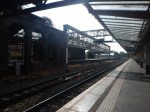
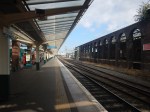
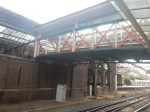
According to Transport for Wales, improvement is coming by 2028.
It certainly needs it!
- Chester is one of England’s historic cities.
- Many residents of Chester commute to Liverpool and Manchester.
- Chester station is a main railway interchange between North Wales and Birmingham, Liverpool, London and Manchester.
- The station doesn’t have enough staff or a decent passenger information system.
As the station is managed from Cardiff, does it suffer from being out of sight and out of mind?
Chester To Llandudno Junction
From Chester to Llandudno Junction station took about an hour in a Class 175 train, along the North Wales Coast Line.
The scenery is mixed as these pictures show.

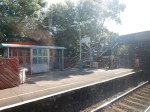






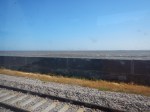






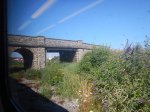
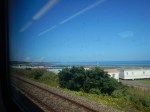
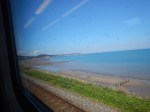
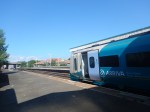

The line has an operating speed of ninety mph, but the train didn’t seem to travel at much over seventy.
The signalling is being improved and it strikes me, that the section of the line to the East of Llandudno could become a route, where Virgin’s Class 221 trains and the new Welsh diesel multiple units to be built in Newport, could really crack on and improve timings.
Up The Conwy Valley Line
Blaenau Ffestiniog has an altitude of 215 metres, and Llandudno Junction has an altitude of perhaps less than ten metres.
The Class 150 train was fairly well loaded, but it managed the climb on the Conwy Valley Line easily.



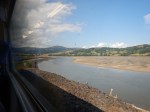




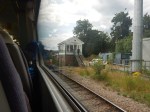
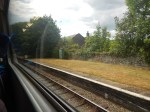
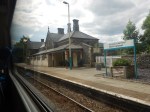
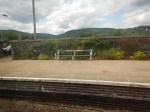


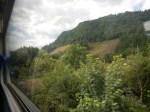


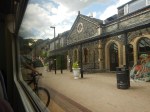



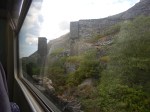


.As you can see the single-track route starts alongside the estuary of the River Conwy, then continues up to the summit in the 3.5 km long Ffestiniog Tunnel. The summit is 240 metres, so the line descends into Blaenau Ffestiniog station.
Transport for Wales intend to run Class 230 trains on this line.
I wrote about this in Class 230 Trains On The Conwy Valley Line.
Conclusion
The trip with its three changes took around three hours, but this time will get a bit shorter, once direct trains between Liverpool and Llandudno Junction stations via the Halton Curve will be faster and there will be no need to change trains at Chester station.
I looked at the effects of the Halton Curve in Between Liverpool Lime Street And Chester Stations.
I came to this conclusion on timings.
I wouldn’t be surprised to see timings of direct trains between Llandudno and Liverpool Lime Street stations in the order of an hour-and-a half.
I suspect the direct train and the improved journey time will attract more passengers to the route.
I
Blaenau Ffestiniog Station
Blaenau Ffestiniog station is the interchange between the Conwy Valley Line and the Ffestiniog Railway.
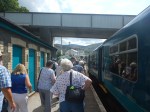
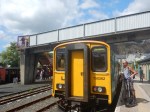
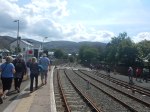
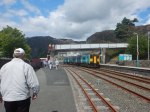
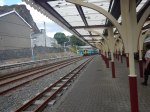
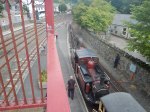
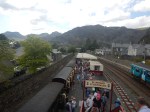
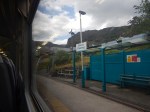
Note that as my train arrived from Llandudno, there was a Ffestiniog Railway train to take travellers to Porthmadog.
This is said in the Wikipedia entry for KeolisAmey Wales under Improvements.
Invest to co-fund new station buildings at Blaenau Ffestiniog
Consider.
- The Conwy Valley Line is scheduled to be run by new Class 230 trains from mid-2019.
- According to Wikipedia, there have been steam workings up the Conwy Valley Line.
- Blaenau Ffestiniog station has a run-around loop to put a locomotive on the other end of a train.
- The Halton Curve will open in December 2018, allowing direct and faster trains between Liverpool and Llandudno.
It would appear Transport for Wales are pulling out all the stops to bring tourists and employment to Blaenau Ffestiniog.
Now That’s What I Call A Footbridge!
This article on Global Rail News is entitled Network Rail Launches Footbridge Design Competition.
This is the first two paragraphs.
A competition for new footbridge design ideas has been launched by Network Rail and the Royal Institute of British Architects (RIBA).
Entrants are asked to design fully accessible footbridges that can be used across Britain’s rail network and that further improve the legacy of rail pioneers.
Hopefully, something better than some of those on Britain’s rail network will be designed.
I was in Wales last week on the Ffestiniog Railway and saw this bridge.
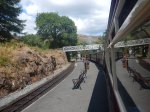
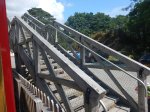



Surely, someone can come up with something like this, that meets all the regulations and looks a lot better, than Network Rail’s standard offering in green-painted steel.
My father used to build structures like this with timber and bolts to create extra floors and storage in his print works in Wood Green. From about the age of seven, I was his little helper.
Perhaps, thirty years later, I had a barn built at a house I owned. The architect had the building designed in a similar manner.
Someone, ought to enter Network Rail’s competition with a similar design.
Will Greater Anglia Fit Batteries To Their Class 755 Trains?
Greater Anglia have ordered the following Class 755 trains.
- 14 x three-car trains with two diesel engines in the power-pack
- 24 x four-car trains with four diesel engines in the power-pack
The power-pack would appear to have four slots, each of which could take.
- A V8 16-litre Deutz diesel that can produce 478 kW and weighs 1.3 tonnes.
- A battery of about 120 kWh, which would probably weigh about 1.2 tonnes.
I estimated the battery size , by using typical battery energy densities for a battery of similar weight to the diesel engine.
The KeolisAmey Wales Tri-Mode Flirts
The Tri-Mode Flirts ordered by KeolisAmey Wales can use either electric, diesel or battery power.
From the pictures it appears that these trains have the same basic structure as the Class 755 trains.
In the July 2018 Edition of Modern Railways, there is an article entitled KeolisAmey Wins Welsh Franchise.
This is said about the Stadler Tri-Mode Flirts on the South Wales Metro.
The units will be able to run for 40 miles between charging, thanks to their three large batteries.
So does this mean that these Flirts have just one Deutz diesel engine of 478 kW and three batteries in the four slots of the power-pack?
These trains will run between Penarth and Rhymney stations.
- I estimate about half the route will be electrified.
- Penarth to the electrification at Cardiff is under ten miles.
- The trains will work on battery power from Ystrad Mynach to Rhymney, which is ten miles up the hill.
- Coming down from Rhymney, Newton’s friend will give assistance.
This seems a challenging task, but it must be possible, even after an important rugby match in Cardiff.
I think it is true to say, that these Tri-Mode Flirts are no wimps.
Greater Anglia’s Flirts And Batteries
Four-Car Flirts
The four-car Class 755 trains don’t have a spare slot, as they have four engines.
I also suspect the four-car trains will tend to serve the longer routes or those with more passengers.
- Colchester and Peterborough
- Stansted Airport and Norwich
- Ipswich and Cambridge
- Lowestoft and London via Ipswich
- Norwich and Lowestoft
- Norwich and Great Yarmouth
Consider.
- These routes are partially-electrified.
- These routes don’t have challenging terrain.
- Except for Lowestoft and Great Yarmouth, all end stations are electrified.
- A short length of electrification could be installed at Lowestoft and Great Yarmouth stations.
I wonder if one of the diesel engines were to be replaced with a battery, by capturing and reusing the regenerative braking energy, this could improve the economics of running the services.
In Tri-Mode Stadler Flirts, I estimated the following.
- A four-car Tri-Mode Flirt will weigh around 150 tonnes.
- I will assume 250 passengers at 90 Kg. each with all their baggage, which gives a weight of 22.5 tonnes.
- This gives a total rain weight of 172.5 tonnes.
- The train is running at 100 mph.
This gives a kinetic energy of 48 kWh.
This would mean that a single 120 kWh battery could easily handle the regenerative braking and use the energy for the following purposes.
- Hotel power, which includes the power to run passenger and train systems.
- Traction power on sections, where low noise is important.
- Traction power, if there is overhead electrification failure.
- Short movements in depots and sidings.
I think that once Stadler have got their Tri-Mode Flirts working, that replacing one diesel with a battery in four-car Class 755 trains may be a sensible decision.
Lowestoft And London Via Ipswich
When the Class 755 trains are running services, there will be four direct trains per day from Lowestoft to London via Ipswich.
I will assume the following.
- There will also be four trains in both directions.
- An hourly service operates between Lowestoft and Ipswich
- Lowestoft to Ipswich will take the current 90 minutes.
- Greater Anglia will meet their promise of Ipswich to London in 60 minutes.
- The first train currently leaves Lowestoft just after five in the morning.
- The last train currently arrives at Lowestoft just before midnight.
For one train to do four round trips between five in the morning and midnight would need a round trip of around four hours and thirty minutes, which would mean that a time of around seventy minutes is needed between Ipswich and Lowestoft.
That is extraordinarily challenging.
But I think that could be Greater Anglia’s ultimate aim.
- There must be savings of a minute or two at each of the nine stations between Ipswich and Lowestoft.
- Some trains could be limited stop.
- The current maximum speed on the East Suffolk Line is just 55 mph and could probably be increased in places.
- The 100 mph Class 755 trains are quicker and probably accelerate and stop faster, than the current 75 mph Class 150 trains.
- Trains turn at Liverpool Street in under five minutes.
If it can be done, then the four trains per day between Lowestoft and London can be run with just one train.
Would batteries help the achievement of this aim?
They might do! But they would certainly improve the electrical efficiency and cut the amount of running of the diesel engines.
Three-Car Flirts
The three-car Class 755 trains have two spare slots, as they have two engines.
I would expect that the three-car trains would be used on the shorter routes and those with less passengers.
- Colchester Town and Sudbury
- Ipswich and Felixstowe
- Norwich and Sheringham via Cromer
To my mind the first two routes stand out for battery operation.
Ipswich and Felixstowe
Consider the following about the service between Ipswich and Felixstowe stations.
- The Felixstowe Branch is just over twelve miles long.
- There is one train per hour (tph) each way.
- It takes the current trains abut 26-29 minutes to do the journey.
- Currently, one train can provide the service.
In The New Trimley Freight Loop And Trimley Station, I talk about how a 1.4 km loop is being built to allow more freight trains to use the branch.
I also feel that there could be a second path in each hour for passenger trains, which would help reliability
But it also might make it possible to run a two tph service with two trains.
I also think, that if it was felt worthwhile, that this route could be run on battery power, charging at Ipswich and possibly with a short length of electrification in Felixstowe.
The advantages would be
- Diesel-free running.
- Less noise.
- The environmentally friendly trains may attract new passengers.
As with the trains on the South Wales Metro, they’d probably have one diesel engine and three large batteries.
Knowing the bicycle-friendly contours of the centre of Ipswich and Felixstowe as I do, the trains would probably need adequate capacity for bikes.
Colchester Town And Sudbury
I am sure that this new route between Colchester Town and Sudbury stations has been designed for a battery train.
Consider.
- A direct run between Colchester Town and Sudbury would probably take 45 minutes.
- Over half the route would be electrified.
- The Gainsborough Line is just eleven miles long.
- A silent battery train would be ideal for the rural route.
A Class 755 train could leave the Great Eastern Main Line at Marks Tey with full batteries, go both ways on the branch and then return to Colchester Town using the electrification.
Norwich And Sheringham Via Cromer
At thirty miles, the Bittern Line is probably too long for running totally on batteries.
But one battery handling regenerative braking would make the train more environmentally friendly.
Conclusion
Batteries would make the Class 755 trains more economical and environmentally-friendly to run, but with the exception of the Felixstowe and Sudbury branches, I suspect that the routes are too long for pure battery power.
I do believe that Greater Anglia knew about Stadler’s concept for fitting batteries on Class 755 trains before they ordered the trains.
As this opens up possibilities for the future and the ability to be more environmentally-friendly and fiscally efficient, I suspect it was a factor in their decision to buy the trains.
.
Gareth Southgate Station
I just had to visit Southgate station and take a few pictures.


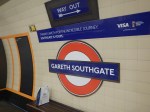


Although the signage will come down tonight, I do think there should be perhaps a picture display at the station.
It would appear that the signage has been funded by Visa, who are a World Cup sponsor.
Transport for London seem willing to change the roundels on stations for various events.
So will we see others in future?
The Battery Trains Are Coming
Every month seems to bring more information about trains where batteries are an important part of the propulsion system of the train.
So what are the various manufacturers offering?
Alstom
Alstom’s Coradia iLint train is hydrogen powered and as this video shows, batteries are an important part of the design of the train, which can probably be considered a hydrogen/battery hybrid train.
As I wrote in Germany Approves Alstom’s Hydrogen Train For Passenger Service, these trains will be entering service in late summer in Germany.
In the UK, Alstom are to convert some of the hundred-plus fleet of Class 321 trains, to running on hydrogen power.
I set out my thoughts on this in Thoughts On A Hydrogen-Powered Class 321 Train.
These were my conclusions.
- The Class 321 train will make a good hydrogen-powered train.
- Alstom would not have looked at converting a thirty-year-old train to hydrogen power, if they thought it would be less than good.
- British Rail’s design of a 750 VDC bus makes a lot of the engineering easier and enables the train to be tailored for world-wide markets, with different electrification systems and voltages.
- Having two different hydrogen-powered trains will give Alstom a better place in an emerging market.
I suspect in a few years time, if these two hydrogen projects are successful, Alstom will design and manufacture, a whole family of hydrogen-powered trains, with different gauges, capacities and operating speeds.
Bombardier
Unlike Alstom, who seem to be telling the world what they are doing with hybrid hydrogen/battery trains, Bombardier are playing their cards close to their chest.
In early 2015, I rode on Bombardier’s Class 379 Battery-Electric Multiple Unit demonstrator between Manningtree and Harwich.
It destroyed my scepticism about battery-electric trains.
Since then, the following has happened.
Class 345 Trains Have Entered Service
Class 345 trains have entered service on Crossrail routes to the East and West of London.
Until denied by Bombardier, I believe that these trains from Bombardier’s new Aventra family use batteries for the following purposes.
- Storing and reuseing the energy generated by regenerative braking.
- Providing an emergency power source, should the main electricity supply fail.
- Allowing depots and stabling sidings without electrification.
The trains should also make Crossrail and the other routes on which they run, more electrically efficient.
Five More Fleets Of Aventras
Bombardier have sold five more fleets of Aventras.
Could electrical efficiency because of clever use of batteries be a reason?
A 125 Mph Bi-Mode Aventra With Batteries Has Been Launched
This article in Rail Magazine is entitled Bombardier Bi-Mode Aventra Could Feature Battery Power.
A few points from the article.
- Development has already started.
- Battery power could be used for Last-Mile applications.
- The bi-mode would have a maximum speed of 125 mph under both electric and diesel power.
- The trains will be built at Derby.
- Bombardier’s spokesman said that the ambience will be better, than other bi-modes.
- Export of trains is a possibility.
In Mathematics Of A Bi-Mode Aventra With Batteries, I analyse the train in detail.
This was my conclusion.
I am rapidly coming to the conclusion, that a 125 mph bi-mode train is a practical proposition.
- It would need a controllable hydrogen or diesel power-pack, that could deliver up to 200 kW
- Only one power-pack would be needed for a five-car train.
- For a five-car train, a battery capacity of 300 kWh would probably be sufficient.
From my past professional experience, I know that a computer model can be built, that would show the best onboard generator and battery sizes, and possibly a better operating strategy, for both individual routes and train operating companies.
Obviously, Bombardier have better data and more sophisticated calculations than I do.
My calculation might be wrong, but it’s in the right area.
Voyager Battery Upgrade
This use of batteries by Bombardier was a total surprise.
In the July 2018 Edition of Modern Railways, there is an article entitled Bi-Mode Aventra Details Revealed.
A lot of the article takes the form of reporting an interview with Des McKeon, who is Bombardier’s Commercial |Director and Global Head of Regional and Intercity.
This is a paragraph.
He also confirmed Bombardier is examining the option of fitting batteries to Voyager DEMUs for use in stations.
I discuss what Bombardier might be doing in Have Bombardier Got A Cunning Plan For Voyagers?.
I feel the simplest use for batteries on these trains would be to store the energy generated by regenerative braking in batteries, from where it would be used for the train’s hotel power!
This would reduce the need for the engines to be running in stations.
Conclusion
I think Bombardier have been thinking very hard about how you design a train with batteries.
CAF
CAF have fitted several of their trams with batteries and this system will be used on the Midland Metro, to create new routes without catenary.
But they only seem to have an on-off order for trains fitted with batteries for Auckland.in New Zealand.
The order seems to be on hold.
Given that CAF, have a reputation for research and development and they have used batteries in trams, I can’t believe that they are not looking seriously at how to use batteries in their train designs.
Hitachi
On page 79 of the January 2018 Edition of Modern Railways, Nick Hughes, who is the Sales Director of Hitachi Rail Europe outlines how the manufacturer is embracing the development of battery technology.
He is remarkably open.
I wrote Hitachi’s Thoughts On Battery Trains, after reading what he said.
Hitachi certainly have working battery trains in Japan and use batteries on Class 800 trains to capture the energy generated by regenerative braking. On these trains, it appears to be used for hotel power.
Siemens
Siemens have now merged with Alstom and they are also developing a hydrogen-powered train.
I wrote about this train in Siemens Joins The Hydrogen-Powered Train Club.
As with Alstom, I suspect this train will be using batteries.
Siemens have also won the order for the New Tube For London.
I wrote about this in Thoughts On The New Tube For London.
In the Future Upgrades section of the Wikipedia entry for the Piccadilly Line, this is said.
Siemens publicised an outline design featuring air-conditioning and battery power to enable the train to run on to the next station if third and fourth rail power were lost. It would have a lower floor and 11% higher passenger capacity than the present tube stock. There would be a weight saving of 30 tonnes, and the trains would be 17% more energy-efficient with air-conditioning included, or 30% more energy-efficient without it
I would suspect, the batteries are also used to handle the energy from regenerative braking
Stadler
Stadler have developed a bi-mode Flirt, which has been ordered by Greater Anglia as the Class 755 train.
They have now sold a diesel/electric/battery tri-mode to KeolisAmey Wales, which from the visualisations look like the trains are closely related to the Class 755 trains.
Stadler are also delivering Class 777 trains to Merseyrail. Wikipedia says this.
In May 2018, it was announced the sixth Class 777 unit to be delivered will be fitted with batteries for a trial.
So it looks like two major fleets of trains for the UK from Stadler will have batteries.
There is also the Stadler Wink, which has been sold to Arriva Nederland.
Wikipedia says this about the design.
It has an aluminium carbody that can be customized in length by the customer, and can be powered by either diesel or electric powertrains with supplemental on board batteries. Arriva units will be delivered with Deutz diesel engines and batteries charged by regenerative braking; the engines are planned to be replaced by additional batteries once electrification is installed over part of their route.
Stadler seem to be putting a lot of effort into batteries.
Vivarail
Vivarail’s Class 230 train started as a diesel-electric and they have now sold a battery version to KeolisAmey Wales, which should be in service in May 2019.
Conclusion
All train manufacturers seem to be applying battery technology to their trains.
The main purpose seems to be to recycle the energy generated by regenerative braking.
Some trains like Alstom’s hydrogen trains, Bombardier’s Aventras and Stadler’s tri-mode Flirt, use the energy for traction, whilst others like Hitachi’s Class 800 trins, use the energy for hotel power.
If a researcher or company comes up with a better battery, they will certainly get a return for their efforts in the rail industry.
NHS Is Still Reliant On Fax Machines
The title of this post as the same as that of an article in The Times last week.
This is the first paragraph.
Hospitals are still using 9,000 fax machines according to a survey that highlights the NHS’s with modern technology.
Other points from the article.
- The survey was done by the Royal College of Surgeons
- Newcastle on Tyne NHS Foundation trust had 603 machines.
- Barts Health uses 369 faxes.
- Only ten trusts said they didn’t own any faxes.
Coupled with another report last year, which showed that NHS hospitals still use an estimated 130,000 pagers, it surely shows the NHS is stuck in the past, as far as communications are concerned.
But this is not all!
A friend told me, he is trying to analyse the computer network of a trust, that stretches across three English counties.
These days, computers and complicated equipment usually have an address on the network, which in most organisations follow a logical pattern controlled by a sensible comprehensive specification.
But the NHS does things differently, with each county relying on one person in their area to create idividual node names.
How much could the NHS save, if they sorted out their communications and computing?
At Least One Class 717 Train Has Arrived
I was passing Ferme Park Sidings in a Great Northern service between Kings Cross and Welwyn Garden City stations, when I took these pictures of what looked to be a Class 717 train.
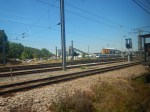


Note that the front is white not yellow, as is shown in this article on on Railway Gazette International.
According to Wikipedia, twelve trains have been built and I couldn’t be sure if it was a single train in the siding or two trains parked close together.
The Railway Gazette International article says the trains will have these features.
- Air-conditioning
- 2+2 seating with wide aisles
- Wide doors for rapid boarding and alighting
- 262 seats per unit
- One power socket per seat.
- No toilets
- No First Class
- No seat back tables
- Wi-fi, but with only limited coverage in the Moorgate tunnels.
Each six-car unit will have a capacity of 943 passengers.
 The Anonymous Widower