Heathrow Southern Railway And The Windsor Link Railway
The Windsor Link Railway is a proposed new railway, that if it is approved, will be built in two phases.
Phase 1 is described in Wikipedia, like this.
Phase 1 of the scheme would run from Slough to Staines, via Chalvey, Windsor, Datchet, Wraysbury and Sunnymeads. A new all-in-one station in the Windsor Goswells would replace the existing two nearby stations (Riverside and Central)
Phase 2 is described like this.
Phase 2 of the project involves linking to Heathrow. As the Heathrow Airtrack scheme has been dropped by BAA, the proponents say a much cheaper method of connecting Heathrow to the north west, west and south would be via a bridge over the M25. This would also have benefits for the proposed intermodal freight depot at Colnbrook, Berkshire.
This map from the Windsor Link Railway web site, shows the new tracks for both phases.
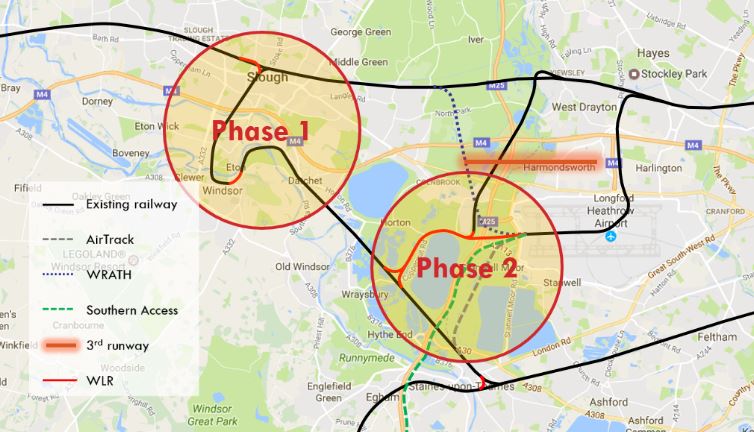
Note that Southern Access on the map is close to the route of the Heathrow Southern Railway.
Thoughts On Phase 1
Phase 1 is mainly a scheme for Windsor and I believe, it could be very beneficial to a town, that will become an even bigger tourist attraction.
It is a scheme, that has no affect on the construction of the Heathrow Southern Railway.
However, if the Windsor Link Railway wanted to increase the frequency of the train service between Windsor and Eton Central and Waterloo, there may well be arguments over who gets the paths on the crowded lines between Staines and London.
Thoughts On Phase 2
If the Heathrow Southern Railway and Windsor Link Railway designed a joint scheme, I don’t believe there is any reason, why trains couldn’t use the Windsor Link Railway to run between Reading and Heathrow.
Capacity Of Heathrow Terminal 5 Station
Heathrow Terminal 5 station has been built with space for two bay platforms.
Each platform could probably handle four trains per hour (tph), although with the right scheduling and good signaling and operation, six tph is possible.
Heathrow Southern Railway proposes the following services to the terminal.
- Four tph from Waterloo via Clapham Junction and Staines.
- Two tph from Weybridge via Viginia Water, Egham and Staines.
So there could be upwards of four tph from Windsor and/or Reading, that terminate at Terminal 5.
Crossrail To Reading Via Windsor And Heathrow
Somebody will want to run Crossrail trains through Heathrow Terminal 5 to Windsor and Reading.
Would Windsor cope with all the extra visitors?
Note that Heathrow Southern Railway are already suggesting that Crossrail trains to Terminal 5 could be extended to a new platform at Staines.
Waterloo To Reading Via Staines, Heathrow Terminal 5 and Windsor
Suppose two tph of the Waterloo to Heathrow Terminal 5 trains, reversed and went on to Windsor and Reading.
- It could make better use of the platforms at Heathrow.
- Reading would have an additional two tph service to Heathrow.
- Windsor would have a four tph service to Waterloo.
It’s a possibility with benefits.
Conclusion
Co-operation could be beneficial to both projects.
Heathrow Southern Railway And West London Orbital Railway
West London waits umpteen years for more rail lines and then two come along at the same time.
Both do substantially, what their names imply.
This map from carto.metro.free.fr shows the tracks between Feltham, Hounslow and Whitton stations.
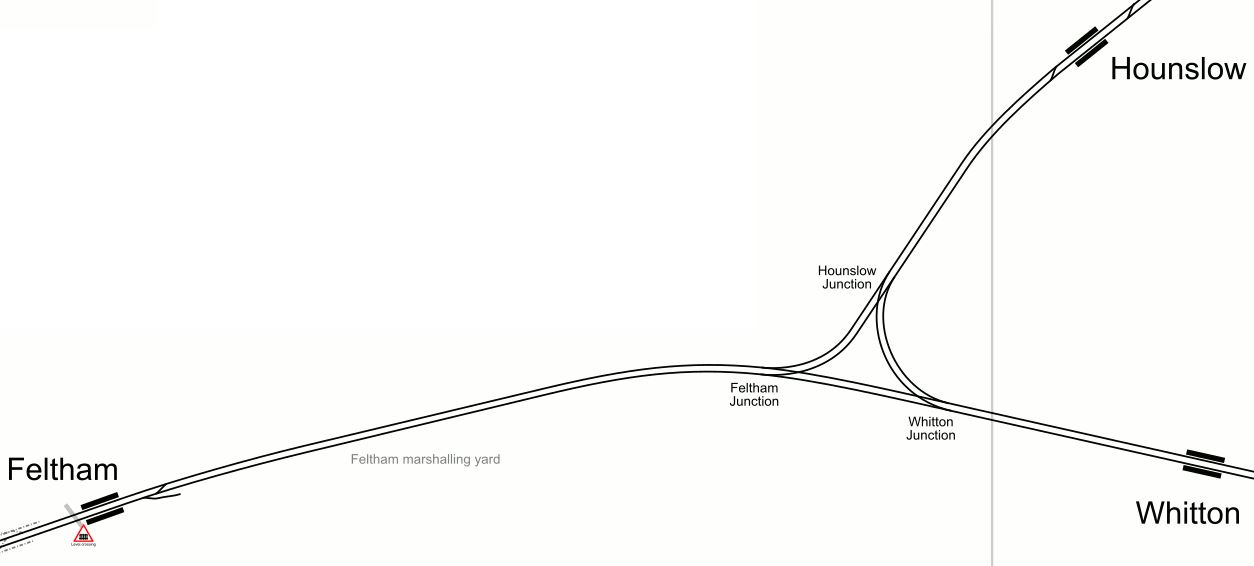
Note.
- Heathrow Southern Railway’s proposed Heathrow – Clapham Junction – Waterloo service will probably go via Whitton, rather than the Hounslow, as Whitton is the faster route.
- Hounslow is the proposed terminus of the route of the West London Orbital Railway from West Hampstead Thameslink station.
- Hounslow will have a new East-facing bay platform, to handle the trains from West Hampstead.
- Heathrow Southern Railway have said their service between Heathrow and Waterloo will be four trains per hour (tph)
I suspect that the West London Orbital Railway will have a typical Overground frequency of four tph.
Unfortunately, the two railways don’t meet up, as it would probably be worthwhile to give more stations a simple route to Heathrow with perhaps a change at Feltham station.
This Google Map shows Feltham station.
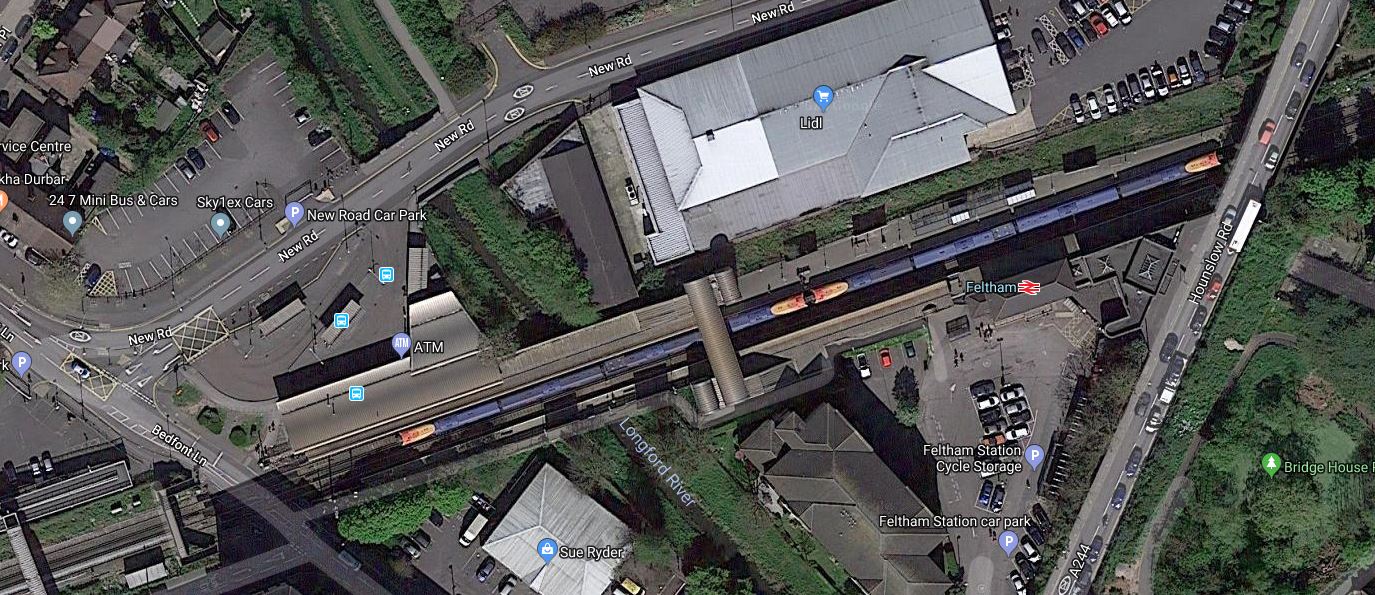
Would there be space to squeeze in an East-facing bay platform on the North side of the station?
- It could be the terminus of the West Hampstead service of the West London Orbital Railway
- It could be useful if there were operational problems to turn trains.
- There is the advantage that Feltham is a step-free station and Hounslow isn’t.
I went to Feltham station and took these pictures.


By the side of the track on the other side of the road bridge to the station, is the Feltham Signalling Centre and a Network Rail yard.
I think it could be possible to fit a platform into the space, behind Platform 1.
- A five-car platform looks possible.
- It would be an island platform with the current Platform 1.
- I doubt overhead electrification could be used.
- Slab track might be needed to squeeze the train under the bridge.
Ideally, it should be able to take a ten-car train, which might be possible, by extending the platform to the other side of the bridge.
Currently, there are six tph each-way through the station. The following new services will be added if both the Heathrow Southern and West London Orbital Railways are built.
- 4 tph – Heathrow Southern Railway’s proposed service between Heathrow Terminal 5 and Waterloo via Staines, Feltham, Twickenham, Richmond and Clapham Junction.
- 4 tph – West London Orbital’s proposed service from Feltham to West Hampstead
Would modern trains and signalling, coupled with good driving, be able to handle this level of trains?
Looking at the tracks and the space on either side, it might be possible to thread a third track between Feltham Station and Feltham Junction.
This Google Map shows Feltham Junction
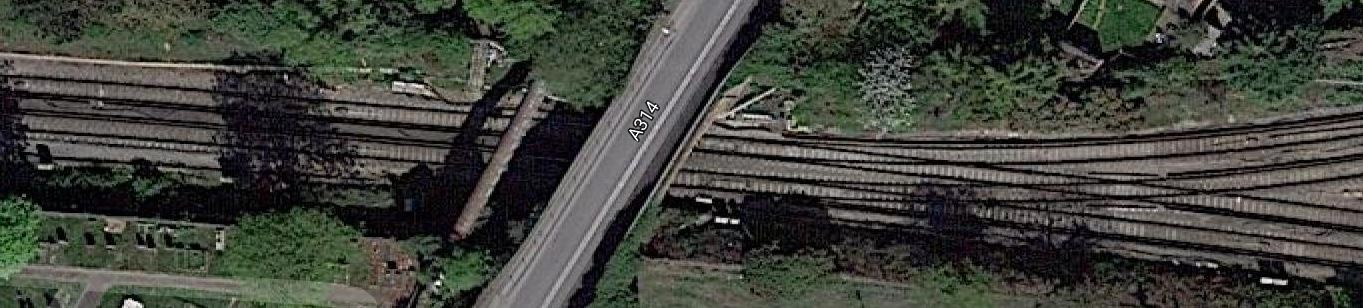
There would appear to be more space on the South side of the tracks, so perhaps an extra track could go on this side.
But I suspect Network Rail could find a solution from their library of cunning plans.
There could be advantages.
- West London Orbital Railway could terminate in a step-free station.
- Travellers between South Acton and Hounslow get a step-free route to Heathrow.
- The bay platform at Feltham, could help when the service is disrupted.
- An extra track to the East of Feltham, might help capacity between Clapham Junction and Staines.
I’m certain that be a simple connection between the two systems can be built.
Conclusion
There are possibilities to connect the West London Orbital Railway to the Heathrow Southern Railway, which could be beneficial for all parties.
Between Heathrow And Gatwick Airports Using Heathrow Southern Railway
I have received a few messages asking how the Heathrow Southern Railway would help travellers get between Heathrow and Gatwick Airports.
How Many Passengers Would Actually Transfer Between The Two Airports?
This question would definitely be filed under pieces of string.
The direct route using Crossrail and Thameslink will take under two hours, with a change at Farringdon.
- There are several major tourist attractions close the the Crossrail/Thameslink route; Oxford Street, British Museum, St. Paul’s, River Thames, Tate Modern, Tower of London and Tower Bridge, for those unencumbered by baggage.
- Will Farrington develop into a joint terminal for both airports?
- How many passengers, will want to have a day of rest and recuperation in the best city in the world?
- How many travellers to and from Europe, the North and Scotland will switch to the long distance trains at Kings Cross and St. Pancras stations?
Passengers wanting to avoid London could use the Waterloo – Heathrow service proposed by Heathrow Southern Railway and change at Clapham Junction.
- The proposed Waterloo – Heathrow service will be four trains per hour (tph)
- It would probably run at an appropriate frequency at night, just like Gatwick Express and Thameslink.
- Passengers would change at Clapham Junction between Gatwick and Heathrow services.
- I estimate, that the Clapham Junction route, could be quicker than the Crossrail/Thameslink route, at perhaps an hour and twenty minutes.
- Clapham Junction station is step-free, but the bridge could be made more passenger-friendly.
Until, I get firm evidence to the contrary, I have a strong feeling that not many passengers will want to a faster service thanthe one, these two routes offer.
What About The Workers?
There must be people in the aviation industry, who need to go regularly to both airports for the purposes of work.
If you were in that class of worker, you might choose to live, somewhere that was convenient for both airports.
I suspect that this valuable group will be well-served by services from Clapham Junction.
- Clapham Junction to Heathrow – 30 minutes
- Clapham Junction to Gatwick – 25 minutes
Feeder times to Clapham Junction using direct trains include.
- Balham – 6 minutes
- Canada Water – 29 minutes
- East Croydon – 11 minutes
- Epsom – 28 minutes
- Peckham Rye – 19 minutes
With four tph, the maximum wait at Clapham Junction would be fifteen minutes.
Clapham Junction Will Become An Even Bigger Hub
Heathrow Southern Railway will make Clapham Junction station, an even more important hub.
- It is about thirty minutes away from both Heathrow and Gatwick Airports.
- Large numbers of stations have direct connections to Clapham Junction in under thirty minutes.
- The Northern Line could be extended from Battersea to Clapham Junction.
- Clapham Junction station is proposed to be on Crossrail 2.
- Clapham Junction is at the centre of an extensive bus network.
It would certainly be very convenient to live close to Clapham Junction station, if you needed to go to both airports regularly.
But improvements are needed at the station.
Changing Trains
The Wikipedia entry for Clapham Junction station says this.
The station is also the busiest UK station for interchanges between services.
I use Clapham Junction regularly as an interchange, if say I’m going from Dalston Junction to Gatwick, Reading or Windsor. It can be a sprint up the stairs, and a rush across the bridge, before a careful decent to the platform.
A typical change from Platform 1/2 to 5/6 took me two and a half minutes, in the middle of the morning.
Changing trains could be improved.
These pictures show the step-free bridge at Clapham Junction
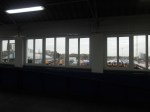
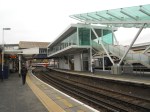
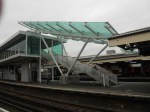

Note.
- Lighting is not of a high quality.
- It is quite wide, but not as wide as the new bridge at Reading.
- There are lifts to most platforms, but they could be bigger.
- Reading has an up and down escalator for each platform. Surely the busiest station in the UK, deserves the same.
- It is cluttered with retail outlets, which could be reduced in number or placed on the platforms.
If I was the CEO of Heathrow Southern Railway, I’d rebuild this bridge, as doing that might attrack more passengers for Heathrow to use the proposed new service.
Information
Clapham Junction is well organised, with trains for a particular destination generally leaving from the same platform or pair of platforms.
They even have a board that gives this information in detail..
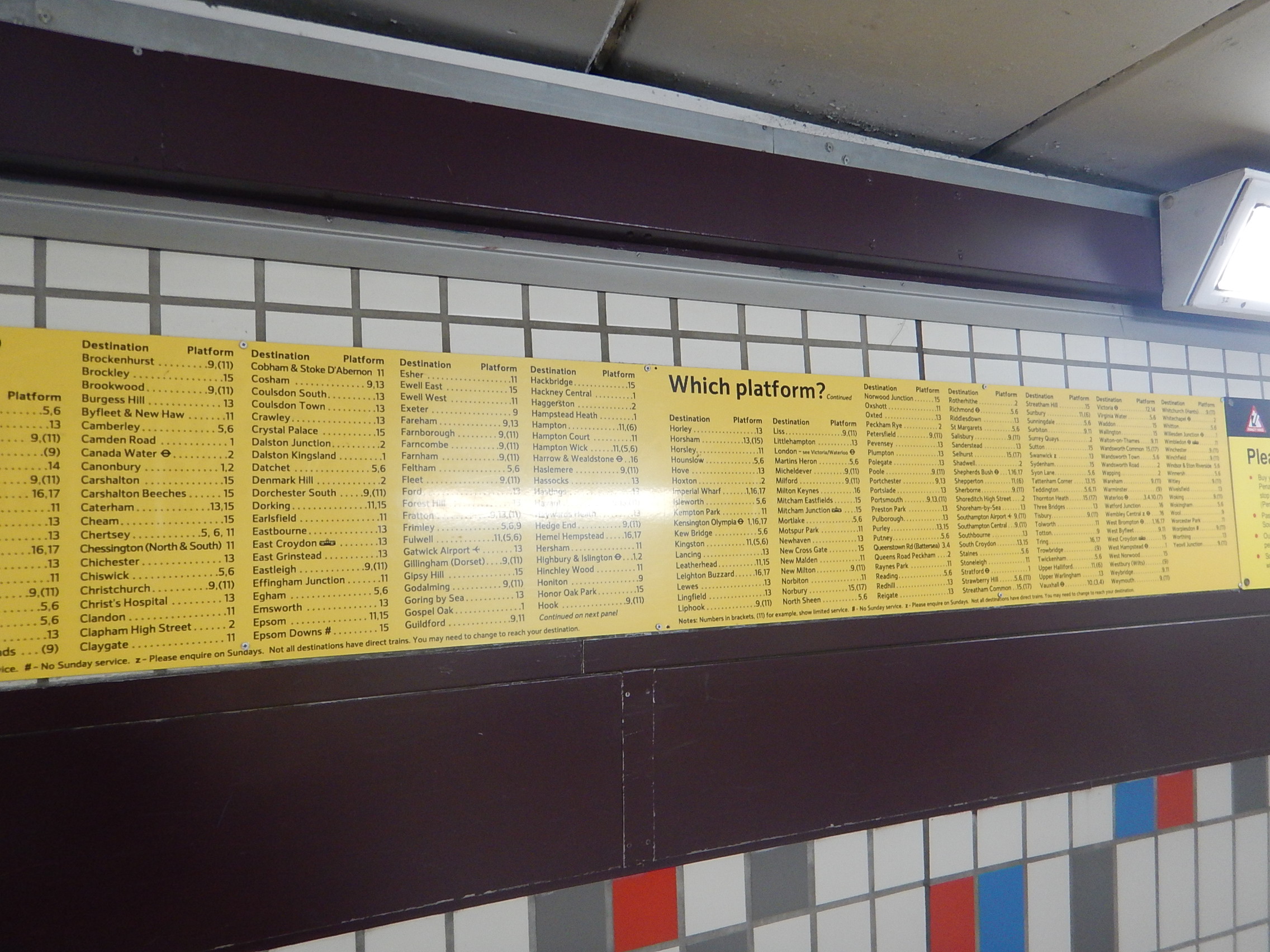
But it’s now 2018 and we can do much better.
There would also need to be large, clear signs everywhere to Gatwick, Heathrow, Victoria and Waterloo!
Timetable Improvements
I took a train from Clapham Junction to Feltham and although there are six tph, I had to wait sixteen minutes for a train.
It’s just that in an hour, there are four short intervals and two long ones.
Improvements need to be made, so that the timetable is more passenger friendly.
Some Platform Reorganisation
This map from carto.metro.free.fr shows the track layout at Clapham Junction station.
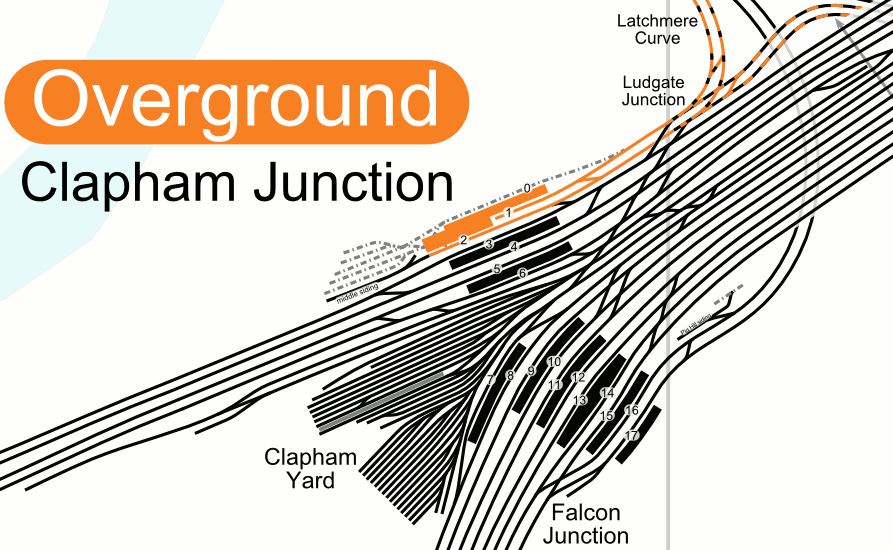
It looks to me, that that terrible engineer; Topsy had a big hand in the design.
Note.
- Tracks and platforms in orange are the London Overground.
- Trains to Heathrow will probably use Plstforms 5 or 6, as do the Reading and Windsor services.
- Trains from Heathrow will probably use Plstforms 3 or 4, as do the Reading and Windsor services.
- Heathrow, Reading and Windsor are to the West.
- Platforms 3 to 11 are for services to and from Waterloo.
- Platforms 12 to 15 are for services to and from Victoria.
- Services to and from Gatwick will use these platforms.
- Platforms 16 and 17 are for West London Line services.
It looks to me, that it might be possible to reorganise the platforms so that Heathrow and Gatwick services weren’t at opposite end of the bridge.
Or should the bridge be made wide enough for a travelator?
West London Line Services
The West London Line has two main passenger services.
- 4 tph – London Overground between Clapham Junction and Stratford, which uses Platform 1
- 1 tph – Southern between Milton Keynes Central and East Croydon, which have virtually sole use of Platforms 16 and 17.
If possible, an increase in frequency on this line would surely help many travellers get to and from London’s two main airports.
- London Overground are planning to add two extra tph between Clapham Junction and Stratford in 2018.
- London Overground will match this in 2019, with another two tph between Clapham Junction and Dalston Junction via the South London Line.
This is going to make Southern’s one tph service between Milton Keynes Central and and East Croydon pathetic, especially as the route will eventually serve Old Oak Common with connections to Crossrail and HS2.
Chris Gibb recommended that this service , should be transferred to the London Overground in the Gibb Report. I wrote about it in Gibb Report – East Croydon – Milton Keynes Route Should Be Transferred To London Overground.
If nothing else the current service which uses two platforms at Clapham Junction for a one tph service, which doesn’t run on Sundays, is a waste of resources at Clapham Junction.
.Conclusions
I have come to the following conclusions.
- If Clapham Junction station is improved, Heathrow Southern Railway will create a faster route to Gatwick.
- Clapham Junction station will become a major hub station feeding London’s two major airports.
It gives very large numbers of passengers a quicker route to the airports.
I also think it could be advantageous for Heathrow Southern Railway to contribute to the upgrading of Clapham Junction station.
Calls For London Overground Extension To Lewisham
The title of this post, is the same as that of this article on IanVisits.
This is the first paragraph.
Lewisham council has issued a call for the Overground to be extended to Lewisham town centre as part of a wider series of improvements to the local rail and DLR networks.
To extend the Overground from New Cross station, Overground trains would need to be able to cross over to the tracks through the station.
This map from carto.metro.free.fr shows the tracks at the station.
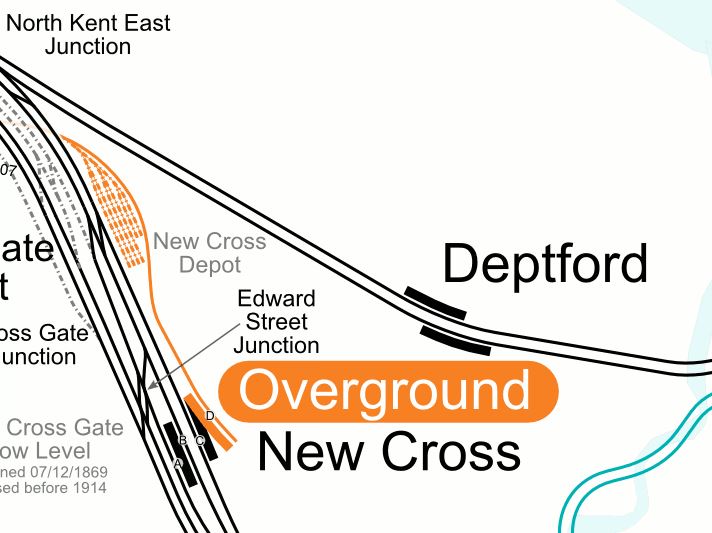
There are four Overground trains from Dalston Junction station and they terminate in the bay Platform D.
Note how the Overground skirts round New Cross Depot to get to the platform.
This Google Map shows the curve of the Overground Line and what lies between the lines out of London Bridge station and the Overground.
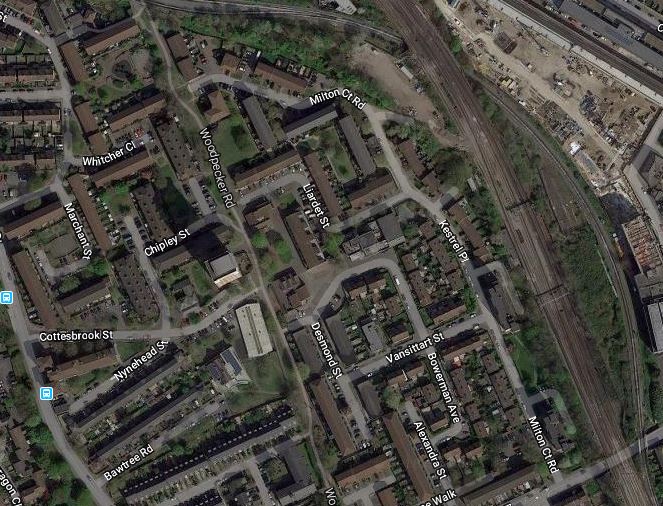
It looks to be the old New Cross depot and a green space surrounded by rail tracks, that is all inaccessible to the public.
I took these pictures as I passed.
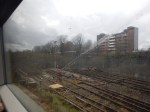



Note.
- The Lines out of London Bridge are much higher.
- It’s quite a big space.
- It might be possible to connect the Overground to the down slow line, that goes through Placform C at New Cross station.
- It would need a tunnel under the lines out of London Bridge to connect to the up slow line, which is goes through Platform A at New Cross station.
- I suspect this connection would be difficult and the lines would have to be slewed to the West, so that trains could dive under the down slow line.
- Do Network Rail want to cause all the grief at London Bridge, whilst they built the junction.
It could be a challenging and very expensive project.
It might even be impossible!
On the other hand, it might be possible using flat junctions, but this line is busy and building and operating them could be the stff of nightmares.
Trains Services At New Cross Station
Wikipedia says these are the service frequencies at New Cross station in trains per hour (tph)
- 10 northbound to Cannon Street
- 4 northbound to Dalston Junction or sometimes Highbury & Islington
- 2 southbound to Hayes
- 4 southbound to Cannon Street via Sidcup, or via Bexleyheath and then returning via Greenwich
- 2 southbound to Orpington, calling at all stations
- 2 southbound to Tunbridge Wells, non-stop to Orpington then all stations
Merging ten trains to and from Cannon Street with four trains to and from Dalston Junction could be extremely difficult.
It should be said that the interchange between Overground services arriving at New Cross and Southbound services on Southeastern is just a walk across between Platform D and C, which is shown in the picture below.

Note the Overground train in Platform D.
It appears that most Overground trains from Dalston Junction, connect to a Lewisham train after between five and ten minutes.
As there is a coffee stall on the station, on a cold day, you can buy a hot drink.
The problem is coming North, as you have to use the step-free foot bridge from Platform A.
Too many times, I’ve negotiated the bridge only to arrive on Platform D, to watch the Overground train disappearing.
Increasing Frequency On The Overground
Currently, the frequency of trains on the East London Line is as follows.
- 4 tph – Dalston Junction to New Cross
- 4 tph – Highbury and Islington West Croydon via New Cross Gate
- 4 tph – Highbury and Islington to Crystal Palace via New Cross Gate
- 4 tph – Dalston Junction to Clapham Junction
In the next couple of years, Crystal Palace and Clapham Junction services will be raised to six tph. I wrote about this in Increased Frequencies On The East London Line.
This will mean that New Cross Gate will have ten tph on the East London Line, as against four at New Cross.
I don’t know whether it’s possible to increase the Dalston Junction to New Cross service to six tph, but this would reduce the wait, when changing at New Cross to go North.
The Bakerloo Line
The Bakerloo Line is being extended to New Cross Gate and Lewisham, so perhaps in the future, East London Line passengers will go via New Cross Gate.
New Cross Interchange
I have read, that Transport for London would like to make it easier to change between New Cross and New Cross Gate stations.
Conclusion
Extension of the Overground to Lewisham will be extremely difficult and other developments will improve rail transport in South-East
London
To Ely In A Class 387 Train
I’ve not used one of the Class 387 trains on this route before.
It was nice to get a table to be able to lay my paper flat.
I was going via Ely to Ipswich for two reasons.
- Yet again, there was no direct service between Liverpool Street and Ipswich.
- Ely makes a change from Cambridge and I wanted to photograph the level crossing.
These are some of the pictures I took.



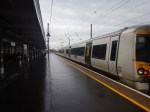

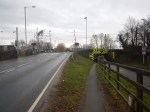


Note.
- With a bit of smartening up, the Class 387 train makes the newer Class 700 train, look very ordinary.
- The Ely by-pass is coming on.
- The level crossing by the station is one of the UK’s worst.
Ely is becoming a much more important interchange, with five train operating companies using the station.
Routes For Bombardier’s 125 Mph Bi-Mode Aventra
This article in Rail Magazine, is entitled Bombardier Bi-Mode Aventra To Feature Battery Power.
A few points from the article.
- Development has already started.
- Battery power could be used for Last-Mile applications.
- The bi-mode would have a maximum speed of 125 mph under both electric and diesel power.
- The trains will be built at Derby.
- Bombardier’s spokesman said that the ambience will be better, than other bi-modes.
- Export of trains is a possibility.
Bombardier’s spokesman also said, that they have offered the train to three new franchises. East Midlands, West Coast Partnership and CrossCountry.
These are my thoughts on these franchises.
Bi-Mode And Pure Electric
I’m pretty certain that if you want to create a 125 mph bi-mode train, you start with a 125 mph electric train, if you want a high degree of commonality between the two trains.
Hitachi have a whole family of Class 800 trains, each of which has a different specification for the diesel power. Even the pure-electric Class 801 trains, has one diesel engine for emergencies.
An electric train with batteries could be very efficient, if the batteries were used to handle regenerative braking and boost the trains, where more power is required.
East Midlands
It is no surprise that Bombardier are talking to the groups, that are bidding to become the new franchise holder for the East Nidlands, when it is awarded in April 2019.
They wouldn’t want to see another company’s product roaring past the factory.
The proposed bi-mode Aventra will probably have been designed very much with the Midland Main Line in mind.
- The Midland Main Line will be electrified from St. Pancras to Kettering and Corby.
- Will the fast lines be electrified to Glendon Junction, where the Corby Branch joins the Midland Main Line?
- The route between St. Pancras and Glendon Junction is being upgraded to four tracks, with as much 125 mph running as possible.
- The non-stop nature of Midland Main Line services South of Kettering could be significant.
- North of Kettering, there is currently no electrification.
- The development of Toton station for HS2 is being accelerated and there could be an island of electrification here, by the mid-2020s.
- If HS2 shares the Midland Main Line corridor between Toton and Sheffield, this section could be electrified by the late-2020s.
Over the next decade, there will be more electrification and a greater proportion of the route, where 125 mph running will be possible.
There has been a bit of controversy, that the number of stops the franchise will make at Bedford and Luton is being reduced after May this year.
The reason given is that it will enable faster services to Derby, Nottingham and Sheffield.
North To Derby, Nottingham and Sheffield
Consider a bi-mode train with batteries going North.
- Between St. Pancras and Kettering, it will be at 125 mph for as long as possible.
- The train will also ensure that at Kettering, it has the batteries brim full, sfter charging from the electrification.
- After a stop at Kettering station, if the electrification reached to Glendon Junction, the acceleration would all be electrically-powered.
- Whether it stopped at Kettering or not, the train would pass Glendon Junction at line speed with full batteries.
It’s almost as if the electrification is being used as a catapult to speed the train North.
South From Derby, Nottingham and Sheffield
Being as electrically efficient coming South would be a lot more difficult.
- I suspect that train batteries will be charged at Derby, Nottingham and Sheffield, so they start their journey South with full batteries.
- Using a full battery and assistance from the onboard generator, trains would be accelerated away from the terminii.
- The trains computer would select automatically, whether to use battery or onboard generator power and would harvest all the power from regenerative braking.
- At each stop on the journey, energy would be lost, as regenerative braking systems do not are only between seventy and ninety percent efficient.
- Once at Glendon Junction, the train would raise the pantograph and switch to getting power from the overhead wires.
It’s all about a well-programmed computer on the train, which knows the route, the timetable and battery state so it can switch power sources appropriately.
Electrification
On the other hand, electrification around Toton could make everything easier and more efficient.
With electrification, every little helps.
- Modern trains can raise and lower pantographs, quickly and automatically.
- Faster journeys.
- Lower carbon emissions.
- Less noise and vibration from diesel generators.
Everyone’s a winner.
Oakham To Kettering
The Oakham-Kettering Line to Corby station is being electrified, double-tracked and I suspect speed limits will be raised.
Speed limits are also being raised and track improvements are being done, South of Glendon Junction.
Currently, services take seventy minutes. With the 125 mph Aventras on the route, they will not need to use the onboard generator, but surely the journey time could be reduced to under an hour, which would attract passengers and need less trains to run a two trains per hour (tph) service.
The Oakham Problem
Oakham station is in the middle of the town, as this Google Map shows.

The Department for transport would like to see more services to the town and the next station of Melton Mowbray.
But the line through the station is busy with freight trains and there is a level crossing in the middle of the town.
125 mph bi-mode trains, won’t help with the problem of Oakham.
Joining And Splitting Of Trains
There is also the possibility of joining and splitting trains.
Hitachi’s Class 800 trains can do this and I’m sure bi-mode Aventras will be able to do this automatically.
There is only four platforms available for trains on the Midland Main Line at St. Pancras and regularly two trains occupy one platform.
The ability to run a pair of bi-mode trains, that joined and split could be a great asset.
Liverpool To Norwich
This long route is an important one for those, who live near its stations. It is usually served by one or two Class 158 trains, which are often very crowded.
The route is partially electrified.
- Liverpool to Hunts Cross
- Manchester Oxford Road to Stockport
- Grantham to Peterborough
- Around Ely
- Around Norwich
So there should be plenty of places to raise the pantograph and charge the batteries.
It is a typical long-distance route for the UK and I’m sure it would benefit from 125 mph bi-mode Aventras.
West Coast Partnership
Bids for the West Coast Partnership, which will run services on the West Coast Main Line and HS2, will be submitted by July 2018. The winning bidder will be announced in May 2019 and take over services two months later.
A modern 125 mph bi-mode would be an ideal replacement for the current twenty Class 221 trains, that work on the West Coast Main Line.
These Class 221 trains are.
- Diesel powered.
- Five-cars long.
- Built in 2001-2002 by Bombardier.
- 125 mph capable.
- Some services are run by splitting and joining trains.
But most importantly, most services are run substantially under wires.
New 125 mph bi-mode trains would certainly improve services.
- Several of the current services operated by Class 221 trains, would become electric ones.
- How much faster would they be able to run a service between London Euston and Holyhead?
- They would also be able to run new services to places like Barrow. Blackburn and Huddersfield.
- Five cars could be a convenient train size for the operator.
But above all, they would offer a better passenger experience, with less noise and vibration from the diesel engines.
The longest section of running using onboard power of a bi-mode Aventra will be along the North Wales Coast Line to Holyhead.
- The line has an 90 mph operating speed.
- The line is 85 miles long.
- The gradients won’t be too challenging, as the line runs along the coast.
- Services stop up to half-a-dozen times on the route.
- From London to Crewe is electrified.
- The section between Crewe and Chester may be electrified.
It looks to be an ideal route for a 125 mph bi-mode Aventra.
As the route appears to not be as challenging as the Midland Main Line, could this route, be the ideal test route for a hydrogen fuel-cell powered Aventra.
West Coast Partnership may well have plans to use 125 mph bi-mode trains as feeder services for HS2’s hubs at Birmingham and Crewe.
I could certainly see West Coast Partnership ordering a mixed fleet of 125 mph Aventras, some of which would be bi-modes and some pure electric.
CrossCountry
CrossCountry has a diverse portfolio of routes, which have every characteristic possible.
- Some are lines with a 125 mph operating speed.
- Some are electrified with 25 KVAC overhead wires.
- Some are electrified with 750 VDC third-rail.
- Some are not electrified.
A bi-mode train with these characteristics would fit well.
- 125 mph capability on both electric and diesel power.
- Battery power for short branch lines.
- Modern passenger facilities.
- Five-cars.
- Ability to work in pairs.
They could actually go for a homogeneous fleet, if they felt so inclined.
That would be a substantial fleet of upwards of fifty five-car trains.
The new CrossCountry franchise will be awarded in August 2019 and start in December 2019.
Other Routes
If the 125 bi-mode Aventra with batteries is built, there could be other routes.
Borders Railway
Why would you run a 125 mph bi-mode Aventra on the 90 mph Borders Railway?
- The Borders Railway will be extended to Carlisle, which will mean, that both ends will be electrified for a few miles.
- This will mean that bi-mode trains with batteries could charge their batteries at both ends of the line.
- If traffic increases, extra cars can be added.
- The trains would be able to use the West Coast Main Line to link the Lake District to Edinburgh.
- They could be given a tourism-friendly interior, to go with the large windows common to all Aventras.
The trains would help to develop tourism in the South of Scotland and the North of England.
East West Rail
The East West Rail between Oxford and Cambridge is going to built without electrification.
- But that doesn’t mean that it should be built with an operating speed in the region of 90 mph!
- The legendary InterCity 125s have been running on lines without electrification at 125 mph since the late 1970s, so it isn’t an unknown practice.
So if the line were to be built for high speed across some of the flattest parts of England, why not unleash the 125 mph bi-mode Aventras?
They could serve Ipswich, Norwich and Yarmouth in the East using their onboard generators.
They could serve Bournemouth, Bristol, Reading and Southampton, if the trains had a dual-voltage capability.
They could use electrification at Bedford, Bletchley, Cambridge and Reading to charge the batteries.
Settle-Carlisle Line
Surely, if the 125 mph bi-mode Aventras are suitable for the Borders Railway, then it should be able to work the Settle-Carlisle Line.
- Both ends of the line are electrified, so batteries could be charged.
- The line needs more and better services.
But the main reason, is that there will be a high-class scenic route between Edinburgh and Leeds.
I estimate that a London to Edinburgh service via Leeds, Settle, Carlisle and the Borders Railway would take six and a half hours, using a 125 mph bi-mode Aventra.
Some tourists love that sort of trip.
Waterloo To Exeter
The West of England Line has the following characteristics.
- It runs between Basingstoke and Exeter.
- It is a hundred and twenty miles long.
- It has a 90 mph operating speed.
- The line is not electrified.
- It is connected to the electrified South Western Main Line to Waterloo.
- The route is electrified between Waterloo and Basingstoke.
- Direct trains take three hours twenty-three minutes between Waterloo and Exeter, with fourteen stops between Basingstoke and Exeter.
- The trains used on the route are twenty-five year-old Class 159 trains.
Would a 125 mph bi-mode Aventra improve the passenger service between Waterloo and Exeter?
- The Aventras are built for fast dwell times at stations, so there could be time saving with all those stops.
- The Aventras could use the third-rail electrification between Waterloo and Basingstoke.
- There may be places, where the operating speed can be increased and the faster Aventras would take advantage.
- The trains could have a passenger-friendly interior and features designed for the route.
The real benefits for South Western Railway and their passengers would come, if the trains could do Waterloo to Exeter in three hours.
Routes For A Pure-Electric Version
There are several routes in the UK, where the following apply.
- Some long-distance trains are run by 125 mph trains.
- The route is fully- or substantially-electrified.
- A proportion of the route allows 125 mph running.
- Sections of the route is only double-track.
Routes satisfying the criteria include.
- The West Coast Main Line
- The East Coast Main Line
- The Great Western Main Line
- The Midland Main Line
On these routes, I believe it would be advantageous, if all passenger trains were capable of operating at 125 mph.
This is cause if all trains were running at 125 mph, they could be more closely spaced, thus increasing capacity.
Digital signalling would probably be needed.
There are several train services,, that use the electrified 125 mph sections of these routes.
Birmingham/Liverpool/Manchester To Edinburgh/Glasgow
TransPennine Express, are replacing their current Siemens 110 mph Class 350 trains on this service, with new CAF 125 mph Class 397 trains.
Euston To The West Midlands, Liverpool And Preston
West Midland Trains are replacing some of their current Siemens 110 mph Class 350 trains with new Aventras.
Information is scarce at the moment, but could some of these new Aventras be 125 mph units for working on the West Coast Main Line?
Leeds/York To Edinbugh
TransPennine Express run trains on this route.
St. Panvras To Corby
The Corby Branch is being upgraded.
- Double-track
- 125 mph running
- Electrification
The section of the Midland Main Line between St. Pancras and Glendon Junction is also being upgraded to allow as much 125 mph running as possible.
If 125 mph bi-mode trains are to be used from St. Pancras to Derby, Nottingham and Sheffield, then surely, it would be logical to use a pure-electric version of the train between St. Pancras and Corby?
Various documents and web pages say, that the St. Pancras to Corby services are going to be worked by 110 mph Class 387 trains. Surely, faster 125 mph trains, which had been designed for the route would be better for passengers and the train operating company.
From my experience of scheduling, the section of the Midland Main Line between St. Pancras and Bedford, must be a nightmare to timetable successfully.
- There are two train operating companies using the route, who go a hundred miles in different directions.
- The Class 700 trains used by Thameslink are only 100 mph trains, so probably can’t use the fast lines too often, as if they do, they’ll delay the expresses..
- Regular passengers object to any change in stopping patterns or journey times.
- Passengers liked to get on express services at Bedford, but they now don’t stop.
- Passengers don’t like the Class 700 trains.
- Luton Airport wants more services.
My experience, says that something radical must be done.
Consider.
- Plans are for two tph between St. Pancras and Corby.
- How many passengers would complain if they ended up in the St. Pancras Thameslink platforms, rather than the high-level ones? They’re both equally badly connected to the Underground, buses and taxis.
- There will be four tph between Bedford and London all day on Thameslink, with an extra four tph in the Peak.
- Some or all of these services will call at both Luton and Gatwick Airports.
- Looking at the two semi-fast services. which both run at tw trph, they seem to stop virtually everywhere.
I think it would be possible for the two tph St. Pancras to Corby services to become express services between Corby, Gatwick Airport and Brighton.
- The services would only stop at Kettering, Bedford, Luton, Luton Airport Parkway, St. Albans, West Hampstead Thameslink, St. Pancras Thameslink, Farringdon, City Thameslink, Blackfriars, London Bridge and East Croydon.
- The services would use the 125 mph fast lines North of St. Pancras, as much as possible.
- Corby services would always call at St. Pancras Thameslink.
- The trains would be designed for both Airport services and long-distance commuting.
- The trains would be maximum length.
Obviously, this is my rough idea, but something like it might satisfy the stakeholders, more than what is proposed.
I think there are also other services, which are fully electrified, which could be upgraded, so that they would be suitable for or need 125 mph electric trains.
Kings Cross To King’s Lynn
I wrote about this route in Call For ETCS On King’s Lynn Route.
Portsmouth Direct Line
Under Topography Of The Line in the Wikipedia enter for the Portsmouth Direct Line, this is said.
The central part of the route, from Guildford to Havant, runs through relatively thinly populated country. The line was designed on the “undulating principle”; that is, successive relatively steep gradients were accepted to reduce construction cost. In the days of steam operation this made the route difficult for enginemen.
But with.
- A second man in the cab, in the shape of the train’s computer, juggling the power.
- Regenerative braking to the batteries saving energy for reuse when needed.
- Bags of grunt from the traction motors.
The pure electric version of the 125 mph Aventra might just have the beating of the topography.
South Western Railway plan to introduce an older train from Litchurch Lane in Derby on this route, in the shape of the last of the Mark 3s, the Class 442 train or the Wessex Electrics, which were built in the 1980s.
It will be interesting to see how a 125 mph pure electric Aventra compares to something made in the same works, thirty years earlier.
Waterloo To Southampton, Bournemouth and Weymouth
The South Western Main Line goes to Southampton Central, Bournemouth and Weymouth.
- It is a 100 mph line
- It is fully-electrified.
Would a 125 mph pure-electric Aventra be able to put the hammer down?
I’m sure Network Rail can improve the line to a maximum safe line-speed.
Conclusion
If Bombardier build a 125 mph bi-mode Aventra with batteries, there is a large market. Especially, if there is a sibling, which is pure electric.
Mathematics Of A Bi-Mode Aventra With Batteries
This article in Rail Magazine, is entitled Bombardier Bi-Mode Aventra To Feature Battery Power.
A few points from the article.
- Development has already started.
- Battery power could be used for Last-Mile applications.
- The bi-mode would have a maximum speed of 125 mph under both electric and diesel power.
- The trains will be built at Derby.
- Bombardier’s spokesman said that the ambience will be better, than other bi-modes.
- Export of trains is a possibility.
It’s an interesting specification.
Diesel Or Hydrogen Power?
Could the better ambience be, because the train doesn’t use noisy and polluting diesel power, but clean hydrogen?
It’s a possibility, especially as Bombardier are Canadian, as are Ballard, who produce hydrogen fuel-cells with output between 100-200 kW.
Ballard’s fuel cells power some of London’s hydrogen buses.
The New Routemaster hybrid bus is powered by a 138 kW Cummins ISBe diesel engine and uses a 75 kWh lithium-ion battery, with the bus being driven by an electric motor.
If you sit in the back of one of these buses, you can sometimes hear the engine stop and start.
In the following calculations, I’m going to assume that the bi-mode |Aventra with batteries has a power source, that can provide up to 200 kW, in a fully-controlled manner
Ballard can do this power output with hydrogen and I’m sure that to do it with a diesel engine and alternator is not the most difficult problem in the world.
The Mathematics
Let’s look at the mathematics!
I’ll assume the following.
- The train is five cars, with say four motored cars.
- The empty train weighs close to 180 tonnes.
- There are 430 passengers, with an average weight of 80 Kg each.
- This gives a total train weight of 214.4 tonnes.
- The train is travelling at 200 kph or 125 mph.
- A diesel or hydrogen power pack is available that can provide a controllable 200 kW electricity supply.
These figures mean that the kinetic energy of the train is 91.9 kWh. This was calculated using Omni’s Kinetic Energy Calculator.
My preferred battery arrangement would be to put a battery in each motored car of the train, to reduce electrical loses and distribute the weight. Let’s assume four of the five cars have a New Routemaster-sized battery of 55 kWh.
So the total onboard storage of the train could easily be around 200 kWh, which should be more than enough to accommodate the energy generated , when braking from full speed..
I wonder if the operation of a bi-mode with batteries would be something like this.
- The batteries would power everything on the train, including traction, the driver’s systems and the passenger facilities, just as the single battery does on New Routemaster and other hybrid buses.
- The optimum energy level in the batteries would be calculated by the train’s computer, according to route, passenger load and the expected amount of energy that would be recovered by regenerative braking.
- The batteries would be charged when required by the power pack.
- A 200 kW power pack would take twenty-seven minutes to put 91.9 kWh in the batteries.
- In the cruise the power pack would run as required to keep the batteries charged to the optimum level and the train at line speed.
- If the train had to slow down, regenerative braking would be used and the electricity would be stored in the batteries.
- When the train stops at a station, the energy created by regenerative braking is stored in the batteries on the train.
- I suspect that the train’s computer will have managed energy, so that when the train stops, the batteries are as full as possible.
- When moving away from a stop, the train would use the stored battery power and any energy used would be topped up by the power pack.
The crucial operation would be stopping at a station.
- I’ll assume the example train is cruising at 125 mph with an energy of 91.9 kWh.
- The train’s batteries have been charged by the onboard generator, on the run from the previous station.
- But the batteries won’t be completely full, as the train’s computer will have deliberately left spare capacity to accept the expected energy from regenerated braking at the next station.
- At an appropriate distance from the station, the train will start to brake.
- The energy of the train will be transferred to the train’s batteries, by the regenerative braking system.
- If the computer has been well-programmed, the train will now be sitting in the station with fully-charged batteries.
- When the train moves off and accelerates to line speed, the train will use power from the batteries.
- As the battery power level drops, the onboard generator will start up and replace the energy used.
This sequence of operations or something like it will be repeated at each station.
One complication, is that regenerative braking is not one hundred percent efficient, so up to thirty percent can be lost in the braking process. In our example 125mph train, this could be 27.6 kWh.
With an onboard source capable of supplying 200 kW, this would mean the generator would have to run for about eight and a half minutes to replenish the lost power. As most legs on the proposed routes of these trains, are longer than that, there shouldn’t be too much of a problem.
If it sounds complicated, it’s my bad explanation.
This promotional video shows how Alstom’s hydrogen-powered Coradia iLint works.
It looks to me, that Bombardier’s proposed 125 mph bi-mode Aventra will work in a similar way, with respect to the batteries and the computer.
But, Bombardier Only Said Diesel!
The Rail Magazine article didn’t mention hydrogen and said that the train would be able to run at 125 mph on both diesel and electric power.
I have done the calculations assuming that there is a fully-controllable 200 kW power source, which could be diesel or hydrogen based.
British Rail’s Class 150 train from 1984, has two 215 kW Cummns diesel engines, so could a five-car bi-mode train, really be powered by a single modern engine of this size?
The mathematics say yes!
A typical engine would probably weigh about 500 Kg and surely because of its size and power output, it would be much easier to insulate passengers and staff from the noise and vibration.
Conclusion
I am rapidly coming to the conclusion, that a 125 mph bi-mode train is a practical proposition.
- It would need a controllable hydrogen or diesel power-pack, that could deliver up to 200 kW
- Only one power-pack would be needed for a five-car train.
- For a five-car train, a battery capacity of 300 kWh would probably be sufficient.
From my past professional experience, I know that a computer model can be built, that would show the best onboard generator and battery sizes, and possibly a better operating strategy, for both individual routes and train operating companies.
Obviously, Bombardier have better data and more sophisticated calculations than I do.
The Camp Hill Line Behind St. Andrew’s Stadium
I took these two pictures, as I left St. Andrew’s Stadium after the Ipswich game.


Note the railway track of the Camp Hill Line, with a bridge over it.
This Google Map shows the stadium.
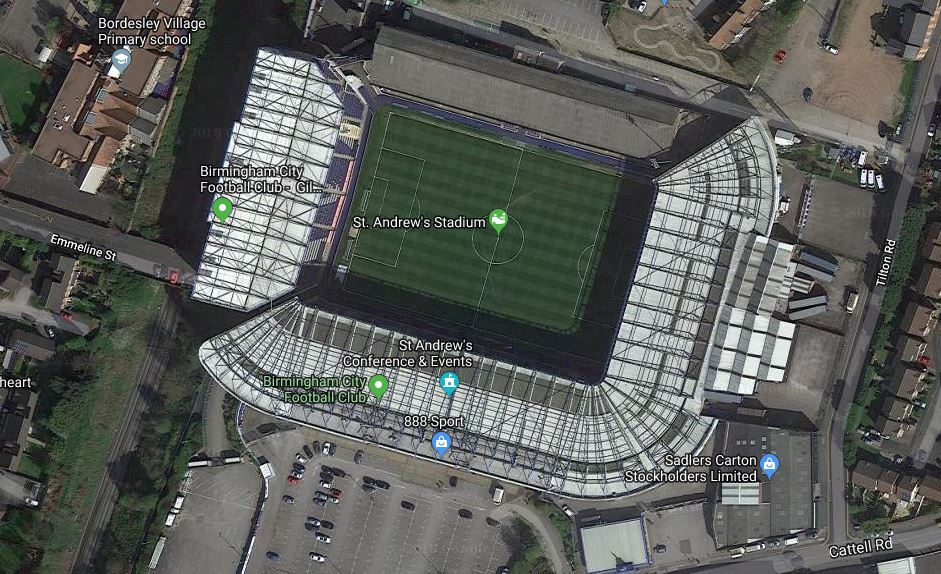
Note the railway line behind the stand on the left.
As it is planned to reopen the Camp Hill Line to passenger services, if Birmingham City were higher in the Leagues, this would surely expect a station to be built here.
Bordesley Station To St. Andrews Has Improved
At various times on this blog, I’ve complained about this route, but it’s finally got better, as these pictures show.


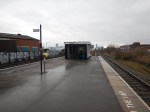

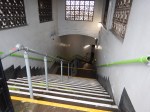
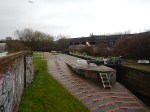


Bordesley station is really only opened for the football, so I suspect that a lift would very much be a low priority.
I have a feeling that it might be possible to walk along the canals from the City Centre, to the lock that I saw.
 The Anonymous Widower