New Tiling On The Northern Line Platforms At Moorgate Station
These pictures show the tiles and other fitments as the Northern Line platforms at Moorgate station are fitted out for Crossrail.
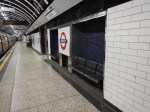
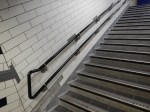


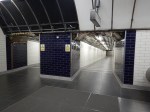
Lifts are being installed to complete the station.
When everything is finished on the Northern Line platforms and the parallel Northern City Line platforms that are above these platforms, there will be step-free access between these platforms and the Crossrail platforms at the massive double-ended Liverpool Street Crossrail station, that connects to Liverpool Street at one end and Moorgate station at the other.
The Future Of Diesel Trains
Many feel that diesel trains have no future in the modern world, because of all those carbon and particulate emissions.
However, this article in Rail Technology News, which is entitled ScotRail To Trial Hydraulic Tech To Cut Of Carbon Emissions.
This is the first paragraph.
A new hydraulic pump could reduce Scotland’s carbon emissions by 4,000 tonnes of carbon dioxide per year.
This sounds impressive, but how is it done?
Many modern diesel muiltiple units, like the Class 170 trains, used in the ScotRail trial have hydraulic transmissions, where a pump fitted to the engine creates hydraulic power, which then drives a hydraulic motor to power the train.
But modern trains also need to have electricity in each car for lighting, air-conditioning and other services.
So typically, a hydraulic unit in each car is used to generate the electricity required.
It is this hydraulic unit, that has been replaced by a much more efficient digitally-controlled hydraulic unit.
That sort of hydraulic unit has one Scottish company’s stamp all over it; Artemis Intelligent Power, which started as a spin-off from Edinburgh University.
Artemis Intelligent Power has a page about Rail applications on their web-site.
This is the introductory paragraphs to their work.
Whilst electrification has enabled the de-carbonisation of much of the UK’s rail sector, the high capital costs in electrifying new lines means that much of Britain (and the world’s) railways will continue to rely on diesel.
In 2010, Artemis completed a study with First ScotRail which showed that between 64 and 73 percent of a train’s energy is lost through braking and transmission.
In response to this, Artemis began a number of initiatives to demonstrate the significant benefits which digital hydraulics can bring to diesel powered rail vehicles.
Two projects are detailed.
The first is the fitting of a more efficient hydraulic unit, that is described in the Rail Technology Magazine article.
Under a heading of Faster Acceleration, Reduced Consumption, there is a technical drawing with a caption of The Artemis Railcar.
This is said.
We are also working with JCB and Chiltern Railways on a project funded by the RSSB to reduce fuel consumption and improve engine performance by combining highly efficient hydraulic transmission with on board energy storage in the form of hydraulic accumulators, which store energy during braking for reuse during acceleration.
Note.
- The use of hydraulic accumulators to provide regenerative braking.
- The involvement of JCB, whose construction equipment features a lot of hydraulics.
- The involvement of Chiltern Railways, who like their parent company, Deutsche Bahn, have a lot of diesel-hydraulic multiple units and locomotives.
The article goes on to detail, how a test railcar will be running before the end of 2017.
This technology could have tremendous potential in the UK.
The Benefit Of Regenerative Braking
In the Wikipedia entry for Regenerative Brake, this is said.
Savings of 17%, and less wear on friction braking components, are claimed for Virgin Trains Pendolinos. The Delhi Metro reduced the amount of carbon dioxide (CO2) released into the atmosphere by around 90,000 tons by regenerating 112,500 megawatt hours of electricity through the use of regenerative braking systems between 2004 and 2007.
The entry also says that some London Underground trains save twenty percent.
It would be a large benefit to the train operating companies, if they could just have a similar saving on the cost of diesel fuel.
Could Existing Trains Be Converted?
In England, Wales and Scotland,currently there are around two hundred modern Turbostar diesel multiple units. of which thirty are used by Chiltern Railways.
Whether these can be converted, depends on the engineers and the result of the current trial, but the economic benefits of a successful conversion route could be very beneficial.
Conclusion
This is technology to watch!
Electrification At Bromsgrove – 26th December 2017
These pictures show the electrification works at Bromsgrove station and up and down the Lickey Incline.


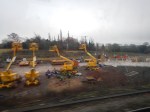
Nearly all the gantries seem to have been erected and much of the wiring seem to have been added.
It would appear that there is every chance that Bromsgrove will be able to run an electric service on Birmingham’s Cross-City Line in May 2018.
Onward From Bromsgrove With Electric Trains
It is worthwhile to look at the options for taking electric trains onward from Bromsgrove station.
The distances to and from Bromsgrove are as possible.
- Birmingham – 25 miles – Electrified
- Worcester – 16 miles – Not Electrified
- Hereford – 42 miles – Not Electrified
West Midlands Trains‘ fleet of four-car diesel CAF Civity trains would handle Birmingham to Hereford with ease.
Abellio, who are a partner in West Midlands Trains, have ordered Stadler bi-mode Class 755 trains for Greater Anglia.
These trains are ideal for routes like Norwich to Stansted and Cambridge to Ipswich, but they would also be efficient on the Birmingham to Hereford route.
So perhaps we might see bi-mode trains or trains with batteries on suburban routes from Birmingham.
I doubt a battery train could go further than Worcester.
The Lickey Incline
Electrifying from Birmingham to Bromsgrove means that the steep Lickey Incline will be included in the works.
Once the Lickey Incline is electrified, I would think it more likely that bi-mode trains could be seen on the routes to Hereford and Worcester.
What A Waste Of Space!
This picture shows two two-car Class 170 trains working together as a four-car unit.
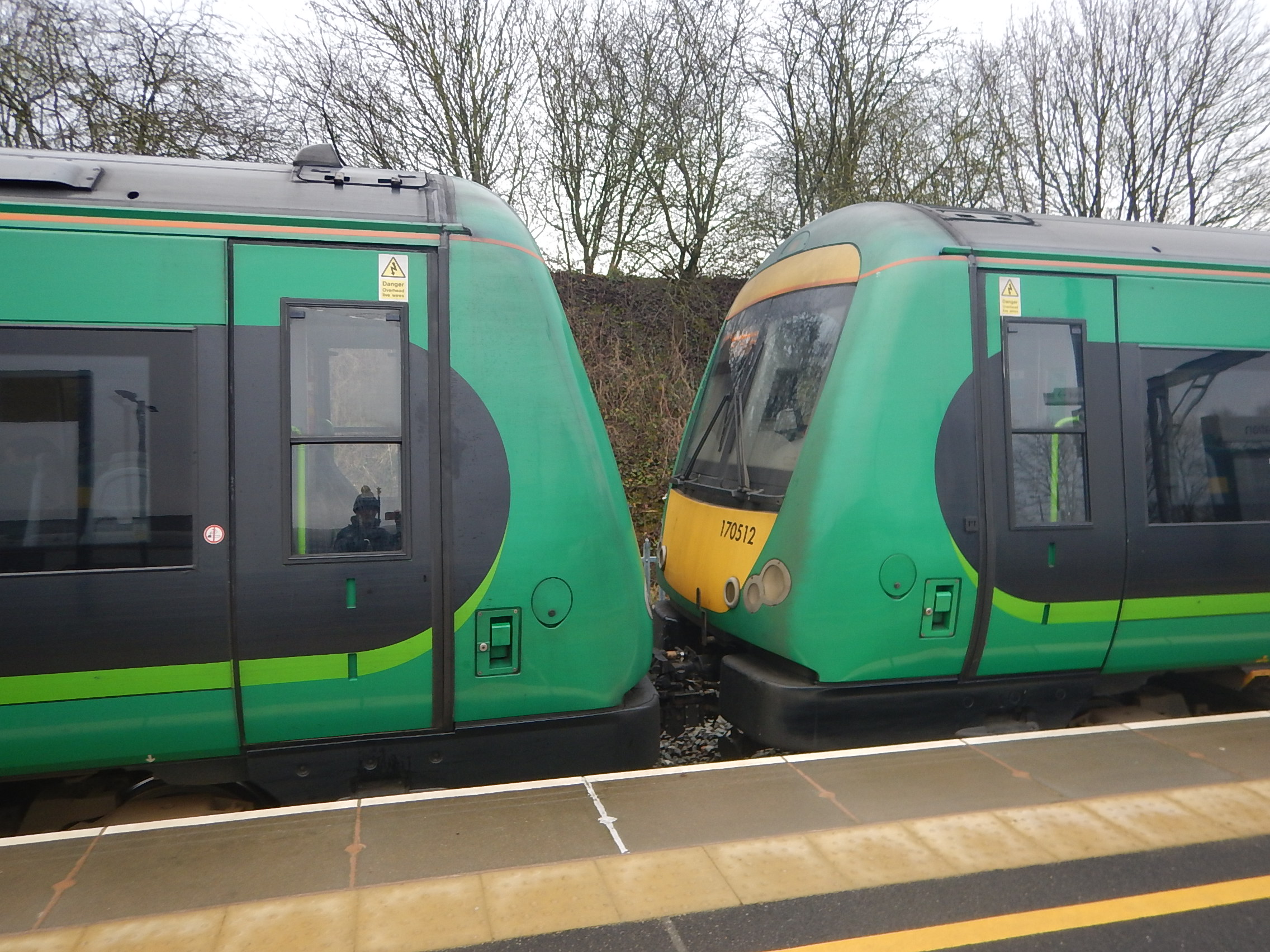
Look at how much space is wasted in the length of this train, by the two middle cabs!
If these Class 170 trains were to be replaced with a four-car train, this would surely increase the capacity of the train, as there would be more space to put seats!
It should be noted that West Midlands Trains have ordered some four-car CAF Civity trains.
A Video About The Class 230 Battery Train
This article on InsideEVs has a rather good video of the Class 230 train demonstrator, which is entitled Fully Charged Checks Out A Battery Powered Train.
Very interesting!
The video was made by Robert Llewellyn of Fully Charged.
A Proposed Trip To Japan
Over the last few months, I have made references to battery trains built by Hitachi running in Japan.
C and myself, bought the guide for Japan, but we didn’t get far in planning a holiday there, as she became ill, with the cancer that killed her.
So perhaps now is the time to go to Japan and explore.
- The plan would be to spend a couple of weeks or so at the end of March, in a decent hotel in Tokyo and explore the country by train.
- Most of the places, I want to visit are served by bullet trains.
- I might also have a few days in South Korea.
If anybody has any ideas or suggestions, then please contact me.
Hitachi Battery Trains On The Great Western Railway
The slow pace of the electrification on the Great Western Main Line has become a big stick with which to beat Network Rail.
But are rolling stock engineers going to pull Network Rail out of their hole?
On page 79 of the January 2018 Edition of Modern Railways, Nick Hughes, who is the Sales Director of Hitachi Rail Europe outlines how the manufacturer is embracing the development of battery technology.
He is remarkably open.
I discuss what he says in detail in Hitachi’s Thoughts On Battery Trains.
But here’s an extract.
Nick Hughes follows his description of the DENCHA; a Japanese battery train, with this prediction.
I can picture a future when these sorts of trains are carrying out similar types of journeys in the UK, perhaps by installing battery technology in our Class 395s to connect to Hastings via the non-electrified Marshlink Line from Ashford for example.
This would massively slice the journey time and heklp overcome the issue of electrification and infrastructure cases not stacking up. There are a large number of similar routes like this all across the country.
It is a prediction, with which I could agree.
I conclude the post with this conclusion.
It is the most positive article about battery trains, that I have read so far!
As it comes direct from one of the train manufacturers in a respected journal, I would rate it high on quality reporting.
Hitachi Battery Train Technology And Their UK-Built Trains
The section without electrification on the Marshlink Line between Ashford International and Ore stations has the following characteristics.
- It is under twenty-five miles long.
- It is a mixture of double and single-track railway.
- It has nine stations.
- It has a sixty mph operating speed.
As the line is across the flat terrain of Romney Marsh, I don’t think that the power requirements would be excessive.
In the Modern Railway article, Nick Hughes suggests that battery technology could be installed in Class 395 trains.
The Class 395 train is part of a family of trains, Hitachi calls A-trains. The family includes.
- Class 800 trains as ordered by GWR and Virgin Trains East Coast.
- Class 801 trains as ordered by GWR and Virgin Trains East Coast
- Class 802 trains as ordered by GWR, Hull Trains and TransPennine Express
- Class 385 trains as ordered by ScotRail.
In Japan, another member of the family is the BEC819, which is the DENCHA, that is mentioned in the Modern Railways article.
As a time-expired electrical engineer, I would think, that if Hitachi’s engineers have done their jobs to a reasonable standard, that it would not be impossible to fit batteries to all of the A-train family of trains, which would include all train types, built at Newton Aycliffe for the UK.
In Japan the DENCHAs run on the Chikuhō Main Line, which has three sections.
- Wakamatsu Line – Wakamatsu–Orio, 10.8 km
- Fukuhoku Yutaka Line – Orio–Keisen, 34.5 km
- Haruda Line – Keisen–Haruda, 20.8 km
Only the middle section is electrified.
It looks to me, that the Japanese have chosen a very simple route, where they can run on electrification for a lot of the way and just use batteries at each end.
Bombardier used a similar low-risk test in their BEMU Trial with a Class 379 train in 2015.
So How Will Battery Trains Be used On the Great Western?
On the Great Western Main Line, all long distance trains and some shorter-distance ones will be Class 80x trains.
The size of battery in the DENCHA can be estimated using a rule, given by Ian Walmsley.
In an article in the October 2017 Edition of Modern Railways, which is entitled Celling England By The Pound, Ian Walmsley says this in relation to trains running on the Uckfield Branch.
A modern EMU needs between 3 and 5 kWh per vehicle mile for this sort of service.
So the energy needed to power the DENCHA, which is a two-car battery train on the just under twenty miles without electrification of the Chikuhō Main Line in a one way trip would be between 112 and 187 kWh.
A Battery-Powered Class 801 Train
The Class 801 train is Hitachi’s all-electric train, of which Great Western Railway have ordered thirty-six of the closely-related five-car Class 800 train and twenty-one of the nine-car units.
The difference between the two classes of train, is only the number of generator units fitted.
- Trains can be converted from Class 800 to Class 801 by removing generator units.
- Bi-mode Class 800 trains have a generator unit for each powered car.
- The all-electric Class 801 train has a single generator unit, in case of electrical power failure.
- When trains couple and uncouple, the train’s computer system determines the formation of the new train and drives and manages the train accordingly.
If I was designing the train, I would design a battery module, that replaced a generator unit
This leads me to think, that a five-car Class 801 train, could have one generator unit and up to four battery modules.
- The computer would decide what it’s got and control the train accordingly.
- The generator unit and battery power could be used together to accelerate the train or at other times where high power is needed.
- If the batteries failed, the generator unit would limp the train to a safe place.
- The number of battery units would depend on the needs of the route.
It would be a true tri-mode train; electric, diesel and battery.
I will now look at some routes, that could see possible applications of a battery version of Class 80x trains.
Cardiff To Swansea
I’ll start with the most controversial and political of the cutbacks in electrification.
At present plans exist to take the electrification on the Great Western as far as Cardiff Central station, by the end of 2018.
The distance between Cardiff Central and Swansea stations is forty-six miles, so applying the Ian Walmsley formula and assuming the train is five-cars, we have an energy usage for a one-way trip between the two cities of between 690 and 1150 kWh.
As the Class 80x trains are a modern efficient design, I suspect that a figure towards the lower end of the range will apply.
But various techniques can be used to stretch the range of the train on battery power.
- From London to Cardiff, the line will be fully-electrified, so on arrival in the Welsh capital, the batteries could be fully charged.
- The electrification can be continued for a few miles past Cardiff Central station, so that acceleration to line speed can be achieved using overhead wires.
- Electrification could also be installed on the short stretch of track between Swansea station and the South Wales Main Line.
- There are three stops between Cardiff and Swansea and regenerative braking can be used to charge the batteries.
- The single generator unit could be used to help accelerate the train if necessary.
- There are only two tph on the route, so efficient driving and signalling could probably smooth the path and save energy.
- Less necessary equipment can be switched off, when running on batteries.
Note. that the power/weight and power/size ratios of batteries will also increase, as engineers find better ways to build batteries.
The trains would need to be charged at Swansea, but Hitachi are building a depot in the city, which is shown in these pictures.


It looks like they are electrifying the depot.
Surely, enough electrification can be put up at Swansea to charge the trains and help them back to the South Wales Main Line..
The mathematics show what is possible.
Suppose the following.
- Hitachi can reduce the train’s average energy consumption to 2 kWh per carriage-mile, when running on battery power.
- Electrification at Cardiff and Swansea reduces the length of battery use to forty miles.
This would reduce the battery size needed to 400 kWh, which could mean that on a five-car train with four battery modules, each battery module would be just 100 kWh. This compares well with the 75 kWh battery in a New Routemaster bus.
Will it happen?
We are probably not talking about any serious risk to passengers, as the worst that can happen to any train, is that it breaks down or runs out of power in the middle of nowhere. But then using the single generator unit, the train will limp to the nearest station.
But think of all the wonderful publicity for Hitachi and everybody involved, if the world’s first battery high speed train, runs twice an hour between Paddington and Swansea.
Surely, that is an example of the Can-Do attitude of Isambard Kingdom Brunel?
Paddington To Oxford
The route between Paddington and Oxford stations is electrified as far as Didcot Parkway station.
The distance between Didcot Parkway and Oxford stations is about ten miles, so applying the Ian Walmsley formula and assuming the train is five-cars, we have an energy usage for the return trip to Oxford from Didcot of between 300 and 500 kWh.
If the five-car train has one generator unit,four battery modules and has an energy usage to the low end, then each battery module would need to handle under 100 kWh.
There are plans to develop a South-facing bay platform at Oxford station and to save wasting energy reversing the train by running up and down to sidings North of the station, I suspect that this platform must be built before battery trains can be introduced to Oxford.
If it’s not, the train could use the diesel generator to change platforms.
The platform could also be fitted with a system to charge the battery during turnround.
Paddington To Bedwyn
The route between Paddington and Bedwyn is electrified as far as Reading station, but there are plans to electrify as far as Newbury station.
The distance between Newbury and Bedwyn stations is about thirteen miles, so applying the Ian Walmsley formula and assuming the train is five-cars, we have an energy usage for the return trip to Bedwyn from Newbury of between 390 and 520 kWh.
As with Paddington to Oxford, the required battery size wouldn’t be excessive.
Paddington To Henley-on-Thames
The route between Paddington and Henley-on-Thames station is probably one of those routes, where electric trains must be run for political reasons.
The Henley Branch Line is only four miles long.
It would probably only require one battery module and would be a superb test route for the new train.
Paddington To Weston-super-Mare
Some Paddington to Bristol trains extend to Weston-super-Mare station.
Weston-super-Mare to the soon-to-be-electrified Bristol Temple Meads station is less than twenty miles, so if Swansea can be reached on battery power, then I’m certain that Weston can be reached in a similar way.
Other Routes
Most of the other routes don’t have enough electrification to benefit from trains with a battery capability.
One possibility though is Paddington to Cheltenham and Gloucester along the Golden Valley Line. The length of the section without electrification is forty-two miles, but unless a means to charge the train quickly at Cheltenham station is found, it is probably not feasible.
It could be possible though to create a real tri-mode train with a mix of diesel generator units and battery modules.
This train might have the following characteristics.
- Five cars.
- A mix of generator units and battery modules.
- Enough generator units to power the train on the stiffest lines without electrification.
- Ability to collect power from 25 KVAC overhead electrification
- Ability to collect power from 750 VDC third-rail electrification.
Note.
- The battery modules would be used for regenerative braking in all power modes.
- The ability to use third rail electrification would be useful when running to Brighton, Exeter, Portsmouth and Weymouth.
The train could also have a sophisticated computer system, that would choose power source according to route,timetable, train loading, traffic conditions and battery energy level.
The objective would be to run routes like Paddington to Cheltenham, Gloucester to Weymouth and Cardiff to Portsmouth Harbour, as efficiently as possible.
Collateral Advantages
Several of the routes out of Paddington could easily be worked using bi-mode Class 800 trains.
- But using battery trains to places like Bedwyn, Henley, Oxford and Weston-super-Mare is obviously better for the environment and probably for ticket sales too!
- If places like Bedwyn, Henley and Oxford are served by Class 801 trains with a battery option, it could mean that they could just join the throng of 125 mph trains going in and out of London.
- Battery trains would save money on electrification.
I also suspect, that the running costs of a battery train are less than those of using a bi-mode or diesel trains.
Conclusion
Hitachi seem to have the technology, whereby their A-train family can be fitted with batteries, as they have done it in Japan and their Sales Director in the UK, has said it can be done on a Class 395 train to use the Marshlink Line.
We may not see Hitachi trains using batteries for a couple of years, but it certainly isn’t fantasy.
Great Western Railway certainly need them!
Conditions And Thoughts On The New Southeastern Franchise
The January 2018 Edition of Modern Railways gives a review of the conditions, that the Department for Transport are imposing on bidders.
The First Sentence
This is the first sentence of the article.
The Department for Transport says bidders for the next Southeastern franchise will be required to provide space for at least 40,000 additional passengers in the morning rush hour with 12-car services on the busiest routes.
This raises an interesting question.
Does the DfT mean actual twelve-car trains or ones as long as current twelve-car trains?
In Big On The Inside And The Same Size On The Outside, I discussed how by using good design, Bombardier were getting more passengers in a train of the same length.
This is an extract from c2c’s Press Release.
The Aventra is one of the fastest-selling trains in the UK rail industry, and these new trains will be manufactured at Bombardier’s factory in Derby. Each new train, which will operate in a fixed set of 10-carriages, will include over 900 seats, plus air-conditioning, wifi, plug sockets and three toilets onboard. Each new carriage is larger and contains more seats than on c2c’s current trains, so each 10-carriage new train provides capacity for 15% more passengers onboard compared to a current 12-carriage c2c train.
So three x four-car trains working as a twelve-car train are replaced by one ten-car train, just as with Greater Anglia. Note the claimed fifteen percent capacity increase!
Metro Services
The article says this about Metro services,
Metro-style trains will be introduced on suburban routes, similar to those on other high-capacity routes into London.
Is the DfT thinking of trains like Crossrail’s Class 345 trains?
Changes Of London Terminals
The DfT was thinking of all inner suburban services going to a single London terminal, but this has been dropped following opposition.
Changes are still proposed, to stop conflicts at Lewisham.
- Bexleyheath Line services will switch from Victoria to Cannon Street or Charing Cross.
- Hayes Line services will serve Victoria and Charing Cross, but not Cannon Street.
- North Kent Line services will run to Cannon Street.
- Sidcup Line services will run to Charing Cross and Cannon Street in the Peak.
- Extra services will serve Abbey Wood for Crossrail.
- More twelve-car trains.
The objective is a turn-up-and-go Metro-style service on suburban routes.
To London Overground, Merseyrail and other commuters around the K, that means four trains per hour.
As there was with the proposal Network Rail made to curtail Sutton Loop Line services at Blackfriars, there will be complaints. Especially, from those who were at Eton with certain MPs!
Hopefully the design of London Bridge station will help smooth things over.
Twelve-Car Trains At Charing Cross And Waterloo East
If most trains are twelve-car trains, then surely all platforms at Cannon Street, Charing Cross, London Bridge, Victoria and Waterloo East stations, must surely be able to handle trains of this length.
As it is specifically mentioned, Charing Cross and Waterloo East stations must be the most problem.
There have been suggestions of rebuilding the two stations, with the platforms at Charing Cross extending over the Thames.
Consider.
- Modern signalling could handle twenty-four trains per hour between Charing Cross and London Bridge.
- Connections to the Jubilee Line could be better.
- The Bakerloo Line is planned to be extended to Lewisham.
- Waterloo East station could surely have over-site development.
- Techniques borrowed from London Underground could be used to turn trains faster at Charing Cross.
I have a feeling that we will see something fairly radical happen in the next few years to increase capacity across the South Bank.
Faster Services To Hastings
This is said about services to and from Hastings.
DfT has specified a new two trains per hour service between London, Tonbridge and Ashford, allowing services to Hastings to be speeded up by removing calls at Orpington, Sevenoaks and Hildenborough.
Bidders are incentivised to develop further proposals for reducing journey times, including for deliveringn high speed services between London St. Pancras, Hastings and Bexhill via Ashford.
That all sounds good for Hastings.
More Trains Between Strood And Tonbridge
This route along the Medway Valley Line will have two trains per hour all day.
Trains For The Franchise
The DfT has specified the trains in a fairly detailed way.
Cars No Longer Than Twenty Metres
This is probably because of curved platforms and other restrictions on the various routes.
It is also a similar car length to the current Class 465 trains and Class 377 trains.
No Extra Selective Door Opening, Except At Waterloo East
I suspect this could be that selective door opening, confuses passengers and perhaps slow the stops.
First Class To Be Removed By September 2020
Will this be popular with all passengers?
There doesn’t seem to have been too many protests about the future removal of First Class on Greater Anglia’s services in Essex.
But it will allow the capacity of the train to be increased, to provide space for some of those 40,000 additional passengers.
ETCS Will Have To Be Deployed
European Train Control System (ETCS) can enable higher frequencies of trains in a safe manner and mandating that it be deployed is a sensible move.
At Least One Accessible Toilet On Main Line And High Speed Trains
I think most train operating companies would do this!
Adequate Wi-Fi
Not providing wi-fi and in addition 4G signals, is probably an easy way to reduce ridership.
Walk Through Trains
The fleets that have been bought recently, are all of this type, so I think it would be unlikely, that any new trains for the Southeastern franchise would be different.
My Thoughts
Train Length
Greater Anglia, Great Western Railway, South Western Railway and Virgin Trains East Coast have set a pattern, by ordering trains and half-trains, that can probably be used in a flexible manner.
Half-train/Full-train ratios for the various companies are.
- Great Western Railway – 1.6
- Greater Anglia – 4.0
- South Western Railway 0.5
- Virgin Trains East Coast – 0.5
Each company has chosen an appropriate number of trains for their routes, but each can adjust numbers by running two half-trains as a full train.
So will we see the same strategy on a future Southeastern franchise?
Perhaps most trains will be twelve-car trains with a small number of six-car trains, that can work together as required.
Train Speed
In Kent On The Cusp Of Change – Elimination Of Slow Trains, I came to this conclusion.
All trains incapable of running a service at 100 mph should be eliminated, just as the two operators;Greater Anglia and South Western Railway, are planning to do.
All of the new Southeastern franchise’s trains should be 100 mph trains.
Plastic Platforms At East Croydon Station
Platforms 1 and 2 at East Croydon station now have glass reinforced plastic surfaces.

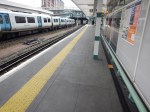
They look good and feature.
- Shorter stepping distance into and out of trains.
- Underfloor heating to prevent ice and snow build up.
- Blue LED edge lighting.
- The lights are blue, so they can’t be confused for signals by the drivers.
- The lighting is designed to deter suicides.
The keen-eyed will notice that the lights aren’t switched on. Apparently, some have failed!
 The Anonymous Widower