Location! Location! Location!
I’ve heard it several times, that the title of this post is the three most important things about property.
This article on Construction Enquirer is entitled Great Portland Estates Plans Work on £233m Trio Of Schemes.
The three schemes are.
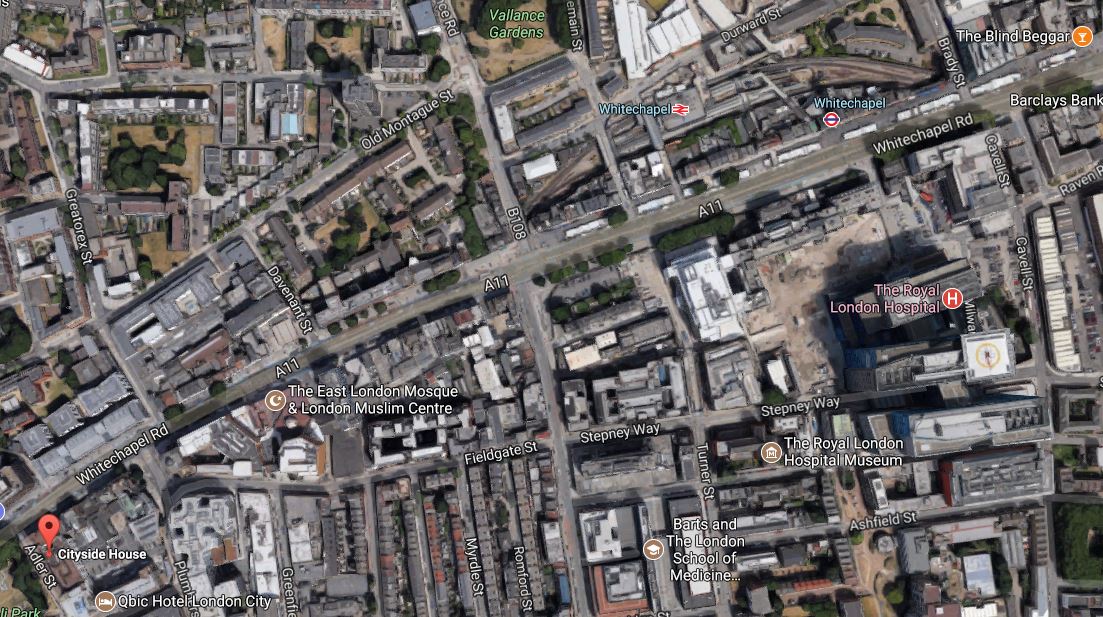
Cityside House E1
This Google Map shows the location.
Note.
- The block is indicated by a red arrow.
- It is a short walk from Whitechapel station, which is served by Crossrail.
The office accommodate is being upgraded and residentialo and a hotel will be added.
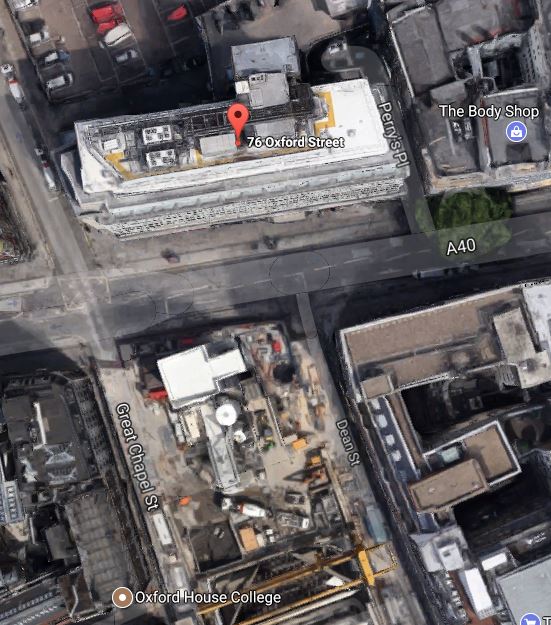
Oxford House W1
This Google Map shows the location.
Note.
- The block is indicated by a red arrow.
- The building site opposite is the under-construction Western entrance to Tottenham Court Road station, which is served by Crossrail.
- Tottenham Court Road station is just thirty minutes to Heathrow on Crossrail, with a train every ten minutes.
The block is to be redeveloped.
Is there a better location for an office block?
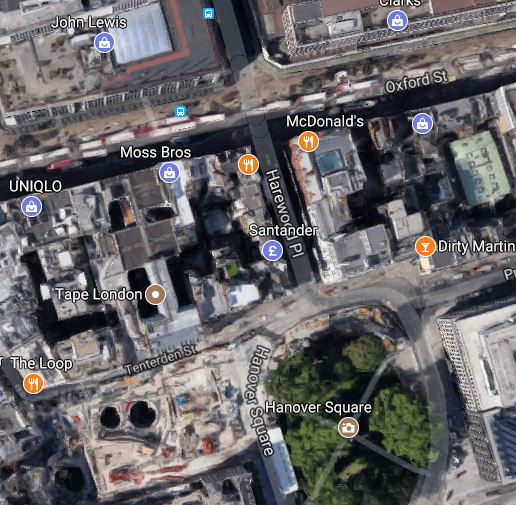
Hanover Square W1
This Google Map shows the location.
Note.
- The site is on the North-West corner of Hanover Square.
- The building will be on top of the Hanover Square entrance to Bond Street station, which is served by Crossrail.
- Bond Street station is just twenty-seven minutes to Heathrow on Crossrail, with a train every ten minutes.
I doubt Great Portland Estates will have problems filling this development.
Conclusion
These three property developments are all tightly tied to Crossrail.
There will be many more!
Will The New Class 710 Trains Use Selective Door Opening At Gospel Oak Station?
These two pictures were taken of a Class 172 train in Platform 3 of Gospel Oak station.
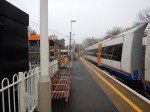
The two-car Class 172 trains are just over 47 metres long.
In The Aventra Car Length Puzzle, I said that the Class 710 trains for the Overground would have twenty metre long cars, which is similar to the 20.4 metres of the Class 378 trains.
For information other four-car electric units, that Aventras are likely to replace have the following car-lengths
- Class 315 trains – 19.80 metres
- Class 317 trains – 19.83 metres
- Class 319/769 trains – 19.83 or 19.92 metres
- Class 321 trains – 19.95 trains
- Class 455 trains 19.83 trains.
So it looks like the Class 710 train, has been sized as a direct replacement foe much of the Mark 3-based electric multiple units.
This would mean, that no platform lengthening work needs to be done, when the many older units are replaced with new Aventras.
It would also mean that as I talked about in Musical Trains On The Overground, that Aventras could share routes with Class 378 trains without too much trouble on the North and West London Lines.
So will a four-car Class 710 train, which will be about eighty metres long fit Platform 3 at Gospel Oak station?
This Google Map shows the station.
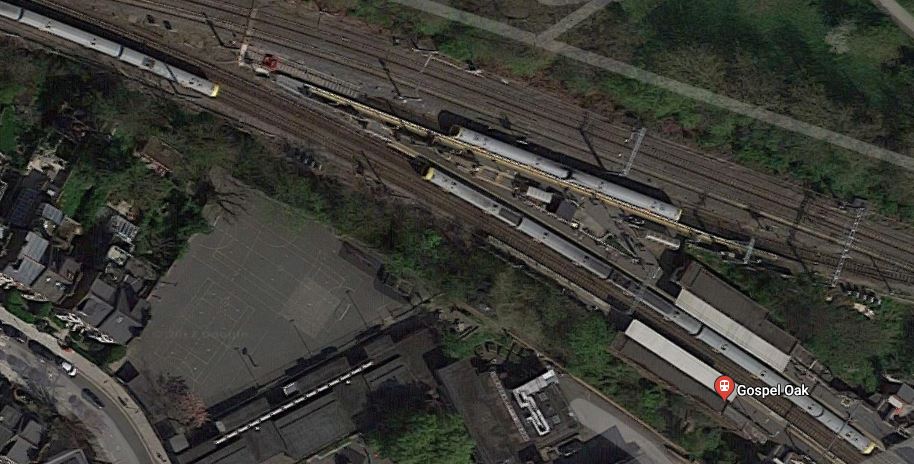
Note that a Class 172 train is in Platform 3 and in Platform 2 there is a five-car Class 378 train.
The length of Platform 3 can be ascertained and it looks like that Platform 3 is already long enough for an eighty metre train.
If it isn’t Bombardier certainly have fitted Selective Door Opening to the new trains.
Diesel And Battery Trains Could Be The Solution For Island Line
The title of this post is the same ass this article on the Island Echo.
The article discusses what is going to happen to the Island Line. I wrote about this line in A Trip On The Island Line.
This is said.
South Western Railway have revealed that the Island’s 80-year-old trains could be replaced with a diesel, battery or flywheel powered locomotive, a tram or even a guided bus lane.
The train operator, which took over the running of Island Line earlier this year, has stated in a consultation document published this week that the Class 483 former London Underground trains are no longer viable, with parts availability becoming an issue and limited capability of electricity. supply.
They are obviously looking for some new trains.
The Current Trains On The Island Line
The current trains on the Island Line are Class 483 trains, which started life as London Underground 1938 Stock.
The trains are 2597 mm. wide and 2883 mm. high.
Looking at the height and widths of London Underground’s 1972 Stock and 1973 Stock, these current trains are about thirty mm. wider and a few mm. higher.
So it might be possible to take some o0f these trains and remanufacture them for the Island Line.
But there are problems.
- These trains are over forty years old.
- London Underground won’t be replacing these trains for several years yet.
- London Underground probably needs all the of the trains in these classes that it’s got.
So the Island Line needs some new trains from another source.
The Trains On The Glasgow Subway
The Glasgow Subway trains were constructed in the late 1970s, by Metro-Cammell, who built the 1972 and 1973 Stock for London Underground.
The Glasgow Subway has an unusual gauge of four foot, as opposed to standard gauge of four foot eight and a half inches. So the Glasgow hauge is 220 mm. narrower than standard.
The Glasgow Subway trains also seem to be 300 mm. narrower and 240 mm. shorter than the 1972 Stock.
I wouldn’t be surprised to be told, that the Glasgow Subway trains were designed by making them slightly smaller than the 1972 and 1973 Stock that had just been built.
New Glasgow Subway trains are being designed and built by Stadler. These will obviously be designed to fit the current platforms and tunnel, as they will have to work with the current trains.
New Trains For The Island Line
Modern computer-aided-design systems can probably scale up Stadler’s Glasgow Subway design to a train that would fit the Island Line.
Standard gauge bogies would have to be fitted.
But it surely is a route to get a basic train, that could be then fitted with appropriate motive power.
How Many Trains Would Be Needed For The Island Line?
Currently, trains on the Island Line run in pairs of two-car trains. This means that to maintain the the current two trains per hour service needs four two-car trains. According to Wikipedia, there are five operational Class 483 trains, with one in store.
If the new trains were similar to the new Glasgow Subway trains, which are four cars, two trains could provide the current service.
After upgrading the Brading loop, four trains would allow a four trains per hour service.
Would a spare train be needed?
Why Would A Big Company Like Stadler Want To Supply A Small Order For The Island Line?
This question has to be asked and I’ll use an extract from this article on Rail Engineer, which is entitled Subway Revival – Glasgow to introduce UTO.
Although there had been concerns that suppliers may not be interested in an order for a small number of four-foot gauge Subway trains, this proved not to be the case. Charlie commented that the Swiss company Stadler was “quite excited at the idea” as it has a bespoke manufacturing operation and its production lines can easily be changed to produce small orders, such as 34 cars for the Berlin Underground and 10 Croydon trams.
Sixteen or twenty cars for the Island Line doesn’t seem so small!
It certainly seems, that if you are a train or tram operator and you want a vehicle that is a little bit out-of-the-ordinary, then Stadler are interested!
What Would The Stadler Trains Be Like For Passengers?
Another extract from the Rail Engineer article, describes the new trains for the Glasgow Subway.
Stadler is to supply 17 four-car articulated trains with wide walk-through connections and a standard floor height, made possible by using smaller diameter wheels. Each train will be 39.25 metres long, compared with 37.74 metres for the current three-car units. The trains have 58 km/hr maximum speed and will have capacity for 310 passengers compared with the current 270. They will also accommodate wheelchairs.
I would suspect that the Island Line trains would be slightly wider and taller, which would give welcome space.
Battery Trains For The Island Line
The Island Echo article mentions battery trains.
So would they be a good idea on the Island Line?
Regenerative Braking
I would be pretty sure that the current Class 483 trains are not fitted with regenerative braking, which saves energy and cuts the electricity bill for running the trains.
I also suspect that the electrical power supply, is not capable of handling the return currents generated by regenerative braking.
However, the new trains for the Glasgow Subway, which I believe could be the basis for an Island Line train, do have regenerative braking.
Putting batteries on the train is a simple way of handling the electricity generated by braking. It is just stored in the battery and then used again, when the train accelerates away.
Health And Safety
Bombardier have stated that batteries on trains can be used to move trains in depots, so the amount of electrification in depots can be reduced.
As batteries can move the train short distances, there may be other safety critical places, where removing the electrification could be recommended.
Track Maintenance Savings
Reducing the amount and complication of electrified track, must save on maintenance.
Emergency Power
Despite the best of intentions, power failures do happen and having a capability to get the train to the next station using batteries must be a good thing.
Running On Batteries
The Island Line is less than ten miles long and the possibility must exist of being able to charge the batteries at each end of the line and run between Ryde Pier Head and Shanklin on batteries.
There would be a balance to be struck between battery size and the length of electrification at each end. Perhaps electrification could be kept on the following sections.
- Ryde Pier Head to Smallbrook Junction
- Sandown to Shanklin
A lot would depend on the state and design of the line’s power network.
Route And Track Extensions
Short extensions or new track layouts could be built without electrification to save building costs.
Conclusion
On balance, battery trains would seem t0 be a useful feature for the new trains on the Island Line.
Improvements To The Island Line
The Wikipedia entry for the Island Line has a section called Future. Various improvements are put forward.
It seems there has been a lot of talk and very little action.
My thoughts follow.
Brading Loop
Wikipedia says this about a loop at Brading station.
A suggestion in early 2009 was to reinstate the loop at Brading, thus allowing a ‘Clock Face’ timetable to encourage greater use. The outcome of this is still awaited.
This Google Map shows the station.
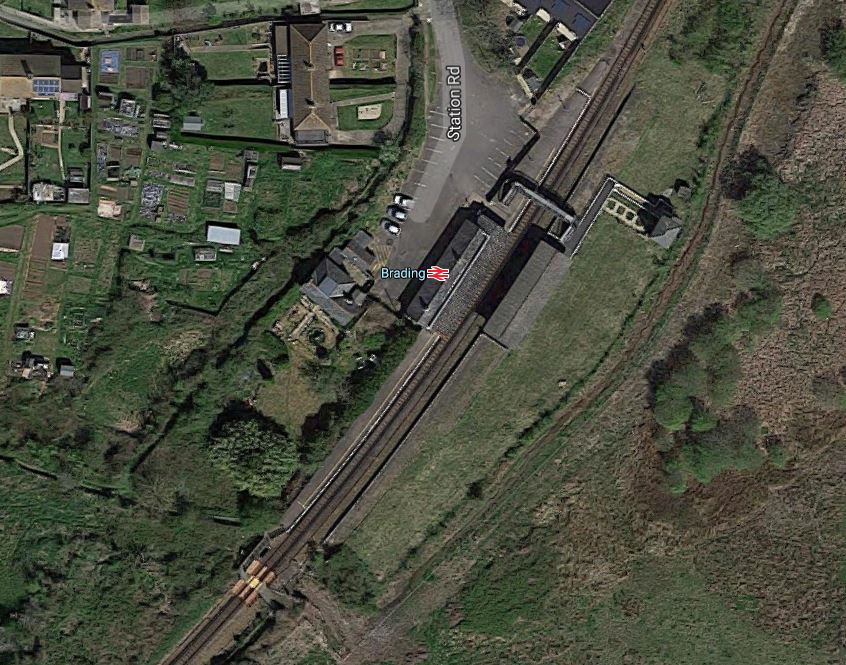
Note the loop is clearly visible to the East of the station.
Trains with a battery capability will give advantages.
- Flexibility of design.
- Simplified track layouts.
- No electrification of new track.
The much-needed loop could become affordable!
Extension to Ventnor
There have been proposals to reopen the line south of Shanklin, to the original terminus at Ventnor.
You can still trace the line on Google Map and if the need is there, trains with a battery capability would surely aid its reopening.
The line could be single track and without electrification.
Conclusion
New trains with a battery capability will give the Island Line a new lease of life.
I also believe that Stadler have the capability to build a suitable battery train, based on their design for the new trains for the Glasgow Subway.
Stadler Comes Up With A New Take And A Big Order For Hybrid And Battery Trains
This article on Global Rail News is entitled Vegetable Oil Fuel Trains To Run In The Netherlands Ahead Of Battery Conversion.
This is said.
- Arriva has ordered eighteen hybrid diesel trains from Stadler to operate its Northern Lines services in the Netherlands.
- The trains will initially be powered by Hydrotreated Vegetable Oil (HVO).
- The trains will have regenerative braking.
- Stadler have called the trains Flirtinos.
- The trains are capable of conversion to battery trains, when there is sufficient electrification.
- The first HVO trains will enter service in 2020.
- Arriva has committed to putting batteries into all of its fleet of fifty-one trains.
This a very strong environmental statement from Stadler and Arriva.
In July 2017, I wrote Battery EMUs For Merseyrail.
These trains are also being built by Stadler.
Conclusion
Have Stadler found the secret for better battery trains?
Certainly, the amount of money that Arriva is paying Stadler and the fact that Arriva are creating sixty-nine trains with batteries, indicates that they have confidence in the product!
You can’t fault Stadler’s marketing either!
A Solution To The Northern Irish Problem!
I am an engineer and therefor tend to favour practical solutions, that are often radical.
The Brexit negotiations are at an impasse over how you deal with the Northern Irish-Irish Republic border.
We only have to look back to the Second World War, where smuggling was rife between a neutral Irish Republic and Northern Ireland.
I believe there is no way to enforce border rules without a border wall in the style of Donald Trump.
That would be unacceptable to probably everyone in the island of Ireland! And probably almost 100 % of the citizens of the UK!
Joint British And Irish Long-Term Objectives
We can sum these up the objectives of the British and Irish people for the island of Ireland like this.
- Prosperous economies.
- Full employment
- Friendly relations at all levels
- A well-maintained And thriving environment
- The final end to The Troubles.
The governments involved don’t always seem to follow sensible routes, that will help in these and other similar objectives.
An Anglo-Irish Fixed Link
I don’t think anybody, except possibly some ferry companies and airlines, would disagree with the fact that the Channel Tunnel has been a success.
Although, I would say that services through the tunnel have been slow to develop.
So surely, one way to improve the economy of the whoile of the island of Ireland would be to create a fixed link across the Irish Sea.
Wikipedia has a section entitled British Isles Fixed Sea Link Connections.
It lists four possibilities for fixed links between Great Britain and Ireland.
Some are more practical than others.
Political Considerations
Post Brexit, I don’t believe that any UK Government would want to contribute any money to a fixed link between Wales and the Irish Republic.
I also feel, that the Irish Government and the EU wouldn’t want to contribute to a fixed link between Scotland and Northern Ireland.
But I do believe that the EU could be persuaded to provide funding to create a high speed rail link between say Belfast, Dublin and Cork.
Practicality
Route 1 is the shortest at just 19 km, whereas routes 3 and 4 are the longest at 100 km.
Route 1 unfortunately, is the only route without a rail connection on the Great Britain side. Any rail link to the main UK rail network would be a challenging undertaking and probably go through environmentally-sensitive areas
The North Channel (Galloway) Route
I believe that the North Channel (Galloway) Route, is the only route that stands a chance of getting built.
Wikipedia says this about the link.
This route has been proposed variously as either a tunnel or a bridge. A 2007 report by the Centre for Cross Border Studies estimated building a bridge from Galloway to Ulster would cost just under £3.5 billion. The proposal would see passengers board trains in Glasgow then cross the bridge via Stranraer and alight in Belfast or Dublin. A longer bridge already exists between Shanghai and Ningbo in east China. Some political parties in Northern Ireland have included the bridge in their manifesto for some time. However, because of the Beaufort’s Dyke sea trench, this route would be deeper than the southern routes. The sea trench was also used for dumping munitions after World War II and so would require an expensive clean up operation. Ronnie Hunter, former chairman of the Institute of Civil Engineers Scotland, suggested that the project was a “stretch but doable”. He cited the lack of “soft rock, the chalk and sandstone” as a challenge compared to the construction of the Channel Tunnel. He also suggested that the change in rail gauge between Ireland and Britain might pose further concerns.
These problems must be solved.
Bridge Or Tunnel?
Having been across the Oresund Bridge, I believe that Civil Engineers could find a solution to crossing between Stranraer and Northern Ireland.
The crossing would be in excess of thirty kilometres long. But look at Wikipedia’s list of longest bridges and there are several a lot longer, including this 164.8 km. monster; Danyang–Kunshan Grand Bridge, which carries the Beijing–Shanghai High-Speed Railway along the Yangtze River.
Beaufort’s Dyke
The Oresund Bridge is part-bridge and part-tunnel and this was obviously a good solution to crossing the Oresund strait.
I believe that mixing various types of crossing could solve the Beaufort’s Dyke problem and provide an affordable solution to the crossing.
Rail Connection In Scotland
The Glasgow South Western Line finishes at Stranraer station and could surely be extended to the crossing.
Electrification would probably be recommended.
Rail Connection To England
Intriguingly, there used to be a railway route from Stanraer to Carlisle via New Galloway, Castle Douglas and Dumfries.
When HS2 opens to Crewe in 2027, I believe that high speed trains could possibly break the four hour barrier between Euston and Belfast.
An electrified route between Carlisle and the crossing would be needed.
Rail Connection In Northern Ireland
This Google Map shows the location of Belfast Central station in the city.
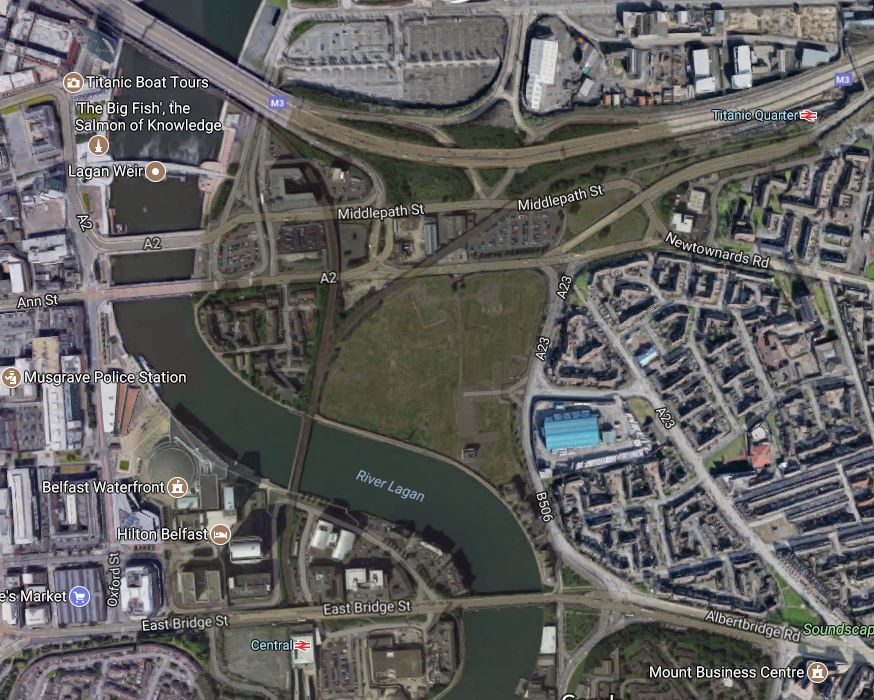
Note.
- The station is on East Bridge Street in the bend of the River Lagon
- The lines crossing the river and then splitting to go East and North West.
- The lines going South from the station towards Dublin.
It would appear to be very convenient.
It would be ideal if trains could come across from Scotland, stop in Belfast Central station and then continue to Dublin’
The Variable Gauge Problem
UK railways and nearly all of Europe’s high speed lines use standard gauge tracks and 25 KVAC overhead electrification.
NI Railways use Irish gauge tracks and are diesel powered.
In an ideal world, trains from Glasgow and Carlisle would be electric trains for environmental reasons and I suspect, that diesel wouldn’t be welcomed in any undersea tunnels.
So this would mean one of the following.
- Passengers would have to change trains on arriving in or leaving Northern Ireland.
- A new electrified standard-gauge line would have to built to Belfast Central station.
- A fleet of bi-mode variable-gauge trains would have to be acquired.
Or alternatively, a high-speed electrified standard-gauge line to European standards could be built between the crossing and Dublin, with these characteristics.
- Twin-track capable of at least 125 mph running.
- 25 KVAC overhead electrification.
- ERTMS signalling
- European GC loading gauge.
- An interchange station with Belfast’s local network.
- A station to load car and truck shuttles as used on the Channel Tunnel.
- Freight terminals as required.
This would certainly allow the following.
- Direct electric services between Dublin and Glasgow via Belfast.
- Direct electric freight services between Ireland and Great Britain.
- Sleeper services between London and Ireland
After HS2 opens to Crewe in 2027, the following services would be possible, without changing trains.
- Euston to Belfast in under four hours.
- Euston to Dublin in under five hours.
- A faster and more frequent service between the two parts of Ireland.
Addition of electrified branches to other important cities would be possible in the future.
So How Does It Solve The Irish Problem?
It would need a lot of development to truly be acceptable to the EU and the UK and the Irish governments!
But for a start a fixed rail link must improve the economies of the island of Ireland.
This in itself would surely mean that the two governments would work more together for their common good.
I also believe that it would be easier to develop an electronic border, if most of the freight ran between the two islands on rail.
Conclusion
I think we should develop the rail link, even if at the last minute, Brexit gets abandoned.
Brexit ‘no deal’ Means Britons Will Be Barred From Taking Pets To The Continent, Michel Barnier warns
The title of this post, is the same as this article in the Telegraph.
Doesn’t this say a lot about the vindictiveness, stubbornness and downright stupidity of those involved in the Brexit negotiations?
Could The Wensleydale Railway Become A New TransPennine Route?
Yesterday, The Times had a nearly full page article with a title of The Village With Nowt Taken Out.
It describes how the small market town of Hawes has by its own efforts turned itself from a very much declining town into a thriving community.
The town’s latest project is to take over the only filling station in the town, to avoid a 36-mile round trip to fill up.
The Times was also very impressed, as the newspaper published a Leading Article, which was entitled Hawes for Thought. This is said.
Hawes is a phenomenon, a case study in self-sufficiency, community spirit, bloody-mindedness and the awesome power of bootstraps.
The Leading Article said that Hawes station closed in 1959, which would have been when I was just twelve.
The station buildings are now part of the Dales Countryside Museum.
I got to wondering as I do, where the railway used to run.
Hawes station used to be on the Wensleydale Railway, which connected the East Coast Main Line at Northallerton station to the Settle-Carlisle Line at Garsdale station.
The Wensleydale Railway is now a heritage railway running trains between Northallerton West and Redmire stations, with up to six intermediate stations.
This section from Wikipedia, details their future plans.
The company’s longer-term aim is to reopen the 18 miles (29 km) of line west from Redmire via Castle Bolton, Aysgarth, Askrigg, Bainbridge, Hawes and Mossdale to join up with the Settle-Carlisle Railway Route at Garsdale. A study commissioned by the railway indicated that an initial extension to Aysgarth from Redmire (3 miles (4.8 km)), would generate an extra income of £3.1 million into the local economy with an additional £500,000 in ticket sales for the railway.
There is also this in the Wikipedia entry for Northallerton West station in a section call Future.
The aim of the Wensleydale Railway in the long-term is to extend the line to Northallerton station and allow passengers to interchange with National Rail services. As this will require an agreement with Network Rail, the provision of the platform is an interim solution which will allow the track to be brought into more regular use whilst also bringing in extra income for the heritage railway.
I’ve have looked on at Ordnance Survey map at the track at the Western end and its original position is clearly visible.
Surely, this is the sort of project that rural areas with a high level of tourism need, if the sums add up in the right way!
Consider.
- The line will have a full length of about forty miles. So it could be a Grand Day Out?
- The line would connect to the iconic Settle-Carlisle Line at its Western end, with connections to Carlisle, Carnforth and Cumbria and Black and Lancashire.
- The Line would connect to the East Coast Main Line at its Eastern end, with connections to Darlington, Middlesbrough, Newcastle and York.
- Network Rail have spent a fortune on the Settle-Carlisle and this would feed in more passengers.
An extended Wensleydale Railway would greatly add to the tourism infrstructure in the area.
Conclusion
If the residents of the area, show the grit and determination, that has been shown by the residents of Hawes, this railway will get built!
There would be another slow-speed TransPennine route.
Updating The Central Line
The Central Line will breathe two huge sighs of relief in the next eighteen months.
- The Elizabeth Line will open between Abbey Wood and Paddington stations in December 2018.
- The Elizabeth Line will open between Shenfield and Paddington stations in May 2019.
Travellers, from London, other parts of the UK and abroad will then have the following.
- Five East-West interconnected routes across Central London; Metropolitan, Central, Elizabeth, District and Jubilee Lines.
- Massive transport interchanges at Canary Wharf, Stratford, Whitechapel, Liverpool Street, Farringdon, Tottenham Court Road, Bond Street and Paddington will tie it all together.
- Liverpool Street. Whitechapel and Stratford will allocate passengers in the East of Central London.
- Paddington will allocate passengers in the West of Central London.
And this is before the Elizabeth Line opens between Paddington and all stations to Heathrow and Reading in December 2019.
The Central Line After the Elizabeth Line Opens
So will the Central Line become a little-used backwater?
- Holborn is a major interchange with the Piccadilly Line, which is that line’s only access to the Central or Elizabeth Lines.
- Oxford Circus is a major interchange with the Victoria Line, which is that line’s only access to the Central or Elizabeth Lines.
- Holborn, Oxford Circus, Marble Arch and other stations are destinations in their own right.
- The overcrowding of the Central Line probably kept passengers away and after freeing up will they come back?
I suspect that in a few years time it will be as busy as it ever was!
Improving the Central Line
It is my view, and probably that of Transport for London, that improvements need to be made to the Central Line.
Three projects are underway.
The Central Line Train Upgrade
This article on Railway-news.com is untitled London Underground’s Central Line Trains Set For Upgrade.
Currently, the Central Line‘s 1992 Stock have DC motors, which will be replaced by more efficient AC motors and a sophisticated control system.
The cost of the upgrade will be £112.1 million or about £1.3 million per train.
Transport for London are only making a reliability claim for the upgrade. Hopefully, if the trains are more reliable, then more can be in service. so can a higher frequency be run?
I also think in addition, the trains could possibly accelerate faster from stops, thus reducing the dwell times at stations and ultimately the journey times.
- Epping to West Ruislip currently takes ninety minutes with 38 stops.
- Ealing Broadway to Newbury Park takes sixty minutes with 24 stops.
- Northolt to Loughton takes sixty-seven minutes with 28 stops.
Saving just ten seconds on each stop will reduce journey times by several minutes.
I suspect that Transport for London will rearrange the timetable to increase the service frequency from the current twenty-four trains per hour (tph).
It will be interesting to see what frequency of trains and journey times are achieved, when all the Central Line trains have been updated.
Bank Station Capacity Upgrade
This page on the Transport for London web site gives details of this important upgrade at Bank station, which is already underway. It starts with this paragraph.
Bank and Monument stations form the third busiest interchange on the London Underground network. Work we’re doing to substantially improve the capacity of Bank station should finish in 2022.
It lists these improvements.
- A new railway tunnel and platform for the Northern line that will reduce interchange times and create more space for passengers
- Step-free access to the Northern line and DLR platforms
- More direct routes within the station, with two new moving walkways
- Two new lifts and 12 new escalators
- A new station entrance in Cannon Street
There will also be a new entrance in Wallbrook Square under the Bloomberg Building, which is planned to open this year.
Comprehensive is a good word to describe the upgrade.
I avoid the Northern Line platforms at Bank because they are so narrow. After the upgrade, I will have no need.
Holborn Station Capacity Upgrade
This page on the Transport for London web site, gives details of this important upgrade at Holborn station. It starts with this paragraph.
We’re proposing changes at Holborn station that would make it substantially easier for customers to enter, exit and move around the station. Subject to funding and permissions, work on the station would start in the early 2020s.
I don’t think this upgrade can come too soon.
As with some parts of Bank station, I avoid Holborn station.
What Still Needs To Be Planned?
The major projects left must surely be upgrading the capacity and providing step-free access at the following Central London stations.
St. Paul’s And Chancery Lane
St. Paul’s and Chancery Lane stations both need step-free access, but the problems of installing lifts at the two stations would be surprisingly similar, as both stations have a similar layout.
- Both stations will need lift access to the ticket halls, which are below street level.
- At both stations, the two Central Line tracks are unusually arranged one on top of the other.
- Even more unusually, the Westbound tunnel is on top at St. Paul’s and the Eastbound tunnel at Chancery Lane.
- At both stations, escalators lead down to a spacious lobby, which has direct access to the top platform.
- St. Paul’s has two escalators and a staircase, whereas Chancery Lane has three escalators.
- From the low-level lobby, two short escalators and a staircase lead down to the bottom platform.
It may be possible to provide lifts that go from the ticket hall to both platforms as before rebuilding in the 1930s, this arrangement was used.
Both stations might also be suitable for the application of inclined lifts.
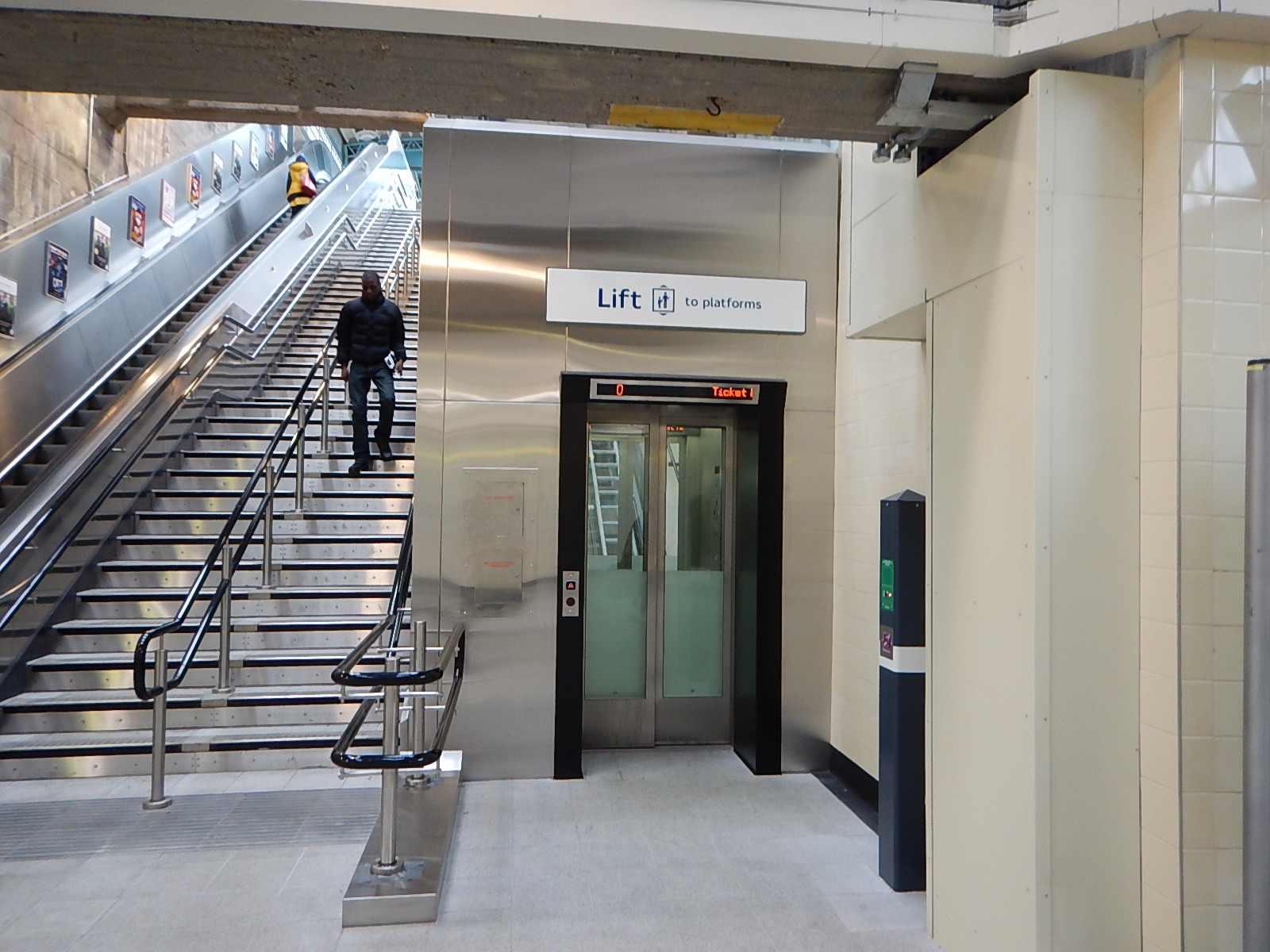
For instance, would two escalators and an inclined lift handle the lower transfer at both stations?
Oxford Circus
Oxford Circus is a busy interchange, where the Bakerloo, Central and Victoria Lines cross each other.
This map from carto.metro.free.fr shows the lines at Oxford Circus station.
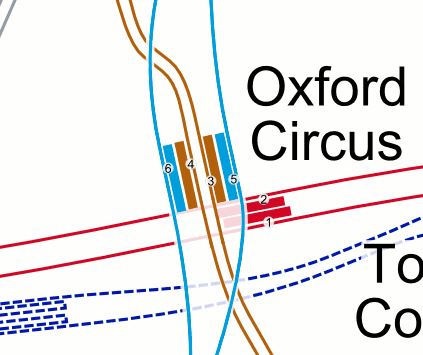
Note.
- The Cemtral Line, shown in red, was built under Oxford Street to avoid disturbing the buildings.
- The Bakerloo Line, shown in brown, was built under Regent Street.
- The Victoria Line, shown in light blue was cleverly threaded through in the 1960s to give cross-platform interchange with the Bakerloo Line.
- The dotted purple lines are the Elizabeth Line.
- Between the two dotted lines, the Eastern End of the platforms at Bond Street station can be seen.
These pictures show the buildings at the four corners of Oxford Circus.



Wikipedia says this about these buildings.
Oxford Circus was designed as part of the development of Regent Street by the architect John Nash in 1810. The four quadrants of the circus were designed by Sir Henry Tanner and constructed between 1913 and 1928.
Note.
- The building on the North-East corner used to be Peter Robinson and is Grade II Listed.
- The other three corner buildings are also Listed.
- The shops in the two Southern corners are being refurbished.
I believe that the following is needed at Oxford Circus station.
- Measures to alleviate the overcrowding.
- Full step-free access to all platforms.
- Improved access to the Central Line platforms.
- Better interchange between the Bakerloo/Victoria platforms and the Central Line.
In some ways, the biggest problem in the next few years will be passengers changing between the Victoria and Elizabeth Lines. Passengers between say Walthamstow and Heathrow will probably want to change between Oxford Circus station and the new Hanover Square entrance to Bond Street station.
- The planned pedestrianisation of Oxford Street will obviously help, especially if the roads around Hanover Square, like Harewood Place and Princes Street are similarly treated.
- Joining the Victoria Line at Oxford Circus is not a problem, as there are four entrances to the ticket hall under Oxford Circus, a large number of entrance gates and four escalators down to the trains.
- But on arrival at the station, you are forced to exit from the station about fifty metres East of the station, which means you’re going the wrong way for the Elizabeth Line.
It strikes me what is needed is a new entrance to the station on the South Western corner of Oxford Circus.
But would this alone satisfy the needs of this station?
More Station Entrances On Oxford Street
For Crossrail, Bond Street station is being given two new entrances in Davies Street and Hanover Square.
But it is also being given another entrance on the North side of Oxford Street, to give better access to the Central and Jubilee Lines.
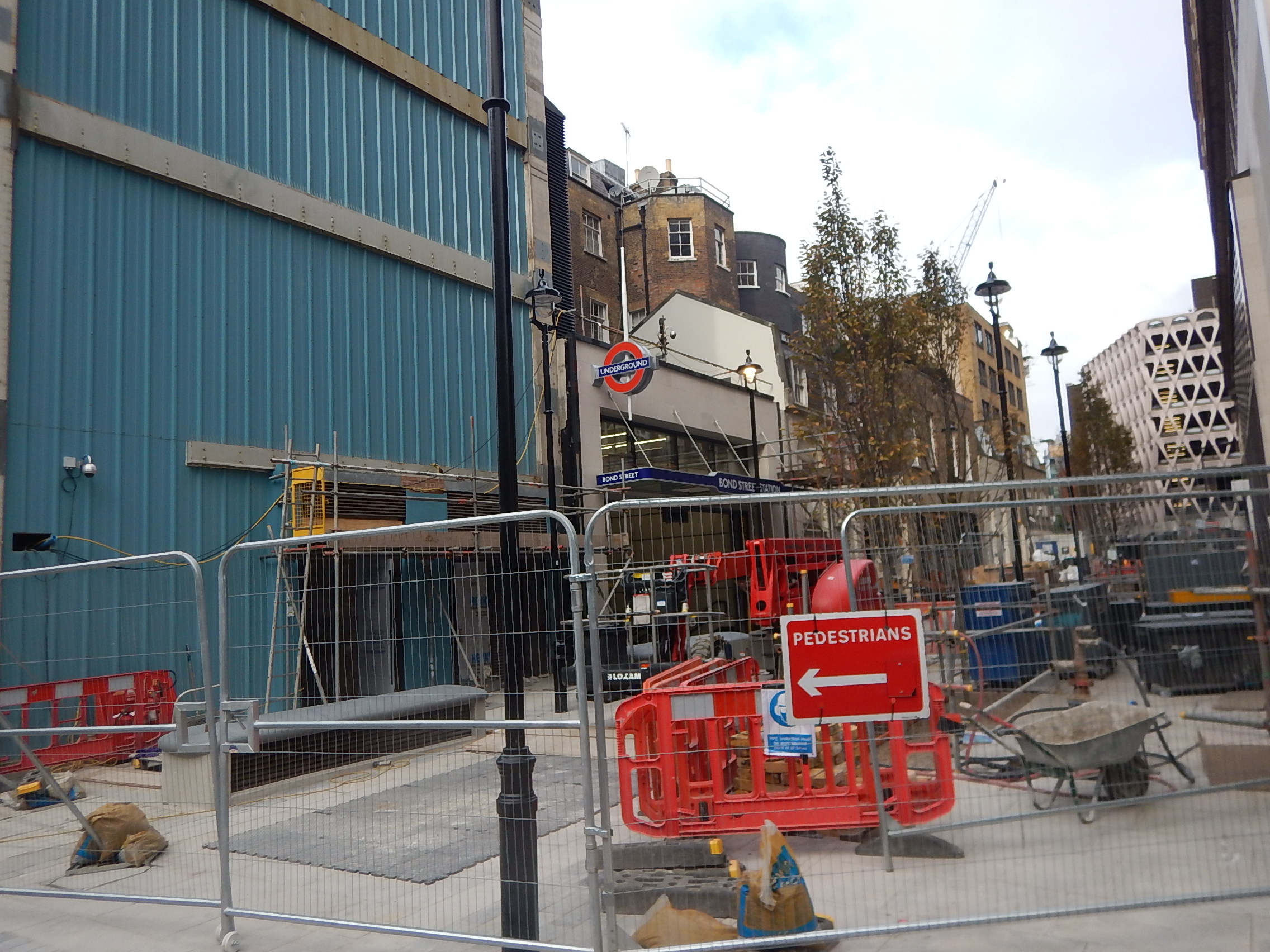
The picture shows the new entrance tucked away in what will probably become a new development.
So could this technique be used on Oxford Street to improve station access?
Look at the map of the lines at Oxford Circus station earlier in the post and you will notice that the Central Line platforms extend to the East. I took these pictures around where the platforms could end.



Could there be space to squeeze in another entrance to the Eastern end of the Central Line platforms?
It probably won’t be possible whilst traffic is running up and down Oxford Street. But after the road is pedestrianised, it would surely be much easier to dig down to the Central Line , which is not very deep below the surface of Oxford Street.
Marble Arch
Marble Arch station is at the Western end of Oxford Street. Wikipedia says this about the station.
The station was modernised (2010) resulting in new finishes in all areas of the station, apart from the retention of various of the decorative enamel panels at platform level.
But has it got the capacity needed?
It is also not step-free and needs lifts.
New Trains In The Mid 2020s
Under Future and Cancelled Plans in the Wikipedia entry for the Central Line, this is said.
The Central line was the first Underground line to receive a complete refurbishment in the early 1990s, including the introduction of new rolling stock. A new generation of deep-level tube trains, as well as signaling upgrades, is planned for the mid-2020s, starting with the Piccadilly line, followed by the Bakerloo Line and the Central Line.
The new trains would fit well to replace the current trains and give an increase of capacity to the line.
Possible Developments
These are possible developments.
Shoreditch High Street Station
There is a possibility of connecting Shoreditch High Street station to the Central Line.
This is said under Plans in the Wikipedia entry for the station.
There have also been discussions of creating an interchange with the Central line between Liverpool Street and Bethnal Green which runs almost underneath the station. However, this would not be able to happen until after the Crossrail 1 project is complete, due to extreme crowding on the Central line during peak hours.
Given that in a few years time, the following will have happened.
- There will have been a lot of development in Shoreditch.
- The East London Line will have a frequency of twenty-four trains per hour.
The connection may be worth creating.
On the other hand, the Elizabeth Line may make the connection unnecessary, as travellers can use the two connections at Stratford and Whitechapel stations.
Mile End Station
If ever there was a station, where step-free access would surely be worthwhile it must be Mile End station.

Consider.
- It is a busy station.
- It has cross-platform access between District/Metropolitan and the Central Lines.
- It has a cab rank.
Knowing the station fairly well, I suspect fitting the probably three lifts required would not be the most challenging of tasks.
Eastern Improvements
Crossrail has a step-free cross-platform interchange with the Central Line at Stratford, which will have the following effects.
Changing at Stratford will give better access to and from Oxford Street, Paddington and Heathrow.
Crossrail trains will be larger, more comfortable, better equipped and probably less crowded.
Journey time savings will be six minutes to Bond Street and nineteen minutes to Ealing Broadway stations.
Taken with the improved Central Line trains, it all must result in increased patronage in the East.
But there are twenty stations East of Stratford, of which only four are step-free.
So I suspect that Transport for London will make strenuous efforts to improve the Eastern end of the Central Line.
- More step-free access.
- Better bus services.
- More small retail outlets at stations.
I believe that in ten years time, the Eastern station will be very different.
Western Improvements
West of Marble Arch, there are seventeen stations, of which by 2020 only two will be step-free.; Ealing Broadway and Greenford.
Improvements will probably a similar pattern to the East, although there are rumours of rebuilding some stations.
Conclusion
There’s a lot of scope for improvement in the Central Line.
We Just Get Leaves On The Line
But the Norwegians have just suffered a bigger problem!
See this article on Global Riail News, which is entitled Tank Removed From Railway Line In Norway.
It reportedly fell of the back of a train.
Do A Lot Of Other Cities Need An Overground?
This article on the MayprWatch web site is entitled London Overground Celebrates Ten Years Of Transforming Rail Travel In The Capital.
The principles behind the Overground are simple.
- Bring run-down suburban railways under local control.
- Clean everything like crazy.
- Run four trains per hour on all routes.
- Introduce contactless ticketing with Oyster and bank cards.
- Have lots of visible well-trained staff.
- Upgrade stations and step-free access, when money allows.
- Increase train length to match passenger numbers.
- Allow disabled passengers to just turn up and get the assistance they need.
- Add lots of passenger information.
The principles certainly appear to have worked. This is from the MayorWatch article.
This investment, which started under Mr Livingstone and was continued by his successor Boris Johnson, has helped the London Overground become one of the UK’s most successful rail services, with independently measured passenger satisfaction scores routinely above 80%.
Since launch, more than a billion passenger journeys have been made on the network which now serves 23 of the Capital’s boroughs as well as southern Hertfordshire.
The investment is continuing.
- In 2018, new Class 710 trains will replace the thirty-year-old Class 315 trains on West Anglia routes to Cheshunt, Chingford and Enfield Town.
- In 2018, the newly-electrified Gospel Oak to Barking Line will change over to four-car Class 710 trains to double capacity.
- In 2018, Friday and Saturday night services will start on the East London Line.
- By 2020, service frequencies on the circular North, East, South and West London Lines will have increased to decrease the overcrowding.
- In 2021, the Gospel Oak to Barking Line Extension to Barking Riverside will open to serve ten thousand new homes.
- In 2026, the North London Line will join the big party at Old Oak Common station, when HS2 opens.
- Could the West London Orbital be the next project?
- Transport for London would love to get their hands on the Northern City Line. This proposal is supported by many Londoners, polticians and rail professionals like Chris Gibb.
So long as passengers turn up, we will see increasing amounts of orange on London’s Rail and Tube Map.
Celebrating Ten Years
To celebrate ten years, London Overground have released a map showing attractions that are accessible from the Overground.
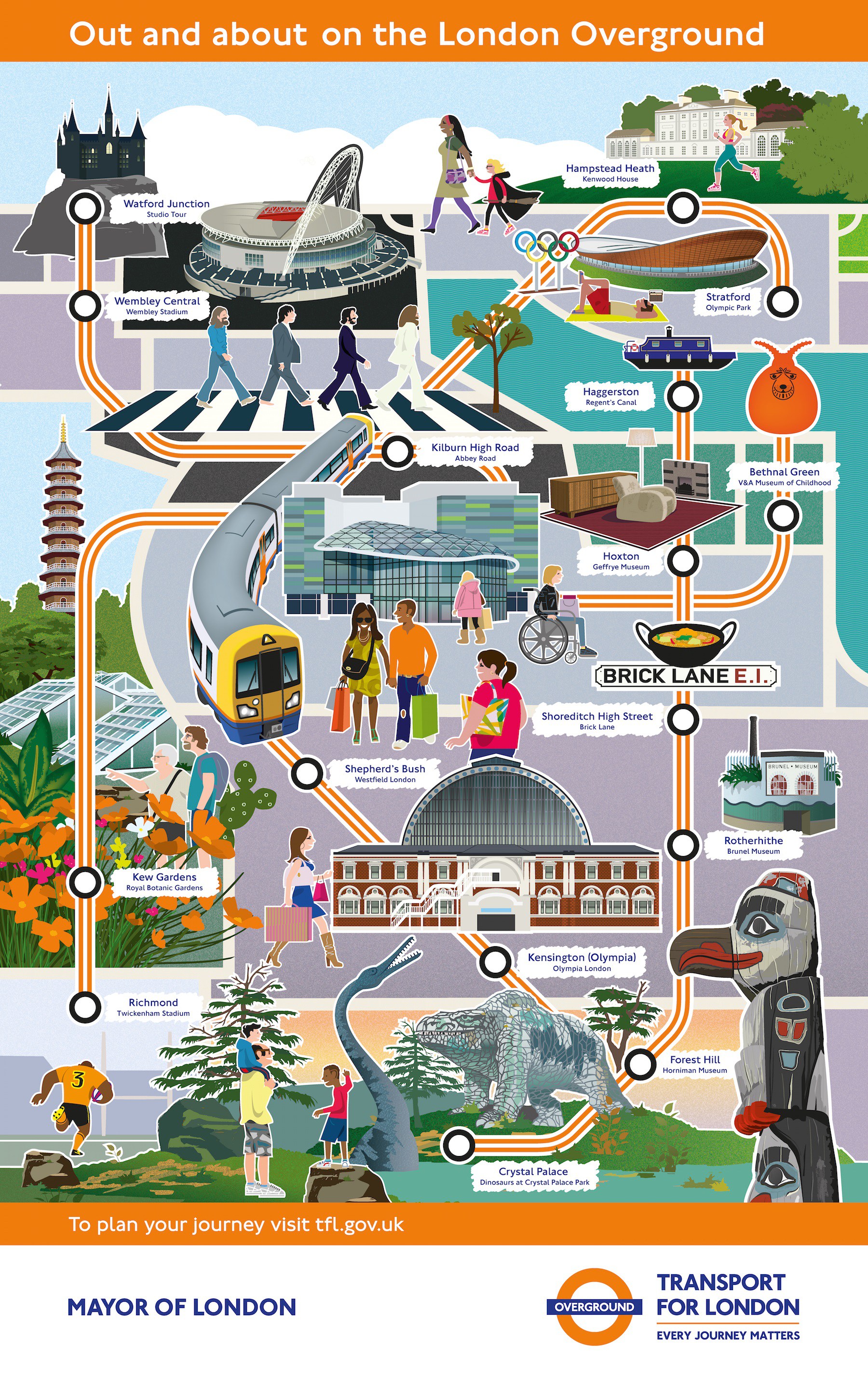
The Overground could become a tourist attraction in its own right.
- No special ticket required – Just touch in and out!
- Many of the attractions served by the Overground are affordable or free.
- Trains have a frequency of at least four trains per hour.
- Stations generally have good directions to local attractions.
In addition, Overground trains have better views from the windows than Underground trains.
The Overground Has Certainly Been A Success
When I moved to Dalston in 2010, the Overground had just opened to four station within walking distance; Canonbury, Dalston Junction, Dalston Kingsland and Haggerston.
New three-car Class 378 trains ran to Clapham Junction, Crystal Palace, New Cross, Richmond, Stratford and West Croydon, every fifteen or so minutes.
Now the trains have grown to five-cars and there is an extra route across South London to Clapham Junction to complete the circlke around Central London.
Passenger numbers have grown with the capacity and the railways have transformed Hackney and Dalston in particular.
Other Overgrounds In The UK
Several cities in the UK have their own local rail networks that are heavily used for commuting, leisure, shopping and tourism.
I’ve rode on systems in Birm,ingham, Glasgow and Liverpool, but none of these railways is as easy to use and as travel information-rich as the London Overground.
Not one of the UK’s local networks for instance, allow ticketing by using a contactless bank or credit card.
But then, with only a couple of exceptions, European networks are no better than the abysmal norm!
Contactless Ticketing
I believe that every local rail or Metro network, should support ticketing using contactless bank or credit cards.
- There is no need to buy a ticket or a special electronic travel card.
- A maximum daily, weekly or monthly cap can be applied.
- \Entry and exit at stations is quick and easy.
I also feel that cities that don’t go this route will lose out, as tourists will go elsewhere.
Network Maps
New Metros in Europe and the rest of the world, shameslessly copy the features of London’s iconic Tube map for one of their networks. But often for various reasons, they position them high-up and make it that you need to be over six foot tall to read them.
Every network, should have a large map, that is at least the size of London’s with the stations laid out in an easy-to-read format, that can be read by anybody from an eleven-year-old child to an eighty-yrear-old with failing eyesight, sitting in a wheelchair.
London’s maps aren’t perfect, but they are a good start!
Merseyrail
I know the Merseyrail network well and it probably comes closest to the London Overground in terms of operation.
But, in terms of Marketing, I don’t think it does is best to sell itself to visitors.
Birmingham
Is a big change about to happen in Birmingham?
This article in the Railway Gazette is entitled West Midlands Trains Announces London Northwestern Brand.
This is also said about services in Birmingham.
Services operating around Birmingham are to use the West Midlands Combined Authority’s West Midlands Railway branding, with a view to facilitating the possible future devolution of responsibility for these services from the national Department for Transport to the authority.
So will Birmingham improve its local rail offering?
It’s certainly going to have new trains and an expanded service, so will they add the following.
- Contasctless bank card ticketing.
- A route pattern and map, that is understandable to non-Brummies.
- Dedicated local platforms at New Street station.
- More visible staff on the platforms.
- More information.
The bare bones are there, but they need a lot more flesh!
Conclusion
The world needs to develop more Overground networks as London has done!
 The Anonymous Widower