HSTs For 2020
The title of this post is the same as that of an article in the September 2017 Edition of Modern Railways.
It describes how Wabtec in Doncaster will be updating the InterCity 125 train, so that meet the latest Persons with Reduced Mobility (PRM) regulations, which come into force in 2020.
The fitting of power doors and retention toilets will see the following trains in service for a number of years after 2020.
- CrossCountry – 5 x 2+8 sets.
- GWR 11 x 2+4 sets.
- Scotrail – 17 x 2+5 sets
- Scotrail – 9 x 2 +4 sets
This totals up to eighty-four Class 43 power cars and two hundred and five Mark 3 coaches.
Work On The Power Cars
With the exception of some interlocks, there appears to be little work being done on the power cars, which is probably because of the good care, that the trains have had over the years.
Although, they’ll obviously be serviced and painted.
Work On The Coaches
This is summed up as follows.
- Sliding power doors for passengers will be fitted.
- A test rig will simulate fifteen years of use.
- Controlled emission toilets are being fitted.
- If a coach has two toilets , only one can be retained due to space limitations, caused by the pockets for the sliding doors.
- Most of the coaches are receiving new universal access toilets.
- From a picture caption in the article, it appears that less work on the interiors will be done on the CrossCountry coaches.
Production details are also given.
- The first GWR and CrossCountry sets will be released in early November.
- Two production lines will be setup.
- The CrossCountry sets are targeted for completion by May 2018.
- The Scotrail sets are targeted for completion by May 2019.
- The final ten GWR sets will be rebuilt last.
Initially coaches will be modified to a 40-day turnround, which should be halved for the Scotrail sets.
Conclusions
Wabtec seem to be doing a comprehensive and quality job in updating the Msrk 3 coaches.
Consider.
- Wabtec are setting up two production lines for the modifications.
- At twenty days to modify a train, that means in a year, they can refurbish 36 coaches or probably four trains.
- Greater Anglia have fifteen rakes of recently-refurbished Mark 3 coaches, one of which has been sold to be used with 60163 Tornado.
- East Midlands Trains have twelve InterCity 125 sets.
- Virgin Trains East Coast have sixteen InterCity 125 sets,
I wonder if any of these extra sets will be converted at Wabtec?
Where would they be used?
Chiltern Railways
Chiltern will probably need some more coaches for their services to Birmingham, Oxford and in the future; Milton Keynes.
If partial electrification should happen on their routes, Chiltern could replace the current Class 68 locomotives for a bi-mode like a Class 88 locomotive.
The New East Midlands Franchise
The new East Midlands franchise could go for a fleet of InterCity 125s for Derby, Leicester, Nottingham and Sheffield services given than electrification won’t happen.in the near future.
It should be noted that HS2 will reach the new East Midlands Hub station around 2032/2033, so this will become a date, when London to East Midlands services will change forever.
CrossCountry
CrossCountry has a capacity problem and might find more InterCity 125s a very well-proven solution, that is liked by passengers.
Long Distance Services
Some long-distance routes like Norwich to Liverpool and Cardff to Manchester might be ideal for shortened InterCity 125s.
New Services
It is well-known that passengers very much like travelling on InterCity 125s and after my trip from Edinburgh to Inverness in the cab, I am convinced that drivers and probably other staff too, have a lot of affection for these superb trains from a very different era.
It is these thoughts and feelings, that led Scotrail to go down the route of introducing shortened InterCity 125s on their major inter-city routes North of Edinburgh and Glasgow.
So could we see Scotrail’s example used in other places in the UK?
Chris Stokes in the September 2017 Edition of Modern Railways, finishes his column, after talking about scenic railways in the rest of the world, with this paragraph.
There are limited examples in Britain, such as the ‘Jacobite’ steam service between Fort William and Mallaig and the expensive and exclusive ‘Royal Scotsman’ service. But elsewhere on the Kyle line, the Cambrian Coast or Settle-Carlisle, all you get is a Class 158, with, if you’re lucky seats aligned with the windows. We could do so much better.
A shortened InterCity 125, perhaps with a regional buffet car would certainly be a lot better.
Scotrail could perhaps start the process by running a Glasgow to Leeds service via the Glasgow South Western Line and the the Settle to Carlisle Line.
Where Are The Class 707 Trains?
This article on Global Rail News is entitled Class 707s Enter Service On Windsor Routes.
This is the first paragraph.
The first two Class 707 EMUs have entered passenger service on the Windsor routes – a few days before the franchise is handed over to First/MTR.
I have been to Waterloo several times this week and the Class 707 trains are conspicuous by their absence.
So where are the trains?
Perhaps, South Western Railway have dragged them off to be repainted or vinyled and have appropriate signs and information fitted?
When, these trains enter service, they will allow another batch of trains to be reliveried.
Improving The Wisley Interchange
It is probably nearly ten years since I drove through the Wisley interchange where the M25 and A3 meet.
The BBC this morning is discussing a proposal to improve this junction by taking some land from the RHS Wisley Garden.
This Google Map shows the area.
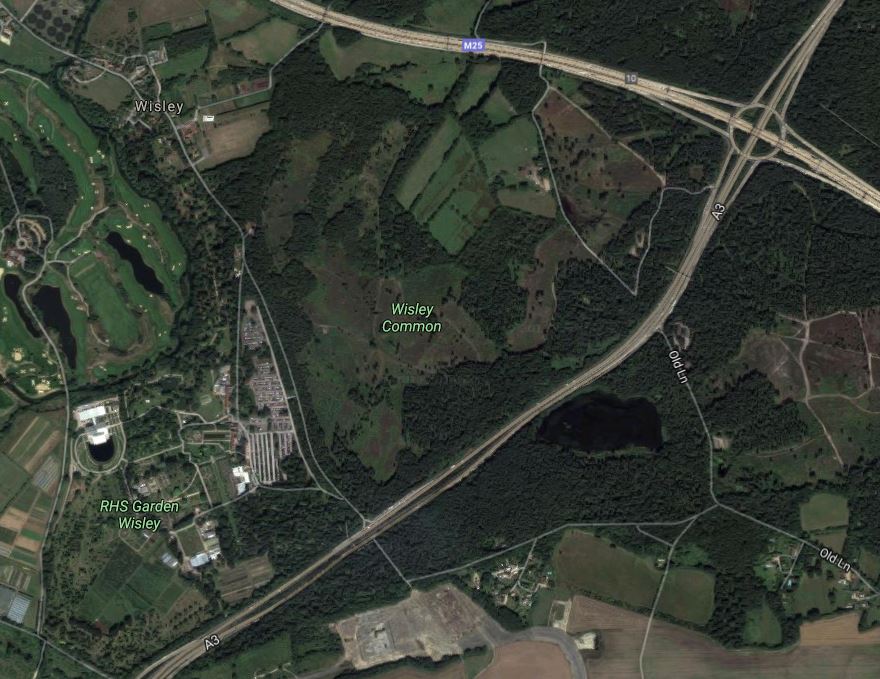
Note how close Wisley Garden is to the A3, which all proposals say should be widened from three lanes to four.
Two proposals have been put forward by Highways England.
This is Option 9, which is a four-level flyover.
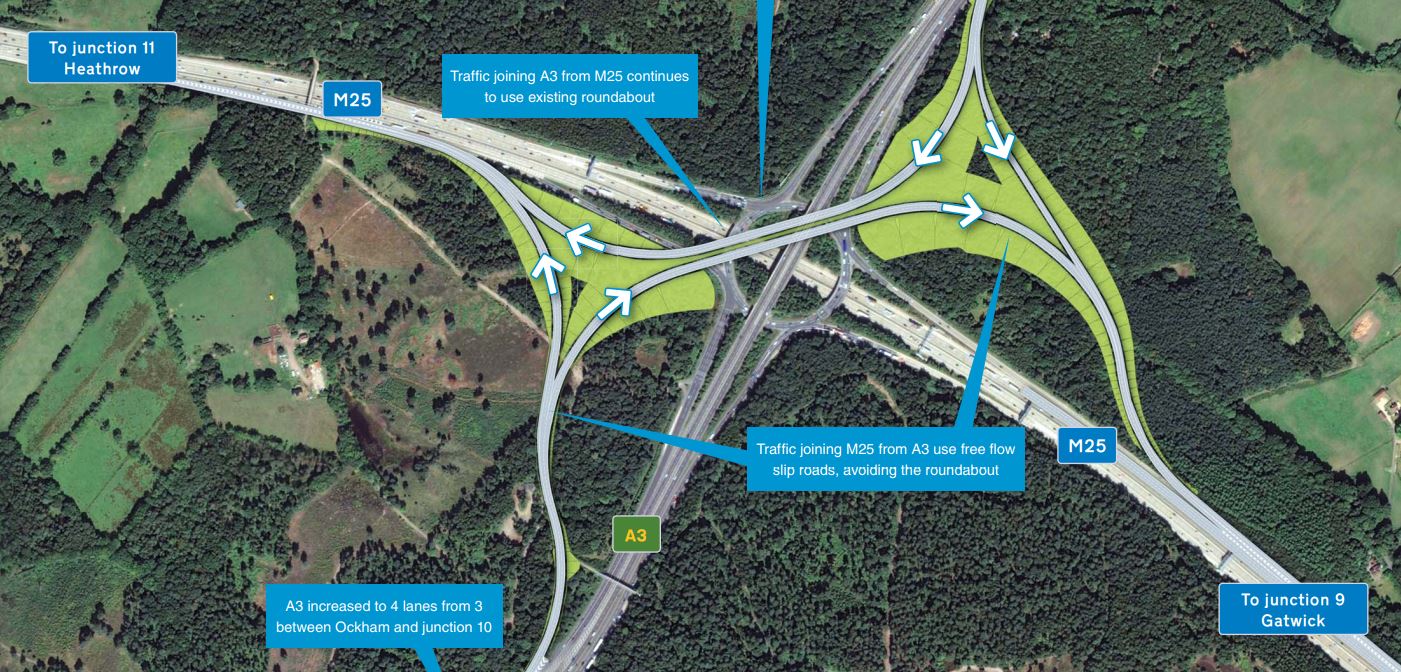
And this is Option 14.

I suspect as far as Wisley Garden is concerned it’s a choice between the Devil and the Deep Blue Sea!
Just out of curiosity, I looked up on the RHS Wisley Garden site, how I could get there easily by public transport.
Effectively, it means taking a train to Woking and a taxi!
Wisley Garden can’t have it both ways, as they encourage people to drive to the Garden and yet are objecting to widening of the A3.
A Wider Problem
Wisley Garden illustrates the wider problem, of how so many attractions are only easily accessible by car.
Some attractions like Brighton and Hove Albion’s new Falmer Stadium, have been built with decent public tyransport access, but others assume everybody comes by car.
Surely, in this age, where the environment matters, no development should be allowed without due consideration of well-thought out public transport.
Is The BBC Anti-Rail?
Consider.
- One of the lead stories on BBC Breakfast this morning, is very negative about how there is tremendous disruption because of engineering work this weekend.
- They keep finding negative stories about the upgrading of Waterloo, when all my observations seem to have been positive.
- One of the most significant rail events of this month has been the start of running of the Aventra trains for Crossrail has been ignored.
I am going to the football in Ipswich on Saturday and according to the BBC, services out of Liverpool Street are severely disrupted.
But I have looked at the Internet and services appear like any other Saturday.
The BBC would appear to have an agenda.
‘Self-driving’ Lorries To Be Tested On UK Roads
The title of this post is the same as that of this article on the BBC. This is the first three paragraphs.
Small convoys of partially driverless lorries will be tried out on major British roads by the end of next year, the government has announced.
A contract has been awarded to the Transport Research Laboratory (TRL) to carry out the tests of vehicle “platoons”.
Up to three lorries will travel in formation, with acceleration and braking controlled by the lead vehicle.
It is a long time since I used to hitch-hike all over the UK in the 1960s and had many a ride in the front of a truck.
One of my memories is sitting there and watching how cars kept jumping into gaps between the truck I was riding in and the one in front.
I have a feeling that platooning is one of those automation ideas, that will work well in theory and practice to a certain degree, but that the behaviour of individuals will give it problems.
Generally, this idea hasn’t been well received, by commentators.
The Greener Alternative
I feel that overall we need to move freight from the roads onto the railways.
In The Go-Anywhere Express Parcel And Pallet Carrier, I proposed converting redundant four-car electric multiple units like the Class 321 trains into 100 mph bi-mode parcel and pallet carriers, which I dubbed High Speed Parcel Train or High Speed Pallet Train.
HSPTs would have the following advantages for parcel and pallet traffic.
- Stations could be used as terminals, especially at night!
- As they are 100 mph trains, they would probably be faster over long distances.
- They would probably emit less carbon emissions.
- Capacity per crew member would be higher.
- There are few parts of the UK, the trains couldn’t go.
- Class 321 trains are built from steel and are as tough as the proverbial brick outhouse.
- The trains could carry a fork-lift if needed.
- The trains could be wrapped in advertising.
The trains would be the ultimate green long-distance delivery truck.
- Recycled trains.
- Proven technology
- Electrically-powered where possible.
- ;Using existing infrastructure where possible.
They wouldn’t be the most expensive trains to create and run.
Risky Business: Train Fleets In A State Of Flux
The title of this post is the same as this article in Rail Magazine.
The article is certainly in the must-read category and it illustrates the perils of not getting your investments right.
You could argue that rolling stock leasing companies (ROSCOs) are sucking money out of the UKs railways.
I would argue differently.
The cause of the troubles for the ROSCOs is threefold.
- Train operating companies would prefer to have lots of similar trains, as this makes, maintenance, training and timetabling easier and more affordable. Some successful companies like c2c, London Overground, Virgin Trains and Merseyrail are one- or two-class companies and others like TransPennine Express and Great Western Railway are moving that way.
- New leasing companies have seen the returns, that the three original ROSCOs have made and have entered the market. As they are leasing new trains, they make it more difficult to find homes for existing rolling stock, many of of which have perhaps twenty years of life left and are priced accordingly.
- The ROSCOs have also badly misjudged the technology. Bombardier, CAF and Stadler have come up with innovative solutions to the problems of our unique Victorian-designed railway and the train operating companies have liked what they have seen and ordered them.
It is interesting to note, that few of the large orders for rolling stock have not been financed by the three original ROSCOs; Angel Trains, Eversholt and Porterbrook.
Greater Anglia
As I know Greater Anglia well, I’ll look at their current fleet, which is being replaced train-for-train by new rolling stock.
- Class 90 locomotives – These are thirty years old and will probably end up pulling freight or be cannibalised for spares.
- Mark 3 coaches – These do not meet the latest regulations for passengers of reduced mobility and most will probably be scrapped, although one rake has been sold to be used by 60163 Tornado.
- Driving Van Trailers – I doubt these will find a use and will join the many others in store or they will be scrapped.
- Class 153 trains – At twenty-five years old, I doubt these single-carriage trains will see serious passenger use again.
- Class 156 trains – At nearly thirty years old, these two-car DMUs may have use on rural lines, but they will need refurbishment.
- Class 170 trains – These two- and three-car 100 mph DMUs will certainly find another operator.
- Class 317 trains – At thirty-five years old, but in good condition, these 100 mph EMUs will be difficult to place, as newly-electrified lines will inevitably deserve new trains.
- Class 321 trains – These 100 mph EMUs will be difficult to place, despite some having been recently upgraded.
- Class 360 trains – These 100 mph EMUs are only fifteen years old and will probably find a new operator.
- Class 379 trains – These modern 100 mph EMUs are only a few years old and will will certainly find a new operator.
Quite frankly most of this rolling stock is not worth much!
The Class 360 and Class 379 trains will be the easiest to release.
The sheer numbers of Class 317 and 321 trains, with little new electrification planned, mean that something innovative will, have to be done to find them a home. I speculated aboutwhat will happen to all these Mark 3-based multiple units in What Will Happen To The Class 319, Class 455, Class 321 And Cl;ass 317 Trains? I certainly suspect that some will find uses, with the upgraded Class 321 trains probably the first in the queue.
As I said in the article, I feel that some Class 321 trains could become small parcel and pallet carriers.
The Class 707 Trains
The Rail Magazine article talks about the problem of the Class 707 trains, that were ordered by South West Trains and will be returned by South Western Railway.
It suggests they could be converted to run on 25 KVAC overhead working, but that will be expensive and in my view a new Desiro City is far inferior to a new Aventra.
So would a quality Class 317 or 321 be a good alternative for an operator, that needed some new trains to perhaps open a new electrified route?
It looks even more of a bad decision of Angel Trains to fund the Class 707 trains.
Is It Innovate Or Die?
Porterbrook saw problems coming with the Class 319 trains, they were leasing to Thameslink.
But they got together with Northern and designed an affordable bi-mode, which is now the Class 769 train.
Thirteen have been ordered!
In anotherf project, InterCity 125 trains are being shortened and updated to last another decade.
Will we be seeing more developments like this, where redundant trains are turned into useful ones for a different purpose?
We could even be seeing some innovative export deals!
Conclusion
It’s a tough world out there!
But those that innovate will survive and make money!
A Low-Alcohol Beer With Flavour
I was buying my usual gluten-free IPA in Marks and Spencer in Islington, when I saw this beer next to it.

This beer is just 0.25 units for a half litre bottle.
It also has flavour, as it is brewed by Adnams.
But the amazing thing was I had no adverse to the beer despite being coeliac, although I’ve never claimed to be a serious one.
Will Innovative Electrification Be Used On The Uckfield Line?
Chris Gibb’s report into the Govia Thameslink Railway franchise recommended electrification of the Uckfield Line. The September 2017 Edition of Modern Railways has a detailed examination of the proposals.
Reasons For Electrification
Various reasons are given for the electrification.
- Removing diesel trains from London Bridge station.
- Operational flexibility.
- More capacity
- Stabling and refuelling considerations with the current Class 171 trains at Selhurst depot.
- Increasing operational efficiency.
The Class 171 trains would probbly be better suited to other routes.
25 KVAC Ovhead Electrification
One of Chris Gibb’s recommendations is to use 25 KVAC overhead rather than 750 VDC third-rail electrification in an area, where third-rail is the norm.
He states that this is on cost grounds.
- Third-rail needs a feed to the National Grid every two to three miles.
- Overhead wires might need just one.
- DC has higher transmission losses, than AC.
He also suggests the following.
- Changeover between the existing third-rail and the new overhead systems would be South of Hurst Green Junction.
- The three tunnels on the route would be electrified using overhead conductor rail.
- Dual-voltage trains would be needed, which would change system on the move.
- Class 377 or Class 700 trains would be used.
He also indicxates that Class 379 trains would be available from 2020.
Stabling At Crowborough
Chris Gibb suggests building stabling for four twelve-car trains at Crowborough for the following reasons.
- It would improve crew efficiency.
- Itwould give more time overnight for maintenance and train cleaning.
- It would eliminate 75,000 miles of empty running a year.
- It would give a £3.6 million a year cost saving.
- It would give more space at Selhurst depot.
This sounds like a good idea.
Project Management And Finance
Chris Gibb gets very innovative about how the project should be managed, by suggesting that SNCF do the design for the electrification and then directly hire the contractor, bypassing Network Rail.
He also suggests an innovative way of financing the project, using private finance.
The Government’s Response
Chris Gibb recommendations of electrification and the stabling of trains at Crowborough have been accepted by the Government.
Conclusion
Surely, if private finance and planning permission can be obtained, this project should go ahead.
Lord Adonis On Crossrail Of The North
There has been a lot of talk recently about HS3, Northern Powerhouse Rail or Crossrail Of The North.
On Radio 5 Live, this morning, Lord Adonis said a lot of sensible things about the high speed line from Liverpool to Hull via Manchester and Leeds.
His plea was for a plan for a start and he suggested that an objective would be to halve the journey time from Manchester to Leeds and have a train every few minutes.
He suggested it could be probably built using a mixture of new track alignments and existing railways.
I agree with what he said, but the problem is that every Tom, Dick and Harriet has their own ideas of what they want.
How Would I Design Crossrail Of The North?
I can at least look at this without favouring any one of the North’s great urban area.
Urban Areas Of The North
I will list those with populations of over 200,000,, from this list in Wikipedia.
- Manchester – 2,553,379
- West Yorkshire – 1,777,934
- Liverpool – 864,122
- Tyneside – 774,891
- Nottingham – 729,977
- Sheffield – 685,368
- Teeside – 376,633
- Stoke-on-Trent – 372,775
- Sunderland – 335,415
- Birkenhead – 325,264
- Hull – 314,018
- Preston – 313,322
- Blackpool – 239,409
- Barnsley – 223,281
Urban areas with populations between 100,000 and 200,000 include Wigan, Mansfield, Warrington, Doncaster, York, Burnley, Blackburn, Grimsby, Accrington, Burton, Lincoln and Chesterfield.
Some of the connections between pairs of these areas are truly dreadful despite being only fifty or so files apart.
Northern Connect
I would think it reasonable that all these centres of population have good, preferably direct, connections between them.
Northern obviously think this way as they are creating a concept called Northern Connect, using new Class 195 trains to connect many of these areas with a quality service.
The North TransPennine Routes
TransPennine operate these North Pennine routes.
- 1 train per hour (tph) – Liverpool Lime Street to Newcastle
- 1 tph – Manchester Airport to Middlesbrough
- 1 tph – Manchester Airport to York
- 1 tph – Liverpool Lime Street – Scarborough
- 1 tph – Manchester Piccadilly to Hull
Note that the opening of the Ordsal Chord iin a few months, might change the routing of some of these services.
All of these services use the Huddersfield Line between Manchester and Leeds, stopping at both Huddersfield and Leeds stations.
Manchester Victoria To Leeds
As Lord Adonis said, the important section is between Manchester Victoria and Leeds stations.
I’ll start with a comparison of a series of rail journeys, all of which are about the same length.
- The fastest trains between Manchester Victoria and Leeds take forty-nine minutes, with a stop at Huddersfield, and are just 1 tph
- Norwich to Ipswich in a couple of years, will take 30 minutes at a frequency of 3 tph.
- Glasgow to Edinburgh currently takes about fifty minutes, at a frequency of 4 tph.
- Cardiff to Swansea currently takes 52-54 minutes, at a frequency of 2 tph.
It does seem that the North has a point if two of East Anglia’s larger cities get a better service than Leeds and Manchester.
The Huddersfield Line And The Great Eastern Main Line Compared
It is also enlightening to compare the Manchester to Leeds Line via Huddersfield to Ipswich To Norwich section of the Great Eastern Main Line.
It should be noted that I’m comparing these two lines, as both have lived on scraps from Central Government for decades. I also know the Great Eastern Main Line well!
- Both lines are double-track.
- Norwich-Ipswich is flat.
- The Huddersfield Line is rather hilly
- Norwich-Ipswich has only two stations and only the occasional slower service.
- The Huddersfield Line has numerous stations and local services.
- Norwich-Ipswich is electrified to a robust standard.
- On the Huddersfield Line, only Manchester to Stalybridge is scheduled for electrification.
- Norwich-Ipswich has a 100 mph speed limit, that could possibly be raised in places.
- I can’t find the speed limit on the Huddersfield Line, but suspect it could be less than 100 mph.
It is truthful to say that the Huddersfield Line is a much more challenging route than the Norwich to Ipswich.
The Effect Of Electrification On The Great Eastern Main Line
It might appear that the electrification of the Great Eastern Main Line makes for the difference in times.
But it should also be remembered that Ipswich to Norwich wasn’t electrified until the mid 1980s and if I remember correctly before that date, the fastest expresses were timed at two hours from Norwich to London with just two stops. The fastest services now are ten minutes under two hours with four stops.
With the introduction of the new Class 745 trains, timings of ninety minutes have been promised to the Department for Transport.
Timings did not drop significantly with the electrification in the mid-1980s, Services just became more reliable with more stops, as electric trains can accelerate better.
The decrease in timings over the next few years will be down to the following.
- Removal of bottlenecks like Trowse Bridge.
- Increase in speed limits.
- Trains with a shorter dwell time at stations.
- Trains with better acceleration and braking.
- Improved track and signalling.
- All passenger trains on the line will have the same performance.
I will be very interested to see what timings, the Class 745 trains eventually achieve!
Electrifying Between Leeds And Manchester Victoria Stations
It looks like the electrification between Manchester Victoria and Stalybridge stations will be complete by the end of this year.
The central section of the route is problematical with the Grade 1 Listed Huddersfield station and large numbers of bridges.
In TransPennine Electrification And Piccadilly Upgrade Now Also In Doubt, I came to these conclusions about electrifying the route.
-
Electrification would not go anywhere near Huddersfield, as the heritage lobby and their lawyers would have a field day.
-
Standedge and Morley tunnels are over 2,000 metres long, double track and Standedge is level. If they needed refurbishment in the future, perhaps they could be electrified with an overhead rail, so that bi-modes could have a couple of miles of electricity.
-
Electrification might be extended at the Manchester and Leeds ends of the line, so that the two cities could improve their local suburban electric networks.
-
An alternative would be that the Leeds and Manchester suburban electric networks were provided with a few Class 769 trains or even some brand new four-car bi-modes.
-
Services between Leeds and Manchester would be run by fast bi-modes.
Is there a more difficult stretch of possible electrification in the UK?
The Ultimate Bi-Mode Train
Currently four bi-mode trains are planned for introduction into the UK.
- Hitachi Class 800 trains and Class 802 trains.
- Stadler Class 755 trains
- Porterbrook Class 769 trains
Note.
- Two hundred and eleven bi-mode trains have been ordered.
- Nineteen Class 802 trains have been ordered for TransPennine routes.
In Do Class 800/801/802 Trains Use Batteries For Regenerative Braking?, I look at the prospect of using energy storage in Hitachi’s bi-mode trains.
The Class 802 train is probably something like the ultimate bi-mode train.
- 125 mph using electrification.
- 100 mph under diesel power
- Regenerative braking at all times using energy storage.
- Automatic pantograph raising and lowering.
- Sophisticated in-cab signalling.
Obviously, interior fitment would be up to the operator.
Class 195 Trains
Northern is acquiring 25 x two-car and 30 x three-car Class 195 trains.
These are 100 mph trains, so it must be a good idea to make sure all Northern services that use the same routes as TransPennine services are run by these faster trains.
Short/Medium Term – A Classic Manchester Victoria To Leeds Route
TransPennine Express are already planning to run Class 802 trains between Liverpool and Newcastle via Manchester and Leeds. It looks to me, that whoever plans their train policy, saw the electrification crisis coming.
I wonder what times they can achieve between Leeds and Manchester Victoria, if the following were to be done.
- Stalybridge to Manchester Victoria electrification is complete.
- Track and signalling is the best it can be.
- The route has a 100 mph operating speed.
- All trains on the route are 100 mph capable.
- Northern replaces their scrapyard specials with Class 195 trains.
The reason for the same operating speed of 100 mph, enables trains to follow each other in a stream. It could be 90 mph, if that was easier for the route.
Station dwell times can also be reduced.
Due to overcrowding, the TransPennine dwell times, must currently be some of the worst in the UK.
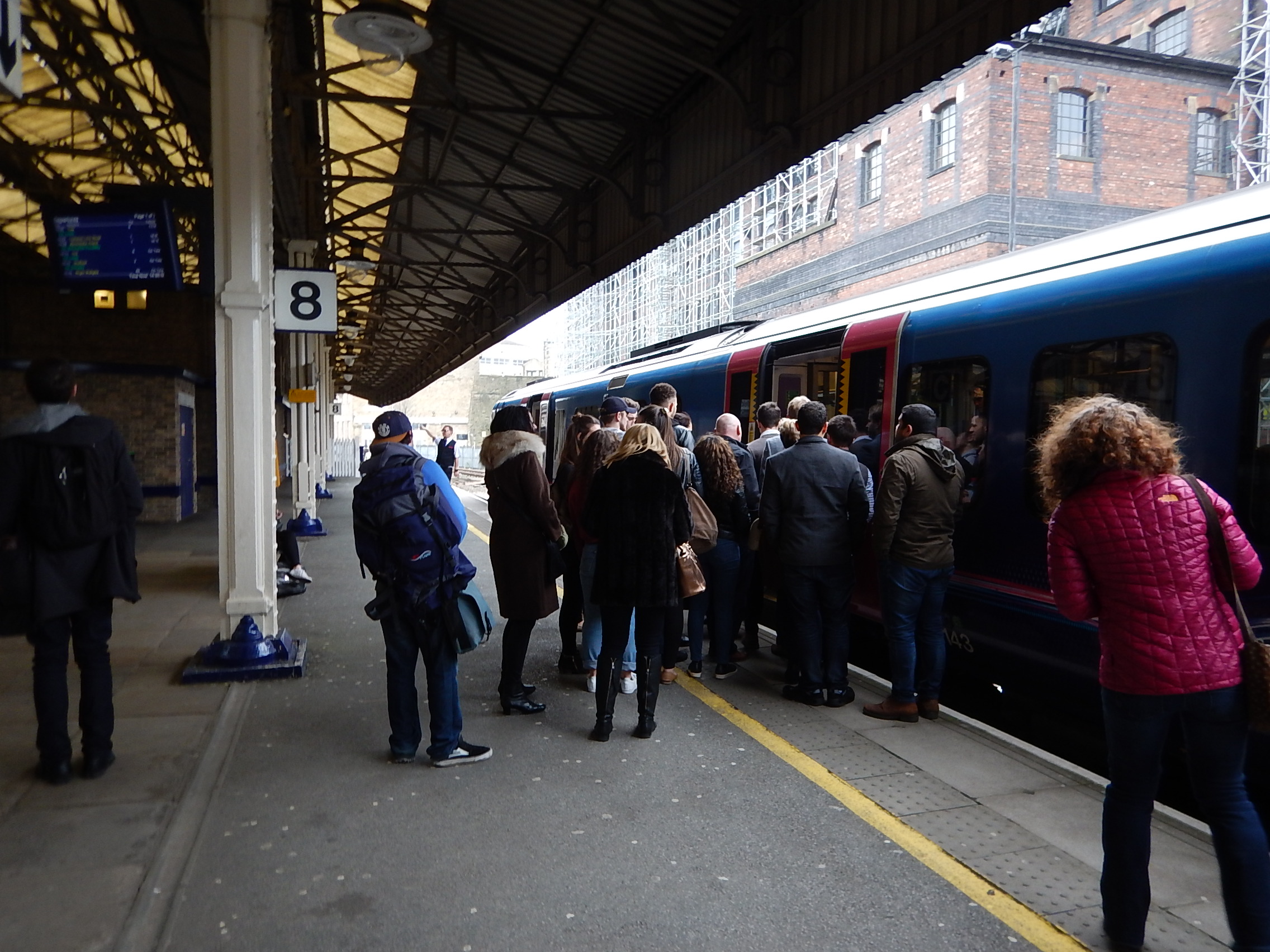
This is typical at Huddersfield.
Not even the Japanese with their pushers could get this to work.
But a modern train like the Class 802 train with wide lobbies and adequate capacity should cope.
So what time could be possible, if everything goes as planned?
If Norwich to Ipswich which is about the same distance as Leeds to Manchester, can be achieved in thirty minutes, I believe it is possible that the Northern route could be achieved in the same time or perhaps thirty-five minutes.
Thirty-five minutes should be adequate for a few years, if say there was a train every ten minutes!
Long Term – A Genuine High Speed Manchester Victoria To Leeds Route
I’ve flown my virtual helicopter between Manchester and Leeds and it is not flat agricultural land like seventy percent of the route of HS2.
I believe that creating a genuine high speed route, with say a 140 mph top speed across the Pennines will be a major engineering challenge that will make Crossrail in London look easy.
It may even be more economic to develop 140 mph hydrogen-powered tilting trains, that can run on the classic route at 125 mph.
Only one thing matters to passengers; a fast reliable and very comfortable and affordable train service across the country.
Manchester Victoria To Manchester Airport
When the Ordsall Chord opens any Leeds to Manchester Victoria service can continue to Deansgate, Oxford Road, Manchester Piccadilly and Manchester Airport stations.
Manchester Victoria To Liverpool
Currently, services between Liverpool Lime Street and Manchester Victoria stations take a few minutes over half-an-hour.
I would suspect that thirty minutes is achievable, if the following is done.
- The four-tracking at Huyton is completed.
- Track and signalling is the best it can be.
- The route has a 100 mph operating speed.
- All trains on the route are 100 mph capable.
- Northern replaces their scrapyard specials with Class 195 trains.
I suspect all of this is in progress.
Note, this is very similar work, to that needed between Manchester and Leeds.
Leeds To Hull
Currently, services between Leeds and Hull stations take a few minutes under an hour.
A few thoughts on the route.
- The Selby Line from Leeds to Hull is double-track and not electrified.
- From my virtual helicopter, it appears to be straight in very flat country, so it is no wonder Hull Trains offered to electrify the line.
- If the Selby swing bridge were to be sorted, it could become a 100 mph line with trains to match.
- Northern replaces their scrapyard specials with Class 195 trains.
- Modern in-cab signalling.
I suspect quite a few minutes could be taken off this route which is about fifty miles.
I suspect this line will eventually be electrified, as it could give sound time savings and it looks relatively easy.
York To Scarborough
Currently, services between York and Scarborough stations take forty-nine minutes, with one tph.
- Similar improvements to the double-track unelectrified line as for the Leeds to Hull route, could be made.
- But if the line has a problem , it is that it has 89 level crossings, although Network Rail intends to close them all before 2025.
I wonder, if the time can be reduced between York and Scarborough, such that two tph can be timetabled.
I doubt York to Scarborough will be electrified.
Northallerton To Middlesbrough
This short line is quite heavily used and is a valuable diversion route, so I suspect nothing urgent needs to be done.
Like Leeds to Hull, I suspect this line will eventually be electrified.
Conclusions
I have come to the following conclusions.
- Manchester Victoria to Leeds is achievable in half-an-hour with the new trains on order and no major infrastructure, other than that already planned.
- Any line where TransPennine Express services run needs to have the highest possible operating speed and no slow trains.
- Northern need to get their Class 195 trains into service as soon as possible.
Improvements are much-needed in the North, which could include.
- A short/medium term plan to deliver the best possible service with the new trains ordered by Northern and TransPennine Express.
- A long term plan to deliver a genuine 140 mph service across the North of England.
- A plan to improve the Calder Valley and Hope Valley Lines across the Pennines.
- A plan to improve some of the poor connections across the North.
- A strategy to make the best use of connections with HS2.
A detailed plan is needed that lays down what should be done in the next ten to twenty years.
The plan is also needed as soon as possible.
The Crazy Idea Of Female-Only Compartments On Trains.
This article on the BBC is entitled Labour MP says ‘merit’ in women-only train carriages.
This is the first paragraph.
Women-only train carriages could combat the rise in sexual offences on public transport, a Labour MP has said.
My use of crazy in the title of this post, is based on what Lord Adonis said on Radio 5 Live, this morning. He also indicated that the solution was to moderate peoples’ and especially men’s behaviour everywhere.
But I don’t think female-only compartments are a good idea for very practical reasons.
The latest generation of commuter trains like the Class 378 trains of the London Overground are walk-through.
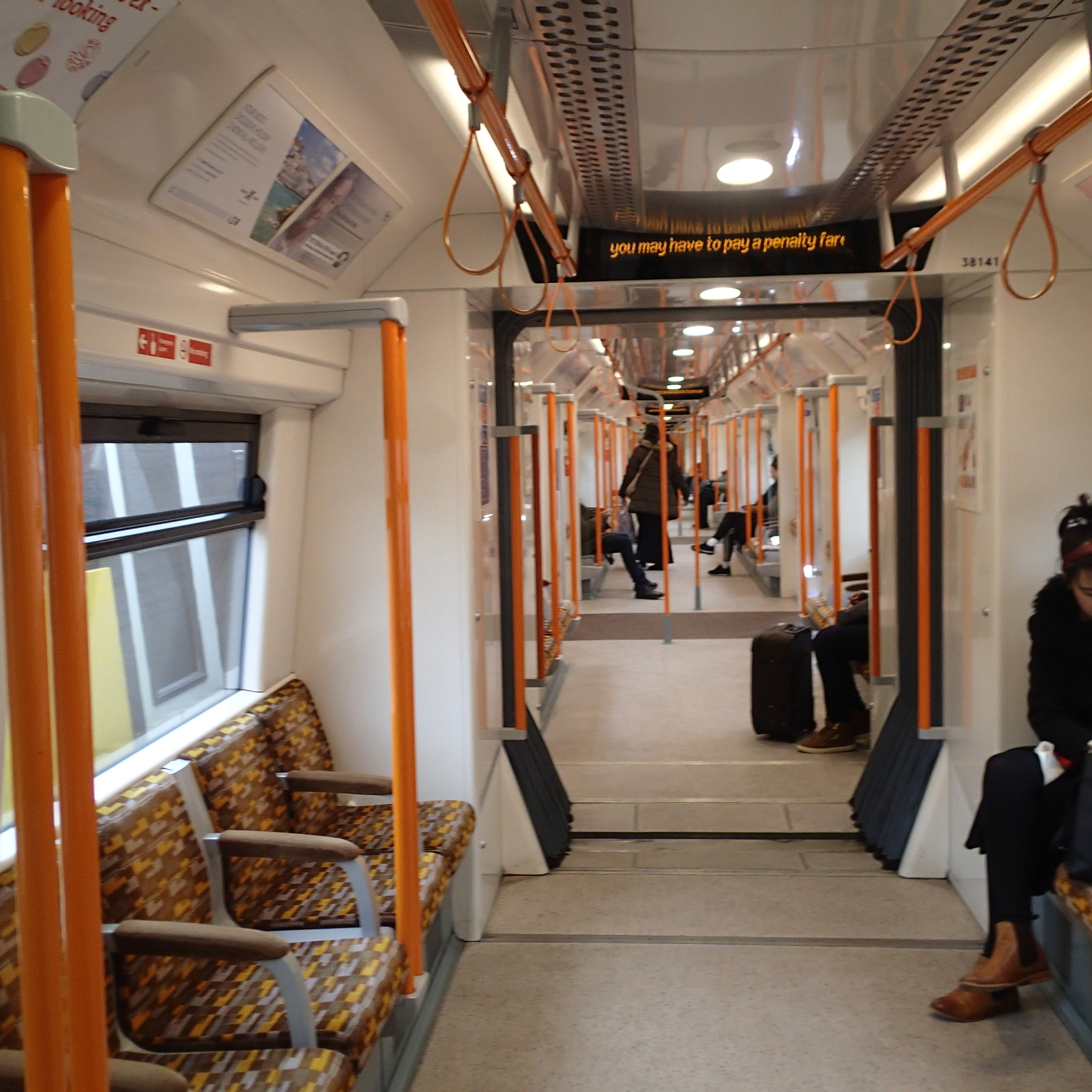
This seems to be a design that is used in modern London Underground and Crossrail trains. Putting separate compartments in a train like this, would block off the ability to walk along the train to perhaps position yourself at the appropriate place to disembark at your station.
I also think that this type of layout is safer and more passenger-friendly.
About a year ago, I had a severe nose-bleed on a train, caused by an excessive sneeze. I had no tissues, but a lady sitting opposite had several and even helped clean me up.
I’d be interested too, to see an analysis of all harrassment on trains differs according to train type.
Conclusion
Like Lord Adonis, I tend to believe that harrassment on trains is better stopped by other means.
 The Anonymous Widower