Council Opposes Six Track Plan For East West Rail
The title of this post, is the same as that of this article on the BBC.
This is the sub-heading.
Councillors have voted to oppose part of a major railway line being built through their district.
These four paragraphs add detail to the story
Bedford Borough Council wants the East West Rail (EWR) line to be made up of four tracks, rather than six, in the Poets area north of the town.
Thirty-seven homes would need to be demolished in order to accommodate the two additional tracks.
However, in their full-council meeting on Wednesday, members agreed to support other parts of the project, such as the relocation of Stewartby station and the closure of Kempston Hardwick.
An EWR spokesperson said it was committed to working with local communities.
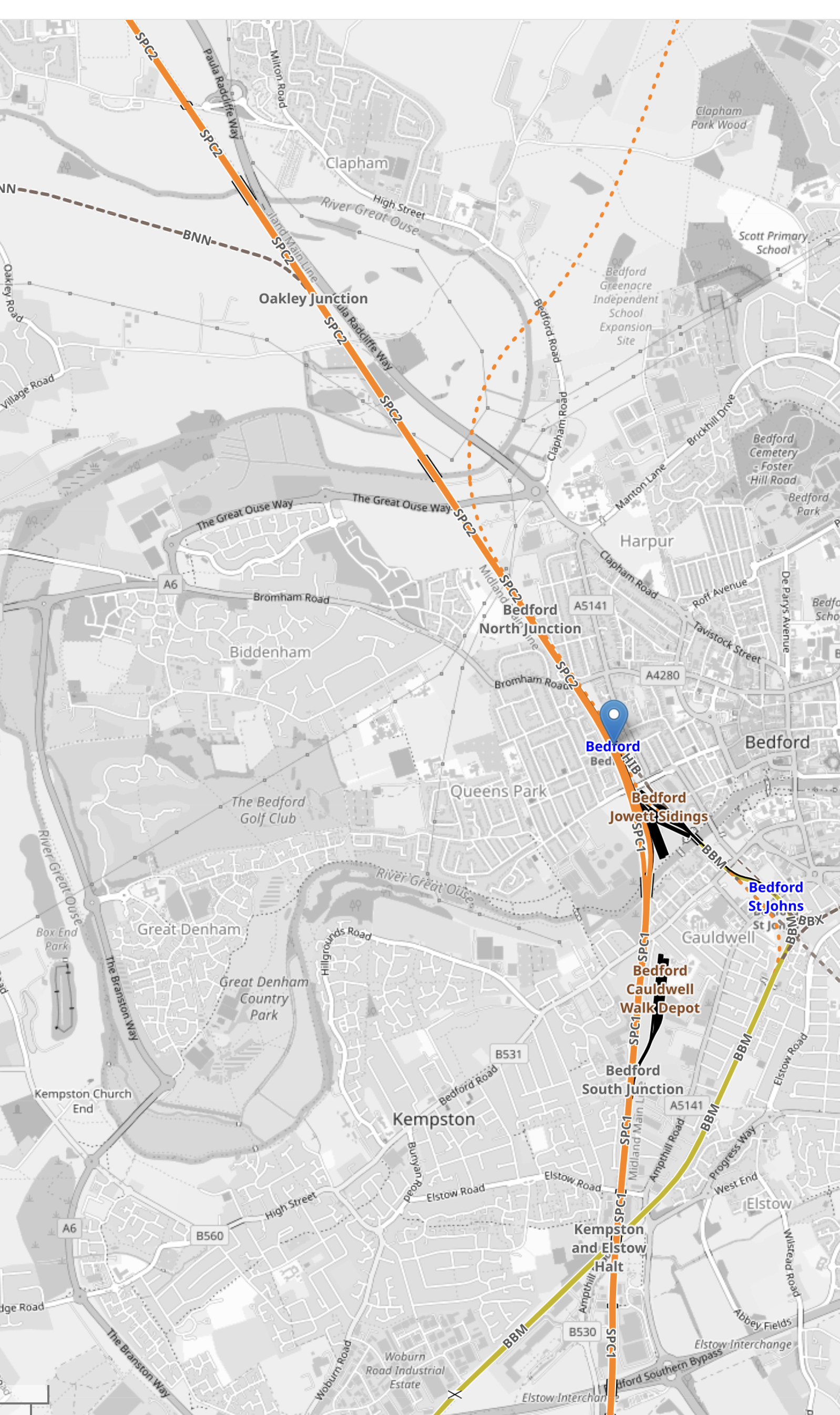
This OpenRailwayMap shows the Midland Main Line and the East-West Rail through Bedford.
Note.
- The solid orange line running from the North-West corner of the map to its Southern edge is the electrified Midland Main Line.
- The blue arrow on this line indicates Bedford station.
- The blue lettering to the South-East of Bedford station, indicates Bedford St. Johns station.
- The yellow line connecting the two stations is the Eastern end of the Marston Vale Line, which connects Bedford and Bletchley stations.
- The Marston Vale Line will be taken over by the East-West Rail.
- Just North of Bedford station is Bedford North junction.
The East-West Rail branches away from Bedford North junction to the North-East on its way to Cambridge. It is shown as a dotted orange line.
This OpenRailwayMap shows Bedford station to a larger scale.

Note,
- The Western pair of orange lines are the current fast lines of the Midland Main Line.
- The Eastern pair of orange lines are the current slow lines of the Midland Main Line.
- To the East the orange dotted line shows indicates a proposed route of the East-West Rail.
- There appear to be crossovers that allow East-West Rail services to use Platforms 1 and 2 through Bedford station.
Between the Midland Main Line and East-West Rail platforms, the current Platform 1A used by the Marston Vale Line can be seen.
This picture show the current Marston Vale Line platform at Bedford station,

Note.
- The Marston Vale Line platform is on the left.
- It is numbered 1A.
- The platform is electrified, so can it be it used to terminate some Thameslink services.
It could also be used to terminate East-West Rail services from the West and if they were battery-electric trains they could be charged.
Oxford and Bedford is 51 miles or 82 kilometers, which is within range of a modern battery-electric train. Es[ecially, if it did a ‘splash and dash’ at Milton Keynes Central or Bletchley!
This OpenRailwayMap shows the lines to the North of Bedford station.

Note.
- The current four-track Midland Main Line running diagonally across the map.
- The East-West Rail running along on the East side and branching off to Cambridge.
- Crossovers between the Midland Main Line and East-West Rail.
It looks to me, that operation of East-West Rail trains through Bedford station will be as follows.
- Oxford to Cambridge trains will use the crossovers to call in the existing Platform 2 at Bedford station.
- Cambridge to Oxford to will use the crossovers to call in the existing Platform 1 at Bedford station.
- Trains that are not stopping could use the avoiding line along the East side of the station.
- Oxford to Bedford terminating trains, would stop in Platform 1A.
Because there would be a crossover between the Midland Main Line slow lines and the East-West Rail to the South and North of Bedford station, I suspect for operatuional reasons and safety Network Rail want a double track avoiding line.
Offshore Wind Innovation Hub in New York Opens Third Call For Applications
The title of this post, is the same as that of this article on offshoreWIND.biz.
This is the sub-heading.
The Offshore Wind Innovation Hub in New York, led by Equinor in collaboration with Urban Future Lab at NYU Tandon School of Engineering and National Offshore Wind Research & Development Consortium (NOWRDC), opened the 2025 application process on 15 January, issuing the third call for its accelerator programme since the Hub was officially launched in January 2023.
These two paragraphs describe the work of the innovation hub.
“We look forward to building on the strong foundation of the Innovation Hub and supporting the next round of entrepreneurs and emerging technologies”, said Molly Morris, President, Equinor Renewables Americas. “The solutions identified by the innovators will play a critical role in advancing the offshore energy industry, developing supply chains, and strengthening energy security for future generations of New Yorkers.”
Last year, six companies were selected to join the Hub’s accelerator programme and receive support to develop further their solutions that could help advance offshore wind in New York and the US: Boxkite Software, Claviate, Indeximate, Pliant Energy Systems, Sensatek, and Triton Anchor. Through the first call for applications in 2023, the Innovation Hub selected Benchmark Labs, Flucto, Heerema Engineering Solutions, RCAM Technologies, OSC, and VinciVR.
Note.
- Many countries have innovation hubs like these based on research institutions and universities.
- Molly Morris, with her Norwegian support, seems the sort of woman, who can keep Trumkopf under control.
- The Offshore Wind Innovation Innovation Hub certainly seems to spread their support around.
- I don’t think the Innovation Hub’s philosophy fits with Trump’s ‘Drill, Baby, Drill’
I can see Molly Morris, Equinor and The Innovation Hub really annoying Trump.
Let the battle commence!
Moment Energy Secures US$15 Million Series A Funding To Build World’s First Second-Life Gigafactory in the U.S
The title of this post is the same as that of this article on Cision.
This is the sub-heading.
Funding co-led by Amazon Climate Pledge Fund and Voyager Ventures to accelerate production of high-performing Battery Energy Storage Systems (BESS) from repurposed EV batteries
Series A brings Moment Energy’s financing in the last three months alone to over US$40 Million with US$52 million raised to date
This introductory paragraph gives more details.
Moment Energy’s battery energy storage systems (BESS) can be deployed in projects ranging from 400 kilowatt hours (kWh) to 10 megawatt hours (MWh), targeting an intermediate market segment that is currently underserved but crucial to the clean energy transition. Designed to serve commercial and industrial sectors, EV charging infrastructure, and renewable energy integration, the company is strategically positioned to capitalize on the convergence of rising EVs and renewable energy sources.
Sounds like a sensible way of handling old lithium-ion batteries.
Moment Energy has a web site.
Are we getting a second-life gigafactory in the UK?
We probably will need one.
As Moment Energy is Canadian, they might supply it.
Trump Preparing Executive Order To Stop Offshore Wind Buildout On US East Coast, US Congressman Claims
The title of this post, is the same as that of this article on offshoreWIND.biz.
This is the sub-heading.
US Congressman Jefferson Van Drew said on Monday that he was working closely with US President-elect Donald Trump on drafting an executive order to stop offshore wind activities along the US East Coast. The directive is expected to be finalised within the first few months of Donald Trump’s administration, the US Congressman stated in a press release on 13 January.
But it does look that Trump himself, is blowing in the wind.
To remind, seven East Coast offshore wind projects (in operation, under construction, or yet to enter the construction phase), were granted construction permits by the Trump administration during his first presidential term.
These include the large-scale offshore wind projects that were awarded federal leases from 2017 to 2020: Kitty Hawk North (2017), Empire Wind (2017), Skipjack (2018), Beacon Wind (2019), SouthCoast Wind (2019), Vineyard Northeast (2019), and South Fork Wind (2020). The Biden administration has approved eleven further offshore wind lease permits.
How did such a technological imbecile get voted in as President of the United States?
50,000 Journeys Made On Northumberland Line In First Month
The title of this post is the same as that of this press release on the Northumberland County County.
These are the first few paragraphs of the press release.
Passengers have made more than 50,000 journeys on Northumberland Line services in the first month after the opening.
The line reopened to passengers – for the first time in 60 years – in December, thanks to a £298.5m project involving the Department for Transport, Network Rail, Northumberland County Council and Northern.
Services now call at Newcastle, Manors, Seaton Delaval and Ashington, with a journey along the entire 18-mile route taking around 35 minutes and a single ticket costing no more than £3.
Tickets for more than 50,000 journeys have been bought since the opening and Saturdays have been particularly popular.
That includes more than 3,500 journeys made on the opening day (Sunday, 15 December), when the platform in Ashington was packed with people waiting to catch a glimpse of the first service.
That is what I would call a good start.
But after I wrote Dartmoor Line Passes 250,000 Journeys On Its First Anniversary, As Rail Minister Visits To Mark Official Opening Of The Station Building, a year after that line opened, I don’t think 50,000 for the Northumberland line is a high figure.
At 50,000 in the first month with only four stations, they must be on course for well over half a million passengers, when the line is fully open.
Figures like these show that enthusiasts for rail closures like Richard Beeching and Harold Wilson were so very wrong.
We need several reopened and new railway lines like this!
Briton Attempts ‘Fastest Ever’ Everest Mission, Using Xenon Gas
The title of this post, is the same as that of this article on The Times.
This is the sub-heading.
Former Gurkha officer leading team that hopes to acclimatise and reach the peak within days not months
These two introductory paragraphs add more detail.
Mountaineers could soon leave home on a Monday, climb to the summit of Everest by Thursday, and “make it home for Sunday lunch” by using gas to boost their red blood cells.
Lukas Furtenbach, a guide from Austria, believes that xenon — a noble gas sometimes used as a rocket propellant — can help climbers “pre-acclimatise” to the high altitude, dramatically cutting the time required to conquer the world’s highest peak.
The Wikipedia entry for Xenon shows that it is more interesting than a noble gas with a heavy atomic weight of 293.
For instance it has been used in anesthesia according to Wikipedia.
Perhaps, it makes you fall asleep on Everest, so that a dozen hardy Sherpas can carry you all the way up to the summit.
So does this explain the use of xenon before climbing the mountain?
The question needs to be answered by a serious cardiologist with an interest in mountaineering and time on their hands.
US DOE Offers US$1.76 billion Loan To Hydrostor For A-CAES California Project
The title of this post, is the same as that of this article on Energy Storage News.
These three paragraphs give more detail.
The US Department of Energy’s (DOE) Loan Programs Office (LPO) has made a conditional commitment for a loan to long-duration energy storage (LDES) developer and operator Hydrostor of up to US$1.76 billion.
If finalised, the loan would be used to help fund the Willow Rock Energy Storage Centre, a 500MW/4,000MWh, 8-hour advanced compressed air energy storage system (A-CAES) in Eastern Kern County, California, led by Hydrostor subsidiary GEM A-CAES.
Compressed air energy storage (CAES) charges by pressurising air and funnelling it into a storage medium, often a salt cavern, and discharges it by releasing the compressed air through a heating system, which expands air before it is sent through a turbine generator.
Note.
- Both the Canadian Hydrostor and the British Highview Power use air in their batteries, with the Canadians using compressed air, often in salt caverns and the British using liquid air in tanks.
- Highview Power’s first large scale battery will be 200MW/2.5GWh, which is about half the size of Hydrostor’s, which will be 500MW/4.0GWh.
- Having mathematically-modeled large tanks full of chemicals in the 1970s for ICI, I wouldn’t be surprised, if the Highview Power battery is more easily scalable.
This could be an interesting technological shootout.
Complicating matters could be Trump’s policies to big batteries.
This article on Utility Dive, which is entitled Potential Trump Policies Pose Risks For US Storage Sector, With Musk Impact Uncertain.
Analysts Say Gives A Reasoned.
Higher battery material tariffs and phased-down IRA tax credits threaten a 15% drop in U.S. storage deployment through 2035 in a “worst-case” scenario,
BNEF analysts said.
German Far-Right Vows To Tear Down Wind Turbines
The title of this post, is the same as that of this article on oilprice.com.
These two paragraphs add detail to the story.
Germany’s far-right Alternative für Deutschland (AfD) party has vowed to dismantle wind parks and wind turbines should it win power in the upcoming presidential elections in February, aligning itself with similar sentiments by U.S. President-elect Donald Trump. AfD asserts in its election platform that it “rejects the further expansion of wind energy” and has called for cuts to renewable subsidies.
German offshore-wind group BWO has hit back at AfD’s anti-wind policy, saying Putin would be the biggest beneficiary of such a move. AfD chairwoman Alice Weidel has also tried to walk back that position, saying her earlier anti-wind comments referred to a local matter in the state of Hesse.
This could be good for the UK.
This is the first two paragraphs of the Wikipedia entry for Wind Power in Germany.
Wind power in Germany is a growing industry. The installed capacity was 55.6 gigawatts (GW) at the end of 2017, with 5.2 GW from offshore installations. In 2020, 23.3% of the country’s total electricity was generated through wind power, up from 6.2% in 2010 and 1.6% in 2000.
More than 26,772 wind turbines were located in the German federal area by year end 2015, and the country has plans for further expansion. As of the end of 2015, Germany was the third largest producer of wind power in the world by installations, behind China and the United States. Germany also has a number of turbine manufacturers, like Enercon, Nordex and Senvion.
By the end of June 2022, Germany had a total of 30,000 installed wind turbines, with a capacity in excess of over 64 GW.
Large numbers of second-hand wind turbines to plant all over Starmer, Reeves and Miliband’s vision of the UK would go down just fine in the cash-strapped Treasury, but would the British public like them?
So as Starmer and Reeves will talk to anybody to save their skins, are they talking to the AfD?
Octopus Energy Generation Acquires 252MW Solar And Storage Projects
The title of this post, is the same as that of this article on Solar Power Portal.
These two introductory paragraphs add more detail.
The generation arm of British energy major Octopus Energy has announced that it has acquired four new solar projects across England as part of a plan to invest £2 billion into renewable energy projects by 2030.
Four new solar farms currently under development have been acquired from renewable energy developer BayWa.re, with a combined generation capacity of 222MW. One of the sites will also play host to a 30MW battery energy storage system (BESS).
On Sunday, there was an Interview with Greg Jackson, who is the boss of Octopus in the Sunday Times, which was entitled Octopus Boss: Split UK Into Price Zones Or Bills Will Keep Rising.
I think we should watch, where Greg splashes his money.
Will Trump Venture To Impose ‘No New (Offshore) Wind Turbines’ Policy And Bring US Industry Supporting 120,000 Jobs To Halt?
The title of this post, is the same as that of this article on offshoreWIND.biz.
This is the sub-heading.
During his presidential campaign in 2024, Donald Trump said he would sign an executive order to stop offshore wind farms from being built in the US “on day one”. On 7 January, the US president-elect reiterated the plan which now seems to apply to wind energy on land too, saying he would look into implementing “a policy where no windmills are being built”.
He really does look to be following his “Drill, Baby, Drill” philosophy.
But the first paragraph of the article does indicate that Trump might not be having it all his own way.
The backlash is coming not only from the wind energy industry but also from government officials, as wind energy now accounts for 10 per cent of the US electricity generation, employs more than 120,000 people, and attracts tens of billions of US dollars in investments per year.
How easy is it to get rid of the President of the United States, without doing them any physical harm?
The whole article is well-worth reading, but the last paragraph is priceless.
So, will the incoming US president fulfil the promise and embark on implementing a policy that bans building new wind farms, both offshore and onshore, jeopardising jobs and billions in investments and federal lease fees?
It would certainly be a policy, that would have a profound negative effect on much of the US economy.
 The Anonymous Widower