New Zealand v Namibia At The Olympic Stadium
These pictures document my visit.

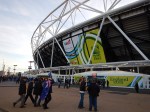


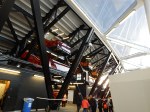




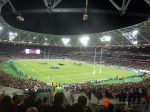


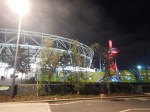
Compare the Olympic Stadium with Old Trafford of the previous night.
The final sporting effect of this stadium will be to propel West Ham up the League, as this is a stadium that would fill, if it was staging Leyton Orient against Accrington. Apologies to both teams and their fans, but spectators would go for the experience!
One of the stadium’s best features is getting to and from the venue.
Going, I went early and easily met my friend in Eastfield, which was uncrowded ninety minutes before the match.
My friend had taken one train from Suffolk ans we bought some snacks in Marks & Spencer. How many stadia are served by long-distance trains?
Coming back, I walked out the back of the stadium and took the DLR from Pudding Mill Lane station. I could even have walked the other way to cross the site on the Greenway to get a 30 bus direct to my door.
When Crossrail opens in 2019, the stadium and the Olympic Park will be at one of the best transport interchanges in the UK.
The Olympic stadium, its setting in an enormous park and its transport links, is in a totally different class.
Manchester Has Ways Of Dealing With Cyclists
I took these pictures in Manchester City Centre.
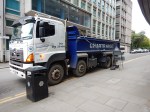

These trucks with no sideguards wouldn’t be allowed in London. Why does Manchester allow them?
Manchester’s Metroshuttle
Manchester has a network of three free Metroshuttle buses that you can use in the City Centre.
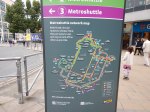

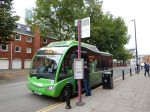
My big complaint about the system is the limited hours. Surely, in a busy City Centre a bus service like this should go on later than 19:00.
I also feel that the stops away from Piccadilly station could be better designed with more information and local maps.
I Rode A Dream
On my way to Manchester for Ipswich Town’s match at United.
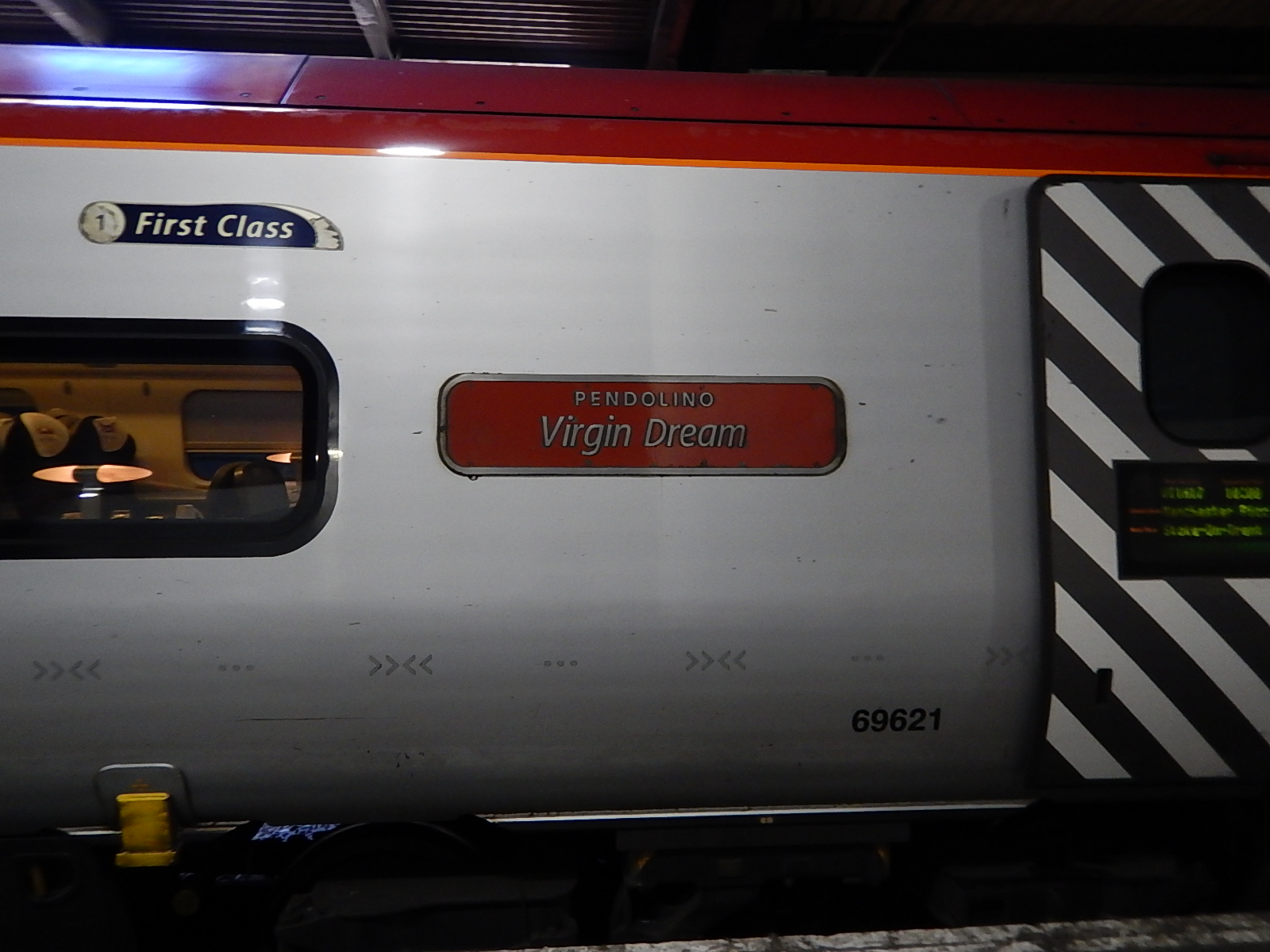
I Rode A Dream
What will be will be!
‘Three Strikers And You’re Out!’
This was the banner headline on the Standard and it describes how just three workers have brought a strike on the Waterloo and City Line.
This is going to be a big story!
Does Your Energy Company Say Sorry When Its Web Site Gets Its Knickers In A Twist?
Mine does!
Ovo Says Sorry
I got this, when I clicked a link to view my statement!
I suppose it’s better than leaving me lost in cyberspace!
An Alternative Approach To Provide A Local Metro Network
The UK rail industry is looking at the creation or upgrading of three local metro networks Bristol, Cardiff and Teesside. You could also argue, that they are seriously thinking about local networks out of Birmingham, Leeds, Manchester, Newcastle, Nottingham and Sheffield.
The Objectives Of A Metro Network
So what do passengers and train companies want to see in a metro?
I would say that the most successful metro lines we have created in the last few years have been the London Overground lines.
They operate under the following rules and principles.
- Quality electric trains – Quality diesels would be fine in some places
- Frequencies of four trains an hour. – Two or three trains per hour might suffice.
- Clean stations, many of which are step-free.
- A station improvement program.
- Reliable service.
- Visible staff on stations from first to last trains.
- Extensive and visible information and maps.
- Touch in and out ticketing with bank cards.
- Good links to local buses.
The major problem of the Overground is that the trains keep needing to be lengthened, as they get crowded. The Class 378 trains started at three-cars and are now five.
Birmingham, Glasgow, Leeds and Liverpool seem to be using similar principles.
So how do three proposed metro networks stack up?
Cardiff
Let’s look at the electrification of the Cardiff Valleys Lines. According to the Wikipedia, the cost of the electrification is £350million.
I just wonder, if the scheme could be made more affordable, if the project was redesigned to use Aventra IPEMUs. The trains would obviously need sufficient electrification at Cardiff and Newport, so that they would leave the coast for their trips up the valleys with a full charge. Coming down wouldn’t be a problem and as the trains have regenerative braking, they would even charge the batteries.
Extensive testing would be easy once the current is switched on at Cardiff in a couple of years time and the clincher would be if an Aventra IPEMU could take a full load of Welshmen up to Merthyr Tydfil or Ebbw Vale after an international rugby match at the Millennium Stadium.
The scope of work would be greatly reduced.
- Upgrading all stations to take a four car train.
- Upgrading of the track layout and signalling, so that four car-trains could use each branch in an efficient manner.
- There may be a need for some selective electrification, to ensure trains left fully charged, or for other operational reasons concerning diversions from the South Wales Main Line or for freight.
There are advantages to this approach.
- Passengers get shiny new four-car trains, instead of refurbished hand-me-downs.
- As money would be spent on trains, track and signalling rather than electrification, this could mean more trains and increased frequencies on the lines.
- The Aventra trains could also take over some longer distance services to Bristol, Cheltenham, Fishguard and Gloucester.
- Much of the network, probably only needs minimal upgrades to track and signalling.
- There would be little or no heavy construction work in difficult places.
- Much of the construction work on the stations has probably been completed.
- There would be few line closures during the construction phase.
- Bridges and tunnels that are not large enough to accept the overhead wires can be left as they are, unless the line is being opened up for freight traffic running to a larger gauge.
- A higher proportion of the work to do will be general construction, rather than specialist overhead line installation, where there is a chronic shortage of engineers.
- There is little scope for something to go seriously wrong.
- The major source of delay would be late delivery of the Aventra IPEMU trains, but this would only mean that the diesel trains that currently work the line, would continue to serve the line for longer.
It strikes me that this approach has only one loser – the construction companies, who have helped create the electrification fiasco we have in this country. Passengers, train companies and the Welsh economy would all benefit!
According to this article on Global Rail News, London Overground’s contract for 45 Aventra trains is worth £260million. This works out at around £5.8million for each train. If the Aventra trains could work the Cardiff Valley Lines, with a little bit extra for the batteries or other energy storage device, twenty trains would probably cost around £140million or £7million a train.
I don’t know how many four-car trains they’d need to work the Valley Lines, but surely there is a trade-off between electrification and Aventra IPEMUs.
I can’t believe that Network Rail are not looking at this alternative approach, where instead of spending money on expensive and difficult electrification, the money is spent on shiny new trains built in a nice warm factory.
Teesside
The Tees Valley Metro is rather stillborn. The only thing that happened was the creation of James Cook station.
But there are two small electrification projects that could happen in the area in the near future.
- Hitachi are building electric trains at Newton Aycliffe and this will probably mean that the Tees Valley Line will at least be electrified between the Hitachi factory and the East Coast Main Line at Darlington.
- Plans exist to electrify between Middlesbrough and the East Coast Main Line, so that the town could benefit from a much improved train service.
If say this electrification were to be sufficient so that Aventra IPEMUs could be fully charged as they travelled from say Saltburn to Bishop Auckland, Phase 1 of the proposed Tees Valley Metro would get the new trains it will need.
Improve the stations and add a few new ones and you’d have a local railway to rival any in the UK.
In some ways if Aventra IPEMUs were used to develop the Metro everything would be in the opposite order to the traditional way of rebuilding a local line.
Normally, you close a line at great inconvenience to everyone, do a lot of construction and then spend months testing the new trains or trams, before a grand opening.
Compare this to upgrading a new line to run Aventra IPEMUs,
- Any work on the line to perhaps lengthen platforms and passing loops, and update signalling would be done first.
- Provided there is enough electrification to charge the trains, Aventra IPEMUs can be introduced alongside the existing trains, as they arrive from the factory and drivers and other staff have been trained.
- Adding new stations, is just a series of small well-defined construction projects, programmed to be done at convenient times and according to the budget.
- Other existing lines can be added to the system, if they are within the capability of the train and the platforms, track and signalling can accept the new trains.
A local network can be built by stealth in a series of small steps.
In Teesside’s case, you would certainly add the Phase 2 of the proposed Teesside Metro between Nunthorpe and Hartlepool.
An interesting possibility would be the Esk Valley Line to Whitby, if the Aventra IPEMU could manage the distance. If it couldn’t a Vivarail D-train certainly could.
Looking at the map, I feel that an Aventra IPEMU could be used on the Northern Rail service from Hexham via Newcastle, Sunderland, Hartlepool and Middlesbrough to Nunthorpe. It would charge the batteries running through Middlesbrough and Newcastle, and I don’t think any of the unelectrified stretches of line are more than thirty miles.
Bristol
Bristol has plans for creating a Metro, based on the two stations at Bristol Temple Meads and Bristol Parkway, which will be electrified (hopefully!) in the near future.
There are lines going all over the place providing services from outlying suburbs and towns to the centre.
Bristol has an opportunity to create a metro in the area, by upgrading all of the lines so they can take four-car trains, with longer platforms and updated track, signalling and stations. But in common with the rest of the country, there isn’t really any sensible trains available, although services could be developed using a collection of Pacers, D-trains and dodgy diesel unit.
However, once the two main stations are electrified, when the budget allows, Aventra IPEMUs could be introduced to the network.
So instead of one massive and expensive project, the metro is created in a series of small steps that don’t inconvenience passengers or train companies.
Other Services
When I discussed Teesside, I said this.
Looking at the map, I feel that an Aventra IPEMU could be used on the Northern Rail service from Hexham via Newcastle, Sunderland, Hartlepool and Middlesbrough to Nunthorpe. It would charge the batteries running through Middlesbrough and Newcastle, and I don’t think any of the unelectrified stretches of line are more than thirty miles.
How many other lines and services fall into this category of lengths of electrified line joined by no more than a total of sixty miles of unelectrified line that can easily be bridged by an Aventra IPEMU running on batteries?
I think these lines could fit the profile.
- Blackpool South to Colne – When Blackpool electrification is finished
- Carlisle to Newcastle
- Hexham to Middlesbrough
- Liverpool and Manchester Victoria to Leeds, York and Newcastle – The gap is just 43 miles
- Liverpool Lime Street to Manchester Oxford Road via Warrington Central
Many are currently served by Pacers and others are served by diesel multiple units like Class 150 or Class 156 trains, that could in turn replace Pacers.
The most significant line is the TransPennine route from Liverpool to Newcastle, which could really transform travel by being run by four-car Aventra IPEMUs rather than inadequate three-car Class 185 diesel trains.
Someone at Bombardier has done a very good job in designing a train to circumvent the problems of electrification in the UK.
Project Costs And Cash Flows
I would be interested to see properly audited figures for the traditional electrification approach and one using Aventra IPEMUs.
There are surely various benefits that the Aventra IPEMU approach will bring to the costs.
- The costs of the trains will be just a matter of negotiation, whereas the cost of electrification is not so predictable.
- Enlarging bridges and tunnels to take the overhead wires, is an expensive process and often results in unexpected problems, that cost a fortune to solve. With the Aventra IPEMU, most infrastructure can be left untouched, unless it needs to be replaced anyway.
- Most construction to accept the new trains, will be small projects, that can be handled by any competent construction company, whereas overhead line installation is a specialist construction job.
- Electrification often seems to attract those who object to the overhead line equipment spoiling the view of an important rural landscape or cityscape. Aventra IPEMUs only need sufficient to charge the batteries.
- With the Aventra IPEMU approach some new trains could be working on the network much earlier than they would be under a traditional approach. In some projects, will this have a beneficial cash flow?
I also come to the conclusion, that the Aventra IPEMU approach is more likely to deliver an affordable project on budget to an agreed time-scale, as the risk profile of electrification is so much worse than building a train on a production line in a factory.
One of the benchmarks of good project management is being able to deliver what is agreed. I believe that an Aventra IPEMU approach is much more likely to hit targets, as there is much less to go wrong.
Railways in the UK need a succession of successful projects, that impress engineers, train companies and passengers alike.
What better way to restore their credibility than for Network Rail, to deliver a series of projects that give millions of passengers efficient new electric train services all over the country.
Have We Got Enough Trains?
In Who Will Be First To Order Vivarail D-Trains?, I came to the conclusion that as the various Pacers need to be replaced, that we’re going to have to work hard to fill the enormous gap.
If you summarise possible requirements for D-Trains to replace Pacers and perhaps sort out the Class 153 trains, you get the following.
East Anglia – 3 to replace inadequate Class 153s
London Midland – 4 to replace inadequate Class 153s, 2 for the Coventry Arena shuttle
East Midlands – 8 to replace inadequate Class 153s, 2 for Robin Hood
Great Western Railway – 8 to replace Class 143 Pacers
Wales – 30 to replace inadequate Class 142 and Class 143 Pacers, 2 for Heart of Wales Line
Northern Rail – 50 to replace inadequate Class 142 Pacers
That totals up to a hundred and three and it assumes that all of the Class 144 Pacers can be upgraded to Class 144e trains and that North Western electrification releases a few good diesel trains to replace Pacers.
There is only a maximum of seventy-five D-Trains. So without any other sources of new trains, we’re definitely in the doo-dah.
So what other sources of good quality diesel or other self-powered trains are there, that we could use to solve this crisis, that will happen, when the inadequate trains hit the brick wall of access and disability regulations in 2019/2020.
The Aventra IPEMU
The Aventra is Bombardier’s successor train to the ubiquitos Electrostar and it has already been ordered for Crossrail and the London Overground.
Bombardier have told me, that all Aventras can be delivered with provision for a battery to allow them to run for up to 60 miles independently of the power supply. This is all based on the technology demonstrated in a BEMU trial with a Class 379 train.
These trains are now called Independently Powered Electric Multiple Units or IPEMUs
The Aventra IPEMU has lots of advantages.
- It is a modern four-coach electric train with everything passengers and train companies expect, that can bring the benefits of electrification to many places without putting up any wires or laying any third rails.
- It is normally an 100 mph train, but some Electrostar versions are faster than this. If it was a 110 mph train, it could mix it up something like the West Coast , East Coast or Great Western Main Lines and then go to an important place just a few miles from the main route, like Chester, Middlesbrough or Oxford.
- The low-speed performance on batteries is the same as the standard train, but with a range of only sixty miles.
- The train has sufficient performance to handle cross-country lines like Newcastle to Carlisle with electrification at both ends, that might be difficult to electrify.
- In some places using an Aventra IPEMU might be more affordable and much quicker to implement than full electrification.
- The trains will probably be available from 2018 or so, when current orders are completed.
- If we end up with too many of the IPEMU variant, the batteries are just removed and probably with a change of software, we have the standard train.
We’ll be hearing a lot about IPEMUs in the future.
There are already rumours that Great Western Railway are going to order some IPEMU trains.
I suspect the biggest problem with these trains, other than demonstrating that trains powered by batteries are not some Mickey-Mouse idea, is that producing enough of them will be challenging for Bombardier.
As the Crossrail order can’t be delayed, I do wonder whether if the pace of delivery of the forty-five Aventras for London Overground will be slowed., after perhaps the eight for Gospel Oak to Barking are delivered, to allow other routes to have Aventra IPEMUs.
Vivarail D-Train, Class 144e Train Or Aventra IPEMU
There are three possible new or refurbished trains that can help to fill the gap of a lack of independently powered trains and help to replace all the trains that will have to be retired in 2020.
So how do they compare?
- The Vivarail D-train is a rebuilt London Underground D78 Stock train powered by a number of Ford Transit engines. It may turn out to be successful train, but the politicians are against it. I see it no more than providing some short term capacity or fulfilling unusual needs in particular places.
- The Class 144e Train is a Class 144 Train that has been rebuilt by Porterbrook. But it is obviously a Pacer! They may be produced as an affordable stop-gap.
- The Aventra IPEMU is a serious train built to the highest and most acceptable standards, whose one disadvantage is that it needs to have access to overhead electrification at times, to charge the batteries! Stop-gap they are not and if the batteries are removed, it becomes the standard Aventra.
My choice as a passenger would be the Aventra, although I would ride in the others out of curiosity.
Electrification
Electrification will be the major source of good quality diesel trains, as these are often no longer needed after a line is electrified.
As a simple example consider the Gospel Oak to Barking Line, which on electrification will release eight rather nice and fairly new Class 172 diesel trains.
North Western Electrification
The North Western Electrification between Manchester and Preston and Preston to Blackpool is in trouble, but if this can be brought on track, so that Manchester to Preston is completed in December 2016 and Preston to Blackpool is completed in 2017, these lines can be run by refurbished Class 319 trains and a number of Pacers will not be needed and some Class 150 and Class 156 trains will be released for service elsewhere.
Everybody blames Network Rail, but it seems the problem is the same one faced by George Stephenson and his fellow engineers in Victorian times – the nature of the land. This is a recent report from the Manchester Evening News about more problems in the Farnworth Tunnel, which is being enlarged. This extract sums up the problems.
Engineers have been hindered by ‘large swathes of sand’, which are proving difficult to bore through.
The sand means it is no longer possible to safely excavate at the same time as grouting sections of the tunnel, as the sand pours down.
The problem first reared its head on August 14, when running sand created a hole which required 35 tonnes of grout to fill it.
Then on August 27, a collapse meant engineers had to remove 100 tonnes of sand by hand.
Let’s hope that the engineers are getting the overhead line equipment up on time.
But I do think some very experienced engineers are wondering, why they didn’t order trains, that could run on the existing infrastructure. On the other hand the Farnworth Tunnel was probably a problem, that could have bit the railway in half at any time.
I think it is essential that other lines in the North West are electrified as soon as possible, so that more Class 319s can replace Pacers and release Class 15X trains (A mixture of 150 and 156 trains!).
This is a map of the proposed electrification in the North.
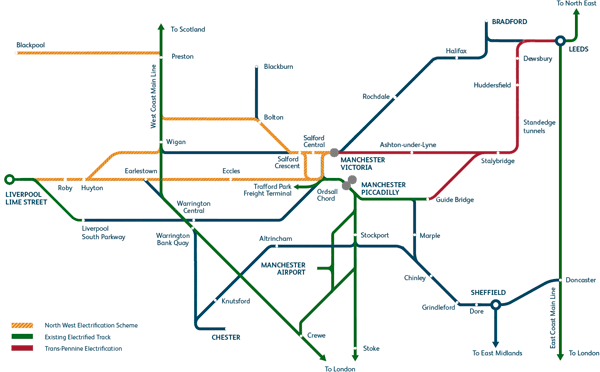
Northern Electrification Map
There are various connecting lines around Liverpool, Manchester and Preston, on which electrification works have not yet started, but have certainly been talked about.
- Salford Crescent to Southport via Wigan Wallgate
- Liverpool to Manchester via Warrington Central
- Preston to Ormskirk
Electrifying these lines would certainly get rid of a few Pacers and release some Class 15X trains for refurshment and use elsewhere.
However, as there is established electrification at Liverpool, Manchester and Preston, it might be more affordable and quicker to use a few Aventra IPEMUs on these lines until the electrification is completed.
Manchester To Leeds Electrification
The Manchester to Leeds electrification has now been paused and it is likely that it will not be completed in the next ten years.
The line has its problems as the three-car Class 185 trains, that work the line, are totally inadequate for the route.
The distance by rail between Manchester and Leeds is 43 miles. When I saw this, I didn’t believe it, but it’s all in this article in the Guardian.
So this means that if you want to run an electric train between Liverpool and Manchester to Leeds, York and Newcastle, the Aventra IPEMU would bridge the gap with ease. The test version of the Aventra IPEMU was a modified Class 379 Train. Similar versions of these like the Class 387 Train are 110 mph trains, so could we see an Aventra IPEMU with such a top speed?
In other words the North Transpennine route could be electrified using four-car 110 mph Aventra IPEMUs. They would certainly be able to serve Newcastle and Middlesbrough, but Scarborough and Hull might still need to be operated by diesel trains.
It would also appear that Aventra IPEMUs could also bridge the gap between Leeds and Manchester Victoria on the Caldervale Line.
This would mean that all stations between Leeds and Manchester on both routes could be served by electric Aventra IPEMUs, if the line was not electrified.
Great Western Electrification
The electrification of the Great Western Main Line is important in solving the train crisis for several reasons.
- If the electrification of the Great Western can be completed as far as Swindon and Newbury, this might release some of the 36, two- and three-car Class 165 trains or the 21, three-car Class 166 trains. These are in good condition and every train company will want a few to provide modern services.
- Once electrification is completed to Bristol and Cardiff and Class 800 and Class 801 trains are running on the route, will release a number of InterCity 125s. Some are ear-marked for Scotland to provide flagship services and I’m sure that train companies will find uses for the rest.
- Electrification to Cardiff will enable electrification of the Cardiff Valleys Lines. But the Valleys electrification needs the new trains to be delivered for Crossrail and/or the London Overground, so that the Class 315 trains can be refurbished and cascaded.
This report in Construction News entitled Crossrail, Thameslink, Great Western and North-west identified as priorities in Network Rail report says this.
The report into the planning of Network Rail’s £38.5bn improvement plan is expected to be released next month.
Sir Peter has identified Crossrail, Thameslink, Great Western and the North-west electrification as the four key “priority projects” for Network Rail, according to sources close to the report.
So it looks like the Great Western and North Western projects might get the resources to finish in time to allow cascades to release trains to help solve the shortage of train problems everywhere.
Scottish Electrification
Although the train shortage is more pronounced in England and Wales, Scottish electrification could give the rest of the UK a helping hand.
In the Wikipedia entry for Abellio ScotRail there is a section entitled Future. This is said.
Abellio ScotRail will introduce a fleet of 46 three car and 24 four car Hitachi AT200 electric trains from December 2017, to operate services on the lines being electrified as part of the Edinburgh to Glasgow Improvement Programme, if it granted a three-year optional franchise extension, it will order a further 10 three car units.
Abellio ScotRail will also introduce 14 four-carriage and 13 five-carriage refurbished High Speed Trains by December 2018 on longer-distance services between Edinburgh, Glasgow, Aberdeen and Inverness. This is contingent on the rolling stock being released by First Great Western, with suggestions in July 2015 that the electrification of the Great Western Main Line was running 12 months late.
This new rolling stock will result in 10 Class 156, eight Class 158 and 34 Class 170s returning to their leasing companies.
So when the new Hitachi trains are delivered by the end of 2018, there could be around fifty diesel trains available to help out in England and Wales.
It is also another reason why electrification of the Great Western must be completed, as without it, Scotland won’t get the High Speed Trains.
Gospel Oak To Barking Electrification
The eight Class 172 trains on the Gospel Oak to Barking Line will be released when that line is electrified.
But who knows when, that will happen?
As the services on the line could be provided by Aventra IPEMUs charging from the electrification at Barking, I do wonder if this should be done to release the Class 172 trains as early as possible. The electrification of the line would then be done at a more relaxed pace, whilst a full service was provided by the Aventras.
Pushing The Train Operating Companies To Help Themselves
In the last few months, some of the franchises have been extended or advertised for new franchisees. And I think it is true to say, that the Department for Transport, is expecting that the train companies do something about improving the service.
- Great Western Railway have taken a pragmatic view on obtaining new trains.
- Chiltern Railways and c2c, the two franchisees with most control over their tracks, are pushing forward with developments.
- East Midlands Trains have got an extension to 2018 with strings. Will we see a rolling stock announcement?
- The just advertised East Anglian franchise, seems to put a lot of pressure on the operator, to sort out the trains and improve customer service.
Perhaps this paragraph from Transforming The North’s Railways is the most significant.
We are looking for a complete modernisation of the Northern rolling stock fleet, which will involve replacing Pacer trains completely by 2020 and delivering high quality modern trains for passengers. Bidders’ rolling stock plans must include at least 120 new-build carriages for use on non-electrified routes. The new carriages that will be introduced on the Northern network, along with the release of diesel units following the introduction of electric trains on newly-electrified routes, will enable the replacement of the Pacer units. Existing electric and diesel trains on Northern will receive a complete modernisation to make them ‘as new’ as soon as practicable after franchise start, with the emphasis that the design of new and existing interiors should feel thoroughly modern and focus on passenger comfort.
One hundred and twenty new build carriages for non-electrified routes either means something like sixty two-car diesel multiple units, thirty four-car Aventra IPEMUs or perhaps a mixture of the two. I don’t thin it means D-Trains or Class 144e Trains.
With Jeremy Corbyn threatening to nationalise the railways, it does seem the train companies are being told to sharpen up their acts significantly.
I think we’ll see more innovation and better services offered in the next few years.
Class Is Permanent
When Chiltern Railways wanted trains to run a high standard of service between London and Birmingham, they turned to locomotive-hauled Mark 3 coaches.
The coaches were refurbished to a very high standard, where every passenger can look out of the window, as shown in Hauled By A Diesel Locomotive To Birmingham. They even have sliding doors and modern toilets that meet all current and known future regulations.
And of course, they still have one of the finest ride qualities of any train in the world.
This is said on the Wikipedia entry for Abellio ScotRail.
Abellio ScotRail will also introduce 14 four-carriage and 13 five-carriage refurbished High Speed Trains by December 2018 on longer-distance services between Edinburgh, Glasgow, Aberdeen and Inverness. This is contingent on the rolling stock being released by First Great Western, with suggestions in July 2015 that the electrification of the Great Western Main Line was running 12 months late.
High Speed Trains are formed of two Class 43 locomotives and an appropriate number of Mark 3 coaches.
I would assume the coaches will be refurbished very much like the Chiltern examples with a high class interior, sliding doors and modern toilets, so they meet all current and known future access, disability and environmental regulations.
Terry Miller’s magnificent design, that was built between 1975 and 1988, just seems to keep putting off the inevitable. I wouldn’t bet against some Mark 3 coaches still being in regular service for a hundred years.
Despite their age, there are still a lot of Mark 3 coaches in regular service. I’m not sure how many, but there are over 800 in InterCity 125 sets.
In addition to the superb Chiltern Class 68 locomotive-hauled sets, there are also several sets used by Abellio Greater Anglia on Liverpool Street to Ipswich and Norwich services, where they are hauled by Class 90 locomotives.
These Greater Anglia sets need upgrading with sliding doors and modern toilets, if they are to stay in service past 2020.
The next operator for this franchise is being given tough conditions, which include putting modern trains on the flagship route and running some services in ninety minutes from Norwich to London and sixty from Ipswich. The question has to be asked if this would be possible with a modern locomotive and refurbished Mark 3 coaches!
I think there is a high chance that the winning bidder for the next Greater Anglia franchise will still be using refurbished Mark 3 coaches between Liverpool Street, Ipswich and Norwich.
The new franchisee will have to offer lots of new services and three possibilities have been run in my lifetime.
- Liverpool Street and Great Yarmouth, via Cambridge, the new Cambridge Science Park station and Norwich.
- Liverpool Street and Peterborough via Colchester, Ipswich, Bury St. Edmunds and Ely.
- Liverpool Street to Lowestoft via Colchester and Ipswich.
They have a problem, in that sections of these routes are not electrified. There are four possible solutions.
- Run the routes in such a way that an Aventra IPEMU can service it. A possibility!
- Buy a few Class 800 electro-diesel trains, which would probably be made in Japan by Hitachi. Expensive but possible!
- Get a few more sets of refurbished Mark 3 coaches and haul them with a Class 88 electro-diesel locomotive. No problem and in style!
- Use InterCity 125s. Possibly, but 100% diesel!
The only options that could be done quickly would be to use the Class 88 or InterCity 125s.
The latter would work, but surely a mainly electric modern solution is probably better and more acceptable to politicians.
I would also never rule out more sets of Mark 3 coaches being used around the country after refurbishment. The only problem is something environmentally-friendly to haul them!
The Scottish solution of shortened High Speed Trains could also be used.
Aventra IPEMUs Running From Or Between Electrified Hubs Or Lines
Many branch lines or secondary routes meet the following conditions.
- They are electrified at one or both ends.
- The electrification is sufficient to charge an Aventra IPEMU’s battery, as it waits to return or passes along the line.
- The non-electrified sections of the line are short enough to be handled by an Aventra IPEMU.
Examples of lines suitable for an IPEMU include.
- Newcastle to Carlisle
- Manchester to Leeds
- Cambridge to Ipswich
- Coventry to Nuneaton
- Carnforth to Barrow-in-Furness
- Norwich to Yarmouth
I think that once the Aventra IPEMU concept is proven, then we’ll see them increasingly used around electrified lines.
There is a long list of places, where branch and secondary routes meet main electrified lines.
- Birmingham
- Carlisle
- Coventry
- Crewe
- Darlington
- Doncaster
- Ely
- Ipswich
- Leeds
- Liverpool
- Manchester Piccadilly
- Manchester Victoria
- Newcastle
- Norwich
- Peterborough
- Preston
- Wolverhampton
- York
This list will hopefully be increased, when the Great Western Main Line is electrified.
- Bristol
- Cardiff
- Reading
- Swansea
I have written An Alternative Approach To Provide A Local Metro Network, which investigates how Aventra IPEMUs can be used to provide electric trains on lines without full electrification.
The only area of the country that will lack electrified hubs in a few years will be the East Midlands Main Line and the far South West and the Northern parts of Scotland and Wales.
So surely, it is important that we electrify the Midland Main Line to bring electrification to the important hubs of Derby, Nottingham and Sheffield, so we can use Aventra IPEMUs to provide electric trains on their local lines.
Conclusions
It’s tight, but I think it’ll be alright in 2020, but there are certain things we must do.
- Use no more than a handful of Vivarail D-Trains to provide services on some far-flung lines.
- The Great Western, North Western and Scottish electrifications must be completed on time.
- Use the Mark 3 coaches intelligently
- Use new Aventra IPEMUs to side-step electrification in places like, the electrification gap between Manchester and Leeds and the Cardiff Valleys Lines.
- Use new Aventra IPEMUs to provide services around electrified hubs.
- Scrap all the Pacers except possibly upgraded Class 144e trains.
- Upgrade the Class 150, Class 153 and Class 156 trains.
I think it’ll be interesting to see how the companies jump.
Platforms 11 and 12 At Stratford
In December this year, an service hourly service called STAR will be started between Stratford and Angel Road along the Temple Mills Branch of the Lea Valley Lines via Lea Bridge, Tottenham Hale and Northumberland Park stations. Wikipedia says this about services to and from the Angel Road station.
Angel Road is only served by a number of trains every weekday to and from Stratford. No services operate at the station on weekends or public holidays. However, from December 2015 Angel Road will receive an hourly service to Stratford that will start here and vice versa, the service will be known as (STAR).
STAR services will obviously call at the new Lea Bridge station, when it opens next year.
I shall probably use the service occasionally, when I need to get home from Stratford, as Lea Bridge station is on the 56 bus route that passes by my house.
At Stratford, there are two platforms that have been positioned to give easy access to the Temple Mills Branch through Lea Bridge and Tottenham Hale and onwards to Stansted Airport. I took these pictures of the platforms.
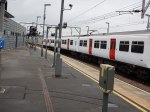
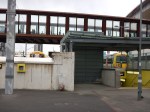
They sit at the end of the two London Overground platforms, which are the Eastern terminus of the North London Line. You can see two Class 378 trains peeking out from underneath the rusty bridge. (Not my name, but an East London nickname, I’ve heard from locals and station staff!) This Google Map shows the layout of the platforms.
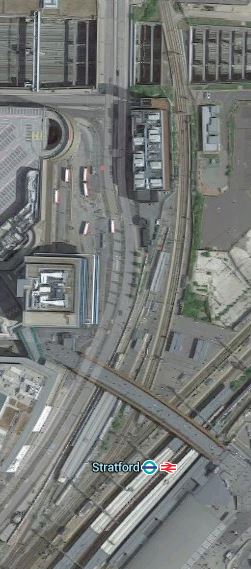
Stratford Platforms 11 And 12
In the map, platforms 11 and 12 curve away to the North from underneath the rusty bridge, which connects Eastfield to Stratford town centre.
Platform 11 is the Easternmost platform and is used as the terminus of the Stratford to Bishops Stortford service, which has been rumoured many would like extended to Stansted.
Platforms 1 and 2 for the North London Line are connected to the unused Platform 12, by a simple walkway, so in the future if Platform 12 is used for the STAR services, passengers going from anywhere on the North London Line to Tottenham Hale or Angel Road would just have an easy interchange.
As the STAR service will initially be an hourly service and the Bishops Stortford service is half-hourly and they run from platforms connected by a subway, I can’t help feeling that this will be an arrangement that won’t last long, before it is improved.
Suppose you arrive at Stratford wanting to get home to your house near Lea Bridge station and just miss the hourly train. Do you wait an hour for another train or catch the Bishops Stortford train, that will probably stop at Lea Bridge, after the new station opens?
It would be so much easier, if the two local services started from an shared island platform or at lest two platforms with a level walk between them.
This is going to get very complicated, if some of the plans for Stratford services up the Lea Valley are implemented.
- I’ve read several times, that reinstatement of the link to Stansted Airport is an aspiration of many, especially as Stratford is close to the Olympic Park and it is an important rail interchange and a terminus for two branches of the DLR and the Jubilee and North London Lines.
- There are also aspirations to start a direct service between the Chingford branch and Stratford using the reinstated Hall Farm Curve.
- With all of the housing, business and leisure developments along the lower Lea Valley, it will not be long before an hourly STAR service is inadequate.
- If the Hall Farm Curve is reinstated, would there be a need to run services between the Chingford branch and the North London Line?
- There is also the Crossrail effect, which in the Lea Valley’s case could not be just Crossrail, but Crossrail 2 if that ever gets built.
- Perhaps unlikely now, but I feel that at some point the Dalston Eastern Curve will be reopened, so enabling services between say Walthamstow to South London.
- Is there a need to better connect Stratford International station to the main regional complex?
I can’t help feeling that the layout of Platforms 11 and 12 will at some time not be able to handle all the Lea Valley services.
I suspect though there may be an innovative solution.
Look at the Google Map and you see that the Temple Mills Branch passes over the deep hole of the International station. I wrote Is This The Most Unwelcoming Station In The UK? about that dreadful station.
So could two or three bay platforms to serve the Lea Valley and Stansted Airport, be built alongside the Temple Mills Branch, as it passes over the International station?
This Google Map shows Stratford International station.
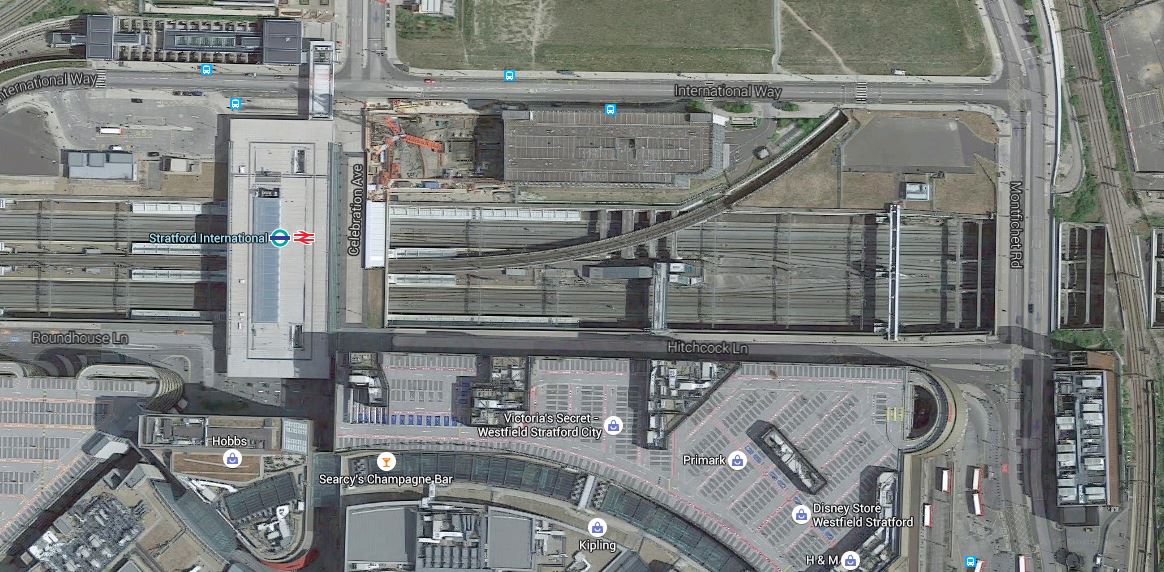
Stratford International Station
The building at the bottom right is also shown on the previous map that shows Platforms 11 and 12.
If the extra platforms were built over the Eastern end of the International station, it would enable the following.
- A new Eastern entrance to the International station could be created to give better connections between International and High Speed services from Stratford International and all the other services at Stratford Regional station.
- Crossrail would have a step-free interchange to Eurostar and other International services, if those services stopped at the International station.
- Interchange between Lea Valley and North London Line services, would be via a double Clapham Kiss, where passengers would just walk on the level to the other set of platforms.
- There might be opportunities to extend or improve the connectivity of the DLR. The current DLR station is at the top left of the map.
- Any direct services between the Temple Mills Branch and the North London Line would use the existing Platforms 11 and 12.
To get the connection right, the pedestrian links would have to be well-designed, but surely there is space to put a travelator effectively between the Regional and International stations.
Stratford International station would end up as what it should be, the International section of Stratford station.
Fifty Years On!
The students are going off to University about now!
Fifty years ago, probably to within a few days, I went off to University for the first time.
In some ways my situation was unusual in that I had been offered an unconditional place by Liverpool University and the way they worked, you had to accept them or possibly lose it.
I didn’t actually go to the University or Liverpool before it was time to go up to University about the end of September.
So on the day of my first trip North of London, I packed everything I was to take in a big cheap cardboard suitcase and took the Tube up to Euston to get a train to Liverpool.
My first memory of the trip, was coming into Lime Street station, through the deep dark wet cutting that actually goes under the University. At one point, I remember thinking looking out into the gloom, that the North is rather dark.
When I arrived, I had to get a Crosville H13 bus to my digs at Huyton. I managed the climb up the hill with my case well enough and found the digs at 178 Huyton Lane after a short walk!
I’ll admit that at times in those first few weeks that I did feel a bit homesick. But it’s amazing how quick University can get that out of you.
It all worked out right in the end.
The next year, I met C, who was to be my constant companion for nearly forty years until her sad death in 2008.
I’ve made a good success of some of my life and I only have a couple of regrets.
After I crashed my Cessna, I should never have given up flying.
A few years before C died, we had a long chat about the future and we virtually decided to move back into London. But we chickened out! Probably, because she liked her work too much and no matter how hard I tried, I couldn’t persuade her to join a Chambers in London.
It wouldn’t have changed the course of her life, but we would have had a couple of good years, in this wonderful city that I love.
I still visit Liverpool and she is the other lady in my life!
But then both have been very good to me!
So if you’re going up to University for the first time this week! Don’t worry!
 The Anonymous Widower