Thoughts On The Airbus A 390
Ask Google what she knows about the Airbus A 390 and you get this AI Summary.
The Airbus A390 is a three-deck, six-engine aircraft that can carry around 1,000 passengers. It’s based on the A380, but with a third deck and extra engines. The A390 was custom-built for Qantas to fly between Melbourne and New York.
Google got their summary from this page on steemit.
Search for images of the Airbus A 390 and you get several images of this unusual three-deck aircraft, that looks like a widened Airbus A 380 with six engines.
These are some of my thoughts.
Wikipedia Entries
There is no Wikipedia entry for the Airbus A 390.
But.
- There is a Wikipedia entry for the Airbus A 380.
- There is also a Wikipedia entry for the six unusual Airbus Beluga XLs, which are used to transport two pairs of Airbus A 350 wings between factories.
The A 390 is supposedly based on the A 380 and the Beluga XL appears to have a fuselage that is a bit like the Airbus A 390.
Will The Airbus A 390 Fly?
After reading the two Wikipedia entries, I am fairly sure that an Airbus A 390 airliner, as shown in the pictures would be able to fly.
Although, I must say, that I was surprised, at seeing an Airbus Beluga XL on video. This is a Beluga XL landing at Heathrow.
So I think we can say, that Airbus know more than a bit about the aerodynamics of three-deck fuselages.
The Antonov An-225 Mriya
This aircraft designed and built in the Soviet Union , does have a Wikipedia entry.
These three paragraphs from the start of the entry, give some details of this unusual and very large aircraft.
The Antonov An-225 Mriya (Ukrainian: Антонов Ан-225 Мрія, lit. ’dream’ or ‘inspiration’) was a strategic airlift cargo aircraft designed and produced by the Antonov Design Bureau in the Soviet Union.
It was originally developed during the 1980s as an enlarged derivative of the Antonov An-124 airlifter for transporting Buran spacecraft. On 21 December 1988, the An-225 performed its maiden flight; only one aircraft was ever completed, although a second airframe with a slightly different configuration was partially built. After a brief period of use in the Soviet space programme, the aircraft was mothballed during the early 1990s. Towards the turn of the century, it was decided to refurbish the An-225 and reintroduce it for commercial operations, carrying oversized payloads for the operator Antonov Airlines. Multiple announcements were made regarding the potential completion of the second airframe, though its construction largely remained on hold due to a lack of funding. By 2009, it had reportedly been brought up to 60–70% completion.
With a maximum takeoff weight of 640 tonnes (705 short tons), the An-225 held several records, including heaviest aircraft ever built and largest wingspan of any operational aircraft. It was commonly used to transport objects once thought impossible to move by air, such as 130-ton generators, wind turbine blades, and diesel locomotives.
This further paragraph described the destruction of the aircraft.
The only completed An-225 was destroyed in the Battle of Antonov Airport in 2022 during the Russian invasion of Ukraine. Ukrainian president Volodymyr Zelenskyy announced plans to complete the second An-225 to replace the destroyed aircraft.
I feel that the Mriya is significant for the Airbus A 390 for three reasons.
- Mriya was a six-engine heavy-lift cargo aircraft developed from a certified four-engine transport.
- Mriya was starting to make a name for being able to move over-sized cargo around the world.
- Given the parlous state of parts of the world and the ambitions of some of its so-called leaders, I believe, as I suspect others do, that a heavy-lift cargo aircraft is needed for disaster relief.
So are Airbus looking at the possibilities of converting some unwanted A 380 airliners into the heavy-lift aircraft, that they believe the world needs?
- They may even want some for their own purposes.
- Jeff Bezos or Elon Musk may need a heavy-lift aircraft for their space programs.
Converting some unwanted Airbus A 380s into heavy-lift cargo aircraft could be a more affordable route, than designing and building new aircraft from scratch.
The Best Plane That Looks Like An Egg
The title of this post is the same as that of this article on interesting Engineering.
This is the sub-heading.
Celera 500L: Redefining aviation with its unique egg-shaped design, unparalleled fuel efficiency, and affordability.
These are the first two paragraphs.
In the world of aviation, where innovation meets the boundless sky, a groundbreaking aircraft is poised to redefine the future of air travel. Meet the Celera 500L, the brainchild of the Otto Aviation Group, an aircraft that not only boasts a distinctive egg-shaped design but also promises to transform the way we think about flying. Set to enter production in 2025, the Celera 500L is a testament to cutting-edge technology and forward-thinking design, promising to make air travel more cost-effective and eco-friendly than ever before.
One cannot help but be captivated by the Celera 500L’s futuristic aesthetics. Its unmistakable egg-shaped design is a departure from the traditional aircraft we’ve grown accustomed to seeing in the skies. However, this unique shape is not just for show; it’s the result of meticulous engineering aimed at reducing drag and maximizing efficiency.
I suggest you read the article and look at Interesting Engineering’s video.
After that have a good look at Otto Aviation’s web site.
Brief details of the business aircraft version are scattered through the pages.
- Passengers – 6
- Range – 5,000 miles
- Fuel-consumption – 33 miles per gallon.
- Power – Single pusher diesel engine.
The Otto Aviation web site, explains how it is done using laminar flow and advanced aerodynamics.
There is also this page on the ZeroAvia web site, which is entitled ZeroAvia & Otto Aviation Partner to Deliver First New Airframe Design with Hydrogen-Electric Engine Option.
Is a new world of aviation emerging?
Introducing JetZero
The Times today has an article which is entitled Up, Up And Away On An Eco-Friendly, Blended-Wing Jet.
This is the sub-heading.
The US air force hopes that a $235 million contract for a radical new design will take off
The article goes on to give a good history of blended wing bodies, before describing JetZero’s blended-wing jet and the company’s deal with the US Air Force.
More on the aircraft is available on the company’s web site. Take a look at the WHY JETZERO page.
In ZEROe – Towards The World’s First Zero-Emission Commercial Aircraft, I describe Airbus’s ZEROe BWB, which is another proposed blended wing body.
Electra.aero
I have signed up to FutureFlight‘s weekly newsletter and this week it gave two articles about a new nine-seat airliner called an Electra.aero.
It must be the first airliner named after its web site or vice-versa.
The first article is entitled Electra.aero Gives A Glimpse If Its eSTOL Technology Development Aircraft.
It says this about the aircraft and the company.
As it works on plans for a nine-passenger eSTOL blown-wing aircraft, Electra.aero has posted a short video teasing followers with a glimpse of what it describes as a technology demonstrator. The video shows what appears to be a subscale model of the larger hybrid-electric design, but the Virginia-based company is giving very little away for now.
This week, the U.S. start-up announced the appointment of former Boeing Commercial Airplanes president and CEO James Albaugh to its board of advisors, along with the former Airbus America CEO and FAA Administrator Allan McArtor, and aircraft finance expert Kristen Bartok Touw.
You can also watch a video.
The second article is entitled Electra.aero Uses Truck To Test Gives A Glimpse If Its eSTOL Aircraft Propulsion System And Wing.
It says about more the aircraft.
Electra.aero’s planned nine-passenger eSTOL aircraft is expected to be able to operate from landing strips as short as 300 feet. The company’s blown-wing design and hybrid-electric propulsion system will be key factors in achieving this breakthrough performance for regional air services. At its base in Manassas Regional Airport in Virginia, the company is using a technology demonstrator and a truck to conduct ground testing key systems in preparation for anticipated test flights later this year.
You can also watch a video.
The home page also shows a visualisation of a flight between Washington DC and New York.
Note.
- Blown-wing and blown flaps have been used before on aircraft like the Lockheed F-104 Starfighter, the Boeing C-17 Globemaster and the Blackburn Buccaneer.
- Blown flaps’ use on the Electra.aero, seems to be the first application on a small propeller-driver airliner.
- Electra.aero seems well-connected, which helps in the aviation industry.
- Power seems to come from a hybrid-electric design.
- Being able to operate from landing strips as short as a football field is a unique characteristic.
- Pictures on the web site show the aircraft has eight propellers, with those close to the fuselage being larger.
- A 400 nautical mile range with a 45 minute reserve, a cruise speed of 175 knots and a quiet take-off are claimed.
As someone, who has over a thousand hours in command of a twin-engined Cessna 340A, this aircraft could be the real deal.
- The field performance is sensational.
- The range is excellent.
- Except for the number of electric engines, it looks like an aircraft and won’t put off the passengers.
- It could fly between Washington DC and New York or London and Paris.
According to their web site, they already have a $3 billion order-book.
Zero-Carbon Emission Flights To Anywhere In The World Possible With Just One Stop
The title of this post, is the same as that of this press release from the Aerospace Technology Institute.
This is the first sentence of the press release.
Passengers could one day fly anywhere in the world with no carbon emissions and just one stop on board a concept aircraft unveiled by the Aerospace Technology Institute (ATI) today.
These three paragraphs describe the concept.
Up to 279 passengers could fly between London and San Francisco, USA direct or Auckland, New Zealand with just one stop with the same speed and comfort as today’s aircraft, revolutionising the future of air travel.
Developed by a team of aerospace and aviation experts from across the UK collaborating on the government backed FlyZero project, the concept demonstrates the huge potential of green liquid hydrogen for air travel not just regionally or in short haul flight but for global connectivity. Liquid hydrogen is a lightweight fuel, which has three times the energy of kerosene and sixty times the energy of batteries per kilogramme and emits no CO2 when burned.
Realising a larger, longer range aircraft also allows the concentration of new infrastructure to fewer international airports accelerating the rollout of a global network of zero-carbon emission flights and tackling emissions from long haul flights.
These are my thoughts.
The Airframe
This picture downloaded from the Aerospace Technology Institute web site is a visualisation of their Fly Anywhere Aircraft.
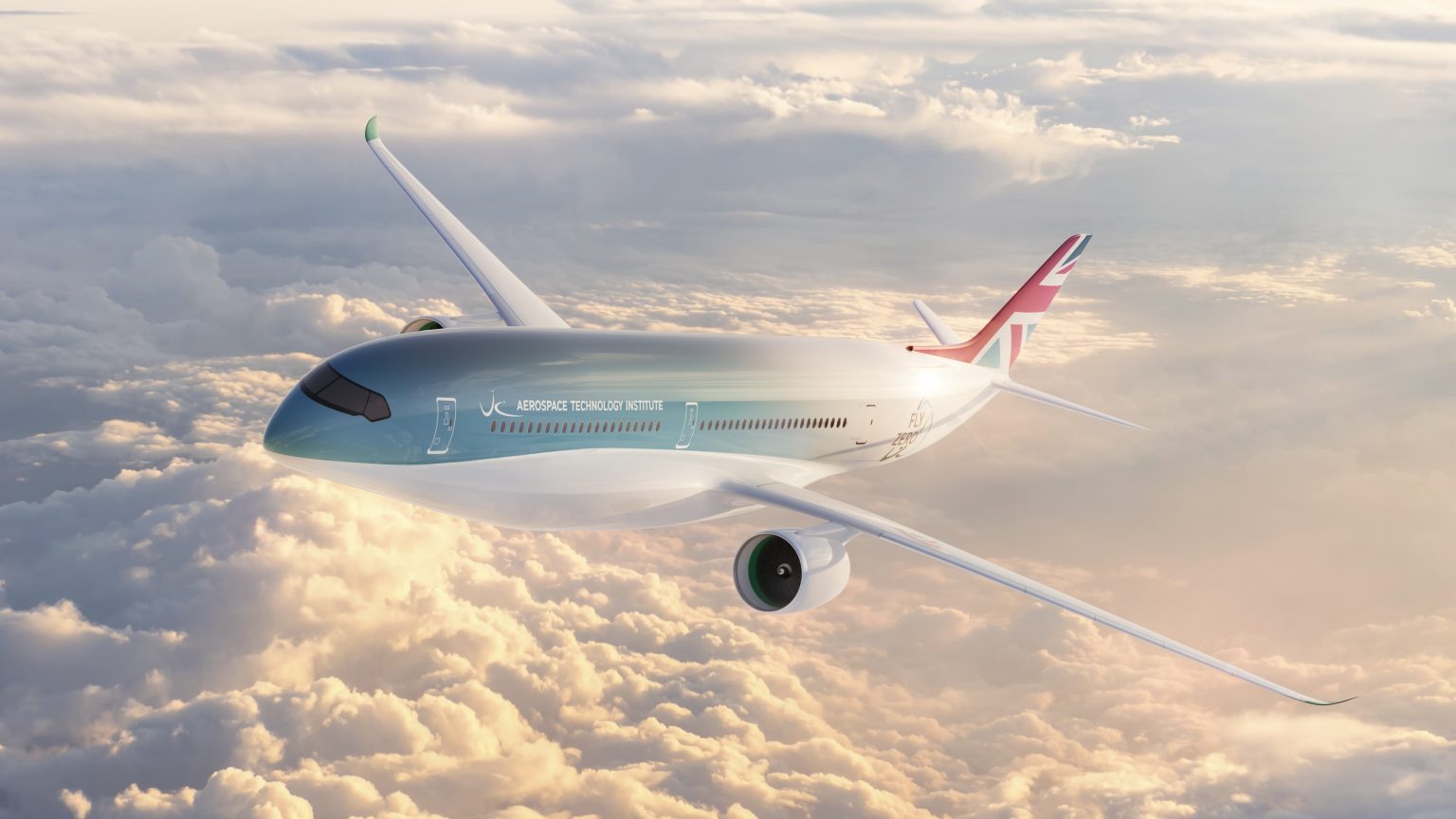
Some features stand out.
The wings are long, narrow and thin, almost like those of a sailplane. High aspect ratio wings like these offer more lift and stability at high altitude, so will the plane fly higher than the 41,000-43,000 feet of an Airbus A350?
I wouldn’t be surprised if it does, as the higher you go, the thinner the air and the less fuel you will burn to maintain speed and altitude.
The horizontal stabiliser is also small as this will reduce drag and better balance with the wing.
The tailfin also appears small for drag reduction.
The body is bloated compared to say an Airbus A 350 or a Boeing 777. Could this be to provide space for the liquid hydrogen, which can’t be stored in the thin wings?
The fuselage also appears to be a lifting body, with the wings blended into the fat body. I suspect that the hydrogen is carried in this part of the fuselage, which would be about the centre of lift of the aeroplane.
The design of the airframe appears to be all about the following.
- Low drag.
- high lift and stability.
- Large internal capacity to hold the liquid hydrogen.
It may just look fat, but it could be as radical as the first Boeing 747 was in 1969.
The Engines
I suspect the engines will be developments of current engines like the Rolls-Royce Trent XWB, which will be modified to run on hydrogen.
If they are modified Trent engines, it will be astonishing to think, that these engines can be traced in an unbroken line to the RB211, which was first run in 1969.
The Flight Controls
Most airliners these days and certainly all those built by Airbus have sophisticated computer control systems and this plane will take them to another level.
The Flight Profile
If you want to fly any aircraft a long distance, you generally climb to a high level fairly quickly and then fly straight and level, before timing the descent so you land at the destination with as small amount of fuel as is safe, to allow a diversion to another airport.
I once flew from Southend to Naples in a Cessna 340.
- I made sure that the tanks were filled to the brim with fuel.
- I climbed to a high altitude as I left Southend Airport.
- For the journey across France I asked for and was given a transit at Flight Level 195 (19,500 feet), which was all legal in France under visual flight rules.
- When the French handed me over to the Italians, legally I should have descended, but the Italians thought I’d been happy across France at FL195, so they didn’t bother to ask me to descend.
- I flew down the West Coast of Italy at the same height, with an airspeed of 185 knots (213 mph)
- I was then vectored into Naples Airport by radar.
I remember the flight of 981 miles took around six hours. That is an average of 163.5 mph.
I would expect the proposed aircraft would fly a similar profile, but the high level cruise would be somewhere above the 41,000-43,000 feet of an Airbus A 350. We must have a lot of data about flying higher as Concorde flew at 60,000 feet and some military aircraft fly at over 80,000 feet.
The press release talks about London to San Francisco, which is a distance of 5368 miles.
This aircraft wouldn’t sell unless it was able to beat current flight time of eleven hours and five minutes on that route.
Ground Handling
When the Boeing 747 started flying in the 1970s, size was a big problem and this aircraft with its long wing may need modifications to runways, taxiways and terminals.
Passenger Capacity
The press release states that the capacity of the aircraft will be 279 passengers, as against the 315 and 369 passengers of the two versions of the A 350.
So will there be more flights carrying less passengers?
Liquid Hydrogen Refuelling
NASA were doing this successfully in the 1960s for Saturn rockets and the Space Shuttle.
Conclusion
This aircraft is feasible.
ZEROe – Towards The World’s First Zero-Emission Commercial Aircraft
The title of this post, is the same as that of this Press Release from Airbus.
This is the introductory paragraph.
At Airbus, we have the ambition to develop the world’s first zero-emission commercial aircraft by 2035. Hydrogen propulsion will help us to deliver on this ambition. Our ZEROe concept aircraft enable us to explore a variety of configurations and hydrogen technologies that will shape the development of our future zero-emission aircraft.
Overall, the Press Release discloses a lot and gives details of three different aircraft, which are shown in this Airbus infographic.
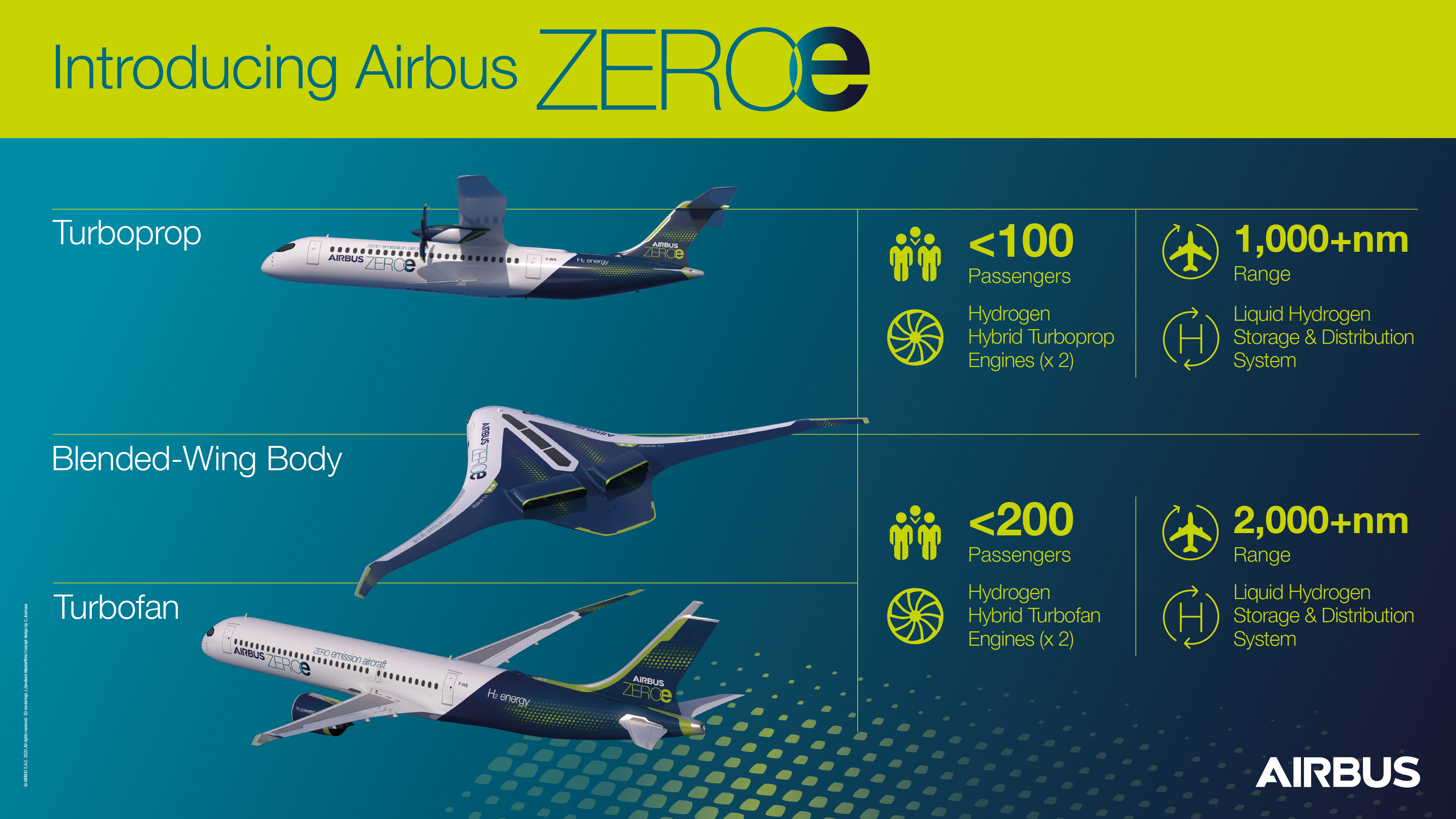
Discover the three zero-emission concept aircraft known as ZEROe in this infographic. These turbofan, turboprop, and blended-wing-body configurations are all hydrogen hybrid aircraft.
I have some thoughts that apply to all three concepts.
Hydrogen Hybrid Power
The Press Release says this about the propulsion systems for the three aircraft.
All three ZEROe concepts are hydrogen hybrid aircraft. They are powered by hydrogen combustion through modified gas-turbine engines. Liquid hydrogen is used as fuel for combustion with oxygen.
In addition, hydrogen fuel cells create electrical power that complements the gas turbine, resulting in a highly efficient hybrid-electric propulsion system. All of these technologies are complementary, and the benefits are additive.
There is a Wikipedia entry which is entitled Hydrogen Fuel, where this is said.
Once produced, hydrogen can be used in much the same way as natural gas – it can be delivered to fuel cells to generate electricity and heat, used in a combined cycle gas turbine to produce larger quantities of centrally produced electricity or burned to run a combustion engine; all methods producing no carbon or methane emissions.
It looks like the aircraft will be powered by engines that are not too different to the current engines in today’s aircraft.
This must be a big advantage, in that much of the research done to improve the current gas-turbine powered by aviation fuel will apply.
Liquid Hydrogen
It appears all three aircraft will use liquid hydrogen.
Liquid Hydrogen Storage
I believe the major uses for hydrogen will be aircraft, buses, cars, rail locomotives and multiple units and heavy trucks.
All will need efficient storage of the hydrogen.
Some applications, will use it in liquid form, as it is a more dense form, but it will need to be kept cold.
As aviation will probably be the most demanding application, will it drive the storage technology?
Oxygen
This will be atmospheric oxygen, which is used by any combustion engine.
Fuel Cells
Will the fuel cells be used to provide power for the plane’s systems, rather than to power the aircraft?
Most airlines do this with an auxiliary power unit or APU, which is just a small gas-turbine engine with a generator. The A 320 family use one made by Pratt & Whitney, which is described on this page of their web site. It is the third one on the page and is called a APS3200. This is said about its function.
Pratt & Whitney APS3200 is the Airbus baseline APU of choice for the Airbus A320 family of aircraft. It is designed to meet performance and environmental requirements for modern day, single-aisle aircraft. The APU comprises a single-shaft, fixedspeed, high-pressure ratio core driving a load compressor that provides bleed air for cabin conditioning and main engine starting, concurrent with 90kVA of electrical power.
The APU is usually located in the tail.
In the ZEROe family will there be a fuel-cell powered compressor to provide bleed air for cabin airconditioning and main engine starting?
Slippery Aerodynamics
Airbus seem to be the masters of slippery aerodynamics, which will help make the planes very fuel efficient.
Lightweight Composite Structures
Like the latest Airbus airliners, these planes will be made from lightweight composite structures and I wouldn’t be surprised to see weight saving in other parts of the aircraft.
Carbon Emissions And Pollution
There will be no carbon dioxide produced, as where’s the carbon in the fuel?
But there could be small amounts of the oxides of nitrogen produced, by the combustion, as nitrogen will be present from the air.
Noise
As the aircraft are powered by gas-turbine engines, there will be some noise.
The Mathematics Of Hydrogen-Powered Aviation
The mathematics for these three aircraft must say, that the designs are feasible.
Otherwise Airbus wouldn’t have published a detailed Press Release, only for it to be torn to pieces.
Pressures Driving Aviation In The Next Ten Years
Aviation will change in the text ten years and it will be driven by various competing forces.
Environmental Issues
Pollution, Carbon Emissions and Noise will be the big environmental issues.
Hydrogen will go a long way to reducing the first two issues, but progress with noise will generally be made by better engineering.
COVID-19 And Future Pandemics
These could have a bigger effect, as to make flying safe in these troubled times, passengers will need to be given more space.
But I do wonder, if there is an administrative solution, backed up, by innovative engineering.
Could a very quick test for COVID-19, that would stop infected passengers boarding, coupled with high quality automatic cleaning and air purification, ensure that passengers didn’t get infected?
Entry Into Service
Airbus are quoting 2035 in the Press Release and this YouTube video.
Is that ambitious?
Thoughts On The Three Designs
My thoughts on the three designs, follow in the next three sections.
The ZEROe Turboprop
This is Airbus’s summary of the design for the ZEROe Turboprop.
Two hybrid hydrogen turboprop engines, which drive the six bladed propellers, provide thrust. The liquid hydrogen storage and distribution system is located behind the rear pressure bulkhead.
This screen capture taken from the video, shows the plane.
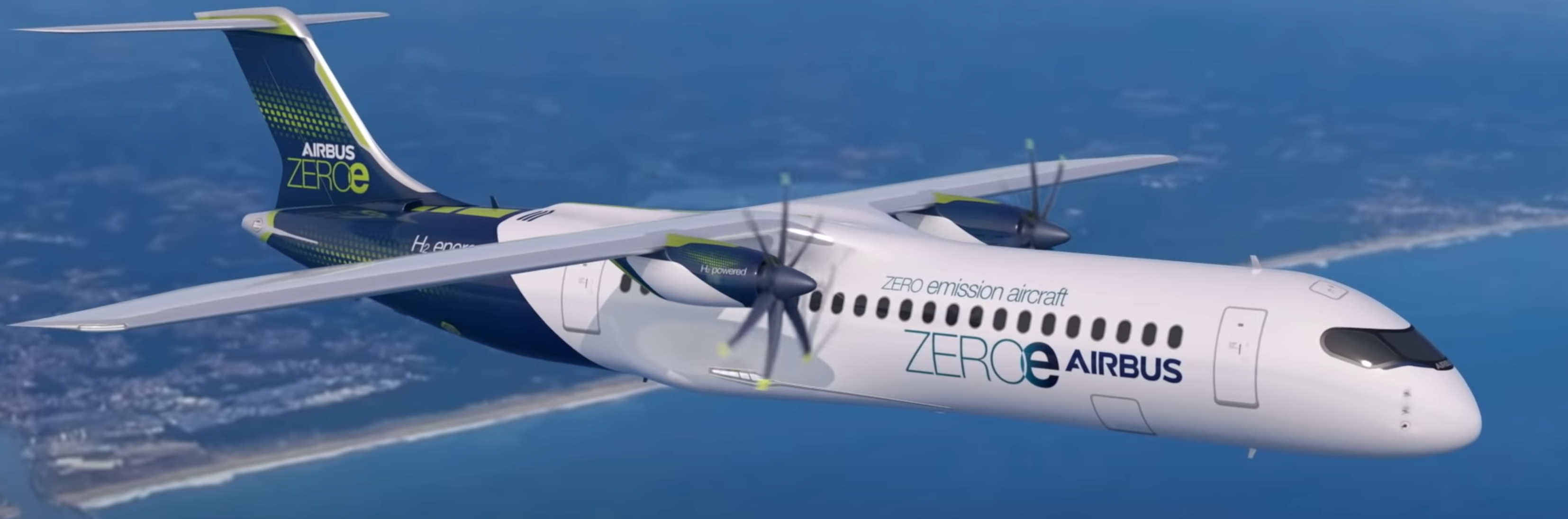
It certainly is a layout that has been used successfully, by many conventionally-powered aircraft in the past. The De Havilland Canada Dash 8 and ATR 72 are still in production.
The Turboprop Engines
If you look at the Lockheed-Martin C 130J Super Hercules, you will see it is powered by four Rolls-Royce AE 2100D3 turboprop engines, that drive 6-bladed Dowty R391 composite constant-speed fully-feathering reversible-pitch propellers.
These Rolls-Royce engines are a development of an Allison design, but they also form the heart of Rolls-Royce’s 2.5 MW Generator, that I wrote about in Our Sustainability Journey. The generator was developed for use in Airbus’s electric flight research program.
I wouldn’t be surprised to find the following.
- , The propulsion system for this aircraft is under test with hydrogen at Derby and Toulouse.
- Dowty are testing propellers suitable for the aircraft.
- Serious research is ongoing to store enough liquid hydrogen in a small tank that fits the design.
Why develop something new, when Rolls-Royce, Dowty and Lockheed have done all the basic design and testing?
The Fuselage
This screen capture taken from the video, shows the front view of the plane.
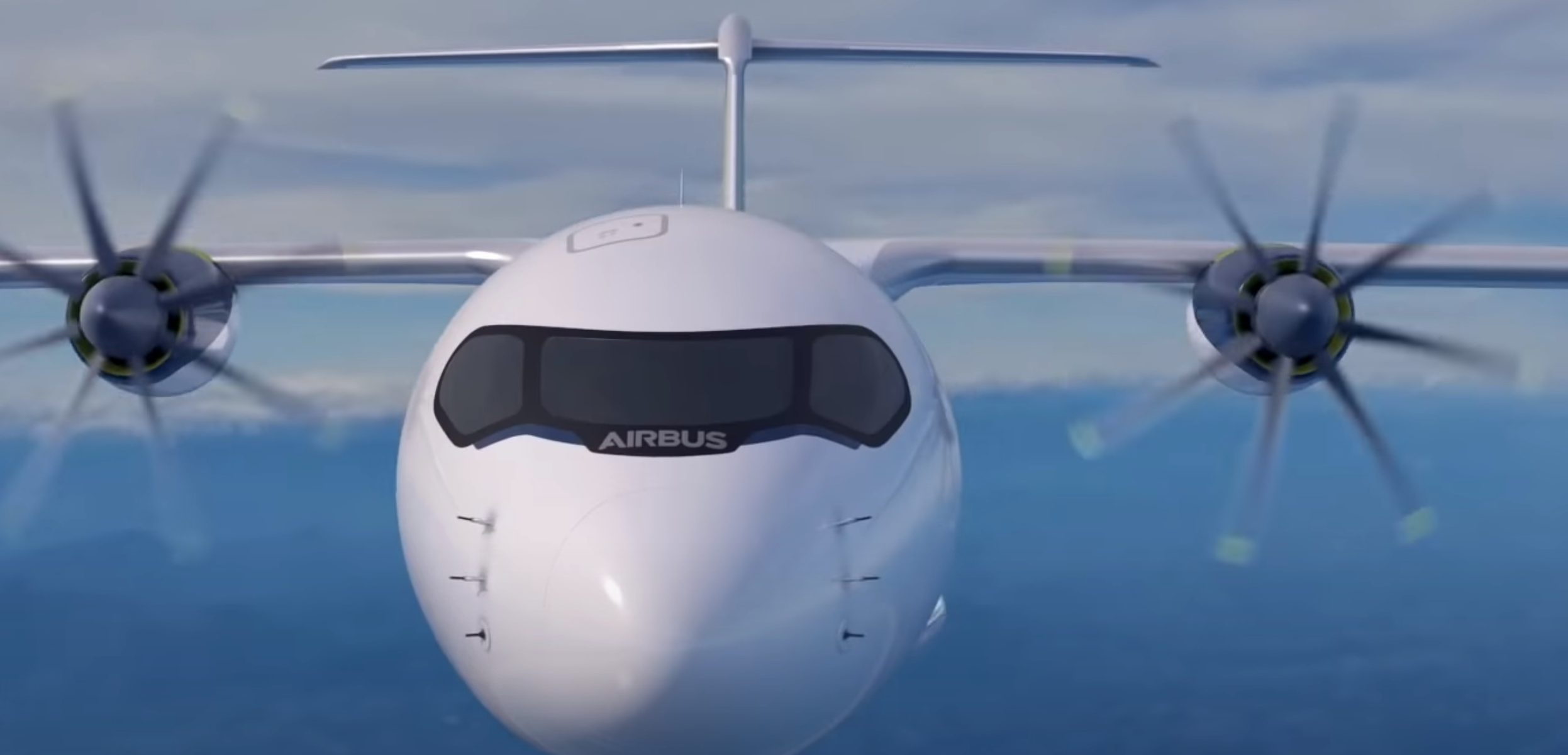
From clues in the picture, I estimate that the fuselage diameter is around four metres. Which is not surprising, as the Airbus A320 has a height of 4.14 metres and a with of 3.95 metres.
So is the ZEROe Turboprop based on a shortened Airbus A 320 fuselage?
As the aircraft has a capacity of less than a hundred passengers and an Airbus A320 has six-abreast seating, could the aircraft have sixteen rows of seats.
With the seat pitch of an Airbus A 320, which is 81 centimetres, this means just under thirteen metres for the passengers.
The Technical Challenge
I don’t feel there are any great technical challenges in building this aircraft.
- The engines appear to be conventional and could even have been more-or-less fully developed.
- The fuselage could be a development of an existing design.
- The wings and tail-plane are not large and given the company’s experience with large composite structures, they shouldn’t be too challenging.
- The hydrogen storage and distributing system will have to be designed, but as hydrogen is being used in increasing numbers of applications, I doubt the expertise will be difficult to find.
- The avionics and other important systems could probably be borrowed from other Airbus products.
Given that the much larger and more complicated Airbus A380 was launched in 2000 and first flew in 2005, I think that a prototype of this aircraft could fly around the middle of this decade.
The Market Segment
It may seem small at less than a hundred seats, but it does have a range of greater than a 1000 nautical miles or 1150 miles.
Consider.
- It compares closely in passenger capacity, speed and range, with the De Havilland Canada Dash 8/400 and the ATR 72/600.
- The ATR 72 is part produced by Airbus.
- The aircraft is forty percent slower than an Airbus A 320.
- It is a genuine zero-carbon aircraft.
- It looks like it could be designed to have a Short-Takeoff-And Landing (STOL) capability.
On the other hand, a lot of busy routes, like London and Edinburgh and Berlin and Munich are less than or around 400 miles.
These short routes are being challenged aggressively by the rail industry, as over this sort of distance, which typically takes four hours by train, rail has enough advantages, that passengers may choose not to fly.
Examples of cities with a range of between 400 and 1000 miles from London include.
- Berlin – 571 miles
- Cork – 354 miles
- Inverness – 445 miles
- Lisbon – 991 miles
- Madrid – 781 miles
- Palma – 835 miles
- Rome – 893 miles
- Stockholm – 892 miles
- Warsaw – 900 miles
This aircraft would appear to be sized as an aircraft, that can fly further than passengers are happy to travel by train. But because of its cruising speed, the routes, where it will be viable would probably be limited in duration.
But important routes to, from and between secondary locations, like those that used to be flown by FlyBe, would surely be naturals for this aircraft.
It looks to be an aircraft that could have a big future.
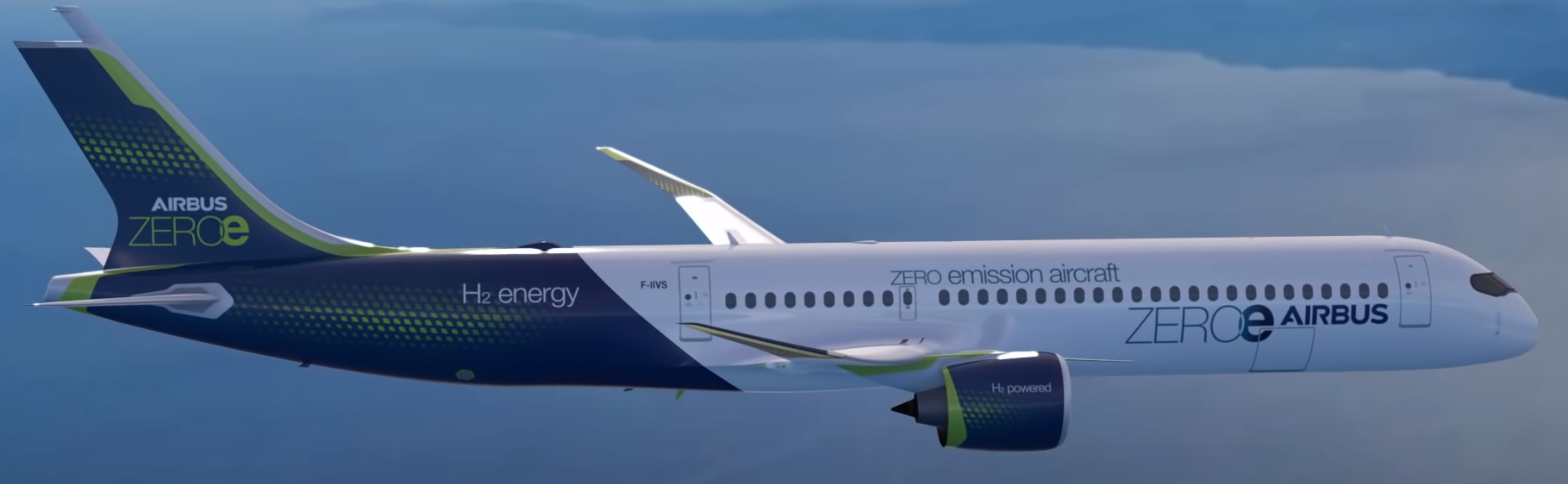
The ZEROe Turbofan
This is Airbus’s summary of the design.
Two hybrid hydrogen turbofan engines provide thrust. The liquid hydrogen storage and distribution system is located behind the rear pressure bulkhead.
This screen capture taken from the video, shows the plane.
This screen capture taken from the video, shows the front view of the plane.
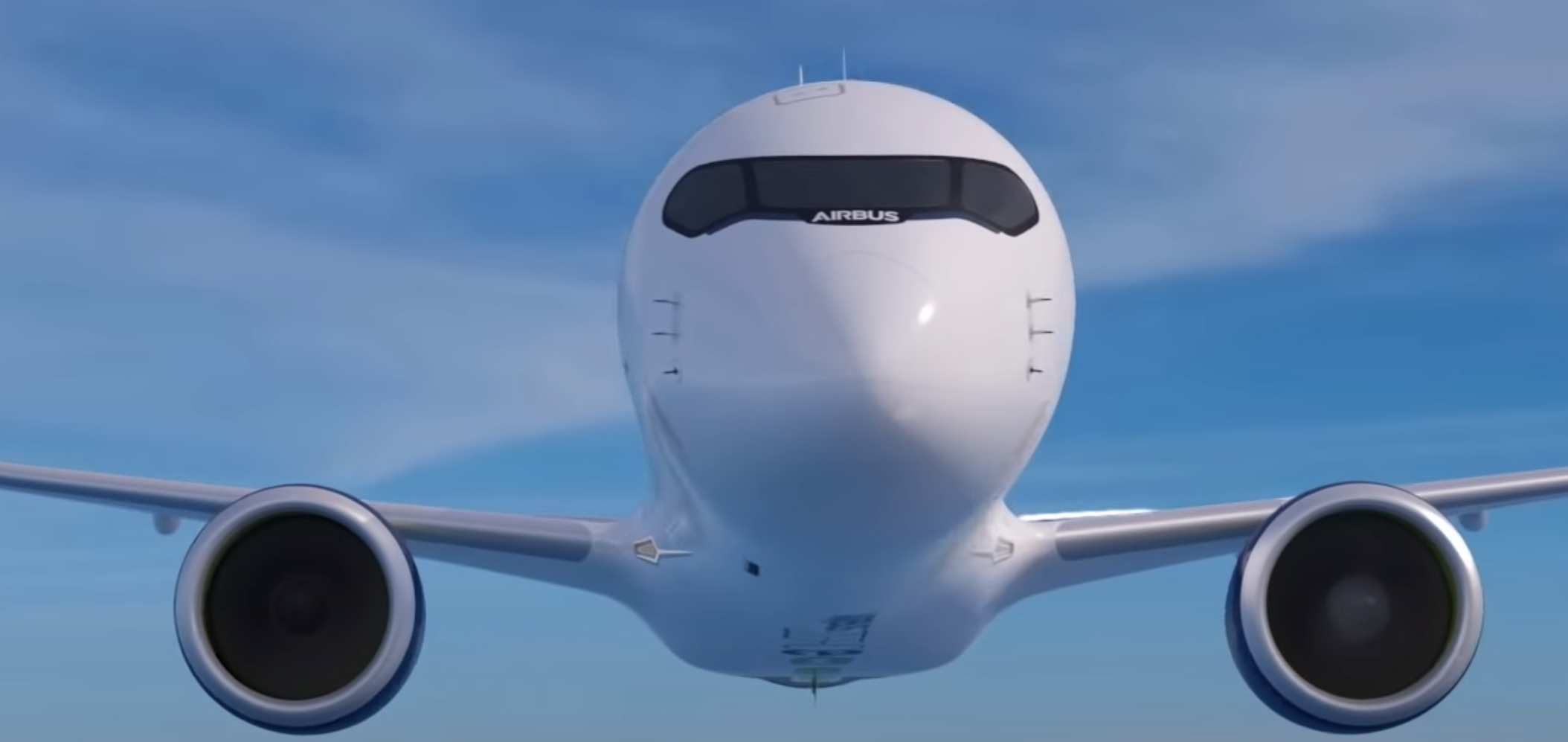
The aircraft doesn’t look very different different to an Airbus A320 and appears to be fairly conventional. It does appear to have the characteristic tall winglets of the A 320 neo.
The Turbofan Engines
These would be standard turbofan engines modified to run on hydrogen, fuelled from a liquid hydrogen tank behind the rear pressure bulkhead of the fuselage.
If you want to learn more about gas turbine engines and hydrogen, read this article on the General Electric web site, which is entitled The Hydrogen Generation: These Gas Turbines Can Run On The Most Abundant Element In the Universe,
Range And Performance
I will compare range, performance and capacity with the latest Airbus A 320.
ZEROe Turbofan
- Range – 2300 miles
- Cruising Speed – Mach 0.78
- Capacity – < 200 passengers
Airbus A 320
- Range – 3800 miles
- Cruising Speed – Mach 0.82
- Capacity – 190 passengers
There is not too much difference, except that the A 320 has a longer range.
The Cockpits Of The ZEROe Turboprop And The ZEROe Turbofan
This gallery puts the two cockpit images together.
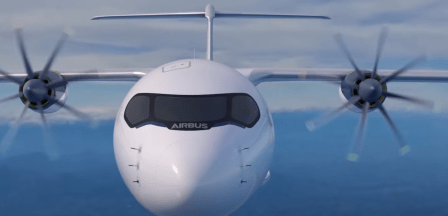
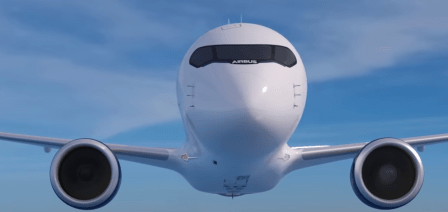
Are they by any chance related?
Could the controls and avionics in both aircraft be the same?
A quick look says that like the Boeing 757 and 767, the two planes have a lot in common, which may enable a pilot trained on one aircraft to fly the other, with only minimal extra instruction.
And would it be a simple process to upgrade a pilot from an A 320 to a ZEROe Turbofan?
The Fuselages Of The ZEROe Turboprop And The ZEROe Turbofan
I estimated earlier that the fuselage of the Turboprop was based on the cross-section of the A320.
Looking at the pair of front views, I wouldn’t be surprised to find, that both aircraft are based on an updated A 320 fuselage design.
Passengers and flightcrew would certainly feel at home in the ZEROe Turbofan, if internally, it was the same size, layout and equipment as a standard A 320 or more likely an A 320 neo.
The Market Segment
These are my thoughts of the marketing objectives of the ZEROe Turbofan.
- The cruising speed and the number of passengers are surprisingly close, so has this aircraft been designed as an A 320 or Boeing 737 replacement?
- I suspect too, that it has been designed to be used at any airport, that could handle an Airbus A 320 or Boeing 737.
- It would be able to fly point-to-point flights between most pairs of European or North American cities.
It would certainly fit the zero-carbon shorter range airliner market!
In fact it would more than fit the market, it would define it!
The ZEROe Blended-Wing Body
This is Airbus’s summary of the design.
The exceptionally wide interior opens up multiple options for hydrogen storage and distribution. Here, the liquid hydrogen storage tanks are stored underneath the wings. Two hybrid hydrogen turbofan engines provide thrust.
This screen capture taken from the video, shows the plane.

This aircraft is proposed to have the same performance and capacity as the ZEROe Turbofan, which includes a 2000 nautical mile plus range.
The only other aircraft with a similar shape is the Northrop Grumman B-2 Spirit or Stealth Bomber. This is not a fast aircraft, but it is able to fly at an altitude of 50,000 ft, which compares to the 60,000 ft of Concorde and the 43,000 ft of an Airbus A 380.
I wonder, if the blended-wing body is designed to fly very high at around the 60,000 ft, which was Concorde territory.
It would only be doing 515 mph and would be well below the speed of sound.
So what is the point on going so high?
The air is very thin and there is a lot less drag.
It is also worth reading Wikipedia on the design of flying wings.
It might be possible to fly much further than 2000 nautical miles. After all Airbus did put in a plus sign!
Is this aircraft the long-distance aircraft of the three?
Extending The Range
I do wonder, if the engines in these aircraft could be capable of running on both hydrogen and aviation biofuel.
As the ZEROe Turboprop and the ZEROe Turbofan planes have empty wings, which in a conventional aircraft would hold fuel, could the space be used to hold aviation biofuel to extend the range?
Certification Of The Planes
The ZEROe Turboprop and ZEROe Turbofan are aircraft, where a lot of the design will already have been proven in previous aircraft, so will probably be much less onerous to approve, than the blended-wing body design.
Conclusion
It looks to me, that Airbus have designed three aircraft to cover the airline market.
I also feel that as the ZEROe Turboprop and ZEROe Turbofan, appear to have conventional airframes, that they could be delivered before 2035.
If I’m right, that the blended-wing body is a high flyer, it will be a ride to experience, travelling at that height all the way to New York.
A Selection Of Train Noses
I have put together a selection of pictures of train noses.
They are in order of introduction into service.
Class 43 Locomotive
The nose of a Class 43 locomotive was designed by Sir Kenneth Grange.


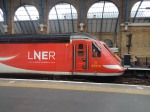
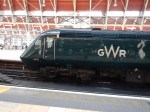
Various articles on the Internet, say that he thought British Rail’s original design was ugly and that he used the wind tunnel at Imperial College to produce one of the world’s most recognised train noses.
- He tipped the lab technician a fiver for help in using the tunnel
- Pilkington came had developed large armoured glass windows, which allowed the locomotives window for two crew.
- He suggested that British Rail removed the buffers. Did that improve the aerodynamics, with the chisel nose shown in the pictures?
The fiver must be one of the best spent, in the history of train design.
In How Much Power Is Needed To Run A Train At 125 mph?, I did a simple calculation using these assumptions.
- To cruise at 125 mph needs both engines running flat out producing 3,400 kW.
- Two locomotives and eight Mark 3 carriages are a ten-car InterCity 125 train.
This means that the train needs 2.83 kWh per vehicle mile.
Class 91 Locomotive
These pictures show the nose of a Class 91 locomotive.



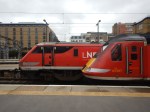

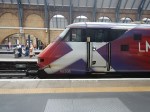
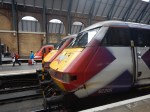
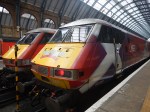
Note, the Class 43 locomotive for comparison and that the Driving Van Trailers have an identical body shell.
It does seem to me, that looking closely at both locomotives and the driving van trailers, that the Class 43s look to have a smoother and more aerodynamic shape.
Class 800/801/802 Train
These pictures show the nose of a Class 800 train.
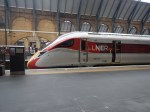
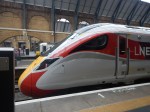
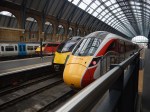
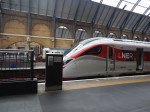
In How Much Power Is Needed To Run A Train At 125 mph?, I did a simple calculation to find out the energy consumption of a Class 801 train.
I have found this on this page on the RailUKForums web site.
A 130m Electric IEP Unit on a journey from Kings Cross to Newcastle under the conditions defined in Annex B shall consume no more than 4600kWh.
This is a Class 801 train.
- It has five cars.
- Kings Cross to Newcastle is 268.6 miles.
- Most of this journey will be at 125 mph.
- The trains have regenerative braking.
- I don’t know how many stops are included
This gives a usage figure of 3.42 kWh per vehicle mile.
It is a surprising answer, as it could be a higher energy consumption, than that of the InterCity 125.
I should say that I don’t fully trust my calculations, but I’m fairly sure that the energy use of both an Intercity 125 and a Class 801 train are in the region of 3 kWh per vehicle mile.
Class 717 Train
Aerodynamically, the Class 700, 707 and 717 trains have the same front.



But they do seem to be rather upright!
Class 710 Train
This group of pictures show a Class 710 train.

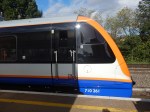
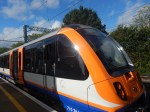
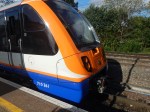
Could these Aventra trains have been designed around improved aerodynamics?
- They certainly have a more-raked windscreen than the Class 717 train.
- The cab may be narrower than the major part of the train.
- The headlights and windscreen seem to be fared into the cab, just as Colin Chapman and other car designers would have done.
- There seems to be sculpting of the side of the nose, to promote better laminar flow around the cab. Does this cut turbulence and the energy needed to power the train?
- Bombardier make aircraft and must have some good aerodynamicists and access to wind tunnels big enough for a large scale model of an Aventra cab.
If you get up close to the cab, as I did at Gospel Oak station, it seems to me that Bombardier have taken great care to create a cab, that is a compromise between efficient aerodynamics and good visibility for the driver.
Class 345 Train
These pictures shows the cab of a Class 345 train.
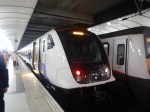
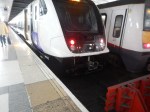

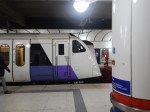
The two Aventras seem to be very similar.
Class 195 And Class 331 Trains
CAF’s Class 195 and Class 331 trains appear to have identical noses.
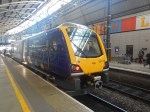

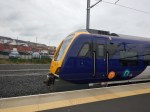
They seem to be more upright than the Aventras.
Class 755 Train
Class 755 trains are Stadler’s 100 mph bi-mode trains.
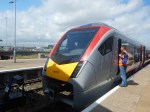
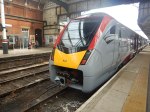
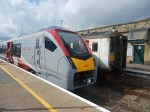

It is surprising how they seem to follow similar designs to Bombardier’s Aventras.
- The recessed windscreen.
- The large air intake at the front.
I can’t wait to get a picture of a Class 755 train alongside one of Greater Anglia’s new Class 720 trains, which are Aventras.
Thoughts On The Aerodynamics Of A Class 91 Locomotive
The Class 91 locomotive is unique in that it the only UK locomotive that has a pointed and a blunt end.
The Wikipedia entry has external and internal pictures of both cabs, which are both fully functional.
The speeds of the locomotive are given as follows.
- Design – 140 mph
- Service – 125 mph
- Record – 161.7 mph
- Running blunt end first – 110 mph
The aerodynamic drag of the train is determined by several factors.
- The quality of the aerodynamic design.
- The cross-sectional area of the train.
- The square of the speed.
- The power available.
The maximum speed on a level track, will probably be determined when the power available balances the aerodynamic force on the front of the train.
But with a train or an aircraft, you wouldn’t run it on the limit, but at a safe lower service speed, where all the forces were calm and smooth.
If you compare normal and blunt end first running, the following can be said.
- The cross sectional area is the same.
- The available power is the same.
- Power = DragCoefficient * Speed*Speed, where the DragCoefficient is a rough scientifically-incorrect coefficient.
So I can formulate this equation.
DragCoefficientNormal * 125*125 = DragCoefficientBlunt * 110*110
Solving this equation shows that the drag coefficient running blunt end first is twenty-nine percent higher, than when running normally.
Looking at the front of a Class 91 locomotive and comparing it with its predecessor the Class 43 locomotive, it has all the subtlety of a brick.
The design is a disgrace.
Conclusion
This crude analysis shows the importance of good aerodynamic design, in all vehicles from bicycles to fifty tonne trucks.
If
 The Anonymous Widower