In Future Will North Africa Be Providing Renewable Energy To Europe?
I believe it is likely that mainland Europe will be getting a considerable amount of renewable energy from Iceland, Ireland, Norway and the UK, and the seas to the North of Europe.
But what about the potential of providing Europe with renewable energy from North Africa?
I asked Google AI, the question in the title of this post and received this answer.
Yes, in the future, North Africa is expected to supply renewable energy to Europe, with potential exports of up to 24 GW through subsea interconnectors. This will be driven by North Africa’s vast solar and wind resources, a strong push for renewable energy in the region, and European demand for clean power. Major projects are planned, but challenges like supply chain constraints and financing hurdles need to be addressed for these projects to be successful.
These are interconnectors I can find.
ELMED
The ELMED interconnector, also known as the Tunisia-Italy interconnector, is a planned 200 km, 600 MW high-voltage direct current submarine power cable between Italy and Tunisia.
This map shows the route of the ELMED interconnector between Tunisia and Italy.
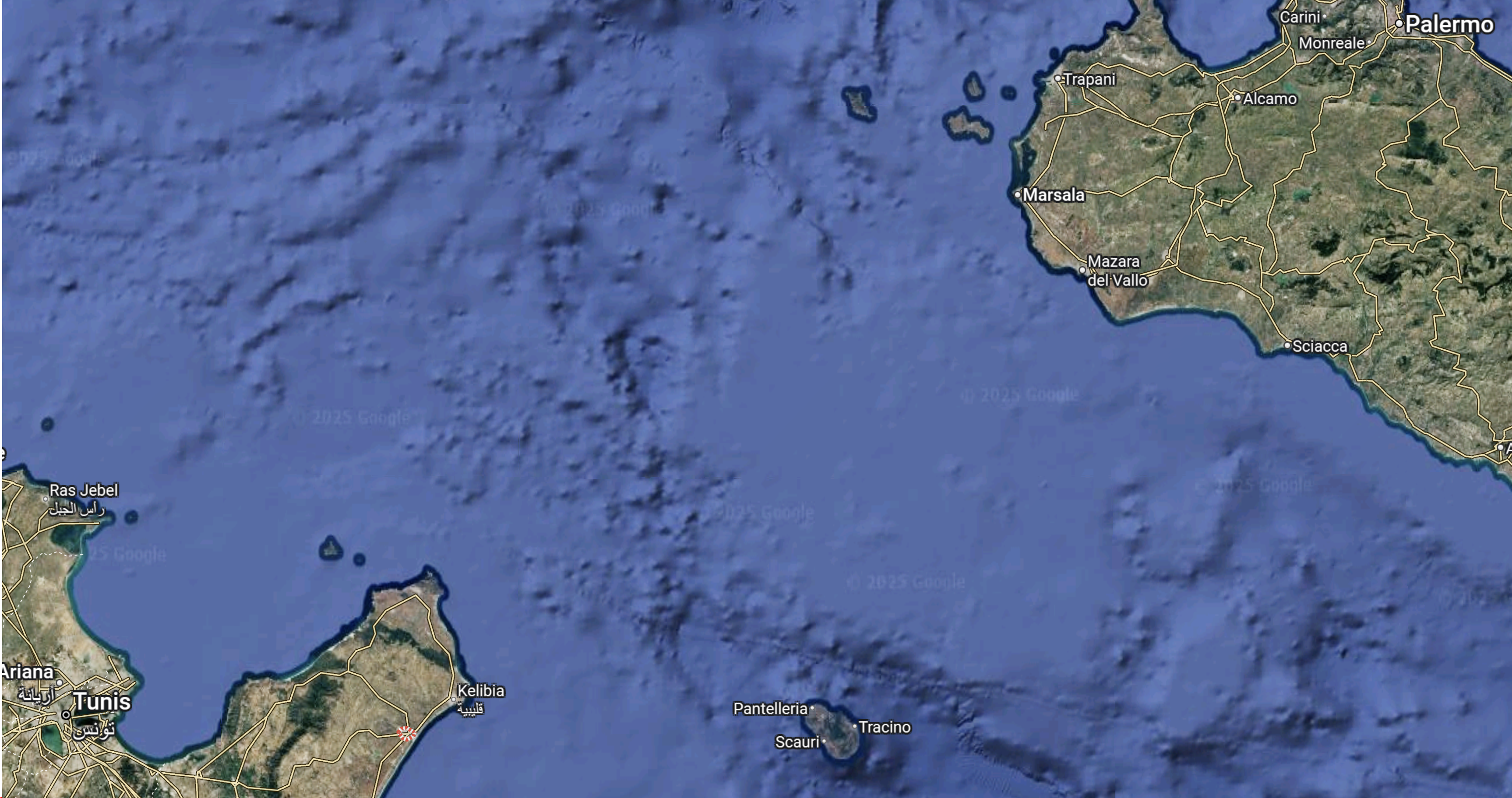
Note.
- Tunis in Tunisia, is in the South-Western corner of the map.
- East of Tunis on the coast is a red blob, which marks the town of Menzel Temime, where the interconnector will connect to a newly-built substation.
- Palermo in Sicily, is in the North-East corner of the map.
- West of Palermo on the North-West coast of Sicily is Trapani, where the interconnector will make landfall in Italy and connect to a substation at .
As with many things engineering designed by Italians, this seems to be an interconnector with a certain simplicity and style.
The Wikipedia entry for the ELMED interconnector gives these further details.
The total cost is budgeted at €850 million.
XLinks
XLinks is a project to build a 3.6 GW interconnector between Morocco and Devon, that appears to have been rejected by the current government.
XLinks shows what engineers think could be possible. More details are given in the Wikipedia entry for the project.
Ryanair Flies Into Sahara on Sea (And Africa’s Oldest Conflict)
The title of this post, is the same as that of this article in The Times.
This is the sub-heading.
Chieftains fighting for a strip of land claimed by Morocco are threatening to step up attacks as the tourist industry grows
These are the first three paragraphs.
Towards the end of the flight on Ryanair’s new route to Dakhla a vast expanse of apparently pristine desert coastline unfurls below.
But this land is nowhere near as tranquil as it looks from above. Instead the Irish airline’s choice of destination has flown the company into the heart of Africa’s longest-running conflict.
These direct flights from Madrid and Lanzarote take its planes to the coastal town in Western Sahara, a tract of desert the size of Britain that tribal chieftains and three countries have struggled to control through the centuries.
This is a Google Map showing the location of Western Sahara with respect to the Canary Islands.
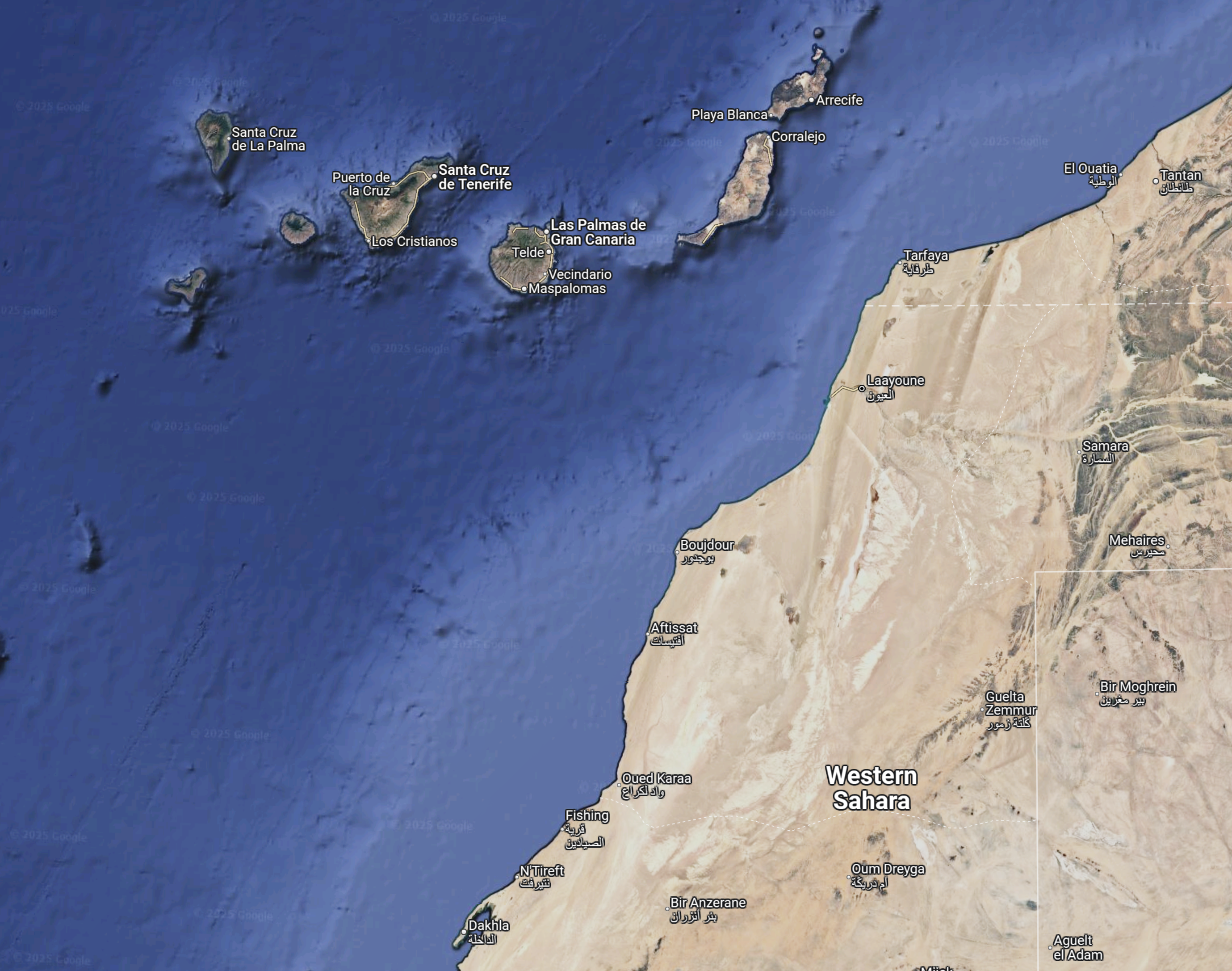
Note.
- The islands off the recognisable coast of North West Africa are the Canary Islands.
- Lanzarote is the Southermostof the two North-Eastern islands.
- Western Sahara is to the South-East of the Canary Islands.
- Dakhla is on the Africa coast at the Southern edge of the map.
The map will be enlarged if you click on it.
I have my thoughts on this article.
Western Sahara And Coeliac Disease
I have a feeling that this area has one of the highest levels of coeliac disease in the world.
- It all started some years ago, when they had a terrible famine, so the US donated a lot of wheat to alleviate the famine.
- But the people of Western Sahara don’t grow wheat and their bodily systems can’t cope with gluten.
- This gave the people a lot of coeliac disease, which can be passed on genetically.
A similar process went on during the slave trade, where the slavers fed their captives on bread made from wheat and water. Consequently, many of the slaves suffered from various problems and that could be why many died on the crossing. These days there is coeliac genes among the Caribbean and American black population that has been passed down through the generations.
After their first actions, it only looks like Trummkopf and his sidekick are going to make matters worse, after their destruction of US Aid.
Centrica Energy, Bord Gáis Energy And Mitsubishi Power Announce Development Of Europe’s First Ammonia Fired Power Generation Facility
The title of this post, is the same as that of this press release from Centrica.
This is the sub-heading.
Centrica plc and Mitsubishi Power Europe Limited “Mitsubishi Power Europe” have signed a Memorandum of Understanding (MOU) to explore the development, construction, and operation of Europe’s first-ever ammonia-fired power generation facility at Bord Gáis Energy’s Whitegate Combined Cycle Gas Turbine (CCGT) power station in Cork, Ireland.
These four paragraphs outline the project.
The project is being led by Centrica through its Bord Gáis Energy and Centrica Energy businesses and Mitsubishi Power Europe and would become Europe’s inaugural ammonia-fired power generation facility and one of only two such facilities in the world.
The utilisation of low carbon ammonia as a clean and sustainable fuel source for power generation has the potential to provide security of supply while reducing greenhouse gas emissions. Low carbon ammonia has a higher volumetric density than hydrogen, enabling the utilisation of low carbon hydrogen in a form which is easy to transport and store, resulting in a fuel that can be combusted with no carbon emissions at point of use. Its use as a fuel is a promising long-term energy solution for the transition to a low-carbon energy value chain.
Bord Gáis Energy’s facility at Whitegate CCGT power station would serve as a global demonstration site for ammonia-fired power generation technology, providing insight into the feasibility and scalability of low carbon ammonia as a green fuel and shaping the future of power generation worldwide, with low carbon ammonia being sourced through Centrica Energy’s global trading network.
Following the signing of the MOU, the project team is being established to commence project feasibility assessments. Upon the successful outcome of this assessment, extensive local stakeholder engagement will commence.
Note.
- No mention of the size of the new power station is given in the press release.
- Whitegate power station is a 445 MW combined cycle gas turbine (CCGT), that was built in 2010.
- It can meet ten percent of Ireland’s electricity demand.
I have a few thoughts.
Will The Existing Power Station Be Converted To Ammonia Or Will A New Ammonia-Fired Power Station Be Built Alongside?
Consider.
- If the second station doesn’t work, there’s no reduction in power.
- If a replacement station doesn’t work, ten percent of Ireland will be in the dark.
- Ireland will be needing more power in the next few years.
- A second power station can be appropriately-sized.
- Japanese don’t like to lose face!
Prudence probably says that building a second station alongside is the least risky route.
Wind Power In Ireland
This Wikipedia entry is entitled Wind Power In Ireland.
This is the first paragraph.
As of 2021 the island of Ireland has 5,585 megawatt and the Republic of Ireland has 4,309 MW of installed wind power nameplate capacity, the third highest per capita in the world. In 2020 wind turbines generated 36.3% of Ireland’s electrical demand, one of the highest wind power penetrations in the world.
There is also one 500 MW interconnector between the islands of Great Britain and Ireland, with another similar-sized one under construction.
As the wind doesn’t blow all the time, the island of Ireland will need some low-carbon backup.
Why Ammonia?
This paragraph from the press release gives several reasons.
The utilisation of low carbon ammonia as a clean and sustainable fuel source for power generation has the potential to provide security of supply while reducing greenhouse gas emissions. Low carbon ammonia has a higher volumetric density than hydrogen, enabling the utilisation of low carbon hydrogen in a form which is easy to transport and store, resulting in a fuel that can be combusted with no carbon emissions at point of use. Its use as a fuel is a promising long-term energy solution for the transition to a low-carbon energy value chain.
There may also be secondary issues here.
If you read the Applications section in the Wikipedia entry for ammonia, you will realise, what a useful chemical ammonia is.
As Ireland has a lot of agriculture, a fertiliser plant could be located close to the power station.
If the ammonia was green ammonia, then this will help to decarbonise the island of Ireland.
Where Will The Green Ammonia Come From?
These posts deal with the production and distribution of green ammonia.
- Could West Africa Become A Green Energy Powerhouse?
- H2U Eyre Peninsula Gateway Hydrogen Project Begins Largest Green Ammonia Plant
- KEPSA Signs Large-Scale Green Energy Projects MoU In Kenya
- Namibia Is Building A Reputation For The Cheapest Green Hydrogen
- Uniper To Make Wilhelmshaven German Hub For Green Hydrogen; Green Ammonia Import Terminal
Note.
- A continent with a lot of renewable energy like Africa or Australia can create lots of green ammonia.
- As the press release says, ammonia is easier to transport and store compared to hydrogen.
- The press release says that low carbon ammonia will be sourced through Centrica Energy’s global trading network.
- Fortescue Future Industries is mentioned in several posts, as producers of green hydrogen and green ammonia.
- Centrica is big enough to stand up to Andrew “Twiggy” Forrest and Fortescue Future Industries.
As in a few years, we will have many GWs of renewable energy, could we be making green ammonia for the Irish?
This news story on the UK Research and Innovation web site is entitled Designs For Green Ammonia Plant Become Reality.
This is the sub-heading.
Science and Technology Facilities Council (STFC) researchers are building a small-scale plant to generate ammonia using only renewable energy sources.
These two paragraphs outline the story.
Ammonia is a promising carbon-free fuel source of the future and so if successful, the plant has the potential to considerably advance the UK’s net zero ambitions.
It marks the second phase of the Ammonia Synthesis Plant from Intermittent Renewable Energy (ASPIRE) initiative which will be led by STFC in conjunction with the University of Bath, Johnson Matthey, and Frazer-Nash Consultancy.
The UK Research and Innovation news story has this description of the ASPIRE technology.
Current commercial ammonia synthesis is optimised for near steady production requiring constant power.
The first phase of ASPIRE however saw the design of a patented modular reactor and thermal management system that should enable operation from an intermittent renewable power supply.
The new plant will have three core elements:
- a pressure swing adsorption system which extracts nitrogen from air
- a modular electrolyser which splits hydrogen from water
- a synthesis loop that uses the modular reactor and a thermal management system to combine hydrogen and nitrogen to make ammonia
This will enable the entire production process to operate autonomously, powered by a small wind turbine and series of solar canopies with an ammonia generation rate proportional to the available renewable power.
There is even this quote from a Dr. Alan Partridge.
Thanks to the incredible work on this initiative by the team at Rutherford Appleton Laboratory as well as the University of Bath and private sector partners, we are closer than ever to producing industry-scale green ammonia for the UK and the world.
Perhaps, this technology will allow the island of Ireland to make all the green ammonia it needs.
Will Centrica Be Going Into The Green Ammonia Business?
The Centrica press release says they will be dealing in green ammonia for the benefit of Ireland. So Yes!
Conclusion
The news story on the UK Research and Innovation web site is a must-read.
As we have so much renewable energy in the UK, some company will build an ASPIRE-based green ammonia plant in the UK.
False Banana: Is Ethiopia’s Enset ‘Wondercrop’ For Climate Change?
The title of this post, is the same as that of this article on the BBC.
This is the introductory paragraph.
Scientists say the plant enset, an Ethiopian staple, could be a new superfood and a lifesaver in the face of climate change.
A new study is saying, that the plant could be used to feed 100 million people in a warming world.
It looks like the study was done in an Ethiopian University, which is surely a heartwarming thing.
This is said about how enset is used for food.
Enset or “false banana” is a close relative of the banana, but is consumed only in one part of Ethiopia.
The banana-like fruit of the plant is inedible, but the starchy stems and roots can be fermented and used to make porridge and bread.
I’m not sure, but I seem to remember that porridge is a major food in Africa.
It is certainly a fascinating good news story. in several ways from Africa.
Historic Go-Ahead For Malaria Vaccine To Protect African Children
The title of this post, is the same as that of this article on the BBC.
This is the first paragraph.
Children across much of Africa are to be vaccinated against malaria in a historic moment in the fight against the deadly disease.
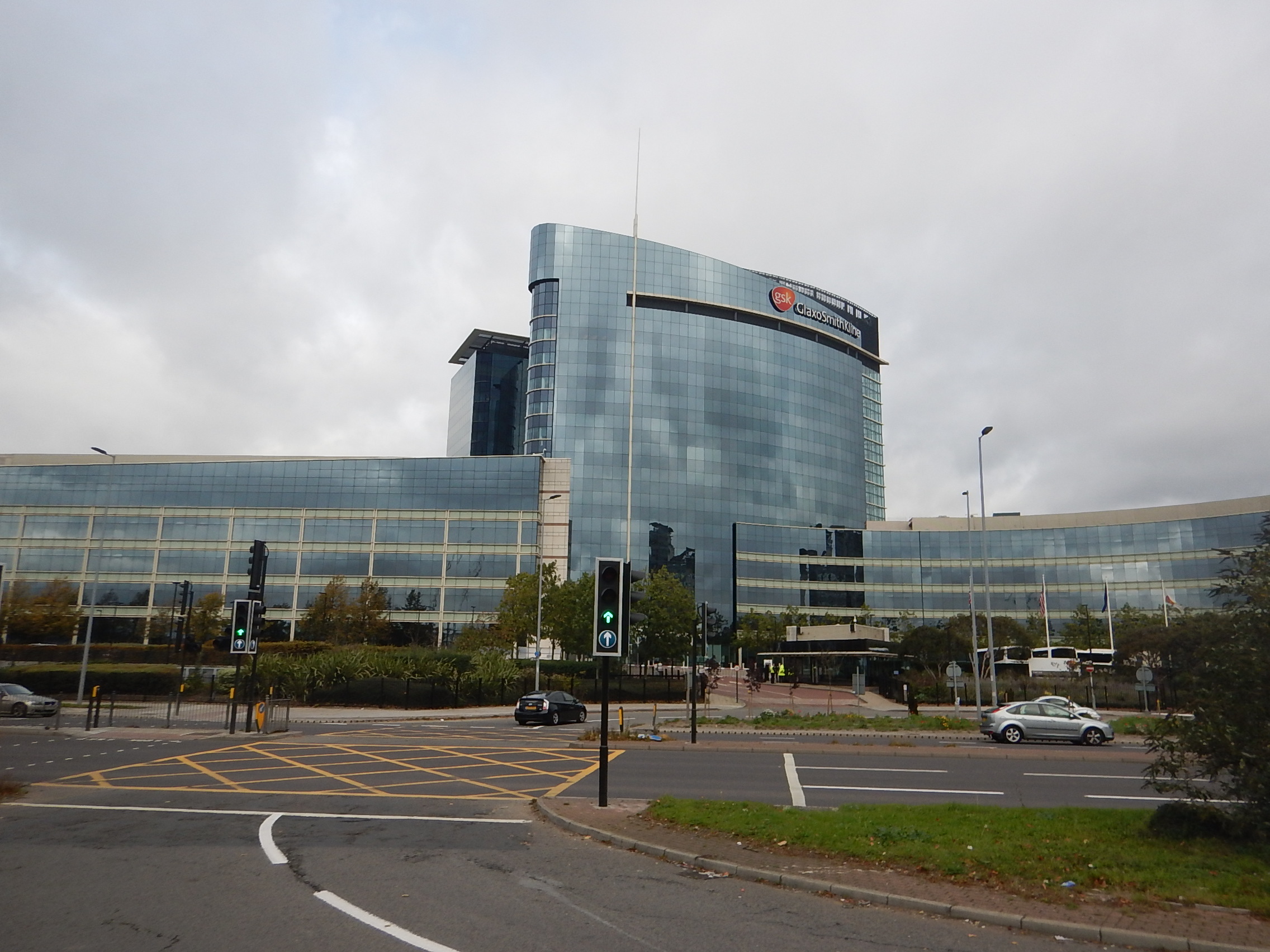
The vaccine has been developed by GSK, who have their headquarters on the Golden Mile in Brentford.
The vaccine is called RTS,S and is described like this in the first paragraph of its Wikipedia entry.
RTS,S/AS01 (trade name Mosquirix) is a recombinant protein-based malaria vaccine.
Approved for use by European regulators in July 2015, it is the world’s first licensed malaria vaccine and also the first vaccine licensed for use against a human parasitic disease of any kind. The RTS,S vaccine was conceived of and created in the late 1980s by scientists working at SmithKline Beecham Biologicals (now GlaxoSmithKline Vaccines) laboratories in Belgium. The vaccine was further developed through a collaboration between GSK and the Walter Reed Army Institute of Research and has been funded in part by the PATH Malaria Vaccine Initiative and the Bill and Melinda Gates Foundation. Its efficacy ranges from 26 to 50% in infants and young children. On 23 October 2015, the World Health Organization’s Strategic Advisory Group of Experts on Immunization (SAGE) and the Malaria Policy Advisory Committee (MPAC) jointly recommended a pilot implementation of the vaccine in Africa.
When you consider how fast the Covid-19 vaccines were developed, this might appear to have taken a long time to be developed. But then as Wikipedia states, “this is the first vaccine licensed for use against a human parasitic disease of any kind.”
I can’t describe this as anything other than good news.
Could The Morocco-UK Power Project Be Developed Into A Western Europe And Africa Interconnector?
This page on the Xlinks web site, describes the Morocco-UK Power Project, which is proposed to generate solar and wind power in Morocco and deliver it to the UK.
- The plan envisages 10.5 GW of electricity being generated.
- There will be a 5GW/20GWh battery in Morocco.
- They will export 3.6 GW of electricity to the UK for at least twenty hours per day.
- The electricity will be exported to the UK by an Interconnector that skirts to the West of Spain, Portugal and France.
- The interconnector will be 3,800 kilometres long.
I described the project in detail in Moroccan Solar-Plus-Wind To Be Linked To GB In ‘Ground-Breaking’ Xlinks Project.
This Google Map shows Western Europe And North Africa.

Note.
- The light blue of the Continental Shelf
- The darker blue of deeper water.
- The Southern end of the Morocco and the UK interconnector will at Guelmim Oued Noun in the South of Morocco, which is indicated by the red arrow.
- The UK end of the cable will be at Alverdiscott between Barnstaple and Bideford in North Devon.
- Southern Morocco and Algeria look to be mainly in the Sahara Desert.
If we look at the route of the cable, it connects a lot of possible renewable energy sources.
- Morocco – Solar and wind
- Spain – Solar and wind
- Portugal – Solar and wind
- France – Nuclear, tidal and wind
- UK – Nuclear and wind.
Could the UK and Morocco interconnector be developed into a bigger power project?
- Solar and wind power from Algeria could be added.
- Tidal power from a Severn Barrage could be added.
- Connections could be added to Gibraltar, the Irish Republic and Wales.
I believe that there could be a large amount of electricity developed on the Western costs of Europe and Africa.
An interconnector would move it to where it is needed.
The Power Of Solar With A Large Battery
This post is based on this press release from Highview Power, which is entitled Highview Enlasa Developing 50MW/500MWh Liquid Air Energy Storage Facility In The Atacama Region Of Chile.
This is the first paragraph.
Highview Enlasa, the 50/50 joint venture between Highview Power, a global leader in long duration energy storage solutions, and Energía Latina S.A.-Enlasa, the largest backup power generation provider in Chile, is pleased to announce that it is developing the first liquid air long duration energy storage project in Chile. This 50MW/500MWh (10 hours) CRYOBattery™, which represents an estimated investment of USD $150 million, will be located in Diego de Almagro in the Atacama Region.
Ican deduce these points from this paragraph.
The power output of 50 MW appears to be standard for all of Highview Power’s CRYOBatteries, which is not surprising as the centre of each system appears to be a standard turbomachinery solution from MAN Energy Solutions, as I wrote about in MAN Energy Partners With Highview Power On Liquid-Air Energy-Storage Project.
But whereas the first system at Carrington, near Manchester, can only store 250 MWh, this plant in Chile is twice the size and can provide 50 MW of electricity for ten hours. The Chile plant will just have twice the number of storage tanks for liquid air.
I can no reason, why if Carrington needed to store more electricity, that more tanks couldn’t be added.
This Google Map shows the area around the city of Diego de Almagro.
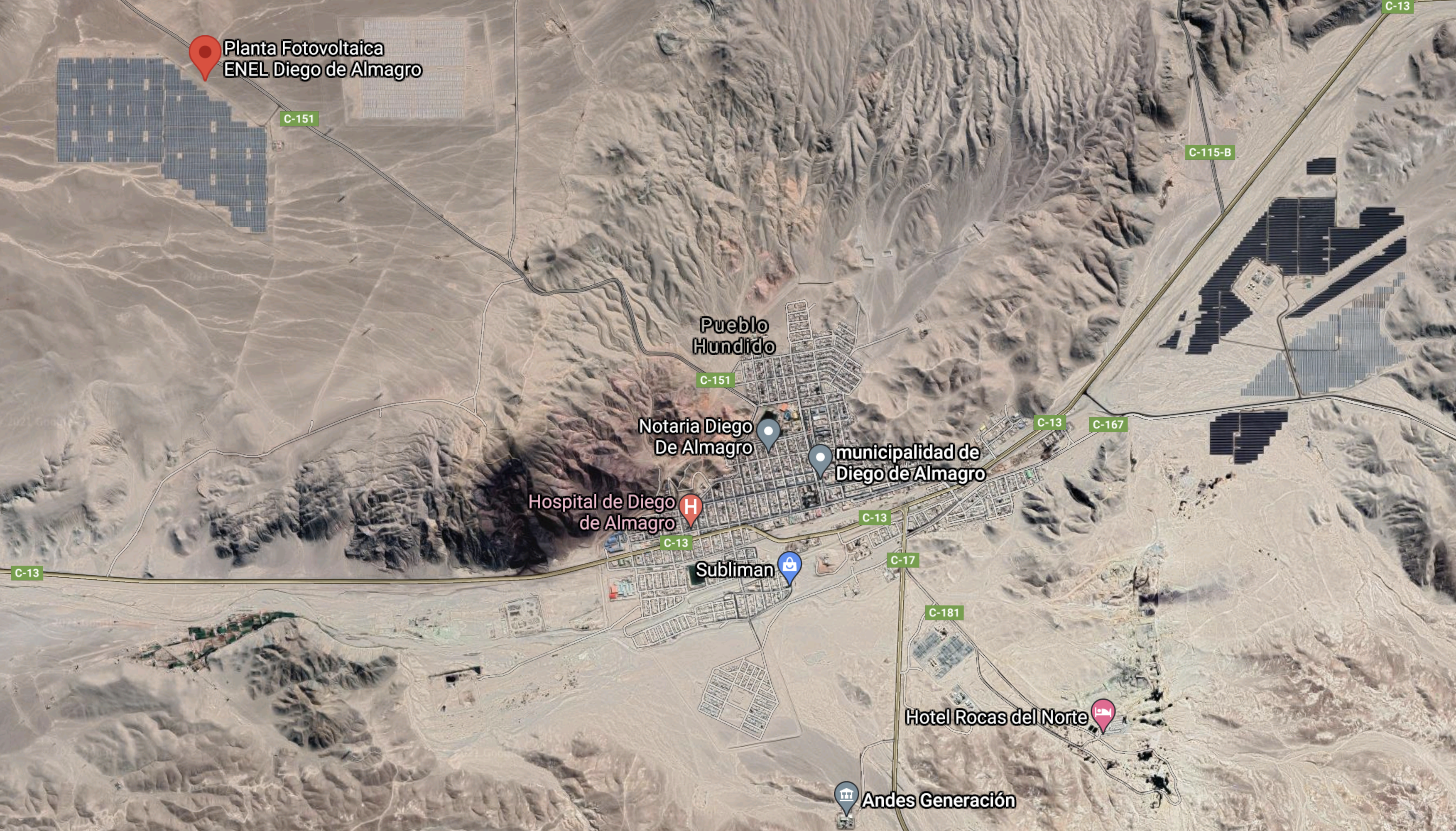
Note.
- The city of Diego de Almagro is in the centre of the map.
- In the North-Western corner is the Planta Fotovoltaica ENEL Diego de Almagro, which even my rudimentary Spanish, identifies as a solar power plant.
- In the North-Eastern corner of the map, is appears that a second solar power plant is under construction.
The city is surrounded by the large Atacama Desert.
This second Google Map shows the location of Diego de Almagro, with respect to the Chilean Coast.
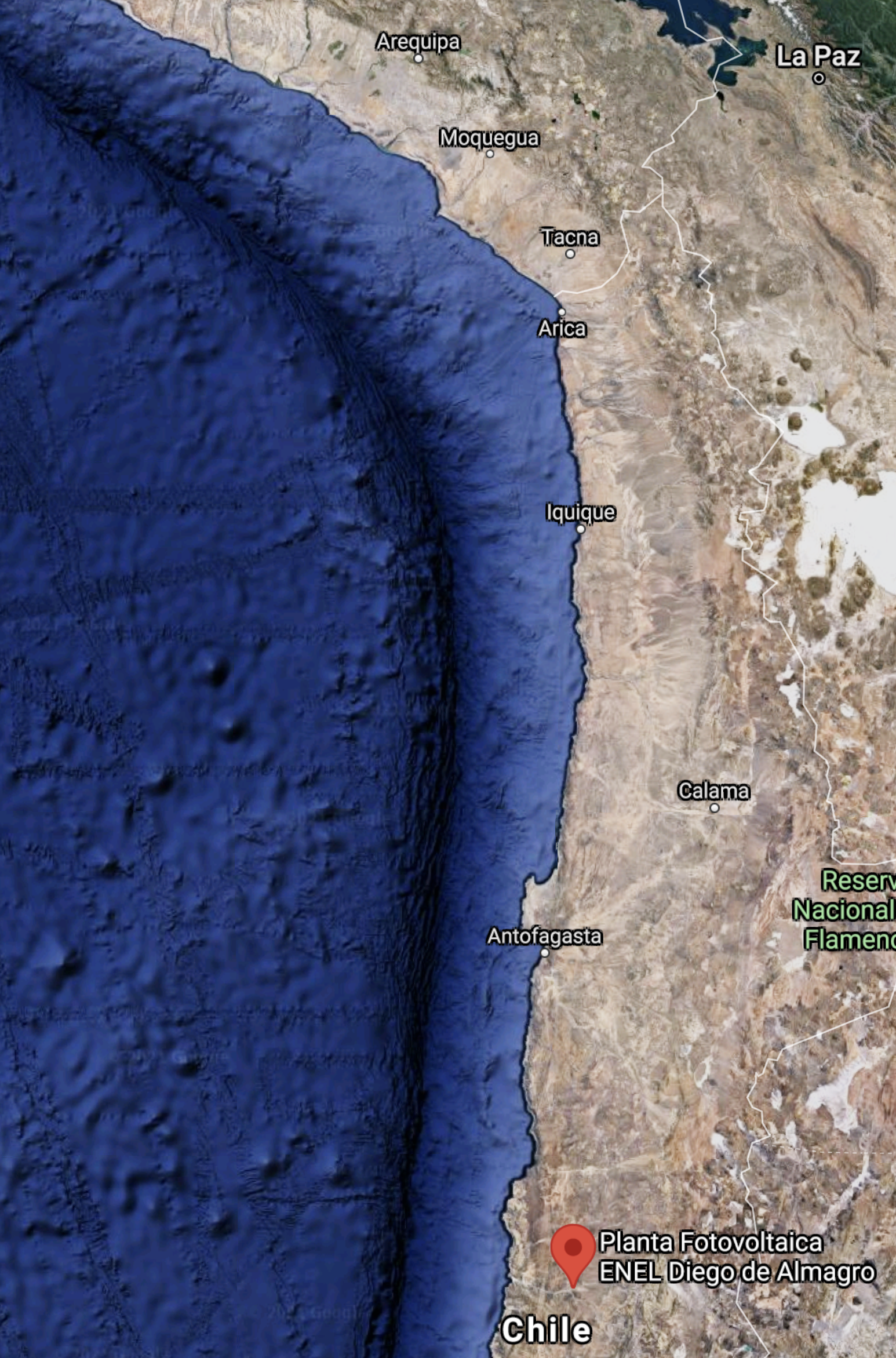
Note.
- The red arrow indicates the solar powerplant at Diego de Almagro.
- La Paz in Bolivia is in the North-East corner of the map.
- The sandy-beige colour indicates the Atacama Desert.
The area would appear not to lack sun.
This extract is from the press release.
With one of the highest solar irradiations in the world, the Atacama Region has the potential to generate all the country’s electricity. By pairing solar with cryogenic energy storage, Chile can benefit from 24/7, 100% renewable energy.
The Wiukipedia entry for Solar Power In Chile, is not as optimistic as the press release, but does show the rapid growth in the amount of solar power.
Conclusion
Solar power installed with large batteries, will transform the electricity supply in countries like Australia, Chile and India and those in Africa and other places, where there are large hot deserts.
In Europe, Spain is investing heavily in solar power and is a big innovator in solar technology.
Could West Africa Become A Green Energy Powerhouse?
I ask this question, because I have just read this article on Hydrogen Fuel News, which is entitled Green Hydrogen Potential Causes Germany to court West African countries.
The article has this sub-title.
Nations in that part of Africa have the capacity to meet 1500 times Germany’s 2030 H2 demand.
That would appear to be a massive amount of hydrogen.
This extract from the article, talks about energy production.
Initial results for the 15 West African Economic Area (ECOAS) countries revealed that a massive three quarters of West African land is appropriate for wind turbines. Moreover, the electricity production from wind energy in the region costs about half the amount it would in Germany.
Additionally, solar power systems can also be economically operated on about one third of the West African region.
Add in a few large electrolysers and you have the hydrogen.
The hydrogen can be transported to Germany by tanker, either as hydrogen or ammonia.
The German strategy is to be underpinned by education, as this extract explains.
In support of developing West African green hydrogen production, a new master’s graduate program on clean H2 technology will begin in September. The purpose of the program will be to train local green hydrogen scientific specialists. The first three waves of the program are expected to train about 180 students attending four universities in Côte d’Ivoire, Togo, Senegal, and Niger.
Perhaps the Commonwealth should do something similar in West African countries like Gambia, Ghana, Nigeria and Sierra Leone.
After all many parts of Australia have very similar climate and population densities and probably energy generation potential to large parts of West Africa.
The Geographical Advantage
It should also be noted that geographically West Africa is close to Europe by ship.
There are no pinch points like the Suez Canal
As the European hydrogen gas network grows, the journey will get shorter.
Does anybody know how long it would take a tanker to go between say Accra in Ghana to Rotterdam?
Conclusion
I would see four main benefits coming to West Africa.
- Electricity for all.
- Employment to support the new industries.
- Hydrogen to power transport.
- The value of all those exports.
Hopefully, the standard of living of all those in West Africa would improve.
Bring Africa Out Of The Dark
The title of this post, is the same as that of this article on the Zimbabwean.
The article has been written by Humphrey Kariuki, who is a Kenyan businessman, who is on a mission to bring electricity to Africa.
He has teamed up with Highview Power to do it using batteries.
Read the article.
Highview Power Introduces Revolutionary Cryogenic Energy Storage Technology To The African Market
The title of this post, is the same as that of this article on the African Review.
This is the first paragraph.
Javier Cavada, CEO and President of Highview Power spoke to African Review about the company’s cryogenic (air liquefaction) battery storage solutions and why they are a perfect fit for the continent
It appears to me, that the story, which started in a garage in Bishops Stortford, is going to have a happy ending for the world.
The article is a must read and I particularly liked this paragraph.
Cavada also noted how cryogenic technology complemented this transition. He added, “The main energy companies call our technology ‘pumped hydro in a box’ and that is how we have been making it. You can deploy over 1GWh without geographical constraints. There is no combustion, no emissions and no rare materials needed. All it comprises is some piping work, compressors and a generator, so it is pretty simple. Our mission is to enable a world that is grid powered by solar and wind, not fossil fuels, and this technology will help us achieve this.”
This is the brightest shade of green!
 The Anonymous Widower