Six Operators Award Joint Contract For Up To 504 Tram-Trains
The title of this post, is the same as that of this article on Railway Gazette.
These are the first three paragraphs.
A consortium of six German and Austrian transport bodies has awarded Stadler a framework contract for the supply and maintenance of up 504 tram-trains worth €4bn, the largest contract in the Swiss company’s history.
The VDV TramTrain framework contract was awarded on January 14 by Karlsruhe’s VBK and AVG, Saarbrücken’s Saarbahn Netz, Schiene Oberösterreich, the Land of Salzburg and Zweckverband Regional-Stadtbahn Neckar-Alb.
It includes a €1·7bn firm order for the supply of 246 Citylink tram-trains over 10 years from 2024, and the provision of 16 years of maintenance. There are options to order up to 258 more vehicles and to extend the maintenance to 32 years.
That will keep the factories running for a few years.
Note that all these Stadler Citylink tram-trains are similar to the Class 399 tram-trains, that run between Sheffield and Rotherham.
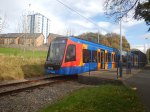
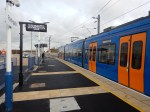
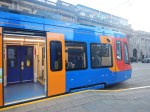
More Stadler Citylink tram-trains will start running in the next couple of years in Cardiff.
I can also envisage these tram-trains being used on the following projects in the UK, if they were to go ahead.
- Reopening The Don Valley Section Of The Former Woodhead Line Between Stocksbridge and Sheffield Victoria To Passenger Services
- Beeching Reversal – South Yorkshire Joint Railway
- Reinstatement Of The Barrow Hill Line Between Sheffield And Chesterfield
- Plans To Reopen The Brentford To Southall Railway
- Tram-Trains To Hale Station
- Manchester Metrolink To Gorton And Glossop
- Sheffield Region Transport Plan 2019 – Tram-Trains Between Sheffield And Doncaster-Sheffield Airport
- Sheffield Region Transport Plan 2019 – Renewal Of Supertram Network
- Sheffield Region Transport Plan 2019 – A New Tram-Train Route To A New Station At Waverley
- Could There Be A Tram-Train Between Ipswich And Felixstowe?
- Could A Class 399 Tram-Train With Batteries Go Between Manchester Victoria And Rochdale/Bury Bolton Street/Rawtenstall Stations?
Note.
- Six are extensions to the Sheffield Supertram network.
- Three projects are extensions to the Manchester Metrolink.
- These are possible orders, that if the projects go ahead would likely have Stadler Citylink as the first choice of tram!
- All the tram-trains would be of a similar design.
How many other projects are under discussion in Europe?
Conclusion
Stadler have designed a tram-train that everybody likes and that generates orders.
I think Stadler will soon need to increase production of these Citylink tram-trains.
Karlsruhe Kombilösung Tram Tunnels Inaugurated
The title of this post, is the same as that as this article on Railway Gazette.
I first came to Karlsruhe to see the tram-trains in 2015 and wrote about them in Exploring Karlsruhe And Its Trams And Tram/Trains.
I couldn’t help notice, that the good citizens of Karlsruhe were digging a tunnel for tram-trains, all the way along their equivalent of Oxford Street.
I said this.
It will certainly be worth returning to Karlsruhe, when the tunnel is complete and the network is expanded.
So now almost seven years after that first visit, the €1·5bn project has been completed and I had better think about returning.
Exploring Metrovalencia
Metrovalencia is a Metro, that uses both trains and trams with a proportion of the network in tunnels.
I took these pictures.

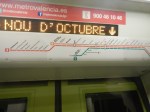
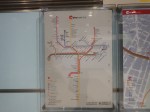



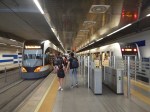


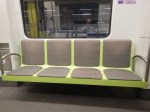

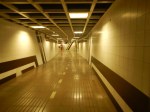
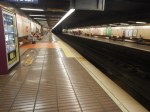


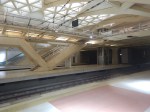



It is in many ways, a typical modern Metro with good and sometimes spectacular architecture, spacious, clear trains and a ticketing system, that relies on a plastic card.
To my mind there are two major problems.
It Doesn’t Go To The City Of Arts And Sciences
The City of Arts and Sciences, is a place that many tourists want to see.
But the Metrovalencia doesn’t go there and I couldn’t find how to get there from the information at various stations.
It would be as if the London Underground didn’t go to Stratford or the Manchester Metrolink didn’t go to Salford Quays.
Finding Stations Is Difficult
Valencia doesn’t have a way-finding system and finding the stations of the Metro can be difficult. Unlike say Berlin, Bilbao, London, Stockholm and many other cities, where stations have a big logo or feature, you can see from a couple of hundred metres, you can walk past stations without seeing them.
I walked a lot farther than I intended to.
The map I had was one that came with my good value 48-hour travel card, which cost eighteen euros.
It wasn’t the easiest to understand, as there was no symbols for Metro stations on the map.
The Citylink Trains Of The Metrovalencia
The Citylink trains of the Metrovalencia were built in Valencia in 2007 and are very different to their cousins; the tram-trains of Karlsruhe and Sheffield.
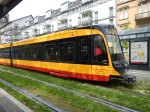
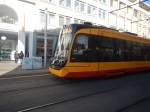
Sheffield is in blue, Karlsruhe in yellow and Valencia in white.
They are metre gauge, have larger bodies, are four or five cars long and I didn’t find one working as a tram-train.
Stadler Citylink Metro Vehicles
This document on the KeolisAmey web site details their plans for the new Wales and Borders Franchise.
The Stadler Citylink Metro Vehicles in the KeolisAmey document. look very similar to Sheffield Supertram‘s Class 399 tram-trains, that are providing a tram service in Sheffield and will soon be running on the heavy rail network to Rotherham.
- The Citylink vehicles seat 88 with 150 standees.
- They can run using 750 VDC or 25 KVAC overhead electrification.
- The tram-trains are built by Stadler in Spain.
- According to a driver, that I spoke to in Sheffield, the tram-trains have a good hill climbing capability.
These pictures were taken of one of the Class 399 tram-trains operating in Sheffield.
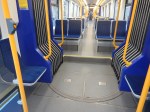
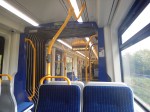
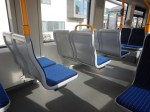
The Keolis/Amey document gives more details on the tram-trains.
- Main power source 25kV overhead line but also operates from battery.
- Capacity of 257 with seats for 129.
- Capable of on-street line-of-sight ‘tramway’ operation.
- They can work in pairs.
I’ve known for some time, that Class 399 tram/trains had a battery.
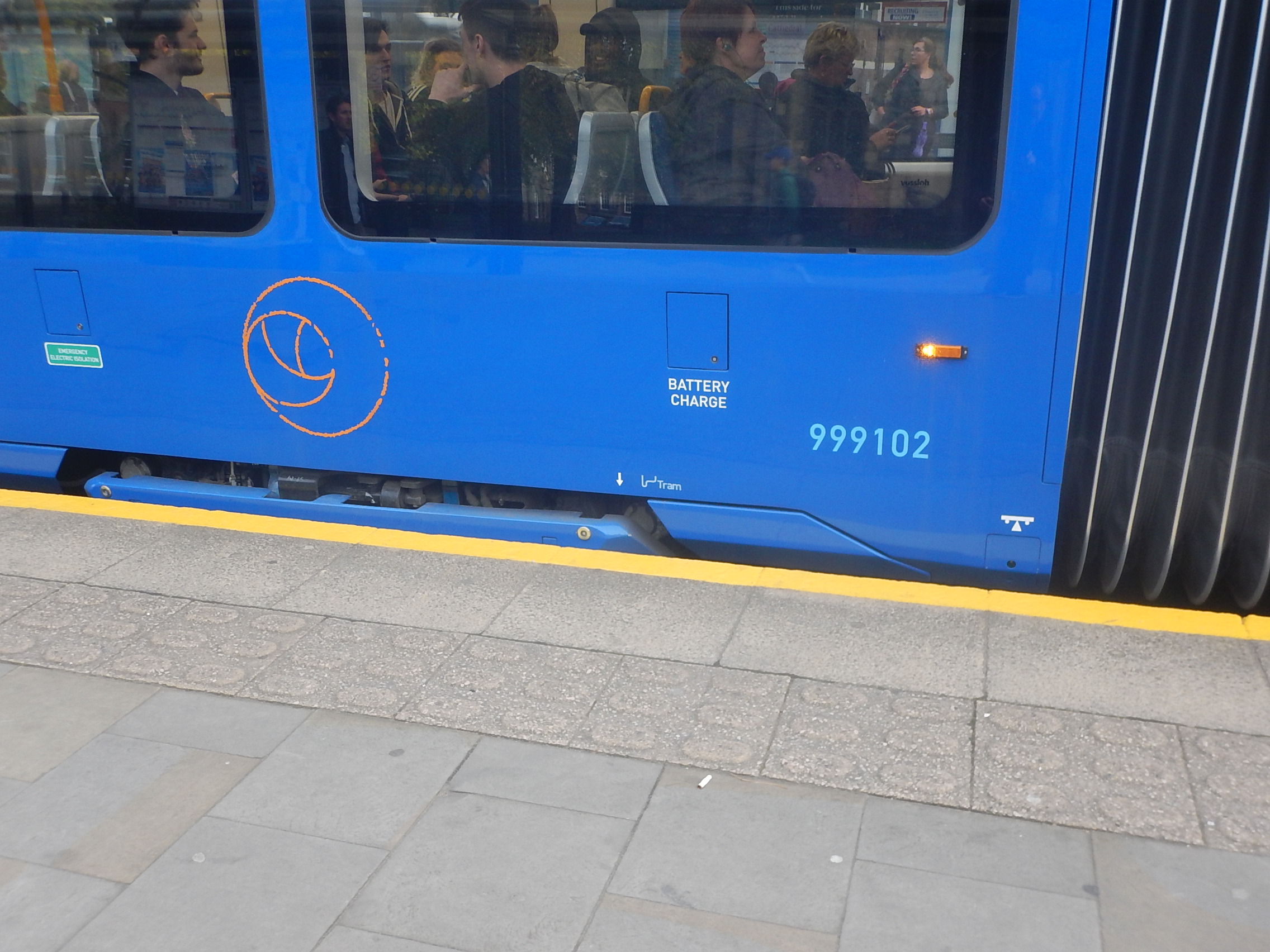
but I thought it was probably for secondary purposes, like making sure the vehicle crossed the boundary, where the two voltages change.
So it looks like in Cardiff, battery power will be used for traction.
How Big Will The Batteries Need To Be?
Consider a Class 399 tram/train, working to and from Merthyr Tydfil.
- Wikipedia gives the weight of the vehicle as 66 tonnes.
- Rhymney has an altitude of 178 metres.
- I will assume 200 passengers at 90 Kg. each, which gives a weight of 12 tonnes.
This means that the train has a potential energy of 41 kWh at Merthyr Tydfil station.
On the way down the hill from Merthyr Tydfil the regenerative braking will convert this potential energy into electricity, which will be stored in the battery.
I would reckon that a battery of about 50 kWh would be an ideal size, but would it be big enough to take the Stadler Citylink Metro Vehicles from Cardiff Queen Street station to The Flourish and back?
That journey is probably about 1.5 miles each way.
How Far Would A Full 50 kWh Battery Take A Stadler Citylink Metro Vehicle?
In an article in the October 2017 Edition of Modern Railways, which is entitled Celling England By The Pound, Ian Walmsley says this in relation to trains running on the Uckfield Branch, which probably has a terrain not much different to the lines to the South and West of Cardiff.
A modern EMU needs between 3 and 5 kWh per vehicle mile for this sort of service.
This would mean that a 50 kWh battery would take a three-car Stadler Citylink Metro Vehicle up to five miles, if the usage of the lighter-weight tram-train was at the lower end of the quoted range.
The battery would certainly take a Stadler Citylink Metro Vehicle from Cardiff Queen Street station to The Flourish and back.
Conclusion
As with the Tri-Mode Stadler Flirts, the Stadler Citylink Metro Vehicle with a battery, looks a very interesting concept.
- Most of the energy is provided by the 25 KVAC electrification, which would power the tram-train up the hill.
- Coming down the hill, the battery would be recharged using the regenerative braking.
- Battery power would used to take the tram-train on routes without electrification to The Flourish station.
Energy efficiency would be high.
The Greening Of The Valleys
This document on the KeolisAmey web site details their plans for the new Wales and Borders Franchise.
The documents gives these two definitions.
- South Wales Metro – Includes the full set of local services around South East Wales. This includes what is currently known as the ‘Valley Lines’, plus services between Cardiff and Ebbw Vale, Maesteg and extending to Severn Tunnel Junction and beyond.
- Central Metro -Refers to the sub-set of the South Wales Metro train services which run from Treherbert, Aberdare, Merthyr Tydfil, Radyr, Rhymney and Coryton, through Queen Street to Cardiff Bay, Cardiff Central, Penarth, Barry Island and Bridgend.
For these services around Cardiff and on the Cardiff Valley Lines, KeolisAmey Wales intend to acquire the following fleet.
- 11 x four-car Stadler Flirt DEMU
- 7 x three-car Stadler Flirt Tri-mode MU
- 17 x four-car Stadler Flirt Tri-mode MU
- 36 x three-car Stadler Citylink Metro Vehicles
This diagram from the document shows the routes and the frequencies.

They also say the following surrounding the map in the document.
- Maintains all existing connections to Cardiff Queen Street and Cardiff Central stations.
- Service pattern easy to understand
- Most frequencies even in the hour ‘clockface’ (e.g. 00-15-30-45 past)
- Vale of Glamorgan, Barry, Penarth and City Lines integrated into Central Metro solution.
- 2tph from Pontypridd station ‘divert’ via City Line but don’t terminate at Central i.e. Aberdare – City Line – Central – Merthyr
Note that Aberdare, Merthyr Tydfil, Rhymney and Treherbert stations all get a total of four trains per hour (tph)
The Trains In More Detail
Stadler Rail are building the three fleets of rail vehicles.
Stadler Flirt DEMUs
Over a thousand Stadler Flirts have been sold to operators around the world. Most have been or will be built in Switzerland.
From the pictures, the trains, that will be delivered to Wales, look very much like the Class 755 trains, that have been ordered by Greater Anglia. These trains will enter service next year.
Stadler Flirt DEMUs gives more details of these trains and the closely-related fleets.
The trains will operate services between Cardiff and Ebbw Vale, Maesteg and extending to Severn Tunnel Junction and beyond.
Tri-Mode Stadler Flirts
I would expect that these trains are very similar to the bi-mode Flirt DEMUs, but that the power-pack would also contain a battery.
Tri-Mode Stadler Flirts gives more details of these trains and how I think they will operate.
The Tri-Mode Stadler Flirts are intended for Rhymney/Coryton <> Penarth/Barry Island/Bridgend via the Vale of Glamorgan Line.
There will be a lot of commonality between the two types of Flirts and I suspect driver and other staff training for the two variants will be the same.
Stadler Citylink Metro Vehicles
The Stadler Citylink Metro Vehicles in the KeolisAmey document. look very similar to Sheffield Supertram‘s Class 399 tram-trains, that are providing a tram service in Sheffield and will soon be running on the heavy rail network to Rotherham.
Stadler Citylink Metro Vehicles gives more details of these trains and how I think they will operate.
From Cardiff Queen Street To The Flourish
It looks like the Metro vehicles will use the batteries for power on the extension to the new terminal station at The Flourish.
I describe the proposal for the extension to the Flourish in The Flourish Station Is The Focus Of The South Wales Metro.
Electrically-Efficient Operation Of The Metro
I have a feeling that Stadler are bringing some of their mountaineering experience from Switzerland to the valleys of South Wales.
It is interesting that both the Tri-mode Stadler Flirts and the Stadler Citylink Metro Vehicles will have batteries.
Climbing The Hills
The main purpose of the batteries is to make the climb and descent to the terminals at the heads of the valleys as energy efficient as possible.
Efficient climbing of the hills will need all uphill tracks to be electrified.
The KeolisAmey document states this about the electrification.
Discontinuous overhead line electrification to 25 KVAC with permanently earthed sections around restricted structures, saving 55 interventions e.g. rebuilding bridges/no need for wire in Caerphilly tunnel.
Battery power would be invaluable for jumping the gaps in the electrification.
Coming down, I believe that the trains and tram-trains will use the batteries to handle the energy generated by regenerative braking.
This means.
- The electrification can be simpler.
- There might be no need to electrify the downhill track in double-track sections.
- Trains can use the battery power to cross sections without wires or restarting from stations, when going downhill.
- Tram-trains going to The Flourish will arrive at Cardiff Queen Street station with enough energy in the batteries for the return trip to The Flourish.
- The Cardiff Bay Line doesn’t need to be electrified, which saves money and possibly increases safety and reduces visual intrusion.
It is not only energy efficient, but it saves construction costs and time.
Why Aren’t Citylink Metro Vehicles Used On The Rhymney Line?
There are several possible reasons.
- Calculations have shown, that the battery capacity of the smaller Citylink vehicle might not be enough to go uphill through the Caerrphilly tunnel.
- The route may need more powerful vehicles.
- More capacity may be needed on this line, so the larger Tri-mode Stadler Flirts will be used.
- The Flirts could use their diesel engines to rescue a train stuck in the tunnel.
But whatever the reason, I’m sure it’s a good one!
Could Downhill Tracks Not Be Electrified?
I think this may be possible, as vehicles coming down the hills could use gravity and small amounts of battery power.
Regenerative braking would also be continuously charging the batteries.
It would certainly be simpler, than having to constantly swap between overhead and battery power on the descent, where the electrification was discontinuous.
As the lines are going to have a more intensive service, there will be additions of a second track in places to allow trains to pass.
Any electrification that could be removed from the project would be beneficial in terms of building and operational costs.
How Would Discountinuous Electrification Be Handled?
I discus this in How Can Discontinuous Electrification Be Handled?
The Lines In More Detail
Click these links to find out more about the individual lines.
Conclusion
The two types of compatible vehicles, allows the plans for the South Wales Metro to be a cost-effective and very green solution for Cardiff’s transport needs.
It is a model, that can be used elsewhere.
Will railway engineers in future talk of the Cardiff Model, just as they talk of the Karlsruhe Model?
Class 399 Tram-Trains In Service
On my two day trip to Sheffield, I reckon that I saw six of the seven Class 399 tram-trains in service on the Supertram.
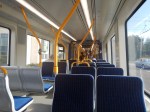
These pictures were taken on a quiet Saturday morning trip from the station to Herdings Park.
Current Service
Currently, the Class 399 tram-trams are running on the Purple Route from Cathedral to Herdings Park, which is generally tun at a frequency of two trams per hour.
If you arrive in Sheffield station and don’t feel like walking up the hill, you take any of the trams from the stop on the station side of the tracks.
But take a tram going to Cathedral and over the two and a bit days I was in Sheffield, it was always a Class 399 tram-train.
Comparison With Current Fleet
The Class 399 tram-trains and the existing Siemend-Duewag Supertram are surprisingly similar in several ways.
- Both have three sections and four doors on either side.
- The Siemens tram is 34.8 metres long, whereas the Class 399 is 37.2 metres long.
- The Siemens tram weights 46.5 tonnes, whereas the Class 399 is a lot heavier at 66.1 tonnes.
- The Siemens tram has installed power of 1108 kW, whereas the Class 399 has just 870 kW.
- The Siemens tram has room for 86 sitting and 155 standing passengers, whereas the Class 399 has room for 88 and 150 respectively.
- The seats and their arrangement are vaguely similar.
- Neither tram has wi-fi.
The big difference other than the tram-train capability and what that entails, is that the Class 399 tram-train is faster with a 100 kph top speed, as against the 80 kph of the Siemens tram.
Other differences are detailed in the next sub-sections.
Step-Free Access
Getting on and off both trams is step-free and I saw people in wheel-chairs on both vehicles. One was easily pushed into a Class 399.
These pictures show the steps inside the two trams.
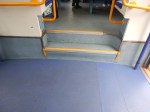
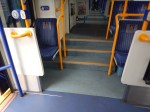
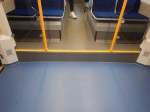
There is only a single-step on the Class 399 tram-train, whereas the Siemens tram has more.
Neither tram is a hundred percent step-free.
Weight
Note that the weight of the Class 399 tram-train is more than that of the Siemens tram.
As the two vehicles are of a similar size, could this mean that any of the following causes the weight increase.
- The electrical equipment needed to handle 15/25 KVAC power.
- The weight of the two extra traction motors.
- Strengthening for main line operation.
As someone, who has ridden for a few hours in both the Karlsruhe and Sheffield variants of the Citylink tram-train, they certainly don’t ride badly.
Performance
The current Siemens tram has 1108 kW of power and a weight of 46.5 tonnes, which gives an installed power/weight ratio of 23.8 kW/tonne.
The Class 399 tram-train has 870 kW of power and a weight of 66.1 tonnes, which gives an installed power/weight ratio of 13.1 kW/tonne.
So it would appear that the Class 399 tram-trains may not have the acceleration and hill-climbing capability of the Siemens trams.
However look at this data sheet on the Stadler Rail Espana web site for the Class 399 tram-train.
It clearly shows that the tram has four bogies and the text says that three are motored and one is a trailer. So this means that the central car is not a trailer and that power must be distributed along the tram, which probably puts the power to the rail in a more efficient way.
I did speak to a driver and he told me that on some of the hills the Siemens trams will strruggle with a full load, but the Class 399s can go up the hills at 40 mph.
The Class 399 tram-trains are very similar to the Stadler tram-trains in Karlsruhe, where the hills are much stiffer than Sheffield.
So it would appear that the layout of six smaller motors in a more modern vehicle probably does the trick.
Energy Efficiency
The question has to be asked if, as the Class 399 tram-trains have twenty-one percent less installed power, does this result in a saving of electricity use?
Comparison With Karlsruhe’s Tram-Trains
The Karlsruhe and Sheffield tram-trains are both variants of the Vossloh Citylink tram-train, that is now built by Stadler at Valencia in Spain.
The tram-trains in Karlruhe would appear to be very similar to the Class 399 tram-train, with a few small technical differences.
- They work on 750 VDC and 15 KVAC overhead wires, whereas the Class 399 can work on 750 VDC and 25 KVAC.
- As an electrical engineer, I wonder if the electrical systems are the same in both tram-trains and both can work 750 VDC and 15-25 KVAC, so they could work cross-border routes between say Germany and France.
- They have couplers to work in multiple.
- They have different passenger door arrangements.
- The driver’s cab windows have different arrangement.
These pictures show Karlsruhe’s tram-trains.
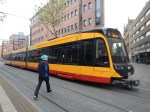
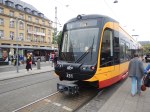
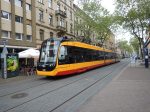
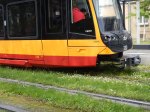
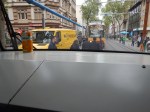
Imagine these trams in Supertram colours on the streets of Sheffield.
Take a close look at picture 4.
You will notice that the Karlsruhe tram-trains have an obvious coupling and it can be assumed that they can work in ,multiple, although I don’t seem to have seen it happening.
Picture 4, also shows passengers apparently sitting in the back cab of the tram-train.
The fifth picture was taken from sitting inside the tram-train looking backwards, over the folded-down driver’s desk.
This feature wasn’t being used in Sheffield and this could be for one the following reasons.
- The Class 399 tram-trains don’t have the feature installed.
- There has been a Health and Safety decision.
- It takes perhaps ten minutes to fold up the driver’s desk and this would slow the timetable.
It’s a pity , as this feature of German trams is very common and popular.
Comparison With Class 144 Train
The Class 399 tram-trains and Northern’s Class 144 train will share routes and on some routes the tram-trains may even take over from the Pacers.
So how do the two trains compare?
- The Class 399 has room for 88 sitting and 150 standing passengers, whereas the Pacer has 99 seats in a two-car and 157 in a three-car train.
- The Class 399 weighs 66.1 tonnes, whereas a two-car Pacer weighs 49.2 tonnes and a three-car weighs 72 .7 tonnes.
- The Pacer has a toilet.
- The Class 399 is air-conditioned, whereas the Pacer relioes on waste heat from the engine.
- The Pacer is a 75 mph train, but seems to operate most of the time at 60 mph
- The Class 399 has installed power of 870 kW, whereas the Pacer has just 336 kW.
- The Pacer is thirty-year-old crap, that should have been strangled at birth, whereas the Clas 399 is a modern unit.
You could argue, that I’m being biased, as the tram-train can’t operate without electrification.
But it can!
Chemnitz or Karl Marz Stadt as the East Germans renamed it. also runs Stadler Citylink tram-trains, which are similar to the Class 399 tram-trains.
But the tram-trains in Chemnitz are different in that instead of being dual-voltage like Sheffield and Karlsruhe, they have a diesel-generator to power them away from the 750 VDC overhead wires.
This data sheet gives a few details of the Chemnitz Hybrid tram-train. The data sheet doesn’t specify the power of the diesel powerpack, but the much heavier Class 769 train uses two rail-proven MAN diesel engines of 390 kW each.
In this article on Rail News, which is entitled Penistone Line Is Chosen For £24m Tram Trains Trial, the original trial is described and this is said.
One of the biggest initial tasks is to set a specification for the building of the five diesel-electro hybrid tram trains at a cost of £9 million.
The article was written in 2008 and hybrid Citylink tram-trains didn’t run in Chemnitz until 2016.
So the original proposal envisaged using hydrid diesel tram-trains.
Why not use them in Sheffield?
Operational Details
The Class 399 tram-trains have other features that became apparent on my observations.
Battery Use
Passing a Class 399 tram-train, I took this picture.
I hadn’t thought about it before, but batteries on a tram must have similar uses to those in any vehicle.
- Starting up the vehicle.
- Raising the pantograph, on an electric tram, train or locomotive.
- Opening the powered doors.
- Providing lighting and other important services in a power failure.
- Being able to move the vehicle a short distance in case of a complete overhead power failure.
- With a dual-voltage vehicle, it must be there in case the changeover isn’t successful.
But with a tram-train, battery operation surely opens up the possibility of changing between the tram and heavy rail lines using very simple track without electrification, points and cross-overs.
The driver would do the following.
- Pan down on one network.
- Use battery power to move perhaps fifty or a hundred metres to the other system.
- Raise the pantograph on the other network.
Provided the driver obeys the rules and the signals, it should be a safe transfer.
Regenerative Braking
This article on the Railway Gazette is entitled Karlsruhe orders Vossloh tram-trains.
These tram-trains were the first of the Citylink family of tram-trains, of which the Class 399 tram-trains are a member.
This is said.
The three-section steel-bodied tram-trains will incorporate extensive crashworthiness design elements and provision for regenerative braking. Top speed will be 80 km/h, with the four bogies having pneumatic secondary suspension. The air-conditioned interior will have 104 seats cantilevered from the sides for easy cleaning.
How do the Citylink tram-trains handle the regenerative braking?
Two methods are possible.
- They return the braking energy to the overhead wires.
- They store it in their battery for reuse.
In the Wikipedia entry for the Supertram, there is a section called Overhead Wiring. This is said.
The contact wires are twin cadmium copper ones, twin wires being necessary because of the high installed power rating of the trams (1 megawatt). The regenerative braking on the tram feeds current back into the wires.
So any braking energy can be returned to the wires.
But as the Railway Gazette article dates from 2011, I wonder if the trams have been developed to use battery storage?
How Far Could The Tram-Train Go On Battery Power?
I’ll assume the following.
- A New Routemaster bus battery of 75 kWh can be fitted to the Class 399.
- Running on an easy track, the Class 399 could need 5 kWh for each car-mile.
This would give a range of five miles.
Note.
- The stiffer the route the smaller the range.
- Battery capacity should increase through the years.
- Battery cost should decrease through the years.
- Charging stations can be fitted at station stops.
The only certainties are that practical battery range will increase and battery cost will decrease.
Conclusions
These tram-trains have been well worth waiting for.
If I was in charge of the Sheffield Supertram and a decision was made to replace the original Siemens trams, I would think seriously about going to Stadler for a replacement fleet.
If the fleet was all Class 399 tram-trains, this could offer other savings.
- The lower-power of the Class 399 tram-trains might cut electricity use.
- Regenerative braking using onboard batteries saves electrification costs.
- Would expensive twin cadmium copper contact wires still be needed?
- One tram type would save costs in maintenance and staff training.
New must-have features like wi-fi and 4G boosters could be added, as the technology has now been developed, since the Siemens trams were built.
 The Anonymous Widower