Greater Anglia’s Class 755 Trains Seem To Have Bags Of Grunt
This article on Rail Magazine, is entitled IN PICTURES: Greater Anglia Unveils First New Stadler Bi-Mode Train In Switzerland.
The text with the excellent and numerous pictures is informative, with other details of the Class 755 trains.
Dynamic Testing
This starts in July and involves.
- Sixteen trains.
- Eight teams.
- Seven locations across Europe including the Czech Republic, Germany, Poland, Romania and Switzerland.
No-one can say that Stadler are not being thorough.
Entry Into Service
The bi-modes will enter service in Summer 2019, when Greater Anglia hope to have twenty trains in service.
The first Class 755 train will be delivered to Norwich Crown Point depot in October.
Articulated Trains
The trains are articulated and the article has a good image of two carriages showing the join.
Power Car And Car Lengths
The article says that the engines will be located in a power car. There is also an image looking through the power car.
I’m still unsure, whether the length of the train, includes the power car!
There are two versions.
- Three-car Class 755/3 trains.
- Four-car Class 755/4 trains.
This clipped image from Wikipedia shows the train formats.
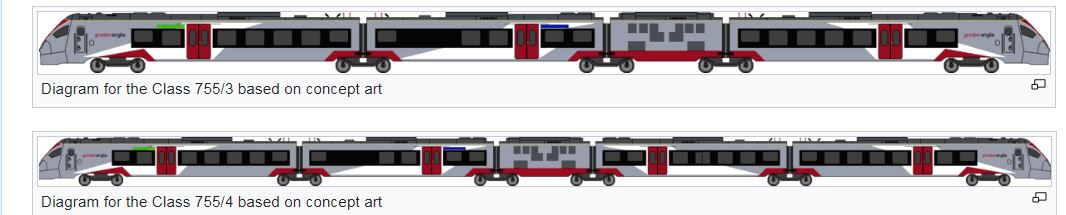
It looks like the four-car Class 755/4 trains, a three-car train with an extra passenger car.
The Class 755/4 train would appear to consist of the following
- Two full-length drive cars, with passenger accommodation.
- A half-length power car.
- Two full-length passenger car.
The three-car Class 755/3 car train would not have the extra full-length passenger car.
So in terms of full-length passenger cars, train lengths could be as follows
- Class 755/3 trains – 3 cars
- Class 755/4 trains – 4 cars
Wikipedia says that each train has the following number of seats
- Class 755/3 trains – 166 seats
- Class 755/4 trains – 224 seats
Calculating the seats per car, gives the following.
- Class 755/3 trains – 55.3 seats/car.
- Class 755/4 trains – 56 seats/car.
This suggests to me, that the interior of a passenger car is very similar to that of a driver car, which must mean manufacturing cost savings.
Diesel Engines
Both trains are fitted with 16 litre V8 engines supplied by Deutz which produce 478 kW.
The power cars have the following numbers of engines
- Class 755/3 trains – 2 engines – 956 kW – 319 kW per car
- Class 755/4 trains – 4 engines – 1912 kW – 478 kW per car.
I suspect that a fifth car could be added to a Class 755 train. This would have 1912 kW and 382 kW per car.
Add a sixth car and this would have 1912 kW and 319 kW per car.
Comparison With A Class 170 Train
Compare these figures with a diesel Class 170 train, which has 315 kW per car.
Both trains are 100 mph trains, built from aluminium, so I suspect that the performance of three-car Class 755/3 and Class 170 trains are roughly the same.
But the four-car Class 755/4 trains have fifty percent more power per car, than the Class 170 train, so these will be no sedate rural trundlers.
Looking at the power figures for five-car and six-car units, they would still have at least as much power per car as a Class 170 train.
Other Possible Routes For Class 755 Trains
Could Class 755 trains be a replacement for routes like the following?
- Aberystwyth to Shrewsbury
- Basingstoke to Exeter – Stadler are doing third-rail in Liverpool
- Birmingham to Stansted Airport
- Cardiff to Holyhead
- Cardiff to Shrewsbury
- Holyhead to Liverpool via Halton Curve
- Holyhead to Manchester Piccadilly
- Liverpool to Norwich
- Milford Haven to Manchester Piccadilly
- Swansea to Shrewsbury
Trains could be any suitable length from three to six cars.
Note that electric FLIRTs can attain 125 mph, so could we see a train with the following characteristics?
- 125 mph on electrified lines, where operating speeds allow.
- 100 mph on lines with no electrification.
This performance is not far off Hitachi’s Class 802 train.
The other major competition could be Bombardier’s proposed 125 mph bi-mode Aventra, that I wrote about in Bombardier Bi-Mode Aventra To Feature Battery Power.
The winners will be the train operating companies and their passengers.
A Video
Greater Anglia have put a video on YouTube.
Conclusion
The Class 755 trains certainly seem to have bags of grunt!
No ‘Ironing Board seats’ For Greater Anglia’s New Trains
The title of this post is the same as the title of this article on Rail Magazine.
The proof will be in the sitting, but the article encourages me, that comfort will be better than some recent new trains.
Direct Trains Between Liverpool Lime Street And Norwich
In my wanderings around the UK, I very often come across this service and use it for short trips between two major towns or cities many miles from both Liverpool and Norwich.
The Current Service
Currently, the service is run by East Midlands Trains and is usually a two-car Class 158 train. Although, I have seen the service worked by a pair of these trains.
The route is very comprehensive with calls at Liverpool South Parkway, Widnes, Warrington Central, Manchester Oxford Road, Manchester Piccadilly, Stockport, Sheffield, Chesterfield, Alfreton, Ilkeston, Nottingham, Grantham, Peterborough, Ely and Thetford.
The service always seems to be full and I suspect that in addition to offering useful routes like Manchester-Sheffield, Liverpool-Nottingham and Nottingham-East Anglia, it is often a convenient route for some long distance business and family travellers.
The major problem for a train operator is that it needs a lot of rolling stock to provide a service.
Liverpool to Norwich takes five and a half hours, so to provide the hourly service probably needs as many as a dozen trains.
This extract comes from the East Midlands Trains section in Wikipedia entry for the Class 158 train.
The hourly Norwich to Liverpool service has been criticised for overcrowding, especially between Liverpool and Nottingham. This resulted from the Department for Transport specifying two-coach units in the EMT franchise starting in November 2007. In the light of persistent and excessive overcrowding, with some passengers being left behind on occasions, the DfT eventually admitted that it had made a mistake. Various cascades of other units enabled more Class 158 stock to be released for this route, and from the December 2011 timetable change the busiest services have been lengthened to four-coach trains between Liverpool and Nottingham, with units splitting and joining at Nottingham as necessary, two-coach trains being regarded as adequate between Nottingham and Norwich. Further services on this route were strengthened from December 2012.
Running a pair of Class 158 trains on the route between Liverpool and Nottingham, does seem to ease problems there, but I’ve encountered bad over-crowding at the Eastern end too.
Improvements On The Route
Several improvements or changes of rolling stock have or are taking place in the next few years.
Increased Capacity At Liverpool Lime Street
This is detailed in the 2017-2018 Station Remodelling section of the Wikipedia entry for Liverpool Lime Street station.
- Two new platforms are being added.
- Platforms are being lengthened.
In addition there are improvements on the approaches to the station.
Ordsall Chord And Related Improvements In Manchester
The Liverpool-Norwich service calls at both Manchester Oxford Road and Manchester Piccadilly stations, although it doesn’t use the new Ordsall Chord.
But I can’t believe that the Liverpool-Norwich service won’t be affected by all the works in Manchester.
Hope Valley Line Improvements
This article on Rail Technology Magazine is entitled Long-Awaited Hope Valley Line Plans Given The Green Light.
Improvements to the Hope Valley Line between Manchester and Sheffield include.
- A loop to allow passenger trains to overtake slow freight trains.
- Removal of a foot crossing.
- Improvements around Dore and Totley station.
This is said on this document on the Transport for the North web site, which announces the Hope Valley improvements.
The new passing loops will mean three fast trains can run per hour between Sheffield and Manchester, one every 20 minutes, freight and stopping trains every hour, and a fast Manchester-Nottingham and East of England service every hour.
If nothing else, the extra capacity between Manchester and Sheffield, will reduce reliance on the Liverpool-Norwich service.
Improvements To The Midland Main Line
The Midland Main Line is not being electrified between Nottingham and Sheffield, but other improvements have taken place over the last few years.
- In particular, the Erewash Valley Line has been improved and a new station at Ilkeston has been added.
- The Liverpool-Norwich service calls at stations on this by-pass.
- The line has been resignalled.
Would a train with a 125 mph capability, as opposed to the 90 mph operating speed of the Class 158 train, allow a faster service?
East Coast Main Line Running
The 90 mph Class 158 trains must present pathing problems on the East Coast Main Line, whereas a 125 mph train could mix it easier with the high speed trains.
Greater Anglia’s Plans
Greater Anglia have ordered a fleet of Class 755 trains.
- The trains are bi-mode.
- The trains have a 100 mph operating speed.
- Greater Anglia have ordered fourteen three-car and twenty-four four-car trains.
Greater Anglia will be replacing 27 diesel trains, that consists of 58 carriages, with 38 bi-mode trains, that consist of 138 carriages.
- There are forty percent more trains.
- There are a hundred and thirty-eight percent more carriages.
- Average train length of the diesels is 2.1 carriages, wheres that of the bi-modes is 3.6.
There are two possible reasons for these large number of trains.
- Abellio have decided to buy a few bi-modes for their other franchises.
- There is going to be a massive expansion of train services in East Anglia.
Two of the new bi-mode services interact with the Liverpool-Norwich service.
- Colchester to Peterborough via Ipswich, Bury St. Edmunds and Ely
- Norwich to Stansted Airport via Ely and Cambridge.
Both services are thought to be hourly.
Consider the Colchester to Peterborough service.
- I estimate that trains will take around two hours.
- The round trip could be under five hours, even with a generous turn-round at both ends and perhaps a wait at Ipswich.
- The waits would allow connecting passengers to join the train.
- A five hour round trip would need five Class 755 trains.
- I would choose four-car trains, as the route can get crowded.
Could the Colchester to Peterborough service be considered as an extension of the Liverpool-Norwich service, that serves Bury St. Edmunds, Ipswich and Colchester?
I think it could if the trains were timed appropriately.
- Passengers from Liverpool to Ipswich, would change at Peterborough or Ely to the Peterborough to Colchester train, which would arrive a few minutes after the Liverpool to Norwich train.
- Passengers from Ipswich to Liverpool, would change at Ely or Peterborough to the Liverpool train, which would arrive a few minutes after Colchester to Peterborough train.
Hopefully, the change would not require a platform change.
Consider the Norwich to Stansted Airport service.
- I estimate trains will take about one hour and fifty minutes.
- The round trip would be four hours and would need four Class 755 trains.
- I would choose four-car trains, as the route can get crowded.
Could the Norwich to Stansted Airport service be equally spaced with the Liverpool-Norwich service between Ely and Norwich to give a clock-face two trains per hour (tph)?
These services call at Ely
- CrossCountry -Birmingham to Stansted Airport
- East Midlands Trains – Liverpool to Norwich
- Greater Anglia – Peterborough to Colchester
- Greater Anglia – Norwich to Stansted Airport
- Great Northern – Kings Lynn to Kings Cross
Totalling them up gives the following frequencies to various stations.
- Bury St. Edmunds/Ipswich/Colchester – 1 tph
- Cambridge North/Cambridge – 3 tph
- Kings Lynn – 1 tph
- Norwich – 2 tph
- Peterborough – 3 tph
- Stansted Airport – 2 tph
I suspect that the services will be arranged so there are convenient interchanges. No-one wants to spend an hour on a draughty Ely station waiting for the next train.
I also suspect that Greater Anglia will use some of their extra trains to improve connectivity at Ely.
Speed Limits On The Route
Speed limits on the route are rather variable.
- Liverpool to Manchester via Warrington is limited to 85 mph
- The Hope Valley Line between Manchester and Sheffield is 90 mph
- The proportion of the Midland Main Line, where 125 mph running is possible, is being increased.
- Grantham to Peterborough on the East Coast Main Line allows 125 mph running.
- The Peterborough to Ely Line is limited to 75 mph.
- The Breckland Line between Ely and Norwich is limited to 75- 90 mph.
I feel that increasing speed limits on some parts of the line would help the Liverpool to Norwich service.
But surely, a train with a 125 mph-capability would help with journey times and train timetabling between Sheffield and Peterborough.
But on the rest of the route, trains with this speed capability, wouldn’t be needed.
Rolling Stock Choices For Liverpool Lime Street And Norwich
Various choices include.
Class 158 Trains
Everything could carry on as now using Class 158 trains
- Two two-car trains working ass a pair would go from Liverpool Lime Street to Nottingham.
- The trains would divide at Nottingham.
- One train would go on its way to Norwich, and the other would wait at Nottingham to join with the train returning from Norwich.
With all the new diesel multiple units arriving in the next few years, I think it is likely that more Class 158 trains could be made available to strengthen the service.
The trouble with the Class 158 trains, is that with only a 90 mph operating speed, they can’t take advantage of the sections of the route where 125 mph running is possible.
Class 170 Trains
These trains were built as successors to the Class 158 trains.
- They are more modern.
- They are 10 mph faster.
- Most are three cars.
But they are still not fast enough for the 125 mph sections of the route.
A Second Service Between Liverpool And Nottingham
Improvements on the Hope Valley Line and in Liverpool and Manchester, might make it possible to run a much-needed second service between Liverpool and Nottingham via Manchester, Stockport and Sheffield..
This extra service could use the same trains as the full service.
Currently, the direct service between Liverpool Lime Street and Nottingham takes two hours thirty five minutes. In some ways, this is a problem, as if the timing was say two hours twenty minutes, a five hour round trip would be possible.
This would mean that the second service would need just five trains.
I doubt that Class 158 trains could meet this schedule, so more would be needed.
Class 800 Trains
Class 800 trains are 125 mph bi-mode trains, but are they fast enough on diesel to make real differences to the timetable by running fast on the Midland Main Line?
I think not!
So more trains would be needed to run the service.
Bombardier’s Proposed 125 mph Bi-Mode
A genuine 125-mph bi-mode, with that performance on both electricity and diesel, would be a totally different matter.
- Timings between Liverpool and Nottingham would drop to perhaps two hours twenty, thus allowing a five hour round trip.
- Timings between Liverpool and Norwich would drop to perhaps four hours fifty, thus allowing a ten hour round trip.
Even so a full service would require fifteen trains.
Bombardier have proposed a train of this type and I wrote about it in Bombardier Bi-Mode Aventra To Feature Battery Power.
In my view, this small exercise shows why some routes in the UK need a 125 mph bi-mode.
If the train can’t do 125 mph, where it is possible on the Midland and East Coast Main Line, the time savings on the route won’t be possible and more trains will be needed to run the service.
One great advantage is that the trains working this route could be the same as those working the main routes of the East Midlands franchise to and from London.
Short Formation InterCity 125 Trains
The forty-year-old InterCity 125 trains have the power and the speed to match the 125 mph bi-mode trains.
Short formation with four or five passenger cars between the two Class 43 locomotives are being used by Scotrail and Great Western Railway, but to use them on Liverpool to Norwich would require another fifteen trains to be updated, which is probably not as cost effective as new 125 mph bi-modes.
Conclusion
If service between the Liverpool Lime Street and Norwich is to continue in its present form, it needs 125 mph bi-more trains.
Greater Anglia, The Fen Line And Class 755 Trains
Greater Anglia currently operates two trains per day between King’s Lynn and Liverpool Street stations, in the Morning Peak
- 05:17 – 07:25 – 2 hr. 8 min.
- 06:17 – 08:25 – 2 hr. 8 min.
This is matched by three trains a day between Liverpool Street and King’s Lynn, in the Evening Peak.
- 17:07 – 19:08 – 2 hr. 1 min.
- 18:-07 – 20:10 – 2 hr. 3 min.
- 19:07 – 21:05 – 1 hr 58 min.
Note.
- The two Morning Peak trains stop at Watlington, Downham Market, Littleport, Ely, Cambridge North, Cambridge, Whittesford Parkway, Audley End, Bishops Stortford and Tottenham Hale.
- The three Evening Peak trains call similarly, but miss out Cambridge North.
- Services are run by Class 317 or Class 379 trains.
All the passenger trains on the Fen Line including Great Northern’s Class 387 trains, are four x twenty metre cars, which can run as four, eight or twelve cars.
Maximum Length Of Trains On The Fen Line
This article in the Eastern Daily Press is entitled Plans For Longer Trains Between King’s Lynn And London Could Be Delayed.
Reading it, I get the following impressions.
- The Fen Line can currently accept four-car trains.
- Eight-car trains are needed.
- Plans have been or are being developed to lengthen all platforms to accept eight car trains.
- Network Rail are quoted as saying “The King’s Lynn eight car scheme is amongst the CP5 projects that have funding.”
Extending further might well be out of the question, on grounds of cost and inconvenience to passengers, whilst the work is carried out.
Greater Anglia’s Trains And The Fen Line
There is a problem for Greater Anglia, as both the Class 317 and Class 379 trains are being moved on.
Class 745 Trains
The thirty x four-car Class 379 trains, that work the express West Anglia Main Line services are being replaced with ten x twelve-car Stadler Class 745 trains.
These trains will be too long for the Fen Line.
Class 720 Trains
Five-car Class 720 trains would fit the Fen line and as they are 100 mph trains, like the Class 317 and Class 379 trains, they could handle the current service.
Class 755 Trains
Greater Anglia currently have the equivalent of twenty-eight assorted diesel trains in different lengths, which they are replacing with thirty-eight bi-mode Class 755 trains.
These are.
- 100 mph trains.
- Bi-mode trains with the ability to run on electric or diesel.
- Compatible with the Class 745 trains.
Fourteen will be three-car trains and twenty-four will be four-car trains.
Greater Anglia, have already said they will run services to and from Liverpool Street from Lowestoft, so will they use the extra trains to run services to and from Liverpool Street to important East Anglian towns?
It is worth looking at the capacity of the various trains.
- Class 379 train – four-car – 189 2nd/20 1st
- Class 755 train – three-car – 166 2nd
- Class 755 train – four-car – 224 2nd
- Class 720 train – five-car – 430 2nd
Would a four-car Class 755 train have sufficient capacity for a service between Kings Lynn and Liverpool Street?
I think the answer is probably in the affirmative, but a six or seven car train couple be created, by joining two trains together, if required.
So if the Class 755 trains can provide direct Liverpool Street services for Kings Lynn and Lowestoft, what other towns could get a direct service to London?
- Bury St. Edmunds – Either via Newmarket and Cambridge or Stowmarket and Ipswich
- Cromer/Sheringham via Norwich and Ipswich
- Norwich via Wymondham, Attleborough, Thetford, Ely and Cambridge
- Peterborough via March and Cambridge
- Yarmouth via Via Norwich and either Ipswich or Cambridge.
I can remember, when some of these towns had services to Liverpool Street.
Trains could also split and join at Cambridge and Ipswich to save paths on the main lines to London.
Could trains go up to London in the Morning Peak and return in the Evening Peak?
If there was sufficient demand, they could return in mid-morning and come back to Liverpool Street in mid-afternoon, in time for the Evening Peak.
If so, how many trains would be needed?
- Bury St. Edmunds (35k) – 1
- Cromer (7k)/Sheringham (7k) – 1
- King’s Lynn (43k) – 3
- Lowestoft (70k) – 1
- Norwich via Cambridge – 2
- Peterborough – 1
- Yarmouth (47k) – 1
The figures in brackets are the population
Considering, that my rough calculation, showed there were ten spare trains, these numbers seem feasible.
I have some questions.
- How many Class 755 trains will be able to link together?
- Will platforms needed to be extended at Liverpool Street
- Could Lincoln be reached from London, via a reopened March to Spalding Line via Wisbech?
- Could a Yarmouth and Lowestoft service to London be created by reopening the chord at Reedham?
- Would it be a good idea to have a dozen First Class seats in the Class 755 trains doing the London commute.
I feel that Greater Anglia have ambitious plans.
Conclusion
From this rather crude analysis, it appears that Greater Anglia will be using the Class 755 trains as three and four car electric trains on the electrified lines to Cambridge, Ipswich and Norwich and then using their diesel power to create new direct routes to the capital.
I also suspect, trains will split and join at Cambridge, Ipswich and Norwich to reduce the number of paths needed to and from London. After all one twelve-car train is cheaper to run than three four-car trains!
Could Greater Anglia be bringing forward a timetable, where any town in East Anglia, with a population of over say 10,000, gets at least one fast train to London in the morning and back in the evening?
As the tracks, signals and stations are already there, away from the main lines, there may be little that needs doing.
If not, Greater Anglia have bought too many trains.
The Intelligent Multi-Mode Train And Affordable Electrification
Some would say we are at a crisis point in electrification, but I would prefer to call it a crossroads, where new techniques and clever automation will bring the benefits of electric traction to many more rail lines in the UK.
Lines That Need Electric Passenger Services
I could have said lines that need to be electrified, but that is probably a different question, as some lines like the Felixstowe Branch Line need to be electrified for freight purposes, but electric passenger services can be provided without full electrification.
Lines include.
- Ashford to Hastings.
- Borderlands Line.
- Caldervale Line from Preston to Leeds
- Camp Hill Line across Birmingham.
- Huddersfield Line from Manchester to Leeds via Huddersfield.
- Midland Main Line from Kettering to Derby, Nottingham and Sheffield.
- Uckfield Branch Line
There are many others, too numerous to mention.
What Is A Multi-Mode Train?
If a bi-mode train is both electric and diesel-powered, a multi-mode train will have at least three ways of moving.
The Intelligent Multi-Mode Train
The intelligent multi-mode train in its simplest form would be an electric train with these characteristics.
- Electric drive with regenerative braking.
- Diesel or hydrogen power-pack.
- Onboard energy storage to handle the energy generated by braking.
- 25 KVAC and/or 750 VDC operation.
- Automatic pantograph and third-rail shoe deployment.
- Automatic power source selection.
- The train would be designed for low energy use.
- Driver assistance system, so the train was driven safely, economically and to the timetable.
Note the amount of automation to ease the workload for the driver and run the train efficiently.
Onboard Energy Storage
I am sure that both the current Hitachi and Bombardier trains have been designed around energy storage. Certainly, there are several quotes from Bombardier executives that say so.
The first application will be to handle regenerative braking, so that energy can be stored on the train, rather than returned to the electrification.
Onboard energy storage is also important in modern electric trains for other reasons.
- Features like remote train wake-up can be enabled.
- Moving the train short distances in case of power failure.
- When Bombardier started developing the use of onboard energy storage, they stated that one reason was to reduce electrification in depots for reasons of safety.
Onboard energy storage will improve in several ways.
- The energy density will get higher, meaning lighter and smaller storage.
- The energy storage capacity will get higher, meaning greater range.
- The cost of energy storage will become more affordable.
- Energy storage will last longer before needing replacement.
- CAF use a supercapacitor to get fast response and a lithium-ion battery for good capacity.
We underestimate how energy storage will improve over the next few years at our peril.
Automatic Onboard Storage Management
The use of the energy storage will also be optimised for route, passenger load, performance and battery life by the trains automatic power source selection system.
Diesel Power Pack
A conventional diesel power pack to drive the train on lines without electrification.
As the train is electrically-driven, when running under diesel, regenerative braking can still be used, with the generated energy being stored onboard the train.
Hydrogen Power Pack
I believe that hydrogen could be used to generate the electricity required, as it is in some buses.
Operation Of The Multi-Mode Train
I’ve read somewhere that Greater Anglia intend to run their Class 755 trains using electricity, where electrification is available, even if it only for a short distance. This is enabled, by the ability of the train to be able to raise and lower the pantograph quickly and at line speed.
The train’s automatic power source selection will choose the most appropriate power source, from perhaps electrification, stored energy and diesel, based on route, load and the timetable.
Do Any Multi-Mode Trains Exist?
The nearest is probably the Class 800 train, which I believe uses onboard energy storage to handle regenerative braking, as I outlined in Do Class 800/801/802 Trains Use Batteries For Regenerative Braking?.
This article in RailNews is entitled Greater Anglia unveils the future with Stadler mock-up and says this.
The bi-mode Class 755s will offer three or four passenger vehicles, but will also include a short ‘power pack’ car to generate electricity when the trains are not under the wires. This vehicle will include a central aisle so that the cars on either side are not isolated. Greater Anglia said there are no plans to include batteries as a secondary back-up.
So does that mean that Class 755 trains don’t use onboard energy storage to handle regenerative braking?
At the present time, there is no bi-mode Bombardier Aventra.
But in Is A Bi-Mode Aventra A Silly Idea?, I link to an article on Christian Wolmar’s web site, which says that Bombardier are looking into a 125 mph bi-mode Aventra.
My technical brochure for the new Class 769 train, states that onboard energy storage is a possibility for that rebuild of a Class 319 train.
I don’t think it is a wild claim to say that within the next few years, a train will be launched that can run on electric, diesel and onboard stored power.
The Pause Of Electrification
Obviously, for many reasons, electrification of all railway lines is an ideal.
But there are problems.
- Some object to electrification gantries marching across the countryside and through historic stations.
- Network Rail seem to have a knack of delivering electrification late and over budget.
- The cost of raising bridges and other structures can make electrification very bad value for money.
It is for these and other reasons, that the Government is having second thoughts about the direction of electrification.
Is There A Plan?
I ask this question deliberately, as nothing has been disclosed.
But I suspect that not for the first time, the rolling stock engineers and designers seem to be getting the permanent way and electrification engineers out of trouble.
As far as anybody knows, the plan seems to be to do no more electrification and use bi-mode trains that can run under both electrification and diesel-power to provide new and improved services.
Use Of Bi-Mode Trains
Taking a Liverpool to Newcastle service, this would use the electrification to Manchester, around Leeds and on the East Coast Main Line, with diesel power on the unelectrified sections.
If we take a modern bi-mode train like a Class 800 train, some features of the train will help on this route.
- The pantograph can raise or lower as required at line speed.
- It is probably efficient to use the pantograph for short sections of electrification.
- Whether to use the pantograph is probably or certainly should be controlled automatically.
On this route the bi-mode will also be a great help on the fragile East Coast Main Line electrification.
Improving Bi-Mode Train Efficiency
Bi-mode trains may seem to be a solution.
However, as an electrical engineer, I believe that what we have at the moment is rather primitive compared to how the current crop of trains will develop.
Onboard Energy Storage
I said this earlier.
- I am sure that both the current Hitachi and Bombardier trains have been designed to use energy storage.
- CAF use a supercapacitor to get fast response and a lithium-ion battery for good capacity.
This is an extract from the the Wikipedia entry for supercapacitor.
They typically store 10 to 100 times more energy per unit volume or mass than electrolytic capacitors, can accept and deliver charge much faster than batteries, and tolerate many more charge and discharge cycles than rechargeable batteries.
Supercapacitors are used in applications requiring many rapid charge/discharge cycles rather than long term compact energy storage: within cars, buses, trains, cranes and elevators, where they are used for regenerative braking.
Pairing them with a traditional lithium-ion battery seems to be good engineering.
The most common large lithium-ion batteries in public transport use are those in hybrid buses. In London, there are a thousand New Routemaster buses each with a 75 kWh battery.
In the past, there has have been problems with the batteries on New Routemasters and other hybrid buses, but things have improved and I suspect there is a mountain of knowledge both in the UK and worldwide on how to build a reliable, affordable and safe lithium-ion battery in the 75-100 kWh range.
As on the New Routemaster the battery is squeezed under the stairs, these batteries are not massive and I suspect one or more could easily be fitted underneath the average passenger train.
Look at this picture of a Class 321 train.
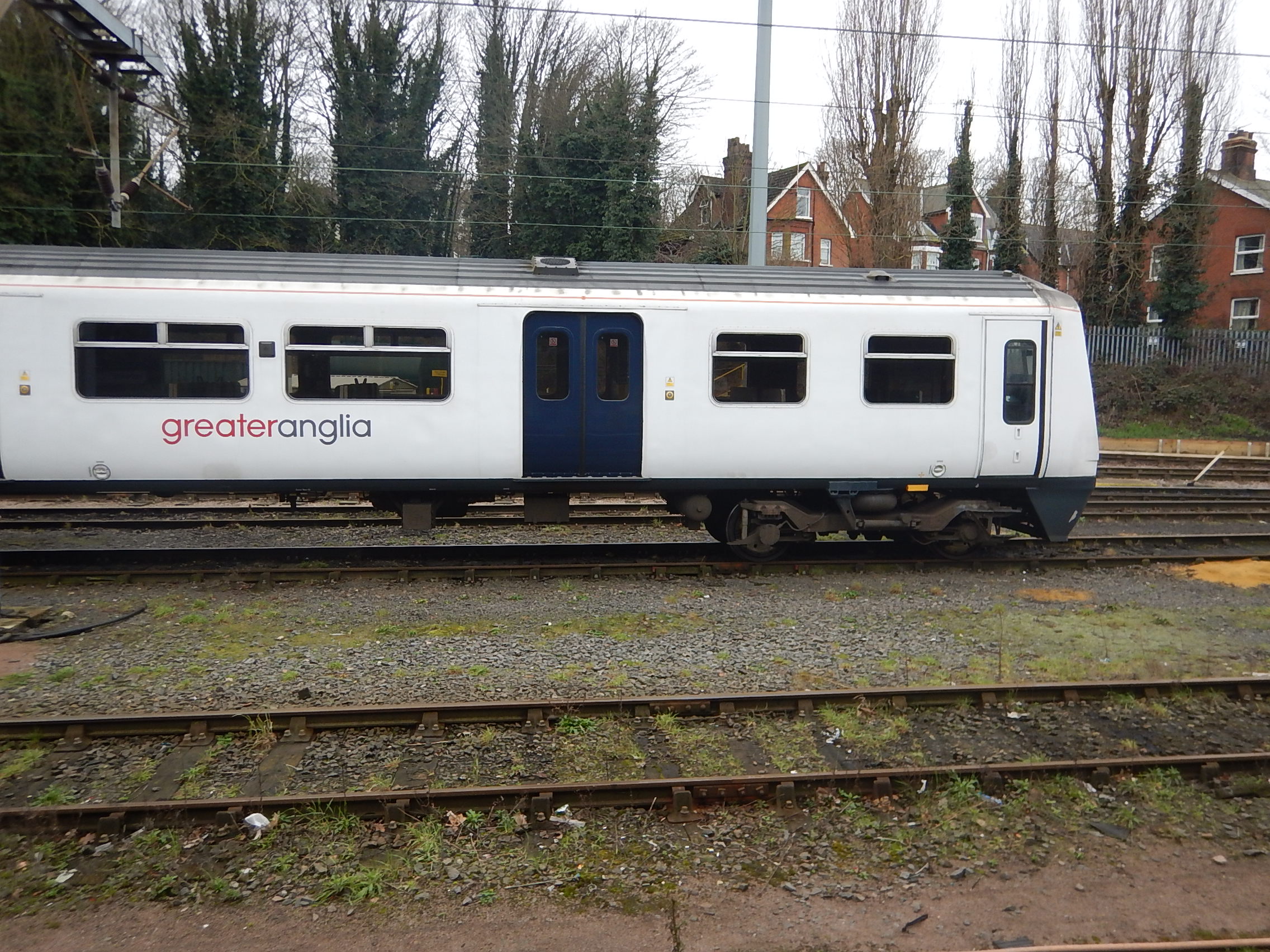
The space underneath is typical of many electrical multiple units.
How Far Could A Train Travel On Stored Energy?
In an article in the October 2017 Edition of Modern Railways, which is entitled Celling England By The Pound, Ian Walmsley says this in relation to trains running on the Uckfield Branch.
A modern EMU needs between 3 and 5 kWh per vehicle mile for this sort of service.
So if we take a battery from a New Routemaster bus, which is rated at 75 kWh, this would propel a five-car electric multiple unit between three and five miles.
Suppose though you put a battery of this size in every car of the train. This may seem expensive, but a typical car in a multiple unit and a double-deck bus carry about the same number of passengers.
A battery in each car would give advantages, especially in a Bombardier Aventra.
- Most cars in an appear to be powered, so each traction motor would be close to a battery, which must reduce electrical transmission losses and ease regenerative braking.
- Each car would have its own power supply, in case the main supply failed.
- The weight of the batteries is spread along the train.
If you take any Aventra, with a 75 kWh battery in each car, using Ian’s figures, they would be able to run between fifteen and twenty-five miles on battery power alone.
Quotes by Bombardier executives of a fifty mile range don’t look so fanciful.
What Onboard Energy Storage Capacity Would Be Needed For Fifty Miles?
This article in Rail Engineer, which is entitled An Exciting New Aventra, quotes Jon Shaw of Bombardier on onboard energy storage.
As part of these discussions, another need was identified. Aventra will be an electric train, but how would it serve stations set off the electrified network? Would a diesel version be needed as well?
So plans were made for an Aventra that could run away from the wires, using batteries or other forms of energy storage. “We call it an independently powered EMU, but it’s effectively an EMU that you could put the pantograph down and it will run on the energy storage to a point say 50 miles away. There it can recharge by putting the pantograph back up briefly in a terminus before it comes back.
What onboard energy storage capacity would be needed for the quoted fifty miles?
I will use these parameters.
- Ian Walmsley said a modern EMU consumes between 3 and 5 kWh for each vehicle mile.
- All vehicles are powered and there is one battery per vehicle.
This will result in the following battery sizes for different EMU consumption rates.
- 3 kWh/vehicle-mile – 150 kWh
- 4 kWh/vehicle-mile – 200 kWh
- 5 kWh/vehicle-mile – 250 kWh
These figures show that to get a smaller size of battery, you need a very energy-efficient train. At least lighting, air-conditioning and other electrical equipment is getting more efficient.
The 379 IPEMU Experiment On The Mayflower Line
In 2015, I rode the battery-powered Class 379 train on the 11.2 mile long Mayflower Line.
I was told by the engineer monitoring the train on a laptop, that they generally went to Harwich using the overhead electrification, charging the battery and then returned on battery power.
Ian Walmsley in his Modern Railways article says that the batteries on that train had a capacity of 500 kWh.
This works out at just over 11 kWh per vehicle per mile.
Considering this was an experiment conducted on a scheduled passenger service, it fits well with the conssumption quoted in Ian Walmsley’s article.
Crossrail’s Emergency Power
If you look at Crossrail’s Class 345 trains, they are nine cars, with a formation of
DMSO+PMSO+MSO+MSO+TSO+MSO+MSO+PMSO+DMSO
All the Ms mean that eight cars are motored.
Suppose each of the motored cars have a battery of 75 kWh.
- This means a total installed battery size of 600 kWh.
- Suppose the nine-car train needs Ian’s Walmsley’s high value of 5 kWh per vehicle mile to proceed through Crossrail.
- Thus 45 kWh will be needed to move the train for a mile.
- Dividing this into the battery capacity gives the range of 13.3 miles.
If this were Crossrail’s emergency range on stored energy, it would be more than enough to move the train to the next station or place of safety in case of a complete power failure.
Trains Suitable For Onboard Energy Storage
I have a feeling that for any train to run efficiently with batteries, there needs to be a lot of powered axles and batteries distributed along the train.
Aventras certainly have a lot of powered axles and I think Hitachi trains are similar.
Perhaps this explains, why after the successful trial of battery technology on a Class 379 train, it has not been retrofitted to any other Electrostars.
There might not be enough powered axles!
Topping Up The Onboard Energy Storage
There are three main ways to top up the onboard energy storage.
- From regenerative braking.
- From the diesel or hydrogen powerpack.
- From the electrification, where it is available.
The latter is probably the most efficient and is ideal, where a route is partly electrified.
Affordable Electrification
Although the Government has said that there will be no more electrification, I think there will be selective affordable electrification to improve the efficiency of multi-mode trains.
Why Is Electrification Often Late And Over Budget?
The reasons I have found or been told are varied.
- Electrification seems regularly to hit unexpected infrastructure like sewers and cables on older routes.
- There have been examples of poor engineering.
- There is a large amount of Victorian infrastructure like bridges and stations that need to be rebuilt.
- There is a certain amount of opposition from the Heritage lobby.
- Connecting the electrification to the National Grid can be a large cost.
My experience in Project Management, also leads me to believe that although Network Rail seems to plan large station and track projects well, they tend to get in rather a mess with large electrification projects.
Electrification Of New Track
It may only be a personal feeling, but where new track has been laid and it is electrified Network Rail don’t seem to have the same level of problems.
These projects are generally smaller, but also I suspect the track-bed has been well-surveyed and well-built, to give a good foundation for the electrification.
It was interesting to note a few weeks ago at Blackpool, where they are electrifying the line, that Network Rail appeared to be relaying all of the track as well.
I know they were also re-signalling the area, but have Network Rail decided that the best way to electrify the line was a complete rebuild?
Short Lengths Of New Electrification
Short lengths of new electrification could make all the difference on routes using multi-mode trains with onboard energy storage.
As a simple example, I’ll take the Felixstowe Branch Line, that I know well. Ipswwich to Felixstowe is about sixteen miles, which is probably too far for a train running on onboard energy storage. But there are places, where short lengths of electrification would be beneficial to both the Class 755 trains and trains with onboard energy storage.
- Ipswich to Westerfield
- On the section of double-track to be built in 2019.
- Felixstowe station
There is also the large number of diesel-hauled freight trains passing through the area, quite a few of which change to and from electric haulage at Ipswich.
So would some selective short lengths of electrification enable the route to be run by trains using onboard energy storage?
Electrification Of Tunnels
Over the last few years, there has been some very successful electrification of tunnels like the seven kilometre long Severn Tunnel. This is said about the problems of electrification in Wikipedia.
As part of the 21st-century modernisation of the Great Western Main Line, the tunnel was prepared for electrification. It has good clearances and was relatively easy to electrify, although due to its age, the seepage of water from above in some areas provided an engineering challenge. The options of using either normal tunnel electrification equipment or a covered solid beam technology were considered and the decision was made to use a solid beam. Over the length of the tunnel, an aluminium conductor rail holds the copper cable, which is not under tension. A six-week closure of the tunnel started on 12 September 2016. During that time, alternative means of travel were either a longer train journey via Gloucester, or a bus service between Severn Tunnel Junction and Bristol Parkway stations. Also during that time, and possibly later, there were direct flights between Cardiff and London City Airport. The tunnel was reopened on 22 October 2016.
It appears to have been a challenging but successful project.
This type of solid beam electrification has been used successfully by Crossrail and Chris Gibb has suggested using overhead beam to electrify the three tunnels on the Uckfield Branch Line.
In the North of England, there are quite a few long tunnels.
Could these become islands of electrification to both speed the trains and charge the onbosrd energy storage?
Third-Rail Electrification Of Stations
Ian Walmsley in his Modern Railways article proposes using third rail electrification at Uckfield station to charge the onboard energy storage of the trains. He also says this.
This would need only one substation and the third rail could energise only when there is a train on it, like a Bordeaux tram, hence minimal safety risk.
There needs to be some serious thought about how you create a safe, affordable installation for a station.
I also feel there is no need to limit the use of short lengths of third-rail electrification to terminal stations. On the Uckfield Branch, some stations are very rural, but others are in centres of population and/or industry, where electricity to power a short length of third-rail might be available.
Overhead Beams In Stations
This picture shows the Seville trams, which use an overhead beam at stops to charge their onboard energy storage.
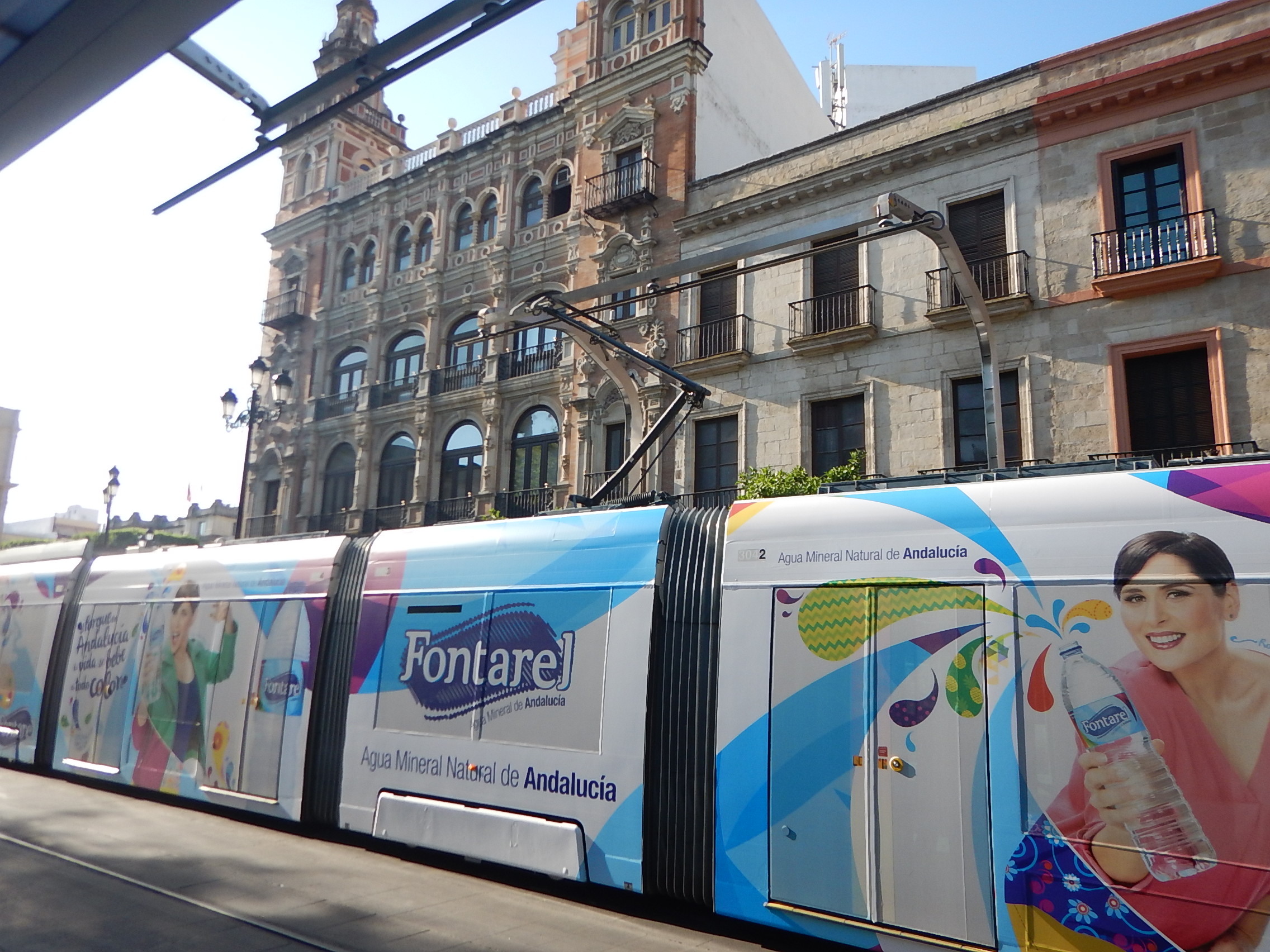
Surely devices like these can be used in selective stations, like Hull, Scarborough and Uckfield.
Third-Rail Electrification On Bridges And Viaducts
Some bridges and high rail viaducts like the Chappel Viaduct on the Gainsborough Line, present unique electrification problems.
- It is Grade II Listed.
- Would overhead electrification gantries be welcomed by the heritage lobby?
- It is 23 metres high.
- Would this height present severe Health and Safety problems for work on the line?
- The viaduct is 320 metres long.
Could structures like this be electrified using third-rail methods?
- The technology is proven.
- As in stations, it could only be switched on when needed.
- The electrification would not be generally visible.
The only minor disadvantage is that dual-voltage trains would be needed. But most trains destined for the UK market are designed to work on both systems.
Getting Power To Short Lengths Of Electrification
One thing that is probably needed is innovation in powering these short sections of electrification.
Conclusion
There are a very large number of techniques that can enable a multi-mode train to roam freely over large parts of the UK.
It is also a team effort, with every design element of the train, track, signalling and stations contributing to an efficient low-energy train, that is not too heavy.
?
Why GA Uses Locomotive-Hauled Trains And Why The Class 755 Trains Are Coming
The first part of the title of this post is the same as that of an article in Rail Magazine, which is well worth a read.
Some interesting points.
- Norwich-Sheringham had 200,000 passengers per year in 1996; it is 600,000 now.
- Competition between Yarmouth and Norwich is the X1 bus with wi-fi and charging sockets and a fifteen minute frequency.
- Level crossing accidents are a problem.
- Locomotive-hauled stock is not a cheap option.
- When Norwich City are at home, extra capacity is needed.
I suspect that Greater Anglia would like to not have to use locomotive haulage.
Class 755 Trains
The article certainly shows why they chose the fleet of Class 755 trains with 24 x four-car and 14 x three-car units.
- A three-car or four-car train can be rostered accordingly.
- The trains are bi-mode, being able to work electrified and non-electrified routes.
- The trains are 100 mph trains and probably have a much shorter station dwell time, which must reduce some journey times.
- The trains will probably have charging sockets, 4G and wi-fi.
- There appear to be enough trains for increased frequencies on all services.
- I suspect that, as the trains will probably carry a high-proportion of leisure passengers, there will be adequate space for buggies, bicycles, large cases and wheel-chairs.
I’ll look at the routes where Class 755 trains will be used.
Some general points apply.
- Several proposed routes like Norwich to Stansted Airport are partially-electrified.
- Most timetables away from the electrified lines are written for a 75 mph Class 150 train.
- Some routes need more capacity and more frequent services.
Norwich To Yarmouth
Currently, this is a one train per hour (tph) service, which takes 33-37 minutes with four or five stops. Two trains are probably needed to run the service, although Greater Anglia do combine it with the Lowestoft services.
Note the following.
- Norwich to Yarmouth is not an easy drive in a car.
- |The X1 buses have a frequency of four tph.
- There are generous turnround times at Norwich and Yarmouth.
- The Wherry Lines are being resignalled, according to this article in Rail Engineer, which is entitled Atkins Awarded £29m Resignalling Contract In Anglia.
I would not be surprised to see the Norwich to Yarmouth service speeded up such that a Class 755 train could do a complete round trip in an hour.
- This would mean the current hourly service would need just one train.
- This would allow a four tph service to be run by just four trains.
- The trains could alternate between the two possible routes to give all stations at least a two tph service to both Norwich and Yarmouth
- Four tph would be a true Turn-Up-And-Go service.
To summarise, the current hourly service would need one train, but a much more customer-friendly four tph would need four trains.
How would a four tph service rejuvenate Yarmouth?
Norwich To Cromer And Sheringham
Currently, this is an hourly service, that takes just under an hour with seven stops. This service needs two trains.
Note the following.
- The Bittern Line is double-track from Norwich to Hoveton and Wroxham station.
- From there it is single-track, with passing opportunities at North Walsham and Cromer stations.
- A new station could be built at Rackheath for an eco-town development of 5,000 houses.
- The line has recently been resignalled.
I am fairly certain that the extra performance of the Class 755 trains, will allow a two tph service between Norwich and Sheringham.
This two tph service would need four trains.
To summarise, the current hourly service would need two trains, but a much more customer-friendly two tph would need four trains.
Norwich To Lowestoft
Currently, this is an hourly service, that takes 35-47 minutes with either one or six stops.
The current service would need two trains.
Note the following.
- The line is double-track.
- As with Norwich to Yarmouth, the current timings are such, that they can be achieved by a 75 mph Class 150 train.
- All the Wherry Lines will be resignalled.
I suspect that two tph may be possible with Class 755 trains, by means of some innovative timetabling.
It might be possible that if a train went fast one way with just one stop and slow the other with six stops, that it could do a round trip to Norwich in an hour.
A two tph service run like this could need just two trains, with the fast trip in probably something under twenty-five minutes.
To summarise, the current hourly service would need two trains, but a much more customer-friendly two tph could also need two trains.
Lowestoft To Yarmouth
There must be lots of good reasons concerning commerce, tourism, leisure and families to connect the two biggest towns in the very East of England by rail. Great Yarmouth is slightly larger with a population of 70,000 to Lowestoft’s 60,000.
Because no connection exists, I’d always thought that to provide one was difficult, as it would perhaps envisage building a large bridge across the water in the area. But I have just read a section entitled Direct Yarmouth Services in the Wikipedia entry for Lowestoft station. This is said.
In January 2015, a Network Rail study proposed the reintroduction of direct services between Lowestoft and Yarmouth by reinstating a spur at Reedham. Services could once again travel between two East Coast towns, with an estimated journey time of 33 minutes, via a reconstructed 34-chain (680 m) north-to-south arm of the former triangular junction at Reedham, which had been removed in c. 1880.The plans also involve relocating Reedham station nearer the junction, an idea which attracted criticism.
Surely if Network Rail has suggested this link in this study on their web site, it must be fairly easy to reinstate, as they don’t want to start any more fiascos.
There are several possible reasons.
- Has the Todmorden Curve shown that these links generate traffic and revenue for Network Rail? Perhaps, they’ve even got the maps out and looked for similar curves to Todmorden.
- Does this link give an extra route between Norwich and Ipswich, that makes it easier for passengers to do certain journeys without changing trains?
- There is a significant number of journeys betwen Lowestoft and Yarmouth by rail and road.
- Does it make it easier for trains to serve Lowestoft and Yarmouth?
- Perhaps reorganising the rail lines and station at Reedham realises a sizable piece of land for development.
- Do Network Rail want to create a record for reopening the oldest closed railway line? 135 years has probably not been beaten.
This map shows the area of the proposed junction.
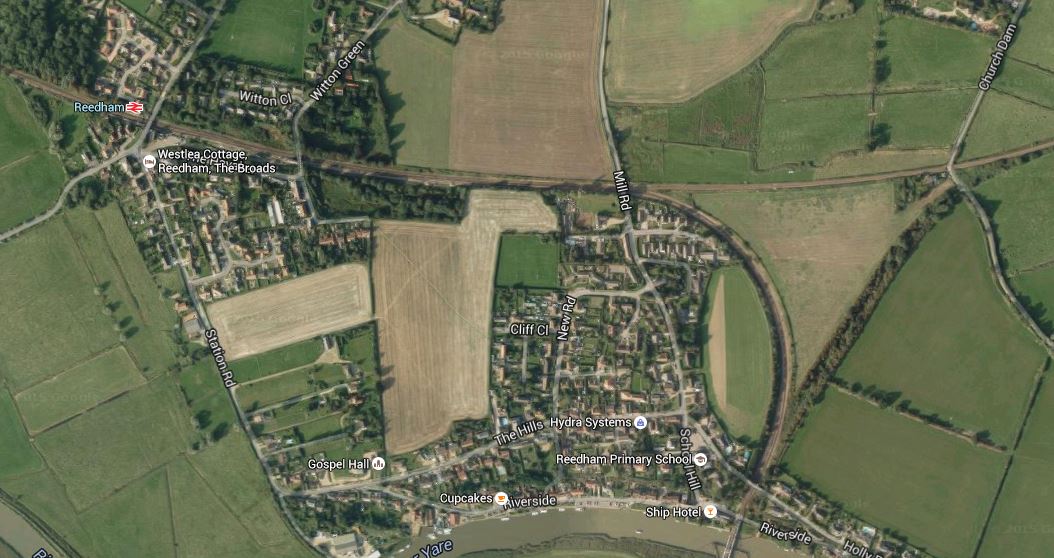 Norwich is to the West, Yarmouth to the North East and Lowestoft is to the South.
Despite being removed in 1880, the line of the third side of the junction is still visible.
But there is opposition as this article in the Great Yarmouth Mercury details. Perhaps, the locals don’t want any more housing?
The article mentions a cost of a billion pounds, which would make it a no-no! However the Todmorden scheme cost less than ten million pounds for a similarly-sized curve.
Currently, the fastest Lowestoft to Yarmouth journey takes about eighty minutes with a change at Norwich.
But these timings are also possible.
- Reedham to Yarmouth – 16 minutes
- Reedham to Lowestoft – 26 minutes
I suspect canny locals know that some trains connect well, so do the trip in under an hour.
It would appear though that if the Reedham chord was relaid, that Yarmouth to Lowestoft could be achieved in about fifty minutes.
I suspect that even if the Reedham Chord is not relaid, Greater Anglia may have plans to incorporate this service into the pattern of trains on the Wherry Lines.
They’ve certainly even got enough trains to run a shuttle using a three-car Class 755 train between Lowestoft and Yarmouth with a reverse at Reedham station.
An hourly service would need only one train.
Norwich To Stansted Airport
Greater Anglia have said that this new hourly service will replace the current service from Norwich to Cambridge on the Breckland Line.
Consider.
- Norwich to Cambridge takes 70 minutes, which is probably timed for 75 mph trains.
- Cambridge to Stansted Airport takes 30 minutes
- Trowse bridge at Norwich, is a major bottleneck on all trains connecting Norwich to the South and it may be improved or replaced. I wrote about Trowse Bridge in Is This The Worst Bottleneck On The UK Rail Network?
- Some sections of the line are electrified.
Would a round trip be possible in three hours?
This would need three trains for an hourly service and six trains for a two tph service.
When this hourly service is combined with services from other operators, there will be two tph from Norwich to Stansted Airport.
So I suspect only one tph will be needed on this route.
To summarise, the current hourly service would need three trains.
Ipswich To Lowestoft
Currently, this is an hourly service, that takes a few minutes under an hour and a half with nine stops.
Looking at the timetable for the 11:17 from Ipswich, the various sections of the journey take.
- Ipswich to Lowestoft – 86 minutes
- Turnround at Lowestoft – 24 minutes
- Lowestoft to Ipswich – 89 minutes
- Turnround at Ipswich – 41 minutes
Which gives a round trip time of four hours.
This is from the Wikipedia entry for the East Suffolk Line and describes the infrastructure.
The line is double-track from Ipswich to Woodbridge and from Saxmundham to Halesworth with the rest of the route being single track, apart from a short passing loop at Beccles. The line is not electrified, has a loading gauge of W10 between Ipswich and Westerfield and W6 for all other sections, and a line speed of between 40-55 mph.
Also note the following.
- The current four hour round trip means that four trains are needed for the service.
- Up and down trains pass at XX:25 at Beccles station and at XX:54-57 at Saxmundham station.
- The turnround times at Ipswich and Lowestoft are long, so that the timetable works and the trains can pass at Beccles and Saxmundham.
Given some track improvements, removal of a couple of level crossings and some clever timetabling, I suspect that the Class 755 trains could probably travel between Ipswich and Lowestoft in around an hour. Greater Anglian would like that for marketing reasons.
Turning these trains in thirty minutes would give a three hour round trip and reduce the number of trains required to three.
The real benefit comes if the line could be upgraded such that the Class 755 trains could do the round trip in two hours, which would reduce the number of trains required to two.
I suspect that there is extensive work being done to find a method to get a time of under an hour between Ipswich and Lowestoft.
When they’ve cracked that problem, they’ll probably move on to increasing the services on the line to two tph.
If they can crack both problems, two tph between Ipswich and Lowestoft running in around an hour, would need just four trains.
To summarise, the current hourly service would need three trains, but a much more customer-friendly fwo tph would need four trains.
When the Lowestoft to London service is introduced, this will probably be a single morning train to London and an evening train back. This would need an additional train.
Ipswich To Felixstowe
Currently, the service is hourly and a single train does a round trip in an hour.
The track is being improved and I’m fairly sure that two tph are possible, which would need two trains.
To summarise, the current hourly service would need a single train, but a much more customer-friendly two tph would need two trains.
Ipswich to Cambridge
Currently, the service is hourly and a single train does a round trip in three hours.
Note the following.
- Three trains are needed to run the hourly service.
- The current three-car trains can get very crowded.
- Some sections of the line are electrified.
- Haughley Junction is going to be improved.
I feel that the Ipswich to Cambridge time can be reduced to under an hour by the new trains.
This would have the following effects.
- Reduce the number of trains required for an hourly service to two trains.
- It might be possible to run a two tph service with four trains.
I suspect that two tph all the way from Cambridge to Ipswich may not be needed, as Greater Anglia’s proposed timetable includes two tph between Ipswich and Bury St. Edmunds and the proposal was developed before Cambridge North station threw a new big and important station into the mix.
Consequently, we could see something very different at the Cambridge end of the route.
Perhaps an hourly service between Cambridge, Cambridge North, Ely and Bury St. Edmunds, needing perhaps two trains.
To summarise, the current hourly service would need two trains, but a much more customer-friendly Western end would need perhaps two extra trains.
Improvements At Ipswich Station
Ipswich station will need extra platform capacity to handle extra services to Cambridge, Felixstowe and Lowestoft.
Colchester Town To Sudbury
Greater Anglia have said that this new route will replace the current service on the Gainsborough Line.
Current timings on this route are.
- Colchester Town to Marks Tey – 14 minutes
- Marks Tey to Sudbury – 20 minutes
- Turnround at Sudbury – 5 minutes
- Audbury to Marks Tey -19 minutes
- Marks Tey to Colchester Town – 16 minutes.
- Turnround at Colchester Town – 5 minutes
This gives a round trip of 79 minutes, with a Marks Tey to Marks Tey time of 44 minutes.
Note the following.
- One train would be needed to run an hourly service, if the round trip could be reduced between an hour.
- Some sections of the line are electrified.
- The Gainsborough Line has an operating speed of 50 mph.
- A new platform will be needed at Colchester Town station.
I think is is highly likely that the Class 755 train will be able to do the round trip in under an hour.
If the time spent on the branch could be reduced to under thirty minutes, then two tph on the route are possible, which would need two trains.
To summarise, the current hourly service would need one train, but a much more customer-friendly two tph would need two trains.
Colchester To Peterborough
Greater Anglia have said that this new hourly service will replace the current service from Ipswich to Peterborough.
Current timings on this route are.
- Colchester to Ipswich – 20 minutes
- Ipswich to Peterborough – 99 minutes
A round trip should be possible in four hours.
Note the following.
- Four trains would be needed to run an hourly service, if the round trip could be under four hours.
- Some sections of the line are electrified.
If this service could be run at two tph, this would need eight trains.
I doubt two tph would be needed, as other trains and operators shadow the route.
To summarise, the proposed hourly service would need four trains.
Summary Of Class 755 Train Services
This is a summary of the current and proposed routes, with their frequencies and the trains needed
- Norwich to Yarmouth – Hourly needs one train.
- Norwich to Sheringham – Hourly needs two trains.
- Norwich to Lowestoft – Hourly needs two trains.
- Lowestoft to Yarmouth – Hourly needs one train.
- Norwich to Stansted Airport – Hourly needs three trains.
- Ipswich to Lowestoft – Hourly needs three trains.
- Lowestoft to London – One train per day would need one train.
- Ipswich to Felixstowe – Hourly needs one train.
- Ipswich to Cambridge – Hourly needs two trains.
- Colchester Town to Sudbury – Hourly needs one train.
- Colchester to Peterborough – Hourly needs four trains.
This is a total of twenty-one trains, which is less than the current number of trains running the service.
The reduction in trains needed is because of the following.
- Class 755 trains are 100 mph trains and the timetable is written for 75 mph trains.
- Class 755 trains will be able to stop at a station quicker than current trains.
- Class 755 trains can take advantage of electrification where it exists.
Three- or four-car trains can be scheduled according to traffic needs.
In my analysis, I added what I thought would be more customer-friendly services.
- Norwich to Yarmouth – Four tph needs four trains.
- Norwich to Sheringham – Two tph needs four trains.
- Norwich to Lowestoft – Two tph needs two trains.
- Lowestoft to Yarmouth – Hourly needs one train.
- Norwich to Stansted Airport – Hourly needs three trains.
- Ipswich to Lowestoft – Two tph needs four trains.
- Lowestoft to London – One train per day would need one train.
- Ipswich to Felixstowe – Two tph needs two trains.
- Ipswich to Cambridge – Hourly needs two trains. Plus two trains to shuttle around Cambridge, Ely and Bury St. Edmunds.
- Colchester Town to Sudbury – Two tph needs two trains.
- Colchester to Peterborough – Hourly needs four trains.
This is a total of thirty-one trains, which is still below the total number of thirty-eight trains.
Greater Anglia probably won’t expand services in the way I have suggested, but consider the following.
- They have a flexible fleet with both three- and four-car Class 755 trains.
- They are the dominant passenger operator.
- Norwich and Cambridge stations have good platform capacity and Ipswich can be improved.
- Most of the signalling and track is in excellent condition.
This would enable train services to be increased as required.
There would also be trains available for new services such as.
- Cambridge to Wisbech.
- Ipswich to Aldeburgh
I could even envisage a Bury St. Edmunds to London service, that splits and joins with the Lowestoft to London service at Ipswich station.
Greater Anglia have planned well.
Infrastructure Required
The infrastructure required to run all these trains includes
- The Wherry Lines are being resignalled, This may not be needed, but it will certainly make things easier.
- Some platforms may need to be lengthened.
- Ideally, all the station platforms will be adjusted so that their height fits the Class 755 trains.
- The Reedham Chord may be reinstated to allow direct Lowestoft to Yarmouth services.
- Track improvements might night be needed on the Esst Suffolk Line.
- Ipswich station will need extra platform capacity to handle extra services to Cambridge, Felixstowe and Lowestoft.
- Colchester Town will need a second platform for the service to Sudbury.
No electrification is required, although to perhaps extend the wires for a few hundred metres in a few places might ease operation.
- From Norwich to where the Bittern and Wherry Lines divide.
- From Ipswich to where the East Suffolk and Felixstowe Lines divide.
- At Marks Tey along the Gainsborough Line.
This will allow the Class 755 trains to run on electricity for longer.
Conclusion
I’m probably very wide of mark, but iI do feel there is scope with the large number of Class 755 trains ordered by Greater Anglia to improve trains in East Anglia by a large amount.
An Affordable Reinstatement Of The Stour Valley Railway
The Stour Valley Railway used to link Cambridge to Colchester. The section between Sudbury and Shelford stations was closed in 1967. The only portion remaining is the Gainsborough Line between Sudbury and Marks Tey stations.
So could the line be reopened in an affordable way using modern technology?
In Sudbury To Cambridge – D-Train, IPEMU Or Tram-Train?, I basked what would be the ideal rolling stock on a reopened Stour Valley Railway.
My conclusion was.
It is very much a case of who pays the money makes the choice.
Purists will want a double-track railway with fully manned stations, served by at least two-trains per hour. But they’re probably not paying!
There are plenty enough single-track, single-platform stations in the UK, that work safely and well. The Gainsborough Line, which would connect a restored Stour Valley Railway to the Great Eastern Main Line has the following characteristics, history and aspirations.
- Single track throughout.
- Single-platform stations at Sudbury, Bures, Chappel and Wakes Colne and Marks Tey
- A line speed of 50 mph. This is the same as the Nottingham Express Transit and the Croydon Tramlink.
- There was a serious accident on a level crossing at Little Cornard in 2010.
- There is pressure for a station at Great Cornard.
So why not extend a railway across Suffolk, with these features.
- Single-track throughout.
- No traditional electrification
- Single-platform stations.
- Passing loops at Sudbury or Great Cornard and Haverhill.
- In-cab wireless signalling, using ERTMS, as piloted on the Cambrian Line in Wales.
- No level crossings.
- No freight, except engineering trains.
- Run under tramway rules.
- Double-manned trains.
- Services would be run by Aventras running on stored power.
It would be the ultimate modern railway connecting to one of the world’s most high-tech cities.
A Few Questions
These questions come to mind. If you have any others, let me know and I’ll answer them.
Could an Aventra Travel Between Marks Tey And Shelford Stations On Battery Power?
Both ends of the Stour Valley Railway connect to double-track main lines, which use 25 KVAC overhead electrification.
Current practice, always extends the electrification for a few hundred metres down a branch line and I would assume this would be done, so that a train running on stored energy, which was running short of power, could pull out onto the main line using the electrification.
Estimates of the distances of the sections of the line are as follows.
- Marks Tey to Sudbury – 12 miles – From Gainborough Line details in Wikipedia.
- Sudbury to Haverhill – 17 miles – From road distances
- Haverhill to West Anglia Main Line – 14 miles – From road distances.
Which gives a total of forty-three miles.
These factors will help.
- The terrain is not challenging.
- The trains will be using regenerative braking at stops.
- The trains have been optimised for low energy use.
- The trains will enter the line with full batteries.
In An Exciting New Aventra, Bombardier are quoted as saying.
So plans were made for an Aventra that could run away from the wires, using batteries or other forms of energy storage. “We call it an independently powered EMU, but it’s effectively an EMU that you could put the pantograph down and it will run on the energy storage to a point say 50 miles away. There it can recharge by putting the pantograph back up briefly in a terminus before it comes back.
The prototype, which was based on a Class 379 train, that I rode in public service in January 2015, could happily travel along the eleven miles of the Mayflower Line. Even then the on-board engineer, that I spoke to, reckoned that longer distances were possible.
Two years on, I can’t believe that Bombardier have not achieved their objective of a train with on-board storage, that can reliably achieve a fifty mile range away from the wires.
In fact for reliable operation over fifty miles, they’d probably need a range of around seventy miles, just to make sure.
Could Charging Be Provided En Route?
Seville’s MetroCentro trams, which I described in Seville’s Elegant Trams, charge themselves at each stop.
I believe that there may be a very simple system, that could be used with Aventra trains.
The Aventras are dual-voltage trains, so could a short length of 750 VDC third rail be provided in some or all stations, which at most times is electrically dead. As is normal practice the rail would be on the side of the track away from the platform.
The sequence of operation would be as follows.
- The train arrives in the station.
- The second crew member gets out to supervise the passengers, as is normal practice.
- The presence of the train, allows the third rail to be switched on.
- The train connects using a third-rail shoe and charges the batteries.
- When charging is complete, the third rail is switched off.
- The second crew member checks all is ready and boards the train.
- The train goes on its way with a full battery.
I’m sure that by careful design, a very safe system of charging the batteries can be developed.
- The third rail can’t be switched on unless a train is in the platform.
- The train would act as a massive safety guard for the third-rail.
- The shoe could be on the middle car of a five-car train.
- CCTV could monitor the third-rail at all times it is switched on.
I don’t think that all stations would have charging facilities, but just enough to ensure reliable operation of the trains.
How Would You Rescue A Failed Battery Train?
There are generally two ways, that failed trains are rescued.
- In most cases, a second train attaches itself to the failed train and drags it out of moves it to a suitable siding out of the way.
- Alternatively, a locomotive, often nicknamed a Thunderbird moves the train.
Would a battery train be able to shift the dead weight of a failed train?
It has been suggested to me, that Greater Anglia’s Class 755 trains, which are bi-mode will be able to rescue a Class 720 train, which are Aventras.
Now that is probably the ideal solution.
If you are using battery trains on a route, you make sure that you have some bi-mode trains working a route nearby.
How Long Would Colchester To Cambridge Take With A Battery Train?
Currently, the fastest journey by train between Colchester and Cambridge, that I can find takes two hours twenty minutes with a change at Ipswich. The Internet gives a driving time of one hour twenty-two minutes.
So how long would a journey take on the Stour Valley Railway?
The following timings are achieved by electric trains on the part of the route that is electrified.
- Marks Tey to Colchester – 7-8 minutes
- Shelford to Cambridge – 7 minutes
With Marks Tey to Sudbury taking twenty minutes. I will assume that a modern train like an Aventra would save a couple of minutes per stop, but then there could be an extra station at Great Cornard.
So let’s leave the timing at twenty minutes.
Scaling this time up for the forty-three miles between Marks Tey and the West Anglia Main Line from the twelve miles between Msrks Tey and Sudbury gives a time of one hour twelve minutes for the centre section of the route without electrification.
Adding everything together gives one hour twenty-seven minutes for the complete Colchester to Cambridge journey.
I suspect a few minutes could be saved by good driving and some extra electrification at the junctions.
This all adds up to a comfortable three-hour round trip between Colchester and Cambridge.
How Many Trains Would Be Needed To Work A Colchester To Cambridge Service?
The previous section would mean that to provide an hourly service between Cambridge and Colchester would require just three trains. A half-hourly service would require six trains.
Why Not Use Bi-Mode Trains?
It could be argued that everything a Class 720 Aventra train running on battery power could be done by a Stadler Class 755 bi-mode train.
Consider.
- The track access charges and leasing costs may favour one train or the other.
- Tha Class 720 train is probably better suited to gliding silently through the Suffolk countryside.
- The Class 755 train would run on diesel for most of the journey. Not very green!
- The five-car Class 720 train may be too big.
Abellio’s accountants and the Marketing Department will decide.
Costs And Benefits
The cost of building the railway between the West Anglia Main Line and Sudbury, is a bit like the old question, as to how long is a piece of string.
Much of the route is still visible in Google Maps and it could be rebuilt as single track with single platform stations, which is the style of the Gainsborough Line.
The picture shows Newcourt station on the Avocet Line in Devon.
There were originally stations between Shelford and Sudbury at the following places.
I don’t suspect all would be needed, but none except perhaps Haverhill and a rebuilt and/or moved Sufbury would be anything more than basic.
To show the level of costs, Newcourt station cost £4 million, when it opened in 2015.
I would estimate that a total cost of the single track and the required stations would be around £100-120 million.
At least, it would be unlikely, if new trains had to be purchased.
Putting value to the benefits is more difficult, but at least they can be listed.
- Fast growing Haverhill will gain a high-capacity public transport link to Cambridge.
- It would give Cambridge access to the housing and industrial sites, the |City needs.
- An efficient route would be built between Cambridge and Colchester via Sudbury and Haverhill.
- Haverhill and Sudbury get good direct links to Colchester and Ipswich.
- Most of the locals would be pleased, as house prices would rise!!
- All areas along the line get links to Addenbrook’s Hospital.
- If you can’t drive in South Suffolk, it is a beautiful prison.
As to the last point, why do you think I moved to London?
Conclusion
Reinstatement of the Stour Valley Railway would be the ultimate modern railway for one of the world’s most high-tech cities.
–
Why Are Greater Anglia Replacing Class 379 Trains With New Stadler Class 745 Trains?
On the West Anglia Main Line, Greater Anglia are replacing ten twelve-car Class 379 trains on Cambridge and Stansted Airport services with ten twelve-car Class 745 trains.
In some ways this is a bit puzzling as the Class 379 trains were only built in 2010-2011 and with the same number of trains, they will probably only be able to run the same level of services between Liverpool Street, Cambridge and Stansted Airport.
Effectively, Greater Anglia have reorganised their fleet which currently is rather diverse into just two train types.
- Stadler Flirts – Electric Class 745 and bi-mode Class 755 trains.
- Aventras – five and ten-car Class 720 trains.
This probably gives tremendous advantages to Greater Anglia in terms of train operation and maintenance and staff utilisation and training.
It also means that as the trains have been specified at the same time, the passenger experience will be similar.
The interiors of the two Stadler Flirts will probably be identical and this must be something the operator will exploit.
Liverpool Street To Ipswich and Norwich
Greater Anglia are saying that they will run three Class 745 services between Liverpool Street and Norwich every hour in ninety minutes. These Great Easstern Main Line services will also do the shorter Liverpool Street to Ipswich journey in sixty minutes.
Greater Anglia have also said they will run a fourth service in each hour to Ipswich. They have also said that some of these extra Ipswich services would be extended to Lowestoft. As the East Suffolk Line is not electrified, the services would require a bi-mode Class 755 train.
When running between Ipswich and Liverpool Street, the Class 755 train would be identical in performance and experience to its electric big sister.
One advantage of the electric and bi-mode trains being the same, is that on electrified routes in the event of a Class 745 train being unavailable, two or even three lass 755 rains could deputise.
Perhaps the only difference would be the lack of a buffet.
Greater Anglia could also use the Class 755 trains to provide a direct Liverpool Street to Bury St. Edmunds service, if they felt the need was there.
Liverpool Street To Cambridge And Stansted Airport
Just as I believe they will be mixing the Class 745 and Class 755 trains on the Great Eastern Main Line, Greater Anglia have said they’ll be mixing the two types on the West Anglia Main Line.
An hourly Norwich to Stansted Airport service will be introduced using a Class 755 train.
Additional Class 755 Services
Greater Anglia have ordered fourteen three-car and twenty-four four-car Class 755 trains, which is a lot more trains than they use at present for the routes.
So in addition to increasing frequencies on routes like Cambridge to Bury St. Edmunds, Ipswich, Norwich and Peterborough are they thinking of expanding services?
In the past the following services have been run.
- Liverpool Street to Norwich via Cambridge.
- Liverpool Street to Peterborough via Ipswich
- Liverpool Street to Great Yarmouth via Norwich.
In addition, there are two services that Greater Anglia might take over from other operators.
- CrossCountry runs an hourly service from Stansted Airport to Birmingham New Street using three-car Class 170 trains.
- East Midlands Trains runs an hourly service from Liverpool to Norwich via Nottingham using two-car Class 158 trains.
Note.
- Both services seem to get overcrowded at times.
- Very little of either route is electrified.
- Liverpool to Norwich currently takes five and a half hours.
- After Norwich-in-Ninety is achieved, it will be possible in four and a half hours via London.
- Birmingham to Stansted Airport currently takes nearly three and a half hours. Time can be saved by going via London.
With the opening of Crossrail and other faster services, I can see that these two routes will increasingly be important local routes, rather than ones used by masses of long distance travellers.
In the public consultation document for the new East Midlands Franchise, this is said about these services.
At the eastern end of the route, options might exist to provide direct services between Nottingham and a wider range of stations in East Anglia, such as Cambridge and Stansted Airport. Some options could also result in changes to the destinations served by the existing Birmingham to Stansted Airport service currently operated by the Cross Country franchise.
It looks to me that there will be a lot of serious discussions going on.
Conclusion
Where does this all fit with Greater Anglia and their fleet of Class 755 trains?
I just think that on some routes, they are ideal to provide new services or boost existing ones and they will give passengers the same experience as they get on the flagship London to Norwich services.
The Class 379 trains don’t give the flexibility and the homogeneous passenger experience.
 The Anonymous Widower