Whisky Galore!
The Levenmouth Rail Link has carried freight in the past.
Mainly in the past, it was coal to the now-demolished Methil power station.
But it has been known to carry whisky for Diageo.
This Google map shows the area.
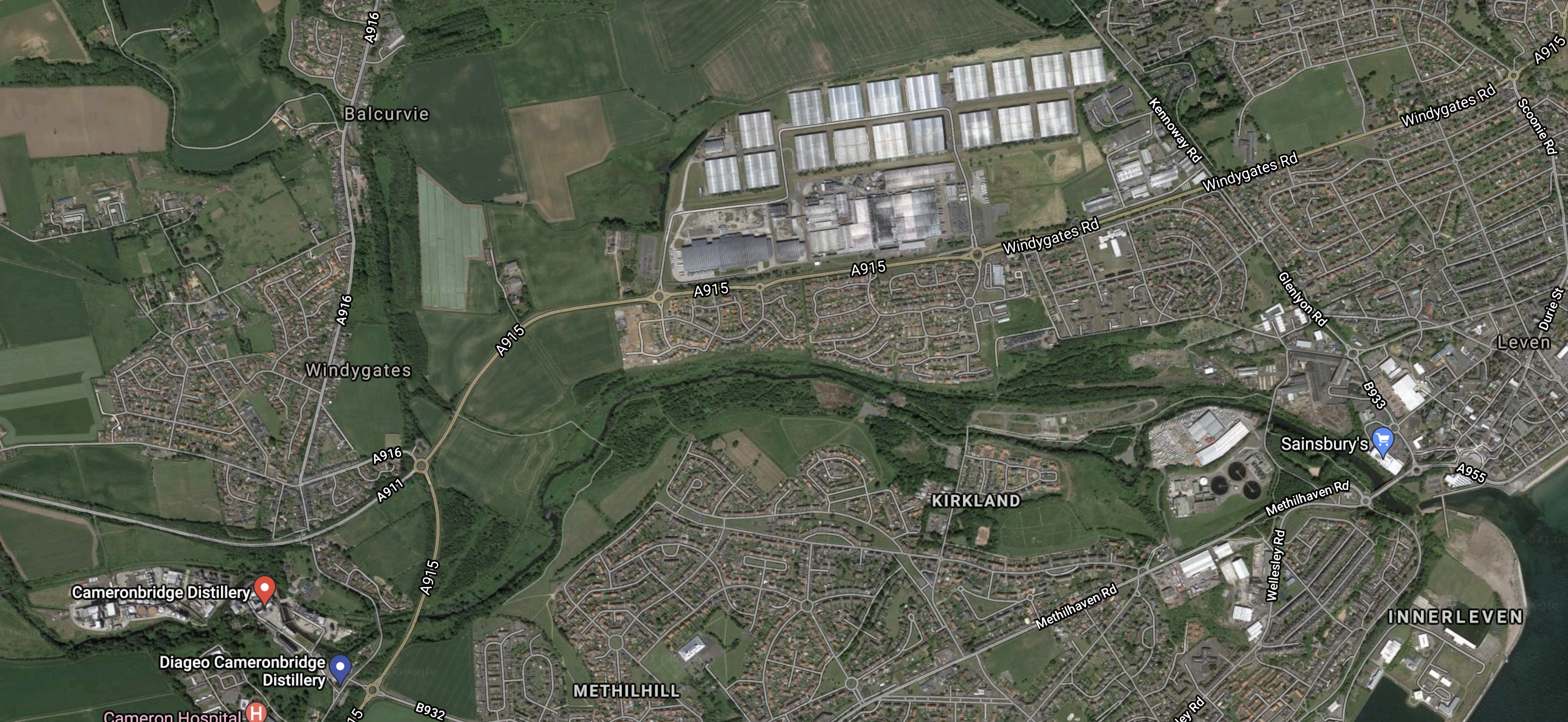
Note.
- The blue dot marking Sainsbury’s by the bew Leven station, by the mouth of the River Leven.
- The railway follows the river with Cameron Bridge station to the East of the A915 and the two Camero Bridge distilleries.
- The silver warehouses at the North side of the map are labelled Diageo Global Supply.
I wonder, if a siding can be provided for the distribution of products stored in the warehouses?
Companies are looking to lower their carbon-footprint and I wouldn’t be surprised, if Diageo were looking at rail distribution.
Modern Rail Freight Distribution
Companies are converting redundant electric multiple units into fast parcel delivery trains to replace diesel trucks.
- Typically, four-car trains are used.
- Trains have a 100 mph capability and can be 240 metres in length.
- Eversholt Rail Group are proposing adding battery power. This would be ideal to reach Cameron Bridge over the Forth Bridge.
These trains would be ideal for the delivery of Scotch Whisky.
They might even be capable of exporting product through the Channel Tunnel.
I don’t think the capacity of the Levenmouth Rail Link would be a problem, as it is a double-track railway, that can probably handle over four trains per hour and there is plenty of capacity for a number of freight trains.
Conclusion
I think freight will play a use in the future of the Levenmouth Rail Link.
Related Posts
The New Leven Station On The Levenmouth Rail Link
The New Cameron Bridge Station On The Levenmouth Rail Link
How Siemens Gamesa Could Give Coal Plants a Second Life
This article on Greentech Media is a must-read as it makes you think. This is the sub-title.
The ETES thermal battery can offer coal plants a new life as heat and power storage hubs. The first customer for a full-size version could be on-board as early as next year.
It talks about the philosophy of reusing coal-fired power station sites and some of their equipment like turbines.
It is an idea much more applicable to countries like the US and Germany rather than the UK, as they still have lots of operational coal-fired power stations and and we only have a few.
I first came across this idea, when Highview Power were talking about their 50/MW/400 MWh installation in Vermont, which was to be built on the site of a demolished coal-fired power station. The utility company and Highview were in that case just reusing the grid connection.
But then I’ve heard of other energy storage systems using old power station sites.
And not to forget that Highview Power’s installation at Carrington is close to a gas-fired power station.
Gravitricity Celebrates Success Of 250kW Energy Storage Demonstrator
The title of this post, is the same as that of this article on the Solar Power Portal.
I have already posted about this success in Gravitricity Battery Generates First Power At Edinburgh Site.
But the news story has now been mentioned in several respected publications and web sites.
So this idea, based on traditional Scottish products of heavy weights and girders seems to be getting valuable publicity.
The demonstrator is only small and uses two 25 tonne weights and a fifteen metre tower.
This is only a storage capacity of only 2.04 kWh, but the company is talking of weights totalling up to a massive 12,000 tonnes.
With a fifteen metre tower, that would be 490 kWh.
Note.
- The shafts at Kellingley Colliery in Yorkshire are 800 metres deep.
- The TauTona mine in South Africa is 3.9 kilometres deep
- In this article in The Engineer, Gravitricity talk about weights of up to 12,000 tonnes.
These are typical storage capacities.
- Kellingley – 50 tonnes – 109 kWh
- Kellingley – 12,000 tonnes – 26.15 MWh
- TauTona – 50 tonnes – 531 kWh
- TuaqTona = 12,000 – 127.5 MWh
Accountants before they invest in a company look at the financial figures. As an engineer, I look at the numbers in the science behind their claims.
If the engineering can be made to work, these figures are to say the least; very promising.
They are also beautifully scalable.
If say your application needed a 2 MWh battery and you had a 400 metre shaft available, you can calculate the weight needed. It’s around 1836 tonnes.
The Solar Power Portal article finishes with these two paragraphs.
The company will now look to rollout the technology in a series of full-scale 4-8MW projects, with conversations already underway with mine owners in the UK, Scandinavia, Poland and the Czech Republic, it said. Additionally, in South Africa Gravitricity is working closely with mine operator United Mining Services as part of a programme funded by an Innovate UK Energy Catalyst programme to identify potential schemes.
“A key feature of our full-scale projects will be their long life” added Blair. “Once built, our system can last for over 25 years, with no loss in output or degradation over time. This makes gravity storage cost-effective. And unlike batteries, we have no reliance on rare metals such as cobalt and nickel which are becoming increasingly scarce in the global drive to electrification.”
Note.
- I assume that they are 4-8 MWh projects.
- Charlie Blair is the Managing Director of Gravitricity.
- A weight of 1836 tonnes would give 4 MWh in the 800 metre shaft at Kellingley.
I wouldn’t be surprised that those owning a deep empty hole in the ground will be starting conversations with Gravitricity!
Conclusion
I am not worried, that I bought a few shares in Gravitricity in the crowd-funding last year!
All this good publicity from the BBC, Good News Network, Science, The Engineer, The Times and other media sites won’t harm my investment.
What Is The £150m Global Centre For Rail Excellence Scheme In South Wales?
The title of this post, is the same as that of this article on Business Live.
This sub-title is a good summary.
The Welsh Government project aims to create a world first in testing trains and rail infrastructure at the same facility
It looks like it will be very comprehensive and is a classic example of the sort of things we should do to attract world class companies to the UK.
This paragraph talks about one of the site’s uses.
Rail infrastructure cannot be tested on a live railway because there isn’t a safe way of doing it. The internal track will have a wagon travelling around at 40mph putting new infrastructure through its paces with rigorous assessment. When owner of the UK rail network Network Rail, which is committed to using the facility, want to test equipment it has to use the Pueblo testing centre in Colorado, as do equivalent organisations in Europe.
It’s surely easier to go from anywhere in Western Europe to Wales than Colorado. Especially, if you want to take some equipmement that might weigh several tonnes.
Conclusion
The Welsh seem to have done their homework and also come up with an innovative use for a worked-out open cast coal mine.
Coal Plant Closures Loom Large As NSW Backs Hydrogen For The Hunter
The title of this post, is the same as that of this article on the Sydney Morning Herald.
This is the first paragraph.
The future of NSW’s coal-fired power plants is under increasing threat from cheap renewable energy, which this week forced Victoria’s Yallourn coal plant to bring forward its closure date as analysts warn the end may come even sooner.
The future for coal in Australia certainly doesn’t look good.
World’s Biggest Battery Storage Project Announced By Australian Renewables Fund
The title of this post, is the same as that of this article on Energy Storage News.
This is the introductory paragraph.
CEP. Energy, a specialist renewable energy fund company in Australia, has just announced the largest proposed grid-scale battery project in the world so far, with up to 1,200MW rated output.
If you read the whole article, you get the impression, that the Australians are going big on energy storage.
But then Australia must be one of the best countries for solar energy in the world.
This paragraph contains an interesting concept.
Construction is anticipated to begin in early 2022 for completion in 2023, so it’s possible even bigger schemes will be announced or even built by then, but for now the project is setting the pace for scale. Another Australian project, proposed by integrated energy company Origin Energy would site 700MW / 2,800MWh of batteries at a retiring coal power station, also in New South Wales and French developer Neoen has filed a plan, to build a 500MW / 1,000MWh battery storage project in the state. New South Wales’s government has implemented an ambitious roadmap to deploying vast shares of renewable energy on its networks, including a handful of multi-gigawatt Renewable Energy Zones.
Note that Origin Energy are replacing a coal-fired power station with a 700 MW/2,800 MWh battery.
We shall see a lot of fossil-fuel-fired power stations replaced by batteries.
North Dakota Coal Country Backlash Against Wind Energy Is Misguided, Wind Advocates Say
The title of this post, is the same as that of this article on Inforum.
This is the introductory paragraph.
Two counties in North Dakota coal country have passed policies aimed at banning wind power development — but federal studies show that abundant natural gas is chiefly to blame for the closure of coal-fired power plants.
It appears that the closure of 1151 MW Coal Creek power station in 2022, will cost almost a thousand jobs.
This is the downside of decarbonisation.
These two paragraphs give a flavour of the argument.
Coal country officials have said they’re not against wind power, but said the economic benefits of wind can’t begin to compare to the contributions, in jobs and tax revenues, to coal-fired power plants and the mines that supply them. Most jobs involving a wind farm come during construction.
“There will be a limited number of permanent jobs after the tower is up, if and when that happens,” said Buster Langowski, the Mercer County economic development director. Wind farms need only four or five employees to operate. “That’s not a lot of folks.”
It appears that the changeover needs to be better managed.
Scotland’s Mines To Be At Centre Of Green Energy Renaissance
The title of this post, is the same as that of this article on the Glasgow Herald.
The article is a good explanation of the pros and cons of using the heat stored in disused coal mines, to heat hones and businesses.
Air-Powered Energy Storage Knocks Out Coal & Gas — Wait, What?
The title of this post, is the same as that of this article on CleanTechnica.
After reading, this must read article, it could have had a title with Knocks Out Coal, Gas and Nuclear.
It makes a passionate article for Highview Power’s long term air-powered energy storage and other systems with a similar energy profile like Form Energy.
It also showed this good graphic from Highview Power, which shows how their system works.
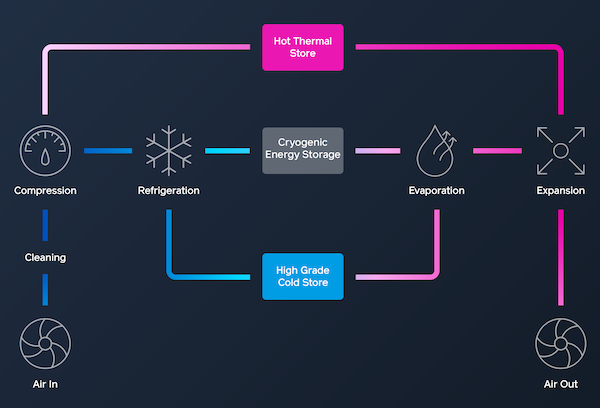
This paragraph gives Highview’s view on what their CRYObatteries will do.
Grid operators are turning to long-duration energy storage to improve power generation economics, balance the grid, and increase reliability. At giga-scale, CRYOBatteries paired with renewables are equivalent in performance to – and could replace – thermal and nuclear baseload power in addition to supporting electricity transmission and distribution systems while providing additional security of supply,” enthuses Highview.
The author then chips in with the attitude of the US Department of Energy.
Don’t just take their word for it. The US Department of Energy is eyeballing long duration energy storage for the sparkling green grid of the future despite all the hot air blowing out of 1600 Pennsylvania Avenue.
In an interesting twist, the Energy Department’s interest in long duration storage was initially connected to its interest in at least preserving, if not growing, the nation’s aging fleet of nuclear power plants.
Will renewables be able to see off nuclear in a country with plenty of sun and/or wind like the United States?
Conclusion
With a lot of help from their friends in the long term energy storage business, the answer must be yes!
After Coronavirus, What’s Next? China: More Coal, US: More Oil, EU: More Renewables
The title of this post, is the same as that of this article on CleanTechnica.
The title says it all, but read the article to get the detail.
 The Anonymous Widower