Leven Station – 15th May 2025
I was only at Leven station for a few minutes, but I was able to take these pictures.








Note.
- There are two platforms, one each side of a wide island.
- The platforms are 205 metres long.
- As four-car Class 385 trains are 93.3 metres long, each platform will be able to take a pair of four-car Class 385 trains.
- Will the station platforms be used to stable four trains overnight.
- The car park has 134 spaces.
- On approach to Leven station, there appears to be a crossover, which allows trains to use either platform.
From the Wikipedia entry for Leven station, it appears a second hourly service starts on the 18th May 2025, with services alternating between going via Kirkcaldy and Cowdenbeath.
It also appears that last night (17th May 2025) two trains spent the night in Platform 1 at Leven station.
In The Lack Of Information At Edinburgh Waverley Cost Me £55.10, I explain, why the chaos at Waverley station didn’t give me enough time to do more on Thursday.
JCB Hydrogen Excavators Approved For UK Roads
The title of this post, is the same as that of this article on Construction Kenya.
This is the sub-heading.
The government’s move supports the UK’s broader net-zero goals.
These are the first two paragraphs.
JCB has celebrated a landmark decision by the UK government allowing hydrogen-powered construction and agricultural machinery on public roads, effective from April 29.
This change enables hydrogen-fuelled diggers, tractors, and other machinery to operate between sites and farms, reducing carbon emissions in two highly polluting industries.
JCB celebrated by driving a hydrogen-powered excavator through London to meet the Minister.
I would have thought that this event would have had more coverage in the news.
But then hydrogen is a taboo subject to many politicians and the media, as the Hindenburg got the anti-hydrogen publicity right.
What Is The Collective Noun For Cement Mixer Trucks?
I took these pictures on Eldon Street and Moorgate this morning.










Note.
- There was obviously a big pour going on in the rebuilding of Broadgate.
- I suspect those outside the hotel in the street restaurant, we’re too amused by the cabaret.
- Cemex were providing the concrete.
Perhaps in view of the location, the collective noun is a pollution of cement mixer trucks.
In Cummins Agrees To Integrate Its Hydrogen ICE Technology Into Terex® Advance Trucks, I describe the latest design of cement mixer trucks from the United States.
This is the European-sized member of the range.
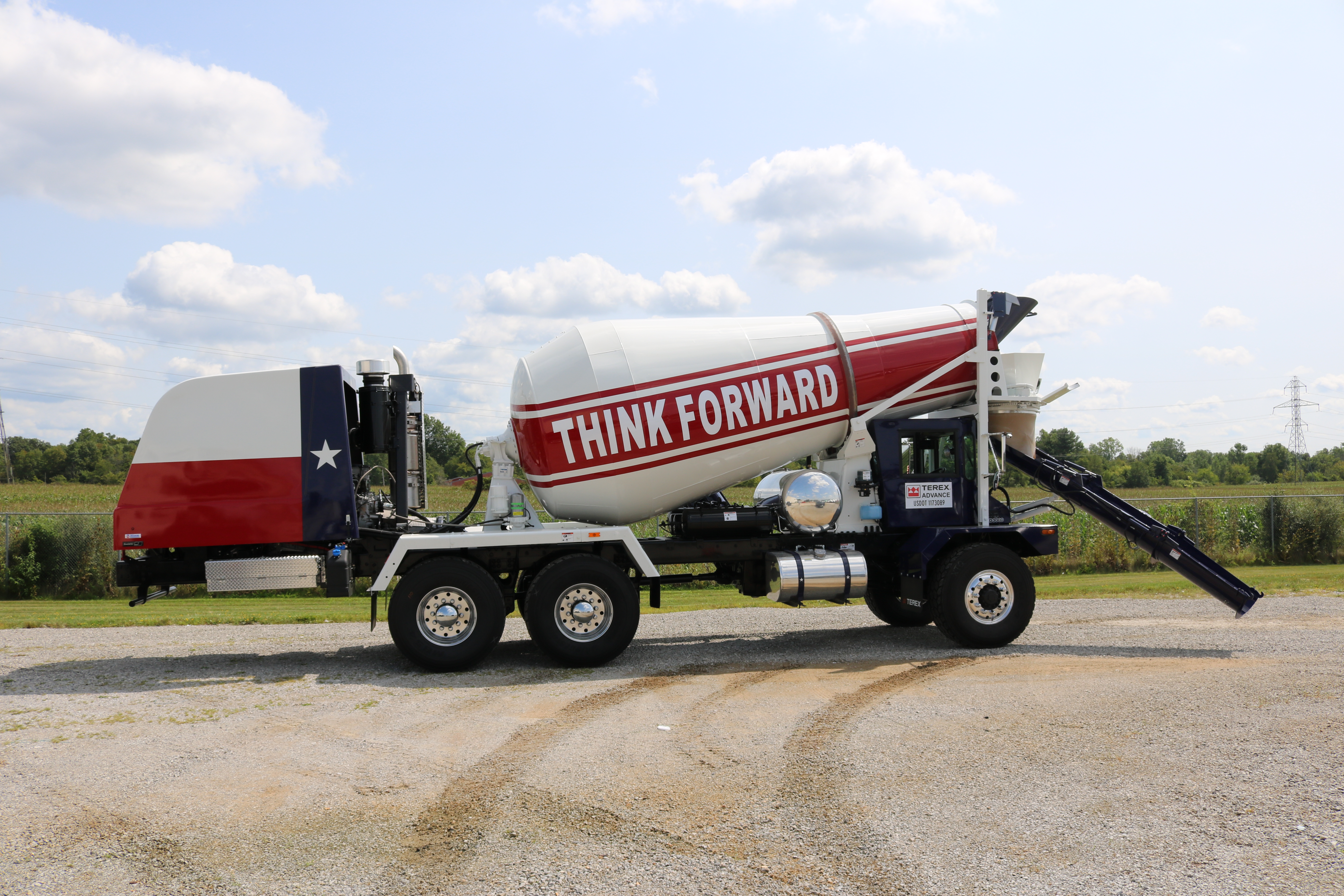
Note.
- Front is to the right.
- The engine is in the pod at the other end.
- The engine can be one of Cummins’s hydrogen internal combustion engines.
These trucks would be much more city-friendly.
Mineral Carbonation International Changed Its Name To MCi Carbon In Early 2023
This post is to retrospectively sort out that Mineral Carbonation International changed its name to MCi Carbon in Early 2023.
Google AI gives this summary.
Mineral Carbonation International (MCi) changed its name to MCi Carbon in early 2023. The company’s rebranding emphasized its focus on commercializing and scaling its technology for carbon capture and utilization. The name change reflected a broader shift in the company’s strategy and market positioning.
They now have a web site at www.mcicarbon.com.
The old web site was at www.mineralcarbonation.com and the address now redirects to the new web site.
As I missed the name change, my last post on the company was Sumitomo Mitsui Trust Bank Makes Substantial Investment In Australia’s MCi Carbon.
I should probably have covered these stories earlier this year.
The world’s first CCU plant in the refractory industry
Japan’s MUCC Invests $5M In MCi Carbon To Advance Cement Decarbonization
MCi Carbon seems to be moving on.
Eastern Green Link 2 Moves Up A Gear Using Low Carbon Fuel For Material Handling Trucks
The title of this post is the same, as that of this press release from National Grid.
These three bullet points act as sub-headings.
- Eastern Green Link 2 (EGL2), a high voltage direct current (HVDC) 436km subsea transmission cable connecting Scotland and England, is being delivered as a joint venture by National Grid Electricity Transmission and SSEN Transmission.
- Project sustainability efforts are accelerating by adopting Hydrogenated Vegetable Oil (HVO) fuelled trucks to move materials in Yorkshire.
- The introduction of HVO fuel will deliver up to 90% reduction in direct CO2 emissions.
The use of HVO fuel is good and the carbon dioxide emission savings are to be welcomed, but there is only so much of this HVO fuel available.
If hydrogen-fueled trucks were available, then this would deliver up to 100% reduction in direct CO2 emissions.
This paragraph from the press release talks about where the HVO fuel will be used.
HVO, a low-carbon biofuel made from waste vegetable oils, will be used at the Wren Hall converter station site in North Yorkshire, where 20-tonne construction trucks will transport approximately 370,000 tonnes of quarry stone from a quarry 27 miles away. This switch from conventional diesel to HVO is expected to deliver up to a 90% reduction in direct CO2 emissions and an 80% reduction in other harmful emissions such as particulate matter.
This Google Map shows the location of Wren Hall with respect to Drax power station.
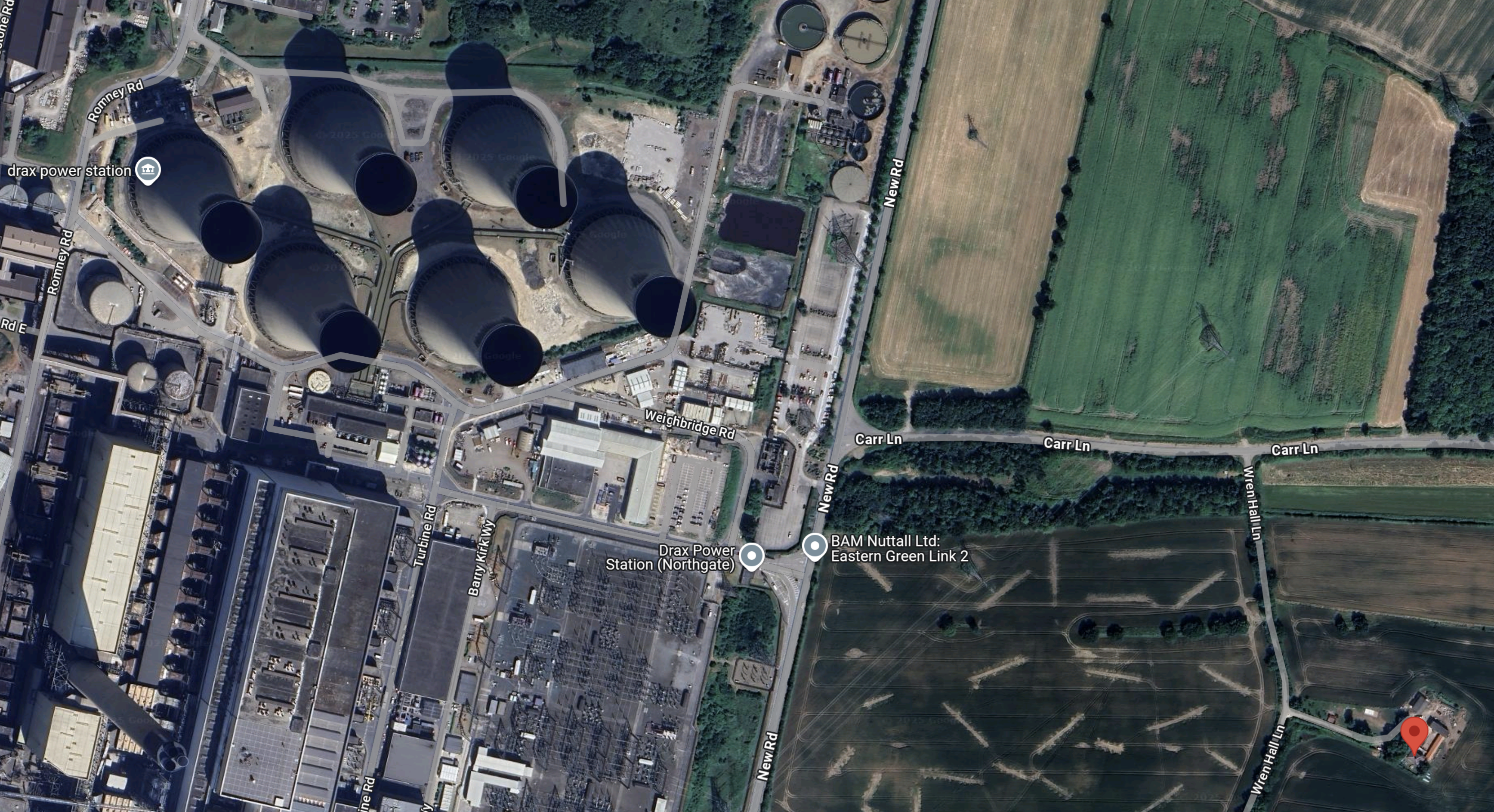
Note.
- The six large cooling towers of the Drax power station are in the North-West corner of the map.
- Google Maps indicate, where they think Wren Hall is, with a red arrow.The lane running North-South to the West of the red arrow is called Wren Hall Lane.
- There is a legend saying BAM Nuttall Ltd Eastern Green Link 2 on the opposite side of the square of lanes to the red arrow.
Click the map to show it to a larger scale.
It looks to me, that if hydrogen could be provided on the Drax site, then the 370,000 tonnes of quarry stone from a quarry 27 miles away could be brought to the site by hydrogen-powered 20-tonne construction trucks.
So how could hydrogen be provided on the Drax site?
- Drax is a 2.6 GW biomass power station, so I’m sure that some electricity could be used to generate hydrogen.
- Drax is a rail-connected site, so hydrogen could be brought in by rail.
- Depending on the amount of hydrogen needed, hydrogen could surely be brought in by road.
I feel that if hydrogen-powered 20-tonne construction trucks were available, this transfer of quarry stone could be performed carbon-free.
Conclusion
This project illustrates a problem with large infrastructure projects all over the UK.
Moving the large amounts of stone, concrete, sand and rubble into and out of construction sites generates a lot of carbon dioxide and pollution from the 20-tonne trucks employed.
If I were to be given Ed Miliband’s job of Secretary of State for Energy Security and Net Zero, one of my first actions, would be to say that all new 20 tonne construction and cement trucks would have to be zero carbon.
I suspect, that zero-carbon with trucks this size, will mean hydrogen, as the weight of the battery would destroy the mathematics of the truck.
This would obviously reduce carbon emissions, but more importantly, what would it do for the health of those working on large construction sites?
In MAN Expands Its Zero-Emission Portfolio, I show MAN’s heavy hydrogen trucks.
This is an articulated heavy hydrogen truck.
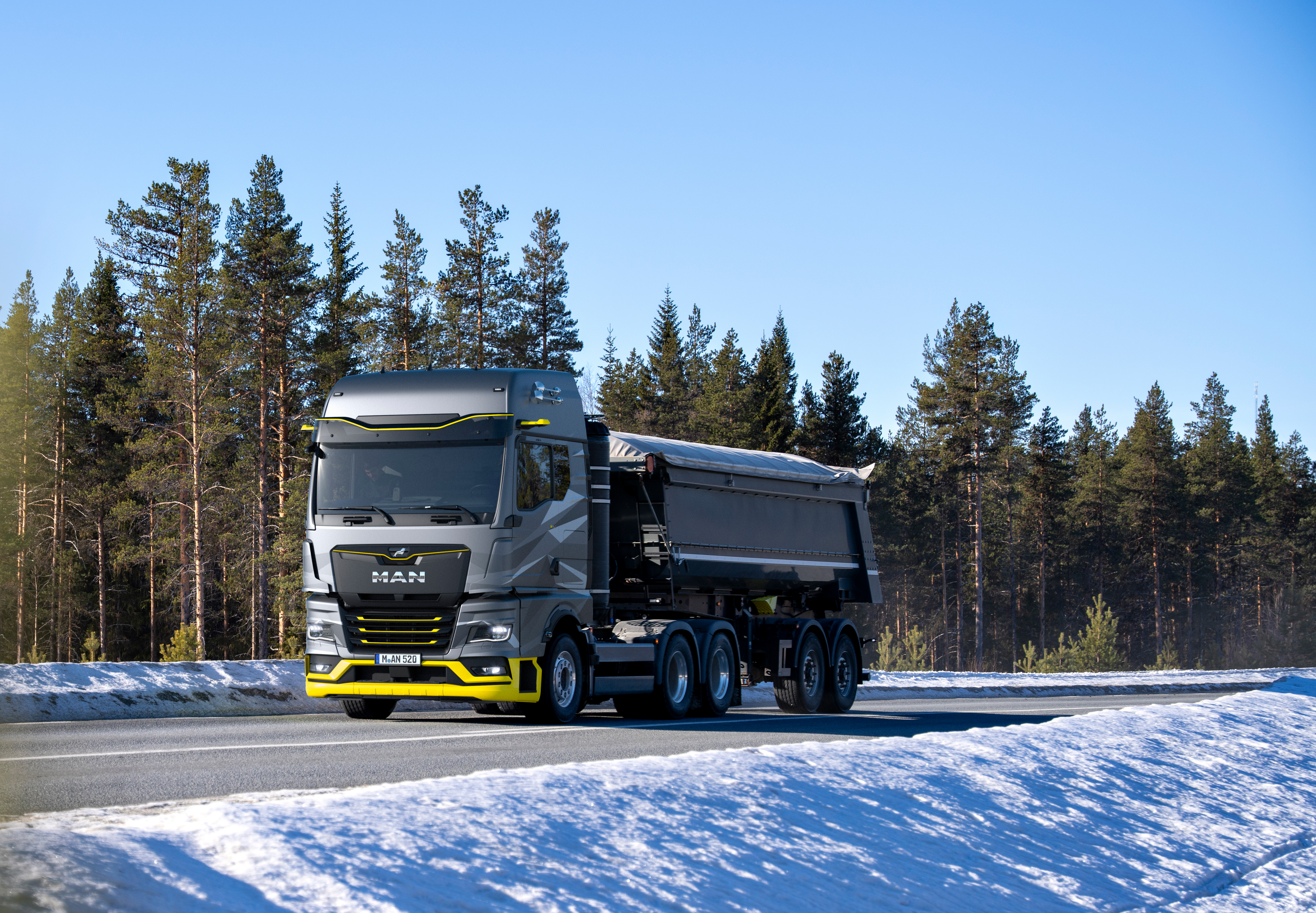
I’m sure that MAN could build a hydrogen-powered 20-tonne construction truck.
In Cummins Agrees To Integrate Its Hydrogen ICE Technology Into Terex® Advance Trucks, I talk about the solution to the cement truck problem.
This is a side view of the top-of-the-range monster.
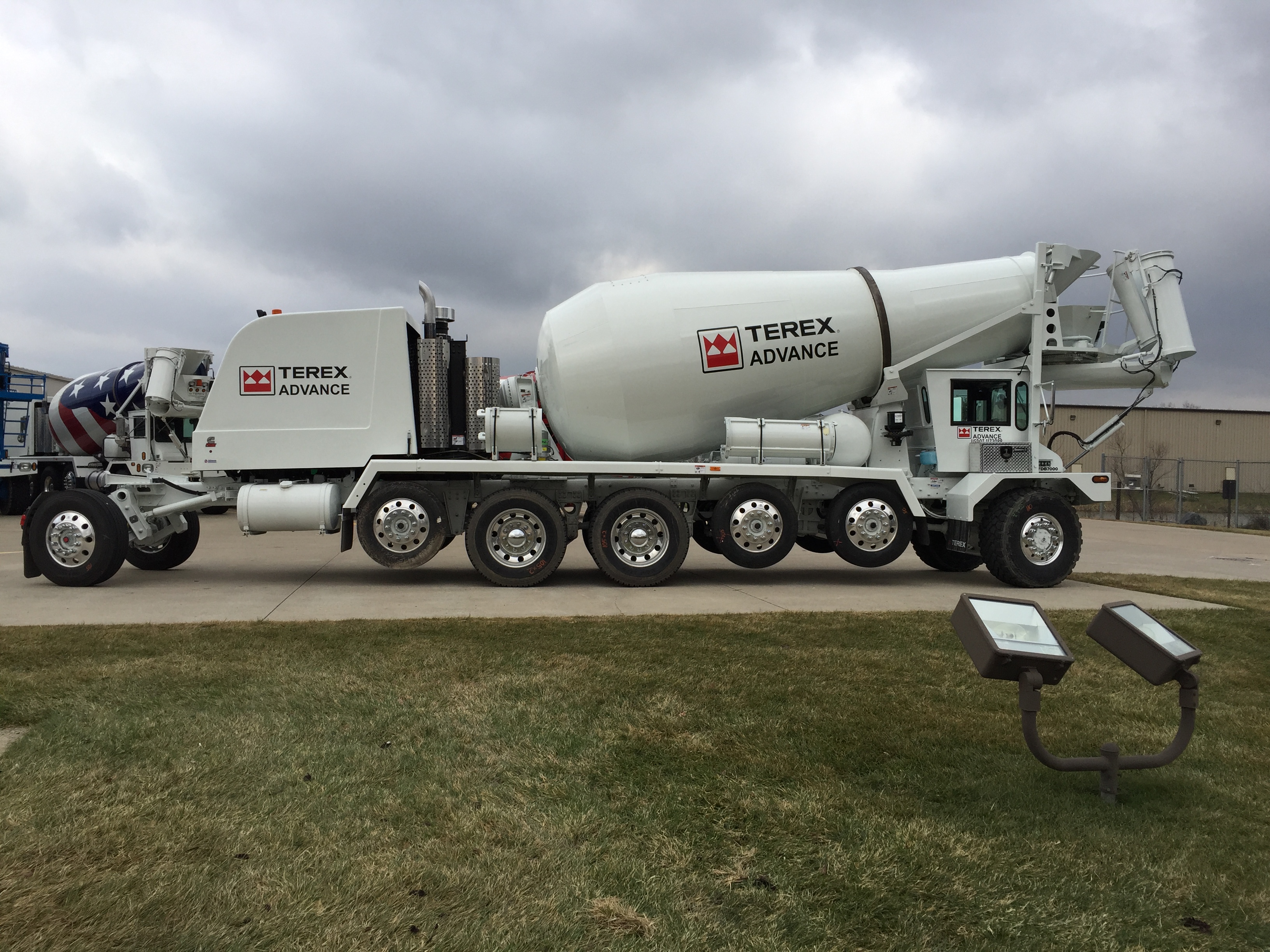
Note.
- Front is to the right.
- I suspect the driver doesn’t have to get out of the cab to discharge the concrete.
- The engine is at the rear with vertical exhausts.
- All axles are driven.
You’d certainly notice one of these if they were to be used in the City of London.
And this is the baby of the range.
Three axles is normal for the UK. so I wonder if this machine will ever make it across the pond.
This last paragraph in the original article describes the X15H hydrogen internal combustion engine.
The X15H was showcased at the Advanced Clean Transportation (ACT) Expo in May (2023), along with its hydrogen ICE-powered concept truck. The X15H features a 700-bar pressure 80kg capacity hydrogen storage system and a range of more than 500 miles, with up to 500 horsepower.
Could one of these trucks really deliver ready-mix concrete from London to Manchester and return?
The trucks would appear to be available, so let’s get a few over and try them out.
Incidentally, if someone had told me ten years ago, there would be rear-wheel drive trucks like Volkswagen Beetles, I’d have said they were wrong in no uncertain terms.
The Wren Hall substation would appear to be an ideal trial project for hydrogen-powered construction trucks and cement trucks.
More Than Four In Ten New Homes In England Built With Solar Power
The title of this post, is the same as this press release from Solar Energy UK.
These two paragraphs add some more detail.
The introduction of more stringent rules on energy efficiency for new homes in England has driven a surge in solar panel installations.
The proportion of new homes and buildings that come with solar photovoltaic panels included has risen by more than three times in the last twelve months.
It certainly appears that solar is now an essential part of a new house.
The article calls it a dramatic jump.
That is a dramatic jump compared to only 5,731 of 44,310 newbuilds sporting solar panels in the last quarter of 2023 – only 13%.
Will the next product to be installed in houses, be batteries for individual houses?
I’m certainly thinking of one to complement my solar panels.
MP Pushes For Tidal Lagoon In Bristol Channel
The title of this post, is the same as that of this article on the BBC.
This is the sub-heading.
Building a tidal lagoon in the Bristol Channel could provide clean energy for 120 years, an MP has said.
These three paragraphs give more details.
The proposed West Somerset Lagoon, which would cost £10bn to build, would run nine miles (14km) from Minehead to Watchet in Somerset.
Its lifespan would be twice that of a nuclear power plant, said Tiverton and Minehead MP Rachel Gilmour.
Mrs Gilmour said she will soon be discussing the proposal with ministers. If the project is pursued, it could be up and running by 2038 – bringing jobs and financial benefits to the area.
The project already has a web site, with this mission statement.
The West Somerset Tidal Lagoon is a proposed Tidal Range power scheme, that aims to harness the energy of the tides to provide zero carbon renewable energy. It is strategically located on the southern coast of the Bristol Channel Basin between Minehead and Watchet to take advantage of the world’s second highest tidal range and will become the UK’s largest sustainable energy project.
This map from OpenRailwayMap shows the coast between Minehead and Watchet.
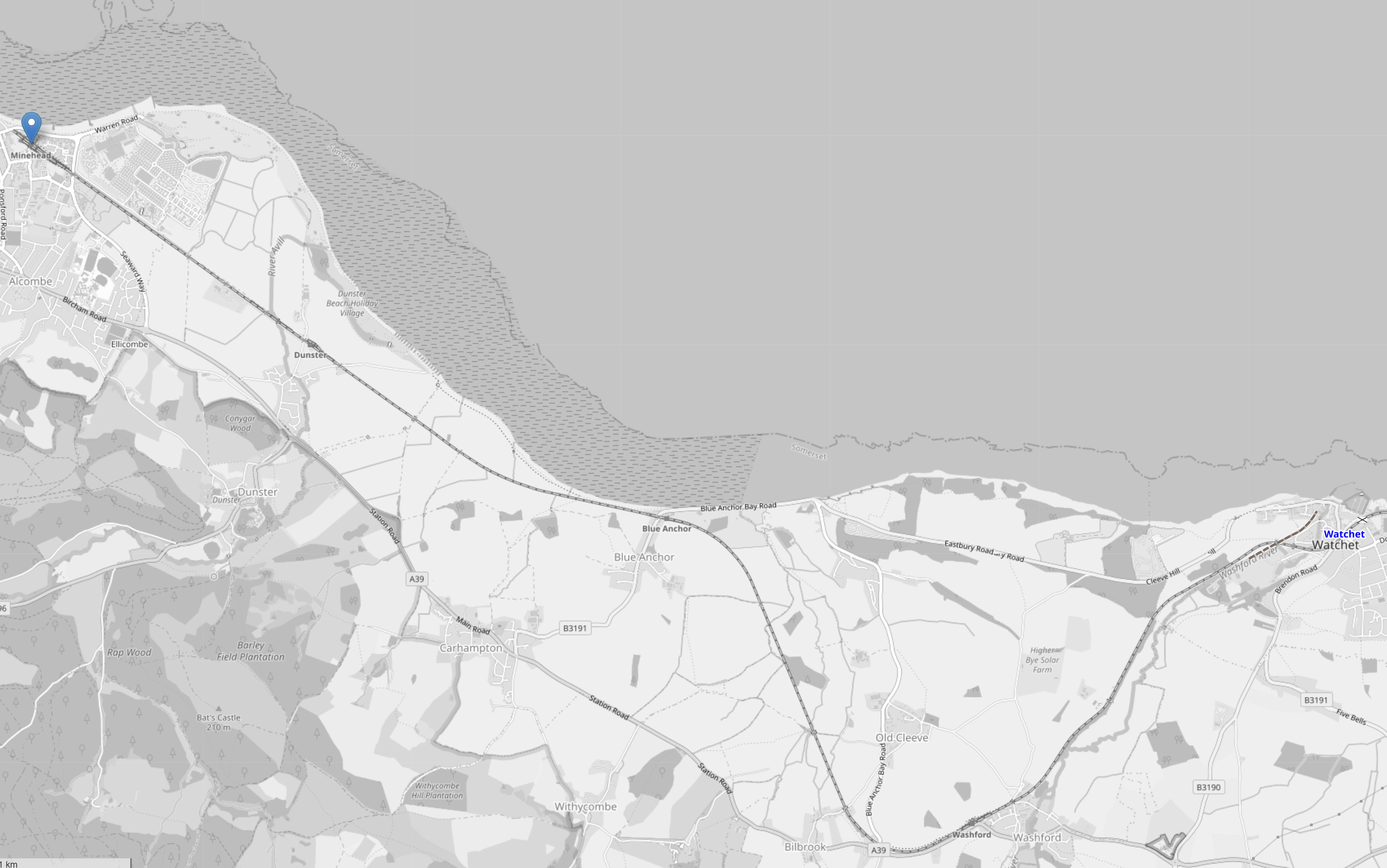
Note.
- Minehead station is indicated by the blue arrow in the North-West of the map.
- Watchet station is indicated by the blue lettering on the Eastern edge of the map.
- The West Somerset Railway links the two stations and connects them to the Bristol and Exeter Line at Norton Fitzwarren station.
It looks like the sea wall of the lagoon will curve between Minehead and Watchet.
The West Somerset Railway
This OpenRailwayMap shows the whole West Somerset Railway.
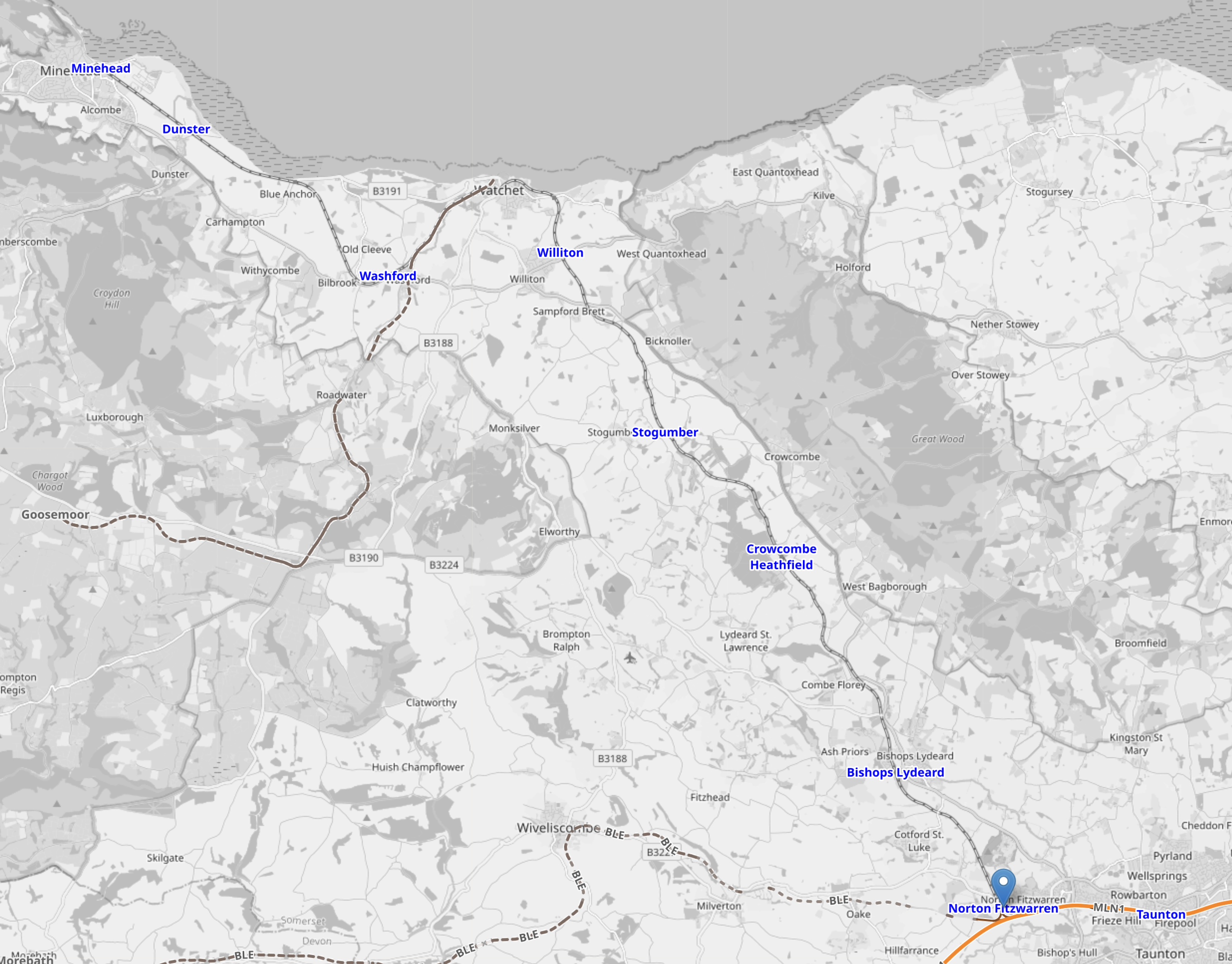
Note.
- Minehead station is in the North-West corner of the map.
- Norton Fitzwarren station is indicated by the blue arrow in the South-East corner of the map, where the West Somerset Railway joins the main line between Exeter and Bristol.
- Taunton station on the main line with trains all over the country is a few miles to the East of Norton Fitzwarren station.
I believe that for the lagoon project to be completed, the West Somerset Railway needs to be turned into a fully-operational branch line from Taunton to improve access for residents, visitors and workers to Minehead and other places in West Somerset.
Large projects like these need large numbers of workers to be completed.
Less disruption to local residents and businesses is caused if a park and ride site is set up. Sizewell C is setting up two from the nearby East Suffolk Line, using hydrogen-powered buses.
Sizewell C also intends to bring in heavy equipment and construction materials by rail from Ipswich and Lowestoft.
The West Somerset Tidal Lagoon could use the railway to bring in heavy loads.
If the West Somerset Railway is going to be used to ease the construction of the lagoon , then this should be properly to connected to Taunton first.
Building A New Concrete Revolution To Net Zero
he title of this post, is the same as that of this article on Pearls and Irritations.
The article is a good explanation of the contributions concrete makes to global warming and what we should do about it.
At least I can find entrepreneurs and scientists willing to develop concretes that will be friendlier to the planet.
- Low-Carbon Concrete: Separating Greenwash From Reality
- Earth Friendly Concrete
- Carbon-Neutral Concrete Prototype Wins €100k Architecture Prize For UK Scientists
- UK Breakthrough Could Slash Emissions From Cement
- HS2 Reveals Dramatic Carbon Saving With Ambitious Modular Design For Thame Valley Viaduct
I believe that this will be a problem that will be solved by technology.
Windar Taps PORR To Build Wind Tower Factory In Poland
The title of this post, is the same as that of this article on offshoreWIND.biz.
This is the sub-heading.
Spain’s Windar Renovables has selected PORR to build a new factory in Szczecin, Poland, that will produce towers, masts, and foundations for the next generation of wind turbines.
This Google Map shows the position of Szezecin.
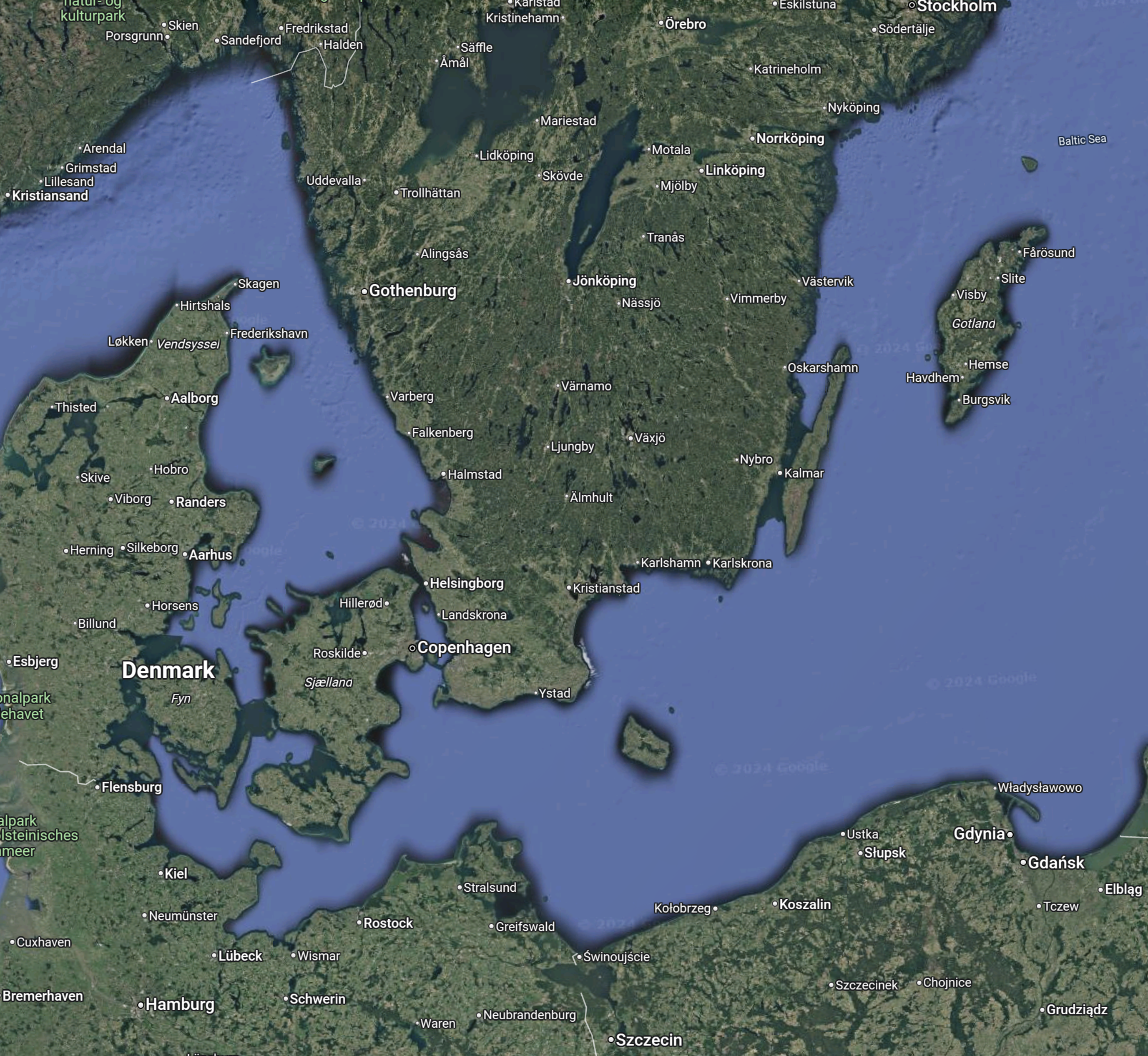
Note.
- The small island to the South of Sweden is the Danish island of Bornholm.
- Szczecin is on an inlet to the South of Bornholm.
- Gdynia and Gdansk are in a bay on the Polish coast to the East.
It looks like there will be several places along the coast, that will be suitable for the building and assembly of wind turbines and their components.
It will surely be easy to transport the turbines and their components up the Kattegat and down the Skagerrak into the North Sea.
This second Google Map shows the Port of Szczecin in more detail.
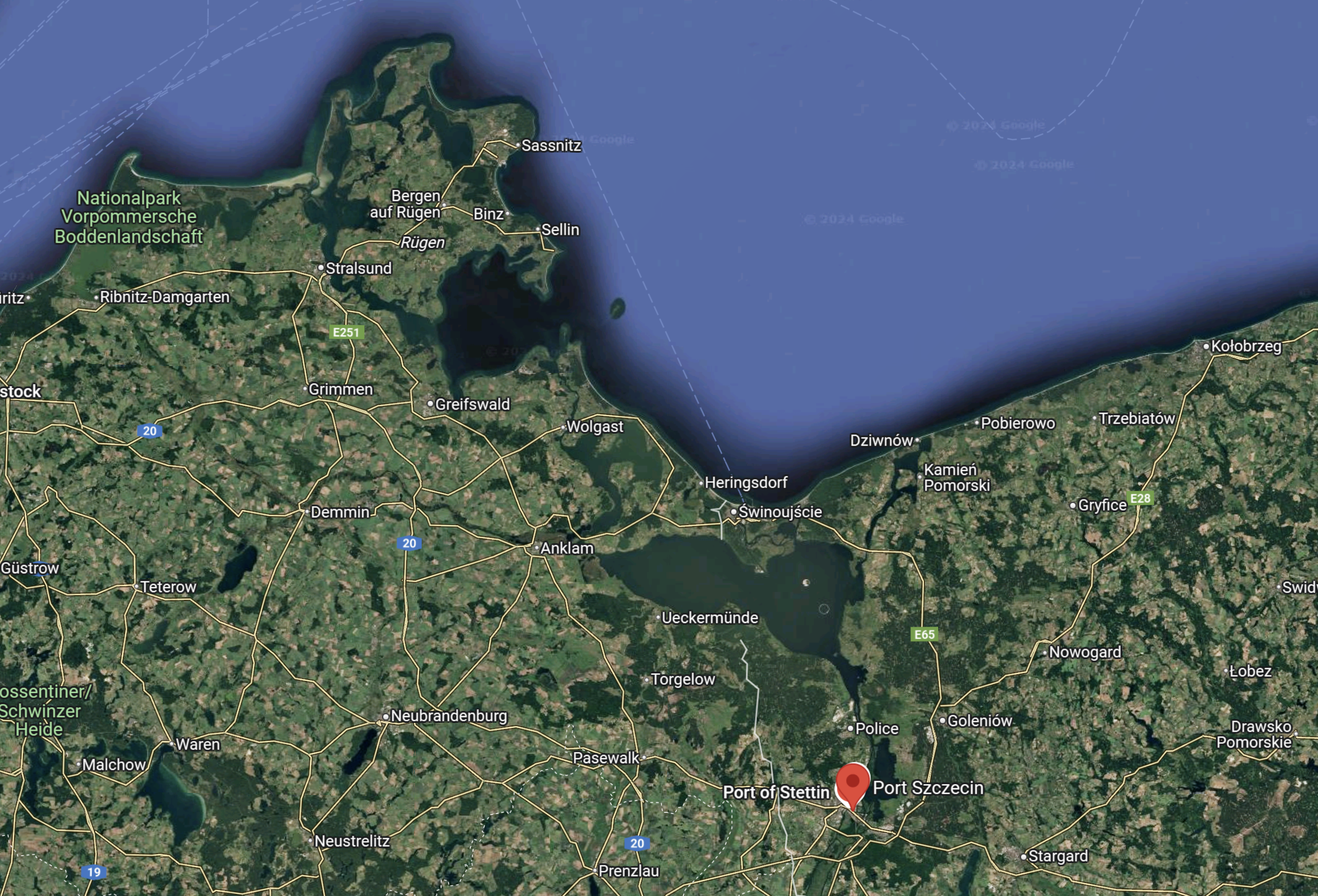
The location of the port is indicated by the red arrow.l
Conclusion
It looks to me to be an ideal place to build the components for wind turbines like towers, masts and foundations.
Redundant Coal Wagons To Be Converted For Construction Traffic
The title of this post is the same as that of this article on Railway Gazette.
These three paragraphs describe the project.
WH Davis is to convert coal wagons owned by leasing company Porterbrook for use by Freightliner to transport aggregates.
’This is a fantastic opportunity to demonstrate what can be achieved by giving redundant fleets a purpose for the next 30-plus years’, said WH Davis Managing Director Andy Houghton on December 19. ‘It’s a truly sustainable option that also gives UK manufacturing a boost to enable the creation of UK jobs in the industry. I really can’t wait to see our latest box wagon design in traffic for Freightliner in 2025.’
Mark Wyborn, Head of Freight at Porterbrook, said freight volumes in the construction sector were expected to continue growing, and the deal ’highlights our commitment to investing in the long-term growth of rail freight while providing affordable, innovative and sustainable rolling stock for the UK railway’.
We need more recycling projects like these.
In the article, there is a picture of a Class 66 locomotive like this one.

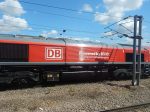
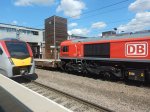
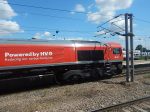
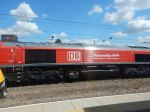
Except this one, which is named after Benjamin Gimbert GC, is different in that it is running on Hydrotreated Vegetable Oil (HVO). which is a more sustainable fuel.
Unfortunately, there is only so much second-hand vegetable oil from the likes of McDonalds and Burger King and it is also a component of Sustainable Aviation Fuel (SAF).
But in the UK, we have engineers at Cummins, JCB, Ricardo and a number of other companies, research organisations and universities, who could create a conversion for the American two-stroke diesels of the Class 66 locomotive so they could run on hydrogen.
These posts detail attempts to create a zero-carbon or dual-fuel locomotive in the UK and some of my thoughts.
- Dual-Fuel Class 37 And 66 Locomotive Concepts Unveiled
- Could Class 66 Locomotives Be Converted Into Battery-Electric Locomotives?
- Freightliner Secures Government Funding For Dual-Fuel Project
- Grants To Support Low-Carbon Technology Demonstrators
- Thoughts On A Battery/Electric Replacement For A Class 66 Locomotive
- A Hydrogen-Powered Locomotive
- Our Sustainability Journey
The Bi-Mode Class 99 locomotive is coming, but we need action now.
I estimate it would probably cost up to £2million to convert a Class 66 locomotive to hydrogen.
So why not have a competition with a prize of perhaps £10million to see who, can produce the best Class 66 or Class 68 locomotive conversion by the end of 2025?
Conclusion
We need urgent action to cut pollution, noise and emissions from heavy freight locomotives and market forces and government grants don’t seem to have produced a solution, so perhaps a competition with a big prize might do it.
It could even be televised,
 The Anonymous Widower